Key words: Ureter, Ileum; Urethral Stricture
Int Braz J Urol. 2012; 38: 779-87
__________________ Submitted for publication: March 21, 2012
__________________ Accepted after revision: July 04, 2012
Purpose: Ureteric substitution using the Yang-Monti principle was reported as a modi-fi cation of simple ileal ureter replacement. In this study, we evaluate its safety, surgical outcome and impact on renal function.
Materials and Methods: Sixteen patients underwent ileal ureter replacement using the Yang-Monti principle to overcome long ureteric defects. Exclusion criteria included pa-tients with elevated serum creatinine > 1.8 mg/dL, infl ammatory bowel syndrome or irradiated bowel. Antirefl ux implantation into the bladder was performed in 12 patients while 4 patients with intact healthy lower ureters underwent distal ileal-ureteral anasto-mosis. Follow-up protocol was carried out for up to 3 years in 9 patients.
Results: No intra-operative or postoperative mortality or signifi cant complications oc-curred. There were minor complications in the form of urinary leakage that necessitated prolonged ureteric stenting in one patient, superfi cial wound infection in another one and 3 patients developed treatable urinary tract infection without late harmful effects. During follow up, no excess mucus production or metabolic abnormalities were encoun-tered. All patients had preserved renal function (improved in 13 patients and stabilized in 3) without any evidence of urinary obstruction.
Conclusions: The reconfi gured ileal segment for ureteric substitution is a safe technique with an excellent outcome. It uses short ileal segments for reconstruction of an ileal tube of adequate length and optimal caliber that permits easy antirefl ux implantation into the bladder so it is not associated with excess mucus production or metabolic abnorma-lities and offers a durable preservation of renal function without urinary obstruction.
INTRODUCTION
Long ureteric defects may occur as a result of iatrogenic ureteral injuries, recurrent pelvi-ure-teric junction obstruction, chronic infl ammatory diseases such as bilhariziasis, retroperitoneal fi -brosis and ureteral carcinoma. Several techniques were described to compensate this defect by in-trinsic urinary tissue such as direct anastomosis, psoas hitch, Boari fl ap, transuretero-ureterostomy and renal autotransplantation.
In some occasions the ureteral defect is too long to the degree that extra urinary tissue is needed to overcome it. Accordingly, other al-ternatives have been tried such as artifi cial urete-ral substitutes e.g. Gore-Tex tube graft (1) which showed disappointing results in contrast to the promising ones that were achieved with the use of pedicled bowel grafts (2). The most commonly used technique is that of ileal ureter replacement which was fi rst described by Schoemaker in 1906 (3) and gained wide acceptance later on. One of
Application of Yang-Monti Principle in Ileal Ureter
Substitution: Is It a benefi cial Modifi cation?
___
_______________________________________________
____________________________________________
M. Esmat, A. Abdelaal, D. Mostafa
Department of Urology, Ain Shams University, Cairo, Egypt
ABSTRACT
ARTICLE
INFO
the modifi cations of this technique was the appli-cation of Yang-Monti principle (4,5) which allo-wed the creation of a long tube from short bowel segment after its reconfi guration. It was applied for ureteral replacement fi rst in dogs (6) then cli-nically (7) in few reports. In this study, we report our experience with ileal ureter substitution using the Yang-Monti principle with follow-up data for up to 3 years.
MATERIALS AND METHODS
The current study was performed from Oc-tober 2005 till February 2010. Patients with long ureteral defects that could not be repaired using the intrinsic urinary tissue were included in this study. Elevated serum creatinine > 1.8 mg/dL, in-fl ammatory bowel syndrome, irradiated bowel or a non functioning renal unit were considered as exclusion criteria.
All patients underwent preoperative eva-luation in the form of careful history taking, me-dical examination and laboratory investigations which included complete urine analysis, serum creatinine, sodium, potassium and chloride and PH level estimation. Radiological investigations to visualize the upper urinary tract included renal ul-trasonography, intravenous urography or magne-tic resonance urography. Renal isotope scanning was performed to estimate the split renal function.
The study was approved by the ethical committee of Ain Shams University. All patients were consented for approval of surgery and un-derwent preoperative colonic preparation for 48 hours.
Technique
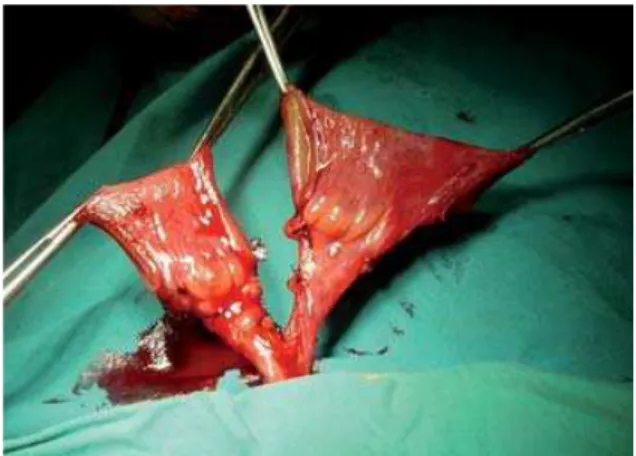
Isolation of 5 - 7.5 cm of the terminal ileum on their vascular bed was performed accor-ding to the length required to compensate the ure-teral defect. Then, according to the Yang-Monti principle, the isolated ileal segment was further subdivided into 2-3 equal parts (each 2.5 cm in length) with preservation of the individual blood supply (Figure-1). The continuity of the ileum was reestablished. Each ileal segment was incised at its longitudinal axis close to the mesenteric border. Unfolding of the incised segments with suturing
of their adjacent ends were performed and resulted in the formation of an intestinal plate 2.5 cm wide and 12-18 cm long (according to the number of isolated ileal segments) (Figure-2). This plate was tubularized around 16F Nelaton catheter using 4/0 absorbable sutures (Figure-3). The proximal end of the ileal tube was anastomosed to the ureter or renal pelvis while the distal end was anastomosed
Figure 1 - Isolation of 2 ileal segments on their mesenteric pedicle.
either to the bladder using a non refl uxing Lich--Gregoir technique (Figures 4 and 5) or to the spa-tulated cephalic end of the lower ureter in cases with the presence of an intact healthy lower ure-ter. At the end of the procedure, a ureteric silicon stent and a urethral catheter were left for 3 weeks and 10 days respectively.
graphy was performed only for patients who un-derwent ileal tube implantation into the bladder at 6 months postoperatively.
Statistical methods
IBM SPSS statistics (V. 19.0, IBM Corp., USA, 2010) was used for data analysis. Data were expressed as “Mean ± SD” for quantitative para-metric measures. Paired t-test was used for com-parison between 2 dependent groups. The proba-bility of error at 0.05 was considered signifi cant.
RESULTS
The study included 16 patients (13 males and 3 females). Their age ranged from 23 - 57 ye-ars (mean: 35 ± 8 yeye-ars). They presented with loin pain secondary to ureteric stricture, lumbar urina-ry fi stula or pyelonephritis. All patients had a long ureteral defect which was secondary to bilharzia-sis in 2 cases or iatrogenic injury in 14 cases [12 after urologic procedures, one post hysterectomy and one post surgical excision of sigmoid tumor (for whom percutaneous nephrostomy and ante-grade study were performed)].
Intraoperatively, we used 2 - 3 ileal seg-ments ( 2 in 13 and 3 in 3 patients) to create a tube about 12 - 18 cm in length and of a reasonable caliber (16 CH) to overcome the ureteral defect.
Figure 3 - Tubularization of the incised ileal segments. Figure 5 - Reapproximation of detrusor layer to create a submucosal tunnel.
Figure 4 - Anastomosis of the ileal tube to bladder mucosa.
cysto-Antirefl ux implantation of the ileal tube into the bladder was performed in 12 patients while 4 pa-tients with intact healthy lower ureter underwent distal ileoureteral anastomosis. No intraoperative complications occurred.
Postoperative follow-up showed no intes-tinal complications or signifi cant morbidity. With application of The Clavien-Dindo Classifi cation of Surgical Complications (8), early postoperati-ve complications were minor in the form of pro-longed urinary leakage in one case (6%) (grade I), superfi cial wound infection in another one (6%) (grade I), and uncomplicated UTI in 3 patients (18%) (grade II) that were managed properly wi-thout late harmful sequelae. No metabolic abnor-malities occurred in any patient during early pos-toperative period.
Follow-up was carried out for up to 3 ye-ars (ranged 6-36 months). At 3 months
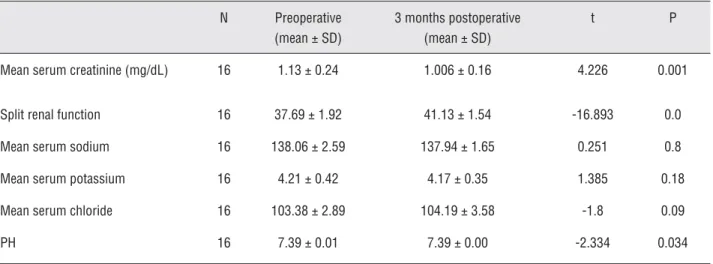
postope-to the lower ureter. Radioisopostope-tope scanning showed split renal function improvement in 13 patients and stable in 3 with no evidence of urinary obs-truction in anyone (Table-1). Ascending cysto-graphy revealed fi rst degree refl ux in one patient. Follow-up was continued for 3 years in 9 patients who showed maintained renal function without metabolic complications or recurrent urinary tract infections (Table-2).
DISCUSSION
Nowadays, iatrogenic ureteral trauma sho-wed an increased incidence as one of the causes of ureteric stricture (9,10). This could occur as a re-sult of direct injury or focal ischemia to the ureter (11). Most of our cases (14/16) had a history of a complicated iatrogenic ureteral injury or strictu-re with an inserted percutaneous nephrostomy to
Table 1 - Preoperative and 3 months postoperative results of laboratory investigations and split renal function.
N Preoperative (mean ± SD)
3 months postoperative (mean ± SD)
t P
Mean serum creatinine (mg/dL) 16 1.13 ± 0.24 1.006 ± 0.16 4.226 0.001
Split renal function 16 37.69 ± 1.92 41.13 ± 1.54 -16.893 0.0
Mean serum sodium 16 138.06 ± 2.59 137.94 ± 1.65 0.251 0.8
Mean serum potassium 16 4.21 ± 0.42 4.17 ± 0.35 1.385 0.18
Mean serum chloride 16 103.38 ± 2.89 104.19 ± 3.58 -1.8 0.09
PH 16 7.39 ± 0.01 7.39 ± 0.00 -2.334 0.034
ratively, improvement of serum creatinine among all patients with no electrolyte disturbance or me-tabolic acidosis were noticed. No complaint of ex-cess mucous production was noticed. Imaging of the upper urinary tract showed improvement of renal dilatations in 12 patients and stable renal confi guration in 4. We noticed transient stagna-tion of the dye at the distal ileoureteral anasto-mosis without upper tract dilatation followed by complete evacuation of the dye into the bladder among the four cases with distal ileal anastomosis
preserve renal function till time of surgical repair and to perform an antegrade study. All cases had a ureteric defect that was too long to be repaired using internal urinary tissue and so the decision of ileal ureter substitution was taken to compensate this defect.
ou-tcome and renal function (2,10), however common drawbacks were reported mostly attributed to the absorbing and secreting criteria of the involved ileal segment such as hyperchloremic metabolic acidosis and excess mucus production and also to the wide caliber refl uxing ileal ureter with subse-quent progressive dilatation, functional obstruc-tion and recurrent UTI (10,13). So, to overcome these complications and to improve the surgical outcome, the Yang-Monti principle was applied as a modifi cation of original simple ileal ureter replacement, which allowed the reconstruction of long tube from a reconfi gured short bowel seg-ment and the ability of antirefl ux implantation of the reconfi gured ileal tube into the bladder. The criticism to this idea was the fear of impaired uri-ne transport through the reconfi gured ileal tube, however a dynamic unidirectional fl ow of urine was reported using cineradiographic studies in a study that explained this by a decrease in tube diameter and reorientation of the 2 muscle layers of the ileal tube after its reconfi guration (7).
Intraoperatively, we used 2 ileal segments in 13 patients. Each ileal segment provided a tube of about 6 cm length after reconfi guration. 3 pa-tients needed 3 ileal segments to compensate the ureteric defect. We found that the addition of a third ileal segment can be done successfully wi-thout complications with better results than per-forming the anastomosis under tension with a risk of subsequent stenosis. On the other hand, extra
length of the ileal tube can lead to redundancy and functional obstruction, so adjustment of the ileal tube length is advisable to prevent such com-plications.
We found that this technique is safe as it was not associated with mortality or signifi cant morbidity. Postoperative complications were mi-nor in the form of prolonged urinary leakage in one case for 3 weeks that was managed conser-vatively by temporary urinary diversion through the preoperative nephrostomy tube and postpo-ning removal of ureteric stent for 5 weeks with no late harmful effects, superfi cial wound infec-tion in one patient that was managed by repeated dressing and secondary suturing of the skin and subcutaneous tissue under local anesthesia and uncomplicated urinary tract infections (UTI) in 3 patients that was treated by proper antibiotics. Other authors also reported absence of any morta-lity or signifi cant morbidity following this proce-dure (7,14).
During follow-up, no complaint of excess mucus production was observed which was also noticed by other authors that used the same pro-cedure (7,15). This observation is considered an advantage of this modifi cation and most proba-bly due to the marked reduction in the size of the secreting surface area in comparison to simple ileal ureter that may be associated with mucous obstruction in some cases (13). Moreover, hyper-chloremic metabolic acidosis did not occur in our
Table 2 - 3 months and 3 years postoperative results of laboratory investigations and split renal function.
N 3 months postoperative (mean ± SD)
3 years postoperative (mean ± SD)
t P
Mean serum creatinine (mg/dL) 9 1.011 ± 0.2 0.989 ± 0.2 0.8 0.44
Split renal function 9 41.56 ± 1.66 40.78 ± 1.39 -0.8 0.44
Mean serum sodium 9 137.22 ± 1.39 138.56 ± 1.74 -0.66 0.52
Mean serum potassium 9 4.10 ± 0.35 4.12 ± 0.32 0.0 1
Mean serum chloride 9 104.89 ± 3.4 105 ± 3.46 -0.13 0.9
series, however it was reported by various studies using simple ileal ureter in varying percentages (9,10). Absence of metabolic disorders among our cases can be explained by proper selection of pa-tients (serum creatinine 1.8 mg%), reduction of the size of absorbing surface area and the antire-fl ux implantation of the reconfi gured ileal tube which decreased the contact of urine with the ileal mucosa.
The importance of antirefl ux implantation of the simple ileal ureter remains a controver-sial issue; some authors recommended it (13) and found that refl uxing anastomosis was harmful (16) while others reported no difference in outco-me as the natural isoperistaltic waves of simple ileal ureter can prevent refl ux from reaching the kidney (7) and an ileal loop longer than 15 cm was considered a safe guard against the harmful effect of refl ux on the kidney (17). Other authors tried to prevent refl ux by construction of an intussus-cepted distal nipple valve, however complications occurred in the form of desussception of the valve and stone formation at the intussuscepted segment (18). In our series, we applied antirefl ux implanta-tion of the ileal tube in 12 patients with excellent results in refl ux prevention which was facilitated by the reasonable caliber of the reconfi gured ile-al tube (16 CH) and the asymmetricile-al incision of the ileal segment that led to creation of an ileal tube with ends free of mesentery. Follow-up of our cases revealed no graft dilation, recurrent UTI or metabolic acidosis so we thought that antirefl ux implantation of the reconfi gured ileal tube is ad-visable as it is now easy to perform, can prevent pressure transmission to the kidney and progressi-ve graft dilation with subsequent functional obs-truction, decreases the incidence of recurrent UTI and metabolic acidosis and subsequently attribu-tes to preservation of renal function.
Four cases with intact lower ureter were included in our series. Intraoperatively, we had to choose between preservation of the lower ureter with distal ileoureteral anastomosis or to sacrifi ce it, add another reconfi gured bowel segment and perform ileovesical anastomosis. We chose the preservation of the lower ureter as we found it he-althy, had good vascularity, non refl uxing and of adequate length (about 7 - 8 cm) so, we performed
ureteric spatulation and end to end anastomosis to the ileal tube which was facilitated by the reaso-nable caliber of the reconfi gured tube. Follow-up imaging of these cases showed transient stagna-tion of dye at the distal anastomosis followed by complete evacuation of the dye into the bladder without renal or graft dilatation. Renal isotope scanning showed improvement of split renal func-tion without urinary obstrucfunc-tion in any patient so we found that distal ileoureteral anastomosis can be done successfully with no worry about organic or functional obstruction in carefully selected ca-ses. This was facilitated by the diminished caliber of the ileal tube after its reconfi guration which added another advantage to YangMonti modifi -cation.
The main target of any technique for ure-teric substitution is to preserve the renal function. Follow-up of our patients by isotope renal scan-ning and upper tract imaging revealed improve-ment of renal function and renal confi guration in most patients while the rest showed stabilized re-nal function without evidence of urinary obstruc-tion or progressive renal or graft dilaobstruc-tion in any patient and this outcome was durable and main-tained all over the follow-up. Other authors that used the Monti principle also reported preserved renal function during their short term follow-up (7,14). We thought that this excellent functional outcome was obtained as a result of gaining the proponents of this procedure that led to absence of organic or functional urinary obstruction, easy antirefl ux implantation into the bladder or distal end to end anastomosis to lower ureter and less incidence of recurrent UTI which were aided by proper selection of cases.
CONCLUSIONS
anastomosis can be performed successfully in ca-refully selected cases.
CONFLICT OF INTEREST
None declared.
REFERENCES
1. Baltaci S, Ozer G, Ozer E, Soygür T, Be alti O, Anafarta K: Failure of ureteral replacement with Gore-Tex tube grafts. Urology. 1998; 51: 400-3.
2. Chung BI, Hamawy KJ, Zinman LN, Libertino JÁ: The use of bowel for ureteral replacement for complex ureteral re-construction: long-term results. J Urol. 2006; 175: 179-83; discussion 183-4.
3. Shoemaker J: Discussie op voordracht van J.M. van Damn over interaabdominale plastiken. Ned Tijdschr Geneesk. 1911; 836.
4. Yang WH: Yang needle tunneling technique in creating antirefl ux and continent mechanisms. J Urol. 1993; 150: 830-4.
5. Monti PR, Lara RC, Dutra MA, de Carvalho JR: New tech-niques for construction of efferent conduits based on the Mitrofanoff principle. Urology. 1997; 49: 112-5.
6. D`Elia G, Ali-El-Dein B, Thuroff J, El-Mekresh M, El-Baz M, Ghoneim MA: Reconfi gured anti-refl ux ileal ureter: a novel surgical technique. BJU Int 2001; 88 (Suppl): 75.
7. Ali-el-Dein B, Ghoneim MA: Bridging long ureteral defects using the Yang-Monti principle. J Urol. 2003; 169: 1074-7. 8. Dindo D, Demartines N, Clavien PA: The Clavien-Dindo
classifi cation of surgical complications. Ann Surg. 2004; 244: 931-7.
9. Armatys SA, Mellon MJ, Beck SD, Koch MO, Foster RS, Bihrle R: Use of ileum as ureteral replacement in urological
reconstruction. J Urol. 2009; 181: 177-81.
10. Verduyckt FJ, Heesakkers JP, Debruyne FM: Long-term results of ileum interposition for ureteral obstruction. Eur Urol. 2002; 42: 181-7.
11. Yates DR, Mehta SS, Spencer PA, Parys BT: Combined an-tegrade and retrograde endoscopic retroperitoneal bypass of ureteric strictures: a modifi cation of the 'rendezvous' procedure. BJU Int. 2010; 105: 992-7.
12. Boxer RJ, Fritzsche P, Skinner DG, Kaufman JJ, Belt E, Smith RB, et al.: Replacement of the ureter by small intes-tine: clinical application and results of the ileal ureter in 89 patients. J Urol. 1979; 121: 728-31.
13. Bonfi g R, Gerharz EW, Riedmiller H: Ileal ureteric replace-ment in complex reconstruction of the urinary tract. BJU Int. 2004; 93: 575-80.
14. Rodríguez Alonso A, González Blanco A, Suárez Pascual G, Bonelli Martín C, Lorenzo Franco J, Cuerpo Pérez MA: Partial substitution of the ureter using a short segment of the ileum following the Monti procedure. Actas Urol Esp. 2005; 29: 607-10.
15. Castellan M, Gosalbez R: Ureteral replacement using the Yang-Monti principle: long-term follow-up. Urology. 2006; 67: 476-9.
16. Tanagho EA: A case against incorporation of bowel seg-ments into the closed urinary system. J Urol. 1975; 113: 796-802.
17. Waldner M, Hertle L, Roth S: Ileal ureteral substitution in reconstructive urological surgery: is an antirefl ux proce-dure necessary? J Urol. 1999; 162: 323-6.
18. Shokeir AA, Ghoneim MA: Further experience with the modifi ed ileal ureter. J Urol. 1995; 154: 45-8.
_____________________
Correspondence address: Dr. Mohamed Esmat Department of Urology, Ain Shams University, Cairo, EgyptEDITORIAL COMMENT
The authors present one more series confirms that the use of intestinal segments reconfigured by the Yang-Monti technique as alternative ureteral replacement.
Their results confirm those published in the literature. Alternatives to the technique used, but always based on the principle of Monti, are modified spiral Casale (1) and the
use of intestinal segments in series to achieve the same purpose as Ghoneim (2). The use of the variation of Casale allows to obtain intes-tinal with conduits and vascular pedicle free ends in its middle portion and does not require performing a circular anastomosis for joining two segments, as is customary when using the technique of Yang-Monti original.
REFERENCES
1. Casale AJ: A long continent ileovesicostomy using a single piece of bowel. J Urol. 1999; 162: 1743-5.
2. Ali-el-Dein B, Ghoneim MA: Bridging long ureteral defects us-ing the Yang-Monti principle. J Urol. 2003; 169: 1074-7.
EDITORIAL COMMENT
Initially, the use of reconfigured ileal tube was described for the replacement of an unavailable cecal appendix, used as efferent conduit for catheterization in continent urinary cutaneous diversions according to Mitrofanoff (references 4 and 5). Pope and Koch were the first to describe the replacement of the right ureter with a single 2 cm segment of recon-figured ascending colonic segment, resulting in a tube of 12 cm (1). The use of ileal segments between the kidney and the bladder has several side effects, well described in the text, and they are avoided with the use of the proposed tech-nique, due to the minimal surface of intestinal mucosa exposed to urine. The reconfigured il-eal segment allows the use of correct caliber and extension for each case; a 2.5 cm segment of ileum results in a tube of 6 cm. Usually a double tube (12 cm) associated with a psoas
hitch is sufficient to replace the lost segment. Anti-reflux technique and interposition of the ureteral inferior and superior stubs are feasible due to the small caliber of the tube. The con-cern of the loss of the peristaltic movements of the tube due to the reconfiguration (transform-ing longitudinal muscular fibers in transverse fibers and vice-versa) has no ground, since dy-namic image studies showed that there is a uni-directional flow of urine, with preservation of the peristaltic capacity (reference 7). The loss of long ureteral segments has a high morbid-ity and is becoming more frequent due to the large use of ureterorrenoscopy. In the present, as concluded by the authors, the transverse tu-bularization technique of ileal segments is ef-ficient, easy to perform and with low morbidity, to replace long ureteral losses, and is superior to the use of natural ileal segments.
REFERENCES
1. Pope J, Koch MO: Ureteral replacement with reconfi gured colon substitute. J Urol. 1996; 155: 1693-5.