Quantitative analysis of oral and pharyngeal transit time
in genetic syndromes
Análise quantitativa do tempo de trânsito oral e faríngeo em
síndromes genéticas
André Vinicius Marcondes Natel Sales1, Paula Cristina Cola2,Rarissa Rubia Dalaqua dos Santos1, Adriana
Gomes Jorge3, Larissa Cristina Berti1, Célia Maria Giacheti1, Roberta Gonçalves da Silva1
ABSTRACT
Purpose: To measure the oral and pharyngeal transit time (OTT and PTT) in genetic syndromes. Methods: Fourteen subjects, ranging in age from 4 months to 7 years, with different genetic diagnoses confirmed by clinical or laboratory examinations participated in this study. Real-time videofluoroscopic swallow study, and oral and pharyngeal transit times were analyzed using a specialized software. Descriptive and inferential statistical analyses were used. Results: In the OTT analysis performed with liquid, of the 11 individuals evaluated, seven had normal OTT with an average of 0.75 s and four had altered OTT averaging 5.42 s. When swallowing a puree, four subjects showed normal OTT averaging 1.12 s and eight had altered OTT averaging 9.54 s. From the analysis of the PTT with liquid, seven had normal values averaging 0.68 s and four had altered PTT averaging 3.74 s. When swallowing a puree, four subjects had normal PTT averaging 0.75 s and eight had abnormal values averag-ing 3.98 s. Conclusion: The oral and pharyngeal transit times may be normal or altered in the studied genetic syndromes. In this study, we found significant differences in transit times only in liquid consistency.
Keywords: Deglutition disorders; Quantitative analysis; Genetics; Deglutition; Evaluation
RESUMO
Objetivo: Analisar, de forma quantitativa, o tempo de trânsito oral e faríngeo da deglutição em indivíduos com síndrome genética. Métodos:
Participaram 14 indivíduos com diagnósticos genéticos distintos, con-firmados por exame clínico ou laboratorial, idade variando de 4 meses a 7 anos. Foi realizada análise de imagens videofluoroscópicas, por meio de software específico, dos tempos de trânsito oral e faríngeo. Após, realizou-se análise estatística descritiva e inferencial. Resultados: Na análise do tempo de trânsito oral (TTO) com líquido constatou-se que dos 11 indivíduos avaliados, 7 apresentaram TTO normal, com média de tempo de 0,75 s e 4 apresentaram TTO alterado, com média de tempo de 5,42 s. Com a consistência pastosa, constatou-se 4 normais, com média de 1,12 s e 8 alterados, com média de 9,54 s. Quanto à análise do tempo de trânsito faríngeo (TTF) com líquido, 7 apresentaram seus valores normais, com média de 0,68 s, e 4 alterados, média de 3,74 s. Com a consistência pastosa, constatou-se 4 normais, média de 0,75 s e 8 apre-sentaram valores alterados, com média de 3,98 s. Conclusão: Os tempos de trânsito oral e faríngeo nas síndromes genéticas estudadas podem ser normais ou alterados, sendo que, neste estudo, encontrou-se significância estatística nos tempos de trânsito apenas na consistência líquida.
Descritores: Análise quantitativa; Genética; Transtorno de deglutição; Avaliação; Deglutição
Study developed in the Dysphagia Laboratory, Postgraduate Program in Speech-Language Pathology, Universidade Estadual Paulista “Júlio de Mesquita Filho” – UNESP – Marília (SP), Brazil.
(1)Postgraduate Program in Speech-Language Pathology, Universidade Estadual Paulista “Júlio de Mesquita Filho” – UNESP – Marília (SP), Brazil.
(2)Postgraduate Program (Post-doctoral), Department of Speech-Language Pathology, Universidade Estadual Paulista “Júlio de Mesquita Filho” – UNESP – Marília (SP), Brazil.
(3) Dysphagia Centre, Bauru State Hospital, (SP), Brazil.
Funding: Coordenação de Aperfeiçoamento de Pessoal de Nível Superior (CAPES).
Conflict of interests: No
Authors’ contribution:AVMNS principal investigator, performed the research work and the chronogram, and was responsible for the literature review, data col-lection and analysis, article writing, and article submission; RRDS, ADGJ, and LCB participated in the data collection and analysis, and article preparation; PCC,
CMG, and RGS, supervisors, were responsible for the research work, chronogram, data analysis, correction of the draft article, and approval of the final version.
Correspondence address: Roberta Gonçalves da Silva. Universidade Estadual Paulista “Júlio de Mesquita Filho” (UNESP), Faculdade de Filosofia e Ciências, Departamento de Fonoaudiologia. Av. Higyno Muzzi Filho, 737, Marília (SP), Brazil, CEP: 17525-900. E-mail: [email protected]
INTRODUCTION
Individuals with genetic syndromes may present with feeding complaints and/or alterations in deglutition resulting from anatomical, physiological, and environmental factors(1).
Although the relationship between different conditions and deglutition problems has been studied, few studies have quan-titatively analyzed deglutition times in specific populations(2-7).
Further, patients with genetic syndromes were not included in the samples in such studies(1,8-10).
Studies on the duration of the deglutition stages, as well as start and finish markers, are important both in the healthy population as well as in distinct etiologies, to standardize the duration and to help with the treatment and therapeutic mana-gement of deglutition dysfunctions(4,11-13).
A few studies have conducted quantitative analysis of the oral and pharyngeal stages to study deglutition in subjects with pediatric and genetic disorders; these studies frequently measured deglutition times in adults, especially in those who suffered stroke(3,4,5,14). Studies measuring oropharyngeal
deglu-tition transit times date from the 1980s. In Brazil, they were developed for use in patients with stroke, cerebral palsy, and gastroesophageal reflux disease(15-23).
Quantitative analysis of the durations of deglutition stages has been given little consideration by clinicians working on oropharyngeal dysphagia, because in the biomechanical analy-sis of deglutition, the emphaanaly-sis is on the presence or absence of penetration and laryngotracheal aspiration. Changes in the oral and pharyngeal deglutition transit times may compromise different aspects of the health of the individual, including nu-tritional(24) and pulmonary conditions, as an increase in these
may prolong the total feeding time and increase the risk of laryngotracheal aspiration.
The aim of the present study was to quantitatively analyze the oral and pharyngeal deglutition transit times in individuals with genetic syndromes.
METHODS
This study was approved by the Research Ethics Committee of the Faculty of Philosophy and Sciences, Universidade Estadual Paulista “Júlio de Mesquita Filho” (UNESP), with the reference number 1755/2009. After being briefed on the study, the legal representatives of the participating children signed the Free and Informed Consent form, agreeing to the children’s participation in this study.
This is a prospective cross-sectional clinical study that included individuals with genetic diagnoses performed in ref-erence centers, either clinical or laboratory exam-based, who presented with feeding and/or swallowing difficulties.
Fourteen individuals with different genetic syndromes participated in this study. Of these, seven were male and seven female, ranging in age from 4 months to 7 years, with an aver-age aver-age of 27.85 months and standard deviation of 27.17. The gross motor function classification (GMFCS scale) varied from levels II to V (Chart 1). Of the 14 individuals, nine participated in the deglutition evaluation using liquid and puree, three using only puree, and two using only liquid.
Videofluoroscopic evaluation of the oropharyngeal degluti-tion and quantitative analysis of the oral and pharyngeal transit times were performed. Standardized liquid and puree food consistencies were used to perform the exam only in individu-als older than 6 months, as proposed by the American Dietetic Association (ADA). For those individuals who were already feeding on pureed consistencies (pudding), the exam was initi-ated using puree, followed by liquid (5 ml). The anatomical limits extending from the oral cavity to the esophagus were observed during the examination, wherein the anterior limit was set by the lips, the posterior by the pharyngeal wall, the superior by the nasopharynx, and the inferior by the cervical stomach(16,17).
The puree was prepared using the usual liquid consumed by the individual (usually milk) and commercially available instant
Chart 1. Case characterization
Syndrome Gender Age MIM phenotype Localization GMFCS 1 2 3 4 5 6 7 8 9 10 11 12 13 14 Down’s Down’s Edwards’ Crouzon Fetal alcohol Down’s Down’s Noonan’s Down’s Down ‘s Lipofuscinosis Charcot Marriet Cri-du-chat Tay-Sachs Male Male Female Male Male Female Female Female Male Female Female Male Male Female 4 months 6 months 7 months 7 months 13 months 13 months 14 months 14 months 2 years 3 years 3 years 4 years 7 years 7 years #190685 #190685 %300484 #123500 -#190685 #190685 #163950 #190685 #190685 #256730 #606482 #123450 #272800 21q22.3 21q22.3 -10q26.13 -21q22.3 21q22.3 12q24.13 21q22.3 21q22.3 1p34.2 19p13.2 5p15.2 15q23 Level IV Level III Level V Level IV Level II Level II Level III Level IV Level II Level II Level V Level I Level IV Level V
food thickener formed of starch and containing (per 100 g, 375 Kcal) 100 g of carbohydrates and 125 mg of sodium. To obtain the desired consistency, the food thickener was added using the measuring cup supplied by the manufacturer (4 g), with one and half measures of thickener added to 100 ml of liquid. Barium sulfate (BaSO4) was added to both the liquid and the puree, in
a proportion of 50% barium to 50% food, without changing the previously standardized consistencies.
The equipment used consisted of a Prestilix remote control seriographer, (model 1600X, 1000 mA, 130 kV; GE). The coupled collimator allowed 35 cm X 43 cm maximum aperture, with the possibility of a total shutter. The radiological examina-tion table had a 90° to 180° inclinaexamina-tion; however, it was always maintained at an inclination of 90o for the examinations.
All evaluations were performed with the subjects sitting in a children’s chair suitable for the examination, or on the lap of the accompanying adult.
A specialized software(13) was used to perform the
quantita-tive analysis of the oral and pharyngeal transit times through the analysis of video frames and seriation of the deglutition, which allowed the time to be registered in milliseconds. These durations were later transformed into seconds due to it being the most commonly used unit in the studies with quantitative data.
The oral transit time (OTT) was defined as starting when the food is seen inside the oral cavity with anterior to posterior tongue propulsion (Figure 1), and ending when the food bolus is in the hypopharynx or at the point where the inferior border of the lower jaw makes an angle with the base of the tongue (Figure 2)(18).
The start of the pharyngeal transit time (PTT) was consid-ered as the moment when the food bolus was in the hypophar-ynx or at the point where the inferior border of the lower jaw makes an angle with the base of the tongue (Figure 3), and the end was considered as the pharyngeal stage when the food bolus passed through the upper esophageal sphincter (Figure 4)(19).
In the present study, the analysis of the examinations was performed by two phonoaudiologists(20), working in the field
of oropharyngeal dysphagia, and trained in deglutition video-fluoroscopy and the use of the software. To analyze OTT and PTT in both types of food consistencies under study (liquid and puree), the subjects were divided in two groups (normal and altered) based on the normal deglutition times during the ingestion of food with these consistencies in a healthy pediatric or adult population(21). The individuals with an OTT
of up to 1.3 s were included in the normal group, and those with a higher OTT value were included in the altered group. Individuals with an PTT of up to 1.15 s were included in the normal group and those with values above 1.15 s were included in the altered group.
Unlike for the liquid consistency, for OTT and PTT analysis with the puree consistency, normal values from a healthy adult population were used, as there are no reference studies of de-glutition times for puree consistency in the pediatric population.
Figure 1. Start of the oral stage
Figure 2. End of the oral stage
Figure 3. Start of the pharyngeal stage
In addition, there is no difference in times of deglutition sta-ges between the adult and pediatric populations(11,19). For the
analysis of OTT with the puree consistency, individuals with OTT values up to 3 s were included in the normal group and individuals with values above 3 s in the altered group. For PTT, the normal group had values up to 1 s and the altered group had values above 1 s.
The t test was used for the final measurement of the deglu-tition times performed by the two examiners, with α < 0.05.
As no difference was found in the analysis of the parameters between the two examiners, the average of the values obtained was used to analyze the results of the oral and pharyngeal transit times for liquid and puree consistencies. To analyze OTT and PTT, descriptive and inferential statistics were performed using the t test for independent samples.
RESULTS
In the OTT analysis of liquid ingestion, of the 11 individuals evaluated, seven (63.63%) were included in the normal group and four (36.37%) in the altered group. Of the individuals in the normal group, four individuals had Down’s syndrome, one had Crouzon syndrome, one had Cri-du-chat syndrome, and one had Fetal alcohol syndrome. The altered group had one individual each with Tay-Sachs disease B1 variant, Down’s syndrome, Edwards’ syndrome, and Noonan’s syndrome. The average liquid OTT and standard deviations are shown in Table 1.
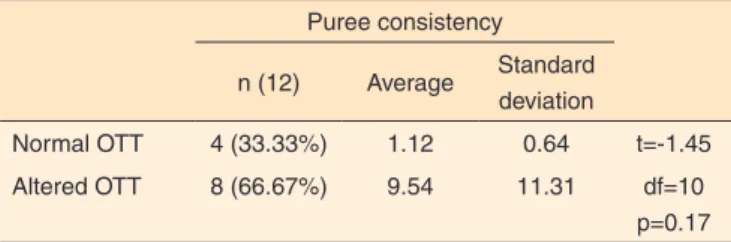
In the analysis of the puree OTT, of the 12 individuals, four (33.33%) were included in the normal group and eight (66.67%) in the altered group. The normal group had three individuals with Down’s syndrome and one with Cri-du-chat syndrome. The altered group had one individual each with Noonan’s syndrome, Down’s syndrome, Charcot Marriet syndrome, Edwards’ syndrome, Tay-Sachs disease B1 variant, Crouzon syndrome, Fetal alcohol syndrome, and Neuronal ceroid lipo-fuscinoses. The average and standard deviation results for the puree OTT are shown in Table 2.
Regarding the analysis of the liquid PTT, of the 11 individu-als studied, seven (63.63%) were placed in the normal group and four (36.37%) in the altered group. In the normal group, five had been diagnosed with Down’s syndrome, one with Crouzon syndrome, and one with Cri-du-chat syndrome. In the altered group, we observed one individual each with Fetal alcohol syndrome, Tay-Sachs disease B1 variant, Edwards’ syndrome,
and Noonan’s syndrome. The average and standard deviation results for the liquid PTT are shown in Table 3.
In the analysis of the puree PTT, the values from four (33.33%) individuals were included in the normal group and eight (66.67%) were included in the altered group. The normal group had three individuals with Down’s syndrome and one with Cri-du-chat syndrome. The altered group had one individual each with Down’s syndrome, Charcot Marriet syndrome, Crouzon syndrome, Fetal alcohol syndrome, Tay-Sachs disease B1 variant, Noonan’s syndrome, Neuronal ceroid lipofuscinoses, and Edwards’ syndrome. The average and standard deviation results found in the different groups for the puree PTT are shown in Table 4.
A statistical difference was observed between the averages of the liquid OTT and PTT values for both normal and altered groups. As for the puree, there was no difference between the average values of both durations evaluated for the normal and altered groups.
DISCUSSION
Quantitative analysis of oropharyngeal deglutition, using
Table 1. Analysis of oral transit time for the liquid consistency n (11) Average Standard
deviation
Normal OTT 7 (63.63%) 0.75 0.24 t=4.27
Altered OTT 4 (36.37%) 5.42 2.99 df=9
p<0.00
t test (p<0.05)
Note: OTT = oral transit time
Table 2. Analysis of oral transit time for the puree consistency Puree consistency
n (12) Average Standard deviation
Normal OTT 4 (33.33%) 1.12 0.64 t=-1.45
Altered OTT 8 (66.67%) 9.54 11.31 df=10 p=0.17
t test (p<0.05)
Note: OTT = oral transit time
Table 3. Analysis of pharyngeal transit time for the liquid consistency Liquid consistency
n (11) Average Standard deviation
Normal PTT 7 (63.63%) 0.68 0.15 t=-3.79
Altered PTT 4 (36.37%) 3.74 2.20 df=9
p<0.00
t test (p<0.05)
Note: PTT = pharyngeal transit time
Table 4. Analysis of the pharyngeal transit time for the puree consistency Puree consistency
n (12) Average Standard deviation
Normal PTT 4 (33.33%) 0.75 0.17 t=-2.10
Altered PTT 8 (66.67%) 3.98 2.99 df=10
p=0.06
t test (p<0.05)
software or other measuring tools, may help phonoaudiological performance in various ways. The use of this method for the evaluation of oropharyngeal deglutition in healthy pediatric populations or those with distinct conditions is important for the standardization of the oropharyngeal transit times and for establishing medical practices.
In the present study, it was found that the liquid OTT of the individuals had a higher frequency distribution in the normal group than in the altered group. A statistically significant differ-ence was observed between average OTT values in the normal and altered groups. Even though some studies that have quan-titatively analyzed deglutition in the pediatric population(21,22)
could be helpful for this discussion, important questions arise from the observed changes in OTT.
Swallowing liquid food requires refined neuromotor con-trol(12,25,26); neurological control of deglutition is one of the most
important markers for oral transit performance. Compared to individuals with OTT within the normal range, those with al-tered OTT values had syndromes such as Tay-Sachs B1 variant disease, Edwards’, Down’s, and Noonan’s syndrome, which cause neurological impairment and compromise gross motor function when. This could be the determining factor for the change in liquid OTT.
Unlike liquid food, pureed food requires a stronger oral ejection of the food bolus, which requires a higher oral pro-pulsion and, consequently, an increased transit time during the deglutition stages(12,27). This factor, in association with the
different oro-motor alterations present in a large proportion of patients with genetic disorders, may explain the higher number of changes found when swallowing food of puree rather than liquid consistency. However, no statistically significant diffe-rence was observed between the average OTT of the normal and altered groups.
The oropharyngeal deglutition stages are interdependent and harmonious, and the increase in frequency of alterations found in the puree PTT only confirms the sequential nature of the deglutition biomechanics(3,28), even when the sequences are
separated for didactic and research purposes.
Regarding the PTT, also for the liquid, it was observed that the individuals kept their distribution both in the normal as well as in the altered groups. Even though the distribution of the groups was similar for OTT and PTT, it is noteworthy that when the characterization of individual cases was performed in these groups, the results changed. Fetal alcohol syndrome was present both in the normal OTT group as well as in the altered PTT group, showing that in this syndrome, the level of impairment between the deglutition transits is different, which is worth investigating in homogeneous samples. In one individual with Down’s syndrome, the OTT was included in the normal group and the PTT in the altered group; therefore, an increased impairment in the PTT was observed. This sug-gests that the differences in OTT and PTT in these two genetic syndrome groups should be studied in a homogenous population
to understand the interference and interdependency between these stages in the biomechanics of deglutition.
Among the individuals with normal OTT and PTT values for swallowing food of puree consistency, three had Down’s syndrome and one had Cri-du-chat syndrome. This suggests that the oro-motor alterations that are part of the phenotype of these syndromes, do not always cause alterations in the transits.
Therefore, the alterations found in the oral and pharyn-geal deglutition stages in these syndromes can be attributed to the presence of structural alterations in the myofunctional skeleton and to difficulties in neuromotor control of degluti-tion(29,30). However, the exact knowledge of the mechanisms
involved in this analysis requires studies in more homogeneous populations.
Conversely, it must be mentioned that in some of the syndro-mes studied, the OTT and PTT were within normal standards, suggesting that the alteration in the oropharyngeal transit may or may not be part of the phenotype of some genetic syndromes. More studies with larger and more homogeneous samples are required to understand the reasons behind the alterations in oropharyngeal transit and the presence or absence of oropha-ryngeal dysphagia in this population.
CONCLUSION
The oral and pharyngeal transit times may or may not be altered in patients with genetic disorders. In this study, a difference in the average transit time was only found when swallowing food of liquid consistency.
REFERENCES
1. Brown LC, Copeland S Dailey S, Downey D, Petersen MC, Stimson C, Dyke DCV. Feeding and swallowing dysfunction in genetic syndromes. Dev Dis Res Rev. 2008;14(2):147-57. http://dx.doi. org/10.1002/ddrr.19
2. Duca AP. Deglutição em crianças com refluxo gastroesofágico: avaliação clínica fonoaudiológica e análise videofluoroscópica [dissertação]. Ribeirão Preto: Universidade de São Paulo; 2004. 3. Gatto AR. Efeito do sabor azedo e da temperatura fria na fase oral da
deglutição e no acidente vascular encefálico [dissertação]. Botucatu: Universidade Estadual Paulista; 2010.
4. Silva RG, Jorge AG, Peres FM, Cola PC, Gatto AR, Spadotto AA. Protocolo para controle de eficácia terapêutica em d i s fa g i a o r o fa r í n g e a n e u r o g ê n i c a ( P RO C E D O N ) . R ev CEFAC. 2010;12(1):75-81. http://dx.doi.org/10.1590/S1516-18462010000100010
5. Cola PC, Gatto AR, Silva RG, Spadotto AA, Ribeiro PW, Schelp AO et al. Test and temperature in swallowing transit time after stroke. Cerebrovasc Dis Extra. 2012;2(1)45-51. http://dx.doi. org/10.1159/000339888
pós-riboflavin. Rev CEFAC. 2014;16(4):1125-32. http://dx.doi. org/10.1590/1982-021620142312
7. Santos CM, Cassiania RA, Nascimento WV, Dantas RO. Timing of pharyngeal swallow events in Chagas’ disease. Gastroenterol Res. 2014;7(3-4):93-97. http://dx.doi.org/10.14740/gr616w
8. Merkens MJ, Sinden NL, Brown CD, Merkens LS, Roullet JB, Nguyen T et al. Feeding impairments associated with plasma sterols in Smith-Lemli-Opitz syndrome. J Pediatr. 2014;165(4):836-41. http://dx.doi.org/10.1016/j.jpeds.2014.06.010
9. O’Neil AC, Richter GT. Pharyngeal dysphagia in children with Down syndrome. Otolaryngol Head Neck Surg. 2013;149(1):146-50. http:// dx.doi.org/10.1177/0194599813483445
10. Sales AVMN, Cola PC, Peres FM, Santos RRD, Motonaga SM, Giacheti CM, Silva RG. Caracterização da deglutição orofaríngea nas síndromes genéticas: achados preliminares. In: Anais do 18° Congresso Brasileiro de Fonoaudiologia; 22-25 set. 2010 [acesso em: 15 out 2014]; Curitiba. Disponível em: http://www.sbfa.org.br/ portal/anais2010/anais_select.php?op=PT&cid=3556&tid=1 11. Logemann JA. Evaluation and treatment of swallowing disorders.
Texas: Pro-ed; 1983.
12. Arvedson JC, Rogers B, Brodsky, L. Anatomy, embryology, and physiology. In: Arvedson JC, Brodsky L. Pediatric swallowing and feeding: assessment and management. San Diego: Singular; 1993. Cap 2, p. 51-5.
13. Spadotto AA, Gatto AR, Cola PC, Montagnoli NA, Schelp AO, Silva RG et al. Software para análise quantitativa da deglutição. Radiol Bras. 2008;41(1):25-8. http://dx.doi.org/10.1590/S0100-39842008000100008
14. Alves LM, Dantas RO. Effect of bolus taste on the esophageal transit of patients with stroke. Dis Esophagus. 2013;26(3):305-10. http:// dx.doi.org/10.1111/j.1442-2050.2012.01366.x
15. Silva RG. Disfagia Orofaríngea Pós-acidente Vascular Encefálico. In: Ferreira LP, Belfi-Lopes DM, Limongi SCO (Organizadores). Tratado de fonoaudiologia. São Paulo: Roca; 2004. p. 354-69. 16. Chee C, Arshad S, Sinch S, Mistry S, Hamdy S. The influence of
chemical gustatory stimuli and oral anaesthesia on healthy human pharyngeal swallowing. Chem Senses. 2005;30(5):393-400. http:// dx.doi.org/10.1093/chemse/bji034
17. Martin-Harris B, Brodsky MB, Michel Y, Lee F, Walters B. Delayed initiation of the pharyngeal swallow: normal variability in adult swallows. J Speech Hear Res. 2007;50(3):585-94. http://dx.doi. org/10.1044/1092-4388(2007/041)
18. Logemann JA, Pauloski BR, Coangelo L, Lazarrus CL, Fujiu M, Kahrilas PJ. Effects of sour bolus on oropharyngeal swallowing measures in patients with neurogenic dysphagia. J Speech Hear Res.
1995;38(3):556-63. http://dx.doi.org/10.1044/jshr.3803.556
19. Kendall KA, Leonard RJ, Mckenzie SW. Accomodation of changes in bolus viscosity in normal deglutition: a videofluoroscopic study. Ann Otol Rhinol Laryngol. 2001;110(11):1059-65. http://dx.doi. org/10.1177/000348940111001113
20. Lazarrus CL, Logemann JA, Rademaker AW, Kahrilas PJ, Pajak T, Lazar P. Effects of bolus volume, viscosity and repeatead swallows in stroke subjects and stroke patients. Arch Phys Med Rehabil. 1993;74(10):1066-70. http://dx.doi.org/10.1016/0003-9993(93)90063-G
21. Weckmueller J, Easterling C, Averdson J. Preliminary temporal measurement analysis of normal oropharyngeal swallowing in infants and young children. Dysphagia. 2011;26(2):135-43. http://dx.doi. org/10.1007/s00455-010-9283-3
22. Aurélio SR, Genaro KF, Macedo Filho ED. Análise comparativa dos padrões de deglutição de crianças com paralisia cerebral e crianças normais. Rev Bras Otorrinolaringol. 2002;68(2):167-73. http:// dx.doi.org/10.1590/S0034-72992002000200003
23. Sales AVMN, Cola PCC, Jorge AG, Peres FM, Santos RRD, Giacheti CM et al. Análise quantitativa da deglutição orofaríngea em indivíduo gastrostomizado com lipofuscinose ceróide neuronal: relato de caso. Rev CEFAC. 2013;15(6):1718-22. http://dx.doi. org/10.1590/S1516-18462013000600036
24. Pereira V, Sacher P, Ryan M, Hayward R. Dysphagia and nutrition problems in infants with Apert syndrome. Cleft Palate Craniofacial J. 2009;46(3):285-91. http://dx.doi.org/10.1597/08-010.1
25. Buchholz DW. Dysphagia associated with neurological disorders. Acta Otorhinolaryngol Belg. 1994;48(2):143-55.
26. Bass NH, Morrel RM. The neurology of swallowing. In: Groher ME. Dysphagia: diagnosis and management. 3 ed. Boston: Butterworth-Heinemann; 1997. p. 1-29.
27. Pansarini AC, Sassi FC, Mangili LD, Fortunato-Tavares T, Limongi SCO, Andrade CRF. Deglutição e consistências pastosas e sólidas: revisão crítica de literatura. Rev Soc Bras Fonoaudiol. 2012;17(3):357-62. http://dx.doi.org/10.1590/S1516-80342012000300020
28. Ramsey DJ, Smithard D, Kalra L. Early assessments of dysphagia and aspiration risk in acute stroke patients. Stroke. 2003;34(5):1252-57. http://dx.doi.org/10.1161/01.STR.0000066309.06490.B8 29. Morgan AT, Dodrill P, Ward EC. Interventions for oropharyngeal
dysphagia in children with neurological impairment. Cochrane Database Syst Rev. 2012;17:10 CD009456. http://dx.doi. org/10.1002/14651858.CD009456.pub2