*Correspondence: T. X. A. M. Ferreira. Grupo de Pesquisas Farmacêuticas e Atenção Básica em Saúde (NAF-Saúde). Faculdade de Farmácia. Universidade Federal de Goiás. Rua 240, esquina com 5ª Avenida, s/n, SetorLeste Univer-sitário, 74605-17 - Goiânia - GO - Brazil. E-mail: [email protected]
A
vol. 52, n. 1, jan./mar., 2016 <http://dx.doi.org/10.1590/S1984-82502016000100017
Medication dispensing as an opportunity for patient counseling and
approach to drug-related problems
Tatyana Xavier Almeida Matteucci Ferreira
1, Luciana Resende Prudente
2, Nathalie de Lourdes
Souza Dewulf
3, Mércia Pandolfo Provin
3, Patrícia de Carvalho Mastroianni
4, Erika Aparecida da
Silveira
5, Rita Goreti Amaral
3,*1Clinical Hospital, Federal University of Goias, Goiânia, Brazil, 2University Pharmacy of the School of Pharmacy, Federal University of Goias, Goiânia, Brazil, 3School of Pharmacy, Federal University of Goias, Goiânia, Brazil, 4School of Pharmaceutical Sciencies, São Paulo State University “Júlio de Mesquita Filho”, Araraquara, Brazil, 5School of Medicine,
Pos-graduation Program in Health Sciences, Federal University of Goias, Goiânia, Brazil
The objective was to describe and evaluate a model of drug dispensing developed and implemented in a community pharmacy in Brazil. This was a descriptive, observational, quasi-experimental study performed in the period between 21 January 2013 and 20 April 2013. The model was evaluated and described in terms of three parameters: structure, process and outcome. The description and assessment of each parameter was performed as follows: (I) Structure: proile of patients, pharmacist’s professional proile, physical facility, informational material; (II) Process: drug-related problems, pharmaceutical interventions performed, results of pharmaceutical interventions; (III) Outcome: patient knowledge of medications. Dispensing service improved patient knowledge of medications (p < 0.05), which was associated with pharmacotherapy complexity (p < 0.05). The main problems identiied were related to lack of patient knowledge regarding their medication (52.9%). Pharmaceutical interventions were mostly performed directly to the patients (86.3%) by verbal (95.4%) and written (68.2%) information, and most of the problems were completely solved (62.7%). The medicine dispensing model was able to identify and solve drug-related problems and promote an improvement in patient knowledge about medication.
Uniterms: Community Pharmacy. Medicines/dispensing. Patients/directive counseling. Medication/ errors. Pharmaceutical Care. Quasi-experimental study.
O objetivo foi descrever e avaliar um modelo de serviço de dispensação de medicamentos desenvolvido e implantado em uma Farmácia Comunitária no Brasil. Trata-se de restudo descritivo, observacional e quase-experimental, realizado no período de 21 de janeiro a 20 de abril de 2013. A descrição e avaliação do modelo foi realizada segundo os parâmetros: estrutura, processo e resultado.Os aspectos descritos e avaliados foram: 1. Estrutura: peril dos pacientes, peril proissiográico dos farmacêuticos, estrutura física, material de informação; 2. Processo: problemas relacionados ao medicamento detectados, intervenções farmacêuticas realizadas, resultados das intervenções farmacêuticas; 3. Resultado: conhecimento do pacientes sobre os medicamentos utilizados. A dispensação proporcionou melhora do conhecimento do paciente sobre os medicamentos (p < 0,05), que demonstrou-se associada à complexidade da farmacoterapia (p < 0,05). Foram identiicados majoritariamente problemas relacionados à falta de condições do paciente em utilizar o medicamento (52,94%). As intervenções farmacêuticas foram realizadas predominantemente junto ao paciente (86,27%) através do fornecimento de informações verbais (95,4%) e escritas (68,2%) e, em sua maioria, o problema que originou a intervenção foi totalmente resolvido (62,75%).O serviço foi capaz de identiicar e resolver os problemas relacionados ao medicamento e contribuiu para a melhoria do conhecimento dos pacientes relativo aos medicamentos utilizados.
INTRODUCTION
According to the current legislation in Brazil,
dispensing consists in “the pharmacist’s role in providing
instructions, medications and medicinal products to a
patient, as a remunerated work or not”(Conselho Federal de Farmácia, 2001).This deinition is in accordance with
regulatory documents in European countries and in the United States of America, as well as the recommendations developed by the World Health Organization (WHO). In these documents, there is a consensual concept that dispensing should incorporate the cognitive aspect of understanding the information contained in the drug prescription to the medication and to the patient, and convert them into individualized instructions in order to promote an appropriate use of the medication and increase the chances of therapeutic success (American Pharmacists
Association, 1998; Angonesi, 2008; Foro de Atención Farmacéutica, 2008; World Health Organization, 2002).
In addition, dispensing aims to identify drug-related problems (DRP), which are those situations that cause or
may cause adverse efects associated with the use of drugs,
and correct them by means of interventions (Angonesi,
2008; Foro de Atención Farmacéutica, 2008).
Some researchers have proposed patient-focused structuring models of dispensing services that consider both cognitive and technical aspects in community pharmacies in Brazil and other countries such as Spain
(Angonesi; Rennó, 2011; Foro de Atención Farmacéutica, 2007; Soares et al., 2013). However, few studies have evaluated these models after their implementation.
The present study aimed to describe and evaluate a medicine dispensing model developed and implemented in a community pharmacy of a public university in Goias, Brazil.
METHODS
This was a descriptive, observational, quasi-experimental study performed in a community pharmacy
of a public, national university, located in Goiás, Brazil. This study was approved by the Research Ethics Committee of the Federal University of Goiás (number 222/2012) and participants gave written informed consent
before taking part.
Setting charachteristics
In Brazil, campus pharmacies are community pharmacies run by schools of pharmacy, and designed for academic education (Conselho Federal de Farmácia, 2008).
The following described process, which is now part of the routine service of the campus pharmacy (CP), was implemented in January 2012 aiming to establish a medication dispensing model in accordance with the National Policy of Pharmaceutical Assistance (Brasil,
2004) and current legislation (Brasil, 2009, 2001;
Conselho Federal de Farmácia, 2001). The model was based on previous experiences reported by Angonesi e
Rennó (2001), Dáder et al. (2008), Iglésias-Ferreira and
Santos (2009) and the Foro de Atención Farmacéutica
(2007). In order to standardize each procedure and conduct, we established standard operating procedures, and performed the training of all pharmacists responsible for drug dispensing.
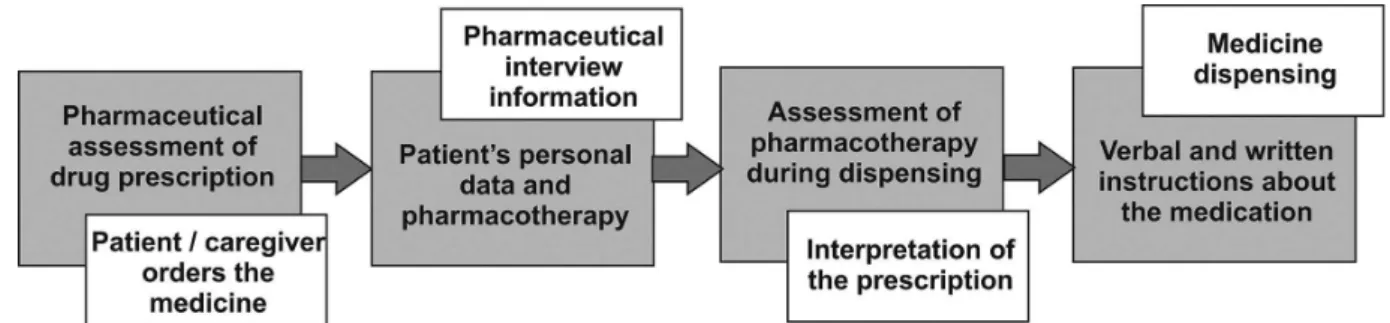
Medication dispensing process at the CP is conducted in continuing steps to obtain personal and pharmacotherapy information about the patient, to understand and interpret drug prescription, to perform pharmaceutical interventions,
and inally to dispense medications (Figure 1). It is worth
pointing out that, since dispensing of compounding medications is also performed at the CP, not all steps illustrated in Figure 1 are performed in the presence of the patient. Interpretation of prescription, for example, is generally conducted in the interval between the compounding medication order and its dispensing.
Medications are dispensed to patients and/or their caregivers. Drug prescription is carefully examined for
its comformity to Brazilian regulations (Brasil, 1973).
Then, the patient is interviewed by a pharmacist regarding
personal data and information related to pharmacotherapy: age, sex, height, weight, occupation, allergies and other
chronic diseases, use of medications, smoking and drinking habits, pregnancy and lactation. Also, the pharmacist asks
whether the patient is aware of the aim of the therapy, how
to take the medications, and veriies if expected results
of the therapy are being achieved and the occurrence of adverse effects. All data are stored in a dedicated software for pharmaceutical data management, Pharmacie
(Pharmasoftware, 2013). Finally, the pharmacist interprets the prescription according to an adaptation of the guidelines proposed by the Grupo de Investigações e m C u i d a d o s F a r m a c ê u t i c o s d a U n i v e r s i d a d e Lusófona, Portugal, (GICUF) (Group for Investigation on Pharmaceutical Care of Lusofona University,
Portugal) (Iglésias-Ferreira, Santos, 2009) (Figure 2).
In this pharmacotherapy assessment tool, the five questions regarding each medication presented in the
flowchart are sequentially answered. When a DRP is
identiied (i.e. when the answer to any of these questions is “no”), the assessment process is discontinued and the
problem-solving process is initiated. According to the
pharmacist’s clinical decision, each DRP may lead to
pharmaceutical interventions, followed by the reassessment of the pharmacotherapy. These steps are successively
repeated until the answers to all the questions are “yes”.
The interventions can be directed to the person who made the prescription, the patient or the medication in use, in
accordance with the Pharmaceutical Care Network Europe
classification of DRP (Version 6.2) (Pharmaceutical
Care Network Europe Foundation, 2010). At the end of
the pharmacotherapy analysis, the pharmacist evaluates whether the patient needs other pharmaceutical services and
refer the patient when deemed necessary. All DRP identiied
and pharmaceutical services performed are registered in the appropriate registration form of the CP.
Medication is then dispensed and proper directions of use are provided by the pharmacist as recommended by the International Pharmaceutical Federation (International Pharmaceutical Federation, 2012). Medication information is provided orally or in written form.
Description and assessment of the CP dispensing service
The description and assessment of the service was performed in terms of the three parameters: structure, process and outcome, used by Donabedian (2005) to evaluate the quality of medical care and adapted by Farris
e Kirking (1993) to evaluate the quality of pharmaceutical
care.
The description and assessment of each parameter was performed as recommended by the Ministry of Health of Brazil (Brasil, 2006), international agencies
(Morak et al., 2010) and previous studies (França Filho et al., 2008; Correr et al., 2004; Dewulf et al.,
2006; Donabedian, 2005; Fernández-Llimós et al.,
2002; Martins, 2012), as follows: (I) Structure: proile of patients, pharmacist’s professional proile, physical facility, informational material; (II) Process: drug-related
problems, pharmaceutical interventions performed, results
of pharmaceutical interventions; (III) Outcome: patient knowledge of medications.
Structure description
The proile of patients was deined by the following
variables: sex, age, type of health service from which drug prescription was obtained (public or private), and complexity of pharmacotherapy, collected from
the CP registration database (Pharmasoftware, 2013). Complexity of pharmacotherapy was calculated using the Medication Regimen Complexity Index (Melchiors, Correr, Fernández-Llimos, 2007) and dichotomized into
low (< 7 points) and high (≥ 7 points)(Fröhlich, Pizzol;
Mengue, 2010).
Pharmacists’ professional proile was deined by the
following variables: the time elapsed since graduation, postgraduate course, graduate degrees, refresher courses in the area completed within the last 5 years, and attendance in symposium and conferences in the last 5 years. These
data were obtained from the pharmacists’ résumé available at the National Council for Scientiic and Technological
Development website (Brasil, 2013a).
The informational material was described according
to updating of the content and classiication of the source
of information (primary, secondary, tertiary).
Process description
The duration of each stage of the dispensing service was recorded by the pharmacists, who used a digital chronometer. The first service was determined as the time elapsed between the moment the patient presented the prescription to the pharmacist and the moment the
patient left the drug dispensing table. The time taken for
the interpretation of the prescription was determined by
the time taken by the pharmacist to start and conclude
the prescription analysis if no DRP was detected, or by
the time taken by the pharmacist to start the prescription analysis and detect the irst DRP. The time for dispensing was deined by the time elapsed between the moment the
patient ordered the prescribed drug and the moment the patient left the drug dispensing table.
DRPs were classiied according to the parameters proposed by the GIGUF (Iglésias-Ferreira, Santos, 2009). Pharmaceutical interventions were classified according to the Pharmaceutical Care Network Europe – PCNE V6.2 classiication(Pharmaceutical Care Network
Europe Foundation, 2010). To each DRP, more than one intervention could be made.
All data were obtained from the CP registration database.
Outcome evaluation
Patients or their caregivers (age ≥ 18 years old) who
attended the dispensing service in the period between 21 January 2013 and 20 April 2013 participated in the outcome evaluation stage. Informed consent was obtained from all participants.
medication was dispensed to other individuals diferent
from the patients or their caregivers, participants who did not answer all questionnaires.
The outcome evaluation questionnaires were applied in a pretest-postest design: first, by the pharmacist, when the patient ordered the medication at the campus
pharmacy; second, by a trained telephone interviewer, 30
days following dispensing (Figure 3).
Patient knowledge of medication was assessed by a validated questionnaire (Fröhlich, Pizzol, Mengue, 2010), which was developed to evaluate the level of knowledge
about drug prescription in the primary health care in Brazil. When more than one medication was dispensed, the
questions were asked regarding the irst medication listed on the prescription. The irst question (“What’s the name of the prescribed medicine?”) was excluded from the evaluation,
since the telephone interviewer stated which medication the
patient would be asked about. The inal classiication point
was adapted and appropriately corrected for this exclusion.
Patients’ level of knowledge about drug prescription was dichotomized into low (< 8 points) and high (≥ 9 points) (Fröhlich, Pizzol, Mengue, 2010).
Patients were categorized into two groups according
to their level of knowledge about medication: (I) persistent low level of knowledge: patients who had a low level of knowledge before and after the pharmaceutical service; (II) increased level of knowledge: patients who had a low level of knowledge about drug prescription before
the pharmaceutical service, and achieved a high level of
knowledge after the service.
Data analysis
All data collected was stored in a Epi Info 3.5.4 (Centers for Disease Control and Prevention, 2012) database, and analyzed by using the STATA software, version 12 (Statacorp, 2011). Comparisons between the
level of knowledge about drug prescription before and after medicine dispensing were performed by McNemar’s test. A p-value < 0.05 was considered to be statistically signiicant. Associations between variables were assessed
by the Wald test.
RESULTS
Structure description
During the study period 769 users attended the
pharmacy, and 170 users met the inclusion criteria. Of these, 48 did not complete the data collection instrument in the second assessment, 16 did not return to the pharmacy to get the medication ordered and 02 did not receive their medications due to DRPs. Hence, a total of 104 patients completed the study.
Most participants were women (80.8%), aged ≥ 40 years (66.0%), users of the public health service (54.0%), who had previously attended the CP (63.5%), following a low-complexity pharmacotherapy regimen (80,8%).
Two pharmacists were responsible for the drug dispensing during the study. They had graduated at least 5 years before the beginning of the study, both of them did
specialization courses, and one of them had a Master’s
degree. Also, they have attended refresher courses in the area, symposium and conferences within the last 5 years.
The sources of informations used in the study
were of primary and secondary types - list of scientiic
journals and database such as Micromedex® e Drugdex®, available at the Capes website (BRASIL, 2013b), and tertiary - a comprehensive bibliography.
Dispensing was performed with the patient seated comfortably in appropriate physical facilities,including tables, chairs and private room if needed.
Process description
The average time for the stage of ‘medicine
ordering’ was 448.30 s (SD = 263.52, Minimum = 32, Maximum = 1284), for ‘interpretion of prescription’ was 109.87 s (SD = 109.87, Minimum = 5, Maximum = 532), and for ‘medicine delivery’ was 130.02 s (SD = 122.05, Minimum = 16, Maximum = 663).
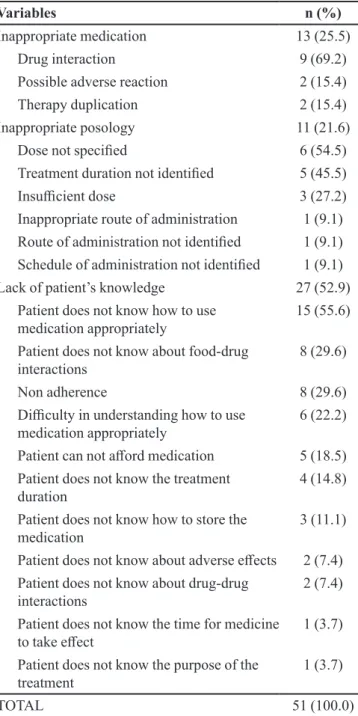
The dispensing service at the CP was able to identify DRPs and correct them by means of pharmaceutical
interventions. The main DRPs identiied were related to the lack of patient’s knowledge regarding their medication
(Table I).
Pharmaceutical interventions were made directly to the patient, by verbal information (Table II).
Outcome evaluation
The dispensing process developed by the group
increased patient knowledge about medication. More than
50% of patients achieved a high level of knowledge after the dispensing process (p = 0.0001) (Table III).
Association between structure, process and outcome
The majority of the pharmaceutical interventions were performed in patients aged greater than 60 years and in users of the public health system (Table IV).
The increase in the level of patients’ knowledge
about their medications was associated with the complexity of pharmacotherapy (Table V).
DISCUSSION
These indings suggest that the dispensing process
developed and implemented in the CP provided patient counseling on medication use, hence increasing patient
knowledge about medications and chances of therapeutic
success.
The lack of patient knowledge of medications
may result in poor adherence and a negative impact on the therapy success, due to pharmacotherapy failure,
increased incidence of adverse efects and intoxications,
and deterioration in health status (Fernandes, Pires,
Gouvêa, 2002; Margonato, Thomson, Paoliello, 2008; Oenning; Oliveira; Blatt, 2011). This is also evident in
previous studies, as reported by Margonato et al. (2008), correlating the incidence of hospitalization secondary
TABLE I - Drug related problems identiied during the dispensing process at Campus Pharmacy, Goias, Brazil, 2013
Variables n (%)
Inappropriate medication 13 (25.5)
Drug interaction 9 (69.2)
Possible adverse reaction 2 (15.4)
Therapy duplication 2 (15.4)
Inappropriate posology 11 (21.6)
Dose not speciied 6 (54.5)
Treatment duration not identiied 5 (45.5)
Insuicient dose 3 (27.2)
Inappropriate route of administration 1 (9.1) Route of administration not identiied 1 (9.1) Schedule of administration not identiied 1 (9.1)
Lack of patient’s knowledge 27 (52.9)
Patient does not know how to use medication appropriately
15 (55.6)
Patient does not know about food-drug interactions
8 (29.6)
Non adherence 8 (29.6)
Diiculty in understanding how to use medication appropriately
6 (22.2)
Patient can not aford medication 5 (18.5) Patient does not know the treatment
duration
4 (14.8)
Patient does not know how to store the medication
3 (11.1)
Patient does not know about adverse efects 2 (7.4) Patient does not know about drug-drug
interactions
2 (7.4)
Patient does not know the time for medicine
to take efect 1 (3.7)
Patient does not know the purpose of the treatment
1 (3.7)
TOTAL 51 (100.0)
TABLE II - Pharmaceutical interventions performed during the dispensing process at Campus Pharmacy, Goias, Brazil, 2013 (n=51)
Intervention domain n (%)
No intervention 3 (5.9)
Prescriber 9 (17.6)
Prescriber was informed 7 (77.8)
Intervention proposed, not approved by prescriber
2 (22.2)
Patient 44 (86,3)
Verbal information provided only 42 (95.4) Writteninformationprovidedonly 30 (68.2) Patient referred to prescriber 7 (15.9)
Drug 8 (15.7)
Dosage changed to… 5 (62.5)
Instructions for use changed to... 6 (75.0)
Outcome of intervention n (%)
Not known Outcome of intervention not
known 11 (21.6)
Solved Problem totally solved 32 (62.7) Partially solved Problem partially solved 2 (3.9)
Not solved 6 (11.8)
Problem not solved, lack of cooperation of patient
1 (16.7)
Problem not solved, lack of cooperation of prescriber
2 (33.3)
to non intentional, acute poisoning by medications
with the lack of instructions for medication use at the time of dispensing. The increase in the knowledge
level may increase the chances of the pharmacotherapy success, as evidenced by Angelini et al. (2009) in a
study demonstrating that the improvement of patients’ knowledge on the management of inhaled corticosteroid
during an education program was associated with
patients’ clinical progress.
In the process description, we have found that most
TABLE III - Patient knowledge about medications before and after the dispensing process at the Campus Pharmacy, Goias, Brazil,
2013 (n=104)
Level of knowledge about medication
After dispensing n (%)
p* Low level of
knowledge
High level of
knowledge Total
Before dispensing n (%)
Low level of knowledge 27 (44.3) 34 (55.7) 61 (100.0)
0.0001
High level of knowledge 9 (20.9) 34 (79.1) 43 (100.0)
Total 36 (100.0) 68 (100.0)
* McNemar test
TABLE IV - Pharmaceutical interventions and associated factors performed during the dispensing process at the Campus Pharmacy, Goias, Brazil, 2013
Characteristics of prescription
Number of prescriptions
dispensed n (%)
Prescriptions that required interventions
n (%)
PR [95% CI] p*
Patient-related
Sex 0.73
Female 84 (80.8) 30 (35.7) 0.7 (0.3 – 1.5)
Male 20 (19.2) 5 (25.0) 1.00
Age 0.02
18 - 40 years 29 (28.2) 4 (13.8) 1.00
41 - 60 years 35 (34.0) 14 (36.8) 2.7 (1.0 – 7.3)
≥ 60 years 33 (32.0) 17 (50.0) 3.73 (1.4 – 9.9)
Drug-related
Complexity of Pharmacotherapy 0.06
Low 20 (19.2) 10 (50.0) 1.7 (0.9 – 2.9)
High 84 (80.8) 25 (29.8) 1.0
Health service-related
Was the prescription originated from the public health system?
0.01
Yes 47 (54.0) 25 (53.2) 2.3 (1.2 – 4.3)
No 40 (46.0) 9 (22.5) 1.00
First time using the dispensing services at the Campus Pharmacy
0.12
Yes 66 (63.5) 26 (39.4) 0.6 (0.3 – 1.2)
No 38 (36.5) 9 (23.7) 1.00
of the DRPs identified were related to the fact that the
patient did not know how to use medication appropriately.
The pharmaceutical interventions were then performed by written and verbal instructions, given directly to the patient.
This inding is corroborated by previous studies conducted
in community pharmacies in Brazil and Germany (Nicolas
et al., 2013; Oenning, Oliveira, Blatt, 2011), revealing that
patient’s knowledge about medications and their correct
use was limited. These results support the importance of
taking the time of dispensing as an opportunity to provide
the patient with instructions for medication use.
In this study, the improvement in patient knowledge
of medications was associated with the complexity of pharmacotherapy. One possible explanation for this is that patients with a high medication regimen complexity index
tend to be more attentive to the instructions provided by the pharmacist during the dispensing process. Another
possibility is that the pharmacist is more likely to provide
the patients with complex medication regimens with better care during dispensing.
In comparison to a similar study previously conducted in the south of Brazil (Oenning, Oliveira,
Blatt, 2011), a greater improvement in patient’s level of knowledge of medication after dispensing was found
in our study. This may be explained by differences regarding the pharmacy structure, including the quality
of informational materials, and pharmacists’ academic background. The structure of the CP in our institution is
considerably distinct from pharmacies located in other parts of Brazil (França Filho et al., 2008; Correr et al., TABLE V - Factors associated with the increase in the level of patient knowledge about medication during the dispensing process at the Campus Pharmacy, Goias, Brazil, 2013
Characteristics Total of patients
Patients with increased level
of knowledge
Odds ration
[CI=95%] p*
Patient-related
Sex 0.51
Female 84 (80.8) 55 (65.5) 1.0
Male 20 (19.2) 13 (65.0) 0.7 (0.3 – 1.8)
Age 0.67
18 - 40 years 29 (28.2) 21 (72.4) 1.0
41 - 60 years 35 (34.0) 24 (68.6) 1.4 (0.6 – 3.0)
≥ 60 years 33 (32.0) 20 (60.6) 1.4 (0.6 – 3.2)
Drug-related
Complexity of Pharmacotherapy 0.00
High 20 (19.2) 9 (45.0) 2.3 (1.3 – 4.1)
Low 84 (80.8) 59 (70.2) 1.0
Health service-related
User of the Brazilian public health system? 0.13
Yes 47 (54.0) 29 (61.7) 1.7 (0.8 – 3.6)
No 40 (46.0) 27 (67.5) 1.0
Utilization of dispensing services at the Campus
Pharmacy for the irst time? 0.20
Yes 66 (63.5) 41 (62.1) 1,0
No 38 (36.5) 27 (71.0) 0.6 (0.3 – 1.3)
Dispensingprocess-related
Was an intervention made? 0.36
Yes 35 (33.6) 21 (60,0) 1.3 (0.7 – 2.4)
No 69 (66.4) 47 (68,1) 1,0
2004; Henningen, 2007; Lucchetta, Mastroianni, 2010;
Silva,Vieira, 2004), where pharmaceutical care decisions
are also strongly inlunced by pharmaceutical industries.
Our study demonstrated that by applying the
dispensing procedures adapted from the GICUF (Iglésias-Ferreira, Santos, 2009), DRPs were identified and completely solved by more than 60% of the pharmaceutical
interventions performed. This is explained by the fact
that the DRPs identiied in the CP, including incomplete
prescriptions, prescribing errors, drug-drug interactions
and lack of patient knowledge, can be prevented. On the
other hand, these DRPs may have a negative impact on
patient’s health, if not identiied or maintained unsolved.
The demand for pharmaceutical interventions was associated with age greater than 60 years, which may be explained by the higher frequency of DRPs detected in elderly patients (Buurma et al., 2001). This is a relevant data considering that the elderly population has increased worlwide. For example, the older population has doubled in the last 20 years in Brazil (Brasil, 2013c),
and is estimated to be between 10-37% of people living in European Union countries (Giannakouris, 2010).
Also, the prevalence of interventions was higher in patients with drug prescriptions that derived from the public health system, which is a major source of low quality prescriptions, as reported by Lyra Junior et al. (2004). These authors indicate that prescription and medication errors may cause DRPs, and the involvement of a pharmacist in the dispensing process would prevent
or minimize such mistakes. DRPs have been frequently identiied in drug prescriptions even in countries with very diferent health systems (Buurma et al., 2001; Nicolas et al., 2013), including European countries.
In this study, the pharmacist was responsible for the
approach of most of the DRPs identiied, and only in few
situations, the prescriber had to be contacted. This is in agreement with other studies (Indermitte et al., 2007; Lyra
Junior et al., 2004) on pharmaceutical interventions in the dispensing process, demonstrating that the pharmacists deal with a variety of DRPs, without requiring the involvement of other health care providers.
Finally, the average time taken for the dispensing
p r o c e s s w a s 11 . 5 m i n u t e s . A s c o m p a r e d t o t h e pharmacotherapy follow-up, which lasts an average time of 60 minutes (Oliveira, 2011), a greater number of patients can be seen in a shorter period of time in the dispensing process. Consultation time is a crucial issue for the quality of the public health system in Brazil, since there are more than 110 million users only in the primary care system, and an average of 0.75 pharmacist per 1000
inhabitants (Brasil, 2013c). The work of the pharmacist
in the dispensing process may contribute to the solution of numerous DRPs. Also, dispensing may be regarded as a screening stage to determine whether a referral to the pharmacy follow-up is required.
Although the study was conducted in a CP with
structural conditions and human resources very diferent from those observed in the vast majority of the country’s
pharmacies, it was interesting to observe how medication dispensing performed by the pharmacist and ideal
conditions could signiicantly contribute to the rational
use of medicines.
One limitation of the study was the limited number of variables assessing the association between structure, process and outcome of the model. Further studies including a greater number of variables are needed to elucidate the possible association between these components of the dispensing service. Also, further studies are required to assess this medication dispensing model
in diferent scenarios and designs in order to evaluate the
reproducibility of the model.
CONCLUSION
The service of medicine dispensing developed and implemented in the CP was able to identify and solve DRPs. Also, it promoted an increased level of patient
knowledge of medications. The model of drug dispensing
represents a component of the appropriate soft technology
in health care, so that patients can have greater beneit from
their pharmacotherapy.
ACKNOWLEDGEMENTS
We would like to thank the pharmacists and other staf members of the Campus Pharmacy, University of Goias, and Paula Iglésias-Ferreira and Henrique Santos
professors of the Instituto Pharmcare.
REFERENCES
AMERICAN PHARMACISTS ASSOCIATION. Pharmacy practice activity classification (Version 1.0). JAPHA – Washington, v.38, n.3, p.139-148, 1998.
ANGONESI, D. Dispensação farmacêutica: uma análise de diferentes conceitos e modelos. Ciênc. Saúde Coletiva, v.13, p.629-640, 2008.
ANGONESI, D.; RENNÓ, M.U.P. Dispensação farmacêutica: proposta de um modelo para a prática. Ciênc. Saúde Coletiva, v.16, n.9, p.3883-3891, 2011.
BRASIL. Lei n.5.991, de 17 de dezembro de 1973. Dispõe sobre o controle sanitário do comércio de drogas, medicamentos, insumos farmacêuticos e correlatos, e dá outras providências.
Diário Oicial da União, Brasília, 17 dez. 1973. Available
at: <http://legislacao.planalto.gov.br/legisla/legislacao.nsf/ Viw_Identiicacao/lei%205.991-1973?OpenDocument?. Accessed on: 01 Nov. 2014.
BRASIL. Agência Nacional de Vigilância Sanitária. Resolução da Diretoria Colegiada - RDC n.44, de 17 de agosto de 2009. Dispõe sobre Boas Práticas Farmacêuticas para o controle sanitário do funcionamento, da dispensação e da comercialização de produtos e da prestação de serviços farmacêuticos em farmácias e drogarias e dá outras providências. Diário Oficial da União, Brasília, 17 ago. 2009. Available at: <http://bvsms.saude.gov.br/ bvs/saudelegis/anvisa/2010/res0044_26_10_2010.html>. Accessed on: 01 Nov. 2014.
BRASIL. Ministério da Saúde. Resolução n.338, de 06 de maio de 2004. Aprova a Política Nacional de Assistência Farmacêutica. Diário Oficial da União, Brasília, 06 maio 2004. Available at: <http://bvsms.saude.gov.br/ bvs/saudelegis/cns/2004/res0338_06_05_2004.html>. Accessed on: 01 Nov. 2014.
BRASIL. Ministério da Saúde. Secretaria de Políticas de Saúde. Departamento de Atenção Básica. Política nacional de medicamentos. Brasília: Ministério da Saúde, 2001. 40p. (Série C. Projetos, Programas e Relatórios, n.25).
BRASIL. Ministério da Saúde. Secretaria de Ciência, Tecnologia e Insumos Estratégicos. Departamento de Assistência Farmacêutica e Insumos Estratégicos. Assistência farmacêutica na atenção básica: instruções técnicas para
sua organização. 2.ed. Brasília: Ministério da Saúde, 2006. 98 p. (Série A. Normas e Manuais Técnicos).
BRASIL. Ministério da Ciência e Tecnologia. Conselho Nacional de Pesquisa. Plataforma Lattes. Available at: <http://lattes.cnpq.br/>. Accessed on: 31 Mar. 2013a.
BRASIL. Coordenação de Aperfeiçoamento de Pessoal de Nível Superior. Periódicos Capes. Available at: <www.periodicos. capes.gov.br>. Access in: Jul. 31, 2013b.
BRASIL. Ministério da Saúde. DATASUS. Available at: www. datasus.gov.br. Accessed on: 24 Out. 2013c.
BUURMA, H.; SMET, P.A.G.M.; HOFF, O.P.; EGBERTS, A.C.G. Nature, frequency and determinants of prescription modiications in Dutch community pharmacies. Brit. J. Clin. Pharmacol, v.52, p.85-91, 2001.
CENTERS FOR DISEASE CONTROL AND PREVENTION. Epi info. Versão 3.5.4. Atlanta: CDCP, 2012.
CONSELHO FEDERAL DE FARMÁCIA. Resolução n.357, de 20 de abril de 2001. Aprova o regulamento técnico das
Boas Práticas de Farmácia. Available at: <http://www.cf. org.br/useriles/ile/resolucoes/357.pdf>. Accessed on: 01 Nov. 2014.
CONSELHO FEDERAL DE FARMÁCIA. Resolução n.480, de 25 de junho de 2008. Dispõe sobre os serviços farmacêuticos na farmácia-escola, pública ou privada, e dá outras providências. Available at: <http://www.cf.org.br/ useriles/ile/resolucoes/res480_2008.pdf>. Accessed on: 01 Nov. 2014.
CORRER, C.J.; ROSSIGNOLI, P.; SOUZA, R.A.P.; PONTAROLO, R. Peril de los farmacéuticos e indicadores de estructura y proceso en farmacias de Curitiba – Brasil.
Seguim. Farmacoter., v.2, n.1, p.37-45, 2004.
DADER, M.J.F.; MUÑOZ, P.A.; MARTÍNEZ-MARTÍNEZ, F. Atenção farmacêutica - conceitos, processos e casos práticos. São Paulo: RCN Editora, 2008. 246 p.
DEWULF, N.L.S.; MONTEIRO, R.A.; VIEIRA, E.M.; PASSOS, A.D.C.; TRONCON, L.E.A. Adesão ao tratamento medicamentoso em pacientes com doenças gastrintestinais crônicas acompanhados no ambulatório de um hospital universitario. Rev. Bras. Cienc. Farm., v.42, n.4, p.575-584, 2006.
DONABEDIAN, A. Evaluating the quality of medical care. Milbank Q., v.83, n.4, p.691-729, 2005.
FERNANDES, P.A.; PIRES, M.S.; GOUVÊA, A.P. Esofagite ulcerativa associada ao uso de alendronato de sódio: achados histopatológicos e endoscópicos. Arq. Gastroenterol., v.39, n.3, p.173-176, 2002.
FERNÁNDEZ-LLIMÓS, F.; FAUS, M.J.; CAELLES, N.; ESPEJO, J.; GASTELURRUTIA, M.A.; IBÁÑEZ, J.; MACHUCA, M.; TUNEU, L. Seguimiento farmacoterapéutico y dispensación activa : diferencias y similitudes. Pharm. Care Esp., v.4, p.179-185, 2002.
FORO de atención farmacéutica informa: dispensación.
Farmacéuticos, v.321, p.47-50, 2007.
FORO DE ATENCIÓN FARMACÉUTICA. Documento de Consenso. 2008.
FRANÇA FILHO, J.B.; CORRER, C.J.; ROSSIGNOLI, P.; MELCHIORS, A.C.; FERNÁNDEZ-LLIMÓS, F.; PONTAROLO, R. Peril dos farmacêuticos e farmácias em Santa Catarina : indicadores de estrutura e processo. Rev. Bras. Ciênc. Farm., v.44, n.1, p.105-113, 2008.
FRÖHLICH, S.E.; PIZZOL, T.S.D.; MENGUE, S.S. Instrumento para avaliação do nível de conhecimento da prescrição na atenção primária. Rev. Saúde Pública, v.44, n.6, p.1046-1054, 2010.
GIANNAKOURIS, K. Regional population projections EUROPOP2008 : most EU regions face older population profile in 2030. Luxembourg: Eurostat: European Commission, 2010.p.1-20. (Eurostat Statistics in docus, v.1).
HENNINGEN, F.W. Utilização de fontes de informação sobre medicamentos por farmacêuticos em drogarias e farmácias da Região Metropolitana de Porto Alegre. Porto Alegre, 2007. 103 p. Dissertation for Master Degree - Faculty of Pharmacy - Federal University of Rio Grande do Sul.
IGLÉSIAS-FERREIRA, P.; SANTOS, H.J. Manual de dispensação farmacêutica. Lisboa: Grupo de Investigação em Cuidados Farmacêuticos da Universidade Lusófona, 2009.
INDERMITTE, J.; BEUTLER, M.; BRUPPACHER, R.; MEIER, C.R.; HERSBERGER, K.E. Management of drug-interaction alerts in community pharmacies. J. Clin. Pharm. Ther., v.32, n.2, p.133-142, 2007.
INTERNATIONAL PHARMACEUTICAL FEDERATION. Counselling, concordance and communication: innovative education for pharmacists. 2.ed. The Hague: International Pharmaceutical Federation, 2012. 130 p.
LUCCHETTA, R.C.; MASTROIANNI, P.C. Avaliação do conhecimento e das condutas dos farmacêuticos, responsáveis técnicos por drogarias. Rev. Ciênc. Farm. Básica Apl., v.31, n.3, p.183-191, 2010.
LYRA JUNIOR, D.P.; PRADO, M.C.T.A.; ABRIATA, J.P.; PELÁ, I.R. As prescrições médicas como causadoras de risco para problemas relacionados com os medicamentos. Seguim. Farmacoter., v.2, n.2, p.86-96, 2004.
MARGONATO, F.B.; THOMSON, Z.; PAOLIELLO, M.M.B. Determinantes nas intoxicações medicamentosas agudas na zona urbana de um município do Sul do Brasil. Cad. Saúde Pública, v.24, n.2, p.333-341, 2008.
MARTINS, B.P.R. Atenção farmacêutica a pacientes com hipertensão arterial na estratégia saúde da família em Goiânia-GO. Goiânia, 2012. 73 p. Dissertation for Master Degree - Faculty of Medicine - Federal University of Goiás.
MELCHIORS, A.C.; CORRER, C.J.; FERNÁNDEZ-LLIMOS, F. Tradução e validação para o português do Medication Regimen Complexity Index. Arq. Bras. Cardiol., v.89, n.4, p.210-218, 2007.
MORAK, S.; VOGLER, S.; WALSER, S.; KIJLSTRA, N.
Understanding the pharmaceutical care concept and applying it in practice. Viena: Austrian Federal Ministry of Health, 2010. 42 p.
NICOLAS, A.; EICKHOFF, C.; GRIESE, N.; SCHULZ, M. Drug-related problems in prescribed medicines in Germany at the time of dispensing. Int. J. Clin. Pharm., v.35, p.476-482, 2013.
OENNING, D.; OLIVEIRA, B.V.; BLATT, C.R. Conhecimento dos pacientes sobre os medicamentos prescritos após consulta médica e dispensação. Ciênc. Saúde Coletiva, v.16, n.7, p.3277-3283, 2011.
P H A R M A C E U T I C A L C A R E N E T W O R K E U R O P E FOUNDATION. The PCNE classification. Versão 6.2. Zuidlaren: Pharmaceutical Care Network Europe Foundation, 2010.
PHARMASOFTWARE. Pharmacie. Goiânia: Pharmasoftware, 2013.
SILVA, L.R.; VIEIRA, E.M. Conhecimento dos farmacêuticos sobre legislação sanitária e regulamentação da proissão.
Rev. Saúde Pública, v.38, n.3, p.429-437, 2004.
SOARES, L.; DIEHL, E.E.; LEITE, S.N.; FARIAS, M.R. A model for drug dispensing service based on the care process in the Brazilian health system. Braz. J. Pharm. Sci., v.49, n.1, p.107-116, 2013.
STATACORP. Stata statistical software: release 12. College Station: Stata Corp LP, 2011.
WORLD HEALTH ORGANIZATION. Patient care indicators. In: ______. Promoting rational use of medicines: core components. Geneva: WHO, 2002. p.1-6. (WHO policy perpectives on medicines).