Andressa Ferreira Leite Ladislau Albuquerque
I, Ana Karina Bezerra Pinheiro
II,
Francisca Márcia Pereira Linhares
I, Tatiane Gomes Guedes
II Universidade Federal de Pernambuco, Postgraduate Program in Nursing. Recife, Pernambuco, Brazil.
II Universidade Federal do Ceará, Postgraduate Program in Nursing. Fortaleza, Ceará, Brazil.
How to cite this article:
Albuquerque AFLL, Pinheiro AKB, Linhares FMP, Guedes TG. Technology for self-care for ostomized women’s sexual and reproductive health. Rev Bras Enferm [Internet]. 2016;69(6):1099-106. DOI: http://dx.doi.org/10.1590/0034-7167-2016-0302
Submission: 06-29-2016 Approval: 08-24-2016
ABSTRACT
Objective: to validate the technology of printed booklets on self-care for ostomized women’s sexual and reproductive health. Method: a methodological study was performed with a focus on the construction and validity of a printed booklet. The content of this booklet was validated by 11 specialist judges/nurses, according to a Content Validity Index (CVI) equal to or higher than 0.80. Appearance was validated by nine ostomized women, according to an assessment of the diffi culty and convenience of the educational material. Results: the booklet was validated by specialists, with an overall mean CVI equal to 0.87. Moreover, the target population showed 100% of agreement in terms of the adequacy of organization, writing style, appearance and motivation of this booklet. Conclusion: the educational technology in question was validated according to content and appearance, thus representing an adequate, reliable and easily understandable resource to acquire knowledge about self-care for ostomized women’s sexual and reproductive health.
Descriptors: Ostomy; Women; Validity Study; Self-care; Sexual and Reproductive Health.
RESUMO
Objetivo: validar uma tecnologia do tipo cartilha impressa para o autocuidado na saúde sexual e reprodutiva de mulheres estomizadas. Método: estudo metodológico, com foco na construção e validação de cartilha impressa. O conteúdo da cartilha foi validado por 11 enfermeiros juízes especialistas, segundo o Índice de Validade de Conteúdo (CVI) maior ou igual a 0,80. A aparência foi validada por 9 mulheres estomizadas segundo avaliação da difi culdade e da conveniência do material educativo. Resultados: a cartilha foi considerada válida segundo os especialistas, com média global de CVI igual a 0,87 e, segundo o público-alvo, com 100% de concordância quanto à adequação da organização, estilo da escrita, aparência e motivação da cartilha. Conclusão: a tecnologia educativa em questão foi validada segundo conteúdo e aparência, constituindo-se, portanto, em um recurso adequado, confi ável e de fácil compreensão para a aquisição de conhecimentos sobre o autocuidado na saúde sexual e reprodutiva de mulheres estomizadas.
Descritores: Estomia; Mulheres; Estudo de Validação; Autocuidado; Saúde Sexual e Reprodutiva.
RESUMEN
Objetivo: validar una tecnología de tipo folleto impreso para el autocuidado de la salud sexual y reproductiva de las mujeres ostomizadas. Método: estudio metodológico, centrándose en la construcción y validación del folleto impreso. El contenido del folleto fue validado por 11 enfermeros jueces expertos, de acuerdo con el índice de validez de contenido (IVC) mayor que o igual a 0,80. El aspecto visual fue validado por nueve mujeres ostomizadas con respecto a la evaluación de la difi cultad y la adecuación del material educativo. Resultados: el folleto impreso fue considerado válido según los expertos, con media global de IVC igual a 0,87, y según el público objetivo, con el acuerdo del 100% sobre la idoneidad de la organización, el estilo de escritura, el aspecto visual y la motivación del manual impreso. Conclusión: la tecnología educativa en cuestión fue validada de
Technology for self-care for ostomized women’s sexual
and reproductive health
Andressa Ferreira L. L. Albuquerque E-mail: [email protected]
CORRESPONDING AUTHOR
INTRODUCTION
The term “ostomized” has been used to describe individuals who have an ostomy. In its turn, ostomy refers to the surgical ex-posure of any hollow organ, whether temporary or permanent(1). According to the International Ostomy Association, in countries with a good level of medical care, there is approxi-mately one ostomized individual per each 1,000 inhabitants, a figure that can be significantly higher in less developed countries. The most recent statistical survey conducted by the Brazilian Ostomy Association indicated that, in 2003, there were 34,262 ostomized individuals in this country, of which 53% were women(2).
Epidemiological data point to malignant neoplasms and in-testinal inflammatory diseases as the main causes of ostomies. However, there has been a significant increase in the incidence of external causes in great urban centers, changing the profile of ostomized individuals, from a predominantly elderly group to an increasing young adult group of women and men(2).
Individuals undergoing an ostomy surgery face the need to overcome not only the difficulties associated with the disease treatment or underlying disease, but also the changes in life result-ing from an altered body image. Alterations in body shape and perception can lead to difficulties to accept this new condition of life, on different levels of intensity and repercussions, including aspects related to care for sexual and reproductive health(3).
Regarding the female body, the impact on sexuality can be even more negative, considering the stereotype of perfect body culturally held by society, represented by the integrity and standardization of good fitness(4).
The psychological impact caused by the strong influence of change in body image on the social concepts of beauty, body and sexuality is also included among the possible physiological dysfunctions secondary to the ostomy surgery. For women, the surgical process frequently results in a reduction in or loss of li-bido, dyspareunia, vaginal dryness and stenosis or even the de-velopment of feelings of insecurity due to the device attached to their abdomen, self-disgust and shame regarding the new body(5). During the process of adaptation to ostomy, the repercussions for the sexual life of some women result from the loss of self-recognition as an attractive sexual being for their partner, denial of basic sexual needs and perception of sexuality as secondary, thus representing a high level of impact on their quality of life(4,6).
In spite of this, the approach to sexuality in multi-disciplinary care of ostomized individuals is very restricted and influenced by taboos(7). Studies point to health guidance being frequently re-stricted to the material used and ways to prevent skin injuries(8-9). Seeking actions that minimize the impact caused by osto-my, the World Council of Enterostomy Therapists (WCET) de-fined the offer and development of new educational resources
and materials in specialized health care, among other recom-mendations, focusing on education for self-care and the ad-aptation process(10), which implies the recognition of general biopsychosocial needs of ostomized individuals.
Thus, the multiprofessional team, particularly nurses as they stand out in the health education process, must emphasize the search for educational strategies that help to establish an effec-tive communication with ostomized individuals and the restart of routine activities in an inclusive, participatory and empower-ing way, beyond the physical aspects of care(11). This requires that professionals have a sensible view of questions associated with self-care for sexual and reproductive health.
In this sense, educational technologies have been regarded as tools that facilitate dialogue, the strengthening of the client-professional relationship and the formation of a critical aware-ness geared towards healthy living. Thus, the effectiveaware-ness of nursing care, in the perspective of ostomized women’s sexual and reproductive health, presupposes the use of educational technologies as an innovative path for health information.
The use of printed educational materials such as booklets plays an important role in the educational process, not only to promote the mediation of learning contents, but also to function as a resource for easy access to information. Thus, it is possible for patients and their families to check such booklet whenever necessary, including at home(12). So that the information meets the objective proposed for readers, health education booklets require a certain level of validity and meeting of methodologi-cal prerequisites of selection and presentation of content and language that contribute to better assimilation of information(13).
Therefore, enabling an educational material to be validated and made available to ostomized women improves the quality of the teaching-learning process in health care, emphasizing the reliability of instructions.
Based on what has been described, the present study aimed to describe the process of construction and validity of the educa-tional technology of booklets, including instructions on self-care for ostomized women’s sexual and reproductive health.
METHOD
Ethical aspects
The present study was approved by the Research Ethics Committee of the Federal University of Pernambuco, meeting the requirements of Resolution 466/12, which foresees the di-rectives and regulating norms for human research.
Study design and period
A methodological study was performed, involving the con-struction and validity of an educational technology, from Oc-tober 2013 to November 2014. This study refers to a research acuerdo con el contenido y el aspecto visual, y considerada un recurso adecuado, fiable y fácil de entender para la adquisición de conocimientos sobre el autocuidado en salud sexual y reproductiva de las mujeres ostomizadas.
strategy focused on the development, validity and assessment of research tools and methods(14).
Population
For the selection of participants, the recommendations made by Pasquali(15) for the ideal number of specialist judges and target population were followed. Consequently, 11 nurses and nine ostomized women participated in the stages of con-tent and appearance validity respectively.
Specialist judges with a high level of knowledge and experi-ence in their area were selected by an adapted Fehring model(16) when reaching a minimum score of five points, according to the following aspects: titles; scientific production; and length of time working with the theme in question. Professionals who did not reach the minimum score established, i.e. with a low level of knowledge and experience in their area, were excluded.
In the stage of content validity, ostomized women regis-tered with the Ostomy Support Program in the city of Recife, PE, Northeastern Brazil, were selected considering the follow-ing inclusion criteria: to have had an intestinal and/or urinary ostomy for at least one year; and to be aged 18 years or older. Women with other ostomies that were not intestinal and/or urinary, with a length of time since surgery of less than a year and aged less than 18 years were excluded from this study. In terms of the length of time since surgery, we considered the fact that patients report a lower level of acceptance of their new condition of life in the first year after surgery, as they are involved with physiological aspects and equipment handling. This is because changes secondary to the ostomy, involved in the life of ostomized individuals, require time to be accepted and for self-care to be learned(9,17).
Study protocol
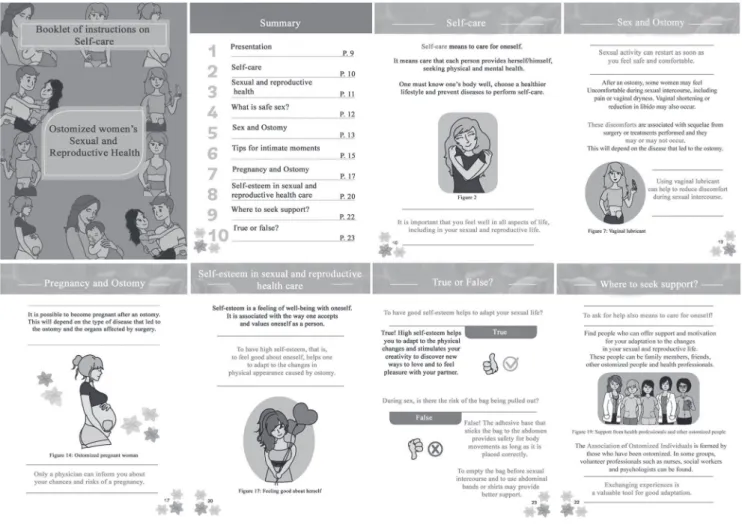
The booklet content, selected through a review of the sci-entific literature and bibliographic survey, was comprised of a brief presentation, followed by sections with instructions on Self-care, Sexual and reproductive health, Safe sex, Sex and Ostomy, Tips for intimate moments, Pregnancy and ostomy, Self-esteem in sexual and reproductive health care, and Sup-port network, in addition to illustrations with captions.
For the booklet to be constructed, a process-based model of design of printed health materials was followed, including recommendations for language, layout and illustration(12). The design of the illustrations, text formatting and layout were per-formed by a designer.
The recommendations for health education materials to be written in easily understandable, readable and legible lan-guage justify the use of the Flesch Reading Ease Score (FRES), which predicts the level of education and measures the struc-tural difficulty of a written text. In Brazil, the FRES adapted to Portuguese texts classifies texts with a FRES higher than 50 as compatible with a level of education of six to nine years of school, i.e. from a very easy to an easy reading level(18).
The final version of the booklet measures 15cm x 21cm and it includes 23 pages, excluding the cover, back cover, au-thor’s message and letter to readers. Each page has from one to three illustrations each, totaling 20 illustrations.
As the first version of the booklet was finished, the process of content and appearance validity began.
Content validity included the assessment of the universe of information that provides the structure and the basis to formu-late questions that adequately represent the content(15-16,18-19). After the Informed Consent Form was signed, researchers sent the questionnaire about characterization, online educational material and content validity instrument, which consisted in an adaptation of the Nursing Diagnostic Content Validity model(20). For this purpose, a semi-structured questionnaire with 17 statements was prepared according to the Likert scale format with five response options: “I completely agree”, “I agree”, “I neither agree nor disagree”, “I disagree”, and “I completely dis-agree”. Each statement corresponded to an assessment item, distributed into three assessment domains (Objective, Structure and organization, and Relevance). Moreover, there were spaces aimed at general comments and suggestions. The speech of participating specialist judges was identified by the initials “SJ”, followed by the number of the completed instrument.
When the content validity was finished, the necessary ad-justments were made and the booklet was printed for appear-ance validity.
Apparent validity, also known as semantic or face validity, consists in the assessment of readability, comprehension and appearance by the target population, which is the aim of this technology(15).
Participants assessed the booklet in terms of organization, writing style, appearance and motivation. A self-administered form was used to characterize participants and to assess the difficulty and convenience of the educational material, adapt-ed from the Suitability Assessment of Materials (SAM)(21). Fi-nally, researchers questioned whether there were any errors or whether an important topic to be approached was missing, apart from general comments and suggestions. The speech from ostomized participants was coded with the letter “O”, followed by the number of the completed form.
Analysis of results and statistics
For the analysis of data on content validity, the Content Va-lidity Index (CVI) was used, considering the Item-Level Con-tent Validity Index (I-CVI) and the Scale-Level ConCon-tent Validity Index/Average Calculation Method (S-CVI/Ave). A Content Va-lidity Index (CVI) equal to 80% (0.80) was used as the cut-off point(22). Items that had a mean lower than the CVI established by this study were changed.
The data on appearance validity were tabulated in the Mi-crosoft Office Excel software and the absolute frequency and agreement were analyzed according to the CVI.
RESULTS
Additionally, there is a section entitled “True or false?”, aimed at reviewing the instructions provided and clarifying possible questions. The cover was designed with several illustrations included in the booklet, so that its content and main message to the reader were represented (Figure 1).
Of all 11 participating specialist judges, seven were enter-ostomal therapy nurses, with a mean length of time of experi-ence in the health care/research area of ostomies of 16.7 years (standard deviation – sd= 10.6). Experience in sexual and re-productive health care/research was reported by seven judges. A total of six judges had previous experience in the devel-opment/validity of educational technologies. The adequacy and validity of themes were confirmed in the content validity process. All the three booklet domains assessed (Objective, Structure and organization, and Revelance) were considered to be valid, as they obtained a mean of agreement per domain equal to or higher than 80%.
Table 1 shows the distribution of absolute frequency of scores obtained from the assessment of specialist judges, ac-cording to the domains assessed and analysis of agreement of adequacy of content validity items.
The mean for all booklet items, which represent the overall content validity of this booklet (S-CVI/AVE global) was 0.87, i.e. higher than the expected CVI.
The analysis of comments/suggestions of specialists in the content validity showed the adequacy of the behavioral rep-resentation of items and emphasized the required changes.
The following items showed disagreement in clarity and ob-jectivity of language, font size and type, and colors and layout re-spectively: 2.1 (I-CVI 0.72), 2.4 (I-CVI 0.63) and 2.5 (I-CVI 0.72). Although item 3.3, which refers to the coherence between the in-formation presented and ostomized women’s needs for sexual and reproductive care, showed an IVC lower than the cut-off point de-fined, it did not receive any suggestions or comments from judges.
As suggested by these judges, the terms/expressions “undesired pregnancy”, “ostomization”, “covering” and “intestinal loops” were replaced by simpler semantic equivalents “unwanted preg-nancy”, “ostomy surgery”, “disguise”, and “intestines” respectively.
The possibility of low agreement among judges for the items referring to font size and type, colors and layout was considered to be associated with the fact that the material was assessed online, thus subject to visualization in adjustment proportions lower than 100% and distortions of color shades, not accurately representing the actual display of the printed material on a ½ A4 sheet with a landscape orientation. In this sense, it should be emphasized that the recommendations for the theoretical material used in the booklet design were maintained during the stage of appearance validity by the target population.
Source: Authors
The validity of the number of illustrations and number of pages indicate the reach of the visual lightness of the mate-rial and the understanding that a greater amount of informa-tion does not necessarily mean better use of informainforma-tion, as pointed out by items 2.7 and 2.9 respectively, which achieved an I-CVI of 0.90, positive assessment and layout adequacy.
A total of three specialist judges emphasized the relevance of the booklet in the scientific environment and for the target population:
A contribution to the construction of knowledge about care
for ostomized people. (SJ7)
An initiative that can help many women to overcome their
fears and to assert themselves. (SJ8)
A colorful and pleasant material with language which is
easy to be assimilated. (SJ10)
In the appearance validity performed in one single group, the minimum age of participants was 28 years and the maxi-mum age was 51 years, with a mean age of 38 years. Regard-ing level of education, it ranged from five to 16 years, with a mean level of 9.6 years (sd=3.8). Of all women who had an
intestinal ostomy, five had a colostomy and four had an ileos-tomy, six of which were permanent and three, temporary. The mean length of time with an ostomy was three years (sd= 6). The reasons for undergoing an ostomy were intestinal inflam-matory disease, Chron’s disease and colon-rectal or gyneco-logical cancer. A total of five women maintained an active post-ostomy sexual life.
In the assessment of difficulty and convenience of the booklet, 100% of the ostomized women answered “yes” for all aspects of appearance validity: Organization – the way that instructions are presented, including coherence, structure and strategy of presentation of information; writing style – lin-guistic characteristics, comprehension and writing style of the educational material presented; appearance – distribution of information, layout adequacy, font and illustrations; motiva-tion – capacity of the material to cause a certain impact, mo-tivation and/or interest, in addition to the level of significance of the educational material presented.
The following comments reveal the results of this stage of validity:
The cover illustrations show what the booklet is about […]
The information makes it clear how we should do it. (O4)
Table 1 – Content Validity Index according to specialist judges’ assessment of the Objective, Structure and presentation and Relevance, in absolute frequency and percentage mean of agreement, Recife, PE, Brazil, 2014
Assessed items Scores* (N=11)
I-CVI**
CA A NAND D CD
1. Objective
1.1 Coherence between information and the promotion of self-care 5 5 1 0 0 0.90
1.2 Scientifically accurate information 3 7 0 1 0 0.90
1.3 Information promotes changes in behavior and attitude 5 6 0 0 0 1.00 1.4 Meets the ostomized women’s needs for information 4 6 1 0 0 0.90
1.5 Meets different socio-cultural levels 4 5 1 1 0 0.81
Subtotal 21 29 3 2 0
Percentage of agreement (S-CVI/AVE***) 90.2% (0.90) 2. Structure and presentation
2.1 Clarity and objectivity of language 5 3 1 2 0 0.72
2.2 Logic in the sequence of ideas 5 5 0 1 0 0.90
2.3 Agreement and orthography 3 7 0 1 0 0.90
2.4 Font size and type 4 3 1 2 1 0.63
2.5 Colors and layout 4 4 2 1 0 0.72
2.6 Coherence between illustrations and content 6 4 0 1 0 0.90
2.7 Number of illustrations 5 5 0 1 0 0.90
2.8 Arouses interest in reading the material 5 6 0 0 0 1.00
2.9 Number of pages 4 6 1 0 0 0.90
Subtotal 41 43 5 9 1
Percentage of agreement (S-CVI/AVE***) 84.1% (0.84) 3. Relevance
3.1 Relevance for dissemination in the scientific environment 5 6 0 0 0 1.00
3.2 Proposes construction of knowledge 6 5 0 0 0 1.00
3.3 Meets the needs for health care for sexual and reproductive health 5 3 3 0 0 0.77
Subtotal 16 14 3 0 0
Percentage of agreement (S-CVI/AVE***) 90.6% (0.90)
Note: *Scores: CA = completely agree; A = agree; NAND = Neither agree nor disagree; D = disagree; CD = completely disagree; **I-CVI = Item-Level Content
It’s easy to understand [...] the text is quite clear. (O1)
Ostomy makes most women feel embarrassed about sex…
when reading the booklet, they’ll have a different opinion. (O8)
It’s difficult for most women to have sexual intercourse [...]
More needs to be written for ostomized people. (O9)
DISCUSSION
Aspects such as sexuality, gender and reproductive health, especially among ostomized women, have been scarcely in-vestigated in the scientific world, thus revealing a deficiency in the area of women’s comprehensive health. In Portugal, a survey on the needs for information about sexuality included 135 ostomized participants and identified that 50% of them had not received any information before or after the surgery, 51% of which women(23).
The majority of ostomized patients have some type of dif-ficulty regarding sexuality, whether related to physiological dysfunctions resulting from surgical procedures – such as the reduction in or loss of libido, dyspareunia, vaginal dryness or stenosis (3-4,8) – or related to the psychological impact result-ing from the change in body image, manifested by feelresult-ings of insecurity and shame about one’s body(5,7).
However, the analysis of national and international scientific productions on health education practices for ostomized indi-viduals performed by nurses revealed the use of a multimedia program and booklet mainly directed towards the rights of such individuals, health care for ostomy, the importance of family for care, and self-care attitude after surgery(24). Other studies also show that instructions on health aimed at ostomized individuals are restricted to the management of collection bags and skin(8-9). Providing information about sexual and reproductive health – through the educational technology proposed in the present study, in accordance with the Ministry of Health’s proposals of design and distribution of technical manuals and educa-tional booklets on sexuality and reproduction – emphasizes a posture of citizenship and comprehensiveness of care for women and empowering regarding rights such as the exercise of autonomy and self-care(3-7). Additionally, it contributes to the development of new knowledge, attitudes, behavior and abilities in their new condition of life, which can help them in their process of adaptation and performance of basic needs associated with sexuality, self-image and self-concept(6,9).
Among the health education technologies, printed educa-tional materials such as booklets, being tools that facilitate the teaching-learning process, are widely used in the process of acquisition, use and deepening of knowledge, mastery, abili-ties and decision-making. Their use is justified as a comple-ment to verbal instructions, working as information guidelines in case of subsequent questions and helping users to cope with and find solutions to health problems on their own(12).
In view of what has been described, it is believed that ex-periencing sexuality with knowledge about the sexual and reproductive rights of ostomized women will enable them to experience an informed, pleasant and safe sexual life based on
self-esteem, allowing quality of life and personal relationships to be improved, in addition to the expression of their own identity as individuals, to the detriment of the presence of ostomy(25).
In the present study, questions about sexuality were included through information about the benefits of the use of vaginal lubri-cants to reduce discomfort during sexual intercourse and illustrat-ed suggestions for adequate moments of intimacy for ostomizillustrat-ed women, among which is the use of adapted and comfortable clothing and lingerie that highlights sensuality and improve their self-esteem; the search for pleasure through caressing, new posi-tions for sex or mutual masturbation; the use of music to mask the noise from the gases; the emptying or exchange of the collection bag before sexual intercourse; the use of collecting devices ad-justed to the type of ostomy; and the possibility of intestinal irriga-tion as an alternative resource to the use of the collecirriga-tion bag(17)
. Once questions about sex are clarified, self-care for sexual and reproductive health of ostomized women must consider the possibility of their desire to become pregnant. Pregnancy is possible for some ostomized women, depending on the type of disease that led to this ostomy and the organs affected by the treatment or surgical procedure(25). Thus, the need for medical evaluation of the conditions and risks of conception was shown, as were some of the possible complications result-ing from the growth of the belly durresult-ing pregnancy, emphasiz-ing the importance of specialized prenatal care in this period.
During the adaptation process, ostomized individuals seek a support network of friends, family members, professionals and others who are also ostomized, as they can contribute to facing the challenges posed by the presence of an ostomy(8,26). The roles of family members, health professionals and other ostomized individuals were emphasized in the learning pro-cess of care, resulting in safety, rehabilitation and living har-moniously with this new condition.
Considering the content presented, with an agreement of 90.2% and mean S-CVI/Ave of 0.90 among specialist judg-es, items related to the objective domain were accepted, i.e. the capacity of instructions presented in the booklet to bring about change in behavior and attitudes through reading.
Although printed educational technologies such as the booklets have been widely used in health communication, aiming to facilitate the teaching-learning process, its applica-bility is subject to limitations associated with one’s aapplica-bility to read and level of education(12-13).
To understand that the vocabulary used in printed materials must be coherent with the message one aims to transmit to the target population and, moreover, that its reading must be easy, inviting and comprehensible(12), the words “stoma”, “ostomy” and “ostomized” were selected as a way to identify this popu-lation through familiar terms frequently used by them.
With a Flesch Reading Ease Score (FRES) equal to 60, the booklet was classified as easy reading. This converges with the result of 100% of agreement regarding the readability of the booklet by the target population, with a level of education between one and eight years of school.
and design of the printed material stands out, aiming to attract readers, stimulate reading and reinforce the idea transmitted(13).
The use of illustrations is essential in health communication as these contribute to the readability and comprehension of the text(12). When placed close to the written text, the attention, as-similation and capacity to recall the message significantly in-crease when compared to this text alone(20), a greater benefit for individuals with a low level of education and reading skills.
Simple illustrations or those in the shape of drawings, such as the ones found in this study, can simplify complex situa-tions and emphasize important points of an idea(12-13). With a percentage of agreement equal to 84.1% and a mean of agree-ment (S-CVI/ Ave) of 0.84, the booklet was considered to be valid regarding the “structure and organization” domain.
When reflecting on the fact that sexuality, gender and reproductive health aspects, especially those of ostomized women, have scarcely been investigated in the scientific world, a great deficiency in the area of women’s comprehen-sive health was found(7).
Thus, the guidance provided by the inter-disciplinary team and nurses, whether they are stoma therapists or not, and es-tablished through interactive and efficient communication with patients and family, is essential. The relevance of the booklet, in view of the gap found in the scientific environ-ment, obtained a percentage of 90.6% and mean S-CVI/Ave of 0.90, meeting the needs for information about sexual and reproductive health care of ostomized individuals and recom-mending the construction of nursing knowledge.
CONCLUSION
The global CVI reached by the assessment of specialist judges (global S-CVI/AVE of 0.87) and the total agreement of the target population enable, respectively, the content validity and appearance validity of the health education booklet en-titled “Booklet of instructions on self-care – ostomized wom-en’s sexual and reproductive health”.
The use of validated educational technologies attributes higher quality to the teaching-learning process and the com-munication in health care emphasizes the reliability of the in-structions presented and the level of coherence of information to meet the proposed objective, an important benefit for the target population and educators.
It is believed that the access to instructions on self-care sci-entifically validated by the present study will contribute to the acquisition of knowledge that can help ostomized women in the process of adaptation to their new condition of life with ostomy, whether it is temporary or permanent, in the giving of a new meaning to their self-image and self-concept, in the overcoming of fears and taboos resulting from a change in body image and in experimenting their sexuality in a more pleasurable way.
Finally, the performance of clinical validity in future stud-ies – for the assessment of the efficiency of this technology as an instrument that can promote changes in attitudes and prac-tices of ostomized women’s sexual and reproductive health – can emphasize the reach of the objectives of the health edu-cation process.
REFERENCES
1. Brasil. Ministério da Saúde. Portaria N° 400, de 16 de no-vembro de 2009. Atenção à Saúde das Pessoas Ostomiza-das [Internet]. Diário oficial da União. Seção 1. Imprensa Nacional [Internet]. Nº 220, quarta-feira, 18 de novembro de 2009 [cited 2013 Dec 10]. Available from: http://www. abraso.org.br/Portaria_400_16_11_2009.pdf
2. Associação Brasileira de Ostomizados (ABRASO). Giro pelo mundo: ações pelo mundo. Rev ABRASO [Internet]. 2005[cited 2013 Nov 8]; (5):1921. Available from: http:// www.abraso.org.br/RevistaABRASO-web2-4.pdf
3. Silva AL, Monteiro PS, Sousa JB, Vianna AL, Oliveira PG. Partners of patients having a permanent colostomy should also receive attention from the healthcare team. Colorec-tal Disease [Internet]. 2014[cited 2015 Feb 12];16:O431-O434. Available from: http://onlinelibrary.wiley.com/ doi/10.1111/codi.12737/epdf
4. Paula MAB, Takahashi RF, Paula PR. Experiencing sexual-ity after intestinal stoma. J Coloproctol [Internet]. 2012[cit-ed 2013 Mar 8];32(2). Available from: http://www.scielo. br/pdf/jcol/v32n2/v32n2a12.pdf
5. Río NG. Los cuidados de enfermería en el impacto psicoló-gico del paciente ostomizado. ENE. Rev Enferm [Internet]. 2013[cited 2016 Jan 16];7(3). Available from: http://ene-e nfermeria.org/ojs/index.php/ENE/article/view/279/pdf_18 6. Galdino YLS, et al. O cotidiano da pessoa estomizada
frente às necessidades humanas Básicas Alteradas. Rev Estima [Internet]. 2012[cited 2014 Jan 7];10(3):22-30. Available from: http://www.revistaestima.com.br/index. php/estima/article/view/77
7. Cerezett CRN. Psychological Instructions and reactive ca-pacity of ostomized individuals and their relatives. Mundo Saúde [Internet]. 2012[cited 2013 Mar 8];36(2):332-9. Avail-able from: http://bvsms.saude.gov.br/bvs/artigos/mundo_ saude/orientacoes_piscologicas_capacidade_reativa_pe ssoas.pdf
8. Cardoso DBR, Almeida CE, Santana ME, Carvalho DS, So-nobe HM, Sawada NO. Sexuality of people with intesti-nal ostomy. Rev Rene [Internet]. 2015[cited 2016 Jan 19]; 16(4):576-85. Available from: http://www.revistarene.ufc. br/revista/index.php/revista/article/viewFile/2051/pdf 9. Poletto D, Silva DMGV. Living with intestinal stoma: the
construction of autonomy for care. Rev Latino-Am Enfer-magem [Internet]. 2013[cited 2014 Jan 22];21(2). Available from: http://www.scielo.br/pdf/rlae/v21n2/pt_0104-1169-rl ae-21-02-0531.pdf
11. Pereira APS, Cesarino CB, Martins MRI, Pinto MH, Ne-tinho JG. Associations among socio-demographic and clinical factors and the quality of life of ostomized pa-tients. Rev Latino-Am Enfermagem [Internet]. 2012[cited 2014 Jan 7];20(1). Available from: http://www.scielo.br/ pdf/rlae/v20n1/13.pdf
12. Moreira MF, Nóbrega MML, Silva MIT. Comunicação es-crita: Contribuição para a elaboração de material educati-vo em saúde. Rev Bras Enferm [Internet]. 2003[cited 2013 Dec 18];56(2):184-8. Available from: http://www.scielo. br/pdf/reben/v56n2/a15v56n2.pdf
13. Echer IC. Elaboração de manuais de orientação para o cuidado em saúde. Rev Latino-Am Enfermagem [Internet]. 2005[cited 2013 Jan 15];13(5):1-5. Available from: http:// www.scielo.br/pdf/rlae/v13n5/v13n5a22.pdf
14. Polit DF, Beck CT. Fundamentos de Pesquisa em gem: avaliação de evidências para as práticas da enferma-gem. 7th ed. Porto Alegre: Artmed; 2011.
15. Pasquali L. Psicometria: teoria dos testes na psicologia e na educação. 2th ed. Petrópolis: Vozes; 2003.
16. Fehring R. Methods to validate nursing diagnoses. Heart Lung [Internet]. 1987[cited 2014 Jan 22]; 16(6):625-9. Available from: http://epublications.marquette.edu/cgi/ viewcontent.cgi?article=1026&context=nursing_fac 17. Mota MS, Gomes GC, Petucco VM. Repercussions in the
living process of people with stomas. Texto Contexto Enferm [Internet]. 2016[cited 2016 May 20];25(1)e1260014. Avail-able from: http://www.scielo.br/pdf/tce/v25n1/pt_0104-07 07-tce-25-01-1260014.pdf
18. Martins TBF et al. Readability formulas applied to text-books in brasilian portuguese. São Paulo: Universidade de São Paulo; 1996.
19. Hulley SB, Newman TB, Cummings SR. Escolhendo os su-jeitos do estudo: especificação, amostragem e recrutamento. In: Hulley SB, Cummings SR, Browner WS, Grady D, Hearst
N, Newman TB. Delineando a pesquisa clínica: uma aborda-gem epidemiológica. Porto Alegre: Artmed; 2003. p. 43-52. 20. Fehring RJ. The Fehring Model. In: Carroll-Johnson and
Paquette: Classification of nursing diagnosis: procedings of the tenth conference. Symposium on Validation Mod-els; 1994.
21. Doak CC, Doak LG, Root JH. Teaching patients with low literacy skills. 2nd ed. Philadelphia: JB Lippincott; 1996. 22. Polit DF, Beck CT. The content validity index: are you sure
you know what’s being reported? critique and recommen-dations. Res Nurs Health [Internet]. 2006[cited 2014 Jan 22];29:489-97. Available from: http://cfd.ntunhs.edu.tw/ ezfiles/6/1006/attach/33/pta_6871_6791004_64131.pdf 23. Ferreira AC. As necessidades de informação sobre
sexuali-dade da Pessoa Ostomizada. Rev Nurs [Internet]. 2009[ci-ted 2016 Aug 11];243:38-41. Available from: http://www. forumenfermagem.org/dossier-tecnico/revistas/nursing/ item/3506-as-necessidades-de-informacao-sobre-sexualida de-da-pessoa-ostomizada#.V7b_h_krLIU
24. Rosado SR, Cicarini WB, Filipini CB, Lima RS, Dázio LMR. Práticas educativas realizadas pelo enfermeiro à pessoa com estomia. Rev Enferm Bras [Internet]. 2015[cit-ed 2016 Jan 22];14(4). Available from: http://portalatlan-ticaeditora.com.br/index.php/enfermagembrasil/article/ viewFile/47/53
25. Carvalho SORM, Budó MLD, Silva MM, Alberti GF, Simon BS. “With some care, we can go on”: experiences of people with ostomy. Texto Contexto Enferm [Internet]. 2015[cited 2016 May 20];24(1):279-87. Available from: http://www. scielo.br/pdf/tce/v24n1/0104-0707-tce-24-01-00279.pdf 26. Azevedo C, Faleiro JC, Ferreira MA, Oliveira SP, Mata LRF.