REVISTA
BRASILEIRA
DE
ANESTESIOLOGIA
OfficialPublicationoftheBrazilianSocietyofAnesthesiologywww.sba.com.br
REVIEW
ARTICLE
Tooth
injury
in
anaesthesiology
José
Miguel
Brandão
Ribeiro
de
Sousa
∗,
Joana
Irene
de
Barros
Mourão
FaculdadedeMedicina,UniversidadedoPorto,Porto,Portugal
Received14March2013;accepted15April2013
Availableonline6April2014
KEYWORDS
Dentaltrauma; Dental
injury/anaesthesiology; General anaesthe-sia/complications
Abstract
Backgroundandobjectives: Dentalinjuryisthemostcommoncomplicationofgeneral anaes-thesiaandhassignificantphysical,economicandforensicconsequences.Theaimofthisstudy istoreviewonthecharacteristicsofdentalinjuryassociatedwithanaesthesiologyandexisting methodsofprevention.
Contents:Inthisreview,thetimeofanaesthesiainwhichthedentalinjuryoccurs,theaffected teeth,themostfrequenttypeofinjury,establishedriskfactors,preventionstrategies, protec-tiondevicesandmedico-legalimplicationsinherenttoitsoccurrenceareapproached.
Conclusions: Before initiating anymedicalprocedure thatrequirestheuse ofclassic laryn-goscopy,athoroughanddetailedpre-aestheticevaluationofthedentalstatusofthepatientis imperative,inordertoidentifyteethatrisk,analyzethepresenceoffactorsassociatedwith difficultintubationandoutlineapreventionstrategythatistailoredtotheriskofdentalinjury ofeachpatient.
© 2014SociedadeBrasileirade Anestesiologia.Publishedby ElsevierEditoraLtda.Allrights reserved.
PALAVRAS-CHAVE
Traumatismo dentário; Anestesiageral; Medic¸ãoderisco; Diagnósticobucal
Lesãodentárianaanestesiologia
Resumo
Justificativaeobjetivos: Alesãodentáriaéacomplicac¸ãomaiscomumdaanestesiagerale apresenta importantesconsequênciasfísicas, econômicasemédico-legais. Oobjetivodeste estudoéfazerumarevisãosobreascaracterísticasdalesãodentáriaassociadaaanestesiologia eosmétodosdeprevenc¸ãoexistentes.
Conteúdo: Nestarevisãosãoabordadosomomentodaanestesiaemquealesãodentáriaocorre, osdentes acometidos,otipodelesão maisfrequente,osfatoresderiscoestabelecidos, as estratégiasdeprevenc¸ão,osdispositivosdeprotec¸ãoeasimplicac¸õesmédico-legaisinerentes àsuaocorrência.
∗Correspondingauthor.
E-mail:[email protected](J.M.BrandãoRibeirodeSousa).
Conclusões:Antesdeiniciarqualquerprocedimentomédicoqueexijaorecursoàlaringoscopia clássicaéimperativaumaavaliac¸ãopré-anestésicaminuciosaedetalhadadoestadodentário dodoente,deformaaidentificarosdentesemrisco,analisarapresenc¸adefatoresassociados adificuldadesdeintubac¸ãoedelinearumaestratégiadeprevenc¸ãoquesejaadaptadaaorisco delesãodentáriadecadadoente.
©2014SociedadeBrasileiradeAnestesiologia.PublicadoporElsevierEditoraLtda.Todosos direitosreservados.
Introduction
Dentalinjuryhasbeenassociatedwithgeneralanaesthesia since many years,1 especially to endotracheal
intuba-tionusingclassic laryngoscopy.2 This is the mostcommon
complication.1---11 The overall incidenceof dentalinjury is
estimated tobe between 0.06% and 12%,3,11---17 andthese
valuescanbeunderestimated.2Therefore,thisisafrequent
injuryinanaesthesiology,inwhichtheaestheticand func-tional consequences and the social impactare important factors.4,6,7,10,11,18
Dental injury is also the most common of all foren-sic claims related to anaesthesia,1,5,19---22 the event being
responsible for the largest number of complaints for medical malpractice against anesthesiologists.2,4---7,23 Its
correctionhasrelevantcosts,whichhave become increas-ingly significant with the evolution and sophistication of technology.6,7,24
Consideringthemagnitudeoftheproblemandthe phys-ical, economicand legalconsequences ofdentalinjury in anaesthesiology,itis importanttocorrespondtotheneed foreducationand trainingofanaesthesiologistsabout the anatomyoftheteeth,thesupportingstructures,the den-talpathologyandtechniquesusedindentalrehabilitation.9
Itis alsonecessary toestablish standardized strategiesof documentation and prevention, since the knowledge and understandingofriskfactorsareessentialtopreventfuture injuries.1,2,4,7,24
Anaesthesia
and
tooth
injury
Healthy teeth are very strong and designed to withstand theenormouspressuresgeneratedduringmastication. How-ever,theinsertion,manipulation,orremovalofanyairway orsuctiondevicemaycauselesionsintheoralcavity.
Occurrence
of
tooth
injury
Dental injuries occur mainly during laryngoscopy,2,5,12 but
canoccur less frequentlyduring anaestheticmaintenance or in the emergence phase of anaesthesia.2,18 Although
therisk of dentalinjury could bepresent also duringthe extubation,19,25itislessimportantandsignificantthanthe
riskduringintubation.2
Most studies show that a lot of injuries occur during intubationfor elective surgeryand onlya minorityoccurs inan emergencycontext,2,11,16 indicating thatthecare to
intubatewillbethesamewhenthepatient’s dentalstate cannot beestablished. Rather, somestudies indicate that emergency surgical procedures are associated with an increasedriskofdentallesions.5,12,17,26
Adolphsetal.11 reportthatperioperativetooth injuries
occur mainly in the general surgery and trauma services, mostlikelybecausethesearetheservicesthatperformthe largest number of surgical procedures usingendotracheal intubationwithlaryngoscope.
Affected
teeth
Generally, only one tooth is subjected to injury,5,6,11 but
thesimultaneoustraumatotwo, threeor evenfourteeth wasalready described.5,6,27 The upper (maxillary)incisors
areatgreatestriskofinjury,3---7,10---12,16,28---32particularlythe
upper leftcentral incisor,6,11---13,19,28,33 but thelower31 and
posterior31 teethcanalsobeinjured.
Type
of
tooth
injury
The most frequent type of dental injury is not constant acrossstudies,andthismaybeduetotheadoptionof dif-ferentmethodologiesforthedetectionandclassificationof lesions. However,the explanation of these criteria is not coveredbythesestudies.Thelesionsmostreportedinthe literatureare:fracture,avulsionanddislocationofnatural teethorprostheticrestorations.3---6,10,11,16,34---36
Risk
factors
Themainriskfactorsofdentaltraumaassociatedwith laryn-goscopyaredifficultintubation3,12,15,37andpoorpreexisting
dentalstatus.1,4---7,11,16---18,26,31,32,38,39
Chenetal.28reportthatinteethwithpreexisting
pathol-ogy,aninjuryisaboutfivetimesmorelikely,12andNewland
etal.15reportedthatpatientswhoaredifficulttointubate
havea20timeshigherriskofdentallesions.
Bucx et al.29 demonstrated that dental injury is more
intubation.Thus,thepredictorsofdifficultintubationalso predicttheriskofdentaltrauma.40
On the other hand, Gaudio et al.16 report that no
type of dentalinjury wassignificantly associated withan anticipatedorunanticipateddifficultintubation.Avulsions, fractures and dislocations occur most frequently during laryngoscopymanoeuvresdescribed asnormalprocedures, asVogeletal.alsodescribed.
The intensityoftheforcesexertedduringlaryngoscopy isalsorelatedtothepotentialriskofdentaltrauma, par-ticularly in the presence of an inadequate technique of intubationorofalongerendotrachealintubation.The pres-enceofprominentupperincisors,withaheightexceeding 1.5cm, is associated with increased tensile strength and durationoflaryngoscopy,andcontributestoincreasingthe risk of tooth injury. Particularly, the laryngoscopy takes longerwhentheexcessweightisassociatedwithalimited tongueprotrusion,lessthan5cmofmouthopening,anda limited neck extension, which increases the likelihood of injurytotheteethduringintubation.2
Other factors have been described in theliterature as enhancersofdentalinjury:theimpactonthedentalarch during laryngoscopy, in association with a poor technique ofintubation5,16,17,42andpatient’sanatomicfactors
(promi-nentandlarge sizeteeth,smallmouthopening,excessof teeth in the anterior part of the dental arch,16 isolated
teeth,28 difficultmask ventilation,oral diseases,presence
ofprostheses,previoushistoryofdifficult intubation, pre-vious neck surgery, chemotherapy or prior radiotherapy tothe oral cavity, tongue neoplasm,oral trauma, andan impaired patient).17 There are also genetic defects and
pharmacologicalagentsthataffectthetoothstructureand its attachment and, therefore, increase the risk of tooth damage.1,25
The level of trainingof the anaesthesiologist does not influencetheprobability/riskofdentalinjury,11,16,32sothe
toothinjurycanoccurwithboththeexperienced anaesthe-siologist as withthe less experienced professionaland in bothscenariosofintubation(easyordifficult).However,in some studiesthe lack of experiencehasbeen citedasan importantcausativefactor.17,26,31
Prevention
of
trauma
Theperioperative dentalinjury doesnotseemtobe com-pletely preventable and must be accepted, both by the anaesthesiologistandhis/herpatient,asaninherentriskof theprocedure.17,26,31However,accordingtoAdolphsetal.,11
thereisasetofactionsandattitudesthatcouldreduceits frequencyandminimizethedamage,startingwithweighing thebenefitsofsurgeryandtheriskofdentalinjuryrelated togeneralanaesthesia.
Preoperative
evaluation
The preoperative visit is criticalto theevaluation of two situations established by several authors as predictors of dentalinjury:difficult intubationandprevious dental sta-tusofthepatient,withthegoalofdevelopingaplanforthe preventionofsuchinjury.
History
and
informed
consent
Duringtheanaestheticconsultation,medicalhistoryaspects thatarerecognizedasfactorsthatincreasedentalfragility must be identified (dental trauma, radiation therapy and chemotherapy in head, important bruxism, diabetes mel-litus and autoimmune diseases, age, smoking status and earlytoothdecayinchildhood,amongothers).Thepatient shouldalsobeaskedaboutanypreviouscomplicationduring apreviousanaestheticact,thecircumstancesinwhichthis happened,teethinvolvedandthemeasuresthatweretaken infaceofthisevent.
The anaesthesiologist should inform the patient about therisk of dental trauma, andevidence of such informa-tionmustbeobtainedandincludedintheclinicalprocess, aspartofinformedconsent.1,9,16,32,34,41,42However,the
reg-ister withthe delivery of this informationis rarely done, whichmayhaveimportantforensicimplications.4,42
Examination
of
the
oral
cavity
The preoperative assessment should allow the anaesthe-siologist to assess the conditions of intubation and the preoperativedentalstatusof thepatient.4,7,9,11,16---18,34,43,44
Tothatend,itis importantthatanaesthesiologistshavea comprehensiveknowledgeoftheanatomyoftheteeth,of theirsupportingstructures,ofthedentalpathologyandthe techniquesusedin dentalrestoration,in ordertobeable toproperly identify teeth that are at risk and develop a preventivestrategy.
Dental
anatomy
Theadult(permanent)dentitionhas32teeth,supportedby twoopposingbonearcs:mandibleandmaxilla.The denti-tionis dividedinto fourquadrants,each witheight teeth (one central incisor, one lateral incisor, one canine, two premolarsandthreemolars).
Theinfant(deciduousorprimary)dentitionconsistsofa maximumof20teethandeachquadrantiscomposedoffive teeth(onecentralincisor,onelateralincisor,onecanineand twomolars).
The tooth is divided into twoparts: the root and the crown,each withthreelayers.Theoutermostpart ofthe crownis theenamel,whichbecomesfragileifit doesnot haveagoodsupportforthedentine,whichistheyellowish intermediatelayer,providingthe frameof thetooth. The pulpistheinnermostlayerandiscomposedofbloodvessels andnervetissue.The roothasastheoutermostlayerthe cement,andthetwoinnermostlayersareidenticaltothose of thecrown. The periodontium is the tissue surrounding andgivingsupporttothetooth;itiscomposedofgingiva, alveolarboneandperiodontalligament.Theanatomyofthe toothcanbeseeninFig.1.
Dental
pathology
Gingiva
Alveolar bone
Enamel
Dentina
Pulp
Crown
Root Cement
Periodontal ligament
Figure1 Dentalanatomy.
onit.5,16,25Therefore,itisimportantthatthe
anaesthesiol-ogistisawareofthediseasesthataffectteethandbeable toidentifyalteredteeth.
Thediseasethatmostoftenaffectsteethisdentalcaries. Thisdiseaseinvolvesasofteningordissolutionofouter lay-ersofthe teethbytheaction of acid-producingbacteria, whichleadstoaweakeningofthetoothstructure.The treat-mentof cariesinvolvesremovalof thetooth portionwith cariesanditsfillingwithrestorationmaterial;thisturnsthe tootphysicallymorefragileandpronetoinjury.
Periodontal disease is a common dental pathology, characterized by a painless inflammatory process, which involves bacterial infection of the periodontium and that usuallymanifests in adultsin theform of inflamed gums, gingival recessionand accumulation of tartar. The patho-physiologicmechanisminvolvestheslowdissolutionofthe bone supporting the teeth and of periodontal ligament, and leads to increased tooth mobility. Consequently, the affectedteethexhibitgreatervulnerabilitytosubluxation oravulsion,evenwhenexposedtominorforces.The eval-uation of tooth mobility is an important aspect in the examinationoftheconditionoftheperiodontiumandmay bemadebypalpationofeachindividualtooth.The system-aticuse ofpreoperativetestsfor detectionofperiodontal disease,asPeriotestTechnique,isnotindicated.31,35Inthe
presenceofanadvancedperiodontaldisease,tooth extrac-tionisusuallythetreatmentofchoicetopreventavulsion.45
Patientswhopresentwithdecayedorrestoredteethin someway(fillingwithcomposite,prostheses,crowns,etc.), aswell as thosewith significant periodontal disease, are classifiedaspeoplewithexistingdentalabnormalities.
Odontogram
Theresultofthepreoperativeassessmentoftheoralcavity statusshouldbedocumentedinasimple,objectiveandeasy tounderstandway.Althoughthereisnotyetastandardized
Right
18 17 16 15 14 13 12 11
48 47 46 45 44 43 42 41 31 32 33 34 35 36 37 38 21 22 23 24 25 26 27 28 Left
Figure2 NumberingsystemoftheFédérationDentaire
Inter-nationale(FDI)---themostwidelyusedsysteminthenumbering
ofteethinPortugal.
Left Right
32
1 2 3 4 5 6 7 8 9
31 30 29 28 27 26 25 24 23 10
22 21 20 19 18 17 11 12 13 14 15 16
Figure3 Universalnumberingsystem.
and universal method for this procedure, several authors have proposedamodel of documentation.1,2,17,33 A simple
diagramwithabriefwrittendescriptionofthealteredteeth may be sufficient.9 The numbering systems illustrated in Figs. 2 and 3 can beused asa basis for this description. In Portugal, the most used system in numbering of teeth is that of theFédération Internationale Dentaire (Fig.2), in which each tooth is designated by two digits:the first determinesthe quadrant towhich thetooth belongs, and theseconddigitcorrespondstothenumberassignedtothe tooth.Thequadrantsaredeterminedclockwise,startingby thequadrantcorrespondingtotherighthalfofthejaw.
IntheUnited Statesof Americathe Universal Number-ing System (Fig. 3) is used.In thissystem, the teethare sequentiallynumberedfrom1to32,beingpresentornot. Thenumberingoftheteethistakenasifwewerefacingthe patient,beginningintheright(quadrant)upper(maxillary) third molar, proceedingclockwise through the left maxil-laryquadrantandthenthroughtheleftmandiblequadrant, endingintherightlower(mandible)thirdmolar.
Despiteperforming aleading rolein the prevention of trauma,studiesrevealthatthewrittendocumentationfor thepreoperativeassessmentofthepatient’sdental condi-tionisrarelyfoundinanaestheticdossiers.4,11,15,19,25
Preexisting
dental
abnormalities
and
type
of
resulting
injury
Dental injuries can be caused by several mechanisms.2
Inapatientwithhealthyteeth,theriskofdentalinjury is mainly associated with intubation difficulties. In these cases,thelesionsmostfrequentlyobservedarefractures. Dentalcracksoftengounnoticedduringtheclinical exam-inationand whentheyarenotdetected, thisexposes the patienttotheriskof majordentalfracturesduring laryn-goscopy.When thepatientusesaprosthesisor hasdental restorations,usuallytheinjurycausedbytraumaisa loos-eningoftheprosthesisoradeteriorationoftherestoration material,eventuallyinassociationwithtoothfracture.2
Incaseofperiodontaldisease,thelesionsresultingfrom laryngoscopyaremorelikelytoothsubluxationsor disloca-tions.Studiesshowthatinthecaseofperiodontaldisease affectingmaxillaryteeth,theriskisassociatedto difficul-ties in intubation, notto the disease. Inmandible teeth, theperiodontaldiseaseisassociatedtodamagefrombiting the oropharyngeal airway, trachealtube or a supraglottic device,nottothelaryngoscopy.2
Protection
The initial preoperative evaluation determines the strat-egytobefollowedinthehandlingoftheairway,fromthe choice ofthe blade andlaryngoscope typeto thetypeof anaesthesia and the possible implementation of a device for dentalprotection. According toNouette-Gaulain, this kindofapproachis importantfor thepreventionofdental injuries,reducingthenumberofclaimsandthecostsofthe litigationprocess.2
Havingevidenceofhighriskofdentalinjury,itis impor-tantthata strategyofprevention thattakesintoaccount the time between consultation and surgery be defined. In non-urgent cases, the anaesthesiologist may suggest a consultation with a stomatologist/dentist,1,9,13,42 in which
dentalandperiodontalcarecanbeprovided,oraocclusal guttercanbeused.Theclosecooperationbetweendentists andanaesthesiologistshavebeenadvocated,10,13,16although
withouteliminatingtheriskofdentaltrauma.
Occlusal
gutters
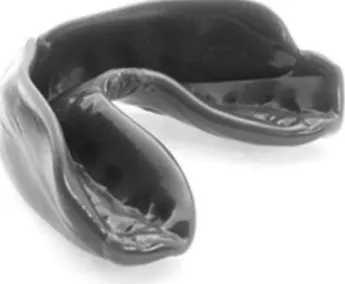
Occlusalgutters(Fig.4)aredevicesmanufacturedofvarious materials,whichcanbeofstandardsizeorcustom-madeby means of an exactmould of the dentalarch. The gutters diminish therisk ofdentalinjuries byreducingthe forces exertedontheupperincisorsduringlaryngoscopy.2,17
How-ever, their use seems to be feasible only in the absence ofdifficultintubationcriteria,sincetheyreducethe open-ingofthemouth, limitthevisualizationof thelarynxand increase the difficulty of tracheal intubation.36 In
addi-tion, the instability of some protectors during intubation procedurescanfunctionasadistraction,causingpoor visu-alization anda reducedspace for the introduction of the blade. Its manufacturing requires a periodof timewhich maybeimportant,depending ontheurgencyofthe surgi-calprocedure.39 Theuseofthesedevicesdoesnotextend
significantlythedurationofintubation,20 andthe
relation-ship betweenthe appliedforce andtheforce required to causetooth injury remains unclear.39 The manufactureof
a custom-made gutter allows a better quality protection
Figure4 Occlusalgutter.
ofmaxillaryteethcomparedtostandardgutters,39 without
aggravatingtheintubationconditions.20
Thereisnoconsensusregardingtherecommendationto theuseofocclusalgutters.Somestudiesreservetheiruse for specific situations of greater risk (teeth in very poor condition),7,14,31,34,36,39whileothersadvocatethethesisthat
theguttersshouldberoutinelyusedinallpatients,11,17even
suggestingthat itsusemay cometobeconsidered asthe standardofgoodmedicalpractice.
Positioning
of
the
head
and
neck
Thetheoreticalobstaclestoviewtheglottisduringdirect laryngoscopyareassignedtotwogroupsofelements: poste-riorandfixed,includingteethofupperjaw,andanteriorand mobile,including tongue, epiglottisand jaw.The upward andforward mobilizationof themandibleandbaseofthe tongueroutinelyperformedbysimpleextensionoftheneck, orthe mobilizationtothe sniffpositionin obesepatients or with blockage of the column, increases the distance amongthe anterior and posterior obstacles and the sub-mandibularspace,facilitatingthelaryngoscopy.Thetensile forcesrequired forlaryngoscopyinthe presenceofa pro-nouncedheadtiltarelessimportantthanthoseinthesniff position,probablyduetothereductionofthetonguevolume foritsmobilizationduringlaryngoscopy.2
In general, the large inter-individual variability in the degree of traction force experienced with certain head positions forcesthe anaesthesiologist to change the head position,assoonasthelevel oftractionappears exagger-atedinhis/heropinion,orifatoothcontactwiththeblade wasperceived.
Available
blades
in
new
devices
Thenumber3Macintoshbladeisclassicallyusedfortracheal intubation,46whatevertheriskofdentaltrauma.However,
reductionof dentaltrauma associated withlaryngoscopy, isavailable.
The non-collared- (Bizzarri-Guiffidra) or low collared-(Cranwall) blades were designed to minimize the risk of injury of the upper incisors, but these devices are not muchwidespread.AmodifiedMacintoshbladewithamore reduced heel at the proximal end increases the distance betweenthebladeandtheteethandreducesthenumberof contactswithoutchangingtheviewofthelarynx;therefore thisdevicemaybeagoodchoicetotheclassicMacintosh bladeinselectedcases.40
Compared to Miller blades (straight), the Macintosh blades facilitate the intubation, because these devices providealargerspaceforthepassageoftheendotracheal tube in patientswithpredictive criteriafor difficult intu-bation. However, the straight blades provide better line ofglotticsightandmay beadvantageousincertain situa-tions.Watanabeetal.47reporttheuseoftheBelscopeblade
(angledblade)asanabsoluteindicationinpatientswithonly onetooth.
Theplasticbladeshavealowerpotentialfortooth frac-turecomparedtometalblades.Nevertheless,theyarenot indicated for difficult intubations,becauseof the greater degreeofforcerequiredinthesesituations.48
The supraglotticdevices(laryngealtube andmask) are of size, shape and composition quite different, accord-ingto themanufacturer. The laryngeal mask produces an incidence of dental injuries up to six times lower than laryngoscopy.1,10,31,49,50
Morerecently, alarge numberofnewdevicesfor intu-bation has been introduced in the market. 51 One of the
optionsarethevideolaryngoscopes,amongwhichthe indi-rectlaryngoscopessuch asGlideScope,EVO2 Truviewand McGrathSeries5,allowthevisualizationoftheglottis with-outaligningtheoralaxiswiththepharyngealandtracheal axesandappeartohaveadvantagesinrelationtothe Mac-intoshlaryngoscope.52,53 Thesedevicesrequiretheuseof
a preformed endotracheal tube with a stylus, unlike the Airtraq and Pentax AWS devices, which are also indirect laryngoscopesavailableinvarioussizes,buthavinga chan-nelthatguides theendotracheal tube towardstheglottic opening. We can count also withthe StorzV-MAC/C-MAC andtheMacGrathMAClaryngoscopes,whichcombineblades identicaltotheMacintoshwithvideotechnologyandcanbe usedforconventionaldirectlaryngoscopy,orasanindirect videolaryngoscope.
TheBonfilsvideolaryngoscopeisadevicethatcanbeused witharetromolarintroductionincasesofalimitedmouth openingandofvertebralcolumnatrisk.
Available information suggests that new devices may come to play a key role in handling the airway, espe-cially as an option in cases of planned or unplanned difficultintubation,orintheeventofafailedintubation.51
It is also suggested that these devices will be able to reduce the risk of dental trauma associated with orotra-chealintubation.2,17,51,52However,studiesthatestablishin
aclearandobjectivemannertheexactroleofthesedevices in dental trauma are still in need, especially when com-paredtotheclassiclaryngoscopywiththeMacintoshblade. The acquisition of skills and experience in their handling is essential for their use to be successful in any clinical setting.51
Forensic
implications
of
tooth
injury
Perioperative dental injuries, as well as all iatrogenic injuries,raisetheproblemofforensicliability,inthiscase withtheutmostimportance,sincethesearethemost fre-quentofallforensicclaimsrelatedtoanesthesia1,5,19---22and
the event alsoincludes thelargest number of complaints againstanaesthesiologistsformedicalmalpractice.2,4---7,23
Althoughthe incidenceof dentalinjuries is important, onlyathirdofthemresultincomplaints4andonlyaminority
isentitledtocompensation,withalowfinancialimpact.4,7
Thiscontrastswiththecommonideathattheseinjuriescost littlemoneytothehospital,butconsidering itsfrequency theoverallcostwouldbehigh.4
Thediscrepancy betweenthe incidenceofinjuries and the numberof complaints maybe linkedtothe fact that patients do not know about the opportunity to do so,or that theyarediscouragedby thelegal andadministrative complexity associated with all thisprocess. On the other hand,somepatientsareawareoftheirpreviouspoordental statusandbelievethattheoccurrenceofinjuryisnotthe directresponsibilityofthehealthunit;besides,thepatient mayfeelthathis/herdentalinjuryisjustacollateral dam-ageinthetreatmentofanoftencomplicatedcondition.The inabilitytoevaluatethequalityofexplanationsgiventothe patient and the psychological care offeredby the anaes-thesiologyteamaftertheaccidentconstituteadifficultto evaluateandpotentiallyrelevant factorinthedecisionto makeacontestation.4
The dental injury occurs even in the absence of negligence;16,17toprovethattheanaesthesiologistdidnot
paytheelementaryhealthcarecanbeadifficultand expen-sivetask.1,41
Conclusion
Ingeneral,thestudiessupporttheconclusionthat,before initiating any medical procedure that requires the use of classic laryngoscopy, a thorough and detailed pre-anaestheticevaluation ofthepatient’sdentalcondition is imperative. This assessment should identifyteethat risk, analyze the presence of factors associated with difficult intubationandoutlineapreventionstrategythatistailored totheriskofdentalinjuryofeachpatient.Itisalso essen-tialthatthepatientbeinformedoftheriskoftoothinjury associatedwithlaryngoscopy;ontheotherhand,itmustbe registeredinwritingthatthisinformationwasconveyedto him/her.Theadoptionofthesemeasuresiscrucialforthe preventionofdentalinjuries,forthedefenceofthe physi-cianinanyforensicconflict,andtoreducecostsassociated withthetreatmentandlitigationprocess.2,4,7,17
Conflicts
of
interest
Theauthorsdeclarenoconflictsofinterest.
References
2.Nouette-Gaulain K, Lenfant F, Jacquet-Francillon D, et al. French clinical guidelines for prevention of perianaesthetic dental injuries: long text. Ann Fr Anesth Reanim. 2012;31: 213---23.
3.Warner ME, BenenfeldSM, Warner MA, et al. Perianesthetic dentalinjuries:frequency,outcomes,andriskfactors. Anes-thesiology.1999;90:1302---5.
4.LaidoowooE, Baert O, Besnier E, et al. Dental trauma and anaesthesiology: epidemiology and insurance-related impact over4yearsinRouenteachinghospital.AnnFrAnesthReanim. 2012;31:23---8.
5.BurtonJF, Baker AB. Dental damageduring anaesthesiaand surgery.AnaesthIntensiveCare.1987;15:262---8.
6.MagninC,BoryEN,MotinJ.Toothinjuriesduringintubation:a newpreventivedevice.AnnFrAnesthReanim.1991;10:171---4. 7.Bernasinski M, Lepouse C, Bankole E, et al. Financial and medicolegalimpactofdentaltrauma.AnnFrAnesthReanim. 2012;31:191---5.
8.AuroyY,LienhartA,BenhamouD.Dentaltrauma.AnnFrAnesth Reanim.2012;31:189---90.
9.SowmyaB,RaghavendraP.Managementofdentaltraumatoa developingpermanenttoothduringendotrachealintubation.J AnaesthesiolClinPharmacol.2011;27:266---8.
10.MouraoJ,NetoJ,VianaJS,etal.Aprospectivenon-randomised studytocompareoraltraumafromlaryngoscopeversus laryn-gealmaskinsertion.DentTraumatol.2011;27:127---30. 11.AdolphsN,KesslerB,vonHeymannC,etal.Dentoalveolarinjury
relatedtogeneralanaesthesia:a14yearsreviewanda state-mentfromthesurgicalpointofviewbasedonaretrospective analysisofthe documentationofa university hospital.Dent Traumatol.2011;27:10---4.
12.LockhartPB,FeldbauEV,GabelRA,etal.Dentalcomplications during and after tracheal intubation. J Am Dent Assoc. 1986;112:480---3.
13.ChadwickRG,LindsaySM.Dentalinjuriesduringgeneral anaes-thesia.BrDentJ.1996;180:255---8.
14.SkeieA, SchwartzO. Traumaticinjuries oftheteethin con-nection with general anaesthesia and the effect of use of mouthguards.EndodDentTraumatol.1999;15:33---6.
15.NewlandMC,EllisSJ,PetersKR,etal.Dentalinjuryassociated withanesthesia:areportof161,687anestheticsgivenover14 years.JClinAnesth.2007;19:339---45.
16.Gaudio RM, Feltracco P, Barbieri S, et al. Traumatic dental injuries duringanaesthesia: Part I: Clinicalevaluation. Dent Traumatol.2010;26:459---65.
17.Gaudio RM, Barbieri S, Feltracco P, et al. Traumatic dental injuriesduringanaesthesia.PartII:Medico-legalevaluationand liability.DentTraumatol.2011;27:40---5.
18.WrightRB,ManfieldFF.Damagetoteethduringthe administra-tionofgeneralanaesthesia.AnesthAnalg.1974;53:405---8. 19.GivolN,GershtanskyY,Halamish-ShaniT,etal.Perianesthetic
dental injuries: analysis of incident reports. J Clin Anesth. 2004;16:173---6.
20.BrosnanC,RadfordP.Theeffectofatoothguardonthedifficulty ofintubation.Anaesthesia.1997;52:1011---4.
21.CassNM.Medicolegal claimsagainstanaesthetists:a 20year study.AnaesthIntensiveCare.2004;32:47---58.
22.ChopraV, Bovill JG, Spierdijk J. Accidents, near accidents, andcomplicationsduringanaesthesia. Aretrospective analy-sis of a 10-year period in a teaching hospital. Anaesthesia. 1990;45:3---6.
23.BlancVF,TremblayNA.Thecomplicationsoftracheal intuba-tion:anewclassificationwithareviewoftheliterature.Anesth Analg.1974;53:202---13.
24.PrunetB, LacroixG, D’ArandaE,et al. Dentalinjury during generalanaesthesia:thelaryngoscopeisnotalwaysguilty.Ann FrAnesthReanim.2010;29:405---6.
25.YasnyJS.Perioperativedentalconsiderationsforthe anesthe-siologist.AnesthAnalg.2009;108:1564---73.
26.FeltraccoP,BarbieriS,SalvaterraF,etal.Unusualdisplacement ofamobiliseddentalbridgeduringorotrachealintubation.Case RepAnesthesiol.2011;2011:781957.
27.Wasmuth CE.Legalpitfalls inthepracticeofanesthesiology. Part2.Complicationsofendotrachealanesthesia.AnesthAnalg. 1960;39:138---40.
28.Chen JJ, Susetio L, Chao CC. Oralcomplications associated with endotracheal general anesthesia. Ma Zui Xue Za Zhi. 1990;28:163---9.
29.BucxMJ,SnijdersCJ,vanGeelRT,etal.Forcesactingonthe maxillaryincisorteethduringlaryngoscopyusingtheMacintosh laryngoscope.Anaesthesia.1994;49:1064---70.
30.Cook TM, Scott S, Mihai R. Litigation related to airway and respiratory complications of anaesthesia: an analysisof claims against the NHS in England 1995---2007. Anaesthesia. 2010;65:556---63.
31.Lacau Saint Guily J, Boisson-Bertrand D, Monnier P. Lesions tolips,oralandnasalcavities,pharynx,larynx,trachea,and esophagusduetoendotrachealintubationanditsalternatives. AnnFrAnesthReanim.2003;22:81s---96s.
32.GaiserRR,CastroAD.Thelevelofanesthesiaresident train-ing does notaffect the risk ofdental injury. Anesth Analg. 1998;87:255---7.
33.GattSP,AurischJ,WongK.Astandardized,uniformand uni-versaldentalchartfordocumentingstateofdentitionbefore anaesthesia.AnaesthIntensiveCare.2001;29:48---50.
34.Jordana F, Fronty Y, Colat-Parros J. Iatrogenic dental and maxillary injuries associated with procedures performed by anesthesiologists.CanJAnaesth.2009;56:545---6.
35.Hoffmann J, Westendorff C,Reinert S. Evaluation of dental injury following endotracheal intubation using the periotest technique.DentTraumatol.2005;21:263---8.
36.Simon JH, Lies J. Silent trauma. Endod Dent Traumatol. 1999;15:145---8.
37.Rose DK,Cohen M.The airway:problems and predictionsin 18,500patients.CanJAnaesth.1994;41:372---83.
38.Huang YF, Ting CK, Chang WK, et al. Prevention of dental damageandimprovementofdifficultintubationusinga para-glossaltechniquewithastraightMillerblade.JChinMedAssoc. 2010;73:553---6.
39.MonacaE,FockN,DoehnM,etal.Theeffectivenessof pre-formed tooth protectors during endotracheal intubation:an upperjawmodel.AnesthAnalg.2007;105:1326---32.
40.Lee J, Choi JH, Lee YK, et al. The Callander laryngoscope blademodificationisassociatedwithadecreasedriskofdental contact.CanJAnaesth.2004;51:181---4.
41.BlumenreichGA.Resipsaloquitur:dentaldamageduring anes-thesia.AANAJ.1997;65:33---6.
42.GersonC,SicotC.Dentalaccidentsinrelationtogeneral anes-thesia.Experienceofmutualmedicalinsurancegroup.AnnFr AnesthReanim.1997;16:918---21.
43.BuffingtonCW,VallejoMC.Asimplepreanesthesiadental exam-ination.Anesthesiology.2006;104:212---3.
44.Singleton RJ, Ludbrook GL,Webb RK, et al. The Australian Incident MonitoringStudy. Physical injuries and environmen-talsafetyinanaesthesia:ananalysisof2000incidentreports. AnaesthIntensiveCare.1993;21:659---63.
45.ClokieC,MetcalfI,HollandA.Dentaltraumainanaesthesia. CanJAnaesth.1989;36:675---80.
46.RayDC,BillingtonC,KearnsPK,etal.AcomparisonofMcGrath andMacintoshlaryngoscopesinnoviceusers:amanikinstudy. Anaesthesia.2009;64:1207---10.
anangulatedstraight,andtwostraightblades.AnesthAnalg. 1994;79:638---41.
48.ItomanEM,KajiokaEH,YamamotoLG.Dentalfractureriskof metalvsplastic laryngoscopebladesindental models.Am J EmergMed.2005;23:186---9.
49.Fung BK,Chan MY.Incidenceof oraltissuetrauma afterthe administration of general anesthesia. Acta Anaesthesiol Sin. 2001;39:163---7.
50.WangLP,HagerdalM.Reportedanaestheticcomplications dur-ingan11-yearperiod.Aretrospectivestudy.ActaAnaesthesiol Scand.1992;36:234---40.
51.Behringer EC, Kristensen MS. Evidence for benefit vs nov-elty in new intubation equipment. Anaesthesia. 2011;66: 57---64.
52.Malik MA, Hassett P, Carney J, et al. A comparison of the Glidescope. Pentax AWS, and Macintosh laryngoscopes when used bynovice personnel: a manikin study. Can J Anaesth. 2009;56:802---11.