AR
TICLE
1 Departamento de Saúde Coletiva, Faculdade de Medicina, Universidade Federal de Juíz de Fora (UFJF). Campus Universitário, Martelos. 36036-330 Juiz de Fora MG Brasil.
[email protected] 2 Departamento de Enfermagem Básica, Faculdade de Enfermagem, UFJF.
3 Departamento de Odontologia Social e Preventiva, Faculdade de Odontologia, UFMG. 4 Departamento de Clínica Odontológica, Faculdade de Odontologia, UFJF.
Impact of oral health conditions on the quality of life of workers
Abstract Occupational health has been the scope of numerous studies, primarily due to the con-cern that the worker should enjoy good working conditions and a satisfactory quality of life. This study seeks to analyze the impact of oral health on the quality of life of workers at a public uni-versity using the simplified version of the Oral Health Impact Profile (OHIP-14) and associat-ed factors. A cross-sectional study was conductassociat-ed with 326 workers who responded the questions of OHIP-14 about self-rated health, oral morbidity, and socioeconomic and demographic questions. Multiple linear regression analysis was performed to verify the association between the independent variables and OHIP-14. About 40% of the impact of oral health on quality of life can be explained by the variables: education level (p = 0,03), age (p = 0,03), reason for visiting a dentist (p = 0,01), oral health perception (p < 0,01) and satisfaction with teeth and mouth (p < 0,01). The use of OHIP-14 can be useful for planning programs and ac-tions focused on health education for occupational health, prioritizing workers with greater psycho-social impacts caused by oral problems.
Key words Occupational health, Oral health,
Sickness impact profile, Quality of life Maria Júlia Campos Guerra 1
Rosangela Maria Greco 2
Isabel Cristina Gonçalves Leite 1
Efigênia Ferreira e Ferreira 3
G
ue
rr
a MJC
Introduction
It is a known fact that oral modifications com-promise the individual’s general health, interfer-ing negatively in his/her quality of life (QL) and
affecting the productive activity of the worker.1
The field of oral health of the worker has as objective the relation between oral health and work in order to promote, preserve, and recover oral health of populations inserted in the vari-ous work processes, thus contributing to a better
quality of life.2
Alterations related to the stomatognathic sys-tem may trigger painful stimuli or psychological and emotional problems that interfere directly in the performance of daily activities of the popula-tion, whether due to morbidity provoked by the pain, distracting the person’s attention with the intention of alleviating discomfort, or due to a difficulty in interpersonal relationships resulting
from the absence of dental elements.3
However, despite recognizing the impor-tance of social and psychological aspects in de-termining disease, dentistry continues to use biological indexes in evaluating and determining the need for treatment and appreciation of oral health programs, such as the decayed, missing, filled teeth - DMFT index and the community periodontal index of treatment needs – CPITN. Nevertheless, such indexes do not take into con-sideration the individual’s subjective perception and do not evaluate the way in which oral health
affects daily life.4
For Petersen5 (2003), oral health extrapolates
the concept of maintaining healthy teeth, and is an essential point for guaranteeing the individu-al’s well-being, since it is inserted into the context of general health and interferes with quality of life. Clinical indexes are not capable of capturing damage, such as pain and interference in chewing and self-esteem; the inference of these aspects is assessed by means of questionnaires that mea-sure the impact of oral health on quality of life. Thus, in order to recognize the impact of mouth diseases on a person’s daily life, the term ‘quality of life’ related to oral health has been used by re-searchers.
Quality of life can be defined as a basically human notion that has been compared to the de-gree of satisfaction found in family, affectionate, social, and environmental life and in existential esthetics itself. It is assumed that the capacity to effect a cultural synthesis of all the elements that a specific society considers its standard of
comfort and well-being. The term covers many meanings, which reflect knowledge, experiences,
and values of individuals and communities.6
Quality of life related to oral health is de-termined by a variety of conditions that affect the individual’s perception, his/her senses, and behavior in day-to-day life. Thus, a growing in-terest has been noted on the part of researchers to quantify the consequences of a disease that
af-fects the routine of the person affected.7
Thus recognizing the importance of quali-ty of life related to oral health, researchers have developed standardized questionnaires in order to assess it. Instruments capable of approach-ing psychological and social aspects by means of self-perception and evaluation of the impacts caused in quality of life have been developed and validated by various authors. Among them, we mention OIDP (Oral Impacts on Daily Perfor-mances), GOHAI (Geriatric Oral Health Assess-ment Index), and the OHIP-49 (Oral Health Im-pact Profile), and its shorter version, OHIP-14.
Observing that there are few studies address-ing the subjective oral health indicators in
popu-lations of workers8-13, and considering that
sub-jective indexes of oral health have been increas-ingly used in dentistry, the present study had as its objective to analyze the impact of oral health conditions on the quality of life of workers at a public university by means of the OHIP-14, and the factors associated with this impact.
Methods
The present study – Impact of oral health on
qual-ity of life of workers – is part of a cross-sectional
exploratory research project – Technical
Admin-istrative Workers in Education: Working and Life Conditions. The survey was initiated with the First Inquiry on Working Conditions and Life
of Workers at the Universidade Federal de Juiz de
Fora (UFJF), applied to a sample of Technical
Ad-ministrative Workers in Education (TAEs, acro-nym in Portuguese) from the UFJF, Minas Gerais, from February 2012 to January 2013.
The study entitled Technical Administrative
Workers in Education: Working and LifeConditions
aúd
e C
ole
tiv
a,
19(12):4777-4786,
2014
The survey was divided into 12 blocks, covering topics about the general health status, oral health, eating habits, physical activity, alcohol ingestion and smoking, relationships with family, with friends and at work, socioeconomic conditions, and demographic profiles, among others.
Considering that the primary interest of this study was to analyze the impact of oral health conditions on the quality of life of the TAEs at UFJF, it is important to emphasize a few points as to the questions analyzed and the block of the questionnaire in reference to oral health of the workers.
The first topic analyzed was on self-percep-tion of general health. The second was about the ‘single item of perceived oral health,’ a mea-surement that incorporates the perception of the individual as to his/her own oral health. The richness of this measurement is illustrated by the strong association with relevant questionnaires on oral health, including topics relative to esthet-ics, chewing, comfort, psychological well-being, social relations, general and oral quality of life,
and general health.14
In the first part of the block on oral health, 10 questions were used from the National Oral
Health Research [Pesquisa Nacional de Saúde
Bu-cal]15 - Projeto SBBrasil 2010, which ask about
re-ported oral morbidity, use of dental services, and self-perception. In the second part, the OHIP-14 questionnaire was used to analyze the impacts of oral health conditions on the quality of life of workers. The OHIP-14 is the most often used in-strument to evaluate the adverse impact caused by oral conditions on well-being and on quality
of life of the individuals16.
In order to delineate the socioeconomic and demographic profile of the study’s popula-tion, topics in reference to age, gender, level of schooling, marital status, and questions from the socioeconomic block were used for the eco-nomic classification as per the Brazilian Associa-tion of Research Companies (ABEP). The Brazil
Economic Classification Criterion17 (CCEB) is
an instrument of economic segmentation that uses the assessment of residential characteristics (presence and quantity of a few items of home comfort and level of schooling of the head of the family) to differentiate the population. The crite-rion attributes points according to the function of each home characteristic and sums up these points. Then a correspondence is made between
the ranges of the mean gross monthlyfamily
in-come, in reals: A (R$ 9,263.00); B1 (R$ 5,241.00);
B2 (R$ 2,654.00); C1 (R$ 1,685.00); C2 (R$ 1,147.00); DE (R$ 776.00).
Before drawing up the final version of the questionnaire in order to perform possible ad-justments in the data collection instrument and train the researchers, a pilot study was conducted in a population of subjects similar to those of this survey composed of 184 outsourced workers at UFJF who did not participate in this study. The reliability of the questionnaire was estimated by the internal consistency by means of McDonald’s Alpha Ordinal and Omega coefficients, with re-sults between 0.94 and 0.96 respectively. In the pilot study, the limitations of the study became evident, such as the incapacity to answer certain questions and the lack of clarity in some topics. Therefore, the necessary changes were made to overcome the perceived difficulties and better adjust the data collection instrument.
To calculate the sample, considering a total of 1,266 TAEs, a mean expected prevalence of 30% was used as parameter for perceived oral health,
based on prior studies7,9,18. A 5% error was
esti-mated, along with a 95% confidence interval, which resulted in 258 participants. To this value, 25% was added to compensate possible losses,
resulting in a minimal sample of 325individuals,
with the expectation of reaching 258 valid ques-tionnaires.
Included in the sample were the TAEs of UFJF, regardless of age and gender, who signed the Informed Consent. Excluded were the work-ers who at the time of collection were on loan to other institutions, or on vacation, or on leave for any reason. Therefore, we obtained a simple random sample of 326 individuals.
The data obtained was tabulated and ana-lyzed using the Statistical Package for the Social Sciences (SPSS) version 15.0 and Microsoft
Of-fice Excel2007.
Likert scale was used to score the answers to each question of the OHIP-14 with the following values: 0 = never, 1 = rarely, 2 = sometimes, 3 = frequently, 4 = always, with a maximal possible
score of 56 points. Based on prior studies8,11,18,
the answers to each question of OHIP-14 were dichotomized, and the presence of impact was defined as the answers ‘frequently’ and ‘always’, and for those without impact, the answers ‘some-times’, ‘rarely’, and ‘never’.
G
ue
rr
a MJC
tendency (mean, median), and variability (stan-dard deviation, total amplitude).
The means of each domain and of total OHIP-14 were verified for posterior comparison
of means7,9,11,13,19,20.
For the bivariate analysis, statistical tests were used with the objective of determining the as-sociation between the OHIP-14 index and the independent variables. The normality of the dependent variables was tested using the Kolm-ogorov-Smirnov test, and the hypothesis of nor-mality of distribution of data was refuted. Thus, we opted for the use of Mann-Whitney nonpara-metric test, with a 5% significance level.
As dependent variables, OHIP-14 and its seven domains were adopted (1: Function-al limitation; 2: PhysicFunction-al pain; 3: PsychologicFunction-al discomfort; 4: Physical disability; 5: Psychologi-cal disability; 6: Social disability; 7: Deficiency). The independent variables adopted sought to translate the association between OHIP-14 and its dimensions and socioeconomic and demo-graphic conditions, self-reported oral morbidity, self-perception, and the use of dental services of the study population.
The independent variables studied were dichotomized according to the mean or were grouped according to homogeneity or according to the distribution of frequencies, into categories, and reclassified for verification of association with the outcome.
Multiple linear regression analysis was made from the variables that showed a statistically significant association (p < 0.05) with the total OHIP-14 in the bivariate analysis. The multivar-iate analysis was conducted in order to identify the predictors of OHIP-14, and was presented in three blocks, in the following order: 1: nomic and demographic variables; 2: socioeco-nomic and demographic variables and the vari-able of use of dental services; 3: socioeconomic and demographic variables, variable of use of dental services, and variable of self-perception of oral morbidity.
This study was submitted to the Ethics in Re-search in Human Beings Committee of the UFJF and approved.
Results
This study population (n = 326) was composed for the most part of men (52.0%). The mean age was 44.01 years, with minimum age of 20 years and maximum of 67 years, and most had
grad-uate level schooling (59.1%). As to economic class, as per the Brazilian Association of Research Companies (ABEP), 56.4% of workers belonged to class B2, with a gross monthly family income of R$ 2,654.00, i.e., approximately four mini-mum (monthly) wages, considering the current value of R$ 678.00.
As to perception of health, 53.4% consid-ered themselves as having good general health and 50.3%, with good oral health. Most admit-ted the need for dental treatment (54.2%) and 82.9% had had no dental pain in the previous six months. As to satisfaction with teeth and mouth, 50.0% were satisfied.
Regarding the use of dental services, 65.2% had gone to the dentist in less than a one-year period and most (76.6%) had used a private ser-vice. Forty-nine point two (49.2%) sought the dentist for a revision, prevention, or check-up, and 31.3% for treatment.
As to frequency of impact for each domain (Table 1), it is important to point out that Phys-ical pain and PsychologPhys-ical discomfort showed the highest frequency (6.5%), as well as the high-est means (1.21 and 1.14, respectively). The mean total found for OHIP-14 was 4.55 (Figure 1).
The variables age (p = 0.01) and level of schooling (p = 0.01) showed a significant associ-ation with the total OHIP-14. Older individuals, aged between 45 and 67 years, and workers with-out a college degree, showed the greatest impact of oral health condition on quality of life (Table 2).
All the variables of oral morbidity and self-perception analyzed showed a statistically significant association with the total OHIP-14 in the bivariate analysis. Those who acknowledged the need for dental treatment had the greatest impact on quality of life caused by oral condi-tions (p < 0.01), as well as those who perceived
Dimension of oral health
Physical limitation Physical pain
Psychological discomfort Physical incapacity Psychological incapacity Social incapacity Disability
No impact
n (%)
314 (97,2) 302 (93,5) 302 (93,5) 313 (97,2) 309 (96,0) 321 (99,7) 322 (100,0)
With impact n (%)
9 (2,8) 21 (6,5) 21 (6,5) 9 (2,8) 13 (4,0) 1 (0,3) 0 (0,0)
aúd
e C
ole
tiv
a,
19(12):4777-4786,
2014
their oral health as being poor (p < 0.01), those who perceived their general health as being poor (p = 0.02), and those who affirmed not being satisfied with their teeth and mouth (p < 0.01) (Table 2).
For the variable of use of dental services, the reason for the last appointment made kept a statistically significant association with the total OHIP-14 (p < 0.01). Those who sought the den-tist for reasons of pain, extractions, treatment, or others different from prevention, showed a more negative impact of the conditions of oral health on quality of life (Table 2).
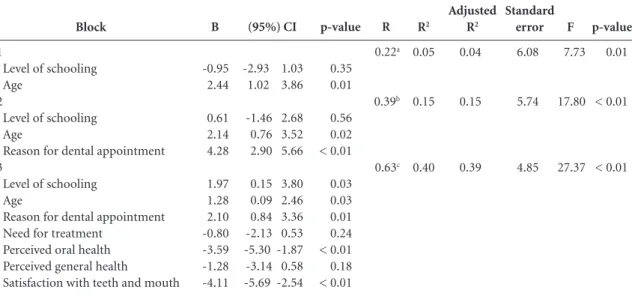
The multiple regression analysis revealed a 0.40 coefficient of determination, which means that about 40.0% of the impact of oral health conditions on quality of life measured by OHIP-14, in this group of workers, might be explained by the variables level of schooling, age, reason for dental appointment, perceived oral health, and satisfaction with teeth and mouth (Table 3).
Discussion and conclusions
This study had most of its population composed of men, but we note that the quantity of wom-en TAEs was very expressive, which reveals the growing insertion of women in the work field, a fact explained by the combination of econom-ic, cultural, and social factors. However, some authors affirm that even with the recent greater participation of women in the work force, the
number of male workers is still greater11.
As to level of schooling, most of the popu-lation studied had done graduate school, which
Variable
Age
20-44 years 45-67 years p-value Level of schooling
Non-university University p-value
Reason for dental appointment Revision, prevention, check-up Pain, extraction, treatment, others p-value
Self-referred need for treatment Yes
No p-value
Perceived oral health Poor
Good p-value
Perceived general health Poor
Good p-value
Satisfaction with teeth and mouth Not satisfied
Satisfied p-value
OHIP-14 total Mean (standard
deviation)
2.97 (4.22) 7.27 (4.41) 0.01
6.49 (7.760) 6.00 (6.343) 0.01
2.28 (4.12) 6.64 (7.32) < 0.01
6.43 (7.05) 2.13 (4.56) < 0.01
10.12 (8.54) 2.49 (3.83) < 0.01
8.25 (9.48) 4.01 (5.76) 0.02
9.38 (7.98) 2.24 (3.69) < 0.01
Table 2. Mean, standard deviation and p-value (Mann-Whitney) of the socioeconomic and demographic variables, of use of dental services, of self-perception, and self-reported oral morbidity, for total OHIP-14 of the TAEs from UFJF, 2012 (n = 326).
Figure 1. Mean total of OHIP-14 and by domains of the TAEs from UFJF, 2012 (n = 326). OHIP-14 TOTAL
Dom. 7: Deficiency Dom. 6: Social disability Dom. 5: Psychological disabilty Dom. 4: Physical disability Dom. 3: Psychological discomfort Dom. 2: Physical pain Dom. 1: Functional limitation
4.55
0.22 0.26
0.75 0.56
G
ue
rr
a MJC
can be explained by the fact that the TAEs are ef-fective workers, and therefore, have a certain level of financial stability and career plans. Additional-ly, they are encouraged to continue their studies, which stimulates the worker to seek supplemen-tation of his/her training.
We noted that the impact of oral health on quality of life was greater when the level of schooling was lower, similar to what was found
in other studies8,12. This might be explained by
the fact that the higher level of schooling is as-sociated with a higher level of income and more information, which determines a greater search for dental services by this working population,
which in turn implies a smaller impact on QL12.
The individual’s level of schooling has a
sig-nificant impact on his/her QL21. The higher the
schooling level, the greater the information
ac-quired and greater the search for dental services12.
As to economic classification, since most be-long to class B2, we can affirm that this is a pop-ulation of workers with good resources, not only financial, but also educational, which probably
reflects in quality of life. As Silva and Fernandes22
confirm, the social environment is important, since life and working conditions afford a special qualification due to the manner in which the indi-viduals think, feel, and act regarding their health. However, in this study no associations were found between the economic class and the
OHIP-14, a result similar to that of the study conducted
by Bombarda-Nunes et al.8.
We can assert that the severity of the impact was reduced in our study, since the total mean of OHIP-14 was low, which also was noted by other
authors.7,9
Montero et al.13 found higher means (9.60)
with Spanish workers. Cohen-Carneiro et al.19,
in a study with coastal riverside populations in the state of Amazonas, found higher mean levels for two communities (10.92 and 14.03). Accord-ing to the authors, these results may be explained by the fact that access to dental services in this region is limited, since it is an area distant from large urban centers.
As to the domains, those with the greatest means were Physical pain, Psychological discom-fort, and Psychological disability. Other authors
found similar results4,23.
Locker24 sustains that pain may cause
physi-cal or psychologiphysi-cal discomfort, or even physiphysi-cal, psychological or social disability, described by the author as limitation or failure in the ability to perform some daily task. The final consequence is the disadvantage, which may be, for example, difficulty in finding employment due to speech
pronunciation problems25.
Considering that the activities carried out by the TAEs from UFJF are characterized by multi-ple functions and that, for the most part, these
Block
1
Level of schooling Age
2
Level of schooling Age
Reason for dental appointment 3
Level of schooling Age
Reason for dental appointment Need for treatment
Perceived oral health Perceived general health
Satisfaction with teeth and mouth
B
-0.95 2.44
0.61 2.14 4.28
1.97 1.28 2.10 -0.80 -3.59 -1.28 -4.11
Table 3. Multiple linear regression for total OHIP-14, as per order of upload of the variables from TAEs of UFJF, 2012 (n = 326).
p-value
0.35 0.01
0.56 0.02 < 0.01
0.03 0.03 0.01 0.24 < 0.01 0.18 < 0.01
(95%) CI
-2.93 1.03 1.02 3.86
-1.46 2.68 0.76 3.52 2.90 5.66
0.15 3.80 0.09 2.46 0.84 3.36 -2.13 0.53 -5.30 -1.87 -3.14 0.58 -5.69 -2.54
R
0.22a
0.39b
0.63c R2
0.05
0.15
0.40
Adjusted R2
0.04
0.15
0.39
a. Predictors: level of schooling, age; b. Predictors: level of schooling, age, reason for dental appointment; c. Predictors: level of schooling, age, reason for dental appointment, need for treatment, perceived oral health, perceived general health, satisfaction with teeth and mouth.
Standard error
6.08
5.74
4.85
F
7.73
17.80
27.37
p-value
0.01
< 0.01
aúd
e C
ole
tiv
a,
19(12):4777-4786,
2014
functions include maintaining direct contact with the public, this makes the worker concerned about his/her appearance, including the aspect of his/her teeth and mouth. Therefore, one can un-derstand that the psychological discomfort and psychological disability have been the two most affected dimensions.
Pena and Minayo-Gomes26 affirm that the
differentiating element of the service sector for workers’ health is the more direct relation with the client or user inserted into the working process. A smile and facial expression, dissociated from af-fection/warmth, and standardized beauty are in-corporated into the service’s work process, as per
racial, sexual, and age criteria among others26.
As to the frequency of impact of each dimen-sion, one can say that it was low. The dimensions that had the most frequent impact were Physi-cal pain and PsychologiPhysi-cal discomfort, similar to
others studies7,8.
A possible explanation for the low frequen-cies of the impact of oral health on QL found in this study may be the use of dental services by the workers, since most stated that they sought these services for revisions and many for treat-ment. These workers, besides having financial conditions to pay for private dental services, are inserted into institutions that provide dental in-surance or a dental plan.
In the present study, the sex variable had no association with the impact of oral health on the QL of the workers, similar to what was found in
other studies7,8,12,27.
The age variable maintained a statistically significant association between the OHIP-14 and the older individuals (45 to 67 years), showing a greater impact on QL than on the other young-er ones (20 to 44 years). A similar result was
found in other studies9,12,18,27. However,
Bombar-da-Nunes et al.8 found no statistically significant
differences as to age range.
The variable, ‘reason for dental appointment’, also maintained an association with the signifi-cance of the impact. The workers who sought dental care for revision, prevention, or check-up showed a smaller impact on QL than those who sought care due to pain, extractions, treatments, and others. This is a result similar to the study
done by Mesquita and Vieira12 and Chapelin et
al.27 who verified that those who sought dental
service due to an emergency had a greater
im-pact, which is similar to other studies8,18.
Pain is the primary motive that leads adults to seek dental care, and usually these individu-als sporadically use the dental service, only when
they have symptoms. Worsening of oral health conditions and in parallel, the increased preva-lence of dental pain in the adult population are a consequence of the historic and systematic ex-clusion of this population group from public ser-vices that concentrate their attention on school-age population, and pregnant woman and babies,
privileging individual and curative attention28.
Slade and Spencer25 sustain that the use of
dental services routinely improves the quality of life of the population. The onus of the disease could diminish with attention directed towards the individuals who present with a standard of dental visits that is symptomatic and irregular. Additionally, one could say that if the workers sought the dental service more often in a preven-tive manner, possibly the constant absences from work due to dental reasons, leaves of absence or discomfort at work would be lesser, or even avoided.
Pain exerts an important impact on the QL of individuals due to the suffering and limita-tions caused in their daily lives. However, little is known about the prevalence of orofacial pain and its impact on the daily lives of workers in
Brazil10.
One might say that TAEs, since they have in-comes that allow paying for dental treatment, are the workers who most seek these services. Also,
Mesquita and Vieira12 affirm that servers in
qual-ified functions, with higher salaries and better control of time, find it easier to have access to dental treatment. This explains the fact of most workers seeking the dental service for revision, prevention, and a large part for treatment, as was mentioned above.
The ‘self-reported need for treatment’ vari-able did not maintain a statistically significant association with OHIP-14. Other authors found associations between the self-reported need for
treatment and impact on quality of life9,19,20.
Bar-cellos and Loureiro29 affirm that the perception
of need may be considered a strong predictor of the use of services.
The perception of oral health maintained a significant association with the OHIP-14. The workers that perceived their oral health as good, suffered a smaller impact, a finding similar to
that of other studies9,12.
G
ue
rr
a MJC
in which the population itself perceives its own
aspects of health and oral diseases22.
The variable, ‘satisfaction with teeth and mouth’ maintained a significant association with the OHIP-14. The workers who stated being sat-isfied showed the least impact of oral health on QL, a finding similar to that of the study by
Pa-paioannou et al.21.
It was observe that at the same time in which most workers perceive their oral health as good and show a low impact of oral health conditions on their quality of life, they also affirm that they
need treatment. As per Alvarenga et al.7, when
there are multiple psychosocial measurements of quality of life, we observe that the field of oral health is not an exception. Very likely, the indi-viduals are content with little in this area, nur-turing low expectations in terms of oral health.
It was important to observe the high fre-quency of the answer ‘never’ for all the questions
of OHIP-14, a result also observed in the study
conducted by Silva et al.23. Such a fact leads us to
reflect that almost all the workers studied did not consider that they had oral problems, and conse-quently, this is had not affected their social lives. Thus, one can affirm that if the worker thinks ev-erything’s fine, he/she possibly does not perceive any oral health problem that will impact his/her QL.
Macedo and Queluz11 affirmed that there
are few reports in literature on oral conditions in adults, as well as a scarcity of collective health programs structured for this economically active population.
The discrepancies found among the popu-lations studied and even among the individuals occur due to the influence of the cultural context and of the values in perception of quality of life, which confirms the subjectivity of the concept.
In face of the results, we can say that, con-sidering that the data gathered refers to the per-ception of the workers studied and are not data from clinical examinations, oral health
condi-tions have a reduced impact on their quality of life. Additionally, the reduced impact might be explained by the fact of this population having good financial resources, a high level of school-ing, and ease of access to dental services.
One can also sustain that the perception of the workers is consistent with the analysis of the variables of health used to explain the study (reason for dental appointment, perceived oral health, and satisfaction with teeth and mouth).
It is important to consider that subjective questions and psychological aspects be consid-ered as essential as normative needs. Additional-ly, the introduction of the model of social deter-mination of the health/illness process as a phi-losophy of work, valuing the patient and making him/her co-responsible for determining the pri-orities in dental treatment is an evident need.
The OHIP-14 could be useful for planning programs and actions focused on workers’ health, giving priority to workers with greater psycho-social impacts produced by oral problems. It is necessary to prepare programs based no equity in order to decrease inequalities and their negative effects on people’s quality of life.
Thus, actions guided towards education in health, with an emphasis on self-perception and self-care, should be better explored, since they would enable greater empowerment of workers to act with more autonomy in seeking improved quality of life and health.
aúd
e C
ole
tiv
a,
19(12):4777-4786,
2014
References
Sales Peres SHC,Theodoro DS, Ribeiro DA, Avila ED, Greghi GA, Silva RPR. Odontologia do trabalho: doen-ças e lesões na prática profissional. Rev Fac Odontol Araçatuba 2006; 27(1):54-58.
Pizzatto E, Garbin CAS. Odontologia do trabalho: im-plantação da atenção em saúde bucal do trabalhador. Odontol Clin-Cient 2006; 5(2):99-102.
Mendonça BMC, Cimões R, Araújo ACS, Caldas Júnior AF, Silva PV. Impacto do número de dentes presentes no desempenho de atividade diárias: estudo piloto. Cien Saude Colet 2010; 15(3):775-784.
Gomes AS, Abegg C. O impacto odontológico no desempenho diário dos trabalhadores do departa-mento municipal de limpeza urbana de Porto Alegre, Rio Grande do Sul, Brasil.Cad Saude Publica 2007; 23(7):1707-1714.
Petersen PE. The World Oral Health Report 2003: con-tinuous improvement of oral health in the 21st cen-tury – the approach of the WHO Global Oral Health Programme. Community Dent Oral Epidemiol 2003; 31(Supl. 1):3-24.
Minayo MCS, Hartz ZMA, Buss PM. Qualidade de vida e saúde: um debate necessário. Cien Saude Colet 2000; 5(1):7-18.
Alvarenga FAS, Henriques C, Takatsui F, Montandon AAD, Telarolli Júnior R, Monteiro ALCC, Pinelli C, Lo-ffredo LCM. Impacto da saúde bucal na qualidade de vida de pacientes maiores de 50 anos de duas institui-ções públicas do município de Araraquara-SP, Brasil. Rev Odontol UNESP. 2011; 40(3):118-124.
Bombarda-Nunes FF, Miotto MHMB, Barcellos LA. Autopercepção de Saúde Bucal do Agente Comunitário de Saúde de Vitória, ES, Brasil. Pesqui Bras Odontope-diatria Clin Integr 2008; 8(1):7-14.
Coelho MP, Cordeiro MCP, Corrêa FF, Carvalho CM, Araújo VE. Avaliação do impacto das condições bucais na qualidade de vida medido pelo instrumento OHIP-14. UFES Rev Odontol 2008; 10(3):4-9.
Lacerda JT, Ribeiro JD, Ribeiro DM, Traebert J. Pre-valência da dor orofacial e seu impacto no desempe-nho diário em trabalhadores das indústrias têxteis do município de Laguna, SC. Cien Saude Colet 2011; 16(10):4275-4282.
Macedo CG, Queluz DP. Quality of life and self-percei-ved oral health among workers from a furniture indus-try. Braz J Oral Sci 2011; 10(4):226-232.
Mesquita FAB, Vieira S. Impacto da condição autoava-liada de saúde bucal na qualidade de vida. RGO 2009; 57(4):401-406.
Montero J, López JF, Vicente MP, Galindo MP, Alba-ladejo A, Bravo M. Comparative validity of the OIDP and OHIP-14 in describing the impact of oral health on quality of life in a cross-sectional study performed in Spanish adults. Med Oral Patol Oral Cir Bucal 2011; 16(6):816-821.
Afonso-Souza G, Nadanovsky P, Werneck GL, Faerstein E, Chor D, Lopes CS. Confiabilidade teste-reteste do item único de saúde bucal percebida em uma popu-lação de adultos no Rio de Janeiro, Brasil. Cad Saude Publica 2007; 23(6):1483-1488.
Brasil. Ministério da Saúde (MS). Pesquisa nacional de saúde bucal - SBBrasil. [acessado 2011 nov 7]. Dispo-nível em: http://dab.saude.gov.br/CNSB/outras_acoes. php
1.
2.
3.
4.
5.
6.
7.
8.
9.
10.
11.
12.
13.
14.
15. Collaborations
MJC Guerra worked in the concept of the study, methodology, data collection, analysis, and final
text of the article. RM Greco and ICG Leite
G
ue
rr
a MJC
Sanders AE, Slade GD, Lim S, Reisine ST. Impact of oral disease on quality of life in the US and Australian populations. Community Dent Health 2009; 37(2):171-181.
Associação Brasileira de Empresas de Pesquisa (ABEP). Critério de classificação econômica do Brasil. [acessado 2013 fev 7]. Disponível em: http://www.abep.org/novo/ Content.aspx?ContentID=835
Miotto MHMB, Barcellos LA, Velten DB. Avaliação do impacto na qualidade de vida causado por problemas bucais na população adulta e idosa em município da Região Sudeste. Cien Saude Colet 2012; 17(2):397-406. Cohen-Carneiro F, Souza-Santos R, Rebelo MAB. Qua-lity of life related to oral health: contribution from social factors. Cien Saude Colet 2011; 16(Supl.1):1007-1015.
Oliveira BH, Nadanovsky P. Psycometric properties of the Brazilian version of the oral health impact profi-le-short form. Community Dent Oral Epidemiol 2005; 33(4):307-314.
Papaioannou W, Oulis, CJ, Latsou D, Yfantopoulus J. Oral Health-Related Quality of Life of Greek Adults: A Cross-Sectional Study. Int J Dent. 2012; 2011:360292. Silva SRC, Fernandes RAC. Autopercepção das condi-ções de saúde bucal por idosos. Rev Saude Publica 2001; 35(4):349-355.
Silva MES, Villaça EL, Magalhães CS, Ferreira EF. Im-pacto da perda dentária na qualidade de vida. Cien Saude Colet 2010; 15(3):841-850.
Locker D. Deprivation and oral health: a review. Community Dent Oral Epidemiol. 2000; 28(3):161-169. Slade GD, Spencer AJ. Development and evaluation of the oral health impact profile. Community Dent Health 1994; 11(1):3-11.
Pena PGL, Minayo-Gomes C. Premissas para a com-preensão da saúde dos trabalhadores no setor serviços. Saude Soc 2010; 19(2):371-383.
Chapelin CC, Barcellos LA, Miotto MHMB. Efetivi-dade do tratamento odontológico e redução de im-pacto na qualidade de vida. UFES Rev Odontol 2008; 10(2):46-51.
Lacerda JT, Simionato EM, Peres KG, Peres MA, Trae-bert J, Marcenes W. Dor de origem dental como motivo de consulta odontológica em uma população adulta. Rev Saude Publica. 2004; 38(3):453-458.
Barcellos LA, Loureiro CA. O público do serviço odon-tológico. UFES Rev Odontol 2004; 6(2):41-50.
Article submitted 30/10/2013 Approved 17/02/2014
Final version submitted 25/02/2014 16.
17.
18.
19.
20.
21.
22.
23.
24. 25.
26.
27.
28.