High Performance and Low Leakage Design Using Cell
Replacement and Hybrid V
t
Standard Cell Libraries
Liang-Ying Lu, Kuang-Yao Chen, and Tsung-Yi Wu
Abstract—In recent years, the chip leakage power may be larger than the chip dynamic power because the semiconductor process technology progresses quickly. Therefore, leakage power reduction becomes an important issue for low power circuit designers. In this paper, we propose a heuristic cell replacement algorithm to reduce the leakage power of a logic design. The algorithm contains two procedures. The first one uses a conventional optimization approach and the second one uses a new optimization approach. In the first procedure, the algorithm uses high Vt, normal Vt, and low Vt cells to do cell replacement. In the second procedure, the algorithm employs hybrid threshold voltage standard cell libraries (HTVSCLs) to do cell replacement. The experimental results show that our technique can further reduce the leakage power up to 14.186% by using the second procedure after invoking the first procedure.
Index Terms—Low Power Design, Leakage Current Reduction, MTCMOS, Hybrid Threshold Voltage Standard Cell Library
I. INTRODUCTION
Currently, in an advanced nanometer CMOS chip, the leakage power becomes larger than the dynamic power. Therefore, if the leakage power of an advanced nanometer CMOS chip used in a portable electronic device is not properly controlled, the chip will extremely shorten the operating time of the device’s battery. Many techniques are proposed for leakage power reduction, for example, Vt
(threshold voltage) assignments, power gating techniques, reverse body bias, etc.
In this paper, we use MTCMOS (Multi-Threshold CMOS) cell replacement technique to do leakage power reduction. Our work employs three kinds of Vt that are low Vt, normal
Vt and high Vt. A low Vt transistor has high leakage power
and short propagation delay while a high Vt transistor has
low leakage power and long propagation delay. In a circuit, high Vt transistors are preferably placed on non-critical
Manuscript received January 7, 2008. This work is supported by the National Science Council of R.O.C. under contract no. NSC 96-2221-E-018-023.
Liang-Ying Lu is with Department of Electronic Engineering, National Changhua University of Education, Changhua, Taiwan (e-mail: [email protected]).
Kuang-Yao Chen is with Department of Electronic Engineering, National Changhua University of Education, Changhua, Taiwan (e-mail: [email protected]).
Tsung-Yi Wu is with Department of Electronic Engineering, National Changhua University of Education, Changhua, Taiwan (phone: 886-4-7232105 EXT.7131; fax: 886-4-7211283; e-mail: [email protected]).
paths to reduce the leakage current of the circuit and low Vt
transistors are placed on critical paths to keep the circuit performance.
Our algorithm contains two procedures. The first one uses a traditional optimization approach and the second one uses a new optimization approach. In the first procedure, our algorithm uses high Vt, normal Vt, and low Vt standard
cells to do cell replacement. In the second procedure, it employs hybrid threshold voltage standard cell libraries
(HTVSCLs) to do cell replacement. The cell replacement actions can reduce the leakage power of the processed circuit and cannot bring any timing violation.
The rest of the paper is organized as follows. Section II describes the first procedure of our algorithm. Section III presents the second procedure of our algorithm and the characteristics of our HTVSCLs. Section IV shows the experimental results. Finally, we conclude this paper in Section V.
II. THE FIRST PROCEDURE OF OUR ALGORITHM
MTCMOS is a well-known technique. Previous works [1]–[11] used dual or triple threshold voltage standard cell libraries to synthesize low power circuits. The first procedure of our algorithm uses high Vt, normal Vt, and
low Vt standard cell libraries to do cell replacement for
reducing the leakage power of the input circuit.
The input circuit of the first procedure of our algorithm is a gate level circuit that is synthesized only by a normal Vt standard cell library. The output circuit of the procedure
may contain high Vt, normal Vt, and low Vt gates. Fig. 1
shows the pseudo code of the procedure. In the code, gN-Vt denotes a normal Vt gate. Let pv be a path that has the worst
timing violation, and let gc be a gate that has the smallest cost among all evaluated gates. The cost function used to decide which gate is gc will be introduced in the next subsection.
A. Cost Function
The cost of the candidate gate that is chosen for being replaced by other Vt gate is defined as follows:
Cost = 1
PathsTotal + ΔPowerLeakage/1000
(1)
where PathsTotal is the amount of the paths through the gate,
and △PowerLeakageis leakage power reduction caused by
the cell replacement. Fig. 2 shows the function
Calculate_Replacement_Costs_of_All_Gates that is called
The_First_Procedure()
{
/* The input circuit only has normal Vt gates; */
For each normal Vt gate gN-Vt
{
Resynthesize gN-Vt by a high Vt gate;
}
Dostatic timing analysis (STA);
While ( there exists a timing violation path ) {
Call Calculate_Replacement_Costs_of_All_Gates(); Find pv that is the worst timing violation path;
If ( there exists a high Vt gate in pv )
{
Decide which gate is gcfrom among allhigh Vt gates in pv;
/* gc is the gate that has the smallest cost among all evaluated
gates. */
Resynthesize gcby a normal Vt gate;
}
Else If ( there exists a normal Vt gate in pv )
{
Decide which gate is gcfrom among all normal Vt gates in pv;
Resynthesize gcby a low Vt gate;
} Else
Break;
Do incremental STA; }
}
Fig. 1 : The first procedure of our algorithm.
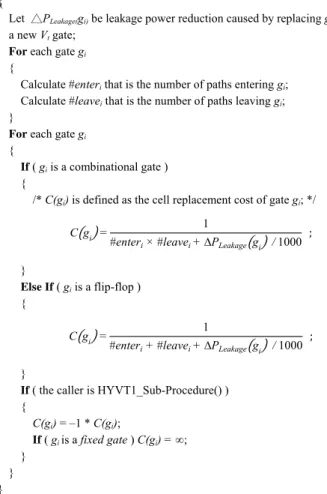
Calculate_Replacement_Costs_of_All_Gates()
{
Let △PLeakage(gi) be leakage power reduction caused by replacing gi by
a new Vt gate;
For each gate gi
{
Calculate #enteri that is the number of paths entering gi;
Calculate #leavei that is the number of paths leaving gi;
}
For each gate gi
{
If ( gi is a combinational gate )
{
/* C(gi) is defined as the cell replacement cost of gate gi; */
C gi = 1
#enteri ×#leavei+ ∆PLeakage gi /1000
;
}
Else If ( gi is a flip-flop )
{
C gi = 1
#enteri + #leavei + ∆PLeakage gi / 1000
;
}
If ( the caller is HYVT1_Sub-Procedure() ) {
C(gi) = –1 * C(gi);
If ( gi is a fixed gate ) C(gi) = ∞;
} }
}
Fig. 2 : The function of calculating the cell replacement cost of each gate.
III. THE SECOND PROCEDURE OF OUR ALGORITHM
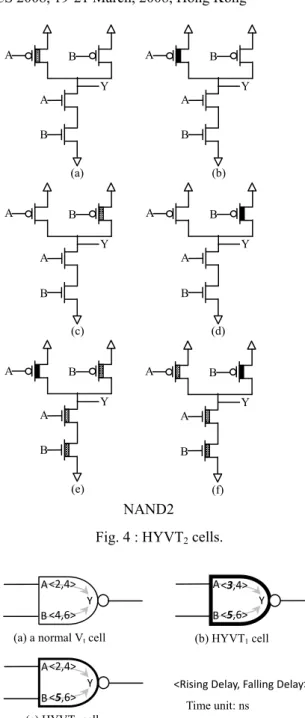
We proposed two kinds of HTVSCL cells. They are HYVT1 cells and HYVT2 cells. Fig. 3 and Fig. 4 show
HYVT1 NAND2 cells and HYVT2 NAND2 cells,
respectively. There are 6 different structures for both HYVT1 NAND2 and HYVT2 NAND2. For convenience
sake, we use different patterns to represent the symbols of logic gates that have the different Vt structures. Fig. 5(a),
Fig. 5(b) and Fig. 5(c) show the symbols of a normal Vt
NAND2, an HYVT1 NAND2, and an HYVT2 NAND2,
respectively. We assume that the corresponding circuit of the symbol shown in Fig. 5(b) is the one shown in Fig. 3(f). Moreover, we assume that the corresponding circuit of the symbol shown in Fig. 5(c) is the one shown in Fig. 4(f).
Fig. 3 : HYVT1 cells.
The second procedure of our algorithm consists of two sub-procedures. One is HYVT1 sub-procedure, and the other is HYVT2sub-procedure. If a path has asymmetric
rising and falling delays, HYVT1 sub-procedure can utilize
the asymmetric property and uses HYVT1 cells to do cell
replacement. If a gate in a path has asymmetric slacks on its input pins, HYVT2 sub-procedure can utilize the asymmetric slacks and uses HYVT2 cells to do cell
replacement.
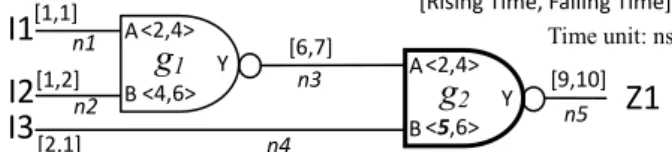
We use the circuit shown in Fig. 6 to explain the main idea of HYVT1 sub-procedure. We assume that the wire delays of n3 and n5 of the circuit are both 0 ns. In the circuit shown in Fig. 6, the rising path delay and the falling path delay ending in the net n5 are 9 ns and 10 ns, respectively. The difference (t1) between the two delays is 1 ns (= 10 − 9). The difference (t2) between the rising delay associated
NAND2
(a)
(e)
(b)
(f) (d) (c)
Y A
A B
B Y A
A B
B
Y A
A B
B
Y A
A B
B
Y A
A B
B
Y A
A B
B
Normal Vt
High Vt
Low Vt
High Vt
Low Vt
Normal Vt
Fig. 4 : HYVT2 cells.
Fig. 5 : The time arc data for NAND cells.
with A-to-Y timing arc of the cell shown in Fig. 5(b) and the rising delay associated with A-to-Y timing arc of the cell shown in Fig. 5(a) is 1 ns (= 3 − 2). The difference (t3) between the rising delays associated with B-to-Y timing arcs of the two cells shown in Fig. 5(b) and Fig. 5(a), respectively, is also 1 ns (= 5 − 4). Because t1 ≥t2 and t1 ≥t3, our algorithm can use the HYVT1 cell to substitute the
normal Vt cell g2 of the circuit shown in Fig. 6 and the
substitution does not change the maximum (falling) delay of the critical path. The substitution result is shown in Fig. 7. HYVT1sub-procedure is shown in Fig. 8.
Fig. 6 : An illustration for HYVT1 sub-procedure.
Fig. 7 : The new circuit using an HYVT1 cell.
HYVT1_Sub-Procedure()
{
For each gate g
{
Calculate the slack of g; Initialize g as an unfixed gate; }
Call Calculate_Replacement_Costs_of_All_Gates(); /* gc is the gate that has the smallest cost. */
Decide which gate is gc;
While ( gc has the positive slack &&gc is an unfixed gate )
{
If ( gc is not implemented by a high Vt gate )
{
Re-implement gc by an HYVT1 gate;
Do incremental static timing analysis;
If ( the action of re-implementing gc induces timing violation )
{
Return gc to its original gate implementation;
Do incremental static timing analysis; }
For each gate g
{
Calculate the slack of g; }
}
Set gc to be a fixed gate;
Call Calculate_Replacement_Costs_of_All_Gates(); Update gc;
}
}
Fig. 8 : HYVT1 Sub-Procedure.
We use the example shown in Fig. 6 again to explain the main idea of HYVT2 sub-procedure. In the circuit shown in Fig. 6, the rising delay and the falling delay of net n2 are assumed as 1 ns and 2 ns, respectively. The maximum rising delay of the maximum rising delay critical path (n2Æg1Æn3Æg2Æn5) is 9 ns (= 1 + 6 + 0 + 2 + 0). The rising delay and the falling delay of net n4 are assumed as 2 ns and 1 ns, respectively. The rising propagation delay and the falling propagation delay of the g2’s A-to-Y timing arc are 2 ns and 4 ns, respectively. The maximum rising delay of the path (n4Æg2Æn5) that is through pin B of g2 to pin Y of g2is 1 + 4 = 5 ns.
The difference between the maximum rising delay of the maximum rising delay critical path (n2Æg1Æn3Æg2Æn5) and the maximum rising delay of the path (n4Æg2Æn5) through g2’s pin B is 9 − 5 = 4 ns (t4). The maximum difference between B-to-Y rising delays of the two cells shown in Fig. 5(a) and Fig. 5(c) is 5 − 4 = 1 ns (t5). Because
t5 < t4, our algorithm can use the HYVT2 cell to substitute
the normal Vt cell g2 and the substitution does not change
the maximum rising delay of the maximum rising delay critical path. The substitution result is shown in Fig. 9. HYVT2sub-procedure is shown in Fig. 10.
NAND2 (a) (b) (d) (c) (f) (e) Y A A B B Y A A B B Y A A B B Y A A B B Y A A B B Y A A B B n1 n2 n3 n4 n5 <2,4> [1,1] [1,2] [2,1] <4,6> [6,7] <4,6> <2,4> [9,10]
I1
I2
I3
Z1
g
1g
2 A B Y A B YTime unit: ns
[Rising Time, Falling Time]
n1 n2 n3 n4 n5 <2,4> [1,1] [1,2] [2,1] <4,6> [6,7]
<5,6>
<3,4> [10,10]
I1
I2
I3
Z1
g
1g
2 A B Y A B YTime unit: ns
[Rising Time, Falling Time]
Time unit: ns
<Rising Delay, Falling Delay>
(a) a normal Vt cell (b) HYVT1 cell
Y
Y Y
<2,4>
<4,6>
<2,4>
(c) HYVT2 cell
<5,6>
<3,4>
Fig. 9 : The new circuit using an HYVT2 cell.
HYVT2_Sub-Procedure()
{
For each low Vt and normal Vt gate g
{
If ( g is a combinational gate && ( replacing g by an HYVT2 gate
cannot induce any timing violation ) )
{
Replace g byanHYVT2 gate;
} }
}
Fig. 10 : HYVT2 Sub-Procedure.
IV. EXPERIMENTAL RESULTS
Our algorithm is implemented in C language. Some ISCAS benchmark circuits and three benchmark circuits got from Global Unichip Corporation are used in the experiment. A 90nm standard cell library is used in the experiment for logic synthesis. All gate-level circuits used in the experiment for evaluating the capability of leakage power reduction of our algorithm are created by Synopsys
Design Compiler.
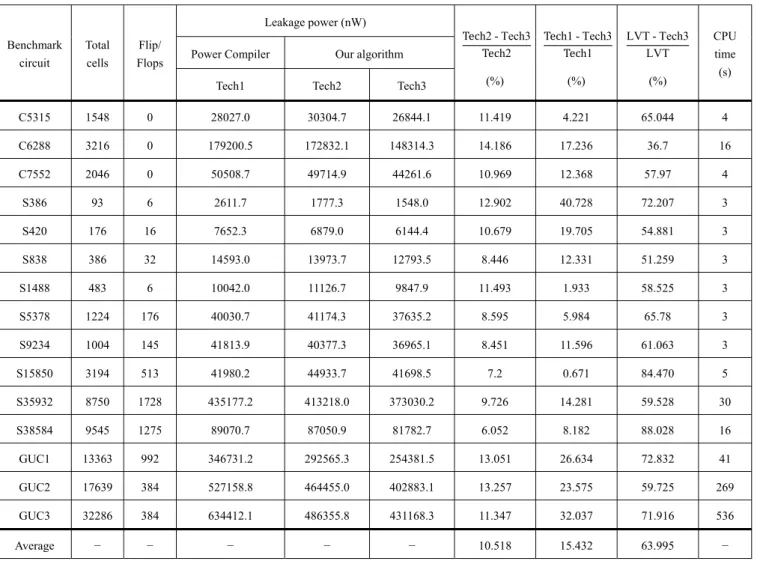
The experimental results are shown in Table I. The Tech1 (column 4) indicates that Synopsys Power Compiler
uses high Vt, normal Vt, and low Vt standard cells and our
HTVSCLs to do leakage power optimization. The Tech2 (column 5) indicates that our program only uses the first procedure of our algorithm to do cell replacement. The Tech3 (column 6) indicates that our algorithm uses both the first procedure and the second procedure to do cell replacement. In the table, LVT indicates that a circuit is synthesized by Design Compiler only using low Vt standard
cells.
In the experiment, Power Compiler uses high Vt,
normal Vt, and low Vt standard cells and our HTVSCLs to
do leakage power reduction and then reports the timing results and the leakage power data. Our program uses our algorithm and HTVSCLs to do cell replacement and then produces a gate level Verilog file. The Verilog file is read
by Design Compiler for reporting the timing data and the
leakage power data. Power Compiler and our program use the same timing constraints when they reduce the leakage power of each benchmark circuit. For each benchmark circuit, there is no timing violation after the cell replacement or circuit optimization in this experiment. The experimental results show that our algorithm can reduce more leakage power than Power Compiler. Moreover, our algorithm does not slow down the performance of the optimized circuit. The second procedure of our algorithm can averagely reduce 10.518% (shown in column 7 of Table I) leakage power of the circuit that has been optimized by the first procedure of our algorithm. Compared with Power
Compiler (shown in column 8 of Table I) and LVT (shown
in column 9 of Table I), our program can save more leakage power.
V. CONCLUSION
The algorithm contains two procedures. The first one is traditional and the second one is new. In the first procedure, the algorithm uses high Vt, normal Vt, and low Vt cells to
do cell replacement. In the second procedure, it employs hybrid threshold voltage standard cell libraries to do cell replacement. The experimental results show that our technique can further reduce the leakage power up to 14.186% by invoking the second procedure after the optimization performed by the first procedure.
REFERENCES
[1] Meeta Srivastav, S.S.S.P. Rao, and Himanshu Bhatnagat, “Power Reduction Technique Using Multi-Vt Libraries,” International
Workshop on System-on-Chip for Real-Time Applications, 2005, pp.
363-367.
[2] Vijay Sundararajan and Keshab K. Parhi, “Low Power Synthesis of Dual Threshold Voltage CMOS VLSI Circuits,” Symposium on
Low Power Electronics and Design, 1999, pp. 139-144.
[3] Liqiong Wei, Zhanping Chen, and Kaushik Roy, “Mixed-Vth (MVT)
CMOS Circuit Design Methodology for Low Power Applications,”
Design Automation Conference, 1999, pp. 430-435.
[4] Mahesh Ketkar and Sachin S. Sapatnekar, “Standy Power Optimization via Transistor Sizing and Dual Threshold Voltage Assignment,” International Symposium on Low Power Electronics
and Design,” 1999, pp. 139-144.
[5] Pankaj Pant, Rabindra K. Roy, and Abhijit Chatterjee, “Dual-Threshold Voltage Assignment with Transistor Sizing for Low Power CMOS Circuits,” IEEE Transactions on Very Large
Scale Integration (VLSI) Systems, 2001, pp. 390-394.
[6] J. Jaffari and A. Afzali-Kusha, “New Dual-Threshold Voltage Assignment Technique for Low-Power Digital Circuits,”
International Conference on Microelectronics, 2004, pp. 413-416.
[7] Yen-Te Ho and Ting-Ting Hwang, “Low Power Design Using Dual Threshold Voltage,” Design Automation Conference, 2004, pp. 205-208.
[8] Frank Sill, Frank Grassert, and Dirk Timmermann, “Low Power Gate-level Design with Mixed-Vth (MVT) Techniques,”
Symposium on Integrated Circuits and Systems, 2004, pp. 278-282.
[9] Frank Sill, Frank Grassert, and Dirk Timmermann, “Reducing Leakage with Mixed-Vth (MVT),” VLSI Design Conference, 2005,
pp. 874-877.
[10] Yu Wang, Huazhong Yang, and Hui Wang, “Signal-Path Assignment for Dual-Vt Technique,” PhD Research in
Microelectronics and Electronics Conference, 2005, pp. 78-81.
[11] Xiaoyong Tang, Hai Zhou, and Prith Banerjee, “Leakage Power Optimization with Dual-Vth Library in High-Level Synthesis,”
Design Automation Conference, 2005, pp. 202-207.
n1
n2
n3
n4
n5
<2,4> [1,1]
[1,2]
[2,1]
<4,6>
[6,7]
<5,6> <2,4>
[9,10]
I1
I2
I3
Z1
g
1g
2A
B Y A
B Y
Time unit: ns
Table I : Experimental results for benchmark circuits
Benchmark circuit
Total cells
Flip/ Flops
Leakage power (nW)
Tech2 - Tech3
Tech2 (%)
Tech1-Tech3
Tech1 (%)
LVT-Tech3 LVT
(%)
CPU time (s) Power Compiler Our algorithm
Tech1 Tech2 Tech3
C5315 1548 0 28027.0 30304.7 26844.1 11.419 4.221 65.044 4 C6288 3216 0 179200.5 172832.1 148314.3 14.186 17.236 36.7 16 C7552 2046 0 50508.7 49714.9 44261.6 10.969 12.368 57.97 4
S386 93 6 2611.7 1777.3 1548.0 12.902 40.728 72.207 3 S420 176 16 7652.3 6879.0 6144.4 10.679 19.705 54.881 3 S838 386 32 14593.0 13973.7 12793.5 8.446 12.331 51.259 3 S1488 483 6 10042.0 11126.7 9847.9 11.493 1.933 58.525 3 S5378 1224 176 40030.7 41174.3 37635.2 8.595 5.984 65.78 3 S9234 1004 145 41813.9 40377.3 36965.1 8.451 11.596 61.063 3 S15850 3194 513 41980.2 44933.7 41698.5 7.2 0.671 84.470 5 S35932 8750 1728 435177.2 413218.0 373030.2 9.726 14.281 59.528 30 S38584 9545 1275 89070.7 87050.9 81782.7 6.052 8.182 88.028 16 GUC1 13363 992 346731.2 292565.3 254381.5 13.051 26.634 72.832 41 GUC2 17639 384 527158.8 464455.0 402883.1 13.257 23.575 59.725 269 GUC3 32286 384 634412.1 486355.8 431168.3 11.347 32.037 71.916 536 Average − − − − − 10.518 15.432 63.995 −