BRAZILIAN JOURNAL OF OCEANOGRAPHY, 52(1):19-34, 2004
DIATOM ASSOCIATIONS IN SHELF WATERS OFF PARANÁ STATE,
SOUTHERN BRAZIL: ANNUAL VARIATION IN RELATION TO
ENVIRONMENTAL FACTORS
Luciano Felício Fernandes1 & Frederico Pereira Brandini2 1
Universidade Federal do Paraná, Departamento de Botânica Setor de Ciências Biológicas, Centro Politécnico
(Caixa Postal 19031 Jardim das Américas, 81531-970, Curitiba, Paraná, Brasil) E-mail: [email protected]
2
Centro de Estudos do Mar, Universidade Federal do Paraná (Av. Beira-mar, s.n., 83255-000, Pontal do Paraná, PR, Brasil)
A
B S T R A C TThe seasonal variation of diatoms in the inshore waters off Paraná State, Southern Brazil was investigated to analyse their temporal dynamics and to detect the main environmental constraints of the planktonic community. Biomass peaks occurred from May to August and from December to March. Among the microplanktonic diatoms, Cerataulina pelagica,
Chaetoceros spp., Dactyliosolen fragilissimus, Guinardia striata, Lauderia annulata,
Leptocylindrus spp., Pseudo-nitzschia cf. delicatissima, P. australis, Rhizosolenia spp.,
Skeletonema costatum and Thalassionema nitzschioides were dominant species.
Nanoplanktonic diatoms were dominated by Naviculaceae, Nitzschia spp., Thalassiosira spp. and Chaetoceros cf. tenuissimus. Concentrations of most of the species decreased during and just after the blooms of Phaeocystis pouchetii in September and of Coscinodiscus wailesii in April. Based on cluster analysis and interpretations of the environmental parameters monitored, six diatom associations were discerned. Four main environmental factors were attributed as the determinants for the grouping: (a) the stronger influence of the tropical oligotrophic waters of the Brazil Current in spring/summer, (b) the alternation between dry and rainy (nutrient-richer) seasons, (c) the influence of subantarctic waters mixed with coastal ones in fall/winter, bringing cold species and promoting the growth of autochthonous species, and (d) the blooms of nanoplanktonic (Phaeocystis) and microplanktonic (C. wailesii) species.
R
E S U M OA variação sazonal das diatomáceas em águas neríticas do estado do Paraná, Sul do Brasil, foi investigada para analisar sua dinâmica temporal e detectar as principais forçantes ambientais da comunidade planctônica. Picos de biomassa ocorreram de Maio a Agosto e de Dezembro a Março. As espécies dominantes foram Cerataulina pelagica, Chaetoceros spp., Dactyliosolen fragilissimus, Guinardia striata, Lauderia annulata, Leptocylindrus spp., Pseudo-nitzschia cf. delicatissima, P. australis, Rhizosolenia spp., Skeletonema costatum e Thalassionema nitzschioides. Representantes de Naviculaceae, Nitzschia spp., Thalassiosira spp. e
Chaetoceros cf. tenuissimus dominaram as diatomáceas nanoplanctônicas. As concentrações da maioria das espécies decresceram durante e logo após as florações de Phaeocystis pouchetii
em Setembro, e de Coscinodiscus wailesii em Abril. Com base na análise de cluster e interpretações dos parâmetros ambientais monitorados, seis associações de diatomáceas foram discernidas. Quatro fatores ambientais principais foram atribuídos como determinantes para o grupamento: (a) influência mais forte de águas oligotróficas da Corrente do Brasil na Primavera/Verão, (b) alternância entre as estações chuvosa (rica em nutrientes) e seca, (c) influência de águas subantárticas enriquecidas misturadas às costeiras no Outono e Inverno, trazendo espécies de águas frias, além de promover o crescimento de autóctones, e (d) florações de espécies nanoplanctônicas (Phaeocystis) e microplanctônicas (C. wailesii).
Descriptors: Bacillariophyta, Diatoms, Phytoplankton, Southern Brazil, Southwestern Atlantic.
I
NTRODUCTIONPhytoplankton studies of South Brazilian waters have documented its composition, distribution, biomass and primary productivity in relation to hydrographic conditions (see review of Brandini et al., 1997 and references therein; Fernandes & Brandini, 1999). As for other investigations carried out in different marine ecosystems around the world, these works have found that diatoms (Bacillariophyta) are responsible for high cell densities and most of the primary productivity. They dominate the phytoplankton community in mid-shelf and coastal regions of southeastern Brazil, gradually diminishing oceanwards, where the relative contribution of dinoflagellates and nanoplankton increases (Brandini & Fernandes, 1996; Brandini et al., 1997). The environmental factors determining the changes in the structure of diatom associations in coastal areas off South Brazil appear to be seasonal fluctuations in the hydrographic regime and land drainage, which affect temperature, salinity and nutrient concentrations (Brandini, 1990). The study region also exhibits a distinctive seasonal oceanographic pattern due to the proximity of the northern limits of the Brazil-Malvinas Confluence Zone, making ecological studies on diatoms more interesting. The Brazil Current transports warm, oligotrophic tropical waters southwards, dominating oceanic and shelf areas. Off Rio Grande State (38-42°S), the tropical waters meet the colder, nutrient-rich waters of the Malvinas Current flowing northwards over the shelf and continental slope of Argentina and Uruguay, which are also greatly affected by freshwater discharges from the La Plata river and the Patos Lagoon (Boltovskoy, 1981; Hubold 1980, 1980a). The influence of the Malvinas Current is stronger in the winter, when the penetration of a tongue of subantarctic waters is regularly detected along the south Brazilian continental shelf (Campos et al., 1996).
The papers on plankton ecology in Brazilian waters describe annual variations in several dominant diatom taxa at the generic level (e. g. Chaetoceros
spp., Nitzschia spp., Thalassiosira spp.), or they are referred to as “centric” and “pennate” diatoms. Few works follow the annual variation of dominant diatoms and discuss the environmental conditions influencing their specific composition (e.g. Valentin
et al., 1986). As a result, the published textbooks on phytoplankton (e. g. Harris, 1986; Smayda, 1980; Werner, 1977) provide limited information on the ecology and biogeography of diatoms over the extensive Brazilian continental shelf.
Many floristic and taxonomic works have been published on the coastal waters off Paraná State, but again not including enough ecological information (see Moreira Filho et al., 1990 for review and list of species). Brandini (1985, 1985a, 1990) described the spatio-temporal dynamics of phytoplankton groups, chlorophyll-a and primary production in oceanic and shelf waters, discussing their association with hydrographic and climatologic regimes.
The present work describes the annual variation of diatom associations at a coastal station off Paraná State, South Brazil, searching for a better understanding of their peak occurrence in relation to the environmental conditions throughout the year.
M
ATERIAL ANDM
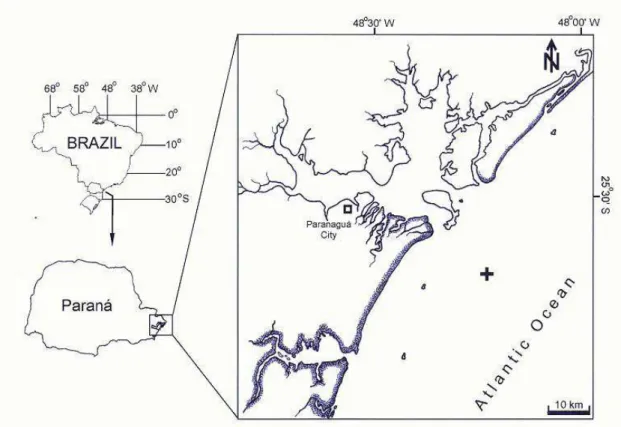
ETHODSThe sampling station was located at 48o15'30"W and 25o37'30"S, 5.4 nautical miles off the entrance of the Bay of Paranaguá, Paraná State, Southern Brazil (Fig. 1). Local depths ranged from 16 to 18 meters, depending on the tidal variation. Water samples were collected every 7-15 days for one year from May 1990 to April 1991, at 0, 2.5, 5, 10 and 15 meters depth, using a 3.5 liters Van Dorn bottle.
Water samples (100 ml) were preserved with buffered formaldehyde solution (0,4%) for diatoms and thecate dinoflagellates; and with Lugol's acetic solution for athecate dinoflagellates and nanoflagellates (Throndsen, 1978). Cell counts were made by allowing 25ml of subsample to settle over 24hs in Utermöhl chambers for inverted microscope analysis (Hasle, 1978). At least 500 individuals of all dominant diatoms were counted, reducing the counting error to 10% (Venrick, 1978). Microplankton and nanoplankton cells were observed at magnifications of 160x and 400x, respectively. Results show average density values of the five depths sampled, except when absolute values for each depth were required. Spectrophotometric measurements of chlorophyll-a were estimated by means of extractions with 90% acetone according to Strickland & Parsons (1972).
FERNANDES & BRANDINI: DIATOM ASSOCIATIONS IN SHELF WATERS OFF PARANÁ STATE, SOUTHERN BRAZIL 33
for the sampling dates (Digby & Kempton, 1987; Krebs, 1989).
Samples for taxonomic analysis of diatoms were obtained by vertical net towing (20 µm mesh) from bottom to surface. Permanent slides were prepared according to Hasle & Fryxell (1970) for species identification with optical (Olympus BX40) and scanning electron (Phillips LX30) microscopes.
Water temperature and salinity, as well as major inorganic nutrients, were measured according to Strickland & Parsons (1972). Water transparency was measured with Secchi disc, and the equation of Holmes (1970) was used to calculate the extension of the euphotic zone. Rainfall and wind data were provided by the meteorological station of the National Institute of Meteorology, Paranaguá City, located about 10 km from our sampling station.
R
ESULTSE
nvironmentalC
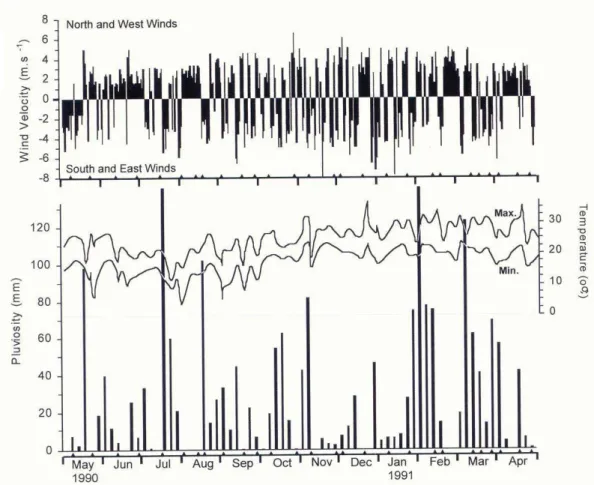
onditionsThe seasonal pattern of precipitation (Fig. 2) was similar to previous years, with rainy periods from January to March, decreasing over the rest of the year, especially in winter, although July also had high values. Win d regime was frequently dominated by moderate (2.1-4.0 m.s-1) northeast winds, and by moderate to strong (4.0-8.3 m.s-1) southeast and east
winds. The latter are the main determinants of the sea and weather conditions over the region. During the period, frequent intrusions of polar air masses invaded the region, sometimes accompanied by strong winds (4.5-7.3 m.s-1). North and west winds were rarely dominant (< 10%) over the study period, at low intensity (less than 2.1 m.s-1).
Fig. 2. Climatological parameters recorded from May/1990 to April/1991 in the study region. Wind velocity (upper panel) is expressed as daily values. North and west wind components were plotted on the positive axis, south and eastcomponents on the negative axis. In the graph for rainfall, values represent the sum of five days.
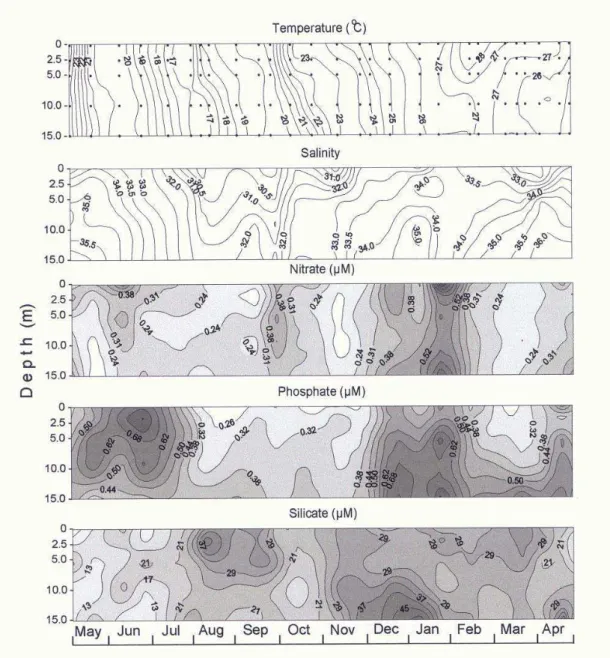
Water temperature (Fig. 3) was usually homogeneous throughout the water column, except from January to March, when thermal stratification occurred near the surface. During winter, temperature varied from less than 17°C to 20°C, gradually increasing to 27°C in summer.
The lowest salinities (Fig. 3) were always recorded at the surface, ranging from 29.5 to 33.5, and increasing to 36.5 near the bottom. From August to December and February to April, salinity stratification was observed in the water column, oscillating between 33.0 and 36.5. In other months, the water column maintained homogeneous, with lower values near the surface.
Nitrate concentrations (Fig. 3) varied from less than 0.20 to 1.02 µM, with higher surface values (>0.50 µM) from May to June, and in the whole water column in January. Nitrite concentrations were very
low, usually below 0.10 µM. Phosphate varied from 0.23 to 1.18 µM, with highest values from May to July (0.39-1.18 µM), in January (0.48-0.81 µM) and in April (0.48-0.68 µM), usually near the bottom. Values were below 0.40 µM from August to early November. Concentrations of silicate varied from 5.5 to 51.9 µM, with highest values occurring from August to early October (20.1-47.3 µM) at the surface, and November to January (23.04-51.9 µM) near the bottom. The lowest values were detected from May to July in the upper 10 meters (5.4-24.2 µM), and in April (12.5-29.2 µM).
FERNANDES & BRANDINI: DIATOM ASSOCIATIONS IN SHELF WATERS OFF PARANÁ STATE, SOUTHERN BRAZIL 33
Fig. 3. Vertical distributions of hydrographic parameters from May/1990 to April/1991 at the sampling station off Paranaguá, Paraná, Brazil. Points (•) on graph of water temperature represent the sampling depths. Vertical distributions of chlorophyll-a and diatom densities
in depth and time
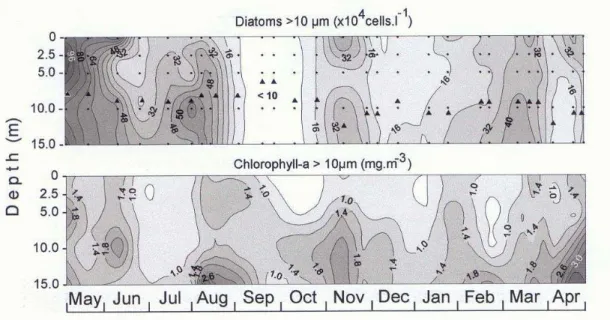
Figure 4 shows the vertical distributions of chlorophyll-a and diatom abundances in the >10 µm size fraction. As a general pattern, chlorophyll-a tended to increase from surface to bottom. High values of chlorophyll were observed throughout the water column during the diatom blooms in May and June (up to 1.2x10⁶ cells.l-1). In August, diatoms were abundant near the bottom. In September, both
Fig. 4. Vertical distributions of microplanktonic diatoms and chlorophyll-a from May/1990 to April/1991 at the sampling station off Paranaguá, Paraná, Brazil. Depth of euphotic zone (1%) is indicated by ( ).
Annual variation of diatoms and other phytoplankton groups in different size classes
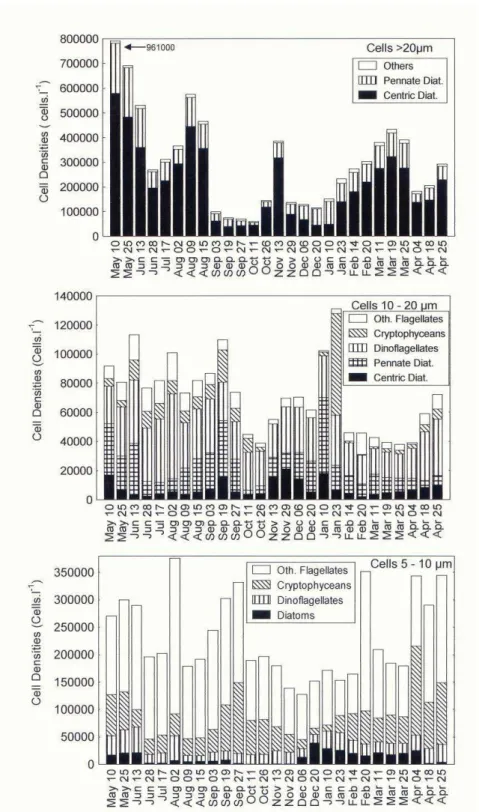
Average densities of microplankton (>20 µm) cells ranged from 6.0x10⁴ to 9.6x10⁵
cells.l-1 (Figs 5 and 6) with diatoms as the dominant group (5.4x10⁴-9.6x10⁵ cells.l-1). They accounted for most of the phytoplankton cells, and should be responsible for the bulk of chlorophyll-a (> 10 µm) concentrations. Diatoms were very abundant
from May to August (2.6x10⁵-9.6x10⁵ cells.l-1), decreasing from September to January 10 (5.5x10⁴ -3.7x10⁵ cells.l-1). From January 23 to March cell densities varied between 1.1x10⁵ cells.l-1 and 4.1x10⁵ cells.l-1. Abundances were low again in April (1.1x10⁵-2.9x10⁵ cells.l-1). In this month, a bloom of Coscinodiscus wailesii (with 290 µm-410 µm valvar diameter and 180 µm-240 µm pervalvar axis) occurred, reaching densities up to 5.6x10³ cells.l-1.
FERNANDES & BRANDINI: DIATOM ASSOCIATIONS IN SHELF WATERS OFF PARANÁ STATE, SOUTHERN BRAZIL 33
The nanoplankton (2-20 µm) was studied in three size classes. In the 10-20 µm size class (Figs 5 and 6) diatoms were also important (9.4x10³ - 7.4x10⁴ cells.l-1), the highest values being detected on May 10, September 19, and January 10. Centric diatoms varied from 2.1x10³ to 3.8x10⁴ cells.l-1 , and pennate diatoms from 5.2x10³ to 5.2x10⁴ cells.l-1,
mainly epiphytic on chain-forming species of
Bacteriastrum spp. and Chaetoceros spp..
Thalassiosira spp. (4 species), Nitzschia spp. (3 species) and two non-identified species of Naviculaceae were often present. In the 5-10 µm size class (Figs 5 and 6), diatoms were poorly represented ranging from less than 1.0x10³ to 3.9x10⁴ cells.l-1, with peaks in May, June, December and January. Identification of species with light microscopy was difficult, but pennate diatoms resembling Nitzschia and Fragilaria, and the small species Chaetoceros cf. tenuissimus (4-6 µm) were frequently observed. Phytoflagellates and gymnodiniaceans were dominant, occurring at densities between 1.4x10⁵ and 3.7x10⁵ cells.l-1. In the 2-5 µm size class (Fig. 5), the contribution of diatoms was low (less than 4.0x10⁴ cells.l-1). Phytoflagellates dominated, with 8.7x10⁴ to 8.6x10⁵ cells.l-1. From August to September, a bloom of Phaeocystis pouchetii in gelatinous colonies (up to 6.1x10⁵ to 1.0x10⁶ cells.l-1 near the surface) occurred. From October to April, flagellate densities tended to diminish, varying between 8.7 x 10⁴ cells.l-1 and 3.1x10⁵ cells.l-1, and the lowest values were detected in April, during the bloom of C. wailesi.
Annual variation of abundant species and groups of diatoms
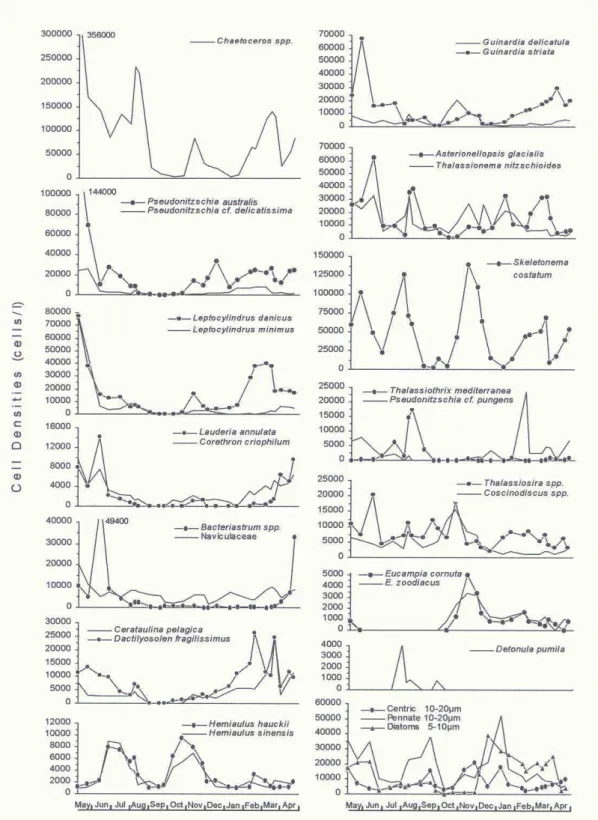
The bulk of the diatom biomass was made up of chain-forming species. Figure 7 shows the annual variation of cell densities (averaged from the five depths sampled) of 27 abundant species or higher taxonomic groups. Two prominent growth episodes (May-August and January-March) were detected (confirmed by Cluster analysis), when Cerataulina pelagica, Chaetoceros spp., Dactilyosolen fragilissimus, G. striata, Lauderia annulata,
Leptocylindrus spp., Pseudo-nitzschia spp. and
Rhizosolenia spp. (mainly R. hebetata followed by R. calcaravis, R. setigera and R. styliformis) dominated. Between these periods, total cell densities tended to decrease, mainly in September, October, January and April. Skeletonema costatum and Thalassionema nitzschioides showed irregular peaks along the study period. In some months, Thalassiosira spp. (May to
August), Hemiaulus spp. (June to August and October to November), Eucampia spp. (November and December) and Coscinodiscus spp. (May, August and October) were important. Large species of
Coscinodiscus were abundant in October and November (C. oculus-iridis and C. centralis) and in April (C. wailesii).
Some additional comments about the dominant species within the taxonomic categories represented in the Figure 7 are given. Within
Chaetoceros, the most abundant species were C.
affinis, C. compressus, C. curvisetus, C. debilis and
C. didymus. The genus Guinardia was composed of
G. delicatissima and G. striata. B. delicatulum and B. hyalinum composed the genus Bacteriastrum. In “Naviculaceae”, a broader taxon composed of many species; Navicula spp. and Mastogloia spp. were abundant, as planktonic and benthic forms.
C
LUSTERA
NALYSISFERNANDES & BRANDINI: DIATOM ASSOCIATIONS IN SHELF WATERS OFF PARANÁ STATE, SOUTHERN BRAZIL 33
The cluster analysis of sampling dates/cell densities (Fig. 8b) indicated the main environmental factors acting over the region. Group I represented periods of low diatom densities under low nutrient levels due to the stronger influence of oligotrophic waters of the Brazil Current, and when the blooms of
Phaeocystis and C. wailesii occurred. Group II
probably represents periods of intermediate or diverse environmental conditions, when different stages of diatom growth took place. Groups III and IV were influenced by the higher abundance of dominant species, resulting from the presence of enriched subantarctic waters from May to early August, and the more intense land drainage in March.
FERNANDES & BRANDINI: DIATOM ASSOCIATIONS IN SHELF WATERS OFF PARANÁ STATE, SOUTHERN BRAZIL 33
N
ETP
LANKTONSome observations were made on the composition of net plankton diatoms, and Appendix I shows the species found in the present study. A mixed flora of warm and temperate planktonic neritic species formed the majority of the community, and their abundance varied depending upon water mass. During spring and summer, species typical of warm waters appeared frequently, e. g. Climacodium frauenfeldianum, Coscinodiscus centralis, C. gigas,
Eucampia spp., Hemiaulus membranaceus,
Stephanopyxis turris and, rarely, Gossleriella tropica
and Planktoniella sol. In addition, the coccolithophorid Umbilicosphaera sibogae and other tropical/subtropical species of dinoflagellates such as
Ceratium azoricum, C. vultur, Corithodinium tesselatum, Podolampas bipes, P. elegans, and
Schuttiella mitra were recorded. In winter, cold water species such as Asteromphalus hookerii, Lauderia annulata, Rhisozolenia setigera, Detonula pumila,
Thalassiothrix frauenfeldii, Thalassiosira nodulolineata, T. poroseriata and T. tumida were frequent. Uncommon diatoms in Brazilian waters were Anorthoneis eurystoma, Asteromphalus arachnae, Asteromphalus sarcophagus,
Bacteriastrum comosum, Minidiscus chilensis and
Porosira pentaportula.
Besides planktonic species, many benthic diatoms were identified in the water column, and were even abundant occasionally. These included
Achnanthes sp., Anorthoneis eurystoma, Cyclotella stylorum, Delphineis surirella, Mastogloia spp.,
Paralia sulcata, Rhaphoneis amphiceros and
Thalassiosira spp. (valvar diameters ranging from 10 to 20 µm). The latter are quite similar to those found in groups of three to eight cells aggregating small sand grains (Ernissee & Abbott, 1975). These benthic species and other dominant tychoplanktonic species as Chaetoceros spp. and T. nitzschioides clearly indicate the bottom influence.
D
ISCUSSIONThe dominance of diatoms within coastal phytoplankton assemblages reflects the physical instability of shallow coastal environments. Turbulence tends to maintain the vertical homogeneity of physical and chemical parameters, maintaining high nutrient concentrations in the euphotic zone due to the ressuspension of sediments (Smetacek, 1985; 1988). In addition, turbulence tends to retard the sinking of species out of the euphotic zone, while land drainage continuously enriches the
neritic region and decreases salinity, favoring diatom growth (Margalef, 1978; Smayda, 1980).
In the present study, microplanktonic diatoms were always the dominant autotrophs, occurring at 4-10 fold higher densities than other groups during the period, except during the period of low biomass in September and October, when nanoplankton dominated. Diatoms also tended to contribute more with chlorophyll-a biomass than the nanoplankton fraction, except in September and October, when a bloom of Phaeocystis pouchetii dominated the phytoplankton, and under the stronger influence of tropical waters carried in the region by the Brazil Current from November to February. Diatoms were also the main primary producers in adjacent areas near our sampling station (Brandini, 1990; 1990a). Their dominance is also reflected in the higher trophic levels, as they represent the principal diet of the dominant copepods (Acartia lilljeborgii,
Corycaeus spp., Oncaea spp., Paracalanus quasimodo, Temora turbinata) in the region, which are large omnivorous or herbivorous grazing on microsize particles (Lopes et al., 1998).
As a general pattern, neritic subtropical diatoms dominated throughout the year, under the influence of the Brazil Current and land drainage. However, colder subantarctic waters and blooms of different algal groups also affected the composition and the overall densities of microphytoplankton. May to August comprised the largest diatom pulses, representing Groups E and F from the cluster analysis, dominated by Asterionellopsis glacialis,
Chaetoceros spp., Guinardia striata, Leptocylindrus
The decrease in diatoms between September and early January (except for the isolated peak in November 13) could be associated with the lower availability of silicate due to uptake during fall/winter blooms. Moreover, precipitation was low compared to other months, diminishing the input of nutrients via land runoff. Cell densities decreased and only
Guinardia delicatula, Detonula pumila,
Thalassionemanitzschioides and some Naviculaceae were abundant. In contrast, a bloom of Phaeocystis pouchetii took place in September, just after the diatom bloom. As for the seasonal phytoplankton succession observed in the North Sea over the last decades, Phaeocystis becomes dominant after silica depletion and aging of the diatom blooms (Lancelot
et al., 1991). In the North Sea such community replacement has been associated with increasing organic pollution, resulting in changes of nutrients and N/P ratios (Riegmann et al., 1992). However, this is not the case on the Paraná coast, where pollution is of minor importance as a factor regulating phytoplankton succession.
Diatom abundance again increased from January 23 to March, when nutrient concentrations near the surface were elevated, due to higher precipitation and concomitant land drainage. In this period, Asterionellopsis glacialis, Cerataulina pelagica, Chaetoceros spp., Dactilyosolen fragilissimus, Guinardia striata, Leptocylindrus danicus, Pseudo-nitzschia spp. and Skeletonema costatum dominated the diatom community. The less pronounced development of diatoms in summer/early fall compared to late fall/winter could be due to the stronger coastward displacement of the oligotrophic Brazil Current waters, mixing with shelf waters (Emílsson, 1960; Brandini, 1990) and diluting nutrients to some extent. The presence of warm-species and higher salinities (up to 35.0) compared to other periods, confirm the influence of tropical waters in the study area. For comparison, near our sampling station in the mesohaline estuarine waters of Paranaguá Bay, the highest phytoplankton biomass occurred during the rainy period from January to March, when nutrient input via land runoff increased. In contrast to our findings, Skeletonema costatum
dominated the community (up to 4.7x10⁶ cells.l-1) in
the Bay, accounting for more than 90% of total densities (Brandini, 1985; 1985a).
The bloom of Coscinodiscus wailesii was another important event affecting phytoplankton community structure during April 1991, when densities of diatoms and other phytoplankton groups had fallen, and even zooplankton was almost absent (L. F. Fernandes and R. M. Lopes, unpublished data). Chlorophyll-a concentration was high, due to the large volume of C. wailesii cell, associated to its
chlorophyll-a content. This bloom persisted until November 1991, and the species became common at Paranaguá Bay in the following years (Fernandes et al., 2001). Despite its large size, this species is fast growing, highly competitive for nutrients, eurioic and inefficiently grazed or even avoided by copepods (Rick & Dürselen, 1995; Roy et al., 1989). All these factors help to explain why C. wailesii has been successful worldwide after invading turbulent coastal waters .
High nutrient concentrations were frequently recorded at 10-15 meters in association with the occurrence of large populations of benthic and tychoplanktonic diatoms. Based on indirect evidence, it seems reasonable that ressuspension of bottom sediments through tidal mixing and wind driven turbulence is responsible for the contribution of benthic diatoms and nutriente regeneration. Studies in coastal areas with similar characteristics have shown that the benthic community is responsible for the regeneration of nutrients to the water column through turbulence (Doering, 1989; Flint & Kamiakowski, 1983; Zeitschel, 1980). Other positive effects of turbulence on the diatom communities inhabiting the study region are: (i) the maintenance of abundant species in the water column, avoiding their sinking to a permanently aphotic zone; and (ii) the ressuspension of resting cysts and of tychoplanktonic forms such as Chaetoceros (Margalef, 1978; Smetacek, 1985) that are frequently dominant in the study region, allowing completion of their life-cycles.
A
CKNOWLEDGEMENTSWe thank CNPq (research grant to L.F.F.) and Centro de Estudos do Mar/UFPR for providing financial support and laboratory facilities. Jaqueline Rebello analyzed most of nutrient samples. We are indebted to Dr. Daura R. Stofella (Centro de Microscopia Eletrônica/UFPR) and Paulo Brixel (LACTEC/Paraná) for the assistance with the scanning electron microscope. This work is part of a MSc. Thesis in Botany, UFPR.
R
EFERENCESBoltovskoy, E. 1981. Masas de água en el Atlantico Sudoccidental. In: Boltovskoy, D. ed. Atlas del Zooplancton del Atlântico Sudoccidental y metodos de trabajo con el zooplancton marino. Mar del Plata, Publ esp INIDEP. p. 227-238.
Brandini, F. P. 1985. Seasonal succession of the phytoplankton in the bay of Paranaguá (Paraná state - Brazil). Rev. brasil. Biol., 45(4):687-694.
FERNANDES & BRANDINI: DIATOM ASSOCIATIONS IN SHELF WATERS OFF PARANÁ STATE, SOUTHERN BRAZIL 33
Brandini, F. P. 1990. Hydrography and characteristics of the phytoplankton in shelf and oceanic waters off southeastern Brazil during winter (july/august-1982) and summer (February/March-1984). Hydrobiol., 196(2):111-148.
Brandini, F. P. 1990a. Produção primária e características fotossintéticas do fitoplâncton na região Sueste do Brasil. Bolm. Inst. oceanogr., S Paulo, 38(2):147-159.
Brandini, F. P. & Fernandes, L. F. 1996. Microalgae of the continental shelf of Paraná State, southern Brazil: review of studies. Bolm. Inst. oceanogr., S. Paulo, 44(1):69-80.
Brandini, F. P.; Lopes, R. M.; Gutseit, K. S.; Spach, H. L. & Sassi, R. 1997. Planctonologia na plataforma continental do Brasil. Diagnose e revisão bibliográfica. Brasília, Ministério do Meio Ambiente/CIRM/FEMAR. 196p. Campos, E. J. D.; Lorenzzetti, J. A.; Stevenson, M. R.; Stech,
J. L. & Souza, R. B. 1996. Penetration of waters from the Brazil-Malvinas Confluence region along the South American continental shelf up to 23ºS. An. Acad. Bras. Ci., 68 (Suppl. 1):49-58.
Ciotti, A. M.; Odebrecht, C.; Fillmann, G. & Möller Jr, O. 1995. Freshwater outflow and Subtropical Convergence influence on phytoplankton biomass on the southern Brazilian continental shelf. Continent. Shelf Res., 15(14):1737-1756.
Digby, P. G. N. & Kempton, R. A. 1987. Multivariate analysis of ecological communities. London, Chapman and Hall. 450p.
Doering, E. G. 1989. On the contribution of the benthos to pelagic production. J. Mar. Res., 47(2):371-383. Emílsson, I. 1960. The shelf and coastal waters off the
Southern Brazil. Bolm. Inst. oceanogr., S Paulo, 11(único):101-112.
Ernissee, J. J. & Abbott, W. H. 1975. Binding of mineral grains by a species of Thalassiosira. Nova Hedwigia, Beih., 53:241-252.
Fernandes, L.F. & Brandini, F.P. 1999. Microplankton communities in Southwestern Atlantic Ocean: biomass and distribution in November 1992. Rev. bras. oceanogr., 47(2):189-205.
Fernandes, L. F.; Zehnder-Alves, L. & Bassfeld, J. C. 2001. The recently established diatom Coscinodiscus wailesii (Coscinodiscales, Bacillariophyta) in Brazilian waters. I. Remarks on morphology and distribution. Phycological Res., 49:89-96.
Flint, R. W. & Kamiakowski, D. 1984. Benthic nutrient regeneration in South Texas coastal waters. Estuar. Coast. Shelf Sci., 18(2):221-230.
Harris, G. P. 1986. Phytoplankton ecology: structure, function and fluctuation. New York, Chapman and Hall. 384p.
Hasle, G. R. 1978. Using the inverted microscopy. In: Sournia, A., ed. Phytoplankton manual. Monogr. Oceanogr. Methodol, U.N. 6:191-196.
Hasle, G. R. & Fryxell, G. A. 1970. Diatoms: cleaning and mounting for light and electron microscopy. Trans. Am. Microsc. Soc., 89:469-474.
Holmes, R. W. 1970. The Secchi disk in turbid coastal waters. Limnol. Oceanogr., 15:688-694.
Hubold, G. 1980. Hydrography and plankton off Southern Brazil and Rio de la Plata: august-november 1977. Atlantica, 4:1-21.
Hubold, G. 1980a. Second report on Hydrography and plankton off Southern Brazil and Rio de la Plata: autumn cruise: april-june 1978. Atlantica, 4:23-42. Krebs, C. J. 1989. Ecological methodology. New York,
Harper Collins Publ. 850p.
Lancelot, C.; Billen, G. & Barth, H. 1991. The dynamics of Phaeocystis blooms in nutrient enriched coastal zones. Water Pollut., Res. Rep., 23:1-116.
Lange, C.B. 1985. Spatial and seasonal variations of diatom assemblages off the argentinan coast (South Western Atlantic). Oceanol. Acta, 8:361-369. Lopes, R. M.; Vale, R. & Brandini, F. P. 1998.
Composição, abundância e distribuição espacial do zooplâncton no complexo estuarino de Paranaguá durante o inverno de 1993 e o verão de 1994. Rev. bras. oceanogr. 46(2):195-211.
Margalef, R. 1978. Life-forms of phytoplankton as survival alternatives in unstable environments. Oceanol. Acta, 1:493-509.
Moreira-Filho, H.; Valente-Moreira, I. M.; Souza-Mosimann, R. M. & Cunha, J.A. 1990. Avaliação florística e ecológica das diatomáceas (Chrysophyta-Bacillariophyceae) marinhas e estuarinas nos estados do Paraná, Santa Catarina e Rio Grande do Sul. Est. Biologia (PUC), 25:5-48.
Rick, H. J. & Dürselen, C. D. 1995. Importance and abundance of the recently established species
Coscinodiscus wailesii Gran et Angst in the German Bight. Helgolander Meeresunters., 49: 355-74. Riegmann, R.; Noordeloos, A. A. M. & Cadée, G. C.
1992. Phaeocystis blooms and eutrophication of the coastal zones of the North Sea. Mar. Biol., 112(3):479-484.
Roy, S.; Harris, R. P. & Pulet, S. A. 1989. Inneficient feeding by Calanus helgolandicus and Temora longicornis on Coscinodiscus wailesii: quantitative estimation using chlorophyll-type pigment and effects on dissolved free amino acids. Mar. Ecol. Prog. Ser., 52:145-53.
Smayda, T. 1980. Phytoplankton species succession. In: Morris, I. ed. The physiological ecology of phytoplankton. Studies in ecology 7. Oxford Blackwell Scient. Publ. p. 493-570.
Smetacek, V. S. 1985. Role of sinking in diatom life-history cycles: ecological, evolutionary and geological significance. Mar. Biol., 84:239-251. Smetacek, V. S. 1988. Plankton characteristics. In:
Postma, H. & Zijlstra, J. J. eds. Ecosystems of the world, Continental shelves, v. 27 Amsterdan, Elsevier. p. 93-130.
Strickland, J. D. H. & Parsons, T. R. 1972. A pratical handbook of seawater analysis. Bull. Fish. Res. Bd. Can., 122:1-172.
Valentin, J. L.; Lins da Silva, N. M.; Monteiro-Ribas, W. M.; Mureb, M. A.; Bastos, C. T. B. T.; Tenembaum, D. R.; André, D. L.; Jacob, S. A. & Pessotti, E. 1986. Le plancton dans l’upwelling de Cabo Frio (Brésil): microrépartition spatio-temporale à une station fixe. Ann. Inst. océanogr., Paris, Nouv. Serv., 62:117-135. Venrick, E.L. 1978. How many cells to count? In: Sournia, A.
ed. Phytoplankton manual. Monogr. oceanogr. Methodol., V.N., 6:167-180.
Werner, D. ed. 1977. The biology of diatoms. Ecolog. Monogr., 13. Los Angeles, University of California Press. 498p.
Zeitschel, B. 1980. Sediment-water interactions. In: Tenore, K. R. & Coull, B. C. eds. Marine benthic dynamics. South Carolina, University of South Carolina Press. p. 195-218.
FERNANDES & BRANDINI: DIATOM ASSOCIATIONS IN SHELF WATERS OFF PARANÁ STATE, SOUTHERN BRAZIL 33
Appendix 1. Diatom taxa recorded during the sampling period in the coastal station off Paranaguá, Paraná, Southern Brazil.
Achnanthes curvirostrum Brun Cocconeis scutellum Ehrenberg
Achnanthes fimbriata (Grunow) Ross Corethron criophilum Castracane
Achnanthes sp. Coscinodiscus asteromphalus Ehrenberg
Actinocyclus ehrenbergii Ralfs Coscinodiscus centralis Ehrenberg
A. ehrenbergii var. ralfsii (Wm.Smith) Hustedt Coscinodiscus curvatulus Grunow
Actinoptychus campanulifer A. Schmidt Coscinodiscus gigas Ehrenberg
Actinoptychus undulatus (Bailey) Ralfs Coscinodiscus granii Gough
Actinoptychus vulgaris Schumann Coscinodiscus jonesianus (Greville) Ostenfeld
Amphiprora alata (Ehrenberg)Kutzing Coscinodiscus kutzingii A. Schmidt
Amphiprora gigantea Grunow Coscinodiscus obscurus A. Schmidt
Amphiprora sp. Coscinodiscus oculus-iridis Ehrenberg
Amphora arenaria Donkin Coscinodiscus rothii (Ehrenberg) Grunow
Amphora spp. Coscinodiscus wailesii Gran and Angst
Anorthoneis eurystoma Cleve Coscinodiscus spp. Asterionellopsis glacialis (Castracane) F.E. Round Cyclotella litorallis Lange & Syvertsen
Asteromphalus arachne (Brébisson) Ralfs Cyclotella stylorum Brightwell
Asteromphalus heptactis (Brebisson) Ralfs Cylindrotheca closterium (Ehrenberg) Reimer
Asteromphalus hookerii Ehrenberg Cymatodiscus planetophorus (Meister) Hendey
Asteromphalus sarchofagus Wallich Cymatonitzschia marina (Lewis) Simonsen
Bacillaria paradoxa Gmelin Cymatotheca weissflogii (Grunow) Hendey
Bacteriastrum comosum Pavillard Dactyliosolen fragilissimus (Bergon) Hasle
Bacteriastrum delicatulum Cleve Dactyliosolen mediterraneus H. Peragallo
Bacteriastrum hyalinum Lauder Delphineis surirella (Grunow) Andrews
B. hyalinum var. princeps (Castracane) Ikari D. surirella var. australis (Grunow) Andrews
Bacteriastrum varians Lauder Dimerogramma marinum (Gregory) Ralfs
Biddulphia longicruris Greville Dimerogramma minor (Gregory) Ralfs
Biddulphia rhombus (Ehrenberg) W. Smith Diploneis bombus Ehrenberg
Biddulphia tridens (Ehrenberg) Ehrenberg Diploneis crabro (Ehrenberg) Ehrenberg
Campylodiscus ecclesianus Greville Diploneis smithii (Brebisson) Cleve
Campylosira cymbeliformis (A. Schmidt) Grunow Diploneis weissflogii (A. Schmidt) Cleve
Cerataulina pelagica H. Peragallo Diploneis sp.
Chaetoceros affinis Lauder Ditylum brightwellii (West) Grunow
Chaetoceros coarctatus Lauder Donkinia reta (Cleve) Cox
Chaetoceros compressus Lauder Eucampia cornuta (Cleve) Grunow
Chaetoceros costatum Pavillard Eucampia zoodiacus Ehrenberg
Chaetoceros curvisetum Cleve Fragilariopsis doliolus (Wallich) Medlin and Sims
Chaetoceros danicus Cleve Grammatophora marina (Lyngbie) Kutzing
Chaetoceros debilis Cleve Guinardia delicatula (Cleve) Hasle
Chaetoceros decipiens Cleve Guinardia flaccida (Castracane) Peragallo
Chaetoceros didymus Ehrenberg Guinardia striata (Stolterfoth) Hasle
Chaetoceros diversus Cleve Gyrosigma balticum (Ehrenberg) Rabenhorst
Chaetoceros eibenii (Grunow) Meister Gyrosigma exoticum Cholnoky
Chaetoceros laevis Leuduger-Fortmorel Gyrosigma scalproides (Rabenhorst) Cleve
Chaetoceros lauderi Ralfs Hemiaulus hauckii Grunow
Chaetoceros lorenzianus Grunow
Hemiaulus membranaceus
Cleve
Chaetoceros messanensis Castracane
Hemiaulus sinensis
Greville
Chaetoceros pendulus KarstenHemidiscus cuneiformis
Wallich
Chaetoceros peruvianus BrightwellLauderia annulata
Cleve
Cont. Appendix 1.
Climacodium frauenfeldianum Grunow
Licmophora abreviata
Agardh
Licmophora clevei Hustedt Proboscia alata (Brightwell) Sündstrom
Lithodesmium undulatum Ehrenberg Psamodycton panduriforme (Grunow) D.G.Mann
Lyrella abruptoides (Hustedt) D.G. Mann Pseudo-nitzschia australis Frenguelli
Lyrella barbara (Heiden and Kolbe) D.G. Mann Pseudo-nitzschia cf. delicatissima (Cleve) Heiden
Lyrella hennedyi (Wm. Smith) Stickle and Mann Pseudo-nitzschia pungens (Grunow ex Cleve) Hasle
Lyrella lyra (Ehrenberg) D.G. Mann Pseudosolenia calcar-avis ( Schultze) Sündstrom
Margaritum terebro (Leuduger F.-Morel) H. Moreira
Rhaphoneis amphiceros (Ehrenberg) Cleve
Mastogloia acutiuscula Grunow Rhizosolenia hebetata Gran
Mastogloia angulata Lewis Rhizosolenia pungens Cleve-Euler
Mastogloia apiculata Wm. Smith Rhizosolenia robusta Norman
Mastogloia decussata Grunow Rhizosolenia setigera Brightwell
Mastogloia exigua Lewis Rhizosolenia styliformis Brightwell
Mastogloia meisterii Hustedt Detonula pumila (Castracane) Gran
Mastogloia pumilla (Grunow) Cleve Skeletonema costatum (Greville) Cleve
Mastogloia spp. Stauropsis membranacea (Cleve) Meunier
Minidiscus chilensis Rivera and Koch Stephanopyxis palmeriana (Grev.) Grunow
Navicula crucicula (Wm. Smith) Donkin Stephanopyxis turris (Greville) Ralfs
Navicula pennata A. Schmidt Streptotheca tamensis Schrub
Navicula yarrensis Grunow Surirella fastuosa Ehrenberg
Navicula spp. (4 species) Synedra sp. Nitzschia longissima (Brebisson) Ralfs Thalassionema nitzschioides Grunow
Nitzschia ventricosa Kitton Thalassiosira anguste-lineata (Schmidt) Fryxell and Hasle
Nitzschia spp. Thalassiosira decipiens (Grunow) Jorgensen
Odontella aurita (Lyngbie) Simonsen Thalassiosira eccentrica (Ehrenberg) Cleve
Odontella mobiliensis (Bailey) Simonsen Thalassiosira gravida Cleve
Odontella sinensis (Greville) Simonsen Thalassiosira leptopus Jouse
Odontella sp. Thalassiosira nanolineata (Mann) Fryxell
Palmeria hardmaniana Greville Thalassiosira nodulolineata (Hasle) Hasle and Fryxell
Paralia sulcata (Ehrenberg) Kutzing Thalassiosira oestrupii (Ostenfeld) Hasle
Parlibellus hagelsteinii (Hustedt) E. J. Cox Thalassiosira poroseriata (Ramsf.) Hasle
Parlibellus tubulosus (Grunow) E. J. Cox Thalassiosira punctigera (Castracane) Hasle
Petrodycton gemma (Ehrenberg) D.G. Mann Thalassiosira rotula Meunier
Petroneis marina (Ralfs) D.G. Mann Thalassiosira simonsenii Hasle and Fryxell
Plagiogramma staurophorum (Gregory) Hendey Thalassiosira subtilis (Ostenfeld) Gran
Plagiotropis sp Thalassiosira tumida (Janisch) Hasle Pleurosigma diversestriatum Meister Thalassiosira spp.
Pleurosigma formosum Wm.Smith Thalassiothrix frauenfeldii Grunow
Pleurosigma intermedium Wm. Smith Thalassiothrix mediterranea Cupp
Pleurosigma sp. Thalassiosira spp. Podocystis adriatica Kutzing Thalassiothrix frauenfeldii Grunow
Podosira stelliger (J.W. Bailey) Mann Thalassiothrix mediterranea Cupp