Article
J. Braz. Chem. Soc., Vol. 27, No. 1, 144-152, 2016. Printed in Brazil - ©2016 Sociedade Brasileira de Química 0103 - 5053 $6.00+0.00
A
*e-mail: [email protected]
Magnetic Nanoparticles Coated with Ionic Liquid as a Sorbent for Solid Phase
Extraction of Chromium(VI) Prior to Its Determination by Electrothermal Atomic
Absorption Spectrometry
Mehdi Karimi, Ali M. H. Shabani and Shayessteh Dadfarnia*
Department of Chemistry, Faculty of Science, Yazd University, 89195-741 Yazd, Iran
A simple, sensitive and reliable method for the separation, preconcentration and determination of ultra trace amounts of chromium species has been developed. Chromium(VI) in aqueous sample was reacted with 9-phenyl-2,3,7-trihydroxy-6-fluorone to produce a chelate at pH of 5.0 and extracted onto the magnetic nanoparticles coated with the ionic liquid 1-hexadecyl-3-methylimidazolium bromide. The trapped analyte was back extracted using 350 µL of nitric acid solution (2 mol L-1) and was determined by electrothermal atomic absorption spectrometry.
Total chromium was determined by oxidizing CrIII to CrVI using KMnO
4 in acidic media. Under
the optimum conditions, the method exhibited a linear dynamic range of 0.01-0.50 µg L-1 with
an enhancement factor of 112 and a detection limit of 0.003 µg L-1 for CrVI. The coefficient of
variation (n = 6) at 0.3 µg L-1 concentration level of CrVI was 3.2%.
Keywords: chromium speciation, electrothermal atomic absorption spectrometry, ionic liquid, solid phase extraction, magnetic nanoparticle
Introduction
The toxicity, reactivity and biological properties of chromium depend on its chemical form. Chromium is found in two most stable oxidation states of CrIII and CrVI. CrIII
is considered as inevitable for the metabolism of glucose, lipid and protein in living organisms whereas CrVI as a
strong oxidizing agent, is dangerous to human health and can affect lungs, liver and kidneys.1-4 The concentration of
CrIII and CrVI in human serum of a normal healthy person is
in the range of 0.52-0.66 and 0.22-0.82 µg L-1 respectively,1
but the level of chromium in the serum of diabetic person is lower. Thus, from medical point of view, accurate and precise determination of chromium in biological sample including human serum is important. Chromium is also known as a major water pollutant.5 The United States
Environmental Protection Agency (USEPA) has set a total concentration of 0.1 mg L-1 chromium in drinking water as
the maximum allowable contaminant level whereas World Health Organization (WHO) states the guideline values of 50 µg L-1 CrVI.6 Consequently, the development of an
accurate, easy and sensitive method for the determination of chromium species in environmental waters and biological samples is an attractive task in analytical chemistry.
Various analytical techniques such as atomic absorption spectrometry (AAS),7-9 spectrophotometry,10 inductively
coupled plasma mass spectrometry (ICP-MS),11-13 X-ray
fluorescence (XRF) spectrometry14 and inductively
coupled plasma optical emission spectrometry (ICP OES)15
have been used for the determination of chromium in different samples. However, these methods only measure the total chromium amount. Thus, due to the presence of low level of chromium in real samples, complexity of the matrices and the importance of measurement of chromium species, a separation and preconcentration step prior to its determination is often a necessary step. Procedures reported in the literature for the speciation of chromium are generally liquid-liquid extraction (LLE),16 solid phase extraction (SPE),17-19
cloud point extraction (CPE),1,20 hollow fiber liquid phase
microextraction (HF-LPME),21 dispersive liquid-liquid
microextraction (DLLME),22-24 solidified floating
organic drop microextraction (SFODME),25 capillary
electrophoresis26 and electrochemical methods.27 Among
these methods, SPE is the widely utilized technique for the separation and preconcentration of metal ions due to its simplicity, selectivity, flexibility, low cost, safety, ease of automation and possibility of obtaining high preconcentration factor.28-31 However, the nature of sorption
determines the analytical sensitivity, affinity, capacity and repeatability of the method. The most important sorbents used in the SPE procedures for speciation of chromium are Ambersorb 563 resin,17 activated carbon,32 cellulose5 and
TiO2.33 In SPE methods, the extraction is often performed
either in batch or in column modes. However, when the extraction is done in the batch mode, separation of traditional sorbent from the sample is difficult and time consuming, whereas, in column mode, the flow rate of sample through the column is limited and thus, for obtaining a high preconcentration factor (PF) the passage of large volume of sample through the column is tedious. Magnetized sorbents are promising substitute for traditional sorbents as the enrichment process can be shortened through their rapid isolation using a strong magnet.34-36 Magnetic nanoparticles
(MNPs) with the large and high surface area make it possible to obtain high PF from smaller sample volume. However, the basic disadvantage of bare MNPs is the lack of the selectivity for target analyte. To overcome this problem, magnetic nanoparticles can be modified with different organic ligands,37 imprinted polymers38 and surfactants.39
Recently, ionic liquids (ILs) have attracted the analytical chemists as a new class of coating materials in SPE.40,41 ILs are organic salts of organic cations paired
with inorganic or organic anions with melting points often less than 100 °C. The physical properties of ILs such as, viscosity, thermal stability, solvent miscibility, vapor pressure, and chemical functionality are tunable which make them a useful class of coating materials for SPE and SPME sorbents.29-31,42,43
However, according to our literature survey the use of ILs for coating the nanoparticles are still in its infancy state. In 2011, Absalan et al.44 coated MNPs with IL
(1-hexyl-3-methylimidazolium bromide) and use it as the sorbent for removal of reactive red-120 and 4-(2-pyridylazo)resorcinol from aqueous samples. In 2012, Farahani et al.30 deposited
hydrophobic IL (1-hexyl-3-methylimidazoliumhexafluorop hosphate) on the surface of magnetic nanoparticles and used it for SPE of lead and cadmium. In 2013, Amjadi et al.29
used modified IL-coated TiO2 nanoparticles as a new solid
phase extraction sorbent for preconcentration of trace nickel. In this study, the sorption/desorption possibility of CrVI-9-phenyl-2,3,7-trihydroxy-6-fluorone complex onto
the MNPs coated with 1-hexadecyl-3-methylimidazolium bromide (C16mimBr) IL was considered and a rapid SPE
method coupled with electrothermal atomic absorption spectrometry (ETAAS) was developed for separation/ preconcentration and speciation of chromium species. Total chromium was determined after oxidation of CrIII to CrVI
and the amount of CrIII was determined from the difference
of concentration of total chromium and CrVI.
Experimental
Apparatus
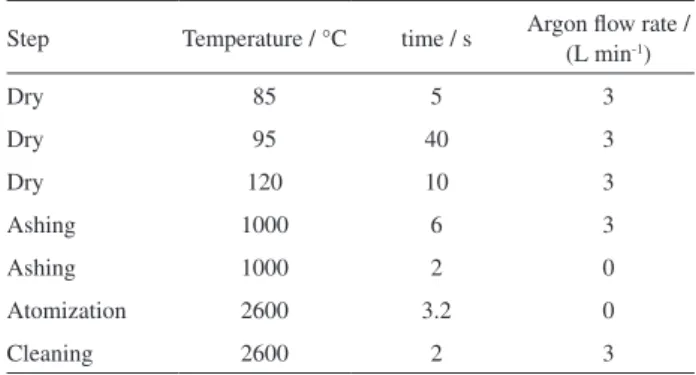
A Varian model SpectrAA 220Z (Mulgrave, VIC, Australia) Zeeman atomic absorption spectrometer equipped with an auto sampler (PSD 120) and a graphite tube atomizer (GTA 120) was used for all the measurements throughout this study. A computer was used to record the absorbance signal profile. A Varian SpectrAA hollow cathode lamp for chromium was operated at 357.9 nm with 7 mA current and a spectral bandwidth of 0.5 nm. The furnace tube was a standard plateau tube with a pyrolytic graphite coating. The Zeeman background correction was used for all measurements. The furnace temperature program applied was as recommended by the manufacturer (Table 1). Peak height measurement was used for all the quantifications. The sample injection volume of 15 µL along with 10 µL modifier was used in all experiments. The pH measurements were carried out with a Metrohm pH meter (model 691, Herisau, Switzerland) using a combined glass calomel electrode. In addition, for magnetic separations a strong neodymium-iron-boron (Nd2Fe12B) magnet (1.31 T) was used.
Standard solution and reagents
Iron(II) chloride tetrahydrate, iron(III) chloride hexahydrate, and 1-hexadecyl-3-methylimidazolium bromide (C16mimBr) were purchased from Sigma-Aldrich (St. Louis,
USA). Double distilled deionized water was used throughout this study. All glassware was washed with 10% (v/v) nitric acid and then rinsed with water before use. Stock standard solutions (1000 mg L-1) of CrVI and CrIII were prepared by
dissolving proper amounts of K2Cr2O7 and CrCl3.6H2O
in distilled water. Working solutions were prepared daily from the stock standard solutions by serial dilutions with double distilled water. 9-Phenyl-2,3,7-trihydroxy-6-fluorone (phenylfluorone), ethanol, hydrochloric acid, nitric acid, potassium permanganate, sodium azide, acetonitrile,
Table 1. Temperature program of ETAAS for determination of CrVI
Step Temperature / °C time / s Argon flow rate / (L min-1)
Dry 85 5 3
Dry 95 40 3
Dry 120 10 3
Ashing 1000 6 3
Ashing 1000 2 0
Atomization 2600 3.2 0
ammonia and all other chemical used were purchased from Merck Company (Darmstadt, Germany). Phenylfluorone solution in ethanol (1 × 10⁻³ mol L-1) was prepared by
dissolving 0.0320 g of phenylfluorone in ethanol containing 1 mL concentrated HCl and diluting to 100 mL upon addition of ethanol. A Pd/Mg modifier was prepared from the palladium modifier solution for ETAAS and Mg(NO3)2.6H2O
according to the literature.45
Synthesis of Fe3O4 nanoparticles
Fe3O4 MNPs were prepared by the coprecipitation
method.35 A 50 mL of an aqueous solution containing 5.2 g
of FeCl3.6H2O and 2.0 g of FeCl2.4H2O was heated at 80 °C
for 15 min. Then, 10 mL of concentrated NH3 was added
dropwise. N2 gas was used as the protective gas in the whole
experiment. After completion of the reaction, the black precipitate was collected by an external magnetic field, washed with water and ethanol and dried in oven at 80 °C.
Preparation of magnetite nanoparticles coated with ILs
Twenty five milliliter of C16mimBr IL (2.0 g L-1) was
added to the Fe3O4 MNPs (0.5 g) in a 50 mL beaker. The
pH was adjusted to 10.0 with sodium hydroxide solution (1.0 mol L-1) and was mixed thoroughly by mechanical stirrer
for 20 min. In this stage, the nanoparticles were suspended in the mixture and covered with the IL. Then, the modified MNPs were isolated by application of an external magnetic field, washed with water and dried at room temperature for 24 h. The sorbent was then used for the further studies.
Preparation of real samples
Water samples were filtered through 0.45 µm Millipore filter. Their pHs were adjusted to 5.0 and treated according to the extraction procedure given below. Frozen serum samples of the diabetic persons were provided from a hospital in Yazd. After reaching the ambient temperature, a small amount of acetonitrile was added to 5.0 mL of serum sample to precipitate the protein contents of it and centrifuged for 10.0 min at the rate of 5000 rpm. The supernatant was diluted with ultrapure water at a ratio 1:10 and was treated according to the given procedure.
Extraction procedure
Determination of CrVI
To 40 mL of sample or standard solution containing of CrVI and CrIII, 1.0 mL of a 1.0 × 10⁻³ mol L-1 phenylfluorone
was added and the pH was adjusted to 5.0 upon addition
of 2 mL acetate buffer. Then, 15 mg modified MNPs was added and the mixture was stirred thoroughly for 15.0 min. At this stage, phenylfluorone-CrVI chelate was adsorbed
onto the modified MNPs. Subsequently, a strong magnet was placed at the bottom of the beaker and the sorbent containing the analyte was trapped. The bulk aqueous phase was easily decanted and the sorbed analyte was desorbed by addition of 350 µL of nitric acid (2.0 mol L-1) and stirred
for 2 min. Finally, the sorbent was retained with the help of a magnet and the supernatant solution was transferred into the electrothermal cup. Then, 15 µL of it along with 10 µL of the Pd/Mg modifier was injected into the graphite tube of ETAAS for the quantification of analyte.
Determination of total chromium and CrIII
To determine the total concentration of chromium in the solution, CrIII was efficiently oxidized to CrVI according to
the given procedure;4 i.e., 4 to 5 drops of KMnO
4 solution
(0.02 mol L-1) and an adequate amount of sulfuric acid to
make its concentration 0.1 mol L-1 were added to 40 mL
of sample, the beaker was covered with a watch glass and heated at 45 °C for 15 min to completely oxidize the CrIII
to CrVI. After the solution was cooled, the excess of KMnO 4
was reduced upon drop wise addition of sodium azide solution (2.0%, m/v) until the pink color of the solution was removed. The solution was then treated according to the given procedure in determination of CrVI. The concentration
of CrIII was determined from the difference of concentration
of total chromium and CrVI.
Results and Discussion
9-Phenyl-2,3,7-trihydroxy-6-fluorone (phenylfluorone) reacts with chromium(VI) and produces a stable and sensitive 2:1 purplish red chelate at pH 4.7-6.6 (Figure 1).46,47 Phenylfluorone had been used for direct
spectrophotometric determination47 and cloud point
extraction of chromium(VI).46,48 In the preliminary work, it
was established that the chelate of CrVI with phenylfluorone
can be extracted onto the IL coated magnetic nanoparticles, while CrIII remains in aqueous phase. Then, the sorbent was
characterized and an extraction system was designed. In order to obtain a high enrichment factor and appropriate situation for the speciation of chromium, different parameters affecting the chelate formation, extraction and analysis process were optimized in a univariable approach.
Characterization of the sorbent
IL were recorded by KBr pellet method (Figure 2). The spectra of IL shows peak at 1168, 1467 and 1575 cm-1
corresponding to C−C, C=C and C=N stretching vibrations, respectively. The same peaks with slight shift to lower wavenumbers (i.e., to 1167, 1444 and 1571 cm-1, respectively) are observed in modified
nanoparticles, indicating that the IL is coated on the magnetic nanoparticles.
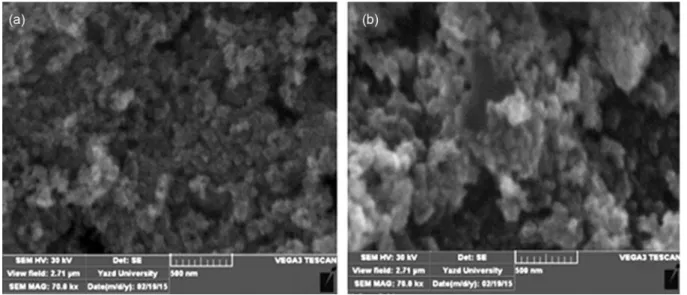
The surface morphology of the magnetic nanoparticles and nanoparticles modified with IL were characterized by scanning electron microscopy (SEM) (Figure 3). As it is demonstrated the size of magnetic nanoparticles after modification with IL is not significantly changed and is still in dimension of nanometers.
Optimization of the SPE variables
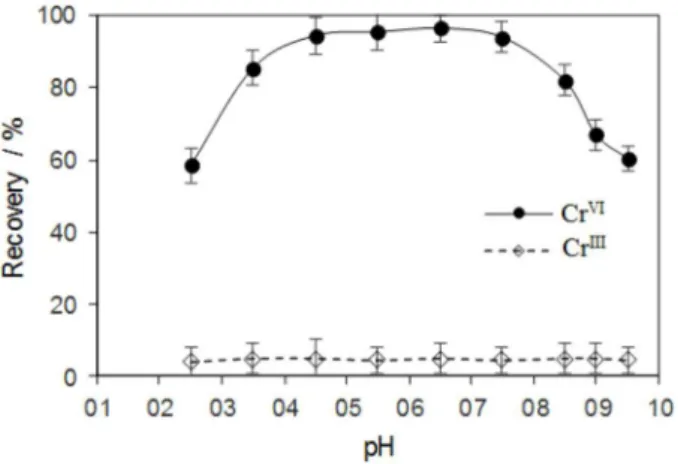
The pH of sample solution plays an important role on the separation/preconcentration and speciation of metal ions by SPE. It has a unique role on the metal-chelate formation, its chemical stability and the lipophilicity of the chelate that must be extracted by the IL modified MNPs sorbent. Furthermore, as in the weak acidic solution the predominant forms of CrVI are CrO
42− and Cr2O72−, the effect
of sample pH on the extraction of CrVI was investigated. The
results (Figure 4) demonstrated that the extraction recovery of CrVI is maximized and constant in the pH range 4.0-7.5
which corresponds to the region where the CrO42− species
is predominate. The decrease in the extraction of CrVI at
pH higher than 7.5 can be related to the decomposition of CrVI-phenylfluorone chelate and instability of complex
at alkaline media. The negligible extraction of CrIII in all
studied pHs is because the phenylfluorone is a selective ligand for CrVI and does not form a stable chelate with CrIII.
Thus, CrVI can be extracted as CrVI-phenylfluorone chelate
while CrIII remains in the aqueous phase. This suggests that
it is possible to separate the CrVI from CrIII in the whole
pH range and the extraction of CrVI reaches its maximum
in the pH range of 4.0-7.5. Therefore, the pH of 5.0 was selected for the subsequent works.
The effect of the concentration of chelating agent on the extraction recovery of CrVI was investigated and
Figure 1. Structure of PF-CrVI complex.
Figure 3. SEM image of (a) MNPs; (b) IL modified MNPs.
the results (Figure 5) demonstrated that the efficiency of analyte extraction increases by an increase in the phenylfluorone concentration up to 1.0 × 10⁻⁵ mol L-1, and
then reaches a plateau. A phenylfluorone concentration of 2.5 × 10⁻⁵ mol L-1 was chosen to account for the other
species that might potentially interfere with CrVI extraction
through chelate formation with the ligand.
The contact time between modified MNPs and chromium chelate has an obvious effect on the performance of extraction processes. Experiments revealed that the extraction recovery of CrVI increases with an increase
in the extraction time from 3.0 to 15.0 min, and then remained constant by further increase in the extraction time. Therefore, an extraction time of 15.0 min was selected for the subsequent experiments.
It is well known that the convection induced by stirring of the sample causes fast mass transfer to occur. Thus, a fast equilibrium between the sample solution and modified MNPs
can be attained by proper stirring of the solution. The effect of stirring rate was investigated in the range of 300-1200 rpm. It was observed that, 1000 rpm was sufficient to achieve a quantitative extraction of the analyte in 15.0 min.
The type, concentration and volume of the desorbing solution have a considerable effect on the extraction efficiency. The eluent must be capable of complete desorption of analyte in minimum volume in a short time and it must not interfere in the measurement of analyte. The possibility of desorption of chromium complex by 500 µL of different eluent including nitric acid, hydrochloric acid and acetic acid all at a concentration of 2.0 mol L-1 was
considered. It was found that nitric acid has the maximum capability in desorbing the analyte, whereas, the recoveries with hydrochloric acid and acetic acid were about 60% and 40% of that of nitric acid, respectively. The effect of nitric acid concentration in the range of 0.5-5.0 mol L-1 on
the recovery was then studied. The results implied that the extraction recovery increased with an increase in nitric acid concentration up to 2.0 mol L-1 and then remained
constant at higher concentrations. Therefore, nitric acid with a concentration of 2.0 mol L-1 was chosen as the
desorbing solution for the subsequent studies. Furthermore, the influence of the volume of nitric acid on the recovery of CrVI was studied by varying its volume in the range of
100-500 µL. The results demonstrated that chromium was quantitatively desorbed from modified MNPs in volumes of 350 µL and larger. For achieving high enrichment factor, the smaller volume of eluent in which the recovery was quantitative (350 µL) was chosen.
The effect of desorption time was also evaluated by varying desorption time between 0.5 and 10.0 min. It was found that desorption of analyte from the sorbent is relatively fast and 2.0 min stirring was sufficient for the quantitative recovery of the analyte.
The recovery values for chromium were dependent on the mass of the sorbent. The recovery increased by an increase in sorbent mass up to 10 mg and then remained constant and quantitative by further increase in amount of the sorbent. A mass of 15 mg of the sorbent was selected as the optimum amount for the further studies.
The effect of ionic strength on the extraction (or stripping or removing) of chromium complex from the modified MNPs sorbent was investigated by varying the NaCl concentration between 0.0-1.0 mol L-1. The results proved that the
extraction efficiency is independent of the salt concentration. Thus, the method can be applied for quantitative separation and preconcentration of chromium from saline solutions. Further studies were done without salt addition.
Demonstrating the capability of the extraction system in obtaining high preconcentration factor is an important
0 20 40 60 80 100
0.0 0.5 1.0 1.5 2.0 2.5 3.0 3.5
Recovery / %
Phenyl uorone concentration / (mol L ) × 10-1 -5
Figure 5. Effect of phenylfluorone concentration on extraction of CrVI. Conditions: pH = 5; sample volume, 40 mL; amount of sorbent, 15 mg; extraction time, 15.0 min; stirring rate, 1000 rpm; eluent concentration, 2.0 mol L-1; eluent volume, 350 µL and amount of CrVI, 12 ng.
aspect of method development as it shows the possibilities of recovery of analyte from a large sample volume. An increase in the ratio of the volume of the aqueous phase to the eluent will increase the preconcentration factor but it may reduce the extraction efficiency. In order to study the effect of the sample volume on the extraction efficiency, 12 ng of CrVI was extracted from different volumes of
solution (10-60 mL) under constant the other experiment conditions. The results showed that the recovery was quantitative up to 40 mL of the sample and then decreased with further increase in sample volume. Thus, based on the volume of desorbing solution (350 µL) and the maximum sample volume that the extraction was quantitative (40 mL) a preconcentration factor of 114 was determined.
Sorbent capacity
The pH of sample solution (20 mg L-1 CrVI, 40 mL) was
adjusted to 5.0. 2.0 mL of phenylfluorone and 50 mg of modified MNPs were added. Then, the mixture was stirred for 120 min and after collection of the sorbent by applying an external magnetic field the amount of chromium on the supernatant solution was determined by flame atomic absorption spectroscopy. The amount of chromium retained by the sorbent was determined from the difference of the concentration of chromium in the initial and final solutions. The capacity of the sorbent was found to be 11.5 mg g-1.
Effect of foreign ions
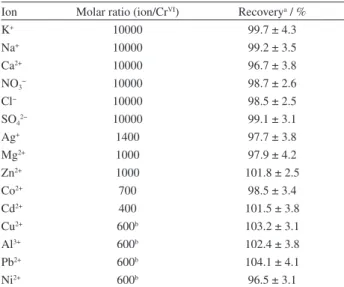
The selectivity of developed SPE method for extraction and determination of chromium was demonstrated by studying the possibility of the effect of common interfering ions usually present in water and biological samples. For this purpose, 40 mL of the solution of 0.30 µg L-1 CrVI and
various amounts of interfering ions was preconcentrated and analyzed according to the recommended procedure. The tolerance limit of the coexisting ions was defined as the largest amount that make a variation of less than 5% in the recovery of the analyte. The results of these studies (Table 2) indicate that with the exception of CuII, AlIII, NiII
and PbII ions, which interfere at the mole ratio of 50, the
other ions at the given level show no significant interference in the determination of chromium. Furthermore, as EDTA forms ionic hydrophilic complexes with the interfering ions but does not have any affinity for CrVI the tolerance
limit of CuII, AlIII, NiII and PbII ions was improved to the
mole ratio of 600 upon addition of EDTA. Thus, when the concentration of CuII, AlIII, NiII and PbII ions in the
sample is more than 50 times of the analyte, the EDTA at a concentration of 2.0 × 10⁻⁴ mol L-1 should be added to the
sample prior to addition of sorbent. These results indicate that the developed method is selective for the determination of chromium(VI) at optimum conditions.
Analytical figures of merit
In the optimum conditions, a calibration graph was constructed for CrVI by preconcentrating of several standard
solutions according to the recommended procedure. The linear concentration range was found to be 0.01-0.50 µg L-1
with a correlation coefficient of 0.9990. The equation of calibration graph was A = 1.622C + 0.036 (where A is the absorbance and C is the concentration of CrVI in µg L-1). The
limits of detection (LOD) and quantification (LOQ) defined as 3 Sb/m and 10 Sb/m (where Sb is the standard deviation
of the blank and m is the slope of the calibration graph) were 0.003 and 0.01 µg L-1, respectively. The precision of
proposed method was evaluated by subjecting a series of six solutions containing 0.3 µg L-1 CrVI to the extraction
and measurement process at same day. The coefficient of variation (CV, %) was found to be 3.2%. The enhancement factor defined as the slope ratio of two calibration curves with and without preconcentration was found to be 112. The closeness of enhancement and preconcentration factor to each other indicate that the extraction is quantitative (about 98% completed).
Application
To check the reliability of the proposed method for speciation of chromium, the method was applied to the
Table 2. Tolerance limits of foreign ions for the determination of chromium(VI)
Ion Molar ratio (ion/CrVI) Recoverya / %
K+ 10000 99.7 ± 4.3
Na+ 10000 99.2 ± 3.5
Ca2+ 10000 96.7 ± 3.8
NO3− 10000 98.7 ± 2.6
Cl− 10000 98.5 ± 2.5
SO42− 10000 99.1 ± 3.1
Ag+ 1400 97.7 ± 3.8
Mg2+ 1000 97.9 ± 4.2
Zn2+ 1000 101.8 ± 2.5
Co2+ 700 98.5 ± 3.4
Cd2+ 400 101.5 ± 3.8
Cu2+ 600b 103.2 ± 3.1
Al3+ 600b 102.4 ± 3.8
Pb2+ 600b 104.1 ± 4.1
Ni2+ 600b 96.5 ± 3.1
determination of CrVI and CrIII in several categories of
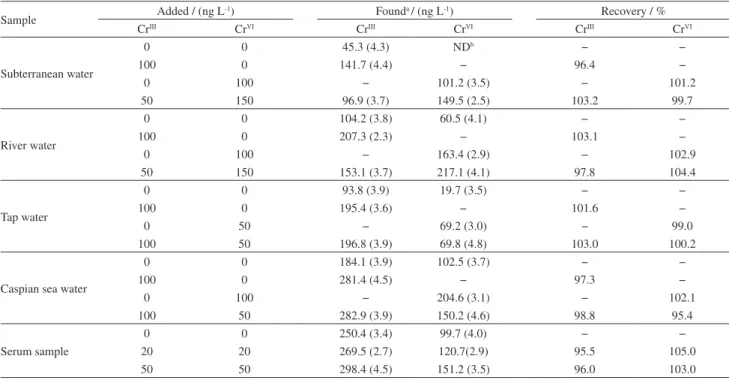
water samples including river water (Zayandeh Rood River, Esfahan, Iran), subterranean water (the two-story subterranean of Ardestan, Esfahan, Iran), sea water and human serum. The accuracy of the method was examined by spiking the samples with two or three different levels of CrIII and CrVI and calculating the recovery. The results
of this investigation are given in Table 3. As it can be seen, the recoveries of added chromium species are good. Thus, the procedure is reliable and accurate for the analysis of chromium species at trace levels in water samples. Furthermore, the procedure was also applied to determination of chromium in a certified reference river water sample SLRS-1 with chromium concentration 0.36 ± 0.03 µg L-1.
The concentration of chromium in this sample was found to be 0.35 ± 0.02 µg L-1. Thus at 95% confidence level there
is no significant difference between the obtained value and the accepted one. Thus, the procedure is reliable for analysis of chromium in the sample types studied.
Comparison with other methods
Table 4 compares figures of merit of the developed method with some other SPE methods reported for the separation, preconcentration and determination of chromium species. As can be seen the LOD of the proposed method is lower or comparable and its enhancement factor is higher than the rest of methods in the Table 4.
Table 3. Determination and speciation of chromium in real samples (n = 3)
Sample Added / (ng L
-1) Founda / (ng L-1) Recovery / %
CrIII CrVI CrIII CrVI CrIII CrVI
Subterranean water
0 0 45.3 (4.3) NDb − −
100 0 141.7 (4.4) − 96.4 −
0 100 − 101.2 (3.5) − 101.2
50 150 96.9 (3.7) 149.5 (2.5) 103.2 99.7
River water
0 0 104.2 (3.8) 60.5 (4.1) − −
100 0 207.3 (2.3) − 103.1 −
0 100 − 163.4 (2.9) − 102.9
50 150 153.1 (3.7) 217.1 (4.1) 97.8 104.4
Tap water
0 0 93.8 (3.9) 19.7 (3.5) − −
100 0 195.4 (3.6) − 101.6 −
0 50 − 69.2 (3.0) − 99.0
100 50 196.8 (3.9) 69.8 (4.8) 103.0 100.2
Caspian sea water
0 0 184.1 (3.9) 102.5 (3.7) − −
100 0 281.4 (4.5) − 97.3 −
0 100 − 204.6 (3.1) − 102.1
100 50 282.9 (3.9) 150.2 (4.6) 98.8 95.4
Serum sample
0 0 250.4 (3.4) 99.7 (4.0) − −
20 20 269.5 (2.7) 120.7(2.9) 95.5 105.0
50 50 298.4 (4.5) 151.2 (3.5) 96.0 103.0
aValues in parentheses are coefficient of variation (%); bND = not detected.
Table 4. Comparison of analytical characteristic of the proposed method with some SPE published method for speciation of chromium
Specie Detection technique LODa / (µg L-1) CVb / % EFc Reference
CrVI FAASd 45 < 1 25 49
CrVI FAASd 2.3 3.0 24.9 50
CrVI FAASd 7.7 − 75 6
CrVI ETAASe 0.0061 6.1 18 51
CrIII ETAASe 0.003 4.0 35 52
CrVI ETAASe 0.19 1.8 − 53
CrVI ETAASe 0.03 9.0 − 54
CrIII ETAASe 0.018 1.0 10 55
CrVI ETAASe 0.003 3.2 112 this work
Conclusions
Magnetic nanoparticles modified by IL combined with ETAAS using phenylfluorone as the chelating agent can be applied for the speciation of ultratrace amounts of chromium ions in different water and human serum samples. In comparison with other reported SPE methods (Table 4), the developed method has higher preconcentration factor and lower detection limit. The method also has the advantages of simplicity, rapidity, selectivity, and relatively low cost. Furthermore, it avoids the time consuming column passing and filtration operation using an external magnetic field for the separation of MNPs from the aqueous phase. However, the drawback of this sorbent is the impossibility of reusing the nanoparticles as desorption process may hurt the stability of IL on Fe3O4 nanoparticles or dissolve the nanoparticles.
Acknowledgments
The authors wish to thank the graduate school of Yazd University for their support.
References
1. Sun, M.; Wu, Q.; J. Pharm.Biomed. Anal. 2012, 60, 14. 2. Bayramoglu, G.; Arica, M. Y.; J. Hazard. Mater.2011, 187,
213.
3. Hosseini, M. S.; Sarab, A. R. R.; Int. J. Environ. Anal. Chem.
2007, 87, 375.
4. Yousefi, S. M.; Shemirani, F.; J. Hazard. Mater.2013, 254-255, 134.
5. Sacher, F.; Raue, B.; Klinger, J.; Brauch, H. J.; Int. J. Environ. Anal. Chem. 1999, 74, 191.
6. Narin, I.; Kars, A.; Soylak, M.; J. Hazard. Mater.2008, 150, 453.
7. Fariñas, M. V.; García, J. B.; Martín, S. G.; Crecente, R. M. P.; Latorre, C. H.; Food Chem.2008, 110, 177.
8. Barbosa Jr, F.; de Souza, S. S.; Santos Jr, D.; Krug, F. J.;
Microchem. J.2004, 78, 7.
9. de Paula, C. E. R.; Caldas, L. F. S.; Brum, D. M.; Cassella, R. J.; J. Pharm. Biomed. Anal.2013, 74, 284.
10. Narayana, B.; Cherian, T.; J. Braz. Chem. Soc.2005, 16, 197. 11. Dufailly, V.; Noël, L.; Guérin, T.; Anal. Chim. Acta2006, 565,
214.
12. Khan, N.; Jeong, I. S.; Hwang, I. M.; Kim, J. S.; Choi, S. H.; Nho, E. Y.; Choi, J. Y.; Kwak, B.-M.; Ahn, J.-H.; Yoon, T.; Kim, K. S.; Food Chem.2013, 141, 3566.
13. Martín-Cameán, A.; Jos, A.; Calleja, A.; Gil, F.; Iglesias-Linares, A.; Solano, E.; Cameán, A. M.; Microchem. J.2014, 114, 73. 14. Ulmanu, M.; Anger, I.; Gament, E.; Mihalache, M.;
Plopeanu, G.; Ilie, L.; Res. J. Agric. Biol. Sci.2011, 43, 235.
15. Sereshti, H.; Khojeh, V.; Samadi, S.; Talanta2011, 83, 885. 16. Nielsen, S. C.; Hansen, E. H.; Anal. Chim. Acta2000, 422, 47. 17. Narin, I.; Surme, Y.; Soylak, M.; Dogan, M.; J. Hazard. Mater.
2006, 136, 579.
18. Zachariadis, G. A.; Trikas, E.; Int. J. Environ. Anal. Chem. 2011,
92, 375.
19. Dadfarnia, S.; Shabani, A. M. H.; Shishebor, M. R.; Cisakht, K. H.; Int. J. Environ. Anal. Chem. 2011, 91, 1320.
20. Kiran, K.; Kumar, K. S.; Prasad, B.; Suvardhan, K.; Lekkala, R. B.; Janardhanam, K.; J. Hazard. Mater.2008, 150, 582. 21. Zeng, C.; Lin, Y.; Zhou, N.; Zheng, J.; Zhang, W.; J. Hazard.
Mater.2012, 237-238, 365.
22. López-García, I.; Briceño, M.; Vicente-Martínez, Y.; Hernández-Córdoba, M.; Talanta2013, 115, 166.
23. Tehrani, M. S.; Azar, P. A.; Husain, S. W.; Shafaei, F.; Asian J. Chem.2010, 22, 6302.
24. Baig, J. A.; Hol, A.; Akdogan, A.; Kartal, A. A.; Divrikli, U.; Kazi, T. G.; Elci, L.; J. Anal. At. Spectrom. 2012, 27, 1509. 25. Moghadam, M. R.; Dadfarnia, S.; Haji Shabani, A. M.;
J. Hazard. Mater.2011, 186, 169.
26. Timerbaev, A.; Semenova, O.; Buchberger, W.; Bonn, G.;
Fresenius J. Anal. Chem.1996, 354, 414.
27. Domínguez-Renedo, O.; Ruiz-Espelt, L.; García-Astorgano, N.; Arcos-Martínez, M. J.; Talanta2008, 76, 854.
28. Mohammadhosseini, M.; Tehrani, M. S.; Ganjali, M. R.; J. Chin. Chem. Soc.2006, 53, 549.
29. Amjadi, M.; Samadi, A.; Colloids Surf., A2013, 434, 171. 30. Farahani, M. D.; Shemirani, F.; Microchim. Acta2012, 179,
219.
31. Moghadam, R. H.; Shabani, A. M. H.; Dadfarnia, S.; Baghban, N.; J. Braz. Chem. Soc. 2014, 25, 1975.
32. Yaman, M.; J. Anal. Chem.2003, 58, 456.
33. Kubota, L. T.; Gushikem, Y.; Moreira, J. C.; Analyst1991, 116, 281.
34. Mohammadi, S.; Khayatian, G.; Atashkar, B.; Rostami, A.;
J. Braz. Chem. Soc.2014, 25, 2039.
35. Khan, S.; Kazi, T. G.; Soylak, M.; Spectrochim. Acta, PartA
2014, 123, 194.
36. Giakisikli, G.; Anthemidis, A. N.; Talanta2013, 110, 229. 37. Tahmasebi, E.; Yamini, Y.; Microchim. Acta 2014, 181, 543. 38. Kazemi, E.; Shabani, A. M. H.; Dadfarnia, S.; Microchim. Acta
2015, 182, 1025.
39. Baghban, N.; Shabani, H.; Mohammad, A.; Dadfarnia, S.;
J. Chin. Chem. Soc.2012, 59, 782.
40. Pourreza, N.; Ghanemi, K.; J. Hazard. Mater.2010, 178, 566.
41. Myasoedova, G. V.; Molochnikova, N. P.; Mokhodoeva, O. B.; Myasoedov, B. F.; Anal. Sci. 2008, 24, 1351.
42. Sun, P.; Armstrong, D. W.; Anal. Chim. Acta2010, 661, 1. 43. Abulhassani, J.; Manzoori, J. L.; Amjadi, M.; J. Hazard. Mater.
44. Absalan, G.; Asadi, M.; Kamran, S.; Sheikhian, L.; Goltz, D. M.;
J. Hazard. Mater.2011, 192, 476.
45. Falomir, P.; Alegría, A.; Barberá, R.; Farré, R.; Lagarda, M. J.;
Food Chem. 1999, 64, 111.
46. Zhu, X.; Hu, B.; Jiang, Z.; Li, M.; Water Res.2005, 39, 589. 47. Qi, W.-B.; Zhu, L.-Z.; Talanta1986, 33, 694.
48. Dondurmacioglu, F.; Filik, H.; J.Anal. Chem. 2009, 64, 455. 49. Tunçeli, A.; Türker, A. R.; Talanta2002, 57, 1199.
50. Maltez, H. F.; Carasek, E.; Talanta2005, 65, 537.
51. Monasterio, R. P.; Lascalea, G. E.; Martínez, L. D.; Wuilloud, R. G.; J. Trace Elem. Med. Biol.2009, 23, 157.
52. Gil, R. A.; Cerutti, S.; Gásquez, J. A.; Olsina, R. A.; Martinez, L. D.; Talanta2006, 68, 1065.
53. Hu, G.; Deming, R. L.; Anal. Chim. Acta2005, 535, 237. 54. Chwastowska, J.; Skwara, W.; Sterlińska, E.; Pszonicki, L.;
Talanta2005, 66, 1345.
55. Leśniewska, B.; Godlewska-Żyłkiewicz, B.; Wilczewska, A. Z.;
Microchem. J.2012, 105, 88.
Submitted:June 13, 2015