336 Brazilian Journal of Physics, vol. 33, no. 2, June, 2003
Study of Excitation Rates in a Hollow Cathode Discharge
V.H. Baggio-Scheid, A.C.J. Paes, and J.W. Neri
Centro T´ecnico Aeroespacial, Instituto de Estudos Avanc¸ados12231-970 S˜ao Jos´e dos Campos, S˜ao Paulo, Brazil
Received on 29 May, 2002. Revised version received on 11 November, 2002.
In this work a dc discharge with a copper hollow cathode in argon used for deposition applications is investi-gated using atomic emission spectroscopy. Typical discharge parameters during our investigation are pressures between80and200P aand current densities up to7mA cm−2. The radial light intensity profiles of some
selected copper and argon lines were measured. An analysis of these profiles gives insigths into the excitation rates of the argon filling gas and the sputtered metal atoms as well as into the radial dimension of the negative glow. The different excitation mechanisms lead to a sharp change of the radial light intensity profiles emitted by many copper spectral lines, which indicates the transition region between the cathode fall and the negative glow. The length of the cathode fall was observed to be very insensitive to all the macroscopic discharge parameters. A nearly constant value was found for the cathode fall length, which corresponds to about 22% of the cathode radius.
1
Introduction
The hollow cathode glow discharge is a good source of metal atoms and ions, which has been used in the pro-cesses of the thin film deposition [1] and as light source for spectroscopy and laser devices [2, 3]. The high energy of the secondary beam electrons, high current density and gas tem-perature make this discharge attractive for other applications in the field of plasma chemistry. Recently, discharges of mi-crohollow cathodes operating at atmospheric pressure also enable their use in large-area plasma processing [4]. Be-cause of the several technological applications, the hollow cathode configuration has been subject of intense research in the last years.
The spatial distribution of the sputtered metal atoms in-side the cathode is particularly interesting for deposition ap-plications. This can be obtained by laser-aided techniques [5, 6]. However, these techniques are usually difficult to be set up in many practical applications. Alternatively, atomic emission spectroscopy is a simple experimental tech-nique that can provide useful information concerning the discharge. In this work a dc discharge with a copper hollow cathode in argon is investigated using atomic emission spec-troscopy. The radial light intensity profiles of some selected copper and argon lines were measured and analyzed. A cor-relation between the emitted light intensities and the excita-tion rates of the argon filling gas and the sputtered copper atoms is proposed.
2
Experimental arrangement
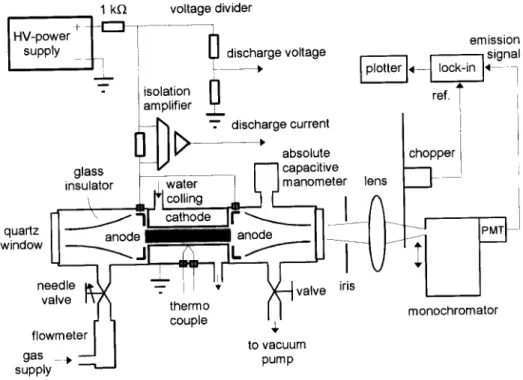
The experimental arrangement is shown in Fig. 1. The discharge consists of a copper hollow cathode of1cminner diameter and7cmlength. The cathode was water cooled. Two cup-shaped anodes, also made of copper, were posi-tioned on both extremities of the cathode. The effective area of the anodes is equal to the cathode area, each with
22cm2
. The discharge was operated with99.999% purity argon. The argon gas flow was measured with a flowmeter and regulated with a needle valve. The pressure was mea-sured downstream with an absolute capacitance manometer and controlled by a throttle valve on the gas exhaust side. The HV-power supply with a load resistor of1kΩwas con-nected to both anodes. Current and voltage were measured, at the anode side, with a digital oscilloscope
For the measurements of the light intensity profiles, the cathode inner cross section was imaged into the entrance slit of the monochromator (1180groove/mm,250mm fo-cal length and3.3nm/mmdispersion) with an object to im-age ratio of0.5. To avoid stray light, due to reflections in the edge of the window, a fixed iris with1.36cmdiameter and
V.H. Baggio-Scheid, A.C.J. Paes, and J.W. Neri 337
Figure 1. Schematic of the experimental set-up for emission spectroscopy measurements of light intensity profiles.
3
Results and discussion
3.1 The discharge characteristic
It has been observed that when a function of some dis-charge parameters is plotted against the applied voltage, the data points fall into the same curve. This curve is denom-inated the discharge characteristic and this function the in-variant parameter [7]. The discharge characteristic curve is a simple way to characterize a gas discharge. The character-istic depends basically on the gas, the cathode material and geometry. For the hollow cathode discharge it has been ob-served that the function given by the product of the cathode length by the current density divided by the pressure,l J/p, is an invariant parameter, because it depends only on the voltage [8]. The discharge characteristic of our discharge is shown in Fig. 2. It was observed that for cathode wall temperatures≤100oCand gas flows≤100sccmthere is no alteration on the measured characteristic. There is a bet-ter overlapping of the experimental points in the low current range because the gas temperatures is close to the room tem-perature.
3.2 Light intensity emitted by noble gases
The light emission of a spectral line (W m−3sr−1) due to the spontaneous decay from a resonance statento
0,0 0,1 0,2 0,3 0,4
200 240 280 320 360
80 Pa 100 Pa 150 Pa 200 Pa
d
isch
ar
g
e
vo
lt
ag
e
(V
)
l J/p(mA cm-1 Pa-1
)
Figure 2. Characteristic curve of the Ar-Cu hollow cathode discharge.
lower statemis described by the emission coefficient [9], ε(n−→m) = hν
338 Brazilian Journal of Physics, vol. 33, no. 2, June, 2003
density of a resonance stateNn is related to the excitation rateRn(g−→n) (m−3s−1)by
Rn(g−→n) =NnA(n−→) (2) whereA(n→) = Pp<nA(n−→p). Then, the emission coefficient can be now written:
ε(n−→m) = hν 4π
A(n−→m)
A(n−→) Rn(g−→n). (3)
For instance, in the hollow cathode discharge, the light emis-sion profile follows the profile of the excitation rate.
The excitation and ionization of noble gases occurs due to collisions with the beam electrons, which are emitted from the cathode surface. The excitation rate is related to the energy distribution of the electron flux Jeb(E)/e(m−2s−1eV−1)by
Rn=Ng
Z Emax
In
σn(E) Jeb(E)
e dE, (4) where Ng is the population density of the ground state, σn(E) (m2) is the energy dependent excitation cross sec-tion,Emax(eV)is the highest energy of the beam electrons,
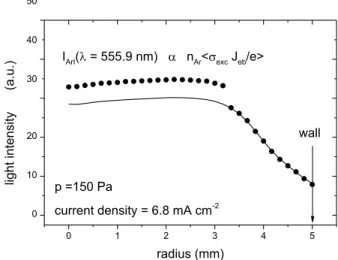
andIn(eV)is the excitation potential [11]. For simplicity, Rn will be symbolic represented byRn = nghσnJeb/ei. The excitation rate increases through the cathode fall as the electrons are accelerated by the strong electric field. In the negative glow the electric field falls to zero and the electrons are no more accelerated, but they are confined inside the po-tential well. As a result, the excitation rate increases through the cathode fall up to a maximal value, which remains con-stant in the negative glow. A typical light intensity profile measured for the4p[1/2]−→ 5d[3/2]at555.9nm decay-ing transition of the argon atoms is shown in Fig. 3. The excitation rate by collisions with the beam electrons, which is proportional to light emission, is also indicated in Fig. 3. The flat profile shows that the excitation rate is constant in the negative glow.
3.3 Light intensity profile emitted by the
sput-tered metal atoms
The situation is more complex for the sputtered metal atoms. The excitation and ionization in the cathode fall is again provided by collisions with the beam electrons, but excitation and Penning ionization by collisions with metastable argon atoms also play an important role. The excitation rate by collisions with the beam electrons should be similar to that of the argon atoms, i.e., it should increase through the cathode fall and stay constant in the negative glow. In the negative glow the excitation rate is enhanced by collisions with the fast electrons of the plasma. These elec-trons have energy of about3eV [5], which is very close to the first resonance energy level of the copper atoms. Laser Induced fluorescence measurements of spatial profiles of
3
P2 metastable argon atoms in a glow discharge show that
the maximum of the density profiles occurs in the middle of the
Figure 3. Radial profiles of the light intensity of the Ar I line at
555.9nm(nArhσexcJeb/ei, excitation rate of the argon atoms by
collisions with beam electrons).
cathode fall [5]. In the negative glow the metastable atoms density is reduced by one order of magnitude. The main loss mechanism is due to excitation collisions with thermal plasma electrons, with an energy of approximately0.3eV, to the 3
P1 resonant level, followed by a decaying
transi-tion to ground state. Therefore, the excitatransi-tion and ioniza-tion rates of the copper atoms by collisions with metastable argon atoms and fast electrons have a strong variation in the interface between the cathode fall and the negative glow. Thus, these different excitation mechanisms lead to a sharp change of the radial light intensity profiles emitted by many copper spectral lines in the cathode fall - negative glow inter-face. This behavior can be observed from the radial profiles of light measured for the 2
P3/2 → 2
D5/2 (metastable) at
510.7nmdecaying transitions of the copper atoms, shown in Fig. 4. The sudden increase in the light intensity profiles indicates the transition region between the cathode fall and the negative glow.
Figure 4. Radial profiles of light intensity of the Cu I line at
510.7nmshowing qualitatively the contribution of the main
ex-citation rates of the copper atoms (ncunefhσexcνefi, excitation
rate by collisions with fast electrons;ncuhσexcJeb/eiexcitation
rate by collisions with beam electrons;ncunAr∗hσexcνri,
V.H. Baggio-Scheid, A.C.J. Paes, and J.W. Neri 339
The main excitation rates are also shown in figure 4. These curves were normalized with respect to the measured light intensity profile. A preliminary calculation with a sim-ple model for the energy distribution of the electron flux, using the cross section for the optically allowed transition
2
S1/2 → 2
P3/2reported by Msezane and Henry [12], gives
for the excitation frequency by collisions with the beam electrons a value of hσexcJeb/ei = 5.5×101s−1. This is approximately 3-fold lower than the excitation frequency by collisions with the fast electrons, which was estimated from the discharge current density, assuming a ratio of103
between the density of the bulk plasma electrons and the fast electrons [5, 13] , to benefhσexcνefi= 1.7×10²s−1. Therefore, we consider in the negative glow a ratio of 1/3 be-tween the excitation rates of the beam electrons and the fast electrons. To represent the shape of the excitation rate of the copper atoms by collisions with the beam electrons, we use the experimental profile of light intensity measured for the argon atoms. As was pointed out previously, the dom-inant excitation in the cathode fall is by collisions with the metastable argon atoms. For simplicity, a parabolic density profile was assumed for the argon metastable to obtain the excitation rate profile shown in figure 4. The profiles for the different excitation rates of the copper atoms are, off course, only a crude estimation, which needs experimental evidence to be well established.
The cathode fall length can be more easily measured at higher current densities. Its length is about1.2mmfor pressures above100P a, and is practically invariant over the investigated current range. A small decrease of the cath-ode fall thickness was observed with increasing pressures. However, the ratio between the cathode fall length dc and the cathode radius rw over all pressures was in the range
0.20≤dc/rw ≤0.24, which corresponds to a variation of only 20%.
4
Conclusions
By measuring the radial light intensity profiles of some selected copper and argon lines the length of the cathode fall was determined for a discharge with a copper hollow cathode in argon. The ratio between the cathode fall length and the cathode radius is aboutdc/rw = 0.22. This value was very insensitive to all the macroscopic discharge pa-rameters showing only a slight increase, never higher than 20%, when the pressure was decreased from200P adown to80P a. Similar results have been observed for discharges
with hollow cathodes of different diameters made of ura-nium, but which were also running in argon. Thus, is seems that, so far the hollow cathode discharge is sustained by the ionization collisions of the beam electrons with the argon filling gas, the ratio between the cathode fall length and the cathode radius is, essentially, gas depend.
The analysis of the experimental radial emission profiles enables us to identify the main excitation rates of the argon filling gas and the sputtered copper atoms. The excitation of the argon occurs due to collisions with the beam electrons emitted from the cathode. In the case of the copper atoms, despite of the excitation by the beam electrons, the collisions with the plasmas fast electrons and metastable argon atoms play also an important role.
Acknowledgements
The authors would like to thank the Brazilian agencies CNPq and FAPESP for partial financial support.
References
[1] A. Thornton, J. Vac. Sci. Technol.15, 171 (1978).
[2] E.M. van Veldhuizen, Eindoven University of Technology,
Thesis(1983).
[3] A.K. Anders, R.C. Tobin, J. Appl. Phys.64 (9), 4285 (1988).
[4] L. B´ardos, H. Bar´ankov´a, Surf. Coat. Technol.133-134, 522 (2000).
[5] V.H.B. Scheid, J¨ulich-Report2655(1992).
[6] A. D. Sappey and T.K. Gamble, Appl. Phys. B, 53, 353 (1991).
[7] G. Francis, ”The Glow Discharge at Low Pressure”, Hand-buch der Physik, Band XXII, Springer Verlag, Berlin, (1956).
[8] V.H. Baggio-Scheid, J.W. Neri, N.A.S. Rodrigues, R. Riva, C. Schwab, M.G. Destro, C.A.B. da Silveira, 5oEncontro Brasileiro de F´ısica dos Plasma,Anais, 61-64 (1998).
[9] H.R. Griem, Plasma Spectroscopy, McGraw-Hill, N.Y., (1984).
[10] C.M. Ferreira, A. Ricard, J. Appl. Phys.54 (5), 2261 (1983).
[11] R.J. Carman, A. Maitland, J. Phys. D: Appl. Phys.20, 1021 (1987).
[12] A.Z. Msezane and R.J.W. Henry, Phys. Rev. A 33, 1631 (1986).