Neutrino Physics and Astrophysics with the MACRO
Experiment at the Gran Sasso Lab
Giorgio Giacomelli
∗Dipartimento di Fisica dell’Universit`a di Bologna and INFN, Sezione di Bologna,
it I-40127 Bologna, Italy
Received on 1 October, 2002
The results of the MACRO experiment on atmospheric neutrino oscillations are presented and discussed. The data concern different event topologies with average neutrino energies of∼4 and∼50 GeV. The Multiple
Coulomb Scattering of muons in the MACRO absorbers was used to estimate the neutrino energy of each event of the higher energy sample. The angular distributions, the absolute fluxes and the L/E distribution strongly favourνµ → ντ oscillations with maximal mixing and∆m
2
= 0.0025 eV2
. Results are presented on the searches for astrophysical sources of high energy muon neutrinos, for bursts of electron antineutrinos from stellar gravitational collapses and on indirect searches for WIMPs from the Earth and from the Sun.
I
Introduction
MACRO was a large multipurpose area underground expe-riment designed to search for rare events in the penetrating cosmic radiation. These included the study of atmospheric neutrinos and their oscillations, high energy(Eν ∼> 1 GeV) muon neutrino astronomy, indirect searches for WIMPs and search for low energy (Eν ∼> 7MeV) stellar collapse neu-trinos. The detector was placed in the Gran Sasso labora-tory, located on the highway Rome-Teramo , 120 km east of Rome. The lab consists of three underground halls, each about 100 m long. It is at an altitude of 963 m above sea level, is well shielded from cosmic rays by a mean rock thickness of ≃ 3700m.w.e.; the minimum is3150m.w.e: this defines the minimum muon energy at the surface at ∼ 1.3 TeV in order to reach MACRO. The average resi-dual muon energy and the muon flux are ∼ 320 GeV and ∼1 m−2
h−1
, respectively.
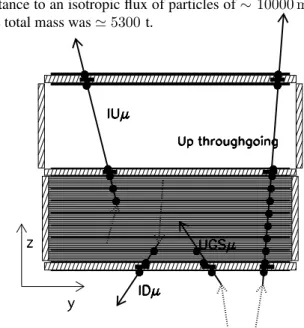
MACRO was composed of three sub-detectors: liquid scintillation counters, limited streamer tubes and nuclear track detectors. Each one of them could be used in “stand-alone” and in “combined” mode. A cross section of the de-tector is shown in Fig. 1. Notice the division in the lower and in the upperpart (this was often referred to as the At-tico); the inner part of the Attico was empty and lodged the electronics [1]. The mass of the lower MACRO was ≃ 4200t, mainly in the form of boxes filled with crushed Gran Sasso rock. The detector had a modular structure: it was divided into six sections referred to as supermod-ules. Each active part of one supermodule had a size of 12.6 ×12×9.3 m3
and had a separate mechanical
struc-ture and electronics readout. The full detector had global dimensions of76.5×12×9.3 m3
and provided a total ac-ceptance to an isotropic flux of particles of∼10000 m2
sr.
The total mass was≃5300t.
Figure 1. Cross section of the MACRO detector and sketch of different event topologies induced byνµ → µ charged current interactions. The black points and the black rect-angles represent streamer tubes and scintillator hits, respec-tively. Tracking was performed by the streamer tubes; the time-of-flight (T.O.F.) of the muons was measured by the scintillators forUp Semicontained (Internal upgoing - IU
µ) and Upthroughgoing events (and also for downgoing muons).
till the end of 2000 with the full detector.
II
Atmospheric neutrino oscillations
If neutrinos have non-zero masses, one has to consider the
weak flavour eigenstatesνe, νµ, ντ and themass eigenstates
ν1, ν2, ν3. The weak flavour eigenstatesνlare linear
combi-nations of the mass eigenstatesνmthrough the elements of the mixing matrixUlm:
νl= 3
X
m=1
Ulmνm (1)
In the simple case of only two flavour eigenstate neutrinos (νµ, ντ) which oscillate with two mass eigenstates (ν2, ν3) one has
½
νµ=ν2cosθ23+ν3sinθ23
ντ=−ν2sinθ23+ν3cosθ23 (2)
whereθ23 is the mixing angle (θ will be used in the fol-lowing). In this case one may easily compute the following expression for the survival probability of aνµbeam
⌋
P(νµ→νµ) = 1−sin22θ23sin2
µE
2−E1
2 t

= 1−sin2
2θ23sin2
µ1.27∆m2·L
Eν

(3)
⌈
where∆m2= m2
3− m
2
2and L is the distance travelled by the muon neutrino from production to detection.
High energy primary cosmic rays interact in the upper atmosphere producing pions and Kaons, which by decay yield muons and muon neutrinos, π → µνµ; further de-cays of the muons lead to electron and muon neutrinos,
µ→νµνll. The neutrinos are produced in a spherical shell at about 10-20 km from the earth surface. Upgoingνµ’s may interact in the rock below MACRO or inside its lower part leading to upgoing muons,νµN→µ+−+....
Upward going muons are identified by the streamer tube system (for tracking) and the scintillator system (for time-of-flight measurement). A rejection factor of at least107
is needed in order to separate upgoing muons from the back-ground due to the downgoing muons. Fig. 1 shows sketches of the different neutrino event topologies analyzed: Up-throughgoing muons, Upsemicontained (also called Internal Upgoing muons, IU), Upgoing Stopping muons (UGS), In-ternal Downgoing muons (ID). The numbers of events mea-sured and expected for the three topologies are given in Ta-ble . All data samples deviate from Monte Carlo expecta-tions; the deviations point to neutrino oscillations.
II.1 Upthroughgoing muons
The upthroughgoing muonscome from νµ interactions
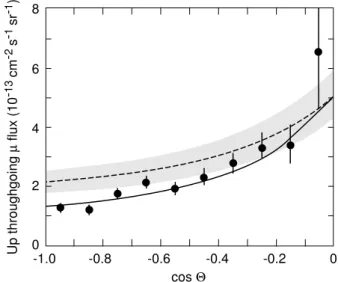
in the rock below the detector; theνµ’s have an average en-ergy Eν ∼ 50 GeV [2,3]. The data refer to a lifetime of 6.16 years (full detector equivalent). The data deviate in absolute value and in shape from Monte Carlo (MC) predic-tions, see Fig. 2. We studied a large number of possible effects that could affect our measurements: no significant systematic problems exist in the detector or in the data anal-yses.
The measured data have been compared with MC simu-lations. For the upthroughgoing muon simulation, the neu-trino flux computed by the Bartol group was used [4]. The cross sections for the neutrino interactions were calculated
using the deep inelastic parton distributions of ref. [5]. The muon propagation to the detector was done using the en-ergy loss calculation in standard rock. The total systematic uncertainty on the expected muon flux, obtained adding in quadrature the errors from neutrino flux, cross section and muon propagation, is estimated to be 17 %. This uncertainty is mainly a scale error; the error on the shape of the angular distribution is∼5%.
8
Up throughgoing
µ
flux (10
-13
cm
-2 s
-1 sr
-1)
6
4
2
0
-1.0 -0.8 -0.6 -0.4 -0.2 0
cos Θ
Figure 2. Zenith angle distribution of upthroughgoing muons (black points). The dashed line is the expectation for no oscillations (with a 17 % scale uncertainty band). The solid line is the fit for an oscillated muon flux which yields maximum mixing and∆m2= 2.5·10−3
eV2 [2] [3]. Figure 2 shows the zenith angle (Θ) distribution of the measured flux of upthroughgoing muons. The Monte Carlo expectation for no oscillations is shown as a dashed line. Assumingνµ →ντ oscillations, the best fit parameters are
∆m2= 2.5·10−3 eV2
andsin22θ= 1
Figure 3 shows the allowed region forνµ →ντ oscilla-tions in thesin2
2θ−∆m2
plane, computed according to ref. [6] for the upthroughgoing muon events; our region is com-pared with those obtained by the SuperKamiokande (SK) [7] and Soudan 2 [8] experiments.
MACRO
SOUDAN 2
SK
∆
m
2 (eV 2)
10-1
10-2
10-3
10-4
10-5
0 0.2 0.4 0.6 0.8 1.0
sin2 (2θ)
Figure 3. 90 % c.l. allowed regions for νµ → ντ oscilla-tions from upthroughgoing muons and comparison with the Soudan 2 and SK allowed regions (the Soudan 2 region is now smaller).
II.2 Matter effects.
ν
µ→
ν
τversus
ν
µ→
ν
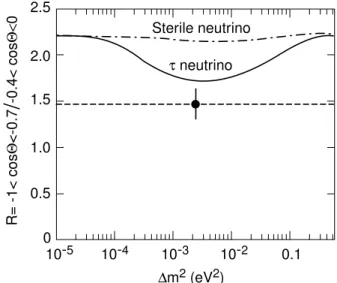
sterileMatter effects due to the difference between the weak interaction effective potential for muon neutrinos with re-spect to sterile neutrinos would produce a different total number and a different zenith distribution of upthrough-going muons [9]. In Fig. 4 the measured ratio between the events with −1 < cosΘ < −0.7 and the events with −0.4 < cosΘ < 0 is shown as a black point. In this ra-tio most of the theoretical uncertainties on neutrino flux and cross section cancel. The remaining theoretical error com-bined with the experimental error is estimated to be7%. We measured 305 events with−1< cosΘ<−0.7and 206 with −0.4< cosΘ<0; the ratio is R =1.48±0.13stat±0.10sys. For∆m2 = 2.5·10−3 eV2
and maximal mixing, the ex-pected value of the ratio forνµ → ντ isRτ = 1.72while forνµ→νsisRsterile = 2.16. The maximum probabilities
Pbestto find a value ofRτ and ofRsterilesmaller than the expected ones are 9.4 % and 0.06 % respectively. The ratio of the maximum probabilities isPbestτ/Pbeststerile = 157,
so that νµ → νs oscillations are disfavoured at 99% c.l. compared to theνµ→ντ channel [3,9].
II.3
ν
µenergy estimates by MCS of
upthrough-going muons
The oscillation probability is a function of the ratio
L/Eν, Eq. 3. Even if a precise measurement ofEν is not possible, MC simulations have shown a correlation between
Eν and the residual muon energyEµ. Eν was thus esti-mated for each event by measuring the muon energyEµ, via Multiple Coulomb Scattering (MCS) of the iduced muon in
Sterile neutrino
τ neutrino 2.5
2.0
R= -1< cos
Θ
<-0.7
/
-0.4< cos
Θ<
0
1.5
1.0
0.5
0
10-5 10-4 10-3 10-2 0.1
∆m2 (eV2)
Figure 4. Ratio of events with−1< cosθ <−0.7to events with−0.4< cosθ <0vs∆m2
23for maximal mixing. The black point is the measured value, the solid line is the pre-diction forνµ →ντ oscillations, the dash-dotted line is the prediction forνµ →νsterileoscillations.
the absorbers. The r.m.s. of the lateral displacement for a muon crossing the apparatus on the vertical isσM CS ≃
10 cm/Eµ( GeV). The muon energyEµ can be measured up to a saturation point, occurring whenσM CSis compara-ble with the detector space resolution. A first analysis was made studying the deflection of upthroughgoing muons with the streamer tubes in “digital mode”. This method could reach a spatial resolution of∼1 cmwhich implies a maxi-mum measurable energy of 10 GeV [10]. As the interesting energy region for atmospheric neutrino oscillations spans from∼ 1 GeV to tens of GeV, it is important to improve the spatial resolution of the detector to push the saturation point as high as possible. For this purpose, a second anal-ysis was performed with the streamer tubes used in “drift mode”. To check the electronics and the feasibility of the analysis, two tests were performed at the CERN PS-T9 and SPS-X7 beams. The space resolution achieved is≃3 mm, a factor 3.5 better than in the first analysis. For each muon, seven MCS sensitive variables were given in input to a Neu-ral Network (NN) previously trained to estimate the muon energy with MC events of known energy crossing the de-tector at different zenith angles. The method allowed to separate the upthroughgoing muons in 4 subsamples cor-responding to average neutrino energies of 12, 20, 50 and 102 GeV, respectively. The comparison of the 4 zenith an-gle distributions with the predictions of the no oscillations MC shows a disagreement at low energies (where there is a deficit of vertical events), while the agreement is restored at the higher neutrino energies. The distribution of the ratios
0 0.2 0.4 0.6 0.8 1 1.2
1.5 2 2.5 3 3.5 4
Figure 5. Data/MC vsL/Eνfor upthrougoing muons (black circles) and for semicontained up-µ (black square). The muon energy was estimated by MCS andEν by MC meth-ods. The shaded region represents the uncertainty in the MC prediction assumingsin2
2θ = 1and∆m2 = 0.0025 eV2
. The horizontal dashed line at Data/MC=1 is the expectation for no oscillations.
shaded areas represents the uncertainties on the MC predic-tions for νµ → ντ oscillations with maximal mixing and
∆m2
= 2.5·10−3 eV2
. The horizontal dashed line is the expectation without oscillations. The black square point was obtained from the low energy IU sample.
II.4 Low energy data
TheInternal Upgoing (IU) muonscome fromνµ
inter-actions in the lower apparatus; for these events two
scintilla-tion counters are intercepted; the T.o.F. is applied to identify upward going muons. The average parent neutrino energy for these events is 4.2 GeV. For neutrino oscillations one ex-pects a reduction by about a factor of two in the flux, without any distortion in the shape of the angular distribution. This is what is observed in Fig. 6a, [12].
Theupstopping muons(UGS) are due to externalνµ
in-teractions yielding upgoing muons stopping in the detector.
The semicontained downgoing muons(ID) are due to νµ
-induced downgoing muon tracks with vertex in the lower MACRO (Fig. 1). The two types of events are identified by topological criteria; the lack of time information prevents to distinguish the two sub-samples. An almost equal number of UGS and ID events is expected. In case of oscillations, the flux of the UGS muons should be reduced by 50%; no reduction is instead expected for the semicontained down-going events (coming from neutrinos with path lengths of ∼20 km); therefore one expects a global reduction of 25%. The number of events and the angular distributions are compared with MC predictions in Table 1 and Figs. 6a,b. The data show a uniform deficit for the whole angular dis-tribution with respect to predictions, ∼ 50% for IU, 75% for ID + UGS; there is good agreement with the predictions based on neutrino oscillations with the parameters obtained from the upthroughgoing muons. The average value of the double ratio R = (Data/M C)IU/(Data/M C)ID+U GS over the measured zenith angle range isR≃0.77±0.07; the error includes statistical and theoretical uncertainties;R= 1 is expected in case of no oscillations.
Number of e
vents
0 20 40 60 80
-1.0 -0.8 -0.6 -0.4
cos Θ cos Θ
-0.2 0
IU ID + UGS
(a)
Number of e
vents
0 20 40 60 80 100
-1.0 -0.8 -0.6 -0.4 -0.2 0 (b)
Figure 6. Zenith distributions for (a) the upsemicontained (IU) and (b) the upstopping plus the downsemicontained (UGD+ID) events. The black points are the data, the dashed lines at the center of the shaded regions correspond to MC predictions assuming no oscillations. The full line is the expectation forνµ→ντoscillations.
Events MC-No oscillations R= (Data/M Cnoosc)
Up throughgoing 809 1122±191 (0.721±0.026stat±0.043sys±0.123th) Internal Up 154 285±28sys±71th (0.54±0.04stat±0.05sys±0.13th) Up Stop + In Down 262 375±37sys±94th (0.70±0.04stat±0.07sys±0.17th)
Table 1. Summary of MACROνµ→µevents in−1< cosθ <0(after background subtraction) for oscillation studies. For each topology
III
Search for Astrophysical Sources
of High Energy Muon Neutrinos
High energyνµare expected to come from several galactic and extragalactic sources. Neutrino production requires as-trophysical accelerators of charged particles and some kind of astrophysical beam dumps.
The excellent angular resolution of our detector allowed a sensitive search for upgoing muons produced by neutri-nos coming from celestial point sources, with a negligible atmospheric neutrino background. An excess of events was searched for around the positions of known sources in 3◦ (half width) angular bins. This value was chosen so as to take into account the angular smearing due to multiple muon scattering in the rock below the detector and by the energy-integrated angular distribution of the scattered muon, with respect to the neutrino direction.
The pointing accuracy of the detector was checked with the observation of the shadow of primary cosmic rays (and thus on downgoing muons) by the Moon and the Sun [13]. It was also checked with the study of the correlations between muons detected by MACRO and extensive air showers de-tected by the EASTOP experiment located above the Gran Sasso massif [14].
In a total lifetime of 6.16 y we obtained a total of 1356 events, see Fig. 7a [3, 13]. The 90% c.l. upper limits on the muon fluxes from specific celestial sources lay in the range10−15−10−14cm−2s−1, see Fig. 7b. The solid line is our sensitivity vs declination. Notice that we have two cases, GX339-4 (α= 255.71o,δ=−48.79o) and Cir X-1 (α= 230.17o,δ=−57.17o), with 7 events: in Fig. 7b they are considered as background, therefore the upper flux lim-its are higher; but they could also be indications of signals [3, 15]. We searched for time coincidences of our upgoing
muons with sources ofγ-ray bursts as given in the BATSE 3B and 4B catalogues, for the period from April 91 to De-cember 2000 [15]. No statistically significant time correla-tion was found.
We have also searched for a diffuse astrophysical neu-trino flux, for which we establish a flux upper limit at the level of1.5·10−14cm−2s−1[16].
IV
Indirect Searches for WIMPs
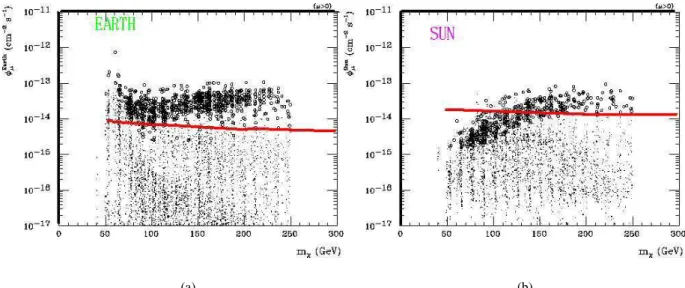
Weakly Interacting Massive Particles (WIMPs) could be part of the galactic dark matter; they could be intercepted by celestial bodies, slowed down and trapped in their cen-ters, where WIMPs and anti-WIMPs could annihilate and yieldνµ → upthroughgoing muons. The annihilations in these celestial bodies would yield neutrinos of GeV- TeV energy, in small angular windows from their centers. For the Earth we have chosen a15o cone around the vertical: we find 863 events. The MC expectation for atmosphericνµ without oscillations gives a larger number of events. We set a conservative flux upper limit assuming that the measured number of events equals the expected ones. We obtain the 90 %c.l. limits for the upgoing muon flux shown in Fig. 8a (it varies from 0.8 to 0.510−14cm−2s−1
) [17, 3]. If the WIMPs are identified with the smallest neutralino mass, our limits may be used to constrain the neutralino mass, follow-ing the model of ref. [18], Fig. 8a.
A similar procedure was used to search for muon neu-trinos from the Sun, using 10 search cones from3oto30o. In the absence of statistically significant excesses the muon flux upper limits are at the level of1.5−2·10−14cm−2s−1
. The limits are shown in Fig. 8b as a function of the WIMP (neutralino) mass.
(a) (b)
Figure 7. High energyνµ astronomy. (a) Upgoing muon distribution in equatorial coordinates (1356 events). (b) The black points are
(a) (b)
Figure 8. (a) The solid line is the MACRO upwardgoing muon flux upper limit (90% c.l.) from the Earth plotted vs neutralino massmχ.
(b) The same as in (a) but for upwardgoing muons from the Sun. Each dot is obtained varying model parameters. The open circles indicate modelsexcluded by direct measurements assuming a local dark matter density of0.5 GeVcm−3
.
V
Neutrinos from Stellar
Gravita-tional Collapses
A stellar gravitational collapse (GC) of the core of a mas-sive star is expected to produce a large burst of all types of neutrinos and antineutrinos with energies of 7−30 MeV and with a duration of < 10 s. The ¯νe’s can be detected via the processν¯e+p→ n+e+ in the liquid scintillator. About100÷150 ¯νeevents should be detected in our 580 t scintillator for a stellar collapse at the center of our Galaxy. We used two electronic systems to search for bursts of ¯
νe’s from stellar gravitational collapses. The first system was based on the dedicated PHRASE trigger, the second one was based on the ERP general trigger. Both had energy thresholds of ∼ 7 MeV and recorded pulse shape, charge and timing informations. Immediately after a trigger, the PHRASE system lowered its threshold to 1 MeV, for a du-ration of 800µs, in order to detect (with a ≃ 25 % effi-ciency) the 2.2 MeV γ released in the reactionn + p →
d + γ2.2 MeV induced by the neutron produced in the
pri-mary process.
A redundant supernovae alarm system was in operation, alerting immediately the physicists on shift. We defined a general procedure to alert the physics and astrophysics com-munities in case of an interesting alarm. Finally, a procedure to link the various supernova observatories around the world was set up [3, 19].
The effective MACRO active mass was∼580 t; the life-time fraction was≃97.5 %; we kept always ruming at least 1-2 supermodules. No stellar gravitational collapses were observed in our Galaxy from the beginning of1989to the end of 2000 [3][19].
VI
Conclusions
The MACRO detector took data from 1989 to the end of the year 2000 and it obtained important results in all the items listed in the proposal, in particular:
• Atmospheric neutrino oscillations. Analyses of dif-ferent event topologies at difdif-ferent energies, the ex-ploitation of the muon Coulomb multiple scattering in the detector give strong support to the hypothesis ofνµ→ντoscillations with∆m2= 0.0025eV2and maximal mixing. We are presently making the final global analysis of all our data.
• High energy muon neutrino astronomy. MACRO has been highly competitive with other underground ex-periments thanks to its large acceptance and good an-gular accuracy. It has been limited by its lifetime and the size of the detector.
• Search for bursts ofν¯efrom stellar gravitational col-lapses. MACRO was sensitive to supernovae events in our Galaxy, it started the SN WATCH system, and for a certain time it was the only detector in operation. • Sensitive indirect searches have been carried out for possible Dark Matter candidates like the neutralinos, looking for upgoing muons from the center of the Earth and from the Sun.
It may be pointed out that MACRO also obtained the best flux upper limits for GUT Magnetic Monopoles over the widestβrange [20].
Acknowledgments
in particular Drs. Y. Becherini, M. Giorgini and M. Spurio. I thank Ms Anastasia Casoni for typing and correcting the manuscript.
References
[1] S. Ahlen et al., Nucl. Instr. Meth. Phys. Res. A 324, 337 (1993); M. Ambrosio et al, Nucl. Instr. Meth. Phys. Res. A 486, 663 (2002); hep-ex/0207043.
[2] S. Ahlen et al., Phys. Lett. B357, 481 (1995); Phys. Lett. B 434, 451 (1998).
[3] M. Ambrosio et al., hep-ex/0206027.
[4] V. Agrawal et al., Phys. Rev. D53, 1314 (1996).
[5] M. Gluck et al., Z. Phys. C67, 433 (1995).
[6] G. Feldman and R. Cousins, Phys. Rev. D57, 3873 (1998).
[7] SK Coll., Y. Fukuda et al., Phys. Rev. Lett.81, 1562 (1998); Phys. Rev. Lett.85, 3999 (2000); hep-ex/0105023.
[8] Soudan 2 Coll., W.W.M. Allison et al., Phys. Lett. B449, 137 (1999).
[9] M. Ambrosio et al., Phys. Lett. B517, 59 (2001).
[10] D. Bakari et al., hep-ex/01050871.
[11] M. Ambrosio et al., Nucl. Instr. Meth. Phys. Res. A ??????, hep-phys/0203018.
[12] M. Ambrosio et al., Phys. Lett. B 478, 5 (2000); hep-ex/01120021.
[13] M. Ambrosio et al., Phys. Rev. D59, 012003 (1999).
[14] EASTOP-MACRO Coll., M. Aglietta et al., Phys. Lett. B 337, 376 (1994).
[15] M. Ambrosio et al., Astrophys. J.546, 1038 (2001).
[16] M. Ambrosio et al., astro-phys/0203181.
[17] M. Ambrosio et al., Phys. Rev. D60, 082002 (1999).
[18] A. Bottino et al., Proceedings of the Ringberg Euroconf.New Trends in Neutrino Physics, Ringberg Castle, Germany, 1998, edited by B. Kniel, World Scientific, Singapore.
[19] M. Ambrosio et al., Astroparticle Phys.8, 123 (1998).