Molecular Parameters for the Band Systems A, B
−
X of AuH and A
−
X of AuD
N. Rajamanickam, M. Vignesh Kumar, V. Raja, and B. Karthikeyan Physics Research Centre, VHNSN College, Virudhunagar - 626 001, India
Received on 18 October, 2006
Franck-Condon factors (vibrational transition probabilities) and r-centroids have been evaluated by a numer-ical integration procedure for the bands of A 0+g −X1Σ+, B 0+g−X1Σ+systems of AuH and A 0+ − X1Σ+system of AuD molecules using a suitable potential. The physical and astrophysical significances of our evaluated Franck-Condon factors and r-centroids have also been discussed, which would be helpful in the prediction of the presence of AuH and AuD molecules in various celestial bodies.
Keywords: Franck-Condon factors; r-centroids; AuH and AuD molecules
I. INTRODUCTION
The theoretical prediction of intensity distribution in the molecular band system requires a knowledge of molecular parameters like vibrational transition probabilities, which are to a good approximation proportional to the Franck-Condon (FC) factors and r-centroids. A precise knowledge of FC fac-tors and related quantities are essential for understanding and calculating many important data for the molecules, e.g., radia-tive lifetime, vibrational temperature and kinetics of energy transfer. Both the molecular parameters that is FC factors and r-centroids play an important role to arrive at the variation of electronic transition moment with internuclear separation, rel-ative band strength and vibrational temperature of the source [1-2]. The vibrational transition probability parameters for the diatomic molecules are therefore necessary for diagnostic ap-plications in astronomy, astrophysics and allied subjects.
The gold atom and its compounds are well-known examples for the influence of relativistic effects on atomic and mole-cular properties [3-5]. In astrophysical application, Johnson et al. [6] calculated the weighted column densities for 248 molecules including AuH which could be possibly present in an oxygen-rich (O-rich) star under the effective temperature 2500≤Te f f≤4000 K.
As there has been no report on the FC factors and r-centroids for the emission band systems A 0+g−X1Σ+, B 0+g−X1Σ+of AuH and A 0+−X1Σ+of AuD, we have computed the values of FC fators and r-centroids for these band systems by the numerical integration procedure using a suitable potential.
II. THEORY
The intensity (Iv′v′′) of a molecular band for an electronic
transition in emission is
Iv′v′′=DNv′Ev4′v′′pv′v′′ (1)
whereDis a constant partly depending on the geometry of the apparatus,Nv′ is the population of the levelv′,Ev′v′′ (=λ−1v′v′′)
is the quantum energy andpv′v′′is the band strength. In terms
of the electronic transition momentRe,pv′v′′is given by pv′v′′=R2e(r¯v′v′′)qv′v′′ (2)
The quantitiesqv′v′′ and ¯rv′v′′ are the Franck-Condon factors
and r-centroids respectively. The form of qv′v′′ can be
ex-pressed as the square of the vibrational overlap integral qv′v′′=|ψv′|ψv′′|2 (3)
whereψv′ andψv′′ are the vibrational wave functions for the
upper and lower states respectively. The r-centroid (¯rv′v′′)
represents the characteristic internuclear separation ofv′−v′′ transition in a diatomic molecular band system and is defined by
¯
rv′v′′=ψv ′|r|ψv′′
ψv′|ψv′′ (4)
Keeping these in view, the FC factors and r-centroids for some electronic band systems of AuH and AuD molecules could be computed as per the procedure described below.
III. COMPUTATIONAL PROCEDURE
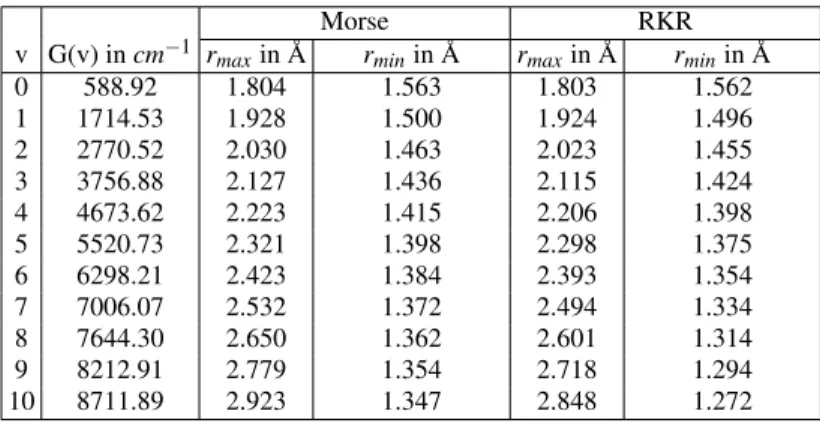
For a proper understanding of the intensity distribution in the band system of the molecule, it is necessary to choose a suitable potential. The potential energy curves for the elec-tronic states of A, B, X, of AuH and A, X of AuD molecules have been constructed using Morse [7] function and also by Rydberg-Klein-Rees (RKR) procedure as modified by Van-dersliceet al. [8]. The vibrational energyG(v), the turning pointsrmax,mindata are reported in tables I to V. It is found that the Morse function represents the potential energy curves of all the electronic states quite adequately, since the RKR curve is nearly coincident with the Morse one.
The Morse functions are then calculated at the intervals of 0.01 ˚A for′r′ ranging from 1.23 ˚A to 1.43 ˚A, from 1.25 ˚A to 2.54 ˚A and from 1.24 ˚A to 2.94 ˚A for every observed vi-brational level of each state of A−X, B−X systems of AuH and A−X system of AuD molecules. Once the appropriate wave functions are obtained, the FC factors can be deter-mined by evaluating the integral in equation (3). The defin-ition of r-centroid offers a method of computing r-centroids directly. The computation of the FC factors is made by Bates’ [9] method of numerical integration according to the detailed procedure provided by Partal Urena et al [10].
TABLE I: Turning points for the molecular vibration in the A-state of AuH
Morse RKR
v G(v) incm−1 rmaxin ˚A rminin ˚A rmaxin ˚A rminin ˚A
0 820.52 1.835 1.548 1.835 1.547
1 2367.18 1.986 1.474 1.998 1.470
2 3768.34 2.109 1.432 2.120 1.421
3 5000.44 2.220 1.403 2.259 1.376
4 6039.89 2.322 1.383 2.406 1.335
5 6863.11 2.410 1.368 2.554 1.297
TABLE II: Turning points for the molecular vibration in the B-state of AuH
Morse RKR
v G(v) incm−1 rmaxin ˚A rminin ˚A rmaxin ˚A rminin ˚A
0 753.75 1.869 1.568 1.862 1.561
1 2150.25 2.042 1.497 2.017 1.472
2 3398.75 2.195 1.457 2.151 1.413
3 4499.25 2.351 1.429 2.284 1.362
4 5451.75 2.519 1.409 2.425 1.315
TABLE III: Turning points for the molecular vibration in the X-state of AuH
Morse RKR
v G(v) incm−1 rmaxin ˚A rminin ˚A rmaxin ˚A rminin ˚A
0 1141.72 1.657 1.414 1.658 1.415
1 3360.35 1.774 1.346 1.776 1.348
2 5492.34 1.866 1.304 1.870 1.307
3 7537.43 1.950 1.273 1.954 1.277
TABLE IV: Turning points for the molecular vibration in the A-state of AuD
Morse RKR
v G(v) incm−1 rmaxin ˚A rminin ˚A rmaxin ˚A rminin ˚A
0 588.92 1.804 1.563 1.803 1.562
1 1714.53 1.928 1.500 1.924 1.496
2 2770.52 2.030 1.463 2.023 1.455
3 3756.88 2.127 1.436 2.115 1.424
4 4673.62 2.223 1.415 2.206 1.398
5 5520.73 2.321 1.398 2.298 1.375
6 6298.21 2.423 1.384 2.393 1.354
7 7006.07 2.532 1.372 2.494 1.334
8 7644.30 2.650 1.362 2.601 1.314
9 8212.91 2.779 1.354 2.718 1.294
10 8711.89 2.923 1.347 2.848 1.272
TABLE V: Turning points for the molecular vibration in the X-state of AuD
Morse RKR
v G(v) incm−1 rmaxin ˚A rminin ˚A rmaxin ˚A rminin ˚A
0 811.82 1.635 1.430 1.635 1.430
1 2401.40 1.729 1.370 1.730 1.371
2 3945.41 1.802 1.333 1.803 1.335
3 5443.67 1.867 1.305 1.869 1.307
4 6896.02 1.927 1.283 1.930 1.285
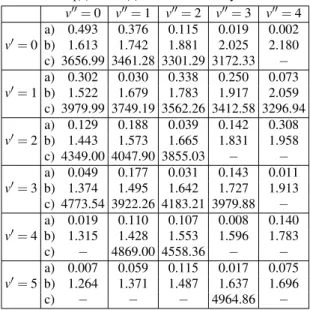
TABLE VI:qv′v′′and ¯rv′v′′of A−X band system of AuH
v′′=0 v′′=1 v′′=2 v′′=3 v′′=4 a) 0.493 0.376 0.115 0.019 0.002
v′=0 b) 1.613 1.742 1.881 2.025 2.180 c) 3656.99 3461.28 3301.29 3172.33 −
a) 0.302 0.030 0.338 0.250 0.073
v′=1 b) 1.522 1.679 1.783 1.917 2.059 c) 3979.99 3749.19 3562.26 3412.58 3296.94 a) 0.129 0.188 0.039 0.142 0.308
v′=2 b) 1.443 1.573 1.665 1.831 1.958 c) 4349.00 4047.90 3855.03 − −
a) 0.049 0.177 0.031 0.143 0.011
v′=3 b) 1.374 1.495 1.642 1.727 1.913 c) 4773.54 3922.26 4183.21 3979.88 −
a) 0.019 0.110 0.107 0.008 0.140
v′=4 b) 1.315 1.428 1.553 1.596 1.783
c) − 4869.00 4558.36 − −
a) 0.007 0.059 0.115 0.017 0.075
v′=5 b) 1.264 1.371 1.487 1.637 1.696
c) − − − 4964.86 −
TABLE VII:qv′v′′and ¯rv′v′′of B−X band system of AuH
v′′=0 v′′=1 v′′=2 v′′=3 a) 0.386 0.395 0.172 0.045
v′=0 b) 1.624 1.740 1.864 1.986
c) 2361.98 2281.73 − −
a) 0.294 ∗ 0.211 0.292
v′=1 b) 1.550 1.785 1.904
c) 2492.61 2428.83 −
a) 0.158 0.080 0.127 0.009
v′=2 b) 1.488 1.614 1.706 1.847 c) 2715.83 2615.62 2567.17 2514.06 a) 0.078 0.126 0.007 0.122
v′=3 b) 1.436 1.552 1.597 1.766
c) 2822.84 2776.77 − −
a) 0.038 0.110 0.010 0.090
v′=4 b) 1.394 1.503 1.653 1.705
c) 2875.51 − − −
the bands of A−X, B−X systems of AuH and A−X system of AuD molecules and the results are tabulated respectively in tables VI to VIII. The available wavelengths data (λv′v′′)
[11-13] are also entered. The molecular constants used in the present study are collected from the compilation of Huber and Herzberg [14].
IV. RESULTS AND DISCUSSION
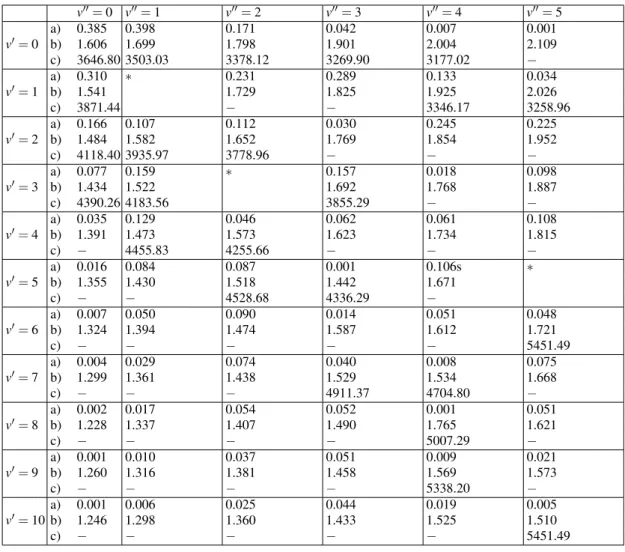
The FC factors indicate that the (0,0), (0,1), (1,0), (1,2), (1,3) and (2,4) bands are bright and all the other bands are comparatively weak for the band system of A−X of AuH. In the case of B−X band system of AuH, FC factors divulge that (0,0), (0,1), (1,0), (1,2) and (1,3) bands are strong when com-pared to other bands. On investigating the FC factors for the band systems A−X of AuD molecule, it is found that the (0,0),
(0,1), (1,0), (1,2), (1,3), (2,4) and (2,5) bands are prominent while all the other bands are weak. We have obtained the FC factor ratio (intensity ratio) for the (0,0) band in A−X system as 1 : 0.7819 of AuH : AuD.
The sequence differences for the A−X and B−X band sys-tems of AuH are found to be varying from 0.014 ˚A to 0.084
˚
A and from 0.040 ˚A to 0.067 ˚A respectively. In case of A−X band system of AuD, the sequence differences are found to be varying in between 0.001 ˚A to 0.070 ˚A.
TABLE VIII:qv′v′′and ¯rv′v′′of A−X band system of AuD
v′′=0 v′′=1 v′′=2 v′′=3 v′′=4 v′′=5
a) 0.385 0.398 0.171 0.042 0.007 0.001
v′=0 b) 1.606 1.699 1.798 1.901 2.004 2.109
c) 3646.80 3503.03 3378.12 3269.90 3177.02 −
a) 0.310 ∗ 0.231 0.289 0.133 0.034
v′=1 b) 1.541 1.729 1.825 1.925 2.026
c) 3871.44 − − 3346.17 3258.96
a) 0.166 0.107 0.112 0.030 0.245 0.225
v′=2 b) 1.484 1.582 1.652 1.769 1.854 1.952
c) 4118.40 3935.97 3778.96 − − −
a) 0.077 0.159 ∗ 0.157 0.018 0.098
v′=3 b) 1.434 1.522 1.692 1.768 1.887
c) 4390.26 4183.56 3855.29 − −
a) 0.035 0.129 0.046 0.062 0.061 0.108
v′=4 b) 1.391 1.473 1.573 1.623 1.734 1.815
c) − 4455.83 4255.66 − − −
a) 0.016 0.084 0.087 0.001 0.106s ∗
v′=5 b) 1.355 1.430 1.518 1.442 1.671
c) − − 4528.68 4336.29 −
a) 0.007 0.050 0.090 0.014 0.051 0.048
v′=6 b) 1.324 1.394 1.474 1.587 1.612 1.721
c) − − − − − 5451.49
a) 0.004 0.029 0.074 0.040 0.008 0.075
v′=7 b) 1.299 1.361 1.438 1.529 1.534 1.668
c) − − − 4911.37 4704.80 −
a) 0.002 0.017 0.054 0.052 0.001 0.051
v′=8 b) 1.228 1.337 1.407 1.490 1.765 1.621
c) − − − − 5007.29 −
a) 0.001 0.010 0.037 0.051 0.009 0.021
v′=9 b) 1.260 1.316 1.381 1.458 1.569 1.573
c) − − − − 5338.20 −
a) 0.001 0.006 0.025 0.044 0.019 0.005
v′=10 b) 1.246 1.298 1.360 1.433 1.525 1.510
c) − − − − − 5451.49
a)qv′v′′; b) ¯rv′v′′(A˚); c) Wavelengthλv′v′′(A˚);∗qv′v′′≈0
V. CONCLUSION
The reported Franck-Condon factor and r-centroid values could be considered as satisfactory and reliable as they have been evaluated by the numerical integration procedure with the suitable potential function. The FC factors are directly proportional to the intensities of the bands and the intensity ratios reflect the abundance of the molecules [15]. Hence the
above indicated intensity ratio may be interpreted as if AuH is present in an astrophysical object, there is about 78 percent possibility for the existence of AuD molecule also. For ex-ample, as already mentioned, AuH is predicted to exist in the O-rich star [6]. If the presence of AuH is confirmed in O-rich star, one may expect the presence of AuD molecule too in the same source. Therefore, the present study results are signifi-cant.
[1] N. Rajamanickam, J. Quant. Spectrosc. Radiat. Transfer37, 207 (1987).
[2] N. Rajamanickam, Acta Phys. Hung.63, 341 (1988).
[3] J. P. Desclanx and P. Pyykko, Chem. Phys. Lett.39, 300 (1976). [4] Y. Watanabe and O. Matsuoka, J. Chem. Phys. 116, 9585
(2002).
[5] I. Nakajima, T. Hanal, and K. Hirao, J. Comput. Chem.23, 847 (2002).
[6] H.R. Johnson and A.J. Sauval, Astron. Astrophys. Suppl. Ser.
49, 77 (1982).
[7] P. M. Morse, Phys. Rev.34, 57 (1929).
[8] J. T. Vanderslice, E. A. Mason, W. G. Maisch, and E. R. Lip-pincott, J. Mol. Spectr.5, 83 (1960).
[9] D. R. Bates, Proc. Rov. Soc. A196, 217 (1949).
[11] T. Heimer, Zeitschrift fur Physik101, 121 (1936). [12] T. Heimer, Zeitschrift fur Physik104, 303 (1937). [13] U. Ringstrom, Arkiv foer Fysik27, 227 (1964).
[14] K. P. Huber and G. Herzberg, Molecular Spectra and Molec-ular Structure, Vol. IV Constants of Diatomic Molecules, Van
Nostrand Reinhold, NewYork (1979).