of these findings for the proper interpretation of behavioral studies withwhitemutant flies are discussed.
Citation:Krstic D, Boll W, Noll M (2013) Influence of theWhiteLocus on the Courtship Behavior ofDrosophilaMales. PLoS ONE 8(10): e77904. doi:10.1371/ journal.pone.0077904
Editor:Bruno van Swinderen, Queensland Brain Institute, Australia
ReceivedAugust 7, 2013;AcceptedSeptember 4, 2013;PublishedOctober 30, 2013
Copyright:ß2013 Krstic et al. This is an open-access article distributed under the terms of the Creative Commons Attribution License, which permits unrestricted use, distribution, and reproduction in any medium, provided the original author and source are credited.
Funding:This work has been supported by the Swiss National Science Foundation grant 3100A0-105823 (to M.N.) and by the Kanton Zu¨rich, Switzerland. The funders had no role in study design, data collection and analysis, decision to publish, or preparation of the manuscript.
Competing Interests:The authors have declared that no competing interests exist.
* E-mail: [email protected]
¤ Current address: Institute of Pharmacology and Toxicology, University of Zu¨rich, Zu¨rich, Switzerland
Introduction
The vinegar fly Drosophila melanogaster serves as an excellent model system to study the control of innate behaviors by the nervous system. The mating behavior ofDrosophilaconsists of well-defined sequential steps that are usually repeated several times until copulation takes place [1–3]. While performing this elaborate courtship ritual, both partners receive a plethora of information in form of chemical and physical signals processed by their olfactory, gustatory, visual, auditory, and mechanosensory organs. These cues determine the courtship behavior and, through their integration in the brain, provide to both partners information about gender, conspecificity, receptivity, and even sexual fitness [4].
The protein encoded by the white (w) gene of Drosophila is a transmembrane ABC transporter involved in the uptake of guanine and tryptophan, which are indispensable precursors in the synthesis of red (drosopterins) and brown (the ommochrome xanthommatin)Drosophilapigments [5–7] (Figure 1). The absence of pigments in the eye of flies without a functionalwgene results in ommatidia without optical insulation. Hence the vision of such white-eyed flies is impaired, especially at high light intensities. These flies have a significantly reduced visual acuity [8] and show no response in optomotor tests [9]. Their photoreceptors receive about 19 times more light than those of wild-type flies [8], and their electroretinograms are abnormal [10]. Since guanine is further required for the synthesis of dopamine and serotonin [11,12] and tryptophan is also a precursor of serotonin [13] (Figure 1), w mutants display altered levels and distributions of these neurotransmitters [14]. Accordingly, mutations affecting the
w function have an impact on the neural control of various behaviors, independent of proper eyesight [15–19].
Specifically,Drosophilamales that ectopically overexpress thew
gene were shown to vigorously court each other and form courtship chains, a behavior called chaining [20,21], which implied a function of w in the control of courtship behavior. Subsequent work suggested that increased male-male courtship results from overexpression-induced mislocalization of White protein within the cells that normally express it [22]. In apparent agreement with this hypothesis, w mutant males did not show enhanced male-male courtship and consequently did not chain [20–22].
Yet contrary to this hypothesis, we demonstrate here that the absence, or insufficient levels, of extra-retinal White protein causes enhanced male-male courtship, observed both in chaining and single-choice courtship assays. We further show that not only visual acuity ofwmutant males is impaired, but that their behavior in daylight largely results from an overflow of light, which impeded the proper interpretation of earlier results on courtship behavior of
wmales [20–22]. In addition, we demonstrate that ‘rescue’ ofw
mutants by the standard mini-white gene does not rescue all behavioral aspects of wild-type behavior. Finally, we present results which suggest that the enhanced male-male courtship ofw
Materials and Methods
Fly Stocks
The genotype of transgenicPoxn-pResflies isDXBs6;PoxnD M22-B5
/PoxnDM22-B5DPBs96.2[4,23]. In thesePoxnDM22-B5flies that are deficient for thePoxngene, allPoxnfunctions are rescued by two
Poxntransgenes,DXBs6andDPBs96.2, except those required for taste bristle development [4]. It should be noted that bothDXBs6
and DPBs96.2[23] include a mini-whitemarker gene in the pW6 vector [24]. The genotype of mini-whiteflies isP{mini-white UAS-Poxn-6} inserted on the second chromosome [25,26]. Since two independent mini-white insertion lines produced comparable results, we present results from only one line. The ninaB360d
mutant was kindly provided by William Pak. The w1118 mutant and a translocation of the white locus to the Y chromosome,
Dp(1;Y)w+y+(BL7060), were obtained from the Bloomington stock
center.
Courtship Assays
All courtship assays, manipulations of object flies, and fly husbandry were performed as described [4]. The courtship vigor index, cvi, is defined as fraction of time the male spent courting from courtship initiation, when first extending and vibrating a wing (love song), until copulation or the end of observation at 10 minutes [4]. Any of the following behaviors were scored as courting: wing vibration, tapping, licking, bending the abdomen, orienting, following with extended wings, and scanning. In daylight experiments with blindninaB360dorw1118males, bilateral wing vibration as well as wing extension that was not directed towards the female was scored as courting since these males never displayed such behaviors in the absence of a female in the courtship chamber. Periods of courtship were measured by eye with a stop watch as the depth of the courtship chamber (9 mm) [4] does not permit the flies to be in focus of the camera during the entire observation period. In addition, flies spend most of their time on the wall of the chamber, which renders male courtship behaviors in movies (taken from above the chamber) difficult to interpret. The advantage of courtship chambers of the size used here has been emphasized previously [4]. Results shown in Figures 2–5 were supplemented, for comparison, with courtship data taken from [4], as specified in the legends to the figures. This
is justified, as all courtship experiments presented here and in [4] were performed at the same time.
Statistical Methods
Statistics was performed by the use of GraphPad Prism statistics software, applying the nonparametric Kruskal-Wallis test, which does not assume a Gaussian distribution of the results, followed by Dunn’s post test to compare all pairs of groups. Instead of indicating significance markers in figures, we provided p values in the text and used double standard error bars in figures to facilitate ‘‘comparison by eye’’ [27].
Results
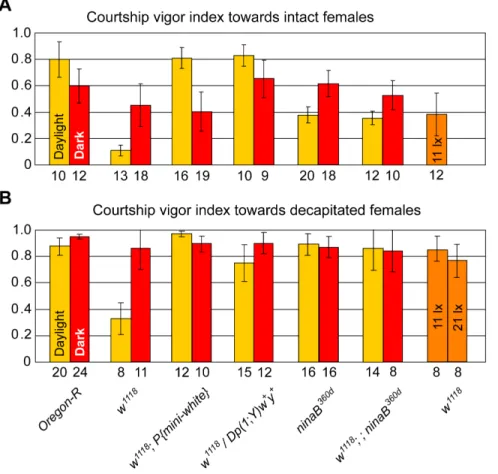
Reduced Sexual Arousal ofw1118Males in Daylight In daylight, the sexual arousal, induced by the presence of a receptive virgin female, was dramatically reduced inw1118males compared toOre-Rmales, as measured by their courtship vigor index cvi (Figure 2A, p,0.001; for cvi, see Material and Methods). This observation is consistent with the inability of w males to follow decamping females in daylight [4]. Accordingly, the low cvi of w1118 males in daylight was raised again to that of wild-type males by amini-whitegene expressed in the eye or by a genomicw+
gene translocated to the Y-chromosome (P{mini-white} or
Dp(1;Y)w+y+ in Figure 2A). In the dark, however, w1118
males displayed wild-type behavior, as indicated by a cvi comparable to that ofOre-Rmales (Figure 2A, p = 0.14). This is explained by the fact that males, in search of a decamping female, switch in the dark to a scanning strategy [4], independent of theirwgene activity. Similarly, the cvis of w1118 males, rescued by a mini-white or genomicw+gene, did not differ significantly in the dark from the
cvi ofOre-Rmales (Figure 2A, p = 0.11 or 0.51).
Astonishingly, the cvi ofw1118males towards intact females in daylight was also considerably lower than that of blindninaB360d
males (Figure 2A, p,0.001), whose blindness is caused by a block in the synthesis of the retinal chromophore of rhodopsin [28,29]. Moreover, unlike wild-typeOre-RandninaB360dmales that courted females, which had been decapitated to prevent them from decamping [4], very intensely in daylight, w1118 males courted such females in daylight three times less vigorously (Figure 2B, p,0.001). Removal of the retinal chromophore by combining the Figure 1. Role of White protein in the biosynthesis ofDrosophilaeye pigments and the neurotransmitters serotonin and dopamine. The White protein is an ABC transporter that, in combination with the Scarlet protein, transports tryptophan and, in combination with the Brown protein, guanine across the cell membrane into the cytoplasm [7]. Tryptophan is a precursor of theDrosophilaOmmochrome pigment xanthommatin (brown) [6], but is also a precursor of the neurotransmitter serotonin [13], as illustrated on the left. Guanine is a precursor of tetrahydrobiopterin (BH4), which in turn is a precursor of most Drosopterins (red eye pigments ofDrosophila) but also an essential cofactor in the conversion of tyrosine to dopamine, as indicated on the right, and of tryptophan to serotonin, as depicted on the left [11,12].
ninaB360d with the w1118 mutation enabledw1118 males again to court both decapitated and intact females in daylight with a cvi comparable to that of ninaB360d males (cf. w1118; ninaB360d with
ninaB360dmales in Figure 2A, p = 0.61; and in Figure 2B, p = 0.49). In the dark, however, ‘blind’ single- or double-mutant males
(w1118,ninaB360d, orw1118;ninaB360d) showed the same behavior as
Ore-R males in both assays, i.e., with intact (Figure 2A) or decapitated females (Figure 2B). Finally,w1118 males whose eye-pigmentation, and hence photoreceptor insulation, was rescued by Figure 2.w1118flies are not only optomotor blind but also dazzled by light.Courtship vigor indices were measured in single-choice courtship assays with mature males of indicated genotypes and receptive (A) or decapitated (B)Ore-Rvirgin females in daylight (yellow columns), under dim red light (red columns), or under low-intensity light conditions (orange columns). The numbers below the columns indicate the number of couples observed that initiated courtship, and error bars always represent double standard errors of the mean. Data forninaB360dmales in panel A are from [4].
doi:10.1371/journal.pone.0077904.g002
Figure 3. Lack of extra-retinal White function influences sexual orientation of males.Courtship vigor indices were measured in single-choice courtship assays with mature males of indicated genotypes and decapitated males (hatched columns) or decapitated females (filled columns) in the dark (red columns) or in daylight (yellow columns). The numbers below the columns indicate the number of males observed that initiated courtship. Data forOre-Rmales are from [4].
means ofmini-white or genomic w+, courted decapitated females
very vigorously, independent of light conditions (Figure 2B). These observations led us to hypothesize that in daylightw1118
males are not only lacking visual acuity and hence are optomotor blind, but that, in contrast toninaB360dmales, they are also dazzled by an excess of light because of the absence of photoreceptor insulation. To test this hypothesis, we evaluated the performance of w1118 males towards females under low-light intensities, at illuminances of 11 lx and 21 lx, which are about 40 and 20 times lower than standard daylight laboratory conditions. Since these illuminances do not represent darkness for the flies, wild-type males do not switch to the scanning strategy after losing track of females, but use visual cues for their pursuit (Movie S1). Indeed, under low light intensities, w1118 males courted decapitated females very intensely (orange bars at the far right in Figure 2B), and their cvi was comparable to that ofw1118in complete darkness
or when the chromophore of their rhodopsin had been removed by the ninaB360d mutation (Figure 2B). Similarly, intact females were courted byw1118males much more intensely at the reduced illuminance of 11 lx (Figure 2A, p,0.01) and to the same extent as by blind ninaB360d males in full daylight (Figure 2A), in good
agreement with our hypothesis. Like wild-type males,w1118males were never observed scanning under these conditions. Therefore, it is the excess of light under standard daylight conditions that is responsible for the reduced sexual arousal ofw1118males.
Reduced Sexual Discrimination ofw1118Males
We next examined the sexual orientation w1118 males. As in daylight the overflow of light reduces the sexual arousal ofw1118
males, they were tested for their courtship preference in the dark and, to avoid the influence of repellent feedback signals from the courted male, with decapitated object males and females in single-choice courtship assays [4]. The cvi of w1118 males towards decapitated males was enhanced as compared to that of Ore-R
males (Figure 3, p,0.001) and equaled the cvi of w1118 males towards decapitated females (Figure 3, p = 0.49). Strikingly, while supplementation ofw1118males with a genomicw+gene reduced
their elevated arousal towards decapitated males to the control level ofOre-Rmales (p = 0.22), their endowment with amini-white
gene clearly did not (Figure 3, p,0.01). As a control, males carrying themini-whitegene in aw+background behaved likeOre-R
males (Figure 3). In addition, neither the inactivation ofwnor its rescue by amini-whiteor genomicw+gene affected the high cvi of
males towards decapitated females, which was equal to that of Ore-Rmales (red filled columns in Figure 3, p = 0.31 forw1118vs. Ore-R, p = 0.10 for w1118; P{mini-white} vs. Ore-R, and p = 0.27 for
w1118;Dp(1;Y)w+y+vs.Ore-R).
In daylight,w1118males, rescued by a genomicw+ormini-white
gene, showed a clear preference toward decapitated females (Figure 3, p,0.001 in both cases). However, whilew1118males, rescued with a genomicw+gene, displayed the same
discrimina-tion against decapitated males asOre-Rmales (Figure 3, p = 0.46),
w1118males, supplemented withmini-white, showed a significantly increased cvi towards decapitated males as compared to Ore-R
males (Figure 3, p,0.01). Thus,w1118flies, rescued by amini-white
rather than a genomic w+ gene, displayed a clear reduction of
sexual discrimination in the dark as well in daylight.
Lack of Extra-retinal White Protein in Males Induces Chaining
Since an effect of White overexpression on courtship behavior has previously been demonstrated for groups of flies [20,21], we further examinedw1118males in chaining assays, in which eight sexually naı¨ve males were observed in daylight in a 10 mm x 35 mm Petri dish filled with a 6 mm agar layer [4]. Under these experimental conditions,w1118males, like wild-typeOre-Rmales, did not court each other, and thus no courtship chains were observed (Figure 4A), in agreement with previous observations [20–22]. However, it is important to emphasize thatw1118males are not expected to display a chaining behavior because (i) they are optomotor blind and hence are unable to follow other flies using visual cues [4], and (ii) excess of light under standard daylight conditions decreases their sexual arousal (Figure 2). In contrast,
w1118 males rescued by a mini-white gene (w1118; P{mini-white}) started courting each other only a few minutes after they had been placed into the Petri dish, whereas w1118 males rescued by a genomicw+gene (w1118
;Dp(1;Y)w+y+) did not chain (Figure 4A).
The chaining indices of groups of w1118; P{mini-white} males, defined as the percentage of time three or more males form a chain during a 10-minute observation period [30], were not very high, and the chains consisted usually of only 3 or 4 males. This behavioral phenotype ofw1118males carrying amini-whitegene was further rescued by a copy of the genomicw+gene or by replacing
the w1118 chromosome with a w+chromosome from Ore-R flies
(Figure 4A). Thus, the missing or reduced discrimination between decapitated females and males in the dark (Figure 3) is similar to Figure 4. Chaining behavior of males is stimulated by aw1118background.(A) In addition to the average chaining indices for groups of
eight males [30] of indicated genotypes, the number of groups for which chaining was observed over the total number of groups tested is shown. Error bars represent double standard errors. The result forPoxn-pResmales is from [4]. (B) Courtship chain of eightw1118;Poxn-pResmales. The picture was taken 10 min after eight mature, but sexually naı¨ve,w1118
the difference in chaining behavior shown in Figure 4A. In both cases, this deficiency is evident inw1118males only when they are supplemented with a mini-white gene but not when they are endowed with a genomicw+gene. Since large parts of the control
regions of the genomicw+gene have been deleted in themini-white
gene [26], this difference in behavior is interpreted in terms of a reduced or absent extra-retinal expression of White protein in
w1118males supplemented with amini-whitegene.
As the chaining phenotype ofw1118males rescued by amini-white
gene resembled that of taste-deficientPoxn-pResmales (Figure 4A) [4], we assumed that thew1118mutation may affect the processing of sex-specific gustatory information. This hypothesis was further
Females and Males
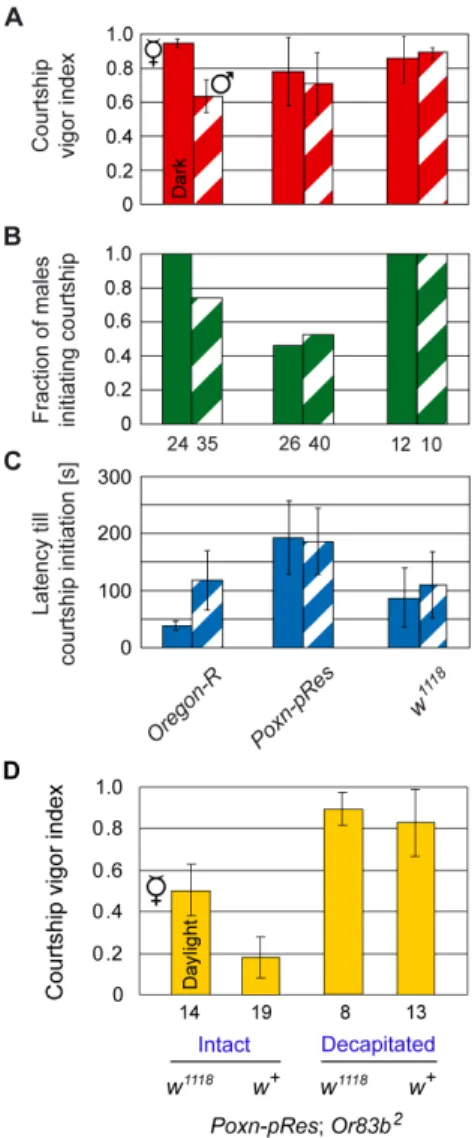
Unlike Ore-R males, whose cvi shows a clear preference for decapitated females as compared to decapitated males [4], no such preference is observed with taste-deficientPoxn-pResmales orw1118
males in the dark (Figure 5A). However, this lack of discrimination between decapitated females and males in the dark may have different reasons for taste-deficient Poxn-pRes males and w1118
males deprived of vision. For, Poxn-pRes males are strongly inhibited from courtship initiation, as evident from the reduced fraction of males initiating courtship during the observation period (Poxn-pResvs.Ore-Rin Figure 5B, p,0.05 in both cases) and from a considerably extended time (latency) till courtship initiation towards females but not males (Figure 5C, p,0.01 and p = 0.07). By contrast, all w1118 males initiate courtship towards both decapitated females and decapitated males (Figure 5B), while their latency till courtship initiation is slightly increased (p = 0.04) towards decapitated females, but unchanged (p = 0.82) towards decapitated males (w1118vs.Ore-Rin Figure 5C). Thus, these two genetic manipulations, which both resulted in the loss of sexual preference, may have opposite effects on the state of sexual arousal in the courting male. While for a courting male the lack of gustatory perception reduced the attractiveness of a female and to some extent of a male [4], the absence ofwfunctions increased its sexual excitability by a decapitated male in the dark. In daylight, on the other hand, lack of extra-retinal White also enhanced the sexual arousal of the courting male towards both decapitated males (Figure 3) and intact males, as reflected by the drastically augmented chaining ofw1118; P{mini-white}and w1118; Poxn-pRes
males (Figure 4 and Movie S2).
To test if lack of extra-retinal White increases the sexual arousal of males in general, i.e., also towards females, we took advantage ofPoxn-pRes;Or83b2males which can neither smell nor taste [4]. In daylight, these males display a rather low cvi towards receptive females in single-choice courtship assays (Figure 5D) [4]. Yet, they court decapitated females very vigorously (Figure 5D). These observations indicate that vision alone does not provide sufficient sexual stimulation to maintain high levels of sexual arousal after the intact female decamps [4]. In agreement with a sexual arousal ofwmutant males supplemented bymini-white, the lack of extra-retinal White protein increased the courtship vigor ofw1118; Poxn-pRes; Or83b2 males two- to three-fold towards intact receptive females in daylight (Figure 5D, p,0.001). The cvi towards decapitated females of these males, as compared to Poxn-pRes;
Or83b2males, could not be significantly enhanced as the cvi of the latter was too close to 1 (Figure 5D).
Figure 5. Increased sexual arousal ofw1118males.(A–C) Male
courtship parameters, the courtship vigor index (A), the fraction of males initiating courtship (B), and the average latency (in seconds) till courtship initiation (C), were measured in single-choice courtship assays with mature males of indicated genotypes and decapitated virgins (filled columns) or males (hatched columns) in the dark. (D) Courtship vigor indices ofPoxn-pRes;Or83b2
males, courting intact or decapitated females, were measured in single-choice courtship assays in daylight.
Poxn-pRes;Or83b2
males were either in aw1118
or w+background. It
should be noted that w1118; Poxn-pRes; Or83b2 males carry two transgenes both of which include a mini-white marker gene (see Materials and Methods) that fully rescues pigmentation. Results for Ore-RandPoxn-pResmales in (A–C) and forPoxn-pRes;Or83b2
males in (D) are from [4].
Discussion
Influence of Light Over-flow on Courtship Behavior of WhiteMales
We have shown in this study that in daylightw1118males court receptive virgin females with a cvi much lower than that ofOre-R
males, as expected from the absence of proper vision on which a male depends to follow a decamping female (Figure 2A). However, in daylight these males also showed a low sexual arousal when facing decapitated females unable to decamp (Figure 2B). As expected, this striking behavioral phenotype of w null mutant males could be reverted to wild-type by rescue of the insulating eye-pigments with amini-whiteor genomicw+gene. Surprisingly,
however, the cvi of thesew1118males was also (i) much lower than that of truly blind ninaB360d males, whose phototransduction is completely inhibited, and (ii) could be elevated to that ofninaB360d
males by a drastic reduction of the light intensity during the test (Figure 2). As the NinaB protein is involved in the synthesis of retinoids, one might argue that the use ofninaBmutants has effects other than those caused by the block in chromophore synthesis of rhodopsin in photoreceptors. Such additional functions would also be impaired inninaB360dmutants and might act upstream of
extra-retinal White protein. Yet, it appears that such functions do not influence male courtship as no difference in courtship behavior of
ninaB360d and Ore-Rmales, whose eyes were covered with black
paint, were observed either in daylight or in the dark [4]. In the dark (dim red light), w1118 males behaved like Ore-R males (Figure 2). Therefore, we concluded that in daylightwmales are dazzled by the over-flow of light and that over-excitation of the photoreceptors suppresses their sexual arousal. In this context, it is remarkable that the sensitivity to the anesthetic halothane ofw1118
flies is increased in ambient light as compared to darkness, which suggests that light over-excitation affects the general state of arousal ofwflies in daylight [31].
Lack of Extra-retinal White in Males Increases their Sexual Arousal
In the absence of light over-excitation in the dark and of the rejective male feedback behavior prevented by decapitation, the
preferred sexual orientation of males for females was completely abolished inw1118males (Figure 3). Wild-type sexual orientation was restored in these males by rescue with a genomicw+gene
(w1118;Dp(1;Y)w+y+) but not with amini-whitegene (Figure 3). In
daylight, however, w1118 males supplemented with a mini-white
gene showed a clear preference for decapitated females, a behavior that is explained by the sexual discriminatory function of the restored vision in the courting male [4], but male-male courtship was elevated (Figure 3). Interestingly, w+; Dp(1;Y)w+y+ males
displayed a slightly but significantly increased male-male courtship in daylight in this assay (data not shown). This increase in cvi probably results from the presence of two genomicw+copies in
these males and the concomitant overexpression of White protein, in line with previous observations [20–22]. In the more complex chaining assay,w1118 males supplemented with amini-whitegene engaged in male-male courtship and chaining (Figure 4). Note that in addition to the results presented in Figure 4, we tested six other
mini-white lines in a w1118 background and observed chaining behavior in all experiments (data not shown). Therefore, we argue that themini-whitegene used here and in numerous other studies, which is fully expressed in the eye, lacks enhancers of the wild-type
wgene that express it in the CNS and/or PNS at levels sufficient to rescue all w functions and mutant behaviors. Thus, this extra-retinal w function is crucial to rescue all mutant behaviors. It follows that an extra-retinal function of White is important to control the sexual arousal in males. In addition and more generally, our findings caution against interpretations of results obtained in behavioral studies ofwmutant flies rescued only by a
mini-whitegene. As the lack of extra-retinal White increases the sexual arousal of males also towards females, the observed male-male courtship and chaining behavior of w1118 males, supple-mented withmini-white, may be a secondary effect of an increased overall sexual excitability of these males. In addition, we would like to emphasize that the excessive and relentless chaining behavior of males (Movie S2) is observed only when in addition to the reduction or removal of extra-retinal White inw1118;P{mini-white}
males, which stimulates their sexual arousal (Figure 5), gustatory reception, which inhibits male-male courtship [4], is abolished in
w1118; Poxn-pResmales by the substitution of wild-typePoxn with the appropriatePoxntransgenes (Figure 4).
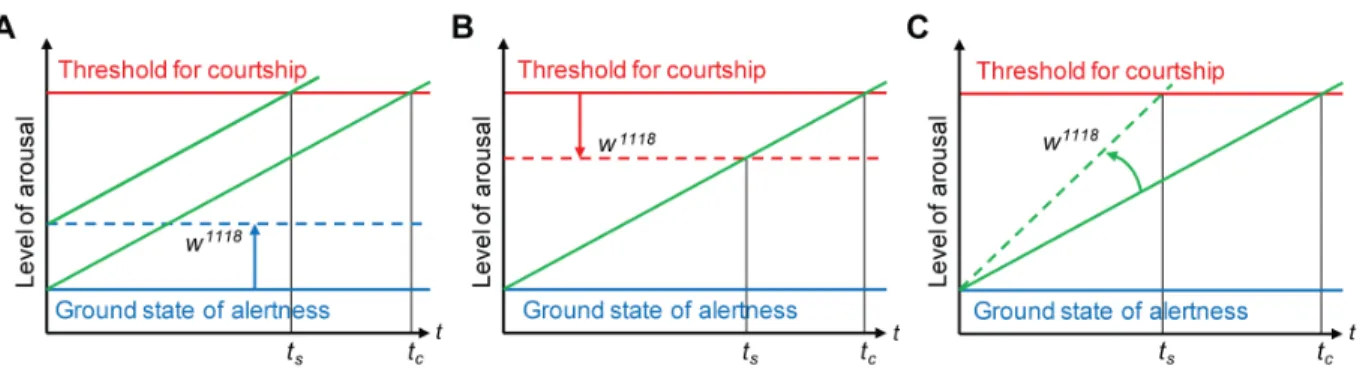
Figure 6. Effect ofwhitemutation on sexual arousal of males.Models explaining possible effects of extra-retinal lack of White function on general sexual arousal of males. Increased sexual arousal ofwhitemales over timetmay be caused by (A) a change in the general alertness from a ground state in wild-type flies (solid blue line) to an enhanced state of alertness inw1118mutants (broken blue line), resulting in a shortened, sensitized period of latency to sustained courtship,ts, as compared to the control period of latency,tc, or (B) a reduction of the threshold from its wild-type (solid red line) to a reducedw1118level (broken red line), which relevant stimuli need to reach to elicit sustained courtship, also resulting in a shortened, sensitized period of latency,ts. Since the processing of various sensory information by the CNS is not affected in either model, both changes can be taken to result from an enhanced sensitivity of the CNS to courtship stimuli. (C) Alternatively,w1118males may reach the threshold level for sustained courtship faster (broken green line inw1118
mutants with slope greater than that of solid green line in wild-type flies) because of an altered processing or integration of courtship information by the CNS or an enhanced sensitivity to relevant stimuli, for example pheromones, of sensory neurons in the PNS. Also in this model, the augmented sexual arousal leads to a shortened, sensitized period of latency to sustained courtship,ts, because of a steeper slope of the broken versus the solid green line.
of extra-retinal White and if these could also be induced by pharmacological reduction of serotonin levels.
It has been proposed that increased dopamine levels in
Drosophilalead to an increase in general arousal, which results in an elevated behavioral responsiveness [36] and, more specifically, in an enhanced courtship vigor [37] as well as male-male courtship [38]. Surprisingly, however, a similar effect is achieved by a reduction of dopamine levels, which appears to decrease the threshold of arousal [36], thus rendering flies responsive to a lower intensity of stimuli. Although the effects of lower dopamine levels on courtship behavior still need to be confirmed, results withw1118
males, whose serotonin as well as dopamine levels are reduced [14] (Figure 1), are consistent with such a bimodal function of dopamine.
Models
The conspicuous mutant phenotype of the w gene was discovered by Morgan in 1910 and was the first reportedDrosophila
mutant [39]. Ever since, thewgene has been extensively used as a convenient genetic marker. Despite this fact, characterization of thewgene at the molecular level, other than determining its DNA sequence and, derived from it, that of its protein, has been hampered, mainly because the protein is expressed at very low levels. Thus, expression outside the eye, where its expression is obvious from its mutant phenotype, is not well documented. Hence, it is unclear wherewis expressed in the central nervous system (CNS) and peripheral nervous system (PNS) of the adult fly. According to FlyBase,wis expressed at low to extremely low levels in the brain and CNS but no evidence for its expression in the PNS is known.
Therefore, based on the behavioral phenotypes ofw mutants reported here, we suggest that the lack of White protein in the CNS, other than eye and ocelli, and perhaps in the PNS, increases
Although in reality a combination of these models may be relevant, further studies are required to discriminate between them. It should be emphasized that the effect of reduced or absent extra-retinal White protein on a male’s state of sexual arousal could be indirect. Thus, the absence or reduction of the extra-retinalwhitefunction might affect a network of the nervous system that is not involved in courtship control but whose state influences the circuitry regulating courtship behavior.
Supporting Information
Movie S1 Courtship assay clip of a wild-type Ore-R
male after he initiated courtship. Experiments were performed under illumination of 21 lx (first part) and 11 lx (second part). Under both conditions, the male orients towards and follows the female and does not switch to scanning behavior after the female decamps. The second part of the clip was recorded by the use of the ‘‘low-illumination mode’’ of the camera. (AVI)
Movie S2 A chaining assay video showing eight sexually naı¨vew1118; Poxn-pRes males in a small Petri dish. All males participate in forming a courtship chain. The video was recorded 3–4 minutes after the males have been placed together. (AVI)
Acknowledgments
We thank William Pak and the Bloomington stock center for fly stocks.
Author Contributions
Conceived and designed the experiments: DK. Performed the experiments: DK. Analyzed the data: DK MN. Contributed reagents/materials/analysis tools: WB. Wrote the paper: DK MN.
References
1. Yamamoto D, Jallon JM, Komatsu A (1997) Genetic dissection of sexual behavior inDrosophila melanogaster. Annu Rev Entomol 42: 551–585. 2. Greenspan RJ, Ferveur JF (2000) Courtship inDrosophila.Annu Rev Genet 34:
205–232.
3. Hall JC (2002) Courtship lite: a personal history of reproductive behavioral neurogenetics inDrosophila.J Neurogenet 16: 135–163.
4. Krstic D, Boll W, Noll M (2009) Sensory integration regulating male courtship behavior inDrosophila. PLoS ONE 4(2): e4457.
5. Sullivan DT, Grillo SL, Kitos RJ (1974) Subcellular localization of the first three enzymes of the ommochrome synthetic pathway inDrosophila melanogaster.J Exp Zool 188: 225–233.
6. Summers KM, Howells AJ, Pyliotis NA (1982) Biology of eye pigmentation in insects. Adv Insect Physiol 16: 119–166.
7. Ewart GD, Howells AJ (1998) ABC transporters involved in transport of eye pigment precursors inDrosophila melanogaster. Meth Enzymol 292: 213–224. 8. Hengstenberg R, Go¨tz KG (1967) Der Einfluss des Schirmpigmentgehalts auf
die Helligkeits- und Kontrastwahrnehmung bei Drosophila-Augenmutanten. Kybernetik 3: 276–285.
9. Kalmus H (1943) The optomotor responses of some eye mutants ofDrosophila. J Genet 45: 206–213.
10. Wu CF, Wong F (1977) Frequency characteristics in the visual system of Drosophila. Genetic dissection of electroretinogram components. J Gen Physiol 69: 705–724.
11. Visser JE, Ba¨r PR, Jinnah HA (2000) Lesch-Nyhan disease and the basal ganglia. Brain Res Rev 32: 449–475.
12. Tho¨ny B, Auerbach G, Blau N (2000) Tetrahydrobiopterin biosynthesis, regeneration and functions. Biochem J 347: 1–16.
13. Murch SJ, KrishnaRaj S, Saxena PK (2000) Tryptophan is a precursor for melatonin and serotonin biosynthesis in in vitroregenerated St. John’s wort (Hypericum perforatumL. cv. Anthos) plants. Plant Cell Reports 19: 698–704. 14. Borycz J, Borycz JA, Kubo´w A, Lloyd V, Meinertzhagen IA (2008)Drosophila
ABC transporter mutantswhite,brown and scarlethave altered contents and distribution of biogenic amines in the brain. J Exp Biol 211: 3454–3466. 15. Campbell JL, Nash HA (2001) Volatile general anesthetics reveal a
16. Diegelmann S, Zars M, Zars T (2006) Genetic dissociation of acquisition and memory strength in the heat-box spatial learning paradigm inDrosophila. Learn Mem 13: 72–83.
17. Sitaraman D, Zars M, Zars T (2007) Reinforcement pre-exposure enhances spatial memory formation inDrosophila. J Comp Physiol A 193: 903–908. 18. Hoyer SC, Eckart A, Herrel A, Zars T, Fischer SA, et al. (2008) Octopamine in
male aggression ofDrosophila. Curr Biol 18: 159–167.
19. Sitaraman D, Zars M, LaFerriere H, Chen YC, Sable-Smith A, et al. (2008) Serotonin is necessary for place memory inDrosophila. Proc Natl Acad Sci U S A 105: 5579–5584.
20. Zhang SD, Odenwald WF (1995) Misexpression of thewhite(w) gene triggers male-male courtship inDrosophila.Proc Natl Acad Sci U S A 92: 5525–5529. 21. Hing ALY, Carlson JR (1996) Male-male courtship behavior induced by ectopic
expression of the Drosophila white gene: role of sensory function and age. J Neurobiol 30: 454–464.
22. Anaka M, MacDonald CD, Barkova E, Simon K, Rostom R, et al. (2008) The whitegene ofDrosophila melanogasterencodes a protein with a role in courtship behavior. J Neurogenet 22: 243–276.
23. Boll W, Noll M (2002) TheDrosophila Pox neurogene: control of male courtship behavior and fertility as revealed by a complete dissection of all enhancers. Development 129: 5667–5681.
24. Klemenz R, Weber U, Gehring WJ (1987) Thewhitegene as a marker in a new P-element vector for gene transfer inDrosophila. Nucleic Acids Res 15: 3947– 3959.
25. Jiao R, Daube M, Duan H, Zou Y, Frei E, Noll M (2001) Headless flies generated by developmental pathway interference. Development 128: 3307– 3319.
26. Brand AH, Perrimon N (1993) Targeted gene expression as a means of altering cell fates and generating dominant phenotypes. Development 118: 401–415. 27. Streiner DL (1996) Maintaining standards: differences between the standard
deviation and standard error, and when to use each. Can J Psychiatry 41: 498– 502.
28. Stephenson RS, O’Tousa J, Scavarda NJ, Randall LL, Pak WL (1983)Drosophila mutants with reduced rhodopsin content. Symp Soc Exp Biol 36: 477–501. 29. von Lintig J, Dreher A, Kiefer C, Wernet MF, Vogt K (2001) Analysis of the
blindDrosophilamutantninaBidentifies the gene encoding the key enzyme for vitamin A formationin vivo. Proc Natl Acad Sci U S A 98: 1130–1135. 30. Villella A, Gailey DA, Berwald B, Ohshima S, Barnes PT, et al. (1997) Extended
reproductive roles of the fruitless gene in Drosophila melanogaster revealed by behavioral analysis of newfrumutants. Genetics 147: 1107–1130.
31. Cheng Y, Nash HA (2008) Visual mutations reveal opposing effects of illumination on arousal inDrosophila. Genetics 178: 2413–2416.
32. Tagliamonte A, Tagliamonte P, Gessa GL, Brodie BB (1969) Compulsive sexual activity induced by p-chlorophenylalanine in normal and pinealectomized male rats. Science 166: 1433–1435.
33. Ferguson J, Henriksen S, Cohen H, Mitchell G, Barchas J, et al. (1970) ‘‘Hypersexuality’’ and behavioral changes in cats caused by administration of p-chlorophenylalanine. Science 168: 499–501.
34. Fratta W, Biggio G, Gessa GL (1977) Homosexual mounting behavior induced in male rats and rabbits by a tryptophan-free diet. Life Sci 21: 379–383. 35. Kain JS, Stokes C, de Bivort BL (2012) Phototactic personality in fruit flies and
its suppression by serotonin andwhite. Proc Natl Acad Sci U S A 109: 19834– 19839.
36. Van Swinderen B, Andretic R (2011) Dopamine inDrosophila: setting arousal thresholds in a miniature brain. Proc Biol Sci 278: 906–913.
37. Andretic R, van Swinderen B, Greenspan RJ (2005) Dopaminergic modulation of arousal inDrosophila. Curr Biol 15: 1165–1175.
38. Liu T, Dartevelle L, Yuan C, Wei H, Wang Y, et al. (2008) Increased dopamine level enhances male-male courtship inDrosophila. J Neurosci 28: 5539–5546. 39. Green MM (1996) The ‘‘Genesis of the white-eyed mutant’’ in Drosophila