ACPD
14, 3537–3562, 2014Black carbon fractal aggregates
A. J. A. Smith and R. G. Grainger
Title Page
Abstract Introduction
Conclusions References
Tables Figures
◭ ◮
◭ ◮
Back Close
Full Screen / Esc
Printer-friendly Version Interactive Discussion
Discussion
P
a
per
|
D
iscussion
P
a
per
|
Discussion
P
a
per
|
Discuss
ion
P
a
per
|
Atmos. Chem. Phys. Discuss., 14, 3537–3562, 2014 www.atmos-chem-phys-discuss.net/14/3537/2014/ doi:10.5194/acpd-14-3537-2014
© Author(s) 2014. CC Attribution 3.0 License.
Atmospheric Chemistry and Physics
Open Access
Discussions
This discussion paper is/has been under review for the journal Atmospheric Chemistry and Physics (ACP). Please refer to the corresponding final paper in ACP if available.
Simplifying the calculation of light
scattering properties for black carbon
fractal aggregates
A. J. A. Smith and R. G. Grainger
Atmospheric, Oceanic and Planetary Physics, Clarendon Laboratory, Oxford, OX1 3PU, UK
Received: 20 December 2013 – Accepted: 1 February 2014 – Published: 7 February 2014
Correspondence to: A. J. A. Smith ([email protected])
ACPD
14, 3537–3562, 2014Black carbon fractal aggregates
A. J. A. Smith and R. G. Grainger
Title Page
Abstract Introduction
Conclusions References
Tables Figures
◭ ◮
◭ ◮
Back Close
Full Screen / Esc
Printer-friendly Version Interactive Discussion
Discussion
P
a
per
|
D
iscussion
P
a
per
|
Discussion
P
a
per
|
Discuss
ion
P
a
per
|
Abstract
Black carbon fractal aggregates have complicated shapes that make the calculation of their optical properties particularly computationally expensive. Here, a method is pre-sented to estimate fractal aggregate light scattering properties by optimising simplified models to full light scattering calculations. It is found that there are no possible spher-5
ical models (at any size or refractive index) that well represent the light scattering in the visible, or near-thermal infrared. As such, parameterisations of the light scattering as a function of the number of aggregate particles is presented as the most pragmatic choice for modelling distributions of black carbon when the large computational over-heads of rigorous scattering calculations cannot be justified. This parameterisation can 10
be analytically integrated to provide light scattering properties for log-normal distribu-tions of black carbon fractal aggregates and return extinction cross-secdistribu-tions with 0.1 % accuracy for typical black carbon size distributions. Scattering cross-sections and the asymmetry parameter can be obtained to within 3 %.
1 Introduction
15
Particulate products of incomplete combustion, such as black carbon (BC), have been the subject of recent intense discussion (e.g. Jacobson, 2002, 2003; Bond, 2007; Bond et al., 2013). Emissions rates are high (Bond et al., 2004), and have tripled in the last 140 yr (Ito and Penner, 2005) although specific regions have not followed this trend. The developed world has reduced emissions while Asian countries have come to dom-20
inate carbon aerosol emission (Streets et al., 2003). Since BC has a high imaginary
part of refractive index, it is one of the few aerosols that has a positive direct effect on
radiative forcing (Jacobson, 2001; Bond, 2007; Bahadur et al., 2011).
Studies have shown that when BC is deposited on snow, the lowering of surface
albedo leads to faster run-off and to an additional warming effect (e.g. Flanner et al.,
25
ACPD
14, 3537–3562, 2014Black carbon fractal aggregates
A. J. A. Smith and R. G. Grainger
Title Page
Abstract Introduction
Conclusions References
Tables Figures
◭ ◮
◭ ◮
Back Close
Full Screen / Esc
Printer-friendly Version Interactive Discussion
Discussion
P
a
per
|
D
iscussion
P
a
per
|
Discussion
P
a
per
|
Discuss
ion
P
a
per
|
et al., 2013). Aside from the positive radiative forcing due to BC, there are considerable
negative health effects from fine particulate matter (Dockery et al., 1993; Jansen et al.,
2005), and in urban environments, issues of poor visibility (Larson et al., 1989). Black carbon fractal aggregates (BCFA) are clusters of BC spherules forming aerosols with a non-spherical shape. Accurate quantification of their optical properties 5
is important both for their measurement, and for predicting their radiative effect.
Cur-rent estimates of the climate forcing caused by BC emissions are positive with a typical
value of 1.1 W m−2(Bond et al., 2013).
The object of this work is to see whether there are spheres (of some radius, r and
complex refractive index,m) whose optical properties are close enough to a BCFA’s
10
light scattering properties (as calculated using T-Matrix code) to acceptably represent
these particles. If some mapping ofr andm to properties of the BCFA can be found,
there may be additional physical insight into the fractal light scattering, additional to the advantage of a much simpler scattering calculation.
After a brief description of black carbon, we show that this is not possible within the 15
bounds of reasonably sized spheres with a wide range of refractive indices and go on to present a parameterisation of BCFA light scattering properties.
1.1 A physical description of aerosol formation and ageing
Formation of sub-micron aggregate aerosols from burning is a rapid process involving several stages, some of which are irreversible. Initially, due to very high temperatures, 20
some of the burning fuel vapourises (if it is not already gaseous). If the fuel is something such as coal, the main products could be inorganics and elemental carbon formed from the vapouried coal ash (Helble et al., 1988; Turns, 2000). In the case of biomass, this could be organics such as benzene and poly-aromatic hydrocarbons (PAH) (Reid et al., 2005).
25
Coagula-ACPD
14, 3537–3562, 2014Black carbon fractal aggregates
A. J. A. Smith and R. G. Grainger
Title Page
Abstract Introduction
Conclusions References
Tables Figures
◭ ◮
◭ ◮
Back Close
Full Screen / Esc
Printer-friendly Version Interactive Discussion
Discussion
P
a
per
|
D
iscussion
P
a
per
|
Discussion
P
a
per
|
Discuss
ion
P
a
per
|
tion is encouraged initially due to a high proportion of hydrocarbon radicals which falls
offas the particles age (Homann, 1967; Calcote, 1981). High resolution TEM images
of individual carbonaceous spherules shows them to be haphazardly ordered micro-structures of graphene-like layers (Buseck et al., 1987; Pósfai et al., 1999; Li et al., 2003) with a very narrow range of diameters for a specific flame (Homann, 1967). 5
After the initial nucleation and coagulation, primary particles can aggregate leading to the fractal soot aerosol often seen (e.g. Helble et al., 1988; Sorensen, 2001; Li et al., 2003; Zhang et al., 2008). As the particles pass through the edge of the flame, some will be oxidised, although not completely (Turns, 2000). Those that make it through the flame without burning are the soot emissions. Flames that burn more intensely have 10
poorer transport of oxygen into the area where the particles are being created, and as a result will emit more particulate matter (Reid et al., 2005).
The aggregates created during burning last a very short amount of time, of the order of hours (Martins et al., 1998b), before being irreversibly deformed as the chain-like structures fold up into more spherical clusters (Martins et al., 1998a; Abel et al., 2003). 15
Although the soot spherules are hydrophobic, their irregular shapes provide active sites where water can be deposited (Zhang et al., 2008). This change is thought to be due to atmospheric processing of the particles by nucleating water, and the coating of the carbon by nucleating additional products of the burning, e.g. sulphate and OC. This also means that the BC cores become coated in shells of other material which are generally 20
hydrophilic (Popovicheva et al., 2008). This coating enhances the light absorption of the BC core (Fuller et al., 1999; Jacobson, 2001; Bond et al., 2006).
1.2 Fractal dimension
ACPD
14, 3537–3562, 2014Black carbon fractal aggregates
A. J. A. Smith and R. G. Grainger
Title Page
Abstract Introduction
Conclusions References
Tables Figures
◭ ◮
◭ ◮
Back Close
Full Screen / Esc
Printer-friendly Version Interactive Discussion
Discussion
P
a
per
|
D
iscussion
P
a
per
|
Discussion
P
a
per
|
Discuss
ion
P
a
per
|
Particles are defined by the equation
ns=kf
Rg
a
!Df
, (1)
wherens is the number of spherules in the aggregate,ais the radius of an individual
spherule in the fractal,Df is the fractal dimension, kf is the fractal prefactor, and Rgis
the radius of gyration which gives the root-mean-square distance of spherules from the 5
cluster’s centre of mass (Sorensen, 2001).
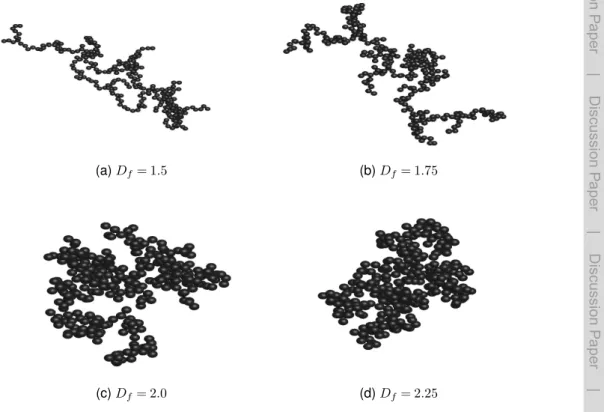
The fractal dimension gives a measure of how “compact” an aggregate is, with lines
of particles whenDf≃1, “flat” surfaces when Df≃2, and lumpy spherical shapes as
Df→3 (although due to the individual spherules having non-negligible size, it is not
possible to form shapes with no free space between constituent parts). This depen-10
dence of shape onDfis shown in Fig. 1.
For particles formed by diffusion limited cluster aggregation (such as soot from
flames), fractal dimensions ofDf≃1.75→1.8 are expected (Sorensen, 2001).
1.3 Light scattering methods
The scattering of light by a spherical particle can be solved analytically using Mie’s 15
solution to Maxwell’s equations (Mie, 1908; Bohren and Huffman, 1983). Additionally,
the derivatives of all light scattering properties are also analytic (Grainger et al., 2004). The scattering of light by fractal clusters can be calculated using the Multiple Spheres T-Matrix Fortran-90 code (MSTM) (Mackowski, 2012) which is based on theory found in Mackowski and Mishchenko (1996). This method combines the spherical wave expan-20
ACPD
14, 3537–3562, 2014Black carbon fractal aggregates
A. J. A. Smith and R. G. Grainger
Title Page
Abstract Introduction
Conclusions References
Tables Figures
◭ ◮
◭ ◮
Back Close
Full Screen / Esc
Printer-friendly Version Interactive Discussion
Discussion
P
a
per
|
D
iscussion
P
a
per
|
Discussion
P
a
per
|
Discuss
ion
P
a
per
|
2 Method
Light scattering properties of BCFAs were calculated over a range of wavelengths,λ,
from 400 nm to 15 µm using the MSTM code. The fractal aggregates were generated using a cluster–cluster algorithm (Thouy and Jullien, 1994) with a spherule radius of
25 nm and fixed fractal prefactor ofkf=1.18 which is very close to value used by Liu
5
and Mishchenko (2005); Zhao and Ma (2009); Li et al. (2010). For 400 nm≤λ≤1 µm,
a step size of∆λ=150 nm and a fixed refractive index ofmBC=1.95+0.79i was
se-lected, following Bond and Bergstrom (2006). Above this, the step size was widened to
∆λ=1 µm and a parameterised refractive index fit by Chang and Charalampopoulos
(1990) was used. To alter the shape and size, the number of spherules was varied in 10
steps of 20 with 20≤ns≤980 and fractal dimension in steps of 0.1 with 1.6≤Df≤2.2.
The calculated optical properties were the extinction and scattering crosssections,σext,
σsca, and the asymmetry parametergwhich gives a measure of the angular distribution
of scattered light (Bohren and Huffman, 1983) and is used in several global circulation
models to represent aerosol optical properties (e.g. Stier et al., 2007). 15
Next, best fits of spherical radius and complex refractive index (m=n+i k) of spheres
were fitted to the individual BCFAs. Optimal estimation (Rodgers, 2000) and
least-squares fitting were tried. The differential optical properties required for the inversion,
e.g. ∂σext
∂r , ∂g
∂n, were obtained using IDL code described in Grainger et al. (2004).
3 Results
20
3.1 Optical properties of black carbon fractal aggregates
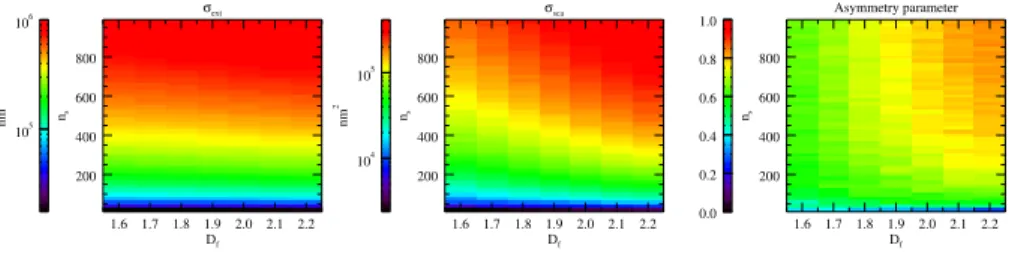
Figure 2 shows the extinction and scattering cross-sections, and asymmetry
parame-ter for BCFAs as a function ofDf andns in the visible. Although not clear from the
ACPD
14, 3537–3562, 2014Black carbon fractal aggregates
A. J. A. Smith and R. G. Grainger
Title Page
Abstract Introduction
Conclusions References
Tables Figures
◭ ◮
◭ ◮
Back Close
Full Screen / Esc
Printer-friendly Version Interactive Discussion
Discussion
P
a
per
|
D
iscussion
P
a
per
|
Discussion
P
a
per
|
Discuss
ion
P
a
per
|
scattering cross-section is more pronounced at higherDf as the fractals become more
densely packed and so a more coherent scattering entity. Similarly,gshows a greated
amount of the light being scattered forwards as the fractals become both more densely packed, and larger.
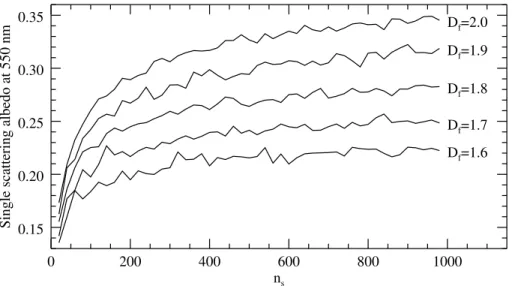
Figure 3 shows the single scatter albedo (SSA=σsca/σext) which agrees well with
5
the literature review by Bond and Bergstrom (2006), who noted that when measured, the SSA of BCFAs are “surprisingly consistent” with a value of 0.2–0.3.
Since fractal aggregates are by nature randomly assembled, these are not the only possible representations of the light scattering properties that a BCFA with these
prop-erties could have. However, as shown in Fig. 4, relative difference from the mean values
10
of the three parameters are small, with variance in the total extincion generally less than
1 % away from the mean, and less than 5 % away forσscaandgatλ=550 nm.
Atλ=12 µm, one might expect things to be more straightforward. The size
parame-ter of the largest BCFAs studied arexV=0.1 andxG=0.6 (by equivalent volume and
radius of gyration respectively) which would place the vast majority of studied equiva-15
lent spherical particles in the Rayleigh limit. In that case it would be expected thatg≃0
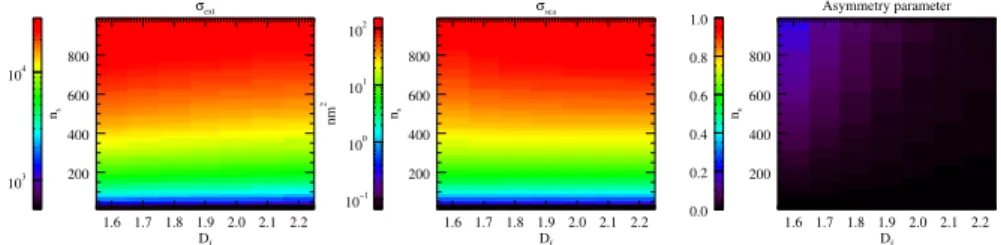
and that there would be little dependency of the cross-sections with shape. Figure 5
shows BCFA light scattering at 12 µm, where the refractive index ismBC=2.93+2.16i.
For particles with largeDf values, the asymmetry is close to zero, but this is not the
case for larger particles with smaller fractal dimensions. 20
The calculations over the entire wavelength range are shown in Fig. 6 at a fixed
frac-tal dimension ofDf=1.8. Extinction cross-sections decrease with decreasing size
pa-rameter (either because of increasing wavelength or decreasing numbers of spherules in the aggregate).
Single scatter albedo and asymmetry also decrease with decreasing size parameter 25
ACPD
14, 3537–3562, 2014Black carbon fractal aggregates
A. J. A. Smith and R. G. Grainger
Title Page
Abstract Introduction
Conclusions References
Tables Figures
◭ ◮
◭ ◮
Back Close
Full Screen / Esc
Printer-friendly Version Interactive Discussion
Discussion
P
a
per
|
D
iscussion
P
a
per
|
Discussion
P
a
per
|
Discuss
ion
P
a
per
|
3.2 Finding appropriate spheres
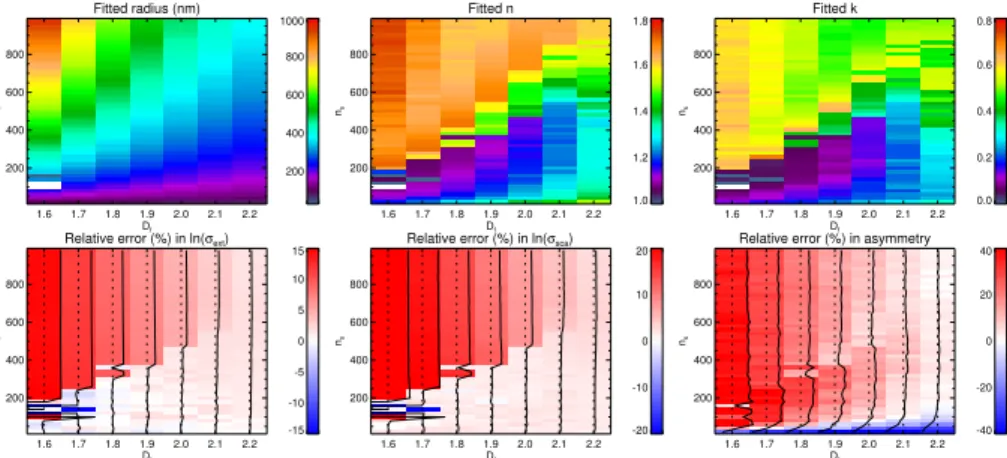
For all of the BCFAs, it was attempted to find matching optical properties using spheres
with 50< r <1500 nm, 1< n <4, and 0< k <4. Attempting to fit closest values of
lnσext, lnσsca, and g using optimal estimation (Rodgers, 2000) is shown in Fig. 7 for
λ=550 nm.
5
Relative errors of>15 % for extinction, >20 % for scattering, and>40 % for
asym-metry at this wavelength are unacceptable, and do not improve with increased
wave-length. Similar attempts fitting the single scatter albedo instead of lnσsca, andσinstead
of lnσ values also were not successful. Least-square fits were also unsuccessful. As
such, it is suggested that within the range 0.4≤λ≤15 µm, there are no suitable sizes
10
or refractive indices of spheres appropriate for the optical modelling of black carbon aggregates.
3.3 Parameterising fractal aggregate optical properties
Since the extinction cross-section scales with volume which is proportional to ns,
a polynomial inns was chosen and order 3 was found to adequately capture the full
15
range ofλ,Dfandnsused here.
σext= 3
X m=0
kmnms. (2)
The scattering cross-section is not so simple to parameterise, and so the SSA is fitted
instead and multiplied byσextto obtainσsca. The SSA andgare both well captured by
a logarithmic ns and a linear offset. This was due to the tendency of these optical
20
properties to initially increase withnsbefore levelling offat largens:
SSA=w0+w1ns+w2lnns, (3)
ACPD
14, 3537–3562, 2014Black carbon fractal aggregates
A. J. A. Smith and R. G. Grainger
Title Page
Abstract Introduction
Conclusions References
Tables Figures
◭ ◮
◭ ◮
Back Close
Full Screen / Esc
Printer-friendly Version Interactive Discussion
Discussion
P
a
per
|
D
iscussion
P
a
per
|
Discussion
P
a
per
|
Discuss
ion
P
a
per
|
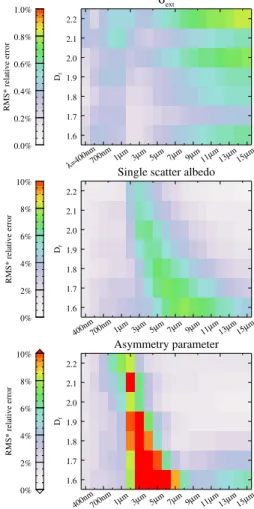
Table 1 shows the fit coefficients at 550 nm and Df=1.8. The root-mean-square
(RMS) errors in σext, SSA, and g compared to the calculated values are also given.
Including the smallest particles is roughly responsible for a doubling in the error of the fits, as can be shown by not including the two smallest particle sizes in the calculation.
This is because the limit limns→0(σext)=0 and limns→0(g)=0 leading to large inflation
5
in the relative differences between points. Over the entire range of λand Df, errors in
the visible are below 3 % as shown in Fig. 8. In the range 2≤λ≤9 µm, RMS errors in
SSA andgcan be as large as 10 %. Errors in extinction are<10 % in all cases.
3.4 Parameterising light scattering for a lognormal distribution of particles
From these fitted optical schemes, the optical properties of lognormal distributions of 10
these particles can be obtained trivially. For the extinction, we first relatens to a size
distribution by volume-equivalent radius,r, saying
r=ap3
ns, (5)
and inserting into a lognormal distribution defined as:
n(r)= N
σr√2πexp
"
−1
2
lnr
−lnr0
σ
2#
, (6)
15
whereN is the total number of particles in the distribution, σis the standard deviation
of lnr, andr0is the geometric mean ofr. The extinction coefficient at some point along
the path of a light beam,z, is defined as
βext(z)= ∞
Z
0
ACPD
14, 3537–3562, 2014Black carbon fractal aggregates
A. J. A. Smith and R. G. Grainger
Title Page Abstract Introduction Conclusions References Tables Figures ◭ ◮ ◭ ◮ Back Close
Full Screen / Esc
Printer-friendly Version Interactive Discussion Discussion P a per | D iscussion P a per | Discussion P a per | Discuss ion P a per |
Following from Eq. (2),σextcan separated into four terms in powers ofr
3 :
σext= 3
X i=0
kmr a
3m
. (8)
Finally, noting that
1
σ√2π
∞
Z
0
rm−1 exp
−
1 2
lnrr 0
σ
!2
dr =r0me
m2σ2
2 , (9)
an expression forβextis given by
5
βext=N 3
X m=0
km r
0
a
3m
e(3mσ)
2
2 . (10)
Scattering is obtained from the extinction and single scatter albedo as:
βsca(z)= ∞
Z
0
σsca(r)n(r,z) dr= ∞
Z
0
σext(r) SSA(r)n(r,z) dr,
= ∞ Z 0 3 X m=0
kmr a
3m
w0+w1
r
a
3
+w2ln
r
a
3
n(r,z)dr. (11)
10
Using
1
σ√2π
∞
Z
0
rm−1
lnrexp
−
1 2
lnrr 0
σ
!2
dr=r0me
m2σ2
2
lnr0+mσ2
ACPD
14, 3537–3562, 2014Black carbon fractal aggregates
A. J. A. Smith and R. G. Grainger
Title Page
Abstract Introduction
Conclusions References
Tables Figures
◭ ◮
◭ ◮
Back Close
Full Screen / Esc
Printer-friendly Version Interactive Discussion
Discussion
P
a
per
|
D
iscussion
P
a
per
|
Discussion
P
a
per
|
Discuss
ion
P
a
per
|
this can be reduced to
βsca=Nβext(w0−3w2lna)
+N
3
X m=0
km r
0
a
3m
e(3mσ)
2
2 ×
"
w1
r
0
a
3
e9σ
2(2m +1)
2 +3w2(lnr0+3mσ)
#
. (13)
Similar integration can be used to find the averaged asymmetry parameter for the 5
size distribution,< g >, using:
< g >=
R∞
0 σsca(r)g(r)n(r,z) dr
βsca
, (14)
by noting that:
1
σ√2π
∞
Z
0
rm−1
ln2rexp
−
1 2
lnrr 0
σ
!2
dr =r0me
m2σ2
2
h
(lnr0+mσ2)2+σ2
i
. (15)
10
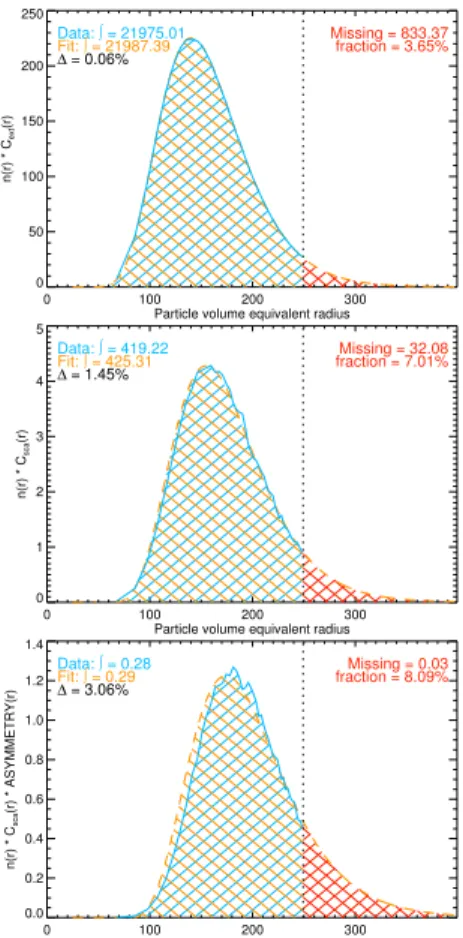
Using a reasonable atmospheric BC size distribution (r0=120 nm;σ=ln 1.32),
dif-ferences between the extinction calculated by summing the various individual fractal calculations, and the parameterisation were investigated. The method used is shown
for the example of λ=2 µm and Df=1.8 in Fig. 9. The parameterisation is an
inte-gral over the whole of particle radius space, whereas the calculations of fractal optical 15
properties were truncated atns=980 (r =248 nm). As such to check the validity of the
integral parameterisation, the limit was set at R248 nm0 f(r) dr. For all wavelengths and
fractal dimensions, agreement between the two methods is within 3 % forgand σsca,
and within 0.15 % forσext. Errors are slightly smaller than for individual scattering
par-ticles, since the parameterisation of individual particles roughly underestimates values 20
as often as it overestimates.
ACPD
14, 3537–3562, 2014Black carbon fractal aggregates
A. J. A. Smith and R. G. Grainger
Title Page
Abstract Introduction
Conclusions References
Tables Figures
◭ ◮
◭ ◮
Back Close
Full Screen / Esc
Printer-friendly Version Interactive Discussion
Discussion
P
a
per
|
D
iscussion
P
a
per
|
Discussion
P
a
per
|
Discuss
ion
P
a
per
|
and asymmetry parameter calculations for individual particles and log-normal distribu-tions.
4 Conclusions
It has been shown that it is not possible to model the optical properties of black carbon
fractal aggregates using spheres with refractive indices in the range 0≤mBC≤3+3i
5
at any wavelength between 400 nm and 15 µm. With this in mind, a prudent step for GCMs requiring constantly changing distributions of BC aerosol could be to include a parameterisation such as this one which is computationally trivial to impliment and is valid within the range of black carbon particles seen in the atmosphere.
Supplementary material related to this article is available online at
10
http://www.atmos-chem-phys-discuss.net/14/3537/2014/ acpd-14-3537-2014-supplement.zip.
Acknowledgement. The authors acknowledge funding from the UK Natural Environment Research Council (NERC) National Centre for Earth Observation and the NERC project NE/F018142/1.
15
References
Abel, S. J., Haywood, J. M., Highwood, E. J., Li, J., and Buseck, P. R.: Evolution of biomass burning aerosol properties from an agricultural fire in southern Africa, Geophys. Res. Lett., 30, 1783, doi:10.1029/2003GL017342, 2003. 3540
Bahadur, R., Feng, Y., Russell, L. M., and Ramanathan, V.: Impact of California’s air pollution 20
ACPD
14, 3537–3562, 2014Black carbon fractal aggregates
A. J. A. Smith and R. G. Grainger
Title Page
Abstract Introduction
Conclusions References
Tables Figures
◭ ◮
◭ ◮
Back Close
Full Screen / Esc
Printer-friendly Version Interactive Discussion
Discussion
P
a
per
|
D
iscussion
P
a
per
|
Discussion
P
a
per
|
Discuss
ion
P
a
per
|
Bohren, C. F. and Huffman, D. R.: Absorption and Scattering of Light by Small Particles,
Wiley-VCH, doi:10.1002/9783527618156, 1983. 3541, 3542
Bond, T. C.: Can warming particles enter global climate discussions?, Environ. Res. Lett., 2, 045030, doi:10.1088/1748-9326/2/4/045030, 2007. 3538
Bond, T. C. and Bergstrom, R. W.: Light absorption by carbonaceous particles: an investigative 5
review, Aerosol Sci. Tech., 40, 27–67, doi:10.1080/02786820500421521, 2006. 3542, 3543 Bond, T. C., Streets, D. G., Yarber, K. F., Nelson, S. M., Woo, J.-H., and Klimont, Z.:
A technology-based global inventory of black and organic carbon emissions from combus-tion, J. Geophys. Res., 109, D14203, doi:10.1029/2003JD003697, 2004. 3538
Bond, T. C., Habib, G., and Bergstrom, R. W.: Limitations in the enhancement of visible light 10
absorption due to mixing state, J. Geophys. Res., 111, D20211, doi:10.1029/2006JD007315, 2006. 3540
Bond, T. C., Doherty, S. J., Fahey, D. W., Forster, P. M., Berntsen, T., DeAngelo, B. J., Flan-ner, M. G., Ghan, S., Kärcher, B., Koch, D., Kinne, S., Kondo, Y., Quinn, P. K., Sarofim, M. C., Schultz, M. G., Schulz, M., Venkataraman, C., Zhang, H., Zhang, S., Bellouin, N., Gut-15
tikunda, S. K., Hopke, P. K., Jacobson, M. Z., Kaiser, J. W., Klimont, Z., Lohmann, U., Schwarz, J. P., Shindell, D., Storelvmo, T., Warren, S. G., and Zender, C. S.: Bounding the role of black carbon in the climate system: a scientific assessment, J. Geophys. Res., 118, 5380–5552, doi:10.1002/jgrd.50171, 2013. 3538, 3539
Buseck, P. R., Huang, B., and Keller, L. P.: Electron microscope investigation of the structures 20
of annealed carbons, Energ. Fuel., 1, 105–110, doi:10.1021/ef00001a020, 1987. 3540 Calcote, H. F.: Mechanisms of soot nucleation in flames – a critical review, Combust. Flame,
42, 215–242, doi:10.1016/0010-2180(81)90159-0, 1981. 3539, 3540
Chang, H. and Charalampopoulos, T. T.: Determination of the wavelength dependence of refractive indices of flame soot, P. Roy. Soc. Lond. A Mat., 430, 577–591, 25
doi:10.1098/rspa.1990.0107, 1990. 3542
Dockery, D. W., Pope, C. A., Xu, X., Spengler, J. D., Ware, J. H., Fay, M. E., Ferris, B. G., and Speizer, F. E.: An association between air pollution and mortality in six U. S. cities, New Engl. J. Med., 329, 1753–1759, doi:10.1056/NEJM199312093292401, 1993. 3539
Doherty, S. J., Warren, S. G., Grenfell, T. C., Clarke, A. D., and Brandt, R. E.: Light-absorbing im-30
ACPD
14, 3537–3562, 2014Black carbon fractal aggregates
A. J. A. Smith and R. G. Grainger
Title Page
Abstract Introduction
Conclusions References
Tables Figures
◭ ◮
◭ ◮
Back Close
Full Screen / Esc
Printer-friendly Version Interactive Discussion
Discussion
P
a
per
|
D
iscussion
P
a
per
|
Discussion
P
a
per
|
Discuss
ion
P
a
per
|
Flanner, M. G., Zender, C. S., Hess, P. G., Mahowald, N. M., Painter, T. H., Ramanathan, V., and Rasch, P. J.: Springtime warming and reduced snow cover from carbonaceous particles, Atmos. Chem. Phys., 9, 2481–2497, doi:10.5194/acp-9-2481-2009, 2009. 3538
Fuller, K. A., Malm, W. C., and Kreidenweis, S. M.: Effects of mixing on extinction by
carbona-ceous particles, J. Geophys. Res., 104, 15941–15954, doi:10.1029/1998JD100069, 1999. 5
3540
Grainger, R. G., Lucas, J., Thomas, G. E., and Ewen, G. B.: Calculation of Mie derivatives, Appl. Optics, 43, 5386–5393, doi:10.1364/AO.43.005386, 2004. 3541, 3542
Helble, J., Neville, M., and Sarofim, A. F.: Aggregate formation from vaporized ash dur-ing pulverized coal combustion, Symposium (International) on Combustion, 21, 411–417, 10
doi:10.1016/S0082-0784(88)80268-6, 1988. 3539, 3540
Homann, K. H.: Carbon formation in premixed flames, Combust. Flame, 11, 265–287, doi:10.1016/0010-2180(67)90017-X, 1967. 3540
Ito, A. and Penner, J. E.: Historical emissions of carbonaceous aerosols from biomass and fossil fuel burning for the period 1870–2000, Global Biogeochem. Cy., 19, GB2028, 15
doi:10.1029/2004GB002374, 2005. 3538
Jacobson, M. Z.: Strong radiative heating due to the mixing state of black carbon in atmospheric aerosols, Nature, 409, 695–697, doi:10.1038/35055518, 2001. 3538, 3540
Jacobson, M. Z.: Control of fossil-fuel particulate black carbon and organic matter,
possi-bly the most effective method of slowing global warming, J. Geophys. Res., 107, 4410,
20
doi:10.1029/2001JD001376, 2002. 3538
Jacobson, M. Z.: Reply to comment by J. E. Penner on “Control of fossil-fuel particulate black
carbon and organic matter, possibly the most effective method of slowing global warming”,
J. Geophys. Res., 108, 4772, doi:10.1029/2003JD003403, 2003. 3538
Jansen, K. L., Larson, T. V., Koenig, J. Q., Mar, T. F., Fields, C., Stewart, J., and Lippmann, M.: 25
Associations between health effects and particulate matter and black carbon in subjects with
respiratory disease, Environ. Health Persp., 113, 1741–1746, doi:10.1289/ehp.8153, 2005. 3539
Larson, S. M., Cass, G. R., and Gray, H. A.: Atmospheric carbon particles and the Los Angeles visibility problem, Aerosol Sci. Tech., 10, 118–130, doi:10.1080/02786828908959227, 1989. 30
3539
ag-ACPD
14, 3537–3562, 2014Black carbon fractal aggregates
A. J. A. Smith and R. G. Grainger
Title Page
Abstract Introduction
Conclusions References
Tables Figures
◭ ◮
◭ ◮
Back Close
Full Screen / Esc
Printer-friendly Version Interactive Discussion
Discussion
P
a
per
|
D
iscussion
P
a
per
|
Discussion
P
a
per
|
Discuss
ion
P
a
per
|
gregates, J. Quant. Spectrosc. Ra., 111, 2127–2132, doi:10.1016/j.jqsrt.2010.05.009, 2010. 3542
Li, J., Pósfai, M., Hobbs, P. V., and Buseck, P. R.: Individual aerosol particles from biomass burning in southern Africa: 2. Compositions and aging of inorganic particles, J. Geophys. Res., 108, 8484, doi:10.1029/2002JD002310, 2003. 3540
5
Liu, L. and Mishchenko, M. I.: Effects of aggregation on scattering and radiative properties of
soot aerosols, J. Geophys. Res., 110, D11211, doi:10.1029/2004JD005649, 2005. 3542 Mackowski, D. W.: MSTM – a multiple sphere T-matrix FORTRAN code for use on
paral-lel computer clusters, Department of Mechanical Engineering, Auburn University, Auburn, AL 36849, USA, available at: http://eng.auburn.edu/users/dmckwski/scatcodes (last access: 10
June 2013), 2012. 3541
Mackowski, D. W. and Mishchenko, M. I.: Calculation of the T-matrix and the scattering matrix for ensembles of spheres, J. Opt. Soc. Am. A., 13, 2266–2278, doi:10.1364/JOSAA.13.002266, 1996. 3541
Martins, J. V., Artaxo, P., Liousse, C., Reid, J. S., Hobbs, P. V., and Kaufman, Y. J.: Effects of
15
black carbon content, particle size, and mixing on light absorption by aerosols from biomass burning in Brazil, J. Geophys. Res., 103, 32041–32050, doi:10.1029/98JD02593, 1998a. 3540
Martins, J. V., Hobbs, P. V., Weiss, R. E., and Artaxo, P.: Sphericity and morphology of smoke particles from biomass burning in Brazil, J. Geophys. Res., 103, 32051–32057, 20
doi:10.1029/98JD01153, 1998b. 3540
Mie, G.: Beiträgge zur Optik trüber Medien, speziell kolloidaler Metallösungen, Ann. Phys., 25, 377–445, a translation can be found at http://diogenes.iwt.uni-bremen.de/vt/laser/papers/ RAE-LT1873-1976-Mie-1908-translation.pdf (last access: 15 March 2011), 1908. 3541 Popovicheva, O., Persiantseva, N. M., Shonija, N. K., DeMott, P., Koehler, K., Petters, M., 25
Kreidenweis, S., Tishkova, V., Demirdjian, B., and Suzanne, J.: Water interaction with hydrophobic and hydrophilic soot particles, Phys. Chem. Chem. Phys., 10, 2332–2344, doi:10.1039/b718944n, 2008. 3540
Pósfai, M., Anderson, J. R., Buseck, P. R., and Sievering, H.: Soot and sulfate aerosol particles in the remote marine troposphere, J. Geophys. Res., 104, 21685–21693, 30
ACPD
14, 3537–3562, 2014Black carbon fractal aggregates
A. J. A. Smith and R. G. Grainger
Title Page
Abstract Introduction
Conclusions References
Tables Figures
◭ ◮
◭ ◮
Back Close
Full Screen / Esc
Printer-friendly Version Interactive Discussion
Discussion
P
a
per
|
D
iscussion
P
a
per
|
Discussion
P
a
per
|
Discuss
ion
P
a
per
|
Reid, J. S., Koppmann, R., Eck, T. F., and Eleuterio, D. P.: A review of biomass burning emis-sions part II: intensive physical properties of biomass burning particles, Atmos. Chem. Phys., 5, 799–825, doi:10.5194/acp-5-799-2005, 2005. 3539, 3540
Rodgers, C. D.: Inverse Methods for Atmospheric Sounding: Theory and Practice, vol. 2 of Atmospheric, Oceanic and Planetary Physics, World Scientific Publishing Co., 2000. 3542, 5
3544
Sorensen, C. M.: Light scattering by fractal aggregates: a review, Aerosol Sci. Tech., 35, 648– 687, doi:10.1080/02786820117868, 2001. 3540, 3541
Stier, P., Seinfeld, J. H., Kinne, S., and Boucher, O.: Aerosol absorption and radiative forcing, Atmos. Chem. Phys., 7, 5237–5261, doi:10.5194/acp-7-5237-2007, 2007. 3542
10
Streets, D. G., Bond, T. C., Carmichael, G. R., Fernandes, S. D., Fu, Q., He, D., Klimont, Z., Nelson, S. M., Tsai, N. Y., Wang, M. Q., Woo, J.-H., and Yarber, K. F.: An inventory of gaseous and primary aerosol emissions in Asia in the year 2000, J. Geophys. Res., 108, 8809, doi:10.1029/2002JD003093, 2003. 3538
Thouy, R. and Jullien, R.: A cluster–cluster aggregation model with tunable fractal dimension, 15
J. Phys. A-Math. Gen., 27, 2953, doi:10.1088/0305-4470/27/9/012, 1994. 3542
Turns, S. R.: An Introduction to Combustion – Concepts and Applications, 2nd edn., McGraw-Hill, 2000. 3539, 3540
Zhang, R., Khalizov, A. F., Pagels, J., Zhang, D., Xue, H., and McMurry, P. H.: Variability in morphology, hygroscopicity, and optical properties of soot aerosols during atmospheric pro-20
cessing, P. Natl Acad. Sci. USA, 105, 10291–10296, doi:10.1073/pnas.0804860105, 2008. 3540
Zhao, Y. and Ma, L.: Applicable range of the Rayleigh–Debye–Gans theory for calculating the scattering matrix of soot aggregates, Appl. Optics, 48, 591–597, doi:10.1364/AO.48.000591, 2009. 3542
ACPD
14, 3537–3562, 2014Black carbon fractal aggregates
A. J. A. Smith and R. G. Grainger
Title Page
Abstract Introduction
Conclusions References
Tables Figures
◭ ◮
◭ ◮
Back Close
Full Screen / Esc
Printer-friendly Version Interactive Discussion
Discussion
P
a
per
|
D
iscussion
P
a
per
|
Discussion
P
a
per
|
Discuss
ion
P
a
per
|
Table 1.Fit coefficients for estimation of BCFA optical properties atλ=550 nm and Df=1.8. Relative RMS errors for all fitted points, equally weighted are also given. The marked, lower
values, “Rel.∗” ignore the first two data points wherens≤40, showing that this is where the
majority of the relative error is contained.
Coeff. σext SSA g
0 −2.026×10³ 8.902×10⁻²
2.669×10⁻¹
1 9.581×10² 0.000×100 0.000×100
2 1.120×10⁻³ 2.876×10⁻² 6.981×10⁻²
3 4.110×10⁻⁶ – –
RMS error
Rel. 0.50 % 2.53 % 5.02 %
ACPD
14, 3537–3562, 2014Black carbon fractal aggregates
A. J. A. Smith and R. G. Grainger
Title Page
Abstract Introduction
Conclusions References
Tables Figures
◭ ◮
◭ ◮
Back Close
Full Screen / Esc
Printer-friendly Version Interactive Discussion
Discussion
P
a
per
|
D
iscussion
P
a
per
|
Discussion
P
a
per
|
Discuss
ion
P
a
per
|
(a)Df= 1.5 (b)Df= 1.75
(c)Df= 2.0 (d)Df= 2.25
ACPD
14, 3537–3562, 2014Black carbon fractal aggregates
A. J. A. Smith and R. G. Grainger
Title Page
Abstract Introduction
Conclusions References
Tables Figures
◭ ◮
◭ ◮
Back Close
Full Screen / Esc
Printer-friendly Version Interactive Discussion
Discussion
P
a
per
|
D
iscussion
P
a
per
|
Discussion
P
a
per
|
Discuss
ion
P
a
per
|
σext
1.6 1.7 1.8 1.9 2.0 2.1 2.2 Df
200 400 600 800
ns 105 106
nm
2
σsca
1.6 1.7 1.8 1.9 2.0 2.1 2.2 Df
200 400 600 800
ns
104
105
nm
2
Asymmetry parameter
1.6 1.7 1.8 1.9 2.0 2.1 2.2 Df
200 400 600 800
ns
0.0 0.2 0.4 0.6 0.8 1.0
Fig. 2. Extinction cross-section, scattering cross-section, and asymmetry parameter
calcu-lated using the MSTM code atλ=550 nm for a range of fractal dimensions and numbers of
ACPD
14, 3537–3562, 2014Black carbon fractal aggregates
A. J. A. Smith and R. G. Grainger
Title Page
Abstract Introduction
Conclusions References
Tables Figures
◭ ◮
◭ ◮
Back Close
Full Screen / Esc
Printer-friendly Version Interactive Discussion
Discussion
P
a
per
|
D
iscussion
P
a
per
|
Discussion
P
a
per
|
Discuss
ion
P
a
per
|
Df=1.6
Df=1.7 Df=1.8
Df=1.9
Df=2.0
0 200 400 600 800 1000 ns
0.15 0.20 0.25 0.30 0.35
Single scattering albedo at 550 nm
Fig. 3.The SSA of BCFAs atλ=550 nm as a function ofns andDf. The most likely values of
ACPD
14, 3537–3562, 2014Black carbon fractal aggregates
A. J. A. Smith and R. G. Grainger
Title Page
Abstract Introduction
Conclusions References
Tables Figures
◭ ◮
◭ ◮
Back Close
Full Screen / Esc
Printer-friendly Version Interactive Discussion
Discussion
P
a
per
|
D
iscussion
P
a
per
|
Discussion
P
a
per
|
Discuss
ion
P
a
per
|
0 50 100 150 200 250 nspherules -10%
-5% 0% 5% 10%
σext
variance from mean
0 50 100 150 200 250 nspherules -10%
-5% 0% 5% 10%
σsca
variance from mean
0 50 100 150 200 250 nspherules -10%
-5% 0% 5% 10%
Asymmetry variance from mean
Fig. 4.Showing the envelope of relative spread from the mean of the three output parameters,
σext,σscaandgatλ=550 nm, for BC withDf=1.75, given four fractal geometries at each size.
The high relative differencesgwith lownscan be accounted for by the lower values ofgin this
ACPD
14, 3537–3562, 2014Black carbon fractal aggregates
A. J. A. Smith and R. G. Grainger
Title Page
Abstract Introduction
Conclusions References
Tables Figures
◭ ◮
◭ ◮
Back Close
Full Screen / Esc
Printer-friendly Version Interactive Discussion
Discussion
P
a
per
|
D
iscussion
P
a
per
|
Discussion
P
a
per
|
Discuss
ion
P
a
per
|
σ
ext
1.6 1.7 1.8 1.9 2.0 2.1 2.2 Df
200 400 600 800
ns
103
104
nm
2
σ
sca
1.6 1.7 1.8 1.9 2.0 2.1 2.2 Df
200 400 600 800
ns
10−1 100
101
102
nm
2
Asymmetry parameter
1.6 1.7 1.8 1.9 2.0 2.1 2.2 Df
200 400 600 800
ns
0.0 0.2 0.4 0.6 0.8 1.0
Fig. 5.Extinction cross-section, scattering cross-section, and asymmetry parameter calculated
ACPD
14, 3537–3562, 2014Black carbon fractal aggregates
A. J. A. Smith and R. G. Grainger
Title Page
Abstract Introduction
Conclusions References
Tables Figures
◭ ◮
◭ ◮
Back Close
Full Screen / Esc
Printer-friendly Version Interactive Discussion
Discussion
P
a
per
|
D
iscussion
P
a
per
|
Discussion
P
a
per
|
Discuss
ion
P
a
per
|
σext
200 400 600 800
ns
λ=400nm700nm 1µm3µm
5µm
7µm
9µm
11µm13µm15µm
103
104
105
106
nm
2
SSA
200 400 600 800
ns
400nm700nm 1µm3µm
5µm
7µm
9µm
11µm13µm15µm
0.0 0.1 0.2 0.3 0.4
Asymmetry parameter
200 400 600 800
ns
400nm700nm 1µm3µm
5µm
7µm
9µm
11µm13µm15µm
0.0 0.2 0.4 0.6
Fig. 6.Extinction cross-section, single scatter albedo, and asymmetry parameter calculated
using the MSTM code atDf=1.8. Note the discontinuity in wavelength step size atλ=1 µm.
ACPD
14, 3537–3562, 2014Black carbon fractal aggregates
A. J. A. Smith and R. G. Grainger
Title Page Abstract Introduction Conclusions References Tables Figures ◭ ◮ ◭ ◮ Back Close
Full Screen / Esc
Printer-friendly Version Interactive Discussion Discussion P a per | D iscussion P a per | Discussion P a per | Discuss ion P a per |
Fitted radius (nm)
1.6 1.7 1.8 1.9 2.0 2.1 2.2
Df 200 400 600 800 ns 200 400 600 800
1000 Fitted n
1.6 1.7 1.8 1.9 2.0 2.1 2.2
Df 200 400 600 800 ns 1.0 1.2 1.4 1.6 1.8 Fitted k
1.6 1.7 1.8 1.9 2.0 2.1 2.2
Df 200 400 600 800 ns 0.0 0.2 0.4 0.6 0.8
Relative error (%) in ln(σext)
1.6 1.7 1.8 1.9 2.0 2.1 2.2
Df 200 400 600 800 ns -15 -10 -5 0 5 10 15
Relative error (%) in ln(σsca)
1.6 1.7 1.8 1.9 2.0 2.1 2.2
Df 200 400 600 800 ns -20 -10 0 10 20
Relative error (%) in asymmetry
1.6 1.7 1.8 1.9 2.0 2.1 2.2
Df 200 400 600 800 ns -40 -20 0 20 40
ACPD
14, 3537–3562, 2014Black carbon fractal aggregates
A. J. A. Smith and R. G. Grainger
Title Page
Abstract Introduction
Conclusions References
Tables Figures
◭ ◮
◭ ◮
Back Close
Full Screen / Esc
Printer-friendly Version Interactive Discussion
Discussion
P
a
per
|
D
iscussion
P
a
per
|
Discussion
P
a
per
|
Discuss
ion
P
a
per
|
σext
1.6 1.7 1.8 1.9 2.0 2.1 2.2
Df
λ=400nm700nm1µ
m
3µm5µm7µm9µm11µm13µm15µm
0.0% 0.2% 0.4% 0.6% 0.8% 1.0%
RMS* relative error
Single scatter albedo
1.6 1.7 1.8 1.9 2.0 2.1 2.2
Df
400nm700nm 1µm3µm5µm7µm9µm11µm13µm15µm
0% 2% 4% 6% 8% 10%
RMS* relative error
Asymmetry parameter
1.6 1.7 1.8 1.9 2.0 2.1 2.2
Df
400nm700nm 1µm3µm5µm7µm9µm11µm13µm15µm
0% 2% 4% 6% 8% 10%
RMS* relative error
Fig. 8.The RMS relative errors between the calculated and parameterised values ofσext, SSA,
ACPD
14, 3537–3562, 2014Black carbon fractal aggregates
A. J. A. Smith and R. G. Grainger
Title Page
Abstract Introduction
Conclusions References
Tables Figures
◭ ◮
◭ ◮
Back Close
Full Screen / Esc
Printer-friendly Version Interactive Discussion
Discussion
P
a
per
|
D
iscussion
P
a
per
|
Discussion
P
a
per
|
Discuss
ion
P
a
per
|
0 100 200 300
Particle volume equivalent radius 0
50 100 150 200 250
n(r) * C
ext
(r)
Data: ∫ = 21975.01 Fit: ∫ = 21987.39 ∆ = 0.06%
Missing = 833.37 fraction = 3.65%
0 100 200 300
Particle volume equivalent radius 0
1 2 3 4 5
n(r) * C
sca
(r)
Data: ∫ = 419.22 Fit: ∫ = 425.31 ∆ = 1.45%
Missing = 32.08 fraction = 7.01%
0 100 200 300
Particle volume equivalent radius 0.0
0.2 0.4 0.6 0.8 1.0 1.2 1.4
n(r) * C
sca
(r) * ASYMMETRY(r)
Data: ∫ = 0.28 Fit: ∫ = 0.29 ∆ = 3.06%
Missing = 0.03 fraction = 8.09%
Fig. 9.Comparing the integrals of extinction, scattering, and asymmetry from a sum of fractal
optical properties, and the parameterisations described in the text. Differences between the
parameterised fit and the data are compared only for the area bounded by the maximum value