14 artigo 331
oRIgINAL ARTICLE
SuRGIcAl TREATmENT OF RHIzARTHROSIS: TRAPEzIEcTOmy
wITH OR wITHOuT lIGAmENTOPlASTy vERSuS TOTAl PROSTHESIS
Claudia Santos1, Manuel Alexandre Pereira1, Luis Fernando Nunes Pires Silva1, Rui Miguel Teixeira Claro2, Miguel Nuno Albuquerque Cardoso Trigueiros2, Joaquim César Ferreira da Silva3
The authors declare that they did not have any conflict of interests in producing this article 1 - Complementary Clinician in the Orthopedics Service, Hospital Santo António, Porto, Portugal.
2 – Hospital Attending Physician in the Orthopedics Service, Hospital Santo António, Porto, Portugal.
3 – Hospital Attending Physician specializing in Orthopedics, Orthopedics Service, Hospital Santo António, Porto, Portugal. Work performed at the Orthopedics Service, Hospital Santo António, Hospital Center of Porto, Porto, Portugal.
Correspondence: Serviço de Ortopedia, Hospital Santo António - Largo Professor Abel Salazar - 4099-001 - Porto, Portugal. E-mail: [email protected] Work received for publication: April 14, 2010; accepted for publication: November 4, 2010.
Rev Bras Ortop. 2011;46(1):83-6
INTRODUCTION
The concept of arthroplasty with implants arose in 1960 as an alternative to trapeziectomy, in order to avoid shortening and instability of the thumb(1,3). In 1970, Swanson introduced silicone implants, which were then rapidly abandoned because they caused bone erosion and marked synovitis. Today, this me-thod is reserved for a few cases of rheumatoid arthri-tis. In 1979, Caffiniére published the first study on total prostheses of the trapezium-metacarpal, using a design similar to that of hip prostheses, with a polye-thylene cup in the trapezium that articulates with the
ABSTRACT
Objective: The aim of this study was to review cases that underwent surgical treatment using two techniques: tra-peziectomy with or without ligamentoplasty and arthro-plasty with implant. Methods: Fifty-two hands that were surgically treated for rhizarthrosis between 1995 and 2008 were evaluated: 32 cases of trapeziectomy with or without ligamentoplasty (group A) and 20 with implant arthro-plasty (group B). The mean follow-up for group A was 72 months and for group B, 23 months. There were no significantly different results with regard to pain, activities of daily living, mobility or strength. In the radiographic evaluation, it was found that the scaphometacarpal height
was better preserved in group B. The mean time taken to achieve recovery was 10 weeks in group A and 4.5 in group B. Four cases with complications were recorded: one case of algoneurodystrophy in group A and two cases of dislo-cation and one case of fracture of the trapezium in group B. Results: The results from prostheses were better than the results from the traditional treatment for rhizarthrosis using trapeziectomy with or without ligamentoplasty be-cause of the rapid recovery that prostheses provide. Con-clusion: However, prostheses should be applied carefully, because there is a potential for complications relating to the implants.
Keywords – Osteoarthritis; Trapezium; Arthroplasty
head of a metal component in the first metacarpal(1,2). This innovation in surgical treatment for rhizar-throsis led to great controversy, since there were few studies that would demonstrate the superiority of arthroplasty over trapeziectomy. The recovery time seems to be shorter in cases of prostheses, but the durability of the implants remains unknown(4).
84
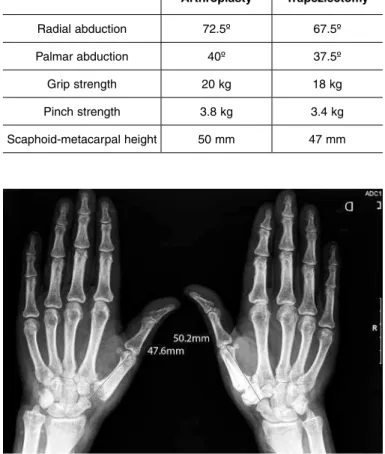
Figure 1 – Patients operated bilaterally using two different techniques.
Rev Bras Ortop. 2011;46(1):83-6
MATERIAL AND METHODS
Between January 1995 and October 2008, opera-tions were performed on 74 patients with grades III and IV rhizarthrosis, according to the classification of Eaton and Litter. Forty-seven patients attended the review consultation. Of these, seven were excluded because they were cases of arthrodesis, silicone pros-theses or resurfacing prospros-theses, while 12 underwent bilateral operations.
In total, 40 patients and 52 hands were evaluated. We divided the patients into two groups, depending on the type of surgical procedure. Thirty-two han-ds underwent trapeziectomy alone or in association with ligamentoplasty in accordance with the techni-que of Sigfuson-Lundborg(5) (group A) and 20 hands underwent ball-and-socket arthroplasty on the trape-zium-metacarpal joint (group B). The inclusion crite-ria for arthroplasty were: female patients, good bone stock, no systemic inflammatory disease and few ma-nual labor demands. The patients with a prosthesis were immobilized using a plaster cast for approxima-tely two weeks, and the patients with trapeziectomy with or without ligamentoplasty were in a plaster cast for around three weeks.
The mean length of the follow-up was 72 months in group A and 23 months in group B. In group A, four male patients and 18 female patients were ope-rated. In group B, 18 female patients were opeope-rated. The mean age at the time of the surgery was 60 years in group A and 62 years in group B (Table 1). Two patients were operated bilaterally with two different techniques (Table 2 and Figure 1).
The result from the treatment was evaluated ac-cording to clinical and radiographic criteria. The Quick Dash functional scale was used. The clinical
evaluation was based on four items: pain, function, mobility and strength. Radiographic evaluations were made before and after the operation, using anterior, lateral and stress views. The height difference in the scaphoid-metacarpal column (i.e. the line joining the most distal point on the scaphoid to the most dis-tal point on the first metacarpal) between the two hands of the same patient was calculated (Figure 2). The imaging evaluation also made it possible to as-sess implant placement, presence of radiolucency lines and preservation of the height of the scaphoid--metacarpal column.
Pain was assessed on a visual pain scale going from 0 to 10 points, corresponding to absence of pain and maximum pain, respectively.
The functional assessment was based on the possi-bility of carrying out activities of daily living, such as: picking up coins, opening a bottle top, turning a key in a lock, fastening/unfastening the buttons on a piece of clothing and writing.
group A group B
No. of patients 22 18
No. of hands 32 20
Sex (male/female) 4 / 18 0 / 18 Mean age (years) 60 (46-76) 62 (46-80)
Side (right/left) 16/12 7/13 Follow-up (months) 72 (180-15) 23 (36-12)
Table 1 – General characteristics of the patients.
Arthroplasty Trapeziectomy
Radial abduction 72.5º 67.5º Palmar abduction 40º 37.5º Grip strength 20 kg 18 kg Pinch strength 3.8 kg 3.4 kg Scaphoid-metacarpal height 50 mm 47 mm
85
Figure 2 – Measurement of the difference in the scaphoid-me-tacarpal column between the operated and non-operated hands.
SURGICAL TREATMENT OF RHIZARTHROSIS: TRAPEZIECTOMY WITH OR WITHOUT LIGAMENTOPLASTY VERSUS TOTAL PROSTHESIS
Rev Bras Ortop. 2011;46(1):83-6 The mobility of the trapezium-metacarpal joint
was measured in two directions: radial abduction and palmar abduction.
For all the patients, grip and pinch strength were measured using the same dynamometer (Jamar ® Hand Dynamometer – 5030J1).
Regarding the recovery time, the patients in group A required an average of 10 weeks to return to their activities of daily living, and group B, 4.5 weeks.
Two patients were operated bilaterally with two different techniques. The hand that underwent arthroplasty with an implant presented better radial and palmar abduction, greater grip and pinch strength and greater scaphoid-metacarpal height (Table 2 and Figure 1).
The radiographic evaluation of the prostheses sho-wed heterotopic calcification and three cases of peri-trapezial radiolucent lines. Only one case presented pain on mobilization, while all the other patients were asymptomatic and satisfied with their treatment.
Four cases of complications were registered: one case of algoneurodystrophy in group A and two dislocations and one fracture of the trapezium
group A group B
Without pain 86 % 82% Pain on mobilization 10% 13% Pain when resting 4% 5%
Pain at night -
-Pain scale 1.3 2.1
Table 3 – Assessment of thumb pain.
Without difficulty With difficulty group A group B group A group B
Picking up coins 81% 89% 19% 11% Opening lids 48% 44% 52% 56% Turning keys 81% 72% 19% 28%
Writing 95% 89% 5% 11%
Using a knife 86% 72% 14% 18%
Table 4 – Activities of daily living.
group A group B operated
hands
Non-operated
hands
operated hands
Non-operated
hands
Radial abduction 67º 64º 68º 66º Palmar abduction 50º 47,5º 38º 36º Grip strength (kg) 17.4 14.8 17.1 16.1 Pinch strength (kg) 4.3 3.5 4.1 3.9
Table 5 – Thumb mobility and strength.
RESULTS
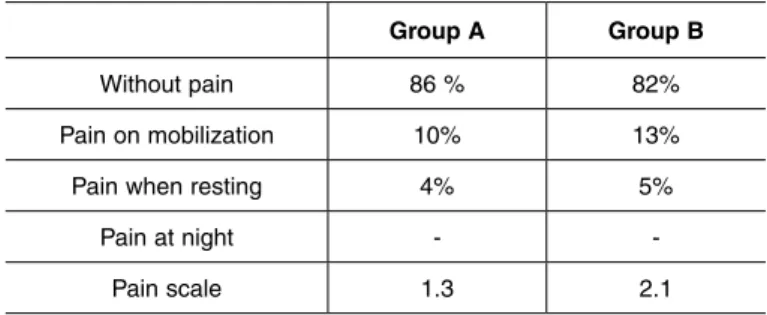
The results relating to pain (Table 3), activities of daily living (Table 4) and thumb mobility and strength (Table 5) did not differ significantly between the two groups.
86
Rev Bras Ortop. 2011;46(1):83-6
in group B. Only one patient required revision surgery. The algoneurodystrophy was resolved after one year of medical treatment. One dislocation was treated using closed reduction and other, using open reduction and removal of the volar osteophyte of the trapezium. The fracture of the trapezium was detected intraoperatively while inserting the implant and was treated postoperatively by means of immobilization, with good evolution.
The mean score on the Quick Dash scale was 45.6 in group A and 41.7 in group B.
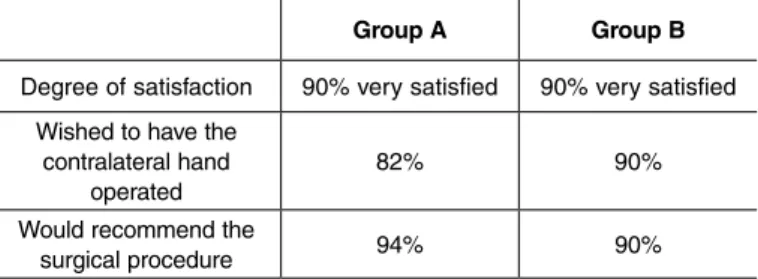
The degree of subjective satisfaction was compa-rable between the two groups (Table 6).
DISCUSSION
The two techniques (trapeziectomy with or without ligamentoplasty versus total prosthesis) did not differ significantly regarding pain, mobility, strength and dexterity in activities of daily living(4,6). The small differences found between the two groups were perhaps related to the difference in follow-up between them. The patients who underwent trapeziectomy
with or without ligamentoplasty had a longer follow-up, through which they may have had more time for adaptation.
Arthroplasty with placement of an implant ena-bles maintenance of the scaphoid-metacarpal colu-mn, although it has not been possible to correlate this with better clinical results and greater stability(7). It is more costly and has a greater risk of complications, namely dislocation and detachment(8). It should be noted that we found a complication rate of 15% in the prosthesis group, of which 10% (two patients) were cases of dislocation, of which only one case required surgical revision.
The great advantage of arthroplasty with place-ment of an implant is the earlier return to activities of daily living(9,10).
It was not within the scope of this study to compare trapeziectomy alone with trapeziectomy associated with ligamentoplasty, or to compare different types of implants.
CONCLUSION
Arthroplasty with placement of an implant for tre-ating rhizarthrosis is an attractive proposition because of the rapid recovery that it provides. However, it ne-eds to be carefully applied, since its long-term results and the surgical revision rate remain unknown. In the authors’ opinion, it should be reserved for women aged over 60 years and should be avoided among young patients and among men with demanding daily activities.
REFERENCES
1. de la Caffinière JY. Prothèse totale trapézio-métacarpienne._Rev Chir Orthop Reparatrice Appar Mot. 1974 Jun;60(4):299-308.
2. Nicholas RM, Calderwood JW. De la Caffinière arthroplasty for the basal thumb joint osteoarthritis. J Bone Joint Surg Br. 1992;74(2):309-12.
3. Pellegrini VD Jr, Burson RI. Surgical management of the basal joint arthritis of the thumb: Part I. Long-term results of silicone implant arthroplasty. J Hand Surg Am. 1986;11(3):309-24.
4. Brutus JP, Kinnen L. Remplacement prothétique total de la trapézométacarpien-ne au moyen de la prothèse ARPE dans le traitement de la rhizarthrose: notre expérience à court terme dans une série personnelle de 63 cas consécutifs. Chir Main. 2004;23(5):224-8.
5. Sigfusson R, Lundborg G. Abductor pollis longus tendon arthroplasty for treat-ment of the arthrosis in the first carpometacarpal joint. Scand J Plast Reconstr Surg Hand Surg. 1991;25(1):73-7.
6. Moutet F, Lignon J, Oberlin C, Alnot JY, Sartorius C. Les prothèses totales trapézo-métacarpiennes. Résultats de l’étude multicentrique (106 cas). Ann Chir Main Memb Super. 1990;9(3):189-94.
7. kadiyala RK, Gelbermann RH, Kwon B. Radiografic assessment of the trape-zial space before and after ligament reconstruction and tendon interposition arthroplasty. J Hand Surg Br. 1996;21(2):177-81.
8. Van Capelle HGJ, Elzenga P, Von Horn JR. Long–term results and loosening analysis of the De La Caffinière replacements of the trapeziometacarpal joint. J Hand Surg Am. 1999;24(3):476-82.
9. Wahl SW, Sunward GR. Non-cemented replacement of the trapeziometacarpal joint. J Bone Joint Surg Br. 1996;78(5):787-92.
10. Wachtl SW, Guggenheim PR, Sennwald GR. Cemented and non-ce men-ted replacements of the trapeziometacarpal joint. J Bone Joint Surg Br. 1998;80(1):121-5.
group A group B
Degree of satisfaction 90% very satisfied 90% very satisfied Wished to have the
contralateral hand
operated 82% 90%
Would recommend the
surgical procedure 94% 90%