EUROPEAN ORGANIZATION FOR NUCLEAR RESEARCH (CERN)
CERN-PH-EP/2013-234 2014/02/17
CMS-TOP-12-007
Measurement of the tt production cross section in the
dilepton channel in pp collisions at
√
s
=
8 TeV
The CMS Collaboration
∗Abstract
The top-antitop quark (tt) production cross section is measured in proton-proton col-lisions at√s= 8 TeV with the CMS experiment at the LHC, using a data sample cor-responding to an integrated luminosity of 5.3 fb−1. The measurement is performed by analysing events with a pair of electrons or muons, or one electron and one muon, and at least two jets, one of which is identified as originating from hadronisation of a bottom quark. The measured cross section is 239±2 (stat.)±11 (syst.)±6 (lum.) pb, for an assumed top-quark mass of 172.5 GeV, in agreement with the prediction of the standard model.
Published in the Journal of High Energy Physics as doi:10.1007/JHEP02(2014)024.
c
2014 CERN for the benefit of the CMS Collaboration. CC-BY-3.0 license
∗See Appendix A for the list of collaboration members
1
1
Introduction
A precise measurement of the tt production cross section can be used to test the theory of quantum chromodynamics (QCD) at next-to-next-to-leading-order (NNLO) level. It can be also used in global fits of the parton distribution functions (PDF) at NNLO, and allows an estimation of αs(MZ)as described in [1, 2]. Furthermore, top-quark production is an important
source of background in many searches for physics beyond the standard model (SM). A large sample of top-quark events has been collected at the Large Hadron Collider (LHC), and studies of top-quark production have been conducted in various decay channels as well as searches for deviations from the SM predictions [3–9].
This paper presents a measurement of the tt production cross section, σtt, based on the dilepton channel (e+e−, µ+µ−, and e±µ∓) in a data sample of proton-proton collisions at
√
s = 8 TeV corresponding to an integrated luminosity of 5.3 fb−1recorded by the Compact Muon Solenoid (CMS) experiment. In the SM, top quarks are predominantly produced in tt pairs via the strong interaction and decay almost exclusively to a W boson and a bottom quark. We measure the tt production cross section selecting final states that contain two leptons of opposite electric charge, momentum imbalance associated to the neutrinos from the W boson decays, and two jets of particles resulting from the hadronisation of two b quarks.
2
The CMS detector and simulation
The CMS detector [10] has a superconducting solenoid occupying the central region that pro-vides an axial magnetic field of 3.8 T. The silicon pixel and the strip tracker cover 0< φ <2π
in azimuth and |η| < 2.5 in pseudorapidity, where η is defined as η = −ln[tan(θ/2)], with θ being the polar angle measured with respect to the anticlockwise-beam direction. The
lead-tungstate crystal electromagnetic calorimeter and the brass/scintillator hadron calorimeter are located inside the solenoid. Muons are measured in gas-ionisation detectors embedded in the steel flux return yoke outside the solenoid. The detector is nearly hermetic, thereby providing reliable measurement of momentum imbalance in the plane transverse to the beams. A two-tier trigger system selects the most interesting pp collisions for offline analysis.
Several MC event generators are used to simulate signal and background events: MADGRAPH(v. 5.1.4.8) [11], POWHEG (r1380) [12] andPYTHIA (v. 6.424) [13], depending on the process con-sidered. The MADGRAPH generator with spin correlations is used to model tt events with a
top-quark mass of 172.5 GeV and combined withPYTHIAto simulate parton showering,
hadro-nisation, and the underlying event. The MADGRAPH generator is also used to simulate the W+jets and Drell–Yan (DY) processes. Single-top-quark events are simulated using POWHEG. Inclusive production of the WZ and ZZ diboson final states is simulated with PYTHIA. Pro-duction of WW fully leptonic final states is simulated with MADGRAPH. Decays of τ leptons are handled with TAUOLA (v. 2.75) [14]. The contributions from WW, WZ and ZZ (referred to as “VV”) and single-top-quark production are taken from MC simulations with appropriate next-to-leading order (NLO) cross sections. All other backgrounds are estimated from control samples extracted from collision data.
The tt production cross section amounts to σtt = 252.9+−6.48.6(scale)±11.7 (PDF+αs)pb as
cal-culated with the TOP++ program [15] at NNLO in perturbative QCD, including soft-gluon resummation at next-to-next-to-leading-log order [16], and assuming a top-quark mass mt =
172.5 GeV. The first uncertainty comes from the independent variation of the factorisation and renormalisation scales, µF and µR, while the second one is associated to variations in the PDF
2 3 Event selection
are normalised to that value unless otherwise stated.
The simulated samples include additional interactions per bunch crossing (pileup), with the distribution matching that observed in data.
3
Event selection
Event selection is similar to that used for the measurement of the tt dilepton cross section at
√
s =7 TeV [4]. At trigger level, events are required to have two electrons, two muons, or one electron and one muon, where one of these leptons has transverse momentum pT>17 GeV and
the other has pT >8 GeV. Events are then selected with two oppositely charged leptons
recon-structed with the CMS particle-flow (PF) algorithm [18], both with pT > 20 GeV and|η| <2.5
for electrons and|η| < 2.1 for muons. In events with more than one pair of leptons passing
these selections, the pair of opposite-sign leptons with the largest value of total transverse mo-mentum is selected. Events with τ leptons contribute to the measurement only if they decay to electrons or muons that satisfy the selection requirements. The efficiency for dilepton triggers is measured in data through triggers based on transverse momentum imbalance. The trigger efficiency is approximately 90% to 93% for the three final states. Using the measured dilepton trigger efficiency in data, the corresponding efficiencies in the simulation are corrected by pT
and η multiplicative data-to-simulation scale factors (SFs), which have an average value of 0.96 and uncertainties in the range 1 to 2%.
Charged-lepton candidates from W-boson decays are usually isolated from other particles in the event. For each electron or muon candidate, a cone of ∆R < 0.3 is constructed around the track direction at the event vertex, where∆R is defined as ∆R=
√
(∆η)2+ (∆φ)2, and∆η and∆φ are the differences in pseudorapidity and azimuthal angle between any energy deposit and the axis of the lepton track. The scalar sum of the pT of all particles reconstructed with
the PF algorithm, consistent with the chosen primary vertex and contained within the cone, is calculated, excluding the contribution from the lepton candidate itself. The relative isolation discriminant, Irel, is defined as the ratio of this sum to the pT of the lepton candidate. The
neutral component is corrected for pileup based on the average energy density deposited by neutral particles in the event: an average transverse energy due to pileup is determined event by event and is subtracted from the transverse energy in the isolation cone. A lepton candidate is rejected if Irel > 0.15. The efficiency of the lepton selection is measured using a
“tag-and-probe” method in dilepton events enriched in Z-boson candidates, as described in [4, 19]. The measured values for the combined identification and isolation efficiencies are typically of 96% for muons and 90% for electrons. Based on a comparison of lepton selection efficiencies in data and simulation, the event yield in simulation is corrected by pT-and η-dependent SFs, which
have an average value of 0.99 and uncertainties in the range 1 to 2% to provide consistency with data. Considering also the dilepton trigger, the combined factors have an average value of 0.96 and uncertainties around 2% for the three tt final states.
Dilepton candidate events with an invariant mass M`` < 20 GeV (` = e or µ) are removed to
suppress backgrounds from heavy-flavour resonances, as well as contributions from low-mass DY processes. Events with dilepton invariant masses within ±15 GeV of the Z mass are also rejected in the same-flavour channels.
Jets are reconstructed from the PF particle candidates using the anti-kTclustering algorithm [20]
with a distance parameter of 0.5. The jet energy is corrected for pileup in a manner similar to the correction of the energy inside the lepton isolation cone. Jet energy corrections are also applied as a function of the jet pTand η [21]. Events are required to have at least two reconstructed jets
3
with pT >30 GeV and|η| <2.5.
The missing transverse energy, E/ , is defined as the magnitude of the momentum imbalance,T
which is the negative sum of the momenta of all reconstructed particles in the plane transverse to the beams. A value of E/T > 40 GeV is required in the e+e− and µ+µ− channels while no
E/ requirement is imposed for the eT ±µ∓ mode, as there is very little contamination from DY
events in this channel.
Since tt events contain jets from hadronisation of b quarks, requiring their presence can reduce background from events without b quarks. Jets are identified as b jets using the combined secondary vertex algorithm (CSV) [22]. The operating point chosen for CSV corresponds to an identification efficiency of about 85% and a misidentification (mistag) probability of about 10% [23] for light-flavour jets (u, d, s and gluons). The selection requires the presence of at least one b jet in the event.
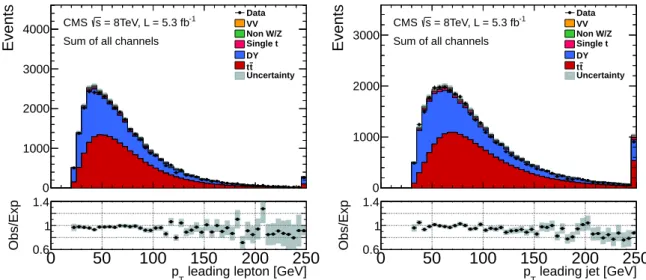
Figure 1 shows the pT distributions of the highest-pTlepton and jet after jet multiplicity
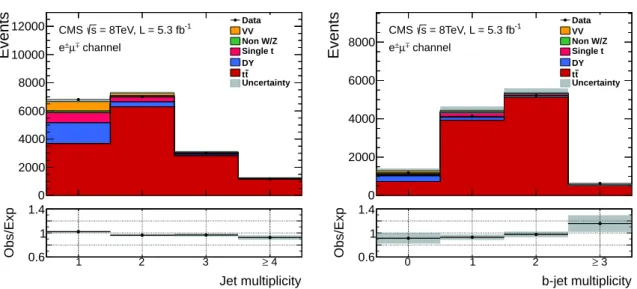
selec-tion, for all three final states combined. In this and the following figures the signal yields refer to an assumed top-quark mass of 172.5 GeV. The hatched regions correspond to the total statis-tical uncertainties in the predicted event yields. The ratio of the data to the sum of simulations and data-based predictions for the signal and backgrounds is shown in the bottom panels. A detailed description of the different background estimates is given in section 4. The multiplici-ties of selected jets and b jets are shown in figure 2 for the e±µ∓channel, which is expected to
have less background contamination. A similar level of agreement is obtained with the e+e− and µ+µ−channels. Events 0 1000 2000 3000 4000 Data VV Non W/Z Single t DY t t Uncertainty -1 = 8TeV, L = 5.3 fb s CMS
Sum of all channels
leading lepton [GeV] T p 0 50 100 150 200 250 Obs/Exp 0.6 1 1.4 Events 0 1000 2000 3000 Data VV Non W/Z Single t DY t t Uncertainty -1 = 8TeV, L = 5.3 fb s CMS
Sum of all channels
leading jet [GeV] T p 0 50 100 150 200 250 Obs/Exp 0.6 1 1.4
Figure 1: The pT distributions of the highest-pT lepton (left) and jet (right) after the jet
multi-plicity selection, for all three final states. The expected distributions for tt signal and individual backgrounds are shown after data-based corrections are applied; the last bin contains the over-flow events. The hatched bands correspond to the total statistical uncertainty in the event yields for the sum of the tt and background predictions. The ratios of data to the sum of the expected yields are given at the bottom.
4 4 Background determination Events 0 2000 4000 6000 8000 10000 12000 DataVV Non W/Z Single t DY t t Uncertainty -1 = 8TeV, L = 5.3 fb s CMS channel ± µ ± e Jet multiplicity 1 2 3 ≥ 4 Obs/Exp 0.6 1 1.4 Events 0 2000 4000 6000 8000 Data VV Non W/Z Single t DY t t Uncertainty -1 = 8TeV, L = 5.3 fb s CMS channel ± µ ± e b-jet multiplicity 0 1 2 ≥ 3 Obs/Exp 0.6 1 1.4
Figure 2: Jet multiplicity (left) in events passing the dilepton criteria, and (right) b-jet multi-plicity in events passing the full event selections but before the b-jet requirement, for the e±µ∓
channel. In the right figure, the hatched bands show the total statistical and b-jet systematic uncertainties in the event yields for the sum of the tt and background predictions. The hatched bands in the left figure show only the total statistical uncertainty on the predicted event yields. The ratios of data to the sum of the expected yields are given at the bottom.
4
Background determination
Backgrounds in this analysis arise from single-top-quark, DY and VV events, in which at least two prompt leptons are produced from Z or W decays. Other background sources, such as tt or W+jets events with decays into lepton+jets and where at least one jet is incorrectly re-constructed as a lepton (which mainly happens for electrons) or a lepton from the decay of bottom or charm hadrons (which mainly happens for muons), are grouped into the non-W/Z lepton category. Background yields from single-top-quark and VV events are estimated from simulation, while all other backgrounds are estimated from data.
The DY background is estimated using the “Rout/in” method [3, 4, 24] in which the events
outside of the Z mass window are obtained by normalising the event yield from simulation to the observed number of events inside the Z mass window. The data-to-simulation scale factor is found to be 1.3±0.4 for the e±µ∓channel. This value is compatible with 1.5±0.5, which is
estimated using a template fit as described in [4]. For the e+e−and µ+µ−channels the factors
are found to be 1.7±0.5 and 1.6±0.5, respectively.
Non-prompt leptons can arise from decays of mesons or heavy-flavour quarks, jet misidentifi-cation, photon conversions, or finite resolution detector effects whereas prompt leptons usually originate from decays of W or Z bosons and are isolated and well identified. Backgrounds with non-prompt leptons are estimated [25] from a control sample of collision data in which leptons are selected with relaxed identification and isolation requirements defining the loose lepton candidate, while the set of signal selection cuts described in section 3 defines the tight lepton candidate. The prompt and non-prompt lepton ratios are defined as the ratio of the number of tight candidates to the number of loose ones as measured from samples enriched in leptonic decays of Z bosons or in QCD dijet events, respectively. These ratios, parametrized as a func-tion of pT and η of the lepton, are then used to weight the events in the loose-loose dilepton
5
signal region. The systematic uncertainty comes from the jet pT spectrum in dijet events and
amounts, together with the statistical one, to 40% of the estimated yield.
5
Sources of systematic uncertainty
Simulated events are scaled according to the lepton efficiency correction factors, which are typically close to one, measured using control samples in data, leading to a 1 to 2% uncertainty in the tt selection efficiency.
The impact of uncertainty in the jet energy scale (JES) and jet energy resolution (JER) are esti-mated from the change observed in the number of selected MC tt events after varying the jet momenta within the JES uncertainties [21], and in the case of JER by an η-dependent correc-tion with an average of±10%. For the e+e− and µ+µ− channels these uncertainties are also
propagated to E/ resulting in a larger uncertainty than for the eT ±µ∓channel.
The uncertainties on the b jet scale factors in tt signal events are approximately 2% for b jets and 10% for mistagged jets [22, 23], depending on the pTof the jets. They are propagated to the
tt selection efficiency in simulated events.
The uncertainty assigned to the pileup simulation amounts to 0.8%, as obtained by varying the inelastic cross section by 5%. The uncertainty in the integrated luminosity is 2.6% [26].
The systematic effects related to the missing higher-order diagrams in MADGRAPH are esti-mated with two different methods. The uncertainty in the signal acceptance is determined by varying the renormalisation and factorisation scales simultaneously up and down by a factor of two using MADGRAPH, and the uncertainty is taken as the maximum difference after the
final event selection. The effect on the calculated tt production cross section is 2.3%, which is the value used in the analysis for this uncertainty. This estimate is cross-checked by comparing the predictions of the leading-order and NLO generators MADGRAPH and POWHEG, where both usePYTHIAfor hadronisation and extra radiation. The systematic uncertainty is found to be 2.2%, comparable with the above estimate.
The matching between the matrix elements (ME) and the parton shower (PS) evolution is done by applying the MLM prescription [27]. Changing the thresholds that control the matching of partons from the matrix element with those from PS by factors of 0.5 and 2.0 for one of the parameters (minimum kT measure between partons) and 0.75 and 1.5 for the other (jet
matching threshold for the kT-MLM scheme) compared to the default thresholds, produces a
1.6% variation in the tt event selection efficiency.
The uncertainty arising from the hadronisation model affects mainly the JES and the fragmen-tation of b jets. As the b-jet efficiencies and mistagging rates are taken from data, no addi-tional uncertainty is expected from this source. The uncertainty in the JES already contains a contribution from the uncertainty in the hadronisation. The hadronisation uncertainty is also determined by comparing samples of events generated withPOWHEGwhere the hadronisation is modelled withPYTHIA or HERWIG, and the effect on the calculated tt cross section is 1.4%, which is well within the JES uncertainty.
Uncertainties in the selected number of single-top-quark and VV events are calculated follow-ing the same prescription as for the signal yield. In addition, an uncertainty in the cross sections for single-top-quark and VV backgrounds, taken from measurements and estimated to be ap-proximately 20% [28–36], is added in quadrature.
6 6 Results
section from the different sources.
Table 1: Summary of the individual contributions to the systematic uncertainty on the σtt mea-surement. The uncertainties are given in pb. The statistical uncertainty on the result is given for comparison.
Source e+e− µ+µ− e±µ∓
Trigger efficiencies 4.1 3.0 3.6 Lepton efficiencies 5.8 5.6 4.0 Lepton energy scale 0.6 0.3 0.2 Jet energy scale 10.3 10.8 5.2 Jet energy resolution 3.2 4.0 3.0 b-jet tagging 1.9 1.9 1.7
Pileup 1.7 1.5 2.0
Scale (µFand µR) 5.7 5.5 5.6
Matching partons to showers 3.9 3.8 3.8 Single top quark 2.6 2.4 2.3
VV 0.7 0.7 0.5 Drell–Yan 10.8 10.3 1.5 Non-W/Z leptons 0.9 3.2 1.9 Total systematic 18.6 18.6 11.4 Integrated luminosity 6.4 6.1 6.2 Statistical 5.2 4.5 2.6
6
Results
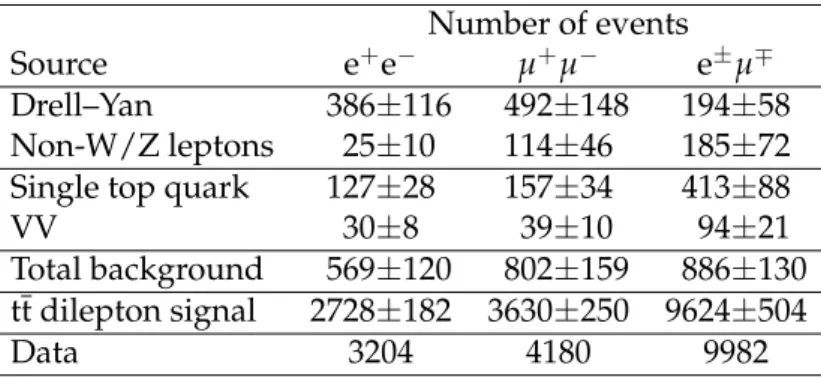
The tt production cross section is measured by counting events after applying the selection criteria described in section 3. Table 2 shows the total number of events observed in data and the number of signal and background events expected from simulation or estimates from data. Table 3 lists the mean acceptance (which contains contributions from W → τντ, with leptonic τdecays) multiplied by the selection efficiency and the branching fraction in the dilepton final
state, and the measured cross section for each of the three final states, e+e−, µ+µ−, and e±µ∓,
which give compatible results. The e+e−and µ+µ− channels have two additional sources of
uncertainty, arising from the DY background estimation and from the propagation of the JES to the E/ estimation, which limit the precision of the measurement of σT ttin those final states.
A combination of the three final states using the BLUE method [37] yields a measured cross section of σtt =239.0±2.1 (stat.)±11.3 (syst.)±6.2 (lum.) pb for a top-quark mass of 172.5 GeV. In the combination, the systematic uncertainties are 100% correlated across channels, except those associated to the lepton efficiencies, which have a correlation coefficient of 0.64 for e+e− with e±µ∓ and 0.55 for µ+µ−with e±µ∓. Finally, the uncertainties associated with the
data-based estimates and the statistical uncertainties are taken as uncorrelated.
In this analysis the dependence of the acceptance on the top-quark mass is found to be quadratic within the present uncertainty of the top-quark mass [38]. The cross-section dependence in the range 160–185 GeV can be parametrized as
σtt/σtt(mt =172.5) =1.00−0.009× (mt−172.5) −0.000168× (mt−172.5)2 (1)
where mtis given in GeV. Assuming a top-quark mass value of 173.2 GeV [38], a cross section
7
Figure 3 shows the distributions of M``, E/ and the difference of the azimuthal angle betweenT
the two selected leptons (∆φ``) and their ratios to expectations for the e±µ∓ channel, which
dominates the combination.
Events 0 200 400 600 800 Data VV Non W/Z Single t DY t t Uncertainty -1 = 8TeV, L = 5.3 fb s CMS channel ± µ ± e
Invariant mass [GeV]
50 100 150 200 250 300 Obs/Exp 0.6 1 1.4 Events 0 200 400 600 800 Data VV Non W/Z Single t DY t t Uncertainty -1 = 8TeV, L = 5.3 fb s CMS channel ± µ ± e [GeV] T E 0 50 100 150 200 Obs/Exp 0.6 1 1.4 Events 0 500 1000 1500 2000 2500 Data VV Non W/Z Single t DY t t Uncertainty -1 = 8TeV, L = 5.3 fb s CMS channel ± µ ± e | [rad] ll φ ∆ | 0 0.5 1 1.5 2 2.5 3 Obs/Exp 0.6 1 1.4
Figure 3: Distributions of (upper left) the dilepton invariant-mass, (upper right) the E/ , andT
(lower) the difference of the azimuthal angle between the two selected leptons, after the b-jet multiplicity selection and for the e±µ∓ channel. For the first two plots the last bin contains
the overflow events. The expected distributions for tt signal, in this case, are normalised to the measured tt cross section. The hatched bands correspond to the total uncertainty in the predicted event yields for the sum of the tt and background predictions. The ratios of data to the sum of the expected yields are given at the bottom.
7
Summary
A measurement of the tt production cross section in proton-proton collisions at √s = 8 TeV is presented for events containing a lepton pair (e+e−, µ+µ−, e±µ∓), at least two jets with at
least one tagged as b jet, and a large imbalance in transverse momentum in the final state. The measurement is obtained through an event-counting analysis based on a data sample
8 7 Summary
corresponding to 5.3 fb−1. The result obtained by combining the three final states is σtt =
239±2 (stat.)±11 (syst.)±6 (lum.) pb, in agreement with the prediction of the standard model for a top-quark mass of 172.5 GeV.
Table 2: Number of dilepton events after applying the event selection and requiring at least one b jet. The results are given for the individual sources of background, tt signal with a top-quark mass of 172.5 GeV and σtt =252.9 pb, and data. The uncertainties correspond to the statistical and systematic components added in quadrature.
Number of events Source e+e− µ+µ− e±µ∓
Drell–Yan 386±116 492±148 194±58 Non-W/Z leptons 25±10 114±46 185±72 Single top quark 127±28 157±34 413±88 VV 30±8 39±10 94±21 Total background 569±120 802±159 886±130 tt dilepton signal 2728±182 3630±250 9624±504
Data 3204 4180 9982
Table 3: The total efficiencies etotal, i.e. the products of event acceptance, selection efficiency and
branching fraction for the respective tt final states, as estimated from simulation for a top-quark mass of 172.5 GeV, and the measured tt production cross sections, where the uncertainties are from statistical, systematic and integrated luminosity components, respectively.
e+e− µ+µ− e±µ∓
etotal(%) 0.203±0.012 0.270±0.017 0.717±0.033
σtt(pb) 244.3±5.2±18.6±6.4 235.3±4.5±18.6±6.1 239.0±2.6±11.4±6.2
Acknowledgments
We congratulate our colleagues in the CERN accelerator departments for the excellent perfor-mance of the LHC and thank the technical and administrative staffs at CERN and at other CMS institutes for their contributions to the success of the CMS effort. In addition, we gratefully ac-knowledge the computing centres and personnel of the Worldwide LHC Computing Grid for delivering so effectively the computing infrastructure essential to our analyses. Finally, we ac-knowledge the enduring support for the construction and operation of the LHC and the CMS detector provided by the following funding agencies: BMWF and FWF (Austria); FNRS and FWO (Belgium); CNPq, CAPES, FAPERJ, and FAPESP (Brazil); MES (Bulgaria); CERN; CAS, MoST, and NSFC (China); COLCIENCIAS (Colombia); MSES and CSF (Croatia); RPF (Cyprus); MoER, SF0690030s09 and ERDF (Estonia); Academy of Finland, MEC, and HIP (Finland); CEA and CNRS/IN2P3 (France); BMBF, DFG, and HGF (Germany); GSRT (Greece); OTKA and NIH (Hungary); DAE and DST (India); IPM (Iran); SFI (Ireland); INFN (Italy); NRF and WCU (Republic of Korea); LAS (Lithuania); CINVESTAV, CONACYT, SEP, and UASLP-FAI (Mex-ico); MBIE (New Zealand); PAEC (Pakistan); MSHE and NSC (Poland); FCT (Portugal); JINR (Dubna); MON, RosAtom, RAS and RFBR (Russia); MESTD (Serbia); SEIDI and CPAN (Spain); Swiss Funding Agencies (Switzerland); NSC (Taipei); ThEPCenter, IPST, STAR and NSTDA (Thailand); TUBITAK and TAEK (Turkey); NASU (Ukraine); STFC (United Kingdom); DOE and NSF (USA).
Individuals have received support from the Marie-Curie programme and the European Re-search Council and EPLANET (European Union); the Leventis Foundation; the A. P. Sloan
References 9
Foundation; the Alexander von Humboldt Foundation; the Belgian Federal Science Policy Of-fice; the Fonds pour la Formation `a la Recherche dans l’Industrie et dans l’Agriculture (FRIA-Belgium); the Agentschap voor Innovatie door Wetenschap en Technologie (IWT-(FRIA-Belgium); the Ministry of Education, Youth and Sports (MEYS) of Czech Republic; the Council of Science and Industrial Research, India; the Compagnia di San Paolo (Torino); the HOMING PLUS pro-gramme of Foundation for Polish Science, cofinanced by EU, Regional Development Fund; and the Thalis and Aristeia programmes cofinanced by EU-ESF and the Greek NSRF.
References
[1] CMS Collaboration, “Determination of the top-quark pole mass and strong coupling constant from the tt production cross section in pp collisions at√s= 7 TeV”, (2013). arXiv:1307.1907.
[2] M. Czakon, M. L. Mangano, A. Mitov and J. Rojo , “Constraints on the gluon PDF from top quark pair production at hadron colliders”, JHEP 07 (2013) 167,
doi:10.1007/JHEP07(2013)167, arXiv:1303.7215.
[3] CMS Collaboration, “Measurement of the t¯t production cross section and the top quark mass in the dilepton channel in pp collisions at√s = 7 TeV”, JHEP 07 (2011) 049, doi:10.1007/JHEP07(2011)049, arXiv:1105.5661.
[4] CMS Collaboration, “Measurement of the tt cross section in the dilepton channel in pp collisions at√s = 7 TeV”, JHEP 11 (2012) 067, doi:10.1007/jhep11(2012)067, arXiv:1208.2671.
[5] ATLAS Collaboration, “Measurement of the cross section for top-quark pair production in pp collisions at√s = 7 TeV with the ATLAS detector using final states with two high-pt leptons”, JHEP 05 (2012) 059, doi:10.1007/JHEP05(2012)059, arXiv:1202.4892.
[6] CMS Collaboration, “Measurements of tt spin correlations and top-quark polarization using dilepton final states in pp collisions at 7 TeV”, (2013). arXiv:1311.3924. [7] CMS Collaboration, “Measurement of the charge asymmetry in top-quark pair
production in proton-proton collisions at√s = 7 TeV”, Phys. Lett. B 709 (2012) 28, doi:10.1016/j.physletb.2012.01.078, arXiv:1112.5100.
[8] ATLAS Collaboration, “Search for new phenomena in t¯t events with large missing transverse momentum”, Phys. Rev. Lett. 108 (2012) 041805,
doi:10.1103/PhysRevLett.108.041805, arXiv:1109.4725.
[9] ATLAS Collaboration, “Search for anomalous production of prompt like-sign muon pairs and constraints on physics beyond the Standard Model”, Phys. Rev. D 88 (2012) 032004, doi:10.1103/PhysRevD.85.032004, arXiv:1201.1091.
[10] CMS Collaboration, “The CMS experiment at the CERN LHC”, JINST 3 (2008) S08004, doi:10.1088/1748-0221/3/08/S08004.
[11] J. Alwall et al., “MadGraph 5: going beyond”, JHEP 06 (2011) 128, doi:10.1007/JHEP06(2011)128, arXiv:1106.0522.
10 References
[12] S. Frixione, P. Nason, and C. Oleari, “Matching NLO QCD computations with parton shower simulations: the POWHEG method”, JHEP 11 (2007) 070,
doi:10.1088/1126-6708/2007/11/070, arXiv:0709.2092.
[13] T. Sj ¨ostrand, S. Mrenna, and P. Skands, “PYTHIA 6.4 physics and manual”, JHEP 05 (2006) 026, doi:10.1088/1126-6708/2006/05/026, arXiv:hep-ph/0603175. [14] N. Davidson et al., “Universal Interface of TAUOLA Technical and Physics
Documentation”, Comput. Phys. Commun. 183 (2010) 821, doi:10.1016/j.cpc.2011.12.009, arXiv:1002.0543.
[15] M. Czakon and A. Mitov, “Top++, a program for the calculation of the top-pair cross-section at hadron colliders”, (2013). arXiv:1112.5675.
[16] M. Czakon, P. Fiedler and A. Mitov, “The total top quark production cross-section at hadron colliders through O(α4S)”, Phys. Rev. Lett. 110 (2013) 252004,
doi:10.1103/PhysRevLett.110.252004, arXiv:1303.6254.
[17] M. Botje et al., “The PDF4LHC Working Group Interim Recommendations”, (2011). arXiv:1101.0538.
[18] CMS Collaboration, “Commissioning of the Particle-Flow Reconstruction in Minimum-Bias and Jet Events from pp Collisions at 7 TeV”, CMS Physics Analysis Summary CMS-PAS-PFT-10-002, (2010).
[19] CMS Collaboration, “Measurements of Inclusive W and Z cross sections in pp Collisions at√s = 7 TeV”, JHEP 01 (2011) 080, doi:10.1007/JHEP01(2011)080,
arXiv:1012.2466.
[20] M. Cacciari, G. P. Salam, and G. Soyez, “The anti-ktjet clustering algorithm”, JHEP 04
(2008) 063, doi:10.1088/1126-6708/2008/04/063, arXiv:0802.1189. [21] CMS Collaboration, “Determination of Jet Energy Calibration and Transverse
Momentum Resolution in CMS”, JINST 6 (2011) P11002,
doi:10.1088/1748-0221/6/11/P11002, arXiv:1107.4277.
[22] CMS Collaboration, “Identification of b-quark jets with the CMS experiment”, J. Instrum.
8(2013) 04013, doi:10.1088/1748-0221/8/04/P04013, arXiv:1211.4462. [23] CMS Collaboration, “Results on b-tagging identification in 8 TeV pp collisions”, CMS
Performance Note CMS-DP-2013-005, (2013).
[24] CMS Collaboration, “First measurement of the cross section for top-quark pair production in proton-proton collisions at√s = 7 TeV”, Phys. Lett. B 695 (2011) 424, doi:10.1016/j.physletb.2010.11.058, arXiv:1010.5994.
[25] CMS Collaboration, “Measurement of Higgs boson production and properties in the WW decay channel with leptonic final states”, (2013). arXiv:1312.1129. Submitted to JHEP.
[26] CMS Collaboration, “CMS Luminosity Based on Pixel Cluster Counting - Summer 2013 Update”, CMS Physics Analysis Summary CMS-PAS-LUM-13-001, (2013).
[27] M. L. Mangano, M. Moretti, F. Piccinini and M. Treccani , “Matching matrix elements and shower evolution for top-quark production in hadronic collisions”, JHEP 01 (2007) 013, doi:10.1088/1126-6708/2007/01/013.
References 11
[28] CMS Collaboration, “Measurement of the W+W−and ZZ production cross section in pp collisions at√s = 8 TeV”, Phys. Lett. B 721 (2013) 190,
doi:10.1016/j.physletb.2013.03.027, arXiv:1301.4698.
[29] CMS Collaboration, “Measurement of the W+W−cross section in pp collisions at√s =7 TeV and limits on anomalous WWγ and WWZ couplings”, Eur. Phys. J. C 73 (2013) 2610, doi:10.1140/epjc/s10052-013-2610-8, arXiv:1306.1126.
[30] CMS Collaboration, “Measurement of WW Production and Search for the Higgs Boson in pp Collisions at√s = 7 TeV”, Phys. Lett. B 699 (2011) 25,
doi:10.1016/j.physletb.2011.03.056, arXiv:1102.5429.
[31] CMS Collaboration, “Measurement of the sum of WW and WZ production with W+dijet events in pp collisions at√s = 7 TeV”, Eur. Phys. J. C 73 (2013) 2283,
doi:10.1140/epjc/s10052-013-2283-3, arXiv:1210.7544.
[32] CMS Collaboration, “Measurement of the ZZ production cross section and search for anomalous couplings in 2`2`0 final states in pp collisions at√s = 7 TeV”, JHEP 01 (2013) 063, doi:10.1007/JHEP01(2013)063, arXiv:1211.4890.
[33] CMS Collaboration, “Measurement of the single-top-quark t-channel cross section in pp collisions at√s = 7 TeV”, JHEP 12 (2012) 035, doi:10.1007/JHEP12(2012)035, arXiv:1209.4533.
[34] ATLAS Collaboration, “Measurement of the WW cross section in√s = 7 TeV pp collisions with the ATLAS detector and limits on anomalous gauge couplings”, Phys. Lett. B 712 (2012) 289, doi:10.1016/j.physletb.2012.05.003, arXiv:1203.6232.
[35] ATLAS Collaboration, “Measurement of the W±Z production cross section and limits on anomalous triple gauge couplings in proton-proton collisions at√s = 7 TeV with the ATLAS detector”, Phys. Lett. B 709 (2012) 341,
doi:10.1016/j.physletb.2012.02.053, arXiv:1111.5570.
[36] ATLAS Collaboration, “Measurement of the ZZ Production Cross Section and Limits on Anomalous Neutral Triple Gauge Couplings in Proton-Proton Collisions at√s = 7 TeV with the ATLAS Detector”, Phys. Rev. Lett. 108 (2012) 041804,
doi:10.1103/PhysRevLett.108.041804, arXiv:1110.5016.
[37] L. Lyons, D. Gibaut, and P. Clifford, “How to combine correlated estimates of a single physical quantity”, Nucl. Instrum. Meth. A 270 (1988) 110,
doi:10.1016/0168-9002(88)90018-6.
[38] Particle Data Group, J. Beringer et al., “The Review of Particle Physics”, Phys. Rev. D 86 (2012) 010001, doi:10.1103/PhysRevD.86.010001.
13
A
The CMS Collaboration
Yerevan Physics Institute, Yerevan, Armenia
S. Chatrchyan, V. Khachatryan, A.M. Sirunyan, A. Tumasyan
Institut f ¨ur Hochenergiephysik der OeAW, Wien, Austria
W. Adam, T. Bergauer, M. Dragicevic, J. Er ¨o, C. Fabjan1, M. Friedl, R. Fr ¨uhwirth1, V.M. Ghete, C. Hartl, N. H ¨ormann, J. Hrubec, M. Jeitler1, W. Kiesenhofer, V. Kn ¨unz, M. Krammer1, I. Kr¨atschmer, D. Liko, I. Mikulec, D. Rabady2, B. Rahbaran, H. Rohringer, R. Sch ¨ofbeck,
J. Strauss, A. Taurok, W. Treberer-Treberspurg, W. Waltenberger, C.-E. Wulz1
National Centre for Particle and High Energy Physics, Minsk, Belarus
V. Mossolov, N. Shumeiko, J. Suarez Gonzalez
Universiteit Antwerpen, Antwerpen, Belgium
S. Alderweireldt, M. Bansal, S. Bansal, T. Cornelis, E.A. De Wolf, X. Janssen, A. Knutsson, S. Luyckx, L. Mucibello, S. Ochesanu, B. Roland, R. Rougny, H. Van Haevermaet, P. Van Mechelen, N. Van Remortel, A. Van Spilbeeck
Vrije Universiteit Brussel, Brussel, Belgium
F. Blekman, S. Blyweert, J. D’Hondt, N. Heracleous, A. Kalogeropoulos, J. Keaveney, T.J. Kim, S. Lowette, M. Maes, A. Olbrechts, D. Strom, S. Tavernier, W. Van Doninck, P. Van Mulders, G.P. Van Onsem, I. Villella
Universit´e Libre de Bruxelles, Bruxelles, Belgium
C. Caillol, B. Clerbaux, G. De Lentdecker, L. Favart, A.P.R. Gay, A. L´eonard, P.E. Marage, A. Mohammadi, L. Perni`e, T. Reis, T. Seva, L. Thomas, C. Vander Velde, P. Vanlaer, J. Wang
Ghent University, Ghent, Belgium
V. Adler, K. Beernaert, L. Benucci, A. Cimmino, S. Costantini, S. Dildick, G. Garcia, B. Klein, J. Lellouch, J. Mccartin, A.A. Ocampo Rios, D. Ryckbosch, S. Salva Diblen, M. Sigamani, N. Strobbe, F. Thyssen, M. Tytgat, S. Walsh, E. Yazgan, N. Zaganidis
Universit´e Catholique de Louvain, Louvain-la-Neuve, Belgium
S. Basegmez, C. Beluffi3, G. Bruno, R. Castello, A. Caudron, L. Ceard, G.G. Da Silveira, C. Delaere, T. du Pree, D. Favart, L. Forthomme, A. Giammanco4, J. Hollar, P. Jez, M. Komm, V. Lemaitre, J. Liao, O. Militaru, C. Nuttens, D. Pagano, A. Pin, K. Piotrzkowski, A. Popov5, L. Quertenmont, M. Selvaggi, M. Vidal Marono, J.M. Vizan Garcia
Universit´e de Mons, Mons, Belgium
N. Beliy, T. Caebergs, E. Daubie, G.H. Hammad
Centro Brasileiro de Pesquisas Fisicas, Rio de Janeiro, Brazil
G.A. Alves, M. Correa Martins Junior, T. Martins, M.E. Pol, M.H.G. Souza
Universidade do Estado do Rio de Janeiro, Rio de Janeiro, Brazil
W.L. Ald´a J ´unior, W. Carvalho, J. Chinellato6, A. Cust ´odio, E.M. Da Costa, D. De Jesus Damiao,
C. De Oliveira Martins, S. Fonseca De Souza, H. Malbouisson, M. Malek, D. Matos Figueiredo, L. Mundim, H. Nogima, W.L. Prado Da Silva, J. Santaolalla, A. Santoro, A. Sznajder, E.J. Tonelli Manganote6, A. Vilela Pereira
Universidade Estadual Paulistaa, Universidade Federal do ABCb, S˜ao Paulo, Brazil
C.A. Bernardesb, F.A. Diasa,7, T.R. Fernandez Perez Tomeia, E.M. Gregoresb, P.G. Mercadanteb, S.F. Novaesa, Sandra S. Padulaa
14 A The CMS Collaboration
Institute for Nuclear Research and Nuclear Energy, Sofia, Bulgaria
V. Genchev2, P. Iaydjiev2, A. Marinov, S. Piperov, M. Rodozov, G. Sultanov, M. Vutova
University of Sofia, Sofia, Bulgaria
A. Dimitrov, I. Glushkov, R. Hadjiiska, V. Kozhuharov, L. Litov, B. Pavlov, P. Petkov
Institute of High Energy Physics, Beijing, China
J.G. Bian, G.M. Chen, H.S. Chen, M. Chen, R. Du, C.H. Jiang, D. Liang, S. Liang, X. Meng, R. Plestina8, J. Tao, X. Wang, Z. Wang
State Key Laboratory of Nuclear Physics and Technology, Peking University, Beijing, China
C. Asawatangtrakuldee, Y. Ban, Y. Guo, Q. Li, W. Li, S. Liu, Y. Mao, S.J. Qian, D. Wang, L. Zhang, W. Zou
Universidad de Los Andes, Bogota, Colombia
C. Avila, C.A. Carrillo Montoya, L.F. Chaparro Sierra, C. Florez, J.P. Gomez, B. Gomez Moreno, J.C. Sanabria
Technical University of Split, Split, Croatia
N. Godinovic, D. Lelas, D. Polic, I. Puljak
University of Split, Split, Croatia
Z. Antunovic, M. Kovac
Institute Rudjer Boskovic, Zagreb, Croatia
V. Brigljevic, K. Kadija, J. Luetic, D. Mekterovic, S. Morovic, L. Tikvica
University of Cyprus, Nicosia, Cyprus
A. Attikis, G. Mavromanolakis, J. Mousa, C. Nicolaou, F. Ptochos, P.A. Razis
Charles University, Prague, Czech Republic
M. Finger, M. Finger Jr.
Academy of Scientific Research and Technology of the Arab Republic of Egypt, Egyptian Network of High Energy Physics, Cairo, Egypt
A.A. Abdelalim9, Y. Assran10, S. Elgammal9, A. Ellithi Kamel11, M.A. Mahmoud12, A. Radi13,14
National Institute of Chemical Physics and Biophysics, Tallinn, Estonia
M. Kadastik, M. M ¨untel, M. Murumaa, M. Raidal, L. Rebane, A. Tiko
Department of Physics, University of Helsinki, Helsinki, Finland
P. Eerola, G. Fedi, M. Voutilainen
Helsinki Institute of Physics, Helsinki, Finland
J. H¨ark ¨onen, V. Karim¨aki, R. Kinnunen, M.J. Kortelainen, T. Lamp´en, K. Lassila-Perini, S. Lehti, T. Lind´en, P. Luukka, T. M¨aenp¨a¨a, T. Peltola, E. Tuominen, J. Tuominiemi, E. Tuovinen, L. Wendland
Lappeenranta University of Technology, Lappeenranta, Finland
T. Tuuva
DSM/IRFU, CEA/Saclay, Gif-sur-Yvette, France
M. Besancon, F. Couderc, M. Dejardin, D. Denegri, B. Fabbro, J.L. Faure, F. Ferri, S. Ganjour, A. Givernaud, P. Gras, G. Hamel de Monchenault, P. Jarry, E. Locci, J. Malcles, A. Nayak, J. Rander, A. Rosowsky, M. Titov
15
Laboratoire Leprince-Ringuet, Ecole Polytechnique, IN2P3-CNRS, Palaiseau, France
S. Baffioni, F. Beaudette, P. Busson, C. Charlot, N. Daci, T. Dahms, M. Dalchenko, L. Dobrzynski, A. Florent, R. Granier de Cassagnac, P. Min´e, C. Mironov, I.N. Naranjo, M. Nguyen, C. Ochando, P. Paganini, D. Sabes, R. Salerno, Y. Sirois, C. Veelken, Y. Yilmaz, A. Zabi
Institut Pluridisciplinaire Hubert Curien, Universit´e de Strasbourg, Universit´e de Haute Alsace Mulhouse, CNRS/IN2P3, Strasbourg, France
J.-L. Agram15, J. Andrea, D. Bloch, J.-M. Brom, E.C. Chabert, C. Collard, E. Conte15, F. Drouhin15, J.-C. Fontaine15, D. Gel´e, U. Goerlach, C. Goetzmann, P. Juillot, A.-C. Le Bihan, P. Van Hove
Centre de Calcul de l’Institut National de Physique Nucleaire et de Physique des Particules, CNRS/IN2P3, Villeurbanne, France
S. Gadrat
Universit´e de Lyon, Universit´e Claude Bernard Lyon 1, CNRS-IN2P3, Institut de Physique Nucl´eaire de Lyon, Villeurbanne, France
S. Beauceron, N. Beaupere, G. Boudoul, S. Brochet, J. Chasserat, R. Chierici, D. Contardo2, P. Depasse, H. El Mamouni, J. Fan, J. Fay, S. Gascon, M. Gouzevitch, B. Ille, T. Kurca, M. Lethuillier, L. Mirabito, S. Perries, J.D. Ruiz Alvarez, L. Sgandurra, V. Sordini, M. Vander Donckt, P. Verdier, S. Viret, H. Xiao
Institute of High Energy Physics and Informatization, Tbilisi State University, Tbilisi, Georgia
Z. Tsamalaidze16
RWTH Aachen University, I. Physikalisches Institut, Aachen, Germany
C. Autermann, S. Beranek, M. Bontenackels, B. Calpas, M. Edelhoff, L. Feld, O. Hindrichs, K. Klein, A. Ostapchuk, A. Perieanu, F. Raupach, J. Sammet, S. Schael, D. Sprenger, H. Weber, B. Wittmer, V. Zhukov5
RWTH Aachen University, III. Physikalisches Institut A, Aachen, Germany
M. Ata, J. Caudron, E. Dietz-Laursonn, D. Duchardt, M. Erdmann, R. Fischer, A. G ¨uth, T. Hebbeker, C. Heidemann, K. Hoepfner, D. Klingebiel, S. Knutzen, P. Kreuzer, M. Merschmeyer, A. Meyer, M. Olschewski, K. Padeken, P. Papacz, H. Reithler, S.A. Schmitz, L. Sonnenschein, D. Teyssier, S. Th ¨uer, M. Weber
RWTH Aachen University, III. Physikalisches Institut B, Aachen, Germany
V. Cherepanov, Y. Erdogan, G. Fl ¨ugge, H. Geenen, M. Geisler, W. Haj Ahmad, F. Hoehle, B. Kargoll, T. Kress, Y. Kuessel, J. Lingemann2, A. Nowack, I.M. Nugent, L. Perchalla, O. Pooth, A. Stahl
Deutsches Elektronen-Synchrotron, Hamburg, Germany
I. Asin, N. Bartosik, J. Behr, W. Behrenhoff, U. Behrens, A.J. Bell, M. Bergholz17, A. Bethani, K. Borras, A. Burgmeier, A. Cakir, L. Calligaris, A. Campbell, S. Choudhury, F. Costanza, C. Diez Pardos, S. Dooling, T. Dorland, G. Eckerlin, D. Eckstein, T. Eichhorn, G. Flucke, A. Geiser, A. Grebenyuk, P. Gunnellini, S. Habib, J. Hauk, G. Hellwig, M. Hempel, D. Horton, H. Jung, M. Kasemann, P. Katsas, J. Kieseler, C. Kleinwort, M. Kr¨amer, D. Kr ¨ucker, W. Lange, J. Leonard, K. Lipka, W. Lohmann17, B. Lutz, R. Mankel, I. Marfin, I.-A. Melzer-Pellmann, A.B. Meyer, J. Mnich, A. Mussgiller, S. Naumann-Emme, O. Novgorodova, F. Nowak, H. Perrey, A. Petrukhin, D. Pitzl, R. Placakyte, A. Raspereza, P.M. Ribeiro Cipriano, C. Riedl, E. Ron, M. ¨O. Sahin, J. Salfeld-Nebgen, P. Saxena, R. Schmidt17, T. Schoerner-Sadenius, M. Schr ¨oder, M. Stein, A.D.R. Vargas Trevino, R. Walsh, C. Wissing
16 A The CMS Collaboration
University of Hamburg, Hamburg, Germany
M. Aldaya Martin, V. Blobel, H. Enderle, J. Erfle, E. Garutti, K. Goebel, M. G ¨orner, M. Gosselink, J. Haller, R.S. H ¨oing, H. Kirschenmann, R. Klanner, R. Kogler, J. Lange, T. Lapsien, T. Lenz, I. Marchesini, J. Ott, T. Peiffer, N. Pietsch, D. Rathjens, C. Sander, H. Schettler, P. Schleper, E. Schlieckau, A. Schmidt, M. Seidel, J. Sibille18, V. Sola, H. Stadie, G. Steinbr ¨uck, D. Troendle, E. Usai, L. Vanelderen
Institut f ¨ur Experimentelle Kernphysik, Karlsruhe, Germany
C. Barth, C. Baus, J. Berger, C. B ¨oser, E. Butz, T. Chwalek, W. De Boer, A. Descroix, A. Dierlamm, M. Feindt, M. Guthoff2, F. Hartmann2, T. Hauth2, H. Held, K.H. Hoffmann, U. Husemann, I. Katkov5, A. Kornmayer2, E. Kuznetsova, P. Lobelle Pardo, D. Martschei, M.U. Mozer, Th. M ¨uller, M. Niegel, A. N ¨urnberg, O. Oberst, G. Quast, K. Rabbertz, F. Ratnikov, S. R ¨ocker, F.-P. Schilling, G. Schott, H.J. Simonis, F.M. Stober, R. Ulrich, J. Wagner-Kuhr, S. Wayand, T. Weiler, R. Wolf, M. Zeise
Institute of Nuclear and Particle Physics (INPP), NCSR Demokritos, Aghia Paraskevi, Greece
G. Anagnostou, G. Daskalakis, T. Geralis, S. Kesisoglou, A. Kyriakis, D. Loukas, A. Markou, C. Markou, E. Ntomari, A. Psallidas, I. Topsis-giotis
University of Athens, Athens, Greece
L. Gouskos, A. Panagiotou, N. Saoulidou, E. Stiliaris
University of Io´annina, Io´annina, Greece
X. Aslanoglou, I. Evangelou, G. Flouris, C. Foudas, J. Jones, P. Kokkas, N. Manthos, I. Papadopoulos, E. Paradas
Wigner Research Centre for Physics, Budapest, Hungary
G. Bencze, C. Hajdu, P. Hidas, D. Horvath19, F. Sikler, V. Veszpremi, G. Vesztergombi20, A.J. Zsigmond
Institute of Nuclear Research ATOMKI, Debrecen, Hungary
N. Beni, S. Czellar, J. Molnar, J. Palinkas, Z. Szillasi
University of Debrecen, Debrecen, Hungary
J. Karancsi, P. Raics, Z.L. Trocsanyi, B. Ujvari
National Institute of Science Education and Research, Bhubaneswar, India
S.K. Swain
Panjab University, Chandigarh, India
S.B. Beri, V. Bhatnagar, N. Dhingra, R. Gupta, M. Kaur, M.Z. Mehta, M. Mittal, N. Nishu, A. Sharma, J.B. Singh
University of Delhi, Delhi, India
Ashok Kumar, Arun Kumar, S. Ahuja, A. Bhardwaj, B.C. Choudhary, A. Kumar, S. Malhotra, M. Naimuddin, K. Ranjan, V. Sharma, R.K. Shivpuri
Saha Institute of Nuclear Physics, Kolkata, India
S. Banerjee, S. Bhattacharya, K. Chatterjee, S. Dutta, B. Gomber, Sa. Jain, Sh. Jain, R. Khurana, A. Modak, S. Mukherjee, D. Roy, S. Sarkar, M. Sharan, A.P. Singh
Bhabha Atomic Research Centre, Mumbai, India
17
Tata Institute of Fundamental Research - EHEP, Mumbai, India
T. Aziz, R.M. Chatterjee, S. Ganguly, S. Ghosh, M. Guchait21, A. Gurtu22, G. Kole, S. Kumar, M. Maity23, G. Majumder, K. Mazumdar, G.B. Mohanty, B. Parida, K. Sudhakar, N. Wickramage24
Tata Institute of Fundamental Research - HECR, Mumbai, India
S. Banerjee, S. Dugad
Institute for Research in Fundamental Sciences (IPM), Tehran, Iran
H. Arfaei, H. Bakhshiansohi, H. Behnamian, S.M. Etesami25, A. Fahim26, A. Jafari, M. Khakzad, M. Mohammadi Najafabadi, M. Naseri, S. Paktinat Mehdiabadi, B. Safarzadeh27, M. Zeinali University College Dublin, Dublin, Ireland
M. Grunewald
INFN Sezione di Baria, Universit`a di Barib, Politecnico di Baric, Bari, Italy
M. Abbresciaa,b, L. Barbonea,b, C. Calabriaa,b, S.S. Chhibraa,b, A. Colaleoa, D. Creanzaa,c, N. De Filippisa,c, M. De Palmaa,b, L. Fiorea, G. Iasellia,c, G. Maggia,c, M. Maggia, B. Marangellia,b, S. Mya,c, S. Nuzzoa,b, N. Pacificoa, A. Pompilia,b, G. Pugliesea,c, R. Radognaa,b, G. Selvaggia,b, L. Silvestrisa, G. Singha,b, R. Vendittia,b, P. Verwilligena, G. Zitoa
INFN Sezione di Bolognaa, Universit`a di Bolognab, Bologna, Italy
G. Abbiendia, A.C. Benvenutia, D. Bonacorsia,b, S. Braibant-Giacomellia,b, L. Brigliadoria,b, R. Campaninia,b, P. Capiluppia,b, A. Castroa,b, F.R. Cavalloa, G. Codispotia,b, M. Cuffiania,b, G.M. Dallavallea, F. Fabbria, A. Fanfania,b, D. Fasanellaa,b, P. Giacomellia, C. Grandia, L. Guiduccia,b, S. Marcellinia, G. Masettia, M. Meneghellia,b, A. Montanaria, F.L. Navarriaa,b, F. Odoricia, A. Perrottaa, F. Primaveraa,b, A.M. Rossia,b, T. Rovellia,b, G.P. Sirolia,b, N. Tosia,b,
R. Travaglinia,b
INFN Sezione di Cataniaa, Universit`a di Cataniab, CSFNSMc, Catania, Italy
S. Albergoa,b, G. Cappelloa, M. Chiorbolia,b, S. Costaa,b, F. Giordanoa,c,2, R. Potenzaa,b, A. Tricomia,b, C. Tuvea,b
INFN Sezione di Firenzea, Universit`a di Firenzeb, Firenze, Italy
G. Barbaglia, V. Ciullia,b, C. Civininia, R. D’Alessandroa,b, E. Focardia,b, E. Galloa, S. Gonzia,b,
V. Goria,b, P. Lenzia,b, M. Meschinia, S. Paolettia, G. Sguazzonia, A. Tropianoa,b
INFN Laboratori Nazionali di Frascati, Frascati, Italy
L. Benussi, S. Bianco, F. Fabbri, D. Piccolo
INFN Sezione di Genovaa, Universit`a di Genovab, Genova, Italy
P. Fabbricatorea, R. Ferrettia,b, F. Ferroa, M. Lo Veterea,b, R. Musenicha, E. Robuttia, S. Tosia,b
INFN Sezione di Milano-Bicoccaa, Universit`a di Milano-Bicoccab, Milano, Italy
A. Benagliaa, M.E. Dinardoa,b, S. Fiorendia,b,2, S. Gennaia, R. Gerosa, A. Ghezzia,b, P. Govonia,b, M.T. Lucchinia,b,2, S. Malvezzia, R.A. Manzonia,b,2, A. Martellia,b,2, B. Marzocchi, D. Menascea, L. Moronia, M. Paganonia,b, D. Pedrinia, S. Ragazzia,b, N. Redaellia, T. Tabarelli de Fatisa,b
INFN Sezione di Napoli a, Universit`a di Napoli ’Federico II’ b, Universit`a della Basilicata (Potenza)c, Universit`a G. Marconi (Roma)d, Napoli, Italy
S. Buontempoa, N. Cavalloa,c, F. Fabozzia,c, A.O.M. Iorioa,b, L. Listaa, S. Meolaa,d,2, M. Merolaa, P. Paoluccia,2
18 A The CMS Collaboration
INFN Sezione di Padovaa, Universit`a di Padovab, Universit`a di Trento (Trento)c, Padova, Italy
P. Azzia, N. Bacchettaa, D. Biselloa,b, A. Brancaa,b, R. Carlina,b, P. Checchiaa, T. Dorigoa, M. Galantia,b,2, F. Gasparinia,b, U. Gasparinia,b, P. Giubilatoa,b, F. Gonellaa, A. Gozzelinoa,
K. Kanishcheva,c, S. Lacapraraa, I. Lazzizzeraa,c, M. Margonia,b, A.T. Meneguzzoa,b, F. Montecassianoa, M. Passaseoa, J. Pazzinia,b, N. Pozzobona,b, P. Ronchesea,b, F. Simonettoa,b, E. Torassaa, M. Tosia,b, P. Zottoa,b, A. Zucchettaa,b, G. Zumerlea,b
INFN Sezione di Paviaa, Universit`a di Paviab, Pavia, Italy
M. Gabusia,b, S.P. Rattia,b, C. Riccardia,b, P. Vituloa,b
INFN Sezione di Perugiaa, Universit`a di Perugiab, Perugia, Italy
M. Biasinia,b, G.M. Bileia, L. Fan `oa,b, P. Laricciaa,b, G. Mantovania,b, M. Menichellia, F. Romeoa,b, A. Sahaa, A. Santocchiaa,b, A. Spieziaa,b
INFN Sezione di Pisaa, Universit`a di Pisab, Scuola Normale Superiore di Pisac, Pisa, Italy
K. Androsova,28, P. Azzurria, G. Bagliesia, J. Bernardinia, T. Boccalia, G. Broccoloa,c, R. Castaldia, M.A. Cioccia,28, R. Dell’Orsoa, F. Fioria,c, L. Fo`aa,c, A. Giassia, M.T. Grippoa,28, A. Kraana, F. Ligabuea,c, T. Lomtadzea, L. Martinia,b, A. Messineoa,b, C.S. Moona,29, F. Pallaa, A. Rizzia,b, A. Savoy-Navarroa,30, A.T. Serbana, P. Spagnoloa, P. Squillaciotia,28, R. Tenchinia, G. Tonellia,b,
A. Venturia, P.G. Verdinia, C. Vernieria,c
INFN Sezione di Romaa, Universit`a di Romab, Roma, Italy
L. Baronea,b, F. Cavallaria, D. Del Rea,b, M. Diemoza, M. Grassia,b, C. Jordaa, E. Longoa,b, F. Margarolia,b, P. Meridiania, F. Michelia,b, S. Nourbakhsha,b, G. Organtinia,b, R. Paramattia, S. Rahatloua,b, C. Rovellia, L. Soffia,b, P. Traczyka,b
INFN Sezione di Torino a, Universit`a di Torino b, Universit`a del Piemonte Orientale (No-vara)c, Torino, Italy
N. Amapanea,b, R. Arcidiaconoa,c, S. Argiroa,b, M. Arneodoa,c, R. Bellana,b, C. Biinoa, N. Cartigliaa, S. Casassoa,b, M. Costaa,b, A. Deganoa,b, N. Demariaa, C. Mariottia, S. Masellia, E. Migliorea,b, V. Monacoa,b, M. Musicha, M.M. Obertinoa,c, G. Ortonaa,b, L. Pachera,b, N. Pastronea, M. Pelliccionia,2, A. Potenzaa,b, A. Romeroa,b, M. Ruspaa,c, R. Sacchia,b, A. Solanoa,b, A. Staianoa, U. Tamponia
INFN Sezione di Triestea, Universit`a di Triesteb, Trieste, Italy
S. Belfortea, V. Candelisea,b, M. Casarsaa, F. Cossuttia, G. Della Riccaa,b, B. Gobboa, C. La Licataa,b, M. Maronea,b, D. Montaninoa,b, A. Penzoa, A. Schizzia,b, T. Umera,b, A. Zanettia
Kangwon National University, Chunchon, Korea
S. Chang, T.Y. Kim, S.K. Nam
Kyungpook National University, Daegu, Korea
D.H. Kim, G.N. Kim, J.E. Kim, M.S. Kim, D.J. Kong, S. Lee, Y.D. Oh, H. Park, D.C. Son
Chonnam National University, Institute for Universe and Elementary Particles, Kwangju, Korea
J.Y. Kim, Zero J. Kim, S. Song
Korea University, Seoul, Korea
S. Choi, D. Gyun, B. Hong, M. Jo, H. Kim, Y. Kim, K.S. Lee, S.K. Park, Y. Roh
University of Seoul, Seoul, Korea
19
Sungkyunkwan University, Suwon, Korea
Y. Choi, Y.K. Choi, J. Goh, E. Kwon, B. Lee, J. Lee, H. Seo, I. Yu
Vilnius University, Vilnius, Lithuania
A. Juodagalvis
University of Malaya Jabatan Fizik, Kuala Lumpur, Malaysia
J.R. Komaragiri
Centro de Investigacion y de Estudios Avanzados del IPN, Mexico City, Mexico
H. Castilla-Valdez, E. De La Cruz-Burelo, I. Heredia-de La Cruz31, R. Lopez-Fernandez,
J. Mart´ınez-Ortega, A. Sanchez-Hernandez, L.M. Villasenor-Cendejas
Universidad Iberoamericana, Mexico City, Mexico
S. Carrillo Moreno, F. Vazquez Valencia
Benemerita Universidad Autonoma de Puebla, Puebla, Mexico
H.A. Salazar Ibarguen
Universidad Aut ´onoma de San Luis Potos´ı, San Luis Potos´ı, Mexico
E. Casimiro Linares, A. Morelos Pineda
University of Auckland, Auckland, New Zealand
D. Krofcheck
University of Canterbury, Christchurch, New Zealand
P.H. Butler, R. Doesburg, S. Reucroft
National Centre for Physics, Quaid-I-Azam University, Islamabad, Pakistan
M. Ahmad, M.I. Asghar, J. Butt, H.R. Hoorani, S. Khalid, W.A. Khan, T. Khurshid, S. Qazi, M.A. Shah, M. Shoaib
National Centre for Nuclear Research, Swierk, Poland
H. Bialkowska, M. Bluj32, B. Boimska, T. Frueboes, M. G ´orski, M. Kazana, K. Nawrocki,
K. Romanowska-Rybinska, M. Szleper, G. Wrochna, P. Zalewski
Institute of Experimental Physics, Faculty of Physics, University of Warsaw, Warsaw, Poland
G. Brona, K. Bunkowski, M. Cwiok, W. Dominik, K. Doroba, A. Kalinowski, M. Konecki, J. Krolikowski, M. Misiura, W. Wolszczak
Laborat ´orio de Instrumenta¸c˜ao e F´ısica Experimental de Part´ıculas, Lisboa, Portugal
P. Bargassa, C. Beir˜ao Da Cruz E Silva, P. Faccioli, P.G. Ferreira Parracho, M. Gallinaro, F. Nguyen, J. Rodrigues Antunes, J. Seixas2, J. Varela, P. Vischia
Joint Institute for Nuclear Research, Dubna, Russia
S. Afanasiev, P. Bunin, I. Golutvin, I. Gorbunov, A. Kamenev, V. Karjavin, V. Konoplyanikov, G. Kozlov, A. Lanev, A. Malakhov, V. Matveev33, P. Moisenz, V. Palichik, V. Perelygin, S. Shmatov, N. Skatchkov, V. Smirnov, A. Zarubin
Petersburg Nuclear Physics Institute, Gatchina (St. Petersburg), Russia
V. Golovtsov, Y. Ivanov, V. Kim, P. Levchenko, V. Murzin, V. Oreshkin, I. Smirnov, V. Sulimov, L. Uvarov, S. Vavilov, A. Vorobyev, An. Vorobyev
Institute for Nuclear Research, Moscow, Russia
Yu. Andreev, A. Dermenev, S. Gninenko, N. Golubev, M. Kirsanov, N. Krasnikov, A. Pashenkov, D. Tlisov, A. Toropin
20 A The CMS Collaboration
Institute for Theoretical and Experimental Physics, Moscow, Russia
V. Epshteyn, V. Gavrilov, N. Lychkovskaya, V. Popov, G. Safronov, S. Semenov, A. Spiridonov, V. Stolin, E. Vlasov, A. Zhokin
P.N. Lebedev Physical Institute, Moscow, Russia
V. Andreev, M. Azarkin, I. Dremin, M. Kirakosyan, A. Leonidov, G. Mesyats, S.V. Rusakov, A. Vinogradov
Skobeltsyn Institute of Nuclear Physics, Lomonosov Moscow State University, Moscow, Russia
A. Belyaev, E. Boos, V. Bunichev, M. Dubinin7, L. Dudko, A. Ershov, V. Klyukhin, O. Kodolova,
I. Lokhtin, S. Obraztsov, M. Perfilov, V. Savrin, N. Tsirova
State Research Center of Russian Federation, Institute for High Energy Physics, Protvino, Russia
I. Azhgirey, I. Bayshev, S. Bitioukov, V. Kachanov, A. Kalinin, D. Konstantinov, V. Krychkine, V. Petrov, R. Ryutin, A. Sobol, L. Tourtchanovitch, S. Troshin, N. Tyurin, A. Uzunian, A. Volkov
University of Belgrade, Faculty of Physics and Vinca Institute of Nuclear Sciences, Belgrade, Serbia
P. Adzic34, M. Djordjevic, M. Ekmedzic, J. Milosevic
Centro de Investigaciones Energ´eticas Medioambientales y Tecnol ´ogicas (CIEMAT), Madrid, Spain
M. Aguilar-Benitez, J. Alcaraz Maestre, C. Battilana, E. Calvo, M. Cerrada, M. Chamizo Llatas2, N. Colino, B. De La Cruz, A. Delgado Peris, D. Dom´ınguez V´azquez, C. Fernandez Bedoya, J.P. Fern´andez Ramos, A. Ferrando, J. Flix, M.C. Fouz, P. Garcia-Abia, O. Gonzalez Lopez, S. Goy Lopez, J.M. Hernandez, M.I. Josa, G. Merino, E. Navarro De Martino, J. Puerta Pelayo, A. Quintario Olmeda, I. Redondo, L. Romero, M.S. Soares, C. Willmott
Universidad Aut ´onoma de Madrid, Madrid, Spain
C. Albajar, J.F. de Troc ´oniz, M. Missiroli
Universidad de Oviedo, Oviedo, Spain
H. Brun, J. Cuevas, J. Fernandez Menendez, S. Folgueras, I. Gonzalez Caballero, L. Lloret Iglesias
Instituto de F´ısica de Cantabria (IFCA), CSIC-Universidad de Cantabria, Santander, Spain
J.A. Brochero Cifuentes, I.J. Cabrillo, A. Calderon, S.H. Chuang, J. Duarte Campderros, M. Fernandez, G. Gomez, J. Gonzalez Sanchez, A. Graziano, A. Lopez Virto, J. Marco, R. Marco, C. Martinez Rivero, F. Matorras, F.J. Munoz Sanchez, J. Piedra Gomez, T. Rodrigo, A.Y. Rodr´ıguez-Marrero, A. Ruiz-Jimeno, L. Scodellaro, I. Vila, R. Vilar Cortabitarte
CERN, European Organization for Nuclear Research, Geneva, Switzerland
D. Abbaneo, E. Auffray, G. Auzinger, M. Bachtis, P. Baillon, A.H. Ball, D. Barney, J. Bendavid, L. Benhabib, J.F. Benitez, C. Bernet8, G. Bianchi, P. Bloch, A. Bocci, A. Bonato, O. Bondu, C. Botta, H. Breuker, T. Camporesi, G. Cerminara, T. Christiansen, J.A. Coarasa Perez, S. Colafranceschi35, M. D’Alfonso, D. d’Enterria, A. Dabrowski, A. David, F. De Guio, A. De Roeck, S. De Visscher, S. Di Guida, M. Dobson, N. Dupont-Sagorin, A. Elliott-Peisert, J. Eugster, G. Franzoni, W. Funk, M. Giffels, D. Gigi, K. Gill, M. Girone, M. Giunta, F. Glege, R. Gomez-Reino Garrido, S. Gowdy, R. Guida, J. Hammer, M. Hansen, P. Harris, V. Innocente, P. Janot, E. Karavakis, K. Kousouris, K. Krajczar, P. Lecoq, C. Lourenc¸o, N. Magini, L. Malgeri, M. Mannelli, L. Masetti, F. Meijers, S. Mersi, E. Meschi, F. Moortgat, M. Mulders, P. Musella, L. Orsini, E. Palencia Cortezon, E. Perez, L. Perrozzi, A. Petrilli, G. Petrucciani, A. Pfeiffer,
21
M. Pierini, M. Pimi¨a, D. Piparo, M. Plagge, A. Racz, W. Reece, G. Rolandi36, M. Rovere, H. Sakulin, F. Santanastasio, C. Sch¨afer, C. Schwick, S. Sekmen, A. Sharma, P. Siegrist, P. Silva, M. Simon, P. Sphicas37, J. Steggemann, B. Stieger, M. Stoye, A. Tsirou, G.I. Veres20, J.R. Vlimant, H.K. W ¨ohri, W.D. Zeuner
Paul Scherrer Institut, Villigen, Switzerland
W. Bertl, K. Deiters, W. Erdmann, R. Horisberger, Q. Ingram, H.C. Kaestli, S. K ¨onig, D. Kotlinski, U. Langenegger, D. Renker, T. Rohe
Institute for Particle Physics, ETH Zurich, Zurich, Switzerland
F. Bachmair, L. B¨ani, L. Bianchini, P. Bortignon, M.A. Buchmann, B. Casal, N. Chanon, A. Deisher, G. Dissertori, M. Dittmar, M. Doneg`a, M. D ¨unser, P. Eller, C. Grab, D. Hits, W. Lustermann, B. Mangano, A.C. Marini, P. Martinez Ruiz del Arbol, D. Meister, N. Mohr, C. N¨ageli38, P. Nef, F. Nessi-Tedaldi, F. Pandolfi, L. Pape, F. Pauss, M. Peruzzi, M. Quittnat, F.J. Ronga, M. Rossini, A. Starodumov39, M. Takahashi, L. Tauscher†, K. Theofilatos, D. Treille, R. Wallny, H.A. Weber
Universit¨at Z ¨urich, Zurich, Switzerland
C. Amsler40, V. Chiochia, A. De Cosa, C. Favaro, A. Hinzmann, T. Hreus, M. Ivova Rikova,
B. Kilminster, B. Millan Mejias, J. Ngadiuba, P. Robmann, H. Snoek, S. Taroni, M. Verzetti, Y. Yang
National Central University, Chung-Li, Taiwan
M. Cardaci, K.H. Chen, C. Ferro, C.M. Kuo, S.W. Li, W. Lin, Y.J. Lu, R. Volpe, S.S. Yu
National Taiwan University (NTU), Taipei, Taiwan
P. Bartalini, P. Chang, Y.H. Chang, Y.W. Chang, Y. Chao, K.F. Chen, P.H. Chen, C. Dietz, U. Grundler, W.-S. Hou, Y. Hsiung, K.Y. Kao, Y.J. Lei, Y.F. Liu, R.-S. Lu, D. Majumder, E. Petrakou, X. Shi, J.G. Shiu, Y.M. Tzeng, M. Wang, R. Wilken
Chulalongkorn University, Bangkok, Thailand
B. Asavapibhop, N. Suwonjandee
Cukurova University, Adana, Turkey
A. Adiguzel, M.N. Bakirci41, S. Cerci42, C. Dozen, I. Dumanoglu, E. Eskut, S. Girgis,
G. Gokbulut, E. Gurpinar, I. Hos, E.E. Kangal, A. Kayis Topaksu, G. Onengut43, K. Ozdemir, S. Ozturk41, A. Polatoz, K. Sogut44, D. Sunar Cerci42, B. Tali42, H. Topakli41, M. Vergili
Middle East Technical University, Physics Department, Ankara, Turkey
I.V. Akin, T. Aliev, B. Bilin, S. Bilmis, M. Deniz, H. Gamsizkan, A.M. Guler, G. Karapinar45, K. Ocalan, A. Ozpineci, M. Serin, R. Sever, U.E. Surat, M. Yalvac, M. Zeyrek
Bogazici University, Istanbul, Turkey
E. G ¨ulmez, B. Isildak46, M. Kaya47, O. Kaya47, S. Ozkorucuklu48
Istanbul Technical University, Istanbul, Turkey
H. Bahtiyar49, E. Barlas, K. Cankocak, Y.O. G ¨unaydin50, F.I. Vardarlı, M. Y ¨ucel
National Scientific Center, Kharkov Institute of Physics and Technology, Kharkov, Ukraine
L. Levchuk, P. Sorokin
University of Bristol, Bristol, United Kingdom
J.J. Brooke, E. Clement, D. Cussans, H. Flacher, R. Frazier, J. Goldstein, M. Grimes, G.P. Heath, H.F. Heath, J. Jacob, L. Kreczko, C. Lucas, Z. Meng, D.M. Newbold51, S. Paramesvaran, A. Poll, S. Senkin, V.J. Smith, T. Williams
22 A The CMS Collaboration
Rutherford Appleton Laboratory, Didcot, United Kingdom
K.W. Bell, A. Belyaev52, C. Brew, R.M. Brown, D.J.A. Cockerill, J.A. Coughlan, K. Harder, S. Harper, J. Ilic, E. Olaiya, D. Petyt, C.H. Shepherd-Themistocleous, A. Thea, I.R. Tomalin, W.J. Womersley, S.D. Worm
Imperial College, London, United Kingdom
M. Baber, R. Bainbridge, O. Buchmuller, D. Burton, D. Colling, N. Cripps, M. Cutajar, P. Dauncey, G. Davies, M. Della Negra, W. Ferguson, J. Fulcher, D. Futyan, A. Gilbert, A. Guneratne Bryer, G. Hall, Z. Hatherell, J. Hays, G. Iles, M. Jarvis, G. Karapostoli, M. Kenzie, R. Lane, R. Lucas51, L. Lyons, A.-M. Magnan, J. Marrouche, B. Mathias, R. Nandi, J. Nash, A. Nikitenko39, J. Pela, M. Pesaresi, K. Petridis, M. Pioppi53, D.M. Raymond, S. Rogerson, A. Rose, C. Seez, P. Sharp†, A. Sparrow, A. Tapper, M. Vazquez Acosta, T. Virdee, S. Wakefield, N. Wardle
Brunel University, Uxbridge, United Kingdom
J.E. Cole, P.R. Hobson, A. Khan, P. Kyberd, D. Leggat, D. Leslie, W. Martin, I.D. Reid, P. Symonds, L. Teodorescu, M. Turner
Baylor University, Waco, USA
J. Dittmann, K. Hatakeyama, A. Kasmi, H. Liu, T. Scarborough
The University of Alabama, Tuscaloosa, USA
O. Charaf, S.I. Cooper, C. Henderson, P. Rumerio
Boston University, Boston, USA
A. Avetisyan, T. Bose, C. Fantasia, A. Heister, P. Lawson, D. Lazic, J. Rohlf, D. Sperka, J. St. John, L. Sulak
Brown University, Providence, USA
J. Alimena, S. Bhattacharya, G. Christopher, D. Cutts, Z. Demiragli, A. Ferapontov, A. Garabedian, U. Heintz, S. Jabeen, G. Kukartsev, E. Laird, G. Landsberg, M. Luk, M. Narain, M. Segala, T. Sinthuprasith, T. Speer, J. Swanson
University of California, Davis, Davis, USA
R. Breedon, G. Breto, M. Calderon De La Barca Sanchez, S. Chauhan, M. Chertok, J. Conway, R. Conway, P.T. Cox, R. Erbacher, M. Gardner, W. Ko, A. Kopecky, R. Lander, T. Miceli, D. Pellett, J. Pilot, F. Ricci-Tam, B. Rutherford, M. Searle, S. Shalhout, J. Smith, M. Squires, M. Tripathi, S. Wilbur, R. Yohay
University of California, Los Angeles, USA
V. Andreev, D. Cline, R. Cousins, S. Erhan, P. Everaerts, C. Farrell, M. Felcini, J. Hauser, M. Ignatenko, C. Jarvis, G. Rakness, P. Schlein†, E. Takasugi, V. Valuev, M. Weber
University of California, Riverside, Riverside, USA
J. Babb, R. Clare, J. Ellison, J.W. Gary, G. Hanson, J. Heilman, P. Jandir, F. Lacroix, H. Liu, O.R. Long, A. Luthra, M. Malberti, H. Nguyen, A. Shrinivas, J. Sturdy, S. Sumowidagdo, S. Wimpenny
University of California, San Diego, La Jolla, USA
W. Andrews, J.G. Branson, G.B. Cerati, S. Cittolin, R.T. D’Agnolo, D. Evans, A. Holzner, R. Kelley, D. Kovalskyi, M. Lebourgeois, J. Letts, I. Macneill, S. Padhi, C. Palmer, M. Pieri, M. Sani, V. Sharma, S. Simon, E. Sudano, M. Tadel, Y. Tu, A. Vartak, S. Wasserbaech54, F. W ¨urthwein, A. Yagil, J. Yoo
23
University of California, Santa Barbara, Santa Barbara, USA
D. Barge, C. Campagnari, T. Danielson, K. Flowers, P. Geffert, C. George, F. Golf, J. Incandela, C. Justus, R. Maga ˜na Villalba, N. Mccoll, V. Pavlunin, J. Richman, R. Rossin, D. Stuart, W. To, C. West
California Institute of Technology, Pasadena, USA
A. Apresyan, A. Bornheim, J. Bunn, Y. Chen, E. Di Marco, J. Duarte, D. Kcira, A. Mott, H.B. Newman, C. Pena, C. Rogan, M. Spiropulu, V. Timciuc, R. Wilkinson, S. Xie, R.Y. Zhu
Carnegie Mellon University, Pittsburgh, USA
V. Azzolini, A. Calamba, R. Carroll, T. Ferguson, Y. Iiyama, D.W. Jang, M. Paulini, J. Russ, H. Vogel, I. Vorobiev
University of Colorado at Boulder, Boulder, USA
J.P. Cumalat, B.R. Drell, W.T. Ford, A. Gaz, E. Luiggi Lopez, U. Nauenberg, J.G. Smith, K. Stenson, K.A. Ulmer, S.R. Wagner
Cornell University, Ithaca, USA
J. Alexander, A. Chatterjee, N. Eggert, L.K. Gibbons, W. Hopkins, A. Khukhunaishvili, B. Kreis, N. Mirman, G. Nicolas Kaufman, J.R. Patterson, A. Ryd, E. Salvati, W. Sun, W.D. Teo, J. Thom, J. Thompson, J. Tucker, Y. Weng, L. Winstrom, P. Wittich
Fairfield University, Fairfield, USA
D. Winn
Fermi National Accelerator Laboratory, Batavia, USA
S. Abdullin, M. Albrow, J. Anderson, G. Apollinari, L.A.T. Bauerdick, A. Beretvas, J. Berryhill, P.C. Bhat, K. Burkett, J.N. Butler, V. Chetluru, H.W.K. Cheung, F. Chlebana, S. Cihangir, V.D. Elvira, I. Fisk, J. Freeman, Y. Gao, E. Gottschalk, L. Gray, D. Green, S. Gr ¨unendahl, O. Gutsche, D. Hare, R.M. Harris, J. Hirschauer, B. Hooberman, S. Jindariani, M. Johnson, U. Joshi, K. Kaadze, B. Klima, S. Kwan, J. Linacre, D. Lincoln, R. Lipton, J. Lykken, K. Maeshima, J.M. Marraffino, V.I. Martinez Outschoorn, S. Maruyama, D. Mason, P. McBride, K. Mishra, S. Mrenna, Y. Musienko33, S. Nahn, C. Newman-Holmes, V. O’Dell, O. Prokofyev, N. Ratnikova, E. Sexton-Kennedy, S. Sharma, W.J. Spalding, L. Spiegel, L. Taylor, S. Tkaczyk, N.V. Tran, L. Uplegger, E.W. Vaandering, R. Vidal, A. Whitbeck, J. Whitmore, W. Wu, F. Yang, J.C. Yun
University of Florida, Gainesville, USA
D. Acosta, P. Avery, D. Bourilkov, T. Cheng, S. Das, M. De Gruttola, G.P. Di Giovanni, D. Dobur, R.D. Field, M. Fisher, Y. Fu, I.K. Furic, J. Hugon, B. Kim, J. Konigsberg, A. Korytov, A. Kropivnitskaya, T. Kypreos, J.F. Low, K. Matchev, P. Milenovic55, G. Mitselmakher, L. Muniz, A. Rinkevicius, L. Shchutska, N. Skhirtladze, M. Snowball, J. Yelton, M. Zakaria
Florida International University, Miami, USA
V. Gaultney, S. Hewamanage, S. Linn, P. Markowitz, G. Martinez, J.L. Rodriguez
Florida State University, Tallahassee, USA
T. Adams, A. Askew, J. Bochenek, J. Chen, B. Diamond, J. Haas, S. Hagopian, V. Hagopian, K.F. Johnson, H. Prosper, V. Veeraraghavan, M. Weinberg
Florida Institute of Technology, Melbourne, USA
M.M. Baarmand, B. Dorney, M. Hohlmann, H. Kalakhety, F. Yumiceva
University of Illinois at Chicago (UIC), Chicago, USA
24 A The CMS Collaboration
O. Evdokimov, L. Gauthier, C.E. Gerber, D.J. Hofman, S. Khalatyan, P. Kurt, D.H. Moon, C. O’Brien, C. Silkworth, P. Turner, N. Varelas
The University of Iowa, Iowa City, USA
U. Akgun, E.A. Albayrak49, B. Bilki56, W. Clarida, K. Dilsiz, F. Duru, M. Haytmyradov, J.-P. Merlo, H. Mermerkaya57, A. Mestvirishvili, A. Moeller, J. Nachtman, H. Ogul, Y. Onel, F. Ozok49, S. Sen, P. Tan, E. Tiras, J. Wetzel, T. Yetkin58, K. Yi
Johns Hopkins University, Baltimore, USA
B.A. Barnett, B. Blumenfeld, S. Bolognesi, D. Fehling, A.V. Gritsan, P. Maksimovic, C. Martin, M. Swartz
The University of Kansas, Lawrence, USA
P. Baringer, A. Bean, G. Benelli, R.P. Kenny III, M. Murray, D. Noonan, S. Sanders, J. Sekaric, R. Stringer, Q. Wang, J.S. Wood
Kansas State University, Manhattan, USA
A.F. Barfuss, I. Chakaberia, A. Ivanov, S. Khalil, M. Makouski, Y. Maravin, L.K. Saini, S. Shrestha, I. Svintradze
Lawrence Livermore National Laboratory, Livermore, USA
J. Gronberg, D. Lange, F. Rebassoo, D. Wright
University of Maryland, College Park, USA
A. Baden, B. Calvert, S.C. Eno, J.A. Gomez, N.J. Hadley, R.G. Kellogg, T. Kolberg, Y. Lu, M. Marionneau, A.C. Mignerey, K. Pedro, A. Skuja, J. Temple, M.B. Tonjes, S.C. Tonwar
Massachusetts Institute of Technology, Cambridge, USA
A. Apyan, R. Barbieri, G. Bauer, W. Busza, I.A. Cali, M. Chan, L. Di Matteo, V. Dutta, G. Gomez Ceballos, M. Goncharov, D. Gulhan, M. Klute, Y.S. Lai, Y.-J. Lee, A. Levin, P.D. Luckey, T. Ma, C. Paus, D. Ralph, C. Roland, G. Roland, G.S.F. Stephans, F. St ¨ockli, K. Sumorok, D. Velicanu, J. Veverka, B. Wyslouch, M. Yang, A.S. Yoon, M. Zanetti, V. Zhukova
University of Minnesota, Minneapolis, USA
B. Dahmes, A. De Benedetti, A. Gude, S.C. Kao, K. Klapoetke, Y. Kubota, J. Mans, N. Pastika, R. Rusack, A. Singovsky, N. Tambe, J. Turkewitz
University of Mississippi, Oxford, USA
J.G. Acosta, L.M. Cremaldi, R. Kroeger, S. Oliveros, L. Perera, R. Rahmat, D.A. Sanders, D. Summers
University of Nebraska-Lincoln, Lincoln, USA
E. Avdeeva, K. Bloom, S. Bose, D.R. Claes, A. Dominguez, R. Gonzalez Suarez, J. Keller, D. Knowlton, I. Kravchenko, J. Lazo-Flores, S. Malik, F. Meier, G.R. Snow
State University of New York at Buffalo, Buffalo, USA
J. Dolen, A. Godshalk, I. Iashvili, S. Jain, A. Kharchilava, A. Kumar, S. Rappoccio
Northeastern University, Boston, USA
G. Alverson, E. Barberis, D. Baumgartel, M. Chasco, J. Haley, A. Massironi, D. Nash, T. Orimoto, D. Trocino, D. Wood, J. Zhang
Northwestern University, Evanston, USA
A. Anastassov, K.A. Hahn, A. Kubik, L. Lusito, N. Mucia, N. Odell, B. Pollack, A. Pozdnyakov, M. Schmitt, S. Stoynev, K. Sung, M. Velasco, S. Won