Metadata of the chapter that will be visualized in
SpringerLink
Book Title Technological Innovation for Cyber-Physical Systems Series Title
Chapter Title GA-ANN Short-Term Electricity Load Forecasting
Copyright Year 2016
Copyright HolderName IFIP International Federation for Information Processing
Author Family Name Viegas
Particle
Given Name Joaquim L.
Prefix Suffix
Division IDMEC, LAETA, Instituto Superior Técnico Organization Universidade de Lisboa
Address Lisbon, Portugal
Email [email protected]
Author Family Name Vieira
Particle
Given Name Susana M.
Prefix Suffix
Division IDMEC, LAETA, Instituto Superior Técnico Organization Universidade de Lisboa
Address Lisbon, Portugal
Corresponding Author Family Name Melício
Particle
Given Name Rui
Prefix Suffix
Division IDMEC, LAETA, Instituto Superior Técnico Organization Universidade de Lisboa
Address Lisbon, Portugal
Division Departament Física, Escola de Ciências e Tecnologia Organization Universidade de Évora
Address Évora, Portugal
Email [email protected]
Author Family Name Mendes
Particle
Given Name Victor M. F.
Prefix Suffix
Organization Universidade de Évora
Address Évora, Portugal
Division
Organization Instituto Superior de Engenharia de Lisboa
Address Lisbon, Portugal
Author Family Name Sousa
Particle
Given Name João M. C.
Prefix Suffix
Division IDMEC, LAETA, Instituto Superior Técnico Organization Universidade de Lisboa
Address Lisbon, Portugal
Abstract This paper presents a methodology for short-term load forecasting based on genetic algorithm feature selection and artificial neural network modeling. A feedforward artificial neural network is used to model the 24-h ahead load based on past consumption, weather and stock index data. A genetic algorithm is used in order to find the best subset of variables for modeling. Three datasets of different geographical locations, encompassing areas of different dimensions with distinct load profiles are used in order to evaluate the methodology. The developed approach was found to generate models achieving a minimum mean average percentage error under 2 %. The feature selection algorithm was able to significantly reduce the number of used features and increase the accuracy of the models.
Keywords (separated by '-')
GA-ANN Short-Term Electricity Load Forecasting
Joaquim L. Viegas1, Susana M. Vieira1, Rui Melício1,2(✉), Victor M.F. Mendes2,3, and João M.C. Sousa1
1 IDMEC, LAETA, Instituto Superior Técnico, Universidade de Lisboa, Lisbon, Portugal
[email protected], [email protected]
2 Departament Física, Escola de Ciências e Tecnologia, Universidade de Évora, Évora, Portugal 3 Instituto Superior de Engenharia de Lisboa, Lisbon, Portugal
Abstract. This paper presents a methodology for short-term load forecasting based on genetic algorithm feature selection and artificial neural network modeling. A feedforward artificial neural network is used to model the 24-h ahead load based on past consumption, weather and stock index data. A genetic algo‐ rithm is used in order to find the best subset of variables for modeling. Three datasets of different geographical locations, encompassing areas of different dimensions with distinct load profiles are used in order to evaluate the method‐ ology. The developed approach was found to generate models achieving a minimum mean average percentage error under 2 %. The feature selection algo‐ rithm was able to significantly reduce the number of used features and increase the accuracy of the models.
Keywords: Load forecasting · Genetic algorithm · Feature selection · Artificial neural networks
AQ1
1
Introduction
Energy is of great importance for the functioning and development of all activities in any nation. If the current pattern of energy consumption continues, at a global level, the total world demand will increase by more than 50 % before 2030 [1]. Meanwhile, the high demand for energy and its production causes degradation of the environment as most energy resources are non-renewable [2]. Allied to the fact that big changes are currently happening to the in the utility industry due to deregulation and an increase in competition, policy makers and utilities are continuously seeking to identify ways to increase energy efficiency and alternate energy sources [3].
The decision making in the energy sector has to be based in accurate forecasts of energy demand, making forecasts one of the most important tools for utilities and deci‐ sion makers in the energy sector. Forecasts of different time horizons and different scopes are essential for operation of plants and of the whole power system, “system response follows closely the load requirement” [4, 5].
© IFIP International Federation for Information Processing 2016
Published by Springer International Publishing Switzerland 2016. All Rights Reserved L. Camarinha-Matos et al. (Eds.): DoCEIS 2016, IFIP AICT 470, pp. 1–9, 2016. DOI: 10.1007/978-3-319-31165-4_45
Short-term time horizon load forecasting is usually used for the one-day ahead fore‐ casting and has a strong influence on the operation of electricity utilities. Many decisions depend on this type of forecast, namely scheduling of fuel purchases, scheduling of power generation, planning of energy transactions and assessment of system safety [6]. The load forecast can be related in complex and non-linear ways with various vari‐ ables such as the past consumption pattern, the season of the year, climatic conditions and others. Several methods to model these relationships have been applied in the past such as regression, econometric, time series, decomposition, co-integration, ARIMA, artificial intelligence, fuzzy and support vector models [2, 7]. In the work of Lin et al. [8, 9], a stock exchange index (TAIEX) was used in order to better the performance of short-term load forecasting (STLF) at times of global economic downturn.
As intuition tells us that many different variables are correlated to the load patterns intended to be predicted, feature selection (FS) becomes increasingly impor‐ tant in order to improve the forecasting performance, provide faster, more scalable models and provide an understanding of the influence of the variables on the future load [10]. Genetic algorithm (GA) is a search metaheuristic inspired in the process of natural evolution [11] that can be used for the selection of the best feature subset to be used for forecasting [12].
This paper proposes the use of artificial neural networks (ANN) together with GA feature selection in order to model future load using the best possible subset of available variables. Stock index variables are used in the study, together with weather and past load data, with the intent of finding a relationship between financial markets behavior and electricity demand. The rest of this paper is organized as follows: Sect. 2 presents a relationship of the paper to cyber-physical systems. Section 3 deals with the applied load forecast methodology. Section 4 presents the case studies for experimental evalu‐ ation. Finally, concluding remarks are given in Sect. 5.
2
Relationship to Cyber-Physical Systems
The smart grid is a concept with the purpose of intelligently integrating the generation, transmission and consumption of electricity through technological means [13, 14]. Cyber-physical systems (CPS) are smart systems with physical and computational components, seamlessly integrated and interacting to sense the changing state of the world [15]. Meters, transformers, switchgear, lines, production plants are incorporating a growing number of automatic control components with the need to effectively sense the changes in the environment. Predicting the future state of the power grid, with the help of the proposed forecasting method, can potentially increase the effectiveness of CPS systems and reduce the complexity of the smart grid challenge by enabling prescriptive capabilities in order to give to the systems the ability of acting on change before it happens.
3
GA-ANN Load Forecasting Methodology
3.1 Feedforward Neural NetworkANN models were initially inspired by studies on brain modeling. This type of model generates a non-linear mapping from to ; and are the dimension of the input and target space [11].
In this work, a feedforward neural network (FFNN) is used, consisting of three layers: an input layer, a hidden layer and an output layer. The input layer is composed of a number of neurons equal to the number of inputs and each of the artificial neurons has a unique input. The hidden layer neurons are fully connected to both the input and output layer and the output layer is composed by a number of neurons equal to the number of outputs. The activation function used for the input and hidden layers is the function and, the output layer makes use a linear or function. FFNN have been widely used for load forecasting with success [2, 16, 17] due their ease of application with inputs from different sources and good performance.
In the proposed methodology the parameters of the model, such as the number neurons of the hidden layer, are optimized using grid search.
3.2 Feature Selection
The objective of FS is to find a subset of the available features by eliminating features with seemingly little or no information useful for prediction and also redundant features that are correlated [18]. FS techniques are usually divided into filter, embedded and wrapper methods. Wrapper and embedded are usually referred to as model-based methods and filter techniques as model-free methods.
Filter techniques assess the features by looking only at the intrinsic properties of the data [12]. Wrapper methods include the classification model within the feature subset optimization. The selected set of features results from training and testing a specific model, rendering this approach tailored to a specific modeling method.
3.3 Genetic Algorithm
This works makes use of GA for wrapper feature selection. This evolution inspired optimization algorithm starts with a random population of individuals (solutions). The
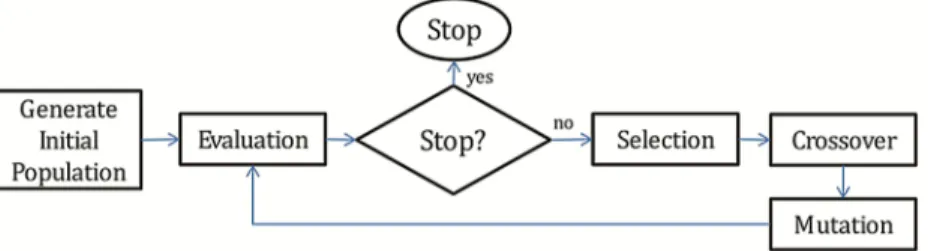
Fig. 1. GA optimization process.
GA-ANN Short-Term Electricity Load Forecasting 3
main driving operators of a GA are selection (survival of the fittest) and recombination through crossover (reproduction), mutation is also used in order to escape local minima [11]. The typical flow of GA process is shown in Fig. 1.
The algorithm starts by generating a random population of individuals, binary encoded with dimension equal to the initial number of features, each chromosome representing if a feature is used in the subset represented by the individual [19]. The individuals are evaluated using the ANN modeling method and depending on the performance of the individuals, they are selected for the creation of the next generation. The selected individuals are then used to generate new solutions using the crossover operator and mutation is used in order to escape local minima. The selection, crossover and mutation operators used in this work are presented in Sect. 4.4.
4
Experimental Evaluation
4.1 DatasetsThree sets with different load patterns and available variables are used in order to better evaluate the proposed methodology. The first dataset is relative to Portugal, the second one to New York West and the third to the city of Rio de Janeiro. The data used is the following:
• Portugal (PT): The historical load data is obtained from the European network of transmission system operators for electricity (ENTSOE) [20], the hourly load data is obtained between and including the days 2010-01-01 and 2013-12-31. The weather data is obtained from the Lisbon Airport Weather Station. The stock data used is from the Portuguese Stock Index 20 (PSI20) which tracks the prices of the twenty listings with the largest market capitalization and share turnover in Portugal [21].
• New York West (NYW): The historical load data was obtained from NYISO [22], the hourly load data was obtained for the same period as the data from Portugal. The weather data was obtained from the Buffalo Weather Station. The stock data used in this case is from Standard & Poor’s 500 (S&P 500), which is based on the capitali‐ zations of the 500 largest companies having stock listed on the NYSE or NASDAQ [21].
• Rio de Janeiro (RIO): The historical load and temperature data is the same used in the article of Hippert and Taylor [16] for the years of 1996 and 1997. No stock data was used with this dataset.
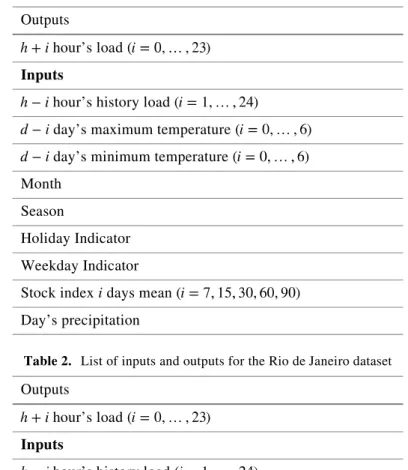
The pre-processing consisted in filling the missing values of the various time series by extending the last existing value. The data was processed for modeling and the input and output vector generated in the way presented by Tables 1 and 2. The use of the 24 prior hours and 7 days temperatures was inspired by the work of Sheikhan and Mohammadi [17] and the use of the mean of stock variables follows the work of Lin et al. [8, 9]. The stock index i days mean is the average value of the stock index value during the i days before the day for which the loads are predicted.
To validate the proposed methodology, datasets encompassing different geogra‐ phies with significantly different electricity consumption dynamics were selected.
AQ3
The datasets present the necessary characteristics to test the modelling approach and have not been extensively explored in the literature.
Table 1. List of inputs and outputs for the Portugal and New York West datasets
Outputs
hour’s load ( )
Inputs
hour’s history load ( )
day’s maximum temperature ( ) day’s minimum temperature ( ) Month
Season
Holiday Indicator Weekday Indicator
Stock index i days mean ( ) Day’s precipitation
Table 2. List of inputs and outputs for the Rio de Janeiro dataset
Outputs
hour’s load ( )
Inputs
hour’s history load ( ) day’s mean temperature ( ) Month
Season
Holiday Indicator Weekday Indicator
4.2 Training and Test Data
The data was divided into training and test sets in the following way: for the PT and NYW sets the first two years are used for training and the third for testing; for the RIO dataset, due to lack of data, one year is used for training and 266 days are used for testing.
GA-ANN Short-Term Electricity Load Forecasting 5
4.3 Performance Evaluation
This work uses the mean absolute percentage error (MAPE) and normalized root-mean-square error (NRMSE) as performance evaluation metrics. The NRMSE is normalized using the maximum and minimum load values. The MAPE is the percentage based index of indicating forecasting accuracy level and is widely used in the field of electricity load forecasting and is calculated by:
(1) where is the total number of hours predicted by system, is the observed load and
the predicted load.
The parameters used for the ANN and GA, determined through grid search, are presented in Tables 3 and 4.
The operators used by the applied genetic algorithm are the following:
• Selection: three random individuals tournaments are run, where n is the size of the population;
• Crossover: Classic three-point crossover is used for selected individuals pairs with probability ;
• Mutation: One-bit flip mutation is done on the selected individuals with probability .
represents the number of generations for which the genetic algorithm runs. Table 3. ANN parameters
Parameter PT NYW RIO
Hidden layer neurons 20 Output layer neurons 24
Training MSE goal 0.0035 0.006 0.00375 Relaxed FS training MSE goal 0.0045 0.007 0.00475
Table 4. GA parameters
200 0.9 0.05 80
4.4 Results
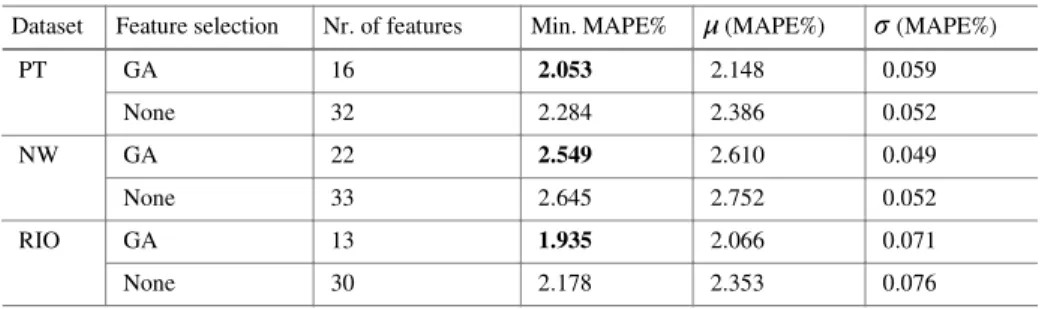
Tables 5 and 6 present the final results for 24-h ahead load forecasting using the feature subsets selected by the genetic algorithm. 35 models were trained using the chosen feature subset for each one of the datasets. The minimum, mean and standard deviation
of the MAPE is presented and compared with the performance of models trained without feature selection. The features used for the training of the models without feature selec‐ tion are the ones used for the ANN parameter tuning with the economic variables removed. This was done in order to have a fairer comparison. For all the datasets the use of feature selection resulted in significantly better results, an improvement of, respectively, 10 %, 3.6 % and 11 % was obtained using the evolutionary approach for best performing models.
Table 5. Performance evaluation results – MAPE%
Dataset Feature selection Nr. of features Min. MAPE% (MAPE%) (MAPE%)
PT GA 16 2.053 2.148 0.059 None 32 2.284 2.386 0.052 NW GA 22 2.549 2.610 0.049 None 33 2.645 2.752 0.052 RIO GA 13 1.935 2.066 0.071 None 30 2.178 2.353 0.076
Table 6. Performance evaluation results – NRMSE%
Dataset Feature selection Nr. of features Min. NRMSE% (NRMSE%) (NRMSE%)
PT GA 16 3.698 3.783 0.051 None 32 3.795 3.932 0.064 NW GA 22 4.595 4.666 0.033 None 33 4.655 4.820 0.074 RIO GA 13 4.051 4.252 0.104 None 30 4.396 4.656 0.122
Regarding the features chosen by the selection algorithm, Table 7 presents the best feature subset selected by the algorithm for each one of the datasets. For the Portuguese dataset, 16 features are selected in total, consisting on 12 load values of the day before the one predicted, the maximum temperature 6 days before and the indicators for the season, holiday and weekday.
For the New York West dataset the number of loads used is equal to 16, the minimum temperature for the predicted day and 3 historic temperatures, prediction day’s precip‐ itation and weekday indicator are used. According to this, a stronger relationship between the load exists between the temperature and load for this dataset, in comparison to the Portuguese data. It is also interesting to note the lack of use of the season indicator. Maybe in this case the load follows closely the temperature in comparison to the Portu‐ guese dataset, where the season is used for correction related to weather changes.
Regarding the Rio de Janeiro dataset, 13 features are selected. 10 historic loads, the prediction days and days before mean temperature and the weekday indicator are used.
GA-ANN Short-Term Electricity Load Forecasting 7
It can be noted that the stock variables are not chosen for either one of the datasets. This way it is believed that these variables are not significant for the load forecasting in the Portuguese and New York West cases.
Table 7. Feature selection results
Dataset Nr. of features Features selected by feature selection
PT 16 hour’s historic loads
( ); day’s
maximum temperature; Season; Holiday; Weekday
NW 22 hour’s historic loads
( );
day’s minimum temperature ( ); Weekday, Prediction day’s precipitation
RIO 13 hour’s historic loads ( );
day’s mean temperature ( ); Weekday Indi‐ cator
5
Conclusions
According to the results presented in this report it is concluded that GA feature selection can provide a performance increase in load modeling, more specifically, short-term load forecasting using ANN. Three distinct datasets with very different load patterns were used in order to study the viability of the applied methods, the presented methodology achieved good performance for all of them.
The use of stock variables was found to not be suitable for this modeling approach. The genetic algorithm never selected these features and no improvements were found when forcing their use.
6
Acknowledgements
The work was supported by: PhD in Industry Scholarship SFRH/BDE/95414/2013, J.L. Viegas, from FCT and Novabase; FCT through IDMEC, under Project SusCity: Urban data driven models for creative and resourceful urban transitions, MITP-TB/CS/ 0026/2013. S.M. Vieira acknowledges support by Program Investigador FCT (IF/ 00833/2014) from FCT, co-funded by the European Social Fund (ESF) through the Operational Program Human Potential (POPH). Acknowledgement to FCT, through IDMEC, under LAETA, project UID/EMS/50022/2013.
References
1. CSIRO and The Natural Edge Project. Energy transformed: sustainable energy solutions for climate change mitigation (2007)
2. Suganthi, L., Samuel, A.A.: Energy models for demand forecasting: a review. Renew. Sustain. Energy Rev. 16(2), 1223–1240 (2012)
3. Niu, D., Wang, Y., Wu, D.D.: Power load forecasting using support vector machine and ant colony optimization. Expert Syst. Appl. 37(3), 2531–2539 (2010)
4. Kyriakides, E., Polycarpou, M.: Short term electric load forecasting: a tutorial. In: Chen, K., Wang, L. (eds.) Trends in Neural Computation, pp. 391–418. Springer, Berlin (2007) 5. Hahn, H., Meyer-Nieberg, S., Pickl, S.: Electric load forecasting methods: tools for decision
making. Eur. J. Oper. Res. 199(3), 902–907 (2009)
6. Ignizio, J.P.: Introduction to Expert Systems. McGraw-Hill, New York (1991)
7. Metaxiotis, K., Kagiannas, A., Askounis, D., Psarras, J.: Artificial intelligence in short term electric load forecasting: a state-of-the-art survey for the researcher. Energy Convers. Manage. 44(9), 1525–1534 (2003)
8. Lin, C.-T., Chou, L.-D.: A novel economy reflecting short-term load forecasting approach. Energy Convers. Manage. 65, 331–342 (2013)
9. Lin, C.-T., Chou, L.-D., Chen, Y.-M., Tseng, L.-M.: A hybrid economic indices based short-term load forecasting system. Int. J. Electr. Power Energy Syst. 54, 293–305 (2014) 10. Guyon, I., Elisseeff, A.: An introduction to variable and feature selection. J. Mach. Learn.
Res. 3, 1157–1182 (2003)
11. Engelbrecth, A.: Computational Intelligence: An Introduction (2007) AQ4 12. Saeys, Y., Inza, I., Larrañaga, P.: A review of feature selection techniques in bioinformatics.
Bioinformatics 23(19), 2507–2517 (2007)
13. Welsch, M., Howells, M., Bazilian, M., DeCarolis, J.F., Hermann, S., Rogner, H.H.: Modelling elements of smart grids: enhancing the OSeMOSYS (open source energy modelling system) code. Energy 46(1), 337–350 (2012)
14. International Energy Agency. Technology Roadmap: smart grids (2011)
15. Energetics Incorporated. Foundations for Innovation in Cyber-Physical Systems. In: Workshop Report. National Institute of Standards and Technology (2013)
16. Hippert, H.S., Taylor, J.W.: An evaluation of Bayesian techniques for controlling model complexity and selecting inputs in a neural network for short-term load forecasting. Neural Netw. 23(3), 386–395 (2010)
17. Sheikhan, M., Mohammadi, N.: Neural-based electricity load forecasting using hybrid of GA and ACO for feature selection. Neural Comput. Appl. 21(8), 1961–1970 (2011)
18. Vieira, S.M., Sousa, J.M.C., Runkler, T.A.: Two cooperative ant colonies for feature selection using fuzzy models. Expert Syst. Appl. 37(4), 2714–2723 (2010)
19. Huang, C.-L., Wang, C.-J.: A GA-based feature selection and parameters optimization for support vector machines. Expert Syst. Appl. 31(2), 231–240 (2006)
20. European network of transmission system operators for electricity (2015). https:// www.entsoe.eu/
21. Google Finance (2015). http://www.google.com/finance
22. The New York Independent System Operator (2015). http://www.nyiso.com/
GA-ANN Short-Term Electricity Load Forecasting 9
Author Query Form
Book ID : 419233_1_En
Chapter No.: 45
Please ensure you fill out your response to the queries raised below
and return this form along with your corrections
Dear Author
During the process of typesetting your chapter, the following queries have arisen. Please check your typeset proof carefully against the queries listed below and mark the necessary changes either directly on the proof/online grid or in the 'Author's response' area provided below
Query Refs. Details Required Author's Response
AQ1 Per Springer style, both city and country names must be present in the affiliations. Accordingly, we have inserted the city name ‘Lisbon’ in affiliations ‘Aff1 and Aff3’. Please check and confirm if the inserted city name ‘Lisbon’ is correct. If not, please provide us with the correct city name.
AQ2 Please confirm if the corresponding author is correctly identified. Amend if necessary.
AQ3 Please check the citation of Sect. 4.4.
AQ4 Please provide complete details for Ref. [11].
MARKED PROOF
Please correct and return this set
Instruction to printer
Leave unchanged
under matter to remain
through single character, rule or underline
New matter followed by or or or or or or or or or and/or and/or e.g. e.g. under character over character new character new characters through all characters to be deleted
through letter or
through characters under matter to be changed under matter to be changed under matter to be changed under matter to be changed under matter to be changed Encircle matter to be changed (As above) (As above) (As above) (As above) (As above) (As above) (As above) (As above) linking characters through character or where required between characters or words affected through character or where required or