Arq. Bras. Med. Vet. Zootec., v.67, n.2, p.622-626, 2015
Communication
[Comunicação]
Continuous and long term measurement of reticuloruminal pH in crossbreed dairy
cows in Brazil by an indwelling and wireless data transmitting unit
[Medidas contínuas e de longo prazo do pH retículo-ruminal em vacas leiteiras brasileiras por meio de uma unidade interna de transmissão de dados sem fio]
J. Gasteiner1, T. Guggenberger1, L. Varga1, R. D. Ollhoff2
1Federal Agricultural Research and Education Centre Raumberg-Gumpenstein, Institute of
Farm Animal Welfare and Animal Health, A-8952 Irdning, Austria 2
Programa de Pós-Graduação Pontifícia Universidade Católica do Paraná –São José dos Pinhais, PR
Subacute rumen acidosis (SARA) is a widespread disease in high yielding dairy cows, characterized by a persistent abnormally low rumen pH. In dairy cows, the negative effects on health associated with SARA are reduced dry matter intake (DMI), decreased body condition, diarrhoea, rumenitis and inflammation, caudal vena cava syndrome, displacement/ulceration of the abomasum, laminitis and immunosuppressive disorders (Plaizier et al., 2008). SARA is difficult to diagnose in the field. The evaluation of fermentation conditions in rumen fluid is the most meaningful criterion but the definitive test for SARA is the determination of the reticuloruminal pH (Krause and Oetzel, 2006). This pH can be measured in rumen fluid which is either collected with a stomach tube or by rumenocentesis, but the stomach tube technique overestimated the pH value by 0.5 pH-units when compared to rumenocentesis, as a result of saliva contamination (Seemann and Spohr, 2007). Recent techniques use indwelling pH probes placed in the rumen or in the reticulum (Gasteiner et al., 2009) for a continuous monitoring of reticuloruminal pH. This method is advantageous as it allows diurnal recording, but data collection requires either the removal of the chip (Penner et al., 2007) or the transmission by cable to an external unit, fixed onto the animal (Krause and Oetzel, 2006). Gasteiner et al. (2009) have described and evaluated a
wireless data transmitting unit allowing
continuous measurement of reticuloruminal pH and therefore long term investigation. The present study is the first time this indwelling pH probe has been tested in the field in Brazil. The aim was to study the variations of reticuloruminal pH and temperature in lactating dairy cows during a several week period and see how this method could be used in further research in rumen physiology and rumen pathology.
For monitoring reticuloruminal pH and temperature an indwelling and wireless data transmitting system (SmaXtec animal care GmbH, Graz, Austria) was used (Gasteiner et al.,
drinking act. The observation period lasted 50 days (October 2013 till December 2013) in the State of Parana/Brazil. Three healthy dairy cows were selected randomly for the trial. All 3 Holstein Friesian dairy cows (cow 308: BW 660 kg, 3rd lactation, Ø 30 l milk yield; cow number 310: BW 620 kg, 1st lactation, Ø 38 l milk; cow number 609: BW 700 kg, 2nd lactation, Ø 48 l milk) were high producing cows. Indwelling pH probes were given to the cows 3 -5 days after parturition. All cows were kept indoors in a free barn during the trial and they were fed the same daily ration. Cows were offered a total mixed ration as follows (fresh matter/cow/day): maize silage (28 kg), beer mash (7kg), concentrates (8kg), rumen-protected fats (300g), salts (150g), sodium bicarbonate (100g), roughly chopped maize grains (1kg), soy bran (1kg) and lime (100 g). The cows were fed after milking, at regular hours every day (6:00 a.m.; 6:00 p.m.). Feed stuff was offered in two equal portions. 1 kg hay/day/cow additional feeding was given all at once at 1:00 p.m. Statistical analysis was performed by GLM (ANOVA, StatgraphicPlus 5.1). P values below 0.05 were considered significant. The procedures were in accordance to the local ethical committee registered under number PA 268 from 13.06.2013.
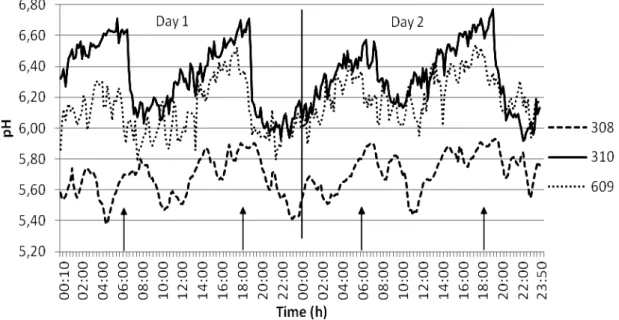
The diurnal patterns of the reticuloruminal pH for 48 hours are presented in figure 1. Cows 310 and 609 had similar patterns, with regular variations during the day and the pH was rarely below 6.0, while in cow 308, the diurnal variations in the pH had a different shape and remained nearly always below 6.0. Immediately after feeding, the pH decreased in cows 310 and 609 to reach a minimum level in less than 2 hours, followed by a progressive increase until the next feeding, 12 hours later. In these cows the daily maximum was reached just before feeding and the daily minimum could be seen within 2 hours after feeding. In cow 308, the drop in the pH was not immediate; in fact, it kept increasing for more than 2 hours after feed intake. The mean pH values were significantly different (P<0.05) in the 3 cows (Table 1). As for the reticuloruminal pH presented in table 1, temperature follows the same trend: cow 310 having the highest mean temperature of 39.1°C and 308 having the lowest with 38.8°C (P<0.05). The drop in temperature at drinking is immediate and returns to normal in a few minutes. There were significant differences (P<0.05) between the results from one week to another during the 8 weeks of the study, for both pH and temperature (Tab. 1). The lowest mean pH value (5.76) was recorded during the last week of the trial.
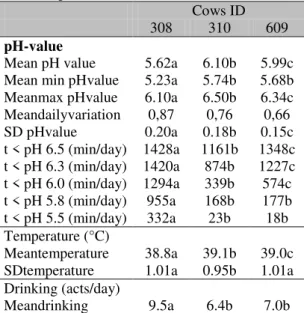
Table 1. Mean values for the reticuloruminal pH, time spent below a given pH (min/day), reticuloruminal temperatures (°C) and drinking frequency (acts/day) for each cow, (n = 7.200 data sets per cow).
Cows ID
308 310 609
pH-value
Mean pH value 5.62a 6.10b 5.99c Mean min pHvalue 5.23a 5.74b 5.68b Meanmax pHvalue 6.10a 6.50b 6.34c Meandailyvariation 0,87 0,76 0,66 SD pHvalue 0.20a 0.18b 0.15c t < pH 6.5 (min/day) 1428a 1161b 1348c t < pH 6.3 (min/day) 1420a 874b 1227c t < pH 6.0 (min/day) 1294a 339b 574c t < pH 5.8 (min/day) 955a 168b 177b t < pH 5.5 (min/day) 332a 23b 18b Temperature (°C) Meantemperature 38.8a 39.1b 39.0c SDtemperature 1.01a 0.95b 1.01a Drinking (acts/day) Meandrinking 9.5a 6.4b 7.0b
Least squares means within a row without a common superscript differ significantly (P<0.05); SD: Standard deviation
Mean ruminal pH value for all cows was 5.99±0.15 and the mean daily variation was 0.66. The pH was below 6.0 for 574 min/day in average (9.6 hours) (Table 1). The diurnal pH variations over a 7-day period showed the regular effect of feeding on reticloruminal pH-value in 310, with a mean pH pH-value of 6.10±0.18 (Table 1) and mean daily variation of 0.76. The peaks were of similar amplitude in a given period of time and the pH rarely decreased above 5.8. The time spent per day below a given pH value is a good indicator of rumen status (Gasteiner et al., 2012). In cow 310, which had the highest mean ruminal pH during the investigation, the pH was in average 339 minutes (5.7 hours) below pH 6.0 (Tab. 1). In cows 310 and 609 the diurnal pattern of reticuloruminal pH-value shows 2 increases per day. The fluctuations of pH-value were within a range of pH 5.8 – 6.7. In cow 308 the pH-peaks and decreases appeared randomly without being clearly linked to the feed intake and their amplitudes were different, remaining abnormally low (mean pH of 5.62±0.20). Ruminal pH value in this cow remained 1294 min/day below pH6.0, of which 955min/day
more drinking acts/day (9.5; 6.4; 7.0) and lowered reticuloruminal pH value when compared to cows 310 and 609 (Table 1). As the performance (lowered milk production) and behaviour (lowered feed intake, dullness) of cow 308 was conspicuous, the animal was examined clinically repeatedly with the beginning of the 2nd week of the trial. Abdominal percussion and auscultation revealed that cow 308 did have left displacement of the abomasum (LDA). As no surgical intervention was conducted, LDA could be demonstrated throughout the entire period of the present investigation on a daily basis. Clinical examination of cows 609 and 310 did not confirm the occurrence of LDA or any other health problems in these animals. The aim of this experiment was to test in Brazil, the wireless transmitting unit for continuous measurement of reticuloruminal pH value and temperature, previously described by Gasteiner et al. (2009).
The producers of the system guarantee valid pH data±0.1 for a measurement period of as many as 50 days. The data obtained from continuous pH measurement (in our study, 144 pH measurements/cow/day) provide a good insight into pH variability in the reticuloruminal system. The pH value patterns enable us to reach conclusions regarding the composition of the diet and feeding management (Gasteiner et al., 2012). The statistical analysis of such a large volume of data makes the outcome more precise and reliable. The diurnal pH variations are the expression of the feed intake (Sato et al., 2012) and diurnal temperature variations can be seen as a consequence of water intake by the animals. As the cows had continuous access to water, it is difficult in this study to evaluate whether the reticuloruminal pH has an impact on the ruminal temperature or not, but it has been shown in earlier works that there is indeed a negative correlation between these two parameters (Alzahal et al., 2008). Gozho et al. (2005) defined SARA as a rumen pH threshold between 5.2 and 5.6 for > 176min/day. Data from Alzahal
and pH 5.5, respectively, and it can be concluded that this cow did have SARA. The outcome of the clinical examination of this cow revealed the diagnosis LDA and this was an explanation for both the poor health status and the lowered pH value. This cow also showed significantly (P<0.05) lowered reticuloruminal temperature and more drinking acts/day (9.5; 6.4; 7.0) when compared to cows 310 and 609 (Table 1). The high amount and density of data per cow provides good insight into the pattern of reticuloruminal pH value and reticuloruminal temperature. External influences like rations composition, feeding management and feeding times, but also the frequency of drinking acts, can be detected in healthy and impaired cows. It is also a finding in our trial, that the low and persistent levels of reticuloruminal pH observed in cow 308 during the trial were clearly indicating rumen acidosis, which was caused by
LDA. To our knowledge this is the first report in literature indicating the pattern of reticuloruminal pH-value in a cow with confirmed LDA.
The indwelling pH measurement and data transmitting system turned out to be a helpful and proper tool for long-term and continuous measurement of reticuloruminal pH value in cows. It was a coincidence that one cow in this trial was diagnosed with LDA. Findings give a better understanding for both the pattern of reticuloruminal pH value of high yielding, healthy dairy cows and the link between LDA and rumen acidosis, caused by abomaso-ruminal reflux of ingesta.
Keywords: rumen acidosis, indwelling pH measuring, wireless data transmission, lactating dairy cattle, left side abomasum displacement
RESUMO
O objetivo do presente experimento foi medir continuamente valores de pH e temperatura em vacas leiteiras usando uma unidade interna de transmissão de dados sem fio. Valores de pH retículo-ruminais foram medidos automaticamente a cada 600 segundos por um período de 50 dias em três vacas leiteiras Holandesas, no pós-parto recente. Valores de pH retículo-ruminais médios diferiram (P<0,05) entre as três vacas (5,69±0,20; 6,10±0,18; 5,99±0,15), assim como o tempo em minutos por dia (332; 23; 18) mantido abaixo de pH 5,5. A variação diurna de pH nas vacas 2 e 3 demonstrou um padrão circadiano e frequente, como consequência dos momentos de fornecimento da alimentação e da ingestão alimentar, respectivamente. Esse padrão diário não pode ser observado no padrão de pH da vaca 1. Os picos e os valores baixos de pH na vaca 1 eram aleatórios, sem relação evidente com os momentos de alimentação, e as amplitudes de pH eram igualmente desordenadas. O valor de pH retículo-ruminal permaneceu anormalmente baixo nesta vaca durante todo o período de observação, caracterizando uma acidose ruminal subaguda. A temperatura retículo-ruminal da vaca 1 foi mais baixa (38.8°C; 39.1°C; 39.0°C) e ela bebeu mais frequentemente por dia (9,5; 6,4; 7,0) quando comparada com as vacas 2 e 3 (P<0,05). O exame clínico revelou um deslocamento de abomaso à esquerda (DAE). Pela literatura consultada, este é o primeiro relato indicando um padrão de pH e temperatura em uma vaca com DAE.
Palavras-chave: acidose ruminal, mensuração do pH interno, transmissão de dados sem fio, vaca leiteira em lactação, deslocamento de abomaso à esquerda
ACKNOWLEDGEMENTS
The authors wish to thank the staff from smaXtec® animal care (Graz, Austria) and from inovotec® animal care (St. Louis, USA) for their kind assistance during the execution of this work.
REFERENCES
ALZAHAL, O.; KEBRAEB, E.; FRANCE, J. et al. Ruminal temperature may aid in the detection of subacuteruminal acidosis. J. Dairy Sci., v.91, p.202-207, 2008.
GASTEINER, J.; FALLAST, M.; ROSENKRANZ, S. et al. Zum Einsatz einer intraruminalen pH-Datenmesseinheit mit kabelloser Datenübertragung bei Rindern unter verschiedenen Fütterungsbedingungen. Vet. Med. Austria, v.96, p.188-194, 2009.
GASTEINER, J.; GUGGENBERGER, T.;
GOZHO, G.N.; PLAIZIER, J.C.; KRAUSE, D.O. et al. Subacute ruminal acidosis induces ruminal lipopolysaccharide endotoxin release and triggers an inflammatory response. J. Dairy Sci., v.88, p.1399-1403, 2005.
KRAUSE, M.K.; OETZEL, G.R. Understanding and preventing subacute ruminal acidosis in dairy herds: a review. Anim. Feed Sci. Technol., v.126, p.215, 2006.
PENNER, G.B.; BEAUCHEMIN, K.A.;
MUTSVANGWA, T. Severity of ruminal acidosis in primiparous Holstein cows during the periparturient period. J. Dairy Sci., v.90, p.365-375, 2007.
PLAIZIER, J.C.; KRAUSE, D.O.; GOZHO G.N.; MCBRIDE, B.W. Subacute ruminal acidosis in dairy cows: The physiological causes, incidence and consequences. The Vet. J., v.176, p.21-31, 2008.
SATO, S.; MIZUGUCHI, H.; KAZUNORI, I. et al. Technical note: development and testing of a radio transmission pH measurement system for continuous monitoring or ruminal pH in cows. Prev. Vet. Med., v.104, p.274-279, 2012.