HEAD POSTURE DETECTION FOR MEASURING PRESCHOOLERS
CONCENTRATION
Cristina Mesquita-Pires, Rui Pedro Lopes
Polytechnic Institute of Bragança (Portugal) [email protected], [email protected]
Abstract
Several decades of research clearly demonstrate that high-quality, developmentally appropriate, early childhood programs, produce short and long-term positive effects on children’s cognitive and social development. Research with the Leuven Involvement Scale has shown that the levels of children’s involvement are a predictor of quality of learning.
An involved child gets extremely fascinated and absorbed by the activity he is performing. There are several indicators that can be used to assess children involvement, such as concentration, energy, com-plexity and creativity, facial expression and posture, persistence, precision, reaction time, language and satisfaction.
Some of these indicators require that the teacher pay attention to posture, measure and record the time that the child is facing a specific activity. Head posture usually indicates the focus of attention, since it coincides with the gaze direction, the direction and focus of a person’s eyes. This task is complex and requires several observations, on many children, distributed through the day. Usually, this is performed with a video recorder to help the teacher to evaluate the observation.
The work described in this paper focus on how modern image processing technology can provide a valu-able aid to kindergarten teachers, helping them in the task of registering observations. In this context, head posture is automatically detected and measured, and time is recorded. Although easy for a human to interpret the orientation and movement of the human head, it is a challenge to computers. Of course there is always subjectivity in this kind of observation, but we hope that this tool can contribute to help teachers to make informed and critical judgments about the quality of teaching and learning they offer.
Keywords: Head pose detection, quality control, preschool education
1 INTRODUCTION
Early childhood education, as in many other areas, demand a constant attention and dedication in order to maintain or increase the process quality. Several decades of research demonstrate that adequate early childhood education is fundamental to ensure a sound basis for later life. In fact, some studies revealed that well-implemented preschool curriculum models had strong effects not only on children’s intellectual and academic performance but on also on criminal behavior, community activities and mis-conduct, as well as other parameters (Schweinhart & Weikart, 1997).
The education process involves many actors and techniques, arranged in very diverse ways. Moreover, the importance that young children’s early learning has in their future life demands rigorous quality assurance mechanisms. These will further extend the expertize and skill of all of those involved in the education process (Belfield, Nores, Barnett, & Schweinhart, 2006).
Several initiatives and projects have been implemented aiming at evaluating and improving quality and effectiveness on early learning. An well known example is the Effective Early Learning (EEL) (Bertram & Pascal, 2004), known in Portugal asDesenvolvendo Qualidade em Parceria(DQP) (Bertram & Pascal, 2009).
These initiatives define a referential for quality assessment and improvement by taking the partici-pants through a systematic and rigorous four stage process ofEvaluation and development Framework
institution, children, in the evaluation process, to better assess quality issues in a broad scope. The eval-uation process not only incorporates all this information but it also fosters improvement of techniques and skills through reflection.
Evaluation process in EEL/DQP
The evaluation of quality of early learning in the scope of EEL/DQP requires obtaining a considerable amount of data through several techniques. Data is obtained through detailed observations of children and adults, interviews of parents, colleagues and children, documentary analysis and a number of ques-tionnaires.
Data is then systematically organized in research portfolios, that will be used in a cyclic process of thinking-do-thinking to research and create change (Mesquita-Pires, 2012). The process of change is constituted as a dynamic, interactive and open process that includes the following phases: (1) a flexible plan; (2) act; (3) reflect; (4) evaluate/validate, where data is described and analyzed, and decisions are evaluated and the effects observed; (5) dialog in order to share the view with other partners (colleagues, or others).
This process of quality assessment is enhanced by the utilization of observation techniques which mea-sure the effectiveness of the learning and teaching processes, such as the Child Involvement Scale, an observation technique which measures the level of a child’s involvement in an activity, the Adult Engage-ment Scale, to evaluate the interaction between the practitioner and the child (Laevers, 1994) or the Child Tracking Observation Schedule, to gain a snapshot of the child’s day and providing information of learning experiences (Bertram & Pascal, 2006).
The application of the procedure has a broad set of difficulties and challenges. Initially, it is neces-sary that the research group learn about participatory pedagogies and theoretical foundations of the EEL/DQP research techniques and the practicalities of their use. The application of interviews come soon after, leading the participants to reflect on the ethical issues involving its use. Learning to observe was another challenge, because the signs are not always evident and observers must be trained to identify them.
In particular, the EEL/DQP initiative defines a four phase/thirteen steps procedure, comprising:
• Evaluation
1. Initial preparation 2. Initial data gathering 3. Interviews
4. Child Tracking Observation Schedule 5. Child Involvement Scale
6. Adult Engagement Scale
7. Development of evaluation report
• Action planning
8. Development of the action plan
• Development
9. Document and support the implementation of the action plan 10. Child Involvement Scale, following the same procedure from 5 11. Adult Engagement Scale, following the same procedure from 6
• Reflection
12. Reflection on the impact of the plan in the future 13. Final report
Child Involvement Scale
As approached earlier in this paper, quality evaluation covers several aspects. In particular, quality of care has three possible angles. The first can be described by the questions: “Are the materials and activities adequate in number and type?”; “Are things well organized? Are they safe?”; “How is the relation between the supervisors and the children?”. This provides an insight into the practice and how it is shaped.
Another way to assess quality is by observing the long term effect of care on children, comprising several areas, such as motor skills, self-reliance, social competence, language, and qualities such as self-confidence, motivation to learn and resilience.
Finally, quality can also be evaluated by assessing the process within the child. Here, the focus is placed on how children are feeling and how they are engaged with the activities presented to them (Laevers, 1994).
Motivation reveals that the children are truly interested and driven to engage in the activity. The im-pressions and experiences obtained by a motivated child are very strong, assuming an influence that will not occur otherwise. High level of involvement also results in a high level of satisfaction. Children spontaneously take initiatives to get into this particular state. This is also achieved through the interest that the children have to discover or explore.
The concept of involvement developed by Laevers (2005) refers to the human quality (visible in children and adults) characterized by intense involvement in activities, being considered as a necessary condition to carry out a deeper level of learning and development. Involvement contributes for a deeper way to learn. When lacking, chances are that the children development will stagnate, and all the actors in the education process should do everything in order to create an environment in which children can engage in a wide variety of activities.
According to the author, when a child is involved, is completely “absorbed” by the activity, which is possible only if it is challenging, taking the kids to operate within the limits of their capabilities. A high level of involvement can be seen when children are concentrated in the activity, showing interest and motivation and even some fascination, visible persistence laying on its action. The children mime body indicates the intense mental activity, full of sensory experiences and meanings. A powerful flow of energy and a high degree of satisfaction emerges from the activity.
To evaluate the involvement of children, Laevers (2005) constructed a scale of analysis consists of two components: a list of indicators of involvement and levels of involvement in a five-point scale.
An involved child focuses his attention on a specific aspect and rarely gets distracted. Simultaneously, there is a tendency for the continuation and persistence in this activity. According to Laevers (2005) the involvement of the child is expressed through a set of indicators that the observer must take into account:
1. concentration, which reflects if the child’s attention is deeply focused on the activity;
2. energy, i.e., if the child invests much effort in the activity. His interest and motivation can be verified through his facial expressions, the way he manipulates objects and the chanting voice;
3. the complexity and creativity that is observed when the child voluntarily mobilizes his cognitive abilities giving his best;
4. facial expression and posture, nonverbal displays information about the involvement of the child, his gaze and posture are indicators of involvement or annoyance;
5. the persistence refers to the duration of child concentration on activity and indicates if he feels pleasure in what he’s doing;
6. reaction time, reveals that children involved are aware and react quickly to stimuli;
7. the language that the child uses in the action or the way he expresses his needs to achieve, indicate the importance that activity has for him;
Considering these indicators, children’s involvement is registered at levels of 1 to 5.
At level 1 children have the absence of activity – the child wanders her gaze elsewhere in the room, away from the action. The posture of her head may indicate movement in different directions, or set up a one direction but not focusing on the activity that is taking place.
At level 2, the activity is frequently interrupted – the child is doing a particular activity, but half of the time her head is lifted and her gaze is absent.
At level 3 children’s activity is more or less continuous – the child often raises her head, looking in other directions but she focus in the activity that is taking place for significant periods of time.
At level 4 child has intense moments of activity – Even if there are moments of interruption child easily returns to its action. Her head is directed at work and their movements show the energy and persistence that poses into action. Her eyes can focus on other stimuli briefly, but returns easily at what she is doing.
At level 5 child maintained intense and prolonged activity – The position of the child’s head, her gaze and her movements are completely focused on the activity. Nothing makes her lift the head an nothing distract her gaze from what she is doing. The child performs the action persistently over a long period of time. She displays energy, creativity and concentration.
Observation Process
The kindergarten teachers should be able to make reasoned assessments and criticisms about the quality of learning that they offer to children. The analysis of the involvement of the child is one of the windows that enable this analysis. For that, kindergarten teachers should make observations accurately and objectively, to obtain data that allow emerging consciously weaknesses about their action and may enhance educational quality.
In practical terms, and following the systematic and rigorous process defined by Laevers (2005), the observation should be held to 50% of children in the room (including the diversity of ages, genders and ethnicities), up to maximum of 12 children. Observations should be made in two sessions a week (morning and afternoon). Each observation should take 2 minutes. Each child is observed three times per period (morning or afternoon) but not continuously. At the end there will be six child observations in a total of 12 minutes.
The observation process involves dealing with several details at the same time and some subjectivity is natural, derived from the observer interpretation of what he is seeing. Moreover, it is difficult to maintain track of the time at the same time that the observation is occurring. Measuring the amount of time the head assumes specific postures can provide an added insight into the concentration a child is having and thus reducing subjectivity.
Essentially, the teacher will pay attention to the child’s gaze. If the child is focused in the learning experience, it may reveal high level of involvement. If the child deviates gaze into his hands, the ceiling or to the side, it may reveal distraction. The relative time each posture is assumed is registered, to be able to quantify the child’s involvement.
2 GAZE DIRECTION
Humans and many other species tend to look at things in their environment that are of immediate interest to them (Langton, Watt, & Bruce, 2000). When facing another person’s gaze, we quickly conclude that we are, some how, of interest to him (probably, we are someone with whom he would like to interact). When living in large groups, the accuracy and speed to detect and interpret other’s intentions can con-tribute to own survivability. This concon-tributed to the evolution of mechanisms that are specially precise in perceiving gaze. Due to this accuracy, gaze is also used to communicate, for example to invite someone to look at a specific object (shared-attention) or to influence someone to follow a specific path.
Gaze is typically associated to the eye direction, a biological characteristic that we are particularly sensi-ble to. According to some studies, we can perceive a change in gaze direction of just 1.4oat a distance of 1m (Langton, Honeyman, & Tessler, 2004). The eye geometry is specially important, since the contrast of the iris with the sclera makes it easier to perceive the direction the eye-ball is assuming.
Gaze Direction and Head Pose
Eye direction by itself is not enough to perceive gaze direction. If, for example, the iris of a person is to the left side, it would mean to you that the person is looking to you right. However, if the head e turned to his right, the eyes may be looking straight to you. Head orientation is evidently important as a cue to attention direction. Humans are able to use head contour and nose angle to judge head orientation (Wilson, Wilkinson, Lin, & Castillo, 2000). In addition, head angle can influence the perception of eye-gaze direction (Langton et al., 2004).
In the context of the Child Involvement Scale observation procedure, it is not very difficult for a trained observer to get an idea of children involvement by analyzing gaze direction and shift. This reveals the persistence and concentration of the child. An involved child rarely deviates his attention from the object or activity he is analyzing of performing and hardly gets distracted. Gaze is constantly directed towards the target of attention.
Automatic measurement of head posture through computer vision can provide a valuable tool for the ob-servation of involvement. In this context, the time the child’s head spends in a discrete number of angles is registered and presented to the observer. Together with his comments, quantified measurements can result in more accurate data as well as a reference for child involvement scale.
3 HEAD POSE ESTIMATION
In computer vision, head pose estimation allows inferring the orientation of a person’s head relative to the view of a camera (Murphy-Chutorian & Trivedi, 2009). This procedure requires several processing steps to transform the data from digital images into the concept of direction. The procedure should be independent of several physical phenomena, such as lighting, facial expression, or the presence of glasses, hats or others.
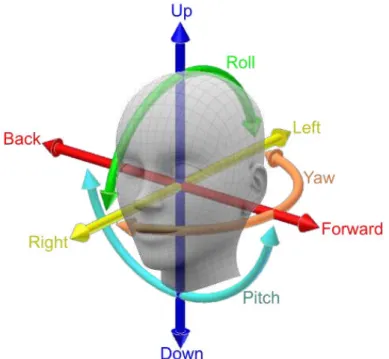
In terms of output, head pose estimation depend on the number of degrees of freedom. A single degree of freedom can be a measurement of turning the head to the right or to the left. Ideally, we would like to measure head posture in six degrees of freedom, including translation (up/down, back/forward, left/right) and rotation (pitch, roll, and yaw) (Fig. 1).
Depth cameras, such as Microsoft Kinect, can provide additional tools for accuracy improvement and independence on some physical conditions (Kondori, Yousefi, Li, Sonning, & Sonning, 2011). However, these kind of devices are not, at the moment, conspicuous enough to be comfortably used for children observation in preschool environment. Acquisition devices should be small, portable, lightweight and should be familiar to children, so that they wont get distracted by it.
We chose to use a single-camera for 3D tracking of the child’s head (monocular). Moreover, camera quality and computation power of current smartphones provide an interesting device to concentrate the measurement in a single, familiar device. We intend to use a smartphone camera to take real-time images from the child as he is performing an activity. Since the head can assume a continuous position on all the six degrees of freedom, it is necessary, at first, to define a discrete set of positions in order to make it possible to count the time each position is assumed.
For this we will consider the following assumptions:
• Facing down/front – the child is facing the activity
• Facing to the left/right – if there is another child to his left/right, he is interacting with another child
• Facing to the left/right – He is distracted
Fig. 1 – Head rotation angles (C. Wang, Li, & Song, 2013).
According to the previous assumptions, we will have four discrete angles for head posture estimation. The application will continuously measure the time the head is assuming each position during the ob-servation session. Before this step, however, is necessary to identify the person’s head and to estimate the direction it is facing.
There are several techniques in a wide variety of approaches that can be used in such scenario (Murphy-Chutorian & Trivedi, 2009). The first approach we followed was based on non-rigid face tracking (Y. Wang, Lucey, Cohn, & Saragih, 2008). This approach calculates an estimation of a quasi-dense set of facial features in each frame of a video stream. We found that it is very processor demanding, making it too slow for smartphones. We later simplified the approach to use a geometric method, calcu-lating the angles between lines connecting the eyes, nose and corners of the mouth. The accuracy was very low, and we also discarded the approach.
Based on the literature, one of the most accurate technique is based on tracking methods. They operate by following the relative movement of the head between consecutive frames of a video sequence. In fact, these methods operate by following low-level facial landmarks from frame to frame. We are currently experimenting this method, based on (La Cascia, Sclaroff, & Athitsos, 2000). First, the application starts by looking for a head, through the Viola-Jones algorithm (Viola & Jones, 2001). After finding the head position a Good Features to Track algorithm is started, in the region of interest defined by the head width and height (Shi, 1994). Fig. 2 show a movement sequence with the interest points to track.
The following steps, not yet implemented, require image correlation between frames, through sum-of-squared-difference (SSD) methods.
4 RESULTS AND OPPORTUNITIES
The observations of the involvement provide a variety of data. The information is based on a sample of children in a kindergarten classroom and indicates in what extent the learning experiences match with the needs, abilities and interests of children. Furthermore the data allow comparisons between the involvement of boys and girls, children of all ages, to know if in that environment are developed relationships of equity.
Fig. 2 – Interest points in child’s face.
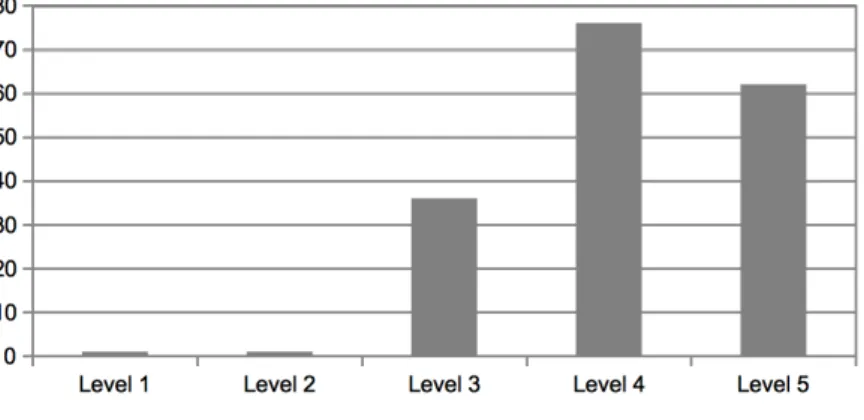
of space and daily routine as well as the type of interactions established. Enabling environment created by the intentional act of kindergarten teachers constitute itself as a key element in the involvement of children. If the observation data indicate that children are not involved, adults should reflect critically about the aspects to improve (Fig. 3).
Fig. 3 – Involvement chart.
5 CONCLUSIONS
The educational studies involve integrated and holistic understanding of the processes, so the use of various methods and techniques of data collection and its analysis help validate and highlight rigor of the hermeneutical and dialectical interpretations.
The indicators of involvement are references that guide the observer to a more authentic understanding of the child’s engagement in the learning process. However they should not be used as a scale but as aspects which, as a whole, help to understand the quality of the learning experience.
The existence of different resources to support the observer to make decisions constitutes itself as an asset in this process. The use of resources that objectively show the posture of the head of the child and the focus of her gaze, allows the observer to eliminate some of his subjectivism.
evaluated through gaze. If the child is involved, he is concentrated in the learning experience.
Some studies discussed gaze direction as dependent, or related to, head posture. Modern digital image processing can be used to measure the time each posture is assumed and, as such, provide a quan-tification of gaze direction. We also propose to use smartphones for this purpose, hoping that it will be easier to handle and more available for daily use.
References
Belfield, C. R., Nores, M., Barnett, W. S., & Schweinhart, L. (2006). The High/Scope Perry Preschool Program: Cost-Benefit Analysis Using Data from the Age-40 Followup. Journal of Human Re-sources, 41(1), 162–190. Retrieved fromhttp://jhr.uwpress.org/content/XLI/1/162.short
doi: 10.3368/jhr.XLI.1.162
Bertram, T., & Pascal, C. (2004). Effective Early Learning ({EEL):} A handbook for evaluating, assuring and improving quality in settings for Three to Five Year Olds. Birmingham: Amber Publishing. Bertram, T., & Pascal, C. (2006). The baby effective early learning programme: Improving quality in
early childhood settings for children from birth to three years. Birmingham: Centre for Research in Early Childhood.
Bertram, T., & Pascal, C. (2009). Manual {DQP} - desenvolvendo a qualidade em parceria. Lisboa: Ministério da Educação.
George, N., & Conty, L. (2008, June). Facing the gaze of others. Neurophysiologie clinique = Clin-ical neurophysiology, 38(3), 197–207. Retrieved from http://www.ncbi.nlm.nih.gov/pubmed/ 18539254 doi: 10.1016/j.neucli.2008.03.001
Kondori, F. A., Yousefi, S., Li, H., Sonning, S., & Sonning, S. (2011, November). 3D head pose estimation using the Kinect. 2011 International Conference on Wireless Communications and Signal Processing (WCSP), 1–4. Retrieved fromhttp://ieeexplore.ieee.org/lpdocs/epic03/ wrapper.htm?arnumber=6096866 doi: 10.1109/WCSP.2011.6096866
La Cascia, M., Sclaroff, S., & Athitsos, V. (2000, April). Fast, reliable head tracking under varying illu-mination: an approach based on registration of texture-mapped 3D models. IEEE Transactions on Pattern Analysis and Machine Intelligence, 22(4), 322–336. Retrieved fromhttp://ieeexplore .ieee.org/lpdocs/epic03/wrapper.htm?arnumber=845375 doi: 10.1109/34.845375
Laevers, F. (1994). Adult Style Observation Schedule for Early Childhood Education ({ASOS-ECE)}. Lovaina: Centre for Experiential Education.
Laevers, F. (Ed.). (2005).{Sics/Zicko.} Well-being and Involvement in Care Settings. A Process-oriented Self-evaluation Instrument. Lovaina: Kind & Gezin e Research Centre for Experientel Education. Langton, S., Honeyman, H., & Tessler, E. (2004, July). The influence of head contour and nose angle
on the perception of eye-gaze direction. Perception & Psychophysics,66(5), 752–771. Retrieved fromhttp://www.springerlink.com/index/10.3758/BF03194970 doi: 10.3758/BF03194970 Langton, S., Watt, R., & Bruce, I. (2000, February). Do the eyes have it? Cues to the direction of social
attention. Trends in cognitive sciences, 4(2), 50–59. Retrieved from http://www.ncbi.nlm.nih .gov/pubmed/10652522
Mesquita-Pires, C. (2012, December). Children and professionals rights to participation: a case study.
European Early Childhood Education Research Journal,20(4), 565–576. Retrieved fromhttp:// dx.doi.org/10.1080/1350293X.2012.737242 doi: 10.1080/1350293X.2012.737242
Murphy-Chutorian, E., & Trivedi, M. M. (2009, April). Head pose estimation in computer vision: a survey.
IEEE transactions on pattern analysis and machine intelligence,31(4), 607–26. Retrieved from
http://www.ncbi.nlm.nih.gov/pubmed/19229078 doi: 10.1109/TPAMI.2008.106
Pascal, C., Bertram, T., & Ramsden, F. (1997). The Effective Early Learning Research Project: Re-flections Upon The Action During Phase 1. Early Years, 17(2), 40–47. Retrieved fromhttp:// www.tandfonline.com/doi/abs/10.1080/0957514970170208 doi: 10.1080/0957514970170208 Schweinhart, L. J., & Weikart, D. P. (1997, January). The high/scope preschool curriculum comparison
study through age 23. Early Childhood Research Quarterly, 12(2), 117–143. Retrieved from
http://dx.doi.org/10.1016/S0885-2006(97)90009-0 doi: 10.1016/S0885-2006(97)90009-0 Shi, J. (1994). Good features to track. InProceedings of ieee conference on computer vision and pattern
Viola, P., & Jones, M. (2001). Robust real-time object detection. International Journal of Computer Vision. Retrieved fromhttp://redwood.cs.ttu.edu/~smohan/Teaching/ClassPapers/Vision/ viola_jones_robust_realtime_object_recognition_IJCV04.pdf
Wang, C., Li, Y., & Song, X. (2013, February). Video-to-video face authentication system robust to pose variations. Expert Systems with Applications, 40(2), 722–735. Retrieved from http:// dx.doi.org/10.1016/j.eswa.2012.08.009 doi: 10.1016/j.eswa.2012.08.009
Wang, Y., Lucey, S., Cohn, J. F., & Saragih, J. (2008, September). Non-rigid face tracking with local appearance consistency constraint. 2008 8th IEEE International Conference on Automatic Face & Gesture Recognition, 1–8. Retrieved from http://ieeexplore.ieee.org/lpdocs/epic03/ wrapper.htm?arnumber=4813409 doi: 10.1109/AFGR.2008.4813409