Duration of cycle and injuries due to heat and chilling in gladiolus
as a function of planting dates
(1)NATALIA TEIXEIRA SCHWAB(2)*, NEREU AUGUSTO STRECK(2), LILIAN OSMARI UHLMANN(2), CAMILA COELHO
BECKER(2), BRUNA SAN MARTIN ROLIM RIBEIRO(2), JOSANA ANDREIA LANGNER(2), REGINA TOMIOZZO(2)
ABSTRACT
The planting date is an important factor affecting the developmental cycle and quality of final product. Indications from the literature are that gladiolus is a species that can be cultivated throughout the year, but in some periods, adverse conditions may occur, reducing the quality of the flower. Two field experiments (Experiment 1: August 2011 to July 2012 and Experiment 2: August 2012 to July 2013) were conducted in Santa Maria, RS, Brazil, to quantify the influence of planting dates on the duration of the developmental cycle and on the quality of flower stems in gladiolus, identifying possible damages by high and low temperatures in the final product. It is concluded that it is possible to cultivate gladiolus throughout the year, but the duration of gladiolus cycle is higher when planting is carried out in periods of low temperatures, and this is important for scheduling the planting date, mainly for meeting specific market demand (commemorative dates). Extreme temperatures (above 35 ºC and below 0 ºC) reduce the commercial flowers quality and even cause the death of plants.
Keywords:Gladiolus x grandiflorus Hort., development cycle, extreme temperatures, frost.
RESUMO
Duração do ciclo e danos por altas e baixas temperaturas em gladíolo em função da época de plantio
A época de plantio escolhida para cultivar uma espécie é fator determinante na duração do ciclo de desenvolvimento e na qualidade do produto colhido. O gladíolo é uma espécie que pode ser cultivada ao longo do ano, porém, em alguns períodos poderão ocorrer condições adversas ao cultivo, reduzindo sua qualidade. Foram conduzidos dois experimentos de campo em Santa Maria, RS, (Experimento 1: de agosto de 2011 a julho de 2012 e Experimento 2: de agosto de 2012 a julho de 2013) a fim de quantificar a influência da época de plantio na duração do ciclo e na qualidade das hastes de gladíolo, identificando possíveis danos por altas e baixas temperaturas no produto final. Conclui-se que é possível cultivar gladíolo ao longo do ano, porém a duração do ciclo de desenvolvimento do gladíolo é maior quando o plantio é realizado em períodos de baixas temperaturas, sendo esse dado importante para a programação da data de plantio, especialmente quando se desejar colher em datas pontuais (datas comemorativas). Temperaturas extremas (acima de 35 ºC e abaixo de 0 ºC) reduzem a qualidade comercial das hastes e até mesmo causam a morte da planta.
Palavras-chave: Gladiolus x grandiflorus Hort., ciclo de desenvolvimento, temperaturas extremas, geada.
DOI: http://dx.doi.org/10.14295/oh.v24i2.1174 (1) Received in 28/03/2018 and accepted in 21/06/2018
(2) Universidade Federal de Santa Maria (UFSM), Departamento de Fitotecnia, Santa Maria-RS, Brasil. *Corresponding author: [email protected]
Licensed by CC BY 4.0
1. INTRODUCTION
Gladiolus (Gladiolus x grandiflorus Hort.) is an important cut flower in several countries worldwide (CHOUDHARY et al., 2011; AHMAD et al., 2011). In Brazil its commercial importance is mainly for All Soul’s day holiday (SCHWAB et al. 2014), but its demand is starting to expand for other commemorative dates such as Mother’s Day and Christmas, as well as for the ornamentation of social events. In 1976, a series of published articles on
gladiolus indicated that environmental factors, such as light intensity, day length, air temperature and soil moisture,
affect the growth and development of gladiolus (SHILLO and HALEVY 1976 a,b,c,d) and therefore the planting date would play an important role in regulating the crop
developmental cycle (ZUBAIR et al. 2006; AHMAD et al. 2011; AKPINAR and BULUT, 2011).
Planting date is a determining factor in the duration
of the developmental cycle and the quality of cut
flowers, which consequently affects the scheduling of the harvest (SCHWAB et al., 2017). The scheduling of harvest is especially important for flower crops, which have a marketing calendar concentrated mainly on commemorative dates. For chrysanthemum, Nardi et al. (2000) reported that the development of plants differs according to the growing season; for “mal-me-quer-do-campo” (Aspilia montevidensis Spreng.), Fagundes
According to Barbosa et al. (2011), gladiolus can be cultivated throughout the year. However, in some periods
adverse conditions may occur, mainly if there is a reduction
in light and temperature, causing, according to Severino (2007), delay in harvesting, small plants, dry stems or stems with low number of buttons and decrease of the quality of floral stems.
Therefore, the objectives of this study were to quantify the influence of planting date on the duration of
developmental cycle and on the quality of the gladiolus
stems, identifying possible damages by high and low temperatures.
2. MATERIAL AND METHODS
Two field experiments (Experiment 1: August 2011 to July 2012 and Experiment 2: August 2012 to July 2013) were conducted with gladiolus in Santa Maria, Rio Grande do Sul State, Brazil. The experimental design was a complete block randomized with four replications, and each replication is a plot of 10 plants. Factor A was composed of three gladiolus cultivars (Peter Pears, Rose Friendship and Jester for Experiment 1, and cultivars Amsterdam, Rose Friendship and Jester for Experiment 2). During the experiment, the cultivar Peter Pears was replaced by the cultivar Amsterdam because the supply of the corms by the company was interrupted. Factor B was composed by 12 planting dates (dd/mm/yy): planting dates in Experiment 1 were 05/08/11, 02/09/11, 03/10/11, 01/11/11, 01/12/11, 04/01/12, 01/02/12, 07/03/12, 02/04/12, 02/05/12, 01/06/12, and 02/07/12, and planting dates in Experiment 2 were 02/08/12, 03/09/12, 04/10/12, 01/11/12, 03/12/12, 04/01/13, 01/02/13, 01/03/13, 01/04/13, 01/05/13, 03/06/13 and 02/07/13.
In each planting date, vernalized gladiolus corms were used, ranging in size from 0.14 to 0.16 m in circumference, which was planted in beds with 1.0 m wide, 17.0 m long and 0.1 m high, containing two paired lines, spaced 0.40 m, and plants spaced 0.20 m in the line. The blocks were set in the beds and spaced 1.0 m apart. The gladiolus water demand was supplied through drip irrigation installed on the beds. Each planting date constituted a bed.
Six plants in each block were evaluated. On these plants, the developmental stages (VE, Vn, R1.0, R1.1, R1.2, R2, R3, R3.4, R3.5, R3.6, R4, and R5), based on Schwab et al. (2015a) phenological scale, were observed daily. Data were averaged for the 24 plants of each cultivar, in each of the planting dates. Minimum and maximum daily air temperatures were measured in the automatic meteorological station of the Brazilian National Institute of Meteorology (INMET) located approximately 150.0 m from the experimental site.
In addition to phenology, daily evaluations were made about the visual aspects of stem quality (VEILING HOLAMBRA, 2018), such as sunburn stains (high temperatures) or chilling (low temperatures). The occurrence of these visual defects was correlated with air temperature,
in order to indicate suitable temperatures for the gladiolus
cultivation, without aesthetic damages on the stems.
3. RESULTS AND DISCUSSION
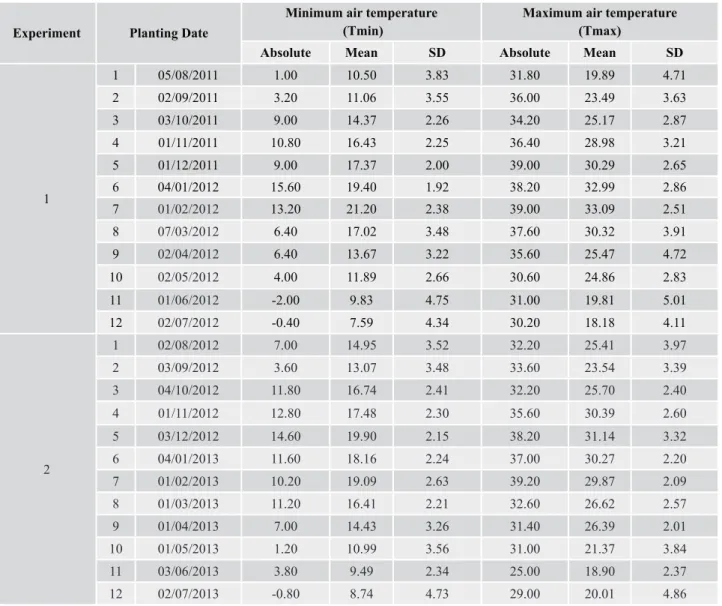
Table 1. Minimum and Maximum air temperature during the experimental period, in °C, (absolute, mean and standard deviation - SD) for two field experiments with gladiolus in Santa Maria, RS, Brazil.
Experiment Planting Date
Minimum air temperature (Tmin)
Maximum air temperature (Tmax)
Absolute Mean SD Absolute Mean SD
1
1 05/08/2011 1.00 10.50 3.83 31.80 19.89 4.71
2 02/09/2011 3.20 11.06 3.55 36.00 23.49 3.63
3 03/10/2011 9.00 14.37 2.26 34.20 25.17 2.87
4 01/11/2011 10.80 16.43 2.25 36.40 28.98 3.21
5 01/12/2011 9.00 17.37 2.00 39.00 30.29 2.65
6 04/01/2012 15.60 19.40 1.92 38.20 32.99 2.86
7 01/02/2012 13.20 21.20 2.38 39.00 33.09 2.51
8 07/03/2012 6.40 17.02 3.48 37.60 30.32 3.91
9 02/04/2012 6.40 13.67 3.22 35.60 25.47 4.72
10 02/05/2012 4.00 11.89 2.66 30.60 24.86 2.83
11 01/06/2012 -2.00 9.83 4.75 31.00 19.81 5.01
12 02/07/2012 -0.40 7.59 4.34 30.20 18.18 4.11
2
1 02/08/2012 7.00 14.95 3.52 32.20 25.41 3.97
2 03/09/2012 3.60 13.07 3.48 33.60 23.54 3.39
3 04/10/2012 11.80 16.74 2.41 32.20 25.70 2.40
4 01/11/2012 12.80 17.48 2.30 35.60 30.39 2.60
5 03/12/2012 14.60 19.90 2.15 38.20 31.14 3.32
6 04/01/2013 11.60 18.16 2.24 37.00 30.27 2.20
7 01/02/2013 10.20 19.09 2.63 39.20 29.87 2.09
8 01/03/2013 11.20 16.41 2.21 32.60 26.62 2.57
9 01/04/2013 7.00 14.43 3.26 31.40 26.39 2.01
10 01/05/2013 1.20 10.99 3.56 31.00 21.37 3.84
11 03/06/2013 3.80 9.49 2.34 25.00 18.90 2.37
12 02/07/2013 -0.80 8.74 4.73 29.00 20.01 4.86
The number of days after planting (DAP) to complete
each developmental stage, according to the phenological
scale of Schwab et al. (2015a), pooling all cultivars and planting dates in Experiments 1 and 2, is presented in Figure 1. The lowest amplitude of variation in the duration of the stages was found for the VE stage (emergency), with a difference of 33 days between the minimum and maximum values of DAP for the occurrence of this stage. The largest amplitude was 66 days for the R4 (corolla of the last floret with visible anthers) and R5 (complete senescence of the floral stem) stages. One possible explanation for this results is that during the VE stage, development is less dependent
on the variation of above ground environmental conditions, mainly air temperature, because its development occurs
below ground where daily temperature variation is lower
than in air temperature and, therefore, the time interval for the occurrence of this stage becomes less variable
between the different planting dates than when compared to the reproductive stages of the plant, when the plant organs (leaves, stem, and florets) are directly exposed to air temperature and solar radiation. Muttoni et al. (2017) when studying the influence of air temperature on the emergence
of gladiolus corms, determined the basal temperature for
Figure 1. Variation in days after planting (DAP) to complete several developmental stages of gladiolus cultivars Jester, Peter Pears, Rose Friendship, and Amsterdam. Data of different planting dates in
Experiment 1 and Experiment 2 are polled. Santa Maria, RS, Brazil.
The duration of the developmental phase (in days) from planting date (PL) to the R2 stage (when the first three florets at the bottom of the spike show the color of the corolla),
considered as the harvest point of gladiolus, is presented in
Table 2. For the PL-R2, there was an increase in the length of the crop developmental cycle when agrown in the coldest periods of the year (May, June, July and August plantings), compared to those cultivated in the warmer months (Table
Table 2. The duration (in days) of the PL (planting) to the R2 (first three florets at the bottom of the spike show the color of the corolla) stage for gladiolus cultivars in Experiments 1 and 2 in Santa Maria, RS, Brazil.
Experiment Planting date Duration of PL-R2 (in days)
Peter Pears Jester Rose Friendship
1
1 05/08/2011 95 Ab 96 Ab 95 Aab
2 02/09/2011 77 Bc 78 Bcd 82 Acd
3 03/10/2011 68 Cd 72 Bde 76 Ad
4 01/11/2011 69 Bd 72 Bde 80 Ad
5 01/12/2011 62 Bd 65 Be 73 Ad
6 04/01/2012 66 Bd 74 Ad 77 Ad
7 01/02/2012 69 Ad 73 Ade *
8 07/03/2012 * 83 Ac 76 Bd
9 02/04/2012 ** ** **
10 02/05/2012 * 112 Aa 102 Ba
11 01/06/2012 103 Aa 112 Aa 98 Aab
12 02/07/2012 99 Aab 105 Aa 90 Abc
2
Amsterdam Jester Rose Friendship
1 02/08/2012 84 Abc 88Ade 87Abc
2 03/09/2012 76 Bc 85Aefg 85Ac
3 04/10/2012 87 Abc 79Afg 84Acd
4 01/11/2012 75 Bc 96Ac 84ABbc
5 03/12/2012 84Abc 92Acd *
6 04/01/2013 70Bc 87Adef 82Acd
7 01/02/2013 69Bc 79Ag 76Ade
8 01/03/2013 72Bc 89Ade 70Be
9 01/04/2013 88Babc 98Ac 80Ccd
10 01/05/2013 99Bab 112Ab 94Bab
11 03/06/2013 104Ba 123Aa 99Ca
12 02/07/2013 99Bab 109Ab 95Ca
* Plots lost due to diseases in corms. ** Development stopped by frost.
Means followed by the same capital letter in the row and means followed by the same lowercase letter in the column do not differ statistically by the Tukey Test at 5%.
For Experiment 1, the increase in the length of the PL-R2 phase was 42, 48 and 28 days in the colder months for the cultivars Peter Pears, Jester and, Rose Friendship, respectively (Table 2); in Experiment 2 the increase was 35, 45 and 28 days for the cultivars Amsterdam, Jester and Rose Friendship (Table 2). The duration of the PL-R2 phase
is an important indicator for farmers, since planting date
planning should consider the harvest date, which is usually timely and intended for a specific event (commemorative dates) (SCHWAB et al., 2017), as the All Souls’ Day holiday.
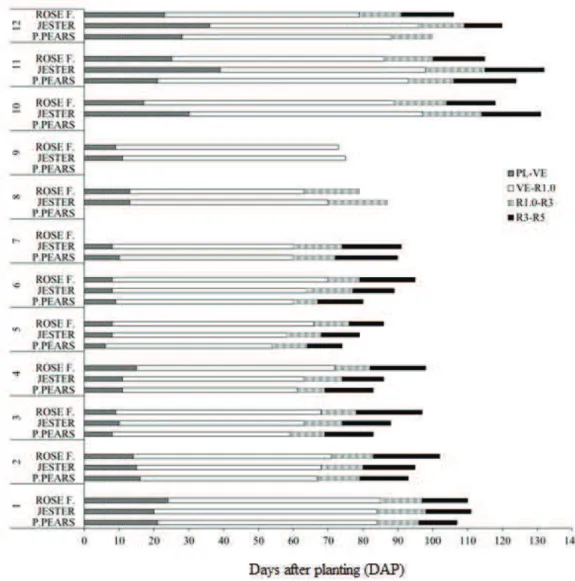
Figures 2 and 3 show the duration of the different developmental phases of gladiolus: PL-VE (from planting
to emergence); VE-R1.0 (from emergence to the beginning of the heading, which represents the vegetative phase); R1.0-R3 (from the beginning of the heading to the beginning of the anthesis); and R3-R5 (from the beginning of the anthesis to the complete senescence of the floral stem). Variations in the duration of developmental phase among
cultivars in the same planting date are due to genotype
characteristics, such as that found by Uhlmann et al. (2017), who classified the cultivars White Friendship, Purple Flora, Rose Friendship and Amsterdam as the earliest cultivars, and the cultivar Gold Field as the latest. The variations
(Table 1) to which they were exposed, as discussed previously.
In Experiment 1 (Figure 2), it was verified that the cultivar Peter Pears had the shortest duration of all developmental phases in the 01/12/11 planting date, totaling 6 days for PL-VE; 48 days for VE-R1.0 and 10 days for R3-R5. An exception occurred for the R1.0-R3 phase, which was shorter in planting date on 04/01/12, totaling 7 days for R1.0-R3. The highest duration of
the developmental phases was in the 01/06/12 planting date, except for the PL-VE phase, which occurred in the 02/07/12 planting date, totaling 28 days for PL-VE; 72 days for VE-R1.0; 13 days for R1.0-R3 and 18 days for R3-R5. Thus, it is evident that planting in high air temperatures dates (December and January) results in the shortening of the phenological phases when compared to plantings at dates with lower air temperatures (June and July) (UHLMANN et al., 2017).
Figure 2. Duration of developmental phases (in days) for three gladiolus cultivars (Rose Friendship, Jester, and Peter Pears) in 12 planting dates (Experiment 1): PL-VE (planting - emergence); VE-R1.0 (emergency - beginning of heading); R1.0-R3 (beginning of heading - beginning of anthesis) and R3-R5
(beginning of anthesis - senescence of floral stem). Santa Maria, RS, Brazil.
For the cultivar Jester, in Experiment 1 (Figure 2), the lowest duration for the developmental phases was obtained at the 01/12/11 planting date, totaling 8 days for PL-VE; 50 days for VE-R1.0; 10 days for R1.0-R3 and 11 days for R3-R5. Duration of PL-VE of 8 days was also observed in the planting dates in January and February (planting dates 6 and 7, respectively). The lengthening of the phases occurred in the 02/05/12 and 01/06/12 planting dates, (planting dates 10 and 11, respectively), was 39 days for PL-VE (planting
date 11), 67 days for VE-R1.0 (planting date 10), and 17 days for R1.0-R3 and R3-R5.
10 (02/05/12), totaling 72 days; for R1.0-R3 was in planting date 8, totaling 16 days; for R3-R5 was in planting dates 2 and 3 (02/09/11 and 03/10/11, respectively), totaling 19 days. In the case of Rose Friendship, in Experiment 1, the influence of planting dates on the duration of the
developmental phases is not as clear as for the cultivars
Peter Pears and Jester, as presented above, probably because Rose Friendship is as an early-cycle cultivar, different from Peter Pears and Jester, which have a longer cycle.
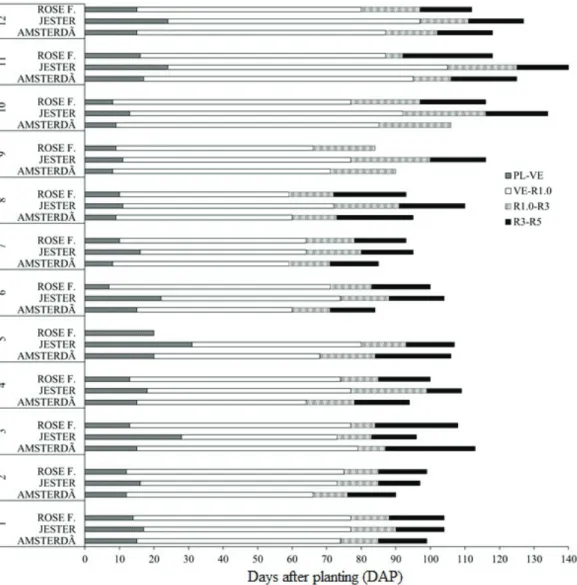
Figure 3 shows the duration of the developmental phases in Experiment 2 for cultivars Jester, Rose Friendship, and Amsterdam. The lowest duration of
PL-VE was 7 days (for Rose Friendship, planted on 04/01/2013), for VE-R1.0 it was 45 days (for Jester, planted on 04/10/2012, and Amsterdam planted on 04/01/2013); for R1.0-R3 it was 5 days (for Rose Friendship, planted on 03/06/2013); and for R3-R5 it was 10 days (for Jester, planted on 01/11/2012). The longest duration for PL-VE was 31 days (for Jester, planted on 03/12/2012); for VE-R1.0 it was 81 days (for Jester, planted on 03/06/2013); for R1.0-R3 was 24 days (for Jester, planted on 01/05/2013); and for R3-R5 it was 26 days (for Rose Friendship, planted on 03/06/2013, and Amsterdam planted on 04/10/2012).
Figure 3. Duration of developmental phases (in days) for three gladiolus cultivars (Rose Friendship, Jester, and Amsterdam) in different planting dates (Experiment 2): PL-VE (planting - emergence); VE-R1.0 (emergency - beginning of heading); R1.0-R3 (beginning of heading - beginning of anthesis) and R3-R5
(beginning of anthesis - senescence of floral stem). Santa Maria, RS, Brazil.
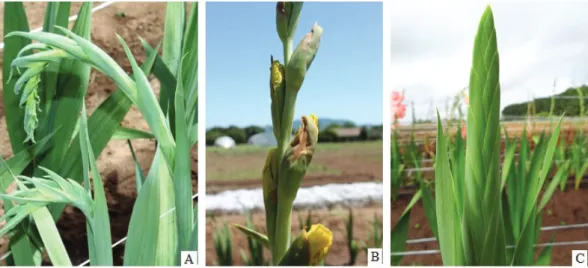
On 09 November 2011, the first strong heat wave was recorded during the Experiment 1 (Figure 4) and injuries due to high air temperatures (36.2 °C) on the gladiolus plants were observed. Injuries due high temperatures inlcuded temporary wilting of floral stems (Figure 5A) and burns in the sepals of the florets, mainly in the Jester
Figure 5. Injuries in gladiolus spikes caused by high air temperatures on 09 November 2011 in Santa Maria, RS, Brazil: (A) wilted floral stem, (B) burned sepals and (C) normal floral stem for comparative purposes. Figure 4. Minimum and maximum air temperatures during August, September, October and November 2011
(Experiment 1) in Santa Maria, RS, Brazil. Date (dd/mm/yy).
The negative effects caused by high air temperature
happened again during the two experiments, when daily maximum temperatures were above 35 ºC, demonstrating
that high air temperatures cause visual damages in gladiolus
and risk of the 3-4 florets of the tip of the stem do not open (UHLMANN et al., 2017), even when kept under irrigation.
These damages, depending on the degree of severity, may
disqualify the floral stem for commercialization (SCHWAB et al., 2005b; VEILING HOLAMBRA, 2018). Although Shillo and Halevy (1976c) have stated that the gladiolus is extremely tolerant to high air temperatures, surviving at temperatures close to 50 ºC, these authors did not present in their results a detail on visual damages in leaves and floral
Figure 6. Minimum and maximum air temperatures in June 2012 (Experiment 1) in Santa Maria, RS, Brazil. Date (dd/mm/yy).
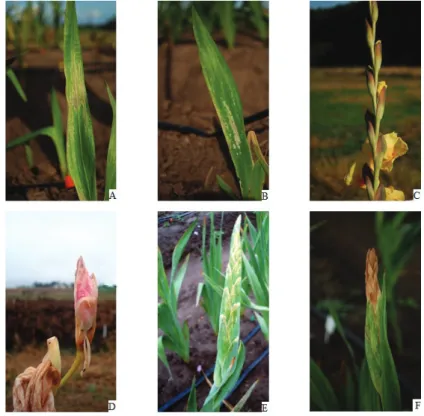
Injuries caused by frost were also observed on the flower stems of the plants planted on 07/03/2012. In Experiment 2, there was a darkening of the sepals of the cultivar Jester (Figure 7C) and, for the Rose Friendship (Figure 7D) there was discoloring of the petals, resulting in a pale pink tone, different from the natural color of the cultivar. For both cultivars, after the frost event, there was
an early senescence of the open buttons and the no opening
of those buttons that were closed on the date of the event, which senesced before opening. Uhlmann et al. (2017),
in their model for simulating development in gladiolus,
alert the possibility of the death of floral stems due to the occurrence of low air temperature (frost). Nowak et al. (1992) state that flowers of subtropical and tropical origin should not be exposed to temperatures lower than 4 °C and 7 °C, respectively, because below these temperatures chilling may occur, presenting symptoms such as flower
discoloration, necrotic lesions on the petals and on the
leaves, and delay in opening the floral button. Thus, the occurrence of intense frost between the stages R1.2 to R3.6 makes it impossible to commercialize gladiolus stems because of visual damage (VEILING HOLAMBRA, 2018).
Figure 7. Damage in gladiolus caused by low air temperatures: (A) and (B) Leaves; (C) Floral stems of Jester; (D) Floral button of Rose Friendship; (E) Heading (picture registered on 18 June 2012 - ten days after a frost); (F) Heading
The plants planted on 02/04/2012 (Experiment 1), which were between the VF (visible flag leaf) and R1.2 stages (emergence of spike completed), presented chilling on the stems. The damage started as small spots (Figure 7E) and, over the days, became more pronounced due to tissue necrosis, especially in the uppermost portion (Figure 7F), the region most exposed to frost. The damages resulted in no flowering of the stems and stop in the development of the plant. In Experiment 2 there were no intense frosts and no damage was observed, corroborating with Schwab et al. (2017), who state that the gladiolus tolerates low air temperatures, which gives the crop a good adaptation to subtropical regions (such as Southern Brazil), where the species can easily be grown during Spring and Fall (SCHWAB et al., 2015b).
4. CONCLUSIONS
The gladiolus developmental cycle is shorter when
planting occurs during periods of high air temperatures
(summer) and higher when planting occurs in periods of low air temperatures (winter). It is possible to grow
gladiolus throughout the year, but it is limited by the
high temperatures in the Summer (cause visual damages in the stems), and the low temperatures in the Winter (frosts), which in addition to causing visual damage, stop the progress of plant development, resulting in lower commercial quality. During the summer months, a practical
recommendation to avoid damage to the gladiolus stems is
to use artificial shading on plants.
ACKNOWLEDGMENTS
The authors are thankful to “Conselho Nacional de Desenvolvimento Científico e Tecnológico” (CNPq), “Coordenação de Aperfeiçoamento de Pessoal de Nível Superior” (Capes) and “Fundação de Amparo à Pesquisa do Estado do Rio Grande do Sul” for the scholarships.
AUTHORS CONTRIBUTIONS
N.T.S.: the conception of work, collection, analysis,
and interpretation of data, writing and critical review of the
article. N.A.S.: the work supervisor, writing and approval of
the final version of the work. L.O.U.: collection, analysis,
and interpretation of data. C.C.B.: collection, analysis,
and interpretation of data. J.A.L.: collection, analysis, and
interpretation of data. B.S.M.R.R.: collection, analysis,
and interpretation of data. R.T.: collection, analysis, and
interpretation of data
REFERENCES
AHMAD, I.; ARA, N.; KHATTAK, M.; AMIM, N.U. Effect of planting dates on the growth of gladiolus corms in Peshawar. Sarhad Journal of Agriculture, v.27, n.2, p.195-199, 2011.
AKPINAR, E; BULUT, Y. Study on the growth and development of some Gladiolus (Gladiolus L.) varieties
planted in different time under the ecological conditions
of Erzurum. African Journal of Agricultural Research,
v.6, n.13, p.3143-3148, 2011. DOI: 10.5897/AJAR11.066
BARBOSA, J.G.; DE SÁ, P.G.; LOPES, L.C.; GROSSI, J.A.S. Plantio. In: BARBOSA, J.G. Palma-de-Santa-Rita (Gladíolo): Produção comercial de flores e bulbos. Viçosa: Ed. UFV, 2011. 113p.
CHOUDHARY, M. MOOND, S.K.; KUMARI, A. Correlation Studies in Gladiolus. Research in Plant Biology, v.4, n.1, p.68-72, 2011.
VEILING HOLAMBRA. Padrão de Qualidade: gladíolo corte. 2018. Available in: <http://veiling.com.br/uploads/ padrao/gladiolo-fc.pdf >. Accessed on: 20 de junho de 2018.
FAGUNDES, J.D.; STRECK, N.A.; STORCK, L.; REINIGER, L.F.S. Temperatura-base e soma térmica de subperíodos do desenvolvimento de Aspilia montevidensis.
Bragantia, v.69, n.2, p.499-507, 2010. DOI: http://dx.doi. org/10.1590/S0006-87052010000200030
MUTTONI, M.; ALBERTO, C.M.; BARTZ, A.C.; UHLMANN, L.O.; TARTAGLIA, V. de L.; STRECK, N.A. Cardinal temperatures for planting-emergence phase in gladiolus. Ciência Rural, v.47, n.10, p.1-7, 2017. DOI: http://dx.doi.org/10.1590/0103-8478cr20160824
NARDI, C.; BELLÉ, R. A.; SCHMIDT, C.; TOLEDO, K. dos A. Crescimento do crisântemo (Dendranthema grandiflora Tzevelev.) ‘Snowdon’ em diferentes populações e épocas de plantio. Revista Brasileira de Agrociência,
v.6, n.2, p.107-111, 2000.
NOWAK, J.; GOSZCZYNSKA, D.; RUDNICKI, R.M. Storage of cut flowers and ornamental plants: present status and future prospects. Postharvest News and Information,
SCHWAB, N.T.; STRECK, N.A.; REHBEIN, A.; RIBEIRO, B.S.M.R.; UHLMANN, L.O.; LANGNER, J.A.; BECKER, C.C. Dimensões lineares da folha e seu uso na determinação do perfil vertical foliar de gladíolo. Bragantia, v.73, n.2 p.97-105, 2014. DOI: http://dx.doi. org/10.1590/brag.2014.014
SCHWAB, N.T.; STRECK, N.A.; BECKER, C.C.; LANGNER, J.A.; UHLMANN, L.O.; RIBEIRO, B.S.M.R. A phenological scale for the development of Gladiolus. Annals of Applied Biology, v.166, p. 496–507, 2015a. DOI: 10.1111/aab.12198
SCHWAB, N.T.; STRECK, N.; RIBEIRO, B.S.M.R.; BECKER, C.C.; LANGNER, J.A.; UHLMANN, L.O.; RIBAS, G.G. Parâmetros quantitativos de hastes florais de gladíolo conforme a data de plantio em ambiente subtropical. Pesquisa Agropecuária Brasileira, v.50, n.10, p.902-911, 2015b. DOI: 10.1590/S0100-204X2015001000006
SCHWAB, N.T.; STRECK, N.A.; UHLMANN, L.O.; RIBEIRO, B.S.M.R.; BECKER, C.C.; LANGNER, J.A. Temperatura base para abertura de floretes e antocrono em gladíolo. Revista Ceres, v.64, n.6, p.557-560, 2017. http:// dx.doi.org/10.1590/0034-737x201764060008
SEVERINO, C.A.M. Dossiê técnico: Cultivo comercial de Palma de Santa Rita (Gladiolussp.Tourm.). Rede de
Tecnologia da Bahia – RETEC/BA, 2007. 22p.
SHILLO, R.; HAVELY, A.H. The effect of various environmental factors on flowering of gladiolus. I. Light Intensity. Scientia Horticulturae, v.4, n.2, p.131-137, 1976a. DOI: https://doi.org/10.1016/ S0304-4238(76)80004-0
SHILLO, R.; HAVELY, A.H. The effect of various environmental factors on flowering of gladiolus. II. Length of the day. Scientia Horticulturae, v.4, n.2, p.139-146, 1976b. DOI: https://doi.org/10.1016/S0304-4238(76)80005-2
SHILLO, R.; HAVELY, A.H. The effect of various environmental factors on flowering of gladiolus. III. Temperature and Moisture. Scientia Horticulturae, v.4, n.2, p.147-155, 1976c. DOI: https://doi.org/10.1016/ S0304-4238(76)80006-4
SHILLO, R.; HAVELY, A.H. The effect of various environmental factors on flowering of gladiolus. IV. Intersection of environmental factors – General discussion. Scientia Horticulturae, v.4, n.2, p.157-162, 1976d. DOI: https://doi.org/10.1016/S0304-4238(76)80007-6
UHLMANN, L.O.; STRECK, N.A.; BECKER, C.C.; SCHWAB, N.T.; BENEDETTI, R.P.; CHARÃO, A.S.; RIBEIRO, B.S.M.R.; SILVEIRA, W.B.; BACKES, F.A.A.L.; ALBERTO, C. M.; MUTTONI, M.; PAULA, G.M. de.; TOMIOZZO, R.; BOSCO, L.C.; BECKER, D. PhenoGlad: A model for simulating development in Gladiolus. European Journal of Agronomy, v.82, p.33-49, 2017. DOI: https://doi.org/ 10.1016/j.eja.2016.10.001