Identification of Yeasts Isolated from Processed and Frozen
Cocoa (
Theobroma cacao
) Pulp for Wine Production
Rita de Cássia Trindade
1, Maria Aparecida de Resende
2*, Eriana Gomes Serpa Barreto
1,
Taniella de Carvalho Mendes
1and Carlos Augusto Rosa
21Depto. Morfologia, Universidade Federal de Sergipe, 49100-000, São Cristovão, SE, Brazil, 2Depto.
Microbiologia, Instituto de Ciências Biológicas, Universidade Federal de Minas Gerais, P.O. Box 486, 31270-901, Belo Horizonte, MG, Brazil
ABSTRACT
The alternative use of cocoa (Theobroma cacao) for wine production was tested. The pulp samples, obtained from Formosa farm, Itacaré, Brazil, were diluted, homogenized and inoculated on Sabouraud dextrose agar medium (SDA) and incubated at 28° C for 5-8 days. Selected colonies were tested for the ability to ferment cocoa pulp and divided into fermentative, non-fermentative and weak/late fermentative species. Isolates characterized as fermentative were further tested in a small-scale wine production plant and identified. Species from the genus
Brettanomyces constituted the main fermentative yeasts, with the exception of two Kloeckera apis samples. The final wine product was normally pale or clear, making clarification unnecessary, and with a sweet or dry pleasant flavor. The predominance of Brettanomyces species in cocoa pulp indicated its ecological importance in this environment and pointed to an active role of Brettanomyces in the deterioration process of the processed cocoa pulp.
Key words: Yeast, Cocoa pulp, Fermentation, Wine production, Brettanomyces sp
* Author for correspondence
INTRODUCTION
Yeasts has been traditionally isolated from industrialized fruit pulp and juice, as well as from other natural or processed foods. That is due to their association with sugary substrates and consequent involvement in various fermenting processes. Studies on the natural yeast populations however, are scarce. Little is know about its communities in tropical flowers and fruits.
Several authors have investigated cocoa pulp for natural fermentation of the seed during chocolate production. The yeast mycobiota of the cocoa seed was investigated during natural fermentation by Sanches et al. (1985) and the
main isolated species were Saccharomyces chevalieri, Torulopsis candida, and Candida novergensis. Besides these species, S. bayanus, C. krusei, Kloeckera apiculata, Schizosaccharomyces pombe, Pichia membranaefaciens, and Brettanomyces
custersianus have also been detected in the
fermentation process in Madagascar (Ravelomanana et al., 1984). Gautier et al.
(1977) identified P. membranaefaciens, S. cerevisiae, C. zeylanoides, T. candida, T. castelli
and T. holmii in natural cocoa fermentation.
Except for Torulopsis Roelofsen (1958) had
already found all these genera. However, Schwan et al. (1995) found mainly the species S. cerevisiae, Kluyveromyces marxianus, Kloeckera apiculata, Lodderomyces elongiosporus and Candida spp during natural
cocoa fermentation. Those authors believed that the differences were due to distinct geographic conditions, along with varied fermentation practices. Some studies were made to improve the natural fermentation performance of the cocoa seeds. Vasquez (1989) tried direct inoculation at the beginning of fermentation with strains of Brettanomyces clausenii, Candida famata, and Acetobacter strains. Only B. clausenii produced positive fermentation, but
traditional fermentation. Other authors using S. chevalieri, a common species that occurs during
the first three days of natural fermentation (Sanches, 1985), have obtained similar results. According to Schwan et al., (1995) yeasts were
the first colonizers during natural cocoa fermentation, following by lactic acid bacteria and finally by acetic acid bacteria, and sporulating bacteria. This was due to the high citric acid content, which gave the pulp a pH around 3.6, and the high oxygenation. Molds, although present through fermentation process, did not seem to play any role during the process. Ribeiro et al. (1986) isolated Aspergillus fumigatus, A. niger, Lasioplodia theobromae, Fusarium moniliforme, F. oxysporum, Mucor racemosus and another unidentified Mucor, Paecilomyces variotii, Penicillium citrinum, P. implicatum, P. spinosum, Thielaviopsis ethaceticus and Trichoderma viridae during the
cocoa fermentation process. This report made the role of moulds clear in the production of non-volatile acids throughout fermentation. At no time, however, did the mould population predominate in the microbial community (Schwan et al., 1995). The study carried out by
Faparusi (1974) in Nigeria is the only one available in the literature that refers to yeast isolated from flowers, epidermis and pulp of unripe and ripe cocoa fruits. This author made a comparative study among the natural communities and their succession during the fermentation process.
The goal of this study was to characterize the yeast communities found in fresh cocoa pulp. A selection of fermenting strains was also made and small-scale cocoa wine production was tested with the objective to provide producers with an alternative use for the cocoa pulp.
MATERIALS AND METHODS
Cocoa pulp was obtained from the Formosa farm, Itacaré, Brazil. The samples were diluted at 1:40 with sterile distilled water, homogenized and inoculated on Sabouraud dextrose agar medium (SDA) and incubated at 28°C for counting and selection purposes. The readings were taken after 5-8 days. The chosen morphotypes were further identified. All tests
for identification were performed with pure yeast cultures originating from a colony kept on SDA and replated between 24 and 48h before use. Species identification was made according methods described by Kreger-van Rij (1984). After selection and purification, the samples were kept in malt agar covered with sterilized mineral oil in the refrigerator.
After isolation, the yeast underwent a fermentation selection, which separated the isolates into fermentative, non-fermentative and weak/late fermentative based on the quantity of CO2 collected in the tubes of Durham. The fast
fermentative isolates were used in a small-scale wine production plant. The cocoa wine production trials were carried out at the Industrial Chemical Laboratory of the Chemical Engineering Department (Federal University of Sergipe), using the following protocol: a) Must preparation: the pulp was diluted at 20% and was centrifuged at 6500 rpm for 30 minutes. The must was then corrected with the addition of 0.01g/ml of magnesium sulfate, 1.0g/ml of ammonium sulfate and commercial sucrose until a Brix 18 (the same Brix of the natural pulp); b) Pre-inoculum: the must corrected was sterilized. Cultures of 24h of each chosen yeast were inoculated into tubes containing 10 ml of the must. The tubes were incubated at room temperature for 24 hours. After this period the gas production or decreasing of the Brix were verified, in order to confirm the beginning of the fermentation process and the activity of the culture; c) Cocoa wine production: the pre-inoculum was added into bottles with 300ml of the corrected must. The must was homogenized and the initial Brix was measured. The bottles were maintained at room temperature, on repose, until the stabilization of the Brix (same values for three consecutive days). The must was centrifuged and the wine was bottled.
RESULTS
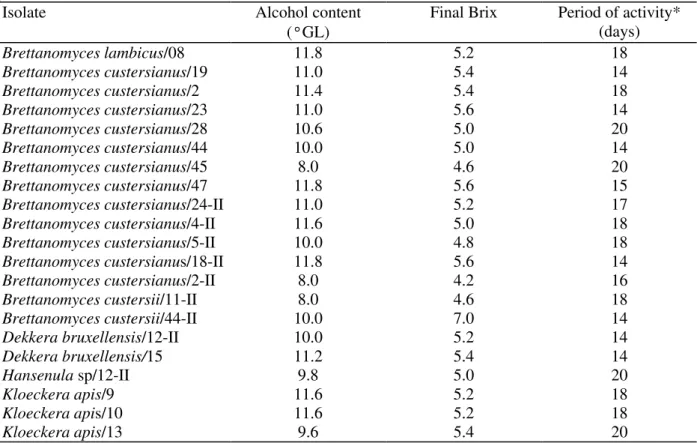
greatly in consumption of the available sugar, as seen in the small variation in the final Brix. The sample 8 (B. lambicus), 18-11 and 23 (B. custersianus), produced wines with a higher
alcohol content (18.8° GL) but had short periods of activity, 18, 14, and 15 days respectively. The final Brix in those trials was around 5.4. Placed second for activity were the samples 4-11 (B. custersianus), 9 and 10 (K. apis) which
produced wines with alcoholic contents similar to the first and in shorts periods, but were less efficient in using the available sugars. Samples with both, higher and lower fermentation activity were isolated within the B. custersianus
species. Sample 45 produced the wine with the lowest alcoholic content (8° GL) and required 20 days for stabilization of the Brix.
Table 1: Final alcohol content, final sugar percentage and period of activity observed in the best cocoa wine producers.
Isolate Alcohol content
(°GL)
Final Brix Period of activity* (days)
Brettanomyces lambicus/08 11.8 5.2 18
Brettanomyces custersianus/19 11.0 5.4 14
Brettanomyces custersianus/2 11.4 5.4 18
Brettanomyces custersianus/23 11.0 5.6 14
Brettanomyces custersianus/28 10.6 5.0 20
Brettanomyces custersianus/44 10.0 5.0 14
Brettanomyces custersianus/45 8.0 4.6 20
Brettanomyces custersianus/47 11.8 5.6 15
Brettanomyces custersianus/24-II 11.0 5.2 17
Brettanomyces custersianus/4-II 11.6 5.0 18
Brettanomyces custersianus/5-II 10.0 4.8 18
Brettanomyces custersianus/18-II 11.8 5.6 14
Brettanomyces custersianus/2-II 8.0 4.2 16
Brettanomyces custersii/11-II 8.0 4.6 18
Brettanomyces custersii/44-II 10.0 7.0 14
Dekkera bruxellensis/12-II 10.0 5.2 14
Dekkera bruxellensis/15 11.2 5.4 14
Hansenula sp/12-II 9.8 5.0 20
Kloeckera apis/9 11.6 5.2 18
Kloeckera apis/10 11.6 5.2 18
Kloeckera apis/13 9.6 5.4 20
*Period necessary for stabilization of the Brix or consumption of the sugar
Table 2: Frequency of isolation of the identified yeast species.
Specie Number of
isolates
Specie Number of isolates
Brettanomyces custersianus 12 Kloeckera africana 01
Brettanomyces custersii 04 Kloeckera apis 03
Brettanomyces lambicus 01 Trichosposron terrestre 02
Brettanomyces bruxellensis 04 Dekkera bruxellensis 07
Brettanomyces intermedius 08 Dekkera intermedia 04
Brettanomyces claussenii 07 Hansenula sp 01
Brettanomyces naardenensis 03 Pichia sp 01
DISCUSSION
The wine produced had a pleasant flavor, varying from dry to sweet, with a pale and clear color that made clarification unnecessary. The result indicated that the Brettanomyces genus,
especially the species B. custersianus, was a
good fermenter for cocoa pulp wine production. In addition, it could be active in deterioration process of processed cocoa pulp, and furthermore, its predominance in the yeast community could indicate an ecologically important role. We suggest that the intense acid production by Brettanomyces spp and the low
pH of the pulp could be some of the factors for the low diversity and the predominance of this genus observed in cocoa pulp. A selective action of the SDA medium, another factor that may be responsible for the low diversity observed was, however, not tested. The Brettanomyces genus
has been mentioned by several authors (Ravelomanana et al., 1984; Vasquez, 1989; Cook, 1958; Jay, 1970; Rose & Harrison, 1987; Magalhães & Queiroz, 1991) as part of the active fungal community during natural cocoa fermentation and in particular by Faparusi (1974) when studying unripe and ripe cocoa fruit and flowers. Few researchers reported the presence of Brettanomyces spp in fresh fruit
pulp. Faparusi (1974) in Madagascar and Ivo (1982) in Brazil observed the presence of
Dekkera (Brettanomyces teleomorph) in fresh
pineapple (Annanas comosus) fruits and, Santos et al. (1996), on cashew (Anacardium occidentale) epidermis. The activity of Kloeckera genus (K. apis) was similar of Brettanomyces but, as its presence was less
frequent, it has secondary importance in the community. Rose and Harrison (1987) also mentioned the Kloeckera presence. Owama and Saunders (1990) reported Kloeckera, Pichia, Debaryomyces, Candida and Dekkera as the
frequent genera observed in cashew juice. Magalhães and Queiroz (1991) isolated Pichia
and Debaryomyces from “mangaba” (Hancornia speciosa) and “pitanga” (Eugenia uniflora)
respectively, and Santos et al. (1996) isolated Pichia spp, Candida spp and Kloeckera spp
from hog plum, “umbu” (Spondias tuberosa)
and cashew. These results corroborate and reinforce the importance of this study, because there is little information about the natural microbiological communities on fresh fruits. This fact makes a critical comparison of these results difficult. Santos et al. (1996), reported
that basidiomycete yeasts predominated on unripe fruits and as the fruit ripens, ascomycete and black yeasts became predominant. Similar result was observed by us. It was likely that part of the yeasts found in cocoa pulp was present on the flowers and nectar, while others species were present on the skin. This yeast community only enters in contact with the pulp when it is processed. As the cocoa fruit has a thick epidermis which difficults vector insect action, the fruit pulp is generally considered germ-free. Yeast isolation attempts from the epidermis were difficult by an excess of mold growth observed.
RESUMO
O uso alternativo de cacau (Theobroma cacao)
para produção de vinho foi testado. A polpa de cacau foi obtida da Fazenda Formosa, Itacaré, Brasil. As amostras de polpa foram diluídas, homogeneizadas e inoculadas em meio de Sabouraud dextrose e incubadas a 28°C por 5-8 dias. Colônias selecionadas foram testadas quanto à habilidade de fermentar a polpa de cacau e divididas em fermentadoras, não-fermentadoras e não-fermentadoras lentas. As amostras fermentadoras foram identificadas e testadas para produção de vinho de cacau em escala piloto. A maioria das amostras fermentadoras pertencem ao gênero
Brettanomyces, com exceção de duas amostras
de Kloeckera apis. O vinho obtido apresentou
coloração fraca e clara, tornando a clarificação desnecessária, além de sabor doce e agradável. A predominância de espécies de Brettanomyces
REFERENCES
Cook, A. H. (1958), The chemistry and biology of yeasts. Academic Press, New York. Faparusi, S. I. (1974), Yeasts associated with
cacao (Theobroma cacao) pods. Rev.
Microbiol. 5(3), 49-54.
Gauthier, B., Guiraud, J. & Vincent, J. C. (1977), Remarques sur la flore de levures de la fermentation traditionnelle du cacao en Côte d’Ivoire. Revue des Fermentations et des Industries Alimentaries (Bruxellas), 32(6), 160-163.
Ivo, M. I. (1982), Leveduras do abacaxi. Dissertação de mestrado. Escola Paulista de Medicina, São Paulo.
Jay, J.N. (1970), Modern food microbiology. Van Nostrand Reinbold, New York.
Kreger-van Rij N.J.W. (1984), The Yeasts: a taxonomic study. 3th ed. Elsevier Sci.
Publishers, Amsterdam.
Magalhães, O. M. C. & Queiroz, L. A.(1991), Levaduras aisladas de diversos tipos de alimentos. Boletín Micológico 6(1-2),49-54. Owama, C. I. & Saunders, J. R. (1990),
Physiological variants of Saccharomyces cerevisiae and Kloeckera apiculata from
palm wine and cashew juice. J. Applied Bacteriol., 68, 491-494.
Ravelomanana, R., Guiraud, J. P., Vincent, J. P. & Galzy, P. (1984), Étude de la flore de levures de la fermentation traditionnelle du cacao a Madagascar. Revue Des Fermentations et des Industries Alimentaries (Bruxelles), 39(4), 104-106.
Ribeiro, N. C. A., Bezerra, J. L. & Lopez, A. S. (1986), Microbiota na fermentação do cacau no Estado da Bahia, Brasil. Rev. Theobroma 16(1),47-55.
Roelofsen P. A. (1958), Fermentation, drying, and storage of cocoa beans. Advances in Food Research. 8,225-296.
Rose, A. H. & Harisson, J. S. (1987), The Yeast; biology of the yeasts, New York. Academic Press.
Sanches, J.,Daugueuet, G., Guiraud, J. P., Vincent, J. C. & Galzy, P. (1985), A study of yeast flora and the effect of pure culture seeding during the fermentation process of cocoa beens. Lebensmittel-Wissenschaft und Technologie (Zurich), 18(2), 69-75.
Santos, E. A., Oliveira, R. B., Mendonça-Hagler, L. C. & Hagler, N. A. (1996), Yeasts associated with flowers and fruits from a semi-arid region of Northern Brazil. Rev. Microbiol 27(1), 33-40.
Schwan R. F, Rose, A. H. & Board, R. G. (1995), Microbial fermentation of cocoa beans, with emphasis on enzymatic degradation of the pulp. J. Appl. Bacteriol. Symposium Suppl. 79, 96S-107S.
Vasquez, J. E. S (1989), Tentative pratique d’amelioration de la fermentation du cacao par inoculation directe de micro-organismes. Café Cacao Thé, 33 (3), 157-164.