Correlations and path analysis of morphological and yield traits of
cactus pear accessions
Diogo Gonçalves Neder1, Fabiane Rabelo da Costa2*, Ricardo Loiola Edvan3 and Lenildo Teixeira Souto Filho4
Received 31 December 2010
Accepted 22 February 2013
Abstract – The objectives of this study were to evaluate the relationships between morphological characteristics and fresh matter yield of cactus pear and identify their direct and indirect effects. Nineteen accessions were evaluated for the following traits: number (NCl), thickness (ThCl), length (LCl) and width (WCl) of cladodes, plant height (PH) and plant width (PW), and green matter yield (GMY), dry matter yield (DMY) and dry matter percentage (DM). The correlations were estimated, and path analysis was performed by the method proposed by Wright. GMY was strongly correlated with DMY, allowing indirect selection for this trait. NCl and ThCl had a direct effect on GMY and can be used for indirect selection or as secondary traits in the selection process. Given the lack of
significant correlations between MS and DMY, it is possible to select a palm variety with high DMY and DM. Key words: Genetic variability, selection, semiarid, Opuntia ficus indica.
INTRODUCTION
The family of cactaceae includes approximately 130 genera and 1500 species, among which the genera Opuntia
and Nopalea stand out, known as cactus pear and sweet palm, respectively, as the most important for human use
(Flores-Valdez and Osorio 1996). Cacti are specifically adapted to conditions of water deficit, opening their stomata
to capture CO2 only at night, when temperatures are lower and humidity higher than during the day, resulting in less water loss (Nobel 1995). This makes it possible to produce large quantities of biomass feed (Felker et al. 2006), a valuable forage resource in arid and semiarid regions, especially in the dry period when the availability of herbaceous plants is reduced. Moreover, they produce tasty and nutritious fruits, used as human food in many countries, while the cladodes can also be directly used as vegetable (Scheinvar 1995, Le Houérou 2000, Juárez and Passera 2002).
Although cactus pear is native to Mexican, the condi-tions for its development in the Brazilian semiarid region are suitable, which has led to its expansion. According to Santos et al. (2006), the area used for cactus pear in the northeastern region of Brazil, was 500,000 ha in 2006,
with yields of up to 40 tons of dry matter ha-1. In the
sub-humid woodland (agreste), three cactus pear varieties are grown: ‘Palma Gigante’, ‘Palma Redonda’ (both Opuntia fícus indica) and ‘Palma Doce’ (Nopalea cochenillifera
Salm-Dyck), while in the semi-arid woodland (sertão), only
O. ficus indica is able to adapt to the poor soil conditions, with high temperatures (above 20.5 °C) and rainfall in the warmer months of the year.
One breeding target of cactus pear is to obtain genotypes that produce higher amounts of biomass with higher quality for use in animal feed. However, yield is a complex trait resulting from the expression and association of different components (Carvalho et al. 2002). Thus, knowledge of the degree of this association through correlation studies can identify traits that could be used as indirect selection criteria
for yield or as secondary traits, improving the efficiency of
the selection process. Knowledge of the correlations between forage traits can measure the magnitude of the relationship between various plant traits and identify on which traits selection could be based for gains in biomass yield.
For a better understanding of the factors involved in the associations of traits, Wright (1921) proposed a method of Crop Breeding and Applied Biotechnology 13: 203-207 2013
Brazilian Society of Plant Breeding. Printed in Brazil
NOTE
1 Universidade Estadual da Paraíba, Centro de Ciências Agrárias e Ambientais, Departamento de Agroecologia e Agropecuária, Sítio Imbaúba, s/n, Zona Rural, , 58.117-000, Lagoa Seca, PB, Brazil
2 Instituto Nacional do Semiárido, Av. Francisco Lopes de Almeida, s/n, 58.429-970, Serrotão, PB, Brazil. *E-mail: [email protected]
partitioning correlations, estimating the direct and indirect effects of variables on a main variable, which is called path
analysis. The direct influence of one variable on another
is measured independently of the others (Gonçalves et al. 2003, Gomes and Lopes 2005, Bárbaro et al. 2006). Path analysis can therefore be made from genetic or environ-mental correlations (Cruz 2001). Despite the potential of this methodology for the determination of selection strate-gies in breeding programs and knowledge of direct and indirect relations between the traits, which may provide a basis for understanding the genetic control of a given trait, no reports were found in the literature about its application to cactus pear.
This study evaluated the relationship between mor-phological characteristics and dry matter yield of cactus
pear and identified their direct and indirect effects by path
analysis, with a view to contribute to the selection process.
MATERIAL AND METHODS
Nineteen accessions of Opuntia ficus indica introduced from Mexico by the Agronomic Institute of Pernambuco (IPA) and transferred to the National Institute for the Semi-Arid
Region (INSA), were evaluated in the field, on the Fazenda
Miguel Arraes of INSA in Campina Grande, Pernambuco (lat 07° 13’ 50’’ S, long 35° 52’ 52’’ W and alt 551 m asl), where the minimum temperature is on average 20 °C, maximum 30 °C, and the relative humidity between 75% to 82%.
These accessions were evaluated in a completely ran-domized design with three replications and one plant per plot, spaced 2.0 m x 1.0 m. Thirty months after planting, we analyzed the number of cladodes (NC), thickness of cladodes (ThCl), length of cladodes (LCl), width of cladodes (WCl), plant height (PH), plant width (PW), green matter yield (GMY), dry matter yield (DMP), and dry matter percentage (DM).
Initially, analysis of variance was performed for each trait. The estimates of genotypic (rg), phenotypic (rph) and environmental correlation (re) between the traits were ob-tained as described by Mode and Robinson (1959), tested at 1 and 5% probability by the t test, at n-2 degrees of freedom, and by the Mantel test with 10,000 iterations for each trait combination, to obtain information about their nature and intensity.
Later, the phenotypic correlations were partitioned in direct and indirect effects of morphological characteristics (independent variable) on dry matter yield (dependent vari-able) by path analysis (Wright 1921). The software Genes (Cruz 2001) was used for all analyses.
RESULTS AND DISCUSSION
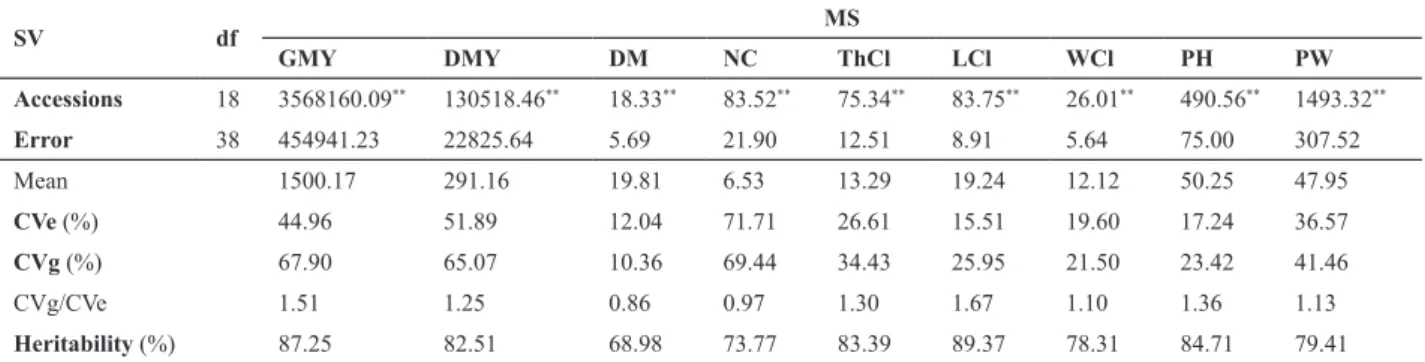
The summary of the analyses of variance (Table 1) showed
significant differences between the nine traits, revealing
genetic variability among cultivars. The ratio between the
coefficients of genetic variation and environmental (CVg/
CVe) was above 1 for seven of the nine characteristics, ex-cept for DM and NC, suggesting a high genetic control in the expression of these traits. The high heritability detected in all traits also corroborated this fact.
The estimates of phenotypic (rph), genetic (rg) and environmental correlations (re) are listed in Table 2. Most
environmental correlations were not significant and there
was virtually no signal difference between genotypic and environmental correlations. In general, the genotypic were higher than the phenotypic and environmental correlation
estimates, but not significant. This fact may have been a
result of the modifying effects of the environment on the association of genetic traits (Gonçalves et al. 1996).
Kang et al. (1983) stated that when the correlations are not similar, the genotypic correlations are inherently more useful than the phenotypic to decide on selection strategies.
Table 1. Summary of the analysis of variance for the traits green matter yield (GMY), dry matter yield (DMY), dry matter percentage (DM), number of cladodes (NC), thickness of cladodes (ThCl), length of cladodes (LCl), width of cladodes (WCl), plant height (PH) e plant width (PW)
SV df MS
GMY DMY DM NC ThCl LCl WCl PH PW
Accessions 18 3568160.09** 130518.46** 18.33** 83.52** 75.34** 83.75** 26.01** 490.56** 1493.32**
Error 38 454941.23 22825.64 5.69 21.90 12.51 8.91 5.64 75.00 307.52
Mean 1500.17 291.16 19.81 6.53 13.29 19.24 12.12 50.25 47.95
CVe (%) 44.96 51.89 12.04 71.71 26.61 15.51 19.60 17.24 36.57
CVg (%) 67.90 65.07 10.36 69.44 34.43 25.95 21.50 23.42 41.46
CVg/CVe 1.51 1.25 0.86 0.97 1.30 1.67 1.10 1.36 1.13
Heritability (%) 87.25 82.51 68.98 73.77 83.39 89.37 78.31 84.71 79.41
However, phenotypically uncorrelated genotypic traits may be unpractical for selection, which is usually based on the phenotype (Shukla et al. 1998). We therefore chose to use phenotypic correlation path analysis, since phenotypes are the focus of breeding.
The traits with significant correlations of DMY (Table
2) were GMY (0.99), NCl (0.76), PW (0.74), and LCl (0.53). Although, a priori, DMY should be preferred for selection of higher-yielding genotypes, due to genotypic variations in DM, the high association be-tween DMY and GMY indicates that selection based on GMY, with proportional gains in DMY, would be perfectly possible, without requiring determination of the plant dry weight. Interestingly, the correlation between DM and DMY was not significant, suggesting that the genetic control of these traits occurs
indepen-dently and that selection of genotypes with high GMY and DM is possible.
The estimates of the direct and indirect effects of path analysis (Table 3) of the trait NCl were high and positively correlated (0.77) and had a high direct effect (0.76), indi-cating that truncated selection with this trait can provide satisfactory gain in DMY.
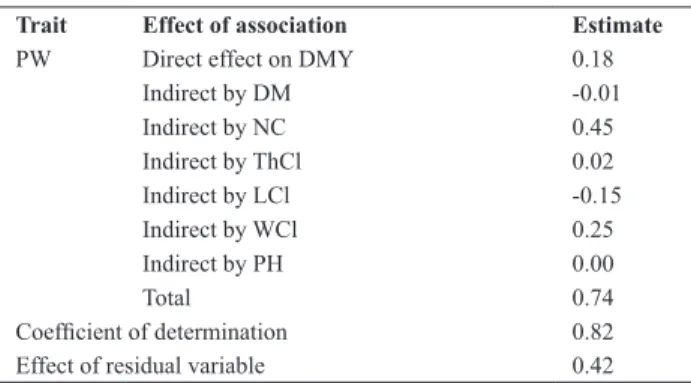
For trait PW, the correlation coefficient was posi-tive and high (0.74), but the direct effect proved low (0.18). The indirect effect via NCl (0.45) and LCl (0.25) contributed most to the high correlation between PW and DMY. In this case the best strategy, according to Cruz and Carneiro (2003), could be the simultaneous selection of traits, focusing on those with significant indirect effects.
Table 2. Estimates of the coefficients of phenotypic (rph), genotypic (rg) and environmental correlations (re) for the traits green matter yield (GMY), dry matter yield (DMY), percentage of dry matter (DM), number of cladodes (NC), thickness of cladodes (ThCl), length of cladodes (LCl), width of cladodes (WCl), plant height (PH) and plant width (PW), in cactus pear accessions
Trait Correlation DM DMY NC ThCl LCl WCl PH PW
GMY rph -0.26 0.99
**++ 0.77**+ 0.19 0.56* 0.40 0.43 0.77**++
rg -0.35 0.99
+ 0.85 0.18 0.65 0.50 0.47 0.89
re 0.06 0.97++ 0.50 0.27 -0.09 -0.10 0.19 0.19
DM rph -0.14 -0.16 -0.43
* -0.36 -0.03 -0.21 -0.34
rg -0.26 -0.27 -0.49 -0.42 0.04 -0.22 -0.49
re 0.23 0.12 -0.24 -0.18 -0.23 -0.18 0.08
DMY rph 0.76
**+ 0.12 0.53* 0.42 0.40 0.74**+
rg 0.82 0.10 0.63 0.56 0.44 0.86
re 0.58 0.21 -0.10 -0.14 0.20 0.22
NC rph -0.15 0.25 -0.06 0.25 0.59
rg -0.20 0.23 -0.11 0.19 0.61
re 0.01 0.34 0.09 0.48 0.51++
ThCl rph 0.31 0.34 0.38 0.15
rg 0.32 0.38 0.43 0.16
re 0.25 0.19 0.15 0.10
LCl rph 0.78**++ 0.73**+ 0.75**++
rg 0.82 0.76 0.81
re 0.67++ 0.48++ 0.45+
WCl rph 0.53* 0.52*
rg 0.49 0.55
re 0.71++ 0.38
PH rph 0.34
rg 0.33
re 0.37
Trait LCl, with a positive and significant correlation in
relation to DMY (0.53), had a direct negative effect (-0.20). The explanation for this is due to its positive effect on other traits related to DMY as NC, favoring his expression. Therefore, direct selection would be more promising on NCl than on LCl, which would disqualify this trait for selection.
On the other hand, the correlation coefficient of LCl with DMY was nonsignificant (0.42), but the direct effect was
high (0.49), indicating the use as secondary variable in the selection for DMY.
Among the traits, NCl had the greatest positive effect, indicating the presence of cause and effect. This trait is related to gains in DMY. On the other hand, the trait LCl can be considered secondary in terms of effect on DMY.
For PW however, despite a high correlation coefficient, the
effects on the said traits were weak.
Low direct and indirect effects were observed for the other traits, indicating possible indirect selection for DMY through selection for NCl, with or without LCl in the se-lection, as well as the use of these as secondary traits, to
increase the efficiency of the selection process.
The results showed: i) a strong association of trait GMY with DMY, allowing indirect selection for this trait, ii) the traits number and width of cladodes have a direct effect on DMY and can be used for indirect selection or as secondary traits in the selection process, emphasizing, however, the low correlation of the latter, iii) the percentage of dry matter
was not significantly correlated with DMY, indicating an
independent genetic control and the possibility of selecting palm varieties with high green and dry matter production. Table 3. Estimates of the direct and indirect effects that involve the main
variable (dry matter yield - DMY) and the explanatory variables dry matter percentage (DM), number of cladodes (NC), thickness of cladodes (ThCl), length of cladodes (LCl), width of cladodes (WCl), plant height (PH), and plant width (PW)
Trait Effect of association Estimate
DM Direct effect on DMY 0.04
Indirect by NC -0.12
Indirect by ThCl -0.05
Indirect by LCl 0.07
Indirect by WCl -0.01
Indirect by PH 0.00
Indirect by PW -0.06
Total -0.14
NC Direct effect on DMY 0.76
Indirect by DM -0.01
Indirect by ThCl -0.02
Indirect by LCl -0.05
Indirect by WCl -0.03
Indirect by PH 0.00
Indirect by PW 0.11
Total 0.76
ThCl Direct effect on DMY 0.12
Indirect by DM -0.02
Indirect by NC -0.11
Indirect by LCl -0.06
Indirect by WCl 0.17
Indirect by PH 0.00
Indirect by PW 0.03
Total 0.12
LCl direct effect on DMY -0.20
Indirect by DM -0.01
Indirect by NC 0.19
Indirect by ThCl 0.04
Indirect by WCl 0.39
Indirect by PH 0.00
Indirect by PW 0.14
Total 0.53
WCl Direct effect on DMY 0.49
Indirect by DM 0.00
Indirect by NC -0.04
Indirect by ThCl 0.04
Indirect by LCl -0.16
Indirect by PH 0.00
Indirect by PW 0.09
Total 0.42
PH Direct effect on DMY 0.00
Indirect by DM -0.01
Indirect by NC 0.19
Indirect by ThCl 0.04
Indirect by LCl -0.15
Indirect by WCl 0.26
Indirect by PW 0.06
Total 0.40
Trait Effect of association Estimate
PW Direct effect on DMY 0.18
Indirect by DM -0.01
Indirect by NC 0.45
Indirect by ThCl 0.02
Indirect by LCl -0.15
Indirect by WCl 0.25
Indirect by PH 0.00
Total 0.74
Coefficient of determination 0.82
REFERENCES
Bárbaro IM, Centurion MAPC, Mauro AOD, Unêda-Trevisoli SH, Arriel NHC and Costa MM (2006) Path analysis and expected response in indirect selection for grain yield in soybean. Crop Breeding and Applied Biotechnology 6:151-159.
Carvalho CGP, Arias CAA, Toledo JFF, Oliveira MF and Vello NA (2002) Correlações e análise de trilha em linhagens de soja semeadas em diferentes épocas. Pesquisa Agropecuária Brasileira 37: 311-320.
Cruz CD (2001) Programa Genes: aplicativo computacional em genética e estatística. UFV, Viçosa, 648p.
Cruz CD and Carneiro PCS (2003) Modelos biométricos aplicados ao melhoramento genético. UFV, Viçosa, 585p.
Flores-Valdez CA and Osorio GA (1996) Opuntia-based ruminant feeding systems in Mexico. FAO International Technical Cooperation Network on Cactus Pear. Available at <http://www.fao.org/AG/
againfo/resources/documents/frg/conf96htm/flores.htm> Accessed
on May 28, 2012.
Felker P, Paterson A and Jenderek MM (2006) Forage potential of opuntia clone maintained by the USDA, National Plant Germplasm System (NPGS) Collection. Crop Science 46: 2161-2168.
Gomes RLF and Lopes ACA (2005) Correlations and path analysis in peanut. Crop Breeding and Applied Biotechnology 5:105-112.
Gonçalves PS, Martins ALM, Bortolleto N and Tanzizi MR (1996) Estimates of genetic parameters and correlations of juvenile characters based on open-pollinated progenies of Hevea. Brazilian Journal of Genetics 19: 105-111.
Gonçalves MC, Correa AM, Destro D, Souza LCF and Sobrinho TA (2003)
Correlations and path analysis of common bean grain yield and its primary component. Crop Breeding and Applied Biotechnology 3: 217-222.
Le Houérou HN (2000) Utilization of fodder trees and shrubs in the arid and semiarid zones of West Asia and North Africa. Arid Soil Research and Rehabilitation 14: 101-135.
Kang MS, Miller JD and Tai PYP (1983) Genetic and phenotypic path analyses and heritability in sugarcane. Crop Science 23: 643-647.
Juárez MC and Passera CB (2002) In vitro propagation of Opuntia ellisiana
Griff. and acclimatization to field conditions. Biocell 26: 319-324.
Mode JC and Robinson HF (1959) Pleiotropism and genetic variance and covariance. Biometrics 15: 518-537.
Nobel JL (1995) Changes in water potential and its component during shoot formation in cacti callus. Physiology Plant 45: 92-97.
Santos DC, Farias I, Lira MA, Santos MVF, Arruda GP, Coelho RSB, Dias FM and Melo JN (2006) Manejo e utilização da palma forrageira (Opuntia e Nopalea) em Pernambuco. IPA, Recife, 48p. (IPA Documentos, 30).
Scheinvar L (1995) Taxonomy of utilized Opuntias. In Barbera G, Inglese P and Pimienta-Barrios E (Eds) Agroecology, cultivation and uses of cactus pear. FAO Plant Production and Protection Paper 132. Rome, Italy, p. 20-27
Shukla S, Singh K and Pushpendra (1998) Correlation and path coefficient
analysis of yield and its components in soybean (Glycine max (L.) Merrill). Soybean Genetics Newsletter 25: 67-70.
Wright S (1921) Correlation and causation. Journal of Agricultural Research20: 557-585.
Correlações e análise de trilha de caracteres morfoagronômicos e de produção
em acessos de palma forrageira
Resumo – Os objetivos deste trabalho foram avaliar as relações entre caracteres morfoagronômicos e a produção de matéria verde
de palma forrageira e identificar seus efeitos diretos e indiretos. Dezenove acessos foram avaliados para os seguintes caracteres:
número (NC), espessura (EC), comprimento (CC) e largura (LC) de cladódios, altura (AP) e largura (LP) de planta, produção de
matéria verde (PMV) e seca (PMS) e porcentagem de matéria seca (MS). Estimaram-se as correlações, e fez-se a análise de trilha pelo método proposto por Wright. O caráter PMV apresentou elevada associação com PMS, permitindo a seleção indireta para este caráter. Os caracteres NC e EC apresentaram efeito direto sobre a PMV, podendo ser empregados na seleção indireta ou como au-xiliares no processo seletivo. Tendo em vista, a não existência de correlações significativas entre MS e PMS, é possível a seleção de variedade de palma com elevada PMS e MS.