Mechanical Properties of Ag-Doped Top-Seeded Melt-Grown YBCO Pellets
C. E. Foerstera∗, E. Limaa, P. Rodrigues Jr.a, F. C. Serbenaa, C. M. Lepienskib, M. P. Cant˜aoc, A. R. Jureloa, and X. Obradorsd
aUniversidade Estadual de Ponta Grossa, Departamento de F´ısica, Ponta Grossa, PR, CEP 84030-000, Brazil bUniversidade Federal do Paran´a, Departamento de F´ısica, C.P. 19044, Curitiba, PR, CEP 81531-990, Brazil
cLACTEC, C.P. 19.067, Centro Polit´ecnico da UFPR, Curitiba, PR, CEP 81.531-990, Brazil dInstitut de Ciˆencia de Materials de Barcelona, CSIC Campus de la UAB, Bellaterra 08193, Spain
(Received on 25 June, 2008)
In the present work we report the mechanical properties ofca(b)-planes of Ag-doped top-seeded melt-grown YBaCuO (YBCO) pellets at different concentrations. Hardness and elastic modulus were obtained by instru-mented indentation and fracture toughness by conventional Vickers indentation. Hardness profiles for both planes indicated values between 7-8 GPa at deep tip penetration. Significant differences in elastic modulus were observed as a function of Ag content for theab-plane while no difference were seen for theca(b)-plane. Doping with 5 wt. % Ag2O increases the hardness and elastic modulus for theab-plane in relation to the undoped sam-ple due to Ag solid-solution hardening. Indentation fracture toughness rises with Ag doping for theab-plane. Intensive plastic deformation was observed inca(b)plane for conventional Vickers indentation.
Keywords: YBaCuO; Anisotropy; Hardness; Elastic modulus; Instrumented indentation; Fracture toughness
1. INTRODUCTION
Despite its very fascinating applications in transport pro-cesses like supporting high critical current density and trap-ping of high magnetic fields at low nitrogen temperature, high-TC superconductors must have good mechanical and tri-bological performance for actual technological applications. Therefore, the study of mechanical properties of these com-pounds, such as of the hardness (H), elastic modulus (E) and fracture toughness (KIC), is very crucial [1, 2].
Melt processed high-TC compounds have its mechanical properties affected by the melting procedure that creates de-fects like pores, cracks and oxygen vacancies [3]. In order to decrease these defect densities and to improve the mechanical properties, it is indicated to dope the high-TC matrix with Ag without loosing the transport properties [2-4]. The doped Ag-YBCO structure has Ag inclusions in addition to the Y211 grains in the Y123 matrix. These inclusions are formed if the Ag content surpasses the Ag solubility limit in the YBCO structure [3, 4].
Bulk hardness of YBCO determinated at room temperature has been mostly obtained by conventional Vickers measure-ments and the values are in the range from 5 to 8 GPa [5, 6]. Elastic modulus values measured in the range from nitrogen to room temperature and having a broad interval between 100-160 GPa [7].
In the present work different Ag2O contents (0%, 5%, 10%
and 15 wt. %) were introduced in the precursors oxides in or-der to form textured Ag-doped YBCO pellets. Subsequently, the hardness and elastic modulus were measured by instru-mented indentation on ab and ca(b)-planes. The fracture toughnessKCwas also calculated inab-plane by conventional Vickers indentations.
∗E-mail address: [email protected]
2. EXPERIMENTAL PROCEDURE
Single domain melt-textured YBCO pellets have been prepared by the top seeding technique using melt-textured NdBa2Cu3O7−δ seeds [3, 4]. Commercial powders of YBa2Cu3O7−x, Y2BaCuO5, CeO2 and Ag2O with purity of
99.9 % were the precursors. The samples composition were 70 wt. % YBa2Cu3O7−x+ 30 wt. % Y2BaCuO5doped with
1 wt. % CeO2 and 5, 10 or 15 wt. % of Ag2O. The
elec-trical characterization of these samples (not here shown) was performed with low-frequency-low-current AC technique that employed a lock-in amplifier as a null detector. For all of the Ag doped YBCO samples an onset resistivity transition tem-perature around 92 K was observed.
Room temperature hardness and elastic modulus profiles were determined by instrumented indentation following the Oliver and Pharr method [8]. The diamond tip was a Berkovich type and the applied loads ranged from 2.5 to 320 mN. At these applied loads, near surface and bulk regions could be analyzed. The values here reported are the average at each tip depth obtained from a matrix indentations (5x5) at different regions on theabandca(b)planes. This procedure was used to check surface homogeneity in respect to the seed position. The fracture toughness was obtained by 0.5 N Vick-ers indentations and using the relation according to Anstinset al.[9]:
Kc=α
³E
Hν
´12
· P c32
(1)
3. RESULTS AND DISCUSSION
Typical Berkovich indentations for pure YBCO inaband ca(b) planes are shown in Figs. 1a and 1b, respectively. Cracks nucleated by the indentations are observed around the tip impressions on theab-plane (Fig. 1a). Moreover, there is a tendency of the cracks direction to follow the indenter di-agonals or/and along specific crystallographic planes. These crystallographic orientations are reported in the literature as {100} planes [10]. For theca(b)-plane (Fig. 1b), no cracks were nucleated around the impressions.
(a)
indentation
crack
Y-211
precipitate
crack due
to processing
5 m
P
(b)
20 m
P
FIG. 1: SEM micrographs of 320 mN Berkovich indentations for (a) ab-plane and (b)ca(b)-plane of pure YBCO.
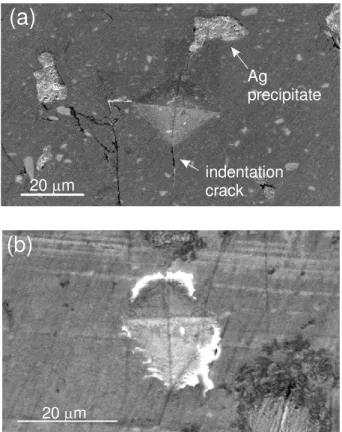
The Figs. 2a and 2b show typical Vickers indentations per-formed onabandca(b)-planes of YBCO with 15 wt. % Ag2O
in, respectively. In agreement to the observed in pure YBCO, cracks are nucleated in theab-plane but not in theca(b)-plane. However, in theca(b)-plane it is now observed that the in-dented material is crushed and displaced around the impres-sion as has been observed in lamellar materials [11]. In the present case, the use of indenters of different geometry is not responsible for the difference in the observed cracking behav-ior between the planes. Vickers indentations were performed onabandca(b)-planes of pure YBCO and cracks were only observed in theab-planes. Moreover, the Berkovich indenter has the same depth-to-area relation in respect to the Vickers indenter and consequently an equivalent behavior in relation to crack nucleation would be expected.
Figures 3a and 3b show typical load/unloading curves at the maximum applied load for pure YBCO and for different Ag
(a)
Ag
precipitate
indentation
crack
20 m
P
(b)
20 m
P
FIG. 2: SEM micrographs of 1 N Vickers indentations for (a)ab -plane and (b)ca(b)-plane of YBCO with 15 wt. % Ag2O.
concentration inabandca(b)-planes, respectively. The shal-lowest tip penetrations for both planes were those with 5 wt. % Ag2O concentration. Meanwhile, the penetrations depth of
samples with 10 and 15 wt. % Ag2O were higher than that for
pure YBCO samples. Another point is that for both planes no tip incursions (pop-ins) were observed in the loading curves for the applied load. This means that no chipping occurred as a result of lateral crack detachment during the indentation tests [12].
0 300 600 900 1200 1500 1800 0 100 200 300 400
0 300 600 900 1200 1500 1800 0
100 200 300 400
0 300 600 900 1200 1500 1800 0
100 200 300 400
0 600 1200 1800
0 100 200 300 400
YBCO - Pure YBCO - 5 % Ag2O
ab-plane
YBCO - 10 % Ag 2O L o a d ( m N ) Displacement (nm)
YBCO - 15 % Ag2O
(a)
0 300 600 900 1200 1500 1800 0
100 200 300 400
0 300 600 900 1200 1500 1800 0
100 200 300 400
0 300 600 900 1200 1500 1800 0
100 200 300 400
0 300 600 900 1200 1500 1800 0 100 200 300 400 L o a d ( m N ) Displacement (nm)
YBCO - 5 % Ag 2O
(b)
YBCO - 10 % Ag2O ca(b)-plane
YBCO - 15 % Ag2O YBCO - Pure
FIG. 3: Typical load-unloading curves for different Ag-doped pel-lets: (a)ab-plane and (b)ca(b)-plane.
the YBa2Cu3O7grains, possibly in a substitutional type
cre-ating a YBa2(Cu,Ag)3Oxstoichiometry [14]. The Ag atoms
change the dimensions of the unit cell, because the Ag ion size is larger than that of the Cu ion. It is also reported that Ag atoms saturates at nominal concentrations higher than 2.5 wt.% Ag [14]. According to the literature [15], substitutional ions interact elastically with dislocations and consequently a higher stress is necessary for dislocation movement. In the case of Ag2O 5 wt.% doping, we expect this interaction yet
to promote the maximum hardening. Increasing further the Ag concentration causes Ag precipitation in the bulk that will decrease the hardness.
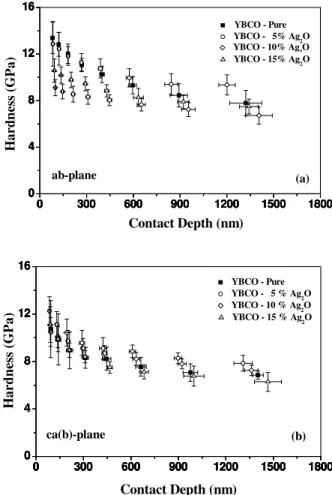
Hardness profiles forca(b)-plane at different Ag contents are shown in figure 4b. Despite a slightly higher hardness near the surface, the hardness dispersion is now lower than for ab-plane. However, hardness of about 6 GPa and 8 GPa were found for the highest and lowest Ag content, respectively. The hardness ofab-plane of the undoped YBCO is around 8 GPa while for ac(b)-plane is 7 GPa. Ag2O addition initially
in-creases the hardness but at high Ag2O content, the hardness
decreases as similarly is observed in theab-plane.
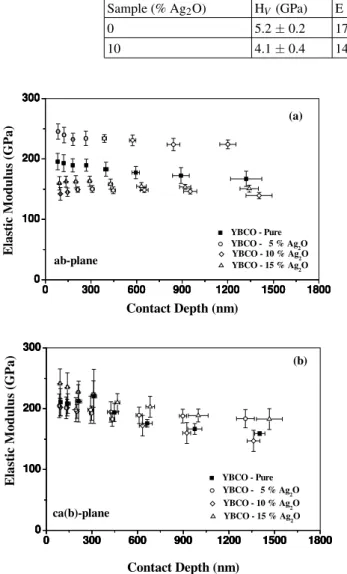
Figure 5a shows the elastic modulus profiles as a function of contact depth for the ab-plane. The pure YBCO sample has an elastic modulus of 180 GPa at the deepest
penetra-0 300 600 900 1200 1500 1800 0
4 8 12 16
0 300 600 900 1200 1500 1800 0
4 8 12 16
0 300 600 900 1200 1500 1800 0
4 8 12 16
0 300 600 900 1200 1500 1800 0
4 8 12 16
YBCO - Pure YBCO - 10% Ag
2O H a rd n es s (G P a
) YBCO - 15% Ag
2O
(a) ab-plane
Contact Depth (nm)
YBCO - 5% Ag2O
0 300 600 900 1200 1500 1800 0
4 8 12 16
0 300 600 900 1200 1500 1800 0
4 8 12 16
0 300 600 900 1200 1500 1800 0
4 8 12 16
0 300 600 900 1200 1500 1800 0
4 8 12 16
YBCO - Pure
Contact Depth (nm)
YBCO - 10 % Ag2O
ca(b)-plane (b) H a rd n es s (G P a )
YBCO - 5 % Ag2O YBCO - 15 % Ag2O
FIG. 4: Profiles of hardness as a function of contact depth for differ-ent Ag2O concentrations: (a)ab-plane and (b)ca(b)-plane.
tion and this value agrees with literature data [16]. The 5 wt.% Ag2O sample has the highest value (220 GPa), while
increasing the Ag content further decreases the elastic mod-ulus to 140 GPa. Fig. 5b shows the elastic modmod-ulus profiles for theca(b)-plane. The hardness and elastic modulus ob-tained in the present work are similar forabandca(b)-planes in comparison to pure YBCO. However, Ag addition at 5 wt. % Ag2O during the melting process improves these values in
both planes. Particularly, this increase is higher forab-plane than forac(b)-plane.
The mechanical properties measured and then employed to calculate the indentation fracture toughness for theab-plane according to equation (1) are shown in table I. The Ag ad-dition decreases the Vickers hardness, elastic modulus and crack lengths. The fracture toughness increases from 1.43 MPa.m1/2 for pure YBCO to 1.6 MPa.m1/2 for 10 wt. % Ag2O doped YBCO. The fracture toughness obtained in this
work is in agreement with values reported in the literature [16-18] for pure YBCO. Yeh and White [18] measured the fracture toughness using SENB (Single Edge Notch Bend) samples. From their work,KIC increased from 1 MPa.m1/2 for undoped condition to 2.3 MPa.m1/2for 30 wt. % Ag2O.
The extrapolated toughness for 10 wt. % Ag2O
TABLE I: Microscopic mechanical properties: Vickers hardness (HV), elastic modulus (E), crack length (c) and indentation fracture toughness
(KC)measured on theab-plane.
Sample (% Ag2O) HV (GPa) E (GPa) c (µm) KC(MPa m1/2)
0 5.2±0.2 177±10 47.5±0.4 1.43±0.02 10 4.1±0.4 149±4 43.5±0.2 1.6±0.1
0 300 600 900 1200 1500 1800 0
100 200 300
0 300 600 900 1200 1500 1800 0
100 200 300
0 300 600 900 1200 1500 1800 0
100 200 300
0 300 600 900 1200 1500 1800 0
100 200 300
E
la
st
ic
M
o
d
u
lu
s
(G
P
a
)
Contact Depth (nm)
YBCO - Pure
YBCO - 15 % Ag2O
(a)
ab-plane
YBCO - 5 % Ag2O YBCO - 10 % Ag
2O
0 300 600 900 1200 1500 1800 0
100 200 300
0 300 600 900 1200 1500 1800 0
100 200 300
0 300 600 900 1200 1500 1800 0
100 200 300
0 300 600 900 1200 1500 1800 0
100 200 300
YBCO - 15 % Ag 2O
(b)
ca(b)-plane
E
la
st
ic
M
o
d
u
lu
s
(G
P
a
)
Contact Depth (nm)
YBCO - 10 % Ag 2O YBCO - 5 % Ag2O YBCO - Pure
FIG. 5: Profiles of elastic modulus as a function of contact depth for different Ag2O concentrations: (a)ab-plane and (b)ca(b)-plane.
is in agreement with the value obtained in this study by nano-microindentation methods.
It is known that the addition of Ag causes a reduction in the number of pores and cracks in the YBCO microstructure [16]. Also, the increase of its concentration produces higher tensile and bending strengths [10]. Miyamotoet al. [19] observed in melt-textured samples that Ag doping improves the me-chanical properties of YBCO and SBCO using a strain gage technique as well as Markovet al. [20] noticed an increase
of microplasticity of polycrystalline YBCO ceramic with 3-5 wt. % Ag2O addition. Tancretet al. [16] observed in
melt-textured YBCO Ag-doped with Y-211 phase that an addition of Ag results in a reduction in more than 50% in porosity. These authors also reported an increase in grain size, a three-fold increase in elastic modulus, a four-three-fold increase in frac-ture toughness and also an approximately five-fold increase in Vickers hardness. Roaet al. [21] measured similar values of hardness and elastic modulus, as here reported, by using the same instrumented indentation technique for theab-plane of melt-textured YBCO.
Comparing the different literature data in respect to the me-chanical properties of YBCO and Ag doped YBCO, it is ob-served a wide spread in the values of hardness, elastic modu-lus and fracture toughness. This can be attributed to the dif-ferent processing routes employed to produce these materials.
4. CONCLUSIONS
Hardness, elastic modulus and indentation fracture tough-ness of Ag-doped top-seeded melt-grown YBCO pellets were measured by using indentation technique at room tempera-ture. The maximum bulk hardness and elastic modulus were reached for a concentration of 5 wt.% Ag2O forab-and
ca(b)-planes. The hardness of theab-plane was∼9 GPa for 5 wt.% Ag2O concentration while for pure YBCO was around 8 GPa.
For higher Ag concentrations, the hardness decreased to 7 GPa. The same behavior was observed for theca(b)-plane, but with smaller hardness values. The differences can be at-tributed to a solid–solution hardening because the Ag atoms substitute the Cu(1) in the YBa2Cu3O7 matrix. The elastic
modulus was also maximum for the 5 wt.% Ag2O
concentra-tion reaching a value of 220 GPa in respect to 180 GPa or undoped condition. The doping with Ag increased the inden-tation fracture toughness from 1.43 MPa.m1/2for pure YBCO to 1.6 MPa.m1/2with 10 wt. % Ag2O concentration.
Acknowledgements
This work was partially financed by Conselho Nacional de Pesquisa (CNPq) under contract n ˚ 474.077/2007-1.
[1] M. Murakami, in Melt Processed High Temperature Supercon-ductors, edited by M. Murakami (World Scientific, Singapore, 1992) p.21.
[2] S. V. Lubenets, V. D. Natsik, and L. S. Fomenko, Low-Temp.
Phys.30, 345 (2004).
[3] E. Mendoza, T. Puig, E. Varesi, A. E. Carrillo, J. Plain, and X. Obradors, Physica C334, 7 (2000).
V. Gomis, T. Puig, and S. Pinol, Supercond. Sci. Technol.10, 884 (1997).
[5] Y. Yoshino, A. Iwabuchi, K. Noto, N. Sakai, and M. Murakami, Physica C357-360, 796 (2001).
[6] S. V. Lubenets, V. D. Natsik, L. S. Fomenko, H. J. Kaufmann, V. S. Bobrov, and A. N. Isotov, Low-Temp. Phys.23, 678 (1997). [7] R. R. Reddy, M. Murakami, S. Tanaka, and P. V. Reddy, Physica
C257, 137 (1996).
[8] W. C. Oliver, G. M. Pharr, J. Mater. Res.7, 1564 (1992). [9] G. R. Anstis, P. Chantikul, B. R. Lawn, and D. B. Marshall, J.
Am. Ceram. Soc.,64, 533 (1981).
[10] N. Sakai, S. J. Seo, K. Inoue, T. Miyamoto, and M. Murakami, Physica C335, 107 (2000).
[11] A. Murugaiah, Nanoindentations in Kinking Nonlinear Elastic Solids, D. Phil thesis, University of Drexel, 2004.
[12] D. H. Mosca, N. Mattoso, C. M. Lepienski, W. Veiga, I. Maz-zaro, V. H. Etgens, and M. Eddrief, J. Appl. Phys. 91, 140 (2002).
[13] R. P. Vasquez, B. D. Hunt, and M. C. Foote, Appl. Phys. Lett.
53, 2692 (1988).
[14] Ch. Zhang, A. Kulpa, and A. C. D. Chaklader, Physica C252, 67 (1995).
[15] M. A. Meyers, K. K. Chawla,Mechanical Behavior of Materi-als(Prentice-Hall International, London, 1998, p. 464). [16] F. Tancret, I. Monot, and F. Osterstock, Mater. Sci. Eng. A298,
268 (2001).
[17] C. Lebiond-Harnois, R. Caillard, I. Monot-Laffez, G. Des-gardin, and B. Raveau, Physica C341-348, 2439 (2000). [18] F. Yeh, K. W. White, J. Appl. Phys.70, 4989 (1991).
[19] T. Miyamoto, K. Nagashima, N. Sakai, and M. Murakami, Physica C340, 41 (2000).
[20] L. K. Markov, T. S. Orlova, N. N. Peschanskaya, B. I. Smirnov, Y. P. Stepanov, and V. V. Shpeizman, Phys. Solid State,45, 1629 (2003).