Brazilian Journal of Physics, vol. 38, no. 3A, September, 2008 293
Temperature and Doping Dependencies of Electron Mobility in InAs,
AlAs and AlGaAs at High Electric Field Application
H. Arabshahi1, M. R. Khalvati2, and M. Rezaee Rokn-Abadi1 1Department of Physics, Ferdowsi University of Mashhad, Mashhad, Iran
2Tarbiat Moallem University of Sabzevar,
P.O.Box 397, Sabzevar, Iran, Email: [email protected]
(Received on 27 January, 2008)
Temperature and doping dependencies of electron mobility in InAs, AlAs and AlGaAs structures have been calculated using an ensemble Monte Carlo simulation. Electronic states within the conduction band valleys at theΓ,LandX are represented by non-parabolic ellipsoidal valleys centred on important symmetry points of the Brillouin zone. The simulation shows that intervalley electron transfer plays a dominant role in high elec-tric fields leading to a strongly inverted electron distribution and to a large negative differential conductance. Our simulation results have also shown that the electron velocity in InAs and AlAs is less sensitive to temper-ature than in other III-V semiconductors like GaAs and AlGaAs. So InAs and AlAs devices are expected be more tolerant to self-heating and high ambient temperature device modeling. Our steady-state velocity-field characteristics are in fair agreement with other recent calculations.
Keywords: Electron Mobility; Steady-state; Ellipsoidal valleys; Self-heating
1. INTRODUCTION
GaAs and related compounds with aluminium and indium currently have great potential for applications in optoelec-tronic devices, high frequency applications and quantum dots (QD’s) infrared photodetectors [1-4]. Different GaAs/AlAs electronic and optoelectronic devices with quantum effects are currently commercially available. An increasing tendency in such devices is the implementation of complicated multi-layered nano-systems, containing two or more components interacting with each other. The Monte Carlo technique has proved valuable for studying non-equilibrium carrier transport in a range of semiconductor materials and devices [5-8], and electron transport in bulk semiconductor was modelled as long ago as 1966 [9]. However, carrier transport modelling has only recently begun to receive sustained attention [10-11], now that the growth of compounds and alloys is able to produce viable material for the electronics industry. As the start of a programme of work modelling high field transport and breakdown in InAs, AlAs and AlGaAs, this paper presents the results of Monte Carlo simulations of electron transport in bulk InAs, AlAS and AlGaAs at different temperature and electron concentrations. The simulations have been carried out using a non-parabolic ellipsoidal valley model to describe transport in the conduction band. This article is organised as follows.
Details of the conduction band parameters and the Monte Carlo simulation are presented in section 2, and the results of steady state and transient transport simulations are discussed in section 3.
2. SIMULATION MODEL
In order to calculate the electron drift velocity for large electric fields, consideration of conduction band satellite
val-leys is necesasry. The first-principles band structure of zincblende InAs, AlAs and AlGaAs predicts a direct band gap located at theΓpoint and lowest energy conduction band satellite valleys at theXpoint and at theLpoint. In our Monte Carlo simulation, theΓvalley, the three equivalentX valleys, the four equivalentLvalleys, are represented by ellipsoidal, nonparabolic dispersion relationships of the following form [12-13]
E(k)[1+αiE(k)] = ~2k2
2m∗ (1)
wherem∗is effective mass at the band edge andα
iis the
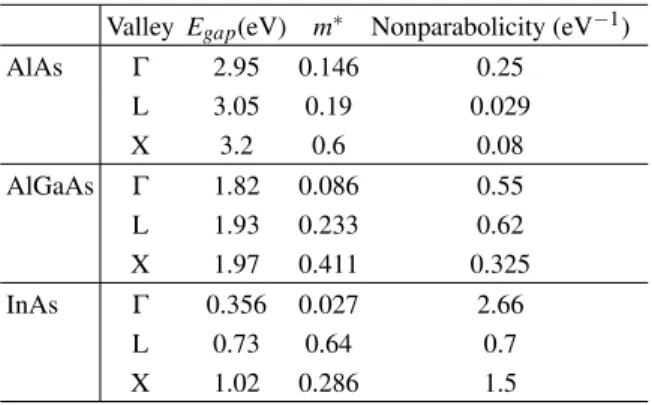
non-parabolicity coefficient of thei-th valley. The band structure and material parameters necessary for calculating the scatter-ing probabilities used in the present Monte Carlo simulation are given in table 1 and 2. Scattering mechanisms included in the simulation are acoustic deformation potential scattering (treated either as an elastic process or as an inelastic process) and pizoelectric scattering (which is found to be negligible in the temperature range discussed here). Furthermore, longitu-dinal optical phonon scattering, nonequivalent and, where ap-plicable, equivalent intervalley scattering events are taken into account among all valley types with the transfers assumed to be governed by the same deformation potential fields and the same phonon frequencies. Degeneracy effects are expected to be negligible over almost all of the temperature and electron concentration ranges of interest here and, hence, are not con-sidered in the calculation.
294 H. Arabshahi, M. R. Khalvati, and M. Rezaee Rokn-Abadi
conduction valley model, the usual Herring-Vogt transforma-tion matrices are used to map carrier momenta into spherical valleys when particles are drifted or scattered. Steady-state results of high field transport studies have been obtained for lattice temperatures up to 400 K, in order to gain some in-sight into the hot carrier transport and the energy distribution function that would be generated in the gate-drain region of a power field effect transistor.
TABLE I: Important band parameters used in the Monte Carlo simu-lation for zincblende AlAs, AlGaAs and InAs.
Valley Egap(eV) m∗ Nonparabolicity (eV−1)
AlAs Γ 2.95 0.146 0.25
L 3.05 0.19 0.029
X 3.2 0.6 0.08
AlGaAs Γ 1.82 0.086 0.55
L 1.93 0.233 0.62
X 1.97 0.411 0.325
InAs Γ 0.356 0.027 2.66
L 0.73 0.64 0.7
X 1.02 0.286 1.5
TABLE II: Material parameter selections for AlAs, AlGaAs, and InAs.
AlAs AlGaAs InAs
Densityρ(kgm−3) 5667 4200 5370
Longitudinal sound velocityvs(ms−1) 4280 5130 5500
Low-frequency dielectric constantεs 14.6 11.4 12.5
High-frequency dielectric constantε∞ 12.25 10.5 8.7
Acoustic deformation potential D(eV) 4.9 8.3 8.8
Polar optical phonon energy~ωpo(eV) 0.015 0.09 0.02
Energy gap (eV) 0.356 1.82 1.43
Lattice constanta0( ˚A) 3.39 2 6.2
Intervalley deformation potentials (107eVm−1) 1 1 1
Intervalley phonon energies (meV) 11.2 26 32.2
3. RESULTS
Electron drift velocity as a function of electric field is im-portant in determining the performance of high-speed and mi-crowave semiconductor devices. Here we show the results of temperature dependence of the steady-state velocity-field characteristics and valley occupancy in bulk InAs, AlAs and AlGaAs materials. Fig. 1 shows the simulated velocity-field characteristics at 300 K, with a background doping concentra-tion of 1017cm−3, and with the electric field applied along one
0 1x10³
2x10³
3x10³ 0.0
1.0 2.0 3.0 4.0
Experimental work for InAs T=300 K
GaAs
AlAs InAs
AlGaAs
Drift Velocity ( 10
5 ms -1)
Electric Field ( kV/m )
FIG. 1: Calculated steady-state electron drift velocity in bulk zincblende InAs, AlAs and AlGaAs using non-parabolic band mod-els in comparison with GaAs material and experimental measur-ments of Brennanet al.[14].
of the cubic axes.
Similar to the experimental results the simulations suggest that the peak drift velocity for zincblende InAs is∼3.4×10
5
ms−1while those for AlAs and AlGaAs are about 0
.8×10
5
ms−1and 105ms−1, respectively. At higher electric fields,
in-tervalley optical phonon emission dominates, causing the drift velocity to saturate at around 1.2×10
5ms−1. The calculated
high field electron drift velocity apparent from Fig. 1 is frac-tionally lower than those that have been simulated by Adachi et al. [4-5] who assumed an effective mass in the upper val-leys equal to the free electron mass. The threshold field for the onset of significant scattering into satellite conduction band valleys is a function of the intervalley separation and the den-sity of electronic states in the satellite valleys.
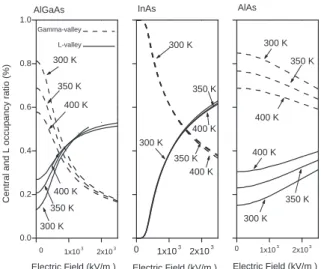
The importance of electron intervalley transfer at high electric fields can be clearly seen in Fig. 2. In this figure the fractional valley occupancies for different materials is plotted. It is ob-vious that the inclusion of satellite valleys in the simulations is important. Significant electron transfer to the upper valleys only begins to occur when the field strength is very close to the threshold value. At the threshold field the electron val-ley occupancies at room temperature forΓ,LandXare about 85%, 13% and 2%, respectively.
Brazilian Journal of Physics, vol. 38, no. 3A, September, 2008 295
0 1x10³ 2x10³ 0.0 0.2 0.4 0.6 0.8 1.0
0 1x10³ 2x10³ L-valley Gamma-valley 400 K 350 K 300 K 300 K 350 K 400 K
Central and L occupancy ratio (%)
0 1x10³ 2x10³ 300 K 350 K 400 K 300 K 350 K 400 K
Electric Field (kV/m ) 350 K 300 K 400 K 300 K 350 K 400 K
Electric Field (kV/m )
AlAs
AlGaAs InAs
Electric Field (kV/m )
FIG. 2: Fractional occupation of the central and satellite valleys in InAs, AlAs and AlGaAs as a function of applied electric field using the non-parabolic band model at different temperatures up to 400 K.
0 1x10³
2x10³ 0.0 0.2 0.4 0.6 0.8 1.0 400 K 350 K 300 K AlAs 400 K 350 K 300 K 400 K 300 K 350 K AlGaAs InAs
Drift Velocity ( 10
5 ms -1 )
Electric Field (kV/m)
0 1x10³
2x10³ 0.0 1.0 2.0 3.0 4.0
Electric Field (kV/m)
0.0 1.0x10³ 2.0x10³ 0.0 0.2 0.4 0.6 0.8 1.0
Electric Field (kV/m)
FIG. 3: Calculated electron steady-state drift velocity in bulk InAs, AlAs and AlGaAs as a function of applied electric field at various lat-tice temperatures and assuming a donor concentration of 1017cm−3.
The peak drift velocity decreases while the threshold field increases by same percent as the lattice temperature increases from 300 to 400 K.
Fig. 2.
Figure 4 shows how the velocity-field relation changes with temperature for electrons in the most populatedΓandL val-leys. There are significant statistical fluctuations in the results for the drift velocity of electrons in the L valleys for fields around 500 kVm−1, which are caused by the relatively small
number of electron particles occupying the valleys just above the threshold for intervalley transfer. Nevertheless it can be
0 1x10³
2x10³ 0.0 0.2 0.4 0.6 0.8 1.0 400 K 400 K 400 K 350 K 300 K 400 K 350 K 300 K AlAs 400 K 350 K 300 K 400 K 300 K 350 K AlGaAs InAs
Drift Velocity in Each Valley ( 10
5 ms -1 )
Electric Field (kV/m)
0 1x10³
2x10³ 0.0 1.0 2.0 3.0 4.0 300 K 350 K
Electric Field (kV/m)
0 1x10³
2x10³ 0.0 0.2 0.4 0.6 0.8 L-valley Gamma-valley 300 K 350 K
Electric Field (kV/m )
FIG. 4: Temperature dependence of the drift velocity in theΓandL
valleys of InAs, AlAs and AlGaAs materials as a function of applied electric field.
seen that the average drift velocity decreases as the ture increases for both valleys. Comparison of the tempera-ture dependence of the transport properties in InAs, AlAs and AlGaAs materials show that the change in peak velocity of AlGaAs from 300 K to 400 K is a reduction of about 45% whereas for InAs and AlAs, it is about 25% and 20%, respec-tively. The reason can be explained in terms of the energy band structure. In particular, the different electron effective mass within the central valley (0.027 m0in InAs versus 0.086
m0and 0.146 m0in AlGaAs and AlAs, respectively). This is
important because electrons which are near a valley minimum have small kinetic energies and are therefore strongly scat-tered. It is apparent that intervalley transfer is substantially larger in InAs over the range of applied electric fields shown, due to the combined effect of a lowerΓeffective mass, lower satellite valley separation energy, and slightly lower phonon scattering rate within theΓvalley.
Therefore, the electron velocity in InAs and AlAs is less sen-sitive to temperature than in AlGaAs, so InAs devices are ex-pected be more tolerant to self-heating and high ambient tem-perature.
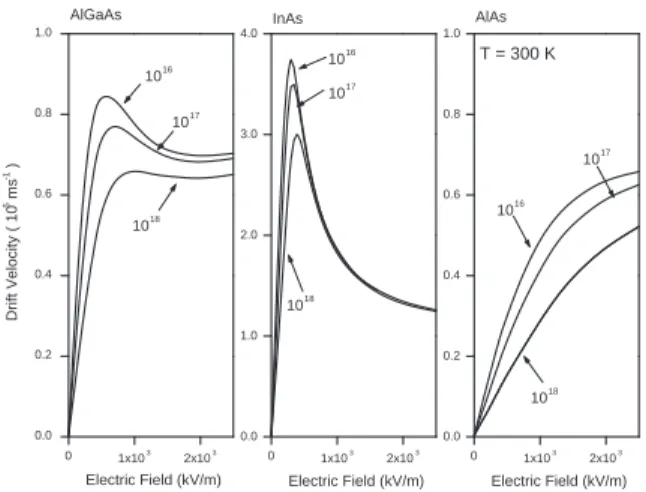
Figure 5 shows how the velocity-field characteristic of InAs, AlAs and AlGaAs materials change with impurity concentra-tion at 300 K. It is clear that with increasing donor concen-tration, there are reduction in the average peak drift velocity and the threshold field because of increasing scattering rate events. The results show the trend expected from increased ionized impurity scattering is in good general agreement with recent calculations by other workers [14-16].
4. CONCLUSIONS
296 H. Arabshahi, M. R. Khalvati, and M. Rezaee Rokn-Abadi
0 1x10³
2x10³ 0.0
0.2 0.4 0.6 0.8 1.0
1017 1017
1018 1016 AlAs
1018 1016 1016
1018
AlGaAs InAs
Drift Velocity ( 10
5 ms -1 )
Electric Field (kV/m)
0 1x10³
2x10³ 0.0
1.0 2.0 3.0 4.0
Electric Field (kV/m)
0 1x10³
2x10³ 0.0
0.2 0.4 0.6 0.8 1.0
T = 300 K
1017
Electric Field (kV/m)
FIG. 5: Calculated electron steady-state drift velocity in bulk InAs, AlAs and AlGaAs as a function of applied electric field at various donor concentration up to 1018cm−3at room temperature. The peak
drift velocity decreases due to increasing scattering rate.
using an ensemble Monte Carlo simulation. Using valley models to describe the electronic bandstructure, calculated velocity-field characteristics show that the intervalley transi-tions in high electric fields play an important role in these materials. The intervalley transitions lead to a large negative differential conductance. Saturation drift velocities of about 1.2×10
5ms−1match recent measurements on low-doped bulk
samples. We have also demonstrated that low temperature sensitivity of the electron transport properties of InAs and AlAs is attractive for high-temperature and high-power elec-tronic applications.
5. ACKNOWLEDGMENTS
This work is be benefited from useful discussion with M. G. paeezi.
[1] H. Cheong, Y. J. Jeon, and H. Hwang,. J. Korean Physical Sc-ciety.,44, 697 (2004).
[2] J. Maes, M. Hayne, Y. Sider, and B. Partoens, Physical Review B.,70, 155311 (2004).
[3] A. H. You, D. S. Ong,Proc. ICSE 2000., 182 (2000).
[5] S. Adachi,GaAs and Related Materials, Bulk semiconducting and Superlattice Properties, World Scientific, Singapore, 1994. [5] S. Adachi, Physical properties of III-V Semiconductor Com-pounds, InP, InAs, GaAs, GaP,AlAs and AlGaAs Wiley, New York, 1992.
[6] M. Allali, C. B. Sorensen, E. Veje, and P. Tidemand-Petersson, Phys. Rev. B48, 4398 (1993).
[7] S. J. Lee, L. Y. Juravel, J. C. Wooley, and A. J. Spring, Phys. Rev. B21, 659 (1980).
[8] B. E. Foutz, L. F. Eastman, U. V. Bhapkar, and M. Shur, Appl. Phys. Lett.70, 2849 (1997).
[9] T. Kurosawa,J. Phys. Soc. Jpn.,21, 424 (1966).
[10] C. Moglestue,Monte Carlo Simulation of Semiconductor De-vices 1993pub. Chapman and Hall.
[11] C. Jacoboni and P. Lugli,The Monte Carlo Method for semi-conductor and Device Simulation 1989pub. Springer-Verlag. [13] H. Arabshahi, M. R. Benam, and B. Salahi Modern Physics
Letters B.21, 1715 (2007).
[13] H. Arabshahi, Modern Physics Letters B.21, 199 (2007). [14] K. Brennan, K. Hess, J. Y. Tang, and G. J. Iafrate, IEEE Trans.
Electron Devices,30, 1750 (1983).
[16] N. Newman, T. Kendelewicz, L. Bowman, and W. E. Spicer, Appl. Phys. Lett.46,1176 (1985).