0103 - 5053 $6.00+0.00
A
r
ti
c
le
* e-mail: [email protected]
Rhodium–Prussian Blue Modified Carbon Paste Electrode (Rh-PBMCPE) for Amperometric
Detection of Hydrogen Peroxide
Viviane Midori Ivama and Silvia H. P. Serrano*
Instituto de Química, Universidade de São Paulo, CP 26077, 05513-970 São Paulo - SP, Brazil
Filmes de azul da Prússia foram superficialmente depositados em eletrodos de pasta de carbono
a partir de soluções contendo 2,0 x 10⁻³ mol L-1 de K
3[Fe(CN)6], 3,0 x 10
-3 mol L-1 FeCl 3 e 1,0 x
10-2 mol L-1 HCl, usando dois potenciais controlados. Para aumentar a estabilidade do eletrodo
modificado, efetuaram-se 50 ciclos em solução contendo 1,0 x 10⁻³ mol L-1 de RhCl
3, 0,50 mol L -1 de
KCl e 1,0 x 10⁻² mol L-1 de HCl no intervalo de – 0,40 a + 0,60 V a 60 mVs-1. Estes eletrodos,
denominados de Rh-PBMCPE, apresentaram boa estabilidade durante a determinação amperométrica
de H2O2 a 0,040 V sem a interferência dos ácidos ascórbico e úrico. A corrente de redução variou
linearmente com a concentração de H2O2 no intervalo de 5,0 x 10- 5 a 8,6 x 10⁻⁴ mol L-1. O limite de
detecção foi de 2,8 x 10⁻⁵ mol L-1 com sensibilidade variando de 1,32 a 0,96 A mol-1 L cm-2 ao longo
de cinco dias (180 determinações).
Prussian Blue was deposited at carbon paste electrode surface from a solution containing 2.0 x 10⁻³ mol L-1 K
3[Fe(CN)6], 3.0 x 10
-3 mol L-1 FeCl
3 and 1.0 x 10
-2 mol L-1 HCl using two controlled
potentials. To improve the stability of the modified electrode it was 50 times cycled in a solution containing 1.0 x 10⁻³ mol L-1 RhCl
3, 0.50 mol L
-1 KCl and 0.010 mol L-1 HCl in the potential range
from – 0.40 V to 0.60 V at 60 mV s-1. The Rh – Prussian Blue carbon paste modified electrode
(Rh-PBMCPE) showed good stability during amperometric catalytic determination of H2O2 at 0.040 V,
without ascorbic and uric acids interferences. The current changed linearly with H2O2 concentrations
in the range of 5.0 x 10⁻⁵ - 8.6 x 10⁻⁴ mol L-1. The estimated detection limit was 2.8 x 10⁻⁵ mol L-1 with
sensibility changing from 1.32 to 0.96 A mol-1 L cm-2 along five days (180 determinations).
Keywords: prussian blue, rhodium, carbon paste electrode, hydrogen peroxide, amperometry
Introduction
Prussian Blue modified electrodes (PBME) have been prepared by electrochemical techniques on electrodes such as glassy carbon,1-18 platinum,1,3,19,20–23 tin oxide,1,3,24-26
gold,3 graphite,27-28 titanium-silver-gold arrays,29 basal
pyrolytic graphite,30 screen printed carbon ink interdigital
arrays,20 conducting polymer coated microelectrode
arrays,31 carbon fiber,32 carbon paste,33 etc.
They were used to design new glucose,8-10,17,21,23,28,30,32
alanine,30 alcohol30 and glutamate13,14 biosensors based on
the electrochemical detection of hydrogen peroxide, which is formed in the course of the substrate enzyme-catalyzed oxidation. In these cases Nafion,8,10,14,17,30 poly
(o-phenylenediamine),21 polypyrrole/poly
(o-phenyl-enediamine)23 and poly (o-diaminebenzene)18 polymers
have been used to immobilize the enzyme and eliminate interferences from ascorbic and uric acids.
Chemical preparations were also described and involve the immersion of the working electrode in aqueous modifier solution,5,6,19 the mixture of Prussian Blue
(chemically synthesized) with graphite and paraffin34 or
hydrocarbons33 to produce modified carbon paste
electrodes and the dispersion of Prussian Blue, supported on graphite, into methyltrimethoxysilane-derived gels to get a renewable three-dimensional modified electrode.35
PB can be reduced to Prussian White (Everitt salt) around 0.2 V or oxidized to Berlin Green around 0.9 V. Generally, the films are not stable during successive cycles around of the two reversible couples of PB, but the effect is more pronounced at 0.9 V,6,25 perhaps because Fe3+ ions
are lost to the solution during this process.24 PB films are
easily destroyed during the catalytic reduction of hydrogen peroxide due to formation of OH- ions, which are able to
capacity is an important parameter to be controlled in the applications of these modified electrodes. Nafion has been also used to improve the stability, reproducibility and sensitivity in several analytical applications.5,6,11
The activity of PBMEs for the electroreduction of molecular oxygen should be lower but it seems to be dependent on the electrode material, applied potential28
and experimental conditions in which the films are prepared.4,10,13-15
In this paper we describe the electrodeposition of Prussian Blue on Carbon Paste Electrodes by using two different applied potentials. First, at 0.4 V the reagents were pre concentrated on the surface electrode.36
Subsequently, the applied potential was reversed to – 0.4 V and PB, probably the “insoluble form”, was deposited on the electrode surface. The modification process was repeated twice. To improve the stability of the modified electrode it was cycled in a solution containing 0.1 mol L-1
KCl, 1.0 x 10⁻³ mol L-1 RhCl
3 and 0.02 mol L
-1 HCl in the
potential range from – 0.4 V to + 0.6 V at 60 mVs-1. The
modified electrode was dried in ambient temperature during 24 h before use.
Using this modification process it was possible to obtain a PB modified carbon paste electrode (Rh-PBMCPE) with good stability, reproducibility and sensitivity. Additionally, the interference from oxygen reduction or ascorbic and uric acids was avoided.
Experimental
Chemicals and solutions
All analytical reagents were from analytical grade and obtained from Merck (Rio de Janeiro, Brazil). Aldrich Chemical Co. supplied Nujol oil and RhCl3 and graphite was Acheson 38 from Fisher. All reagents were used without previous purification. Citrate/ Citric Acid buffer solutions, pH 6.1 were prepared as described previously.37
Purified water from a Barnstead Nanopure system was always used.
Apparatus and electrodes
All electrochemical measurements were performed using a potentiostat/galvanostat MQPG-01 (Santa Catarina, Brazil). pH measurements were carried out using a pH meter model 654 with a combined glass electrode, both from Metrohm.
The working electrode was a carbon paste, A = 0.080 cm2, prepared with graphite/Nujol in 2:1 (m/m) proportion;
counter and reference electrodes were Pt wire and a
miniaturized Ag/AgCl (saturated KCl) electrode,38
respectively all contained in a one-compartment cell.
Rh-PB-Modified Carbon Paste (Rh-PBMCP), PB-Modified Carbon Paste (PB-MCP) and Rh-Modified Carbon Paste (Rh-MCP) Electrodes
Rh-PBMCP electrodes : carbon paste electrodes were immersed in a stirred solution containing 2.0 x 10⁻³ mol L-1
K3[Fe(CN)6], 3.0 x 10⁻³ mol L-1 FeCl
3 and 1.0 x 10
-2 mol L-1
HCl. The working electrode was maintained at 0.4 V during 2 min (pre concentration step)35 and just reversed to – 0.4 V,
also during 2 min (step during which the “insoluble” Prussian Blue was precipitated on the electrode surface). This process was repeated twice. After that the electrodes were washed with deionised water and transferred to an electrochemical cell containing 1.0 x 10⁻³ mol L-1 RhCl
3, 0.50 mol L -1 KCl
and 0.010 mol L-1 HCl and 50 cyclic voltammograms were
recorded at 60 mV s-1 in the range of – 0.4 to + 0.6 V. The
working electrode was dried at room temperature overnight before use. PB-MCP and Rh-MCP electrodes were prepared using the same process but without treatment in RhCl3 solution (PB-MCP electrode) or using only 1.0 x 10⁻³ mol L-1
RhCl3, 0.50 mol L-1 KCl and 0.010 mol L-1 HCl as a modifying
solution (Rh-MCP electrode).
Amperometric hydrogen peroxide detections
The Rh-PBMCPE, reference and counter electrodes were immersed in the electrochemical cell containing 10.00 mL of citric acid/potassium citrate buffer at pH 6.1 in 0.5 mol L-1 KCl solution. Measurements were performed
at 0.040 V after several additions of 5.0 x 10⁻³ mol L-1
H2O2. After each H2O2 addition, current values were subtracted from background current (recorded in supporting electrolyte), to get the analytical curves.
Rh-PB-Modified Carbon Paste Electrode (Rh-PBMCPE) behaviour in ascorbic and uric acid solutions
The Rh-PBCPME, reference and counter electrodes were immersed in the electrochemical cell containing 10.00 mL of citric acid/potassium citrate buffer at pH 6.1 in 0.5 mol L-1 KCl solution. After stabilization of the
baseline, an aliquot of 100 µL of 1.0 x 10⁻¹ mol L-1 ascorbic
or uric acids was injected in the cell and current values recorded in the range of –0.21 to+ 0.19 V.
Results and Discussion
voltammo-gramms carried out in a solution containing 1.0 x 10⁻³ mol L-1
RhCl3, 0.5 mol L-1 KCl and 0.01 mol L-1 HCl. The
Rh-PBCPME shows good stability during successive cycles, with anodic and cathodic peaks recorded at 0.30 V and 0.18 V being attributed to a redox process involving Prussian White/Prussian Blue couple. E0 calculated as
(Ep,a + Ep,c/2), is 0.24 V.
In potassium citrate/ citric acid buffer solution containing 0.5 mol L-1 KCl at pH 6.1, the peak currents
changed linearly with the square of sweep rate in the range from 0.025 to 0.400 Vs-1 showing that the process is
governed by ion diffusion from support electrolyte to the electrode surface (during the reduction step) or from the electrode to the solution (during the oxidation step) to ensure the electroneutrality rule.
The modifier surface excess was 4.3 x 10⁻⁸ mol cm-2,
calculated using the anodic charge obtained from cyclic voltammograms, after subtraction of the background charge recorded with an unmodified carbon paste electrode in an electrolyte support solution (1.0 x 10⁻³ mol L-1 RhCl
3,
0.5 mol L-1 KCl and 0.01 mol L-1 HCl, ν = 60 mV s-1),
utilizing the relation: Γ = I(idt/nFA) = Q/nFA, where Q is the charge in coulombs and A the electrode area in cm2.
The calculated value is higher than others reported in the literature.6,9, 10,12,13,16,34,35 This was expected, since we used
a pre-concentration step and higher deposition times, a total of 6 min during 3 deposition steps.
From Figure 1 it is also possible to see that no peaks were recorded, with an unmodified carbon paste electrode, in the same potential range from – 0.4 V to + 0.6 V. It is
possible that rhodium (III) can form binuclear species (Rh2O63+) inside the PB zeolytic structure through cyano
and oxo bonds such as Fe –CN – Rh and Fe – O –Rh, as previously reported39-43 using ruthenium salts.
Electro-catalytic oxidation of S2O32-, 2 – furaldehyde, cystein and
As (III) using Ruthenium-Modified indium-hexacyano-ferrate have been described.40
Improvement in the stability and selectivity can be attributed to Prussian Blue/Rhodium modification since the amperometric signal due catalytic reduction of H2O2 is lower at Prussian Blue (PB-MCPE) or Rhodium carbon paste (Rh-MCPE) modified electrodes (Figure 2).
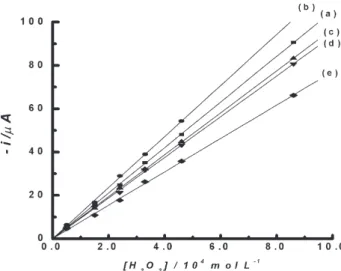
Figure 3 shows the analytical curves obtained during hydrogen peroxide detections along 5 days. Each one of them represents an average of 6 consecutive amperometric
Figure 1. (a) 1st, (b) 30th and (c) 50th cyclic voltammograms carried
out with a PB - carbon paste modified electrode (PB-CPME) and (d) with unmodified carbon paste electrode in a solution containing 1.0 x 10⁻³ mol L-1 RhCl
3, 0.5 mol L
-1 KCl and 0.01 mol L-1 HCl at 60 mVs-1.
Figure 3. Analytical curves obtained for amperometric hydrogen peroxide detections with an Rh-PBCPE at 0.040V: (a) 1st, (b) 2nd, (c)
3rd, (d) 4th and (e) 5th days. Each analytical curve represents an
average of 6 consecutive amperometric analytical curves performed in the same day.
Figure 2. Amperograms recorded during the catalytic reduction of: (a) 5.0 x 10⁻⁶, (b) 1.4 x 10⁻⁴, (c) 2.3 x 10⁻⁴, (d) 3.2 x 10⁻⁴, (e) 4.0 x10⁻⁴
and (f) 8.6 x10⁻⁴ mol L-1 hydrogen peroxide. Applied potential =
analytical curves carried out in the same day. The current changed linearly with hydrogen peroxide concentrations in the range from 5.0 10-5 to 8.6 10-4 mol L-1; the parameters,
derived from analytical curves, are presented in Table 1. The estimated detection limit (2.8 x 10⁻⁵ mol L-1),44 was
higher than those reported in the literature for the determination of glutamate14 or direct flow injection
analysis of H2O215 and glucose8,9,13 but the sensibility,
measured during five days, changed from 1.32 to 0.96 A mol-1 L cm-2 and was better than values obtained
with sensors covered8,9,14 or not13,15 with Nafion film, always
used to protect the modified electrode surface and to immobilize the enzyme.8,9 After 5 days, the Rh-PBMCP
electrode still maintained 73% of its activity for catalytic reduction of hydrogen peroxide (Table 1).
Figure 4 shows that at 0.040 V about 8% of the total current recorded in 1.0 x 10⁻³ mol L-1 H
2O2 solution
corresponds to direct O2 reduction (Figure 4a) and no interference was detected due to mediated or direct oxidation of uric acid (Figure 4b). Interference of ascorbic acid was significant only at 0.060 V or higher applied potentials (Figure 4c).
Conclusions
In the present study an alternative procedure to prepare Prussian Blue carbon paste modified electrodes was described. Using two distinct steps, reagent preconcen-tration and Prussian Blue deposition, followed by rhodium incorporation in the PB zeolytic strucuture, it was possible to design modified electrodes with good stability and reproducibility in the catalytic reduction of hydrogen peroxide. These results, associated to those reported before by other researchers represent a continuous effort in optimising Prussian Blue modified electrodes for electroanalytical applications.
Acknowledgements
Viviane Midori Ivama thanks CNPq for a fellowship; we thank FAPESP (Processo 01/011923and CNPq for financial support and Dr. Paulo Celso Isolani for helpful suggestions.
Table 1. Principal parameters obtained from analytical curves
Day Equation Linear Range Sensitivity Relative sensitivity
104 mol L-1 A mol-1 L cm-2 %
1st I = 0.0029 + 10.5 [H
2O2] 0.5 – 8.6 1.32 ± 0.02 100
2nd I = 0.044 + 11.8 [H
2O2] 0.5 – 8.6 1.47 ± 0.03 111
3rd I = 0.026 + 9.68 [H
2O2] 0.5 – 8.6 1.21 ± 0.02 9 2
4th I = 0.011 + 9.38 [H
2O2] 0.5 – 8.6 1.17 ± 0.03 8 9
5th I = 0.027 + 7.70 [H
2O2] 0.5 – 8.6 0.96 ± 0.02 7 3
Figure 4. Rh-PBCPE amperometric currents recorded in citric acid/ sodium citrate, pH 6.1, containing 0.5 mol L-1 KCl in the presence of
O2 (a1), absence of O2 and 1.0 x 10⁻³ mol L-1 H
2O2 (a2); absence of O2
and 1.0 x 10⁻³ mol L-1 uric acid (b
1) and absence of O2 and 1.0 x 10 -3
mol L-1 H
2O2 (b2); absence of O2 and 1.0 x 10
-3 mol L-1 ascorbic acid
(c1) and absence of O2 and 1.0 x 10⁻³ mol L-1 H 2O2 (c2).
(a)
(b)
References
1. Itaya, K.; Akahoshi, H.; Toshima, S.; J. Electrochem. Soc.
1982, 129,1498.
2. Itaya, K.; Ataka, T.; Toshima, S.; Shinohara, T.; J. Phys. Chem.
1982, 86, 2415.
3. Itaya, K.; Ataka, T.; Toshima, S.; J. Am. Chem. Soc.1982,
104, 4767.
4. Itaya, K.; Shoji, N.; Uchida, I.; J. Am. Chem. Soc. 1984, 106, 3423.
5. Hou, W.; Wang, E.; J. Electroanal. Chem. 1991, 316, 155. 6. Hou, W.; Wang, E.; Anal. Chim. Acta 1992, 257, 275. 7. Zhou, J.; Wang, E.; J. Electroanal. Chem.1992, 331, 1029. 8. Karyakin, A. A.; Gitelmacher, O. V.; Karyakina, E. E.; Anal.
Lett.1994, 27, 2861.
9. Karyakin, A. A.; Gitelmacher, O. V.; Karyakina, E. E.; Anal. Chem.1995, 67, 2419.
10. Karyakin, A. A.; Karyakina, E. E.; Gorton, L.; Talanta1996,
43, 1597.
11. Lu, W.; Walace, G. G.; Karyakin, A. A.; Electroanal. 1998, 10, 472.
12. Karyakin, A. A.; Karyakina, E. E.; Gorton, L.; Electrochem. Commun.1999, 1, 78.
13. Karyakin, A. A.; Karyakina, E. E.; Sensors Actuactors B. 1999,
57, 268.
14. Karyakin, A. A.; Karyakina, E. E.; Gorton, L.; Anal. Chem.
2000, 72, 1720.
15. de Mattos, I. L.; Gorton, L.; Ruzgas, T.; Karyakin, A. A.; Anal.
Sci.2000, 16, 795.
16. Castro, S. S. L.; Balbo, V. R.; Barbeira, P. J. S.; Stradiotto, N. R.; Talanta,2001, 55, 249.
17. de Mattos, I. L.; Lukachova, L. V.; Gorton, L.; Laurell, T.; Karyakin, A. A.; Talanta 2001, 54, 963.
18. Lukachova, L. V.; Kotel´nikova, E. A.; D´Ottavi, D.; Shkerin,. E. A.; Karyakina, E. E.; Moscone, D.; Palleschi, G.; Curulli, A.; Karyakin, A. A; Bioelectrochemistry2002, 55, 145. 19. Lundgren, C. A.; Murray, R. W.; Inorg. Chem. 1988, 27, 933. 20. McCormac, T.; Cassidy, J.; Cameron, D.; Electroanal.1996,
8, 195.
21. Garjonyte,R.; Malinauskas A.; Sensors ActuatorsB 1999, 56, 85.
22. Oliveira, M. F.; Mortimer, R. J.; Stradiotto, N. R.; Microchem.
J.2000, 64, 155.
23. Garjonyte, R.; Malinauskas, A.; Sensors ActuactorsB 2000,
63, 122.
24. Plichon, V.; Besbes, S.; J. Electroanal. Chem. 1990, 284, 141. 25. García – Jareño, J.J.; . Sanmatías, A.; Vicente F.; Gabrielli, C.; Keddam, M.; Perrot, H.; Electrochim. Acta 2000, 45, 3765. 26. Ho, K. - C.; Lin, C. – L.; Sensors ActuactorsB2001, 76, 512. 27. Neff, V. D.; J. Electrochem. Soc.1985, 132, 1382.
28. Deng, Q.; Lin, B.; Dong, S.; Analyst 1998, 123, 1995. 29. Hartmann, M.; E. W. Grabner; Anal. Chim. Acta1991, 242,
249.
30. Chi, Q.; Dong, S.; Anal. Chim. Acta 1995, 310, 429. 31. Lu, W.; Nguyen, T.; Wallace, G. G.; Electroanal.1998, 10,
1101.
32. Zhang, X.; Wang, J.; Ogorevc, B.; Spichiger, U. E.; Electroanal.
1999, 11, 945.
33. Garjonyte, R.; Malinauskas, A.; Sensors ActuactorsB1998,
46, 236.
34. Khlert, H.; Komorsky-Lovriæ, S.; Hermes, M.; Scholz F.;
Fresenius J. Anal. Chem.1996, 356, 204.
35. Wang, P.; Yuan, Y.; Wang, X.; Zhou, G.; J. Electroanal. Chem.
2000, 493, 130.
36. Pharr, C. M.; Griffiths, P.R.; Anal. Chem. 1997, 69, 4673. 37. Perrin, D.D.; Dempsey, B.; Buffer for pH and Metal Ion
Con-trol; Science Paperback, Chapman and Hall: London, 1983. 38. Pedrotti, J.J.; Angnes, L.; Gutz, I. G. R.; Electroanal. 1996, 8,
673.
39. Cataldi, T. R. I.; Benedetto, G. E.; Campa, C.; J.Electroanal. Chem.1997, 437, 93.
40. Cataldi, T. R. I.; Benedetto, G. E.; Bianchini, A.; Electroanal.
1998, 10, 1163.
41. Cataldi, T. R. I.; Benedetto, G. E.; J. Electroanal. Chem. 1998,
458, 149.
42. Benedetto, G. E.; Cataldi, T. R. I.; Langmuir 1998, 14, 6274. 43. Benedetto, G. E.; Guascito, M. R.; Ciriello, R.; Cataldi, T. R. I.;
Anal. Chim. Acta2000, 410, 143.
44. Miller, J. C.; Miller, J. N.; Statistics for Analytical Chemistry,
2nd ed.; Ellis Horwood: London, 1988, chap. 5.
Received: December 4, 2002
Published on the web: July 16, 2003