Standardization of the normative
group for the third version of the
test of visual attention – TAVIS
Gabriel Coutinho
1, Paulo Mattos
2, Catia Araújo
3, Manuela Borges
1, Angela Alfano
4Abstract – Despite the importance of objective measures of attention to clinical practice, there is a paucity of Brazilian standardized tests. Objective: The aim of the present study was the standardization of a normative group for the third version of a computerized test of visual attention (TAVIS-3), developed to evaluate children and adolescents in the 6 to 17 years age range. Methods: 631 students from 3 schools in Rio de Janeiro city were assessed with TAVIS-3, administered by experienced psychologists, following parents’ authorization. Results:
The normative groups were determined considering performance of different age groups: from 6 to 10 years (with scores for 5 different ages); from 11 to 12 and from 13 to 17 years. Three tasks (focused, shifted and sus-tained attention) were standardized for each age group. Conclusion: The standardization of a normative group for TAVIS-3 discriminated performance ranges for distinct age groups, allowing its use as a neuropsychological assessment of attention.
Key words: attention, neuropsychology, computerized tests.
Padronização do grupo normativo da terceira versão do teste de atenção visual – TAVIS
Resumo – Embora a avaliação objetiva da atenção seja de extrema importância para a prática clínica, observa-se escassez de testes neuropsicológicos com padronização brasileira para esta função. Objetivo: O objetivo do presen-te estudo foi desenvolver um grupo normativo de referência para a presen-terceira versão de presen-tespresen-te computadorizado de atenção visual (TAVIS-3), destinado à avaliação de crianças e adolescentes com idades entre 6 e 17 anos. Métodos:
631 alunos de 3 instituições de ensino da cidade do Rio de Janeiro foram submetidos ao TAVIS-3, administrado por aplicadores treinados, mediante autorização dos pais. Resultados: A divisão dos grupos etários levando-se em consideração as diferenças de desempenho permitiu identificar faixas etárias de 6 aos 10 anos (com escores para cada uma das 5 idades compreendidas); de 11 a 12 anos e de 13 a 17 anos. Três tarefas distintas de atenção (seletiva, alternada e sustentada) foram padronizadas para cada faixa etária avaliada. Conclusões: A padronização de grupo normativo para o TAVIS-3 permitiu individualizar o desempenho de acordo com a idade, para uso como instrumento de avaliação neuropsicológica de atenção.
Palavras-chave: atenção, neuropsicologia, testes computadorizados.
Psicólogo do Centro de Neuropsicologia Aplicada, mestrando em saúde mental – Instituto de Psiquiatria da UFRJ. 2Psiquiatra, doutorado em Psiquiatria,
Professor Associado – Instituto de Psiquiatria da UFRJ. 3Neuropsicóloga do Centro de Neuropsicologia Aplicada, Mestre em Informática – Instituto de
Matemática da UFRJ. 4Psicóloga do Centro de Neuropsicologia Aplicada, Doutoranda em Psicologia – Instituto de Psicologia da UFRJ.
Attention has been conceived as a complex phenom-enon that shares it limits with perceptual skills, memory, affect and consciousness.1 There are a number of different definitions of attention where the focused type has been the most used.2 The amount of information that may be processed simultaneously (working memory) is another commonly used definition for attention. It is noteworthy that attention is characterized by its variability even in the same individual.3
Attention is comprised of somewhat different aspects, as follows: a) focused attention: is the ability to focus only on relevant stimulus despite distractive ones, selecting infor-mation relevant to conscious processing; b) sustained atten-tion: is the ability to sustain a consistent behavioral response through a continuous action. This skill comprises two dif-ferent, but related, aspects: the amount of time that the performance level may be kept up, and performance con-sistency throughout this interval; c) shifted attention: this is
Gabriel Coutinho – Rua Paulo Barreto, 91 - 22280-010 Rio de Janeiro RJ - Brazil. E-mail: [email protected]
related to the ability of shifting focus among tasks with dif-ferent cognitive ability demands, determining the informa-tion that will be focused on at any specific moment of time.
Attention deficit hyperactivity disorder (ADHD),4 Epilepsy5 and Learning Disorders (LD)6 are some of the most common neuropsychiatric disorders associated with inattention. The establishment of an accurate diagnosis of ADHD, for example, may demand an assessment with multiple informants (such as parents and teachers); how-ever, some studies have demonstrated that the agreement rates between parents’ and teachers’ reports might be low.7-9 Therefore, objective measures of attention would prove extremely important to clinical practice.
Neuropsychological tests might provide two different, but related contributions: a) contribute to the establish-ment of a clinical diagnosis; b) determine the cognitive profile in cases where the clinical diagnosis had been previ-ously determined, furnishing an estimate of the disorder’s severity and evolution, as well as response to treatments.10
The objective of the current paper was to work toward standardizing the normative data of a test previously devel-oped in Brazil by Duchesne and Mattos1 to evaluate chil-dren and adolescents within the 6 to 17 years age, and now in its third version. This third version also differs from the former one because it has been adapted for Windows; other differences will be mentioned below. This computerized test consists of three tasks aimed at evaluating focused, shifted and sustained visual attention. Each of the tasks provides scores of hit reaction time, omission and commission errors for the aforementioned aspects. Both positive and negative predictive values of TAVIS-3 for Attention-Deficit Hyper-activity Disorder (ADHD) have been published elsewhere.11
Methods
Sample
631 consecutive children and adolescents with ages ranging from 6 to 17 years were evaluated over a 2-year period. Recruitment and assessment occurred in three schools (two private and one public) of Rio de Janeiro city. The evaluations were coordinated by schools’ educational services.
Individuals with previous history of epilepsy or trau-matic brain injury and individuals undergoing treatment for psychiatric or neurological disorders were excluded from the study. Schools held data regarding students’ health and use of medication. Use of psychoactive substances was investigated with parents using direct questioning. The evaluations were conducted individually by intensively trained psychologists in quiet rooms at schools. The study was approved by the Ethics Committee of the Psychiatry Institute of the Federal University of Rio de Janeiro.
Tools
TAVIS-3 included the following tasks:
Task 1
The examinee must selectively respond to target stimu-lus regardless of distracters. This task follows a model of tests that demands the subject to inhibit concurrent stimuli, often used in cancellation tests, such as the teste de atenção concentrada (AC)12. This task still requires visual scanning (ability to follow a group of information with eyes) as well as sustained attention. Impaired performances may suggest difficulties in focused or sustained attention.
Task 2
The examinee responds to the task shifting between two different patterns of rules: color/shape (12 year-old subjects or older) or equal/different (subjects younger than 12 years’ old). This task intends to evaluate shifted atten-tion, demanding the subject to switch focus between two different concepts (adolescents) or two parameters of the same concept (children).
Task 3
This task demands the examinee to sustain attention for a certain amount of time (6 minutes for small children and 10 minutes for adolescents) while responding quickly to the appearance of a target stimulus. This is mainly a task of sustained attention, lasting for 10 minutes in adolescent form and 6 minutes for children.
In order to minimize difficulties due to little practice with the joystick, the examinee is previously trained with the tool. Also, each of the tasks comprises a training ses-sion in order to guarantee that a full understanding of the procedures was achieved. The training process of each task has a time limit that varies with age; however this process can be repeated in cases where examinee presents difficul-ties in understanding the instructions.
Analyzed variables
The variables considered in the analysis of each of the tasks were:
Hit reaction time (HRT)
demon-Figure 1. Task 1 Stimuli (geometric figures for adolescents, and ani-mals for children). The examinee must press the button as soon as the target stimuli appear. Despite the distracters.
Figure 2. Concepts of Task 2 (Equal and different for children; and shape and color for adolescents). The examinee must press the but-ton whenever the stimuli satisfy the rule.
Figure 3. Task 3 stimuli for children. The examinee must press the button whenever a target stimulus appears in the empty screen, maintaining focus throughout a monotonous task.
Table 1. General characteristics of each task sample, divided by age group and gender.
Age
Total Male Female
N % N % N %
Task 1
6 7 8 9 10 11 to 12 13 to 17 Total
55 52 80 77 73 75 219 631
100.0 100.0 100.0 100.0 100.0 100.0 100.0 100.0
24 18 42 43 32 44 115 318
43.6 34.6 52.5 55.8 43.8 58.7 52.5 50.4
31 34 38 34 41 31 104 313
56.4 65.4 47.5 44.2 56.2 41.3 47.5 49.6
Task 2
7 8 9 10 11 to 12 13 to 17 Total
42 41 47 51 58 105 344
100.0 100.0 100.0 100.0 100.0 100.0 100.0
14 20 27 20 28 56 165
33.3 48.8 57.4 39.2 48.3 53.3 48.0
28 21 20 31 30 49 179
66.7 51.2 42.6 60.8 51.7 46.7 52.0
Task 3
6 7 8 9 10 11 to 12 13 to 17 Total
52 49 74 74 71 74 218 612
100.0 100.0 100.0 100.0 100.0 100.0 100.0 100.0
24 18 38 40 31 43 115 309
46.2 36.7 51.4 54.1 43.7 58.1 52.8 50.5
28 31 36 34 40 31 103 303
53.8 63.3 48.6 45.9 56.3 41.9 47.2 49.5
Table 2. Hit reaction time (in seconds), divided by task and age group.
Age
6 7 8 9 10 11 to 12 13 to 17
Task 1
N Mean
Standard deviation Minimum Maximum
55 0.743 0.090 0.510 0.930
52 0.673 0.077 0.470 0.890
80 0.555 0.051 0.434 0.700
77 0.540 0.055 0.388 0.670
73 0.500 0.050 0.375 0.611
75 0.470 0.052 0.340 0.580
219 0.449 0.036 0.361 0.553
Task 2
N Mean
Standard deviation Minimum Maximum
42 0.845 0.154 0.440 1.160
41 0.673 0.094 0.470 0.910
47 0.671 0.104 0.420 0.980
51 0.611 0.099 0.410 0.830
58 0.541 0.118 0.320 0.820
105 0.555 0.093 0.310 0.880
Task 3
N Mean
Standard deviation Minimum Maximum
52 0.641 0.134 0.410 0.920
49 0.585 0.082 0.440 0.800
74 0.492 0.090 0.340 0.760
74 0.464 0.086 0.335 0.735
71 0.421 0.057 0.309 0.590
74 0.388 0.064 0.276 0.570
strated in other etiologies13-16. When reaction time is very slow, there is the possibility of registering a “double error”, i.e., an omission error plus a subsequent commission er-ror. This current version of TAVIS does not consider the subsequent commission error.
Omission errors (OE)
These occur when there is no register of a response to a target stimulus. This might occur due to the absence of a response to a target stimulus or if the response occurs only when the stimulus has already disappeared. Task 3 was developed to permit low frequency of omission errors.
Commission errors (CE)
This consists of responding to a distracter stimulus or in the absence of the target stimulus. In general, a high number of commissions may suggest impulsivity.
Results
The sample was balanced for gender in all of the stud-ied age groups. The number of children and adolescents submitted to each of the three tasks was not necessarily the same, given that task 2 was not administered to younger children and that some of the evaluations were not con-sidered for the final analysis (Table 1).
Table 3. Number of commission errors (in percentage), divided by task and age group.
Commission errors
Age
6 7 8 9 10 11-12 13-17
n % n % n % n % n % n % n %
Task 1 0 1 2 3 4 5 6 7 8 9 10 to 16
Total 8 17 15 7 2 2 2 2 0 0 0 55 14.5 30.9 27.3 12.7 3.6 3.6 3.6 3.6 0.0 0.0 0.0 100 6 19 16 9 1 1 0 0 0 0 0 52 11.5 36.5 30.8 17.3 1.9 1.9 0.0 0.0 0.0 0.0 0.0 100 5 15 20 16 10 8 1 5 0 0 0 80 6.3 18.8 25.0 20.0 12.5 10.0 1.3 6.3 0.0 0.0 0.0 100 9 27 13 16 6 3 1 2 0 0 0 77 11.7 35.1 16.9 20.8 7.8 3.9 1.3 2.6 0.0 0.0 0.0 100 8 25 23 8 6 1 1 1 0 0 0 73 11.0 34.2 31.5 11.0 8.2 1.4 1.4 1.4 0.0 0.0 0.0 100 20 19 25 6 3 1 1 0 0 0 0 75 26.7 25.3 33.3 8.0 4.0 1.3 1.3 0.0 0.0 0.0 0.0 100 10 30 40 34 28 23 13 14 9 5 13 219 4.6 13.7 18.3 15.5 12.8 10.5 5.9 6.4 4.1 2.3 5.9 100 Task 2 0 1 2 3 4 5 6 7 8 9 10 to 13
The normative age groups were determined consider-ing the individual’s performance. Therefore, one group was created for those aged from 6 to 10 years; another group for ages 11 and 12; and another one for ages from 13 to 17 years. It is noteworthy that children aged from 6 to 7 years and 11 months were submitted to tasks in which stimuli were presented for a longer period. Only older children and adolescents were considered for task 2 due to the incon-sistent and poor performance of younger children on this task. It is reasonable to consider that some of the difficulties faced by infants may be associated to reading abilities.
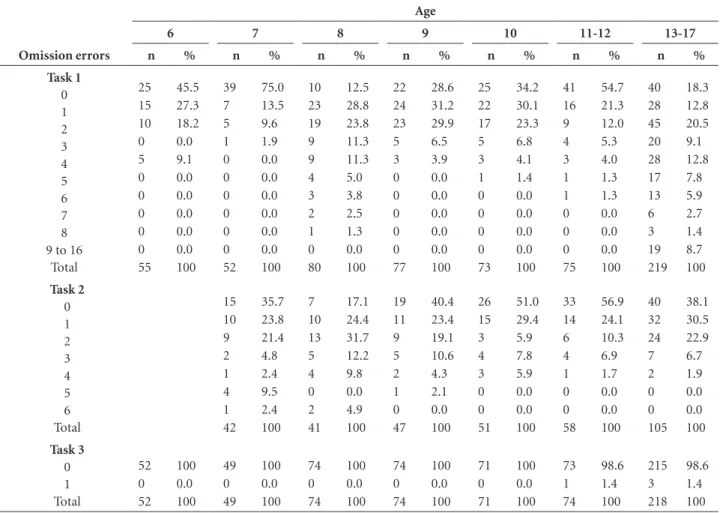
The descriptive statistics of HRT are shown in Table 2; the descriptive statistics of CE are shown in Table 3 and the descriptive statistics of OE are shown in Table 4.
Discussion
Given that attention is a complex phenomenon, it must be emphasized that TAVIS-3 allows the evaluation of dif-ferent aspects of visual attention (focused, shifted and sustained) separately. Moreover, the test provides indexes of HIT, CE and OE for each of the three aforementioned
aspects of visual attention; it also permits identification of deficits with high accuracy. The training session with the joystick before the administration of each of the tasks is es-pecially important to guarantee the reliability of the results because it minimizes the possibility of poor performances due to low familiarity with the tools.
Mattos17 presented the most important advantages of utilizing computerized tests: a) optimization of time (there is no need for consulting tables or calculating scores), b) higher accuracy in administrating and correcting (both automatic), c) the possibility to show complex stimulus on screen, d) the possibility of obtaining specific variables (for example, hit reaction time in seconds, information that is often imprecise when measured manually with a chro-nometer), e) frees the examiner to observe the examinee’s behavior qualitatively during the execution of the task.
Working with percentiles allows a dimensional analysis of the results, instead of classifying the performances only as normal or impaired. Thus, it is possible to estimate the
severity of the impairment based on comparisons to nor-mative groups.
Table 4. Number of omission errors (in percentage). Divided by task and age group.
Omission errors
Age
6 7 8 9 10 11-12 13-17
n % n % n % n % n % n % n %
Task 1 0 1 2 3 4 5 6 7 8 9 to 16
Some limitations must be considered before adminis-tering and interpreting these results, as in any neuropsycho-logical test, namely: important motor deficits, acromatopsy, daltonism, deficits in visual perceptual skills and behavioral variables through the execution of the tasks which might generate results with low reliability.
It must be noted that neuropsychological test results must be understood in the light of clinical history and also taking into consideration the neuropsychologist’s qualita-tive evaluation. Impaired performances in tests of visual attention are neither sufficient nor necessary for the diag-nosis of any neuropsychiatric disorder. Nevertheless, when combined with clinical history and qualitative evaluation, the results of the test may be extremely useful to delineate the symptomatic profile, enabling a more precise diagnosis.
The standardization of the normative group for TAVIS-3 will allow its use as another tool for neuropsychological assessment. Although there are other tests of attention with Brazilian normalization – such as the AC11 and, more re-cently, the Stroop18 – there are currently few computerized tests available in our environment. The use of computer-ized tests decreases the chances of errors in administering and correcting them, which is very important to assure the reliability of the results obtained.
Limitations
The current study should be understood in light of some limitations. We did not investigate the presence of LD in our sample, which might be considered a limitation given that previous studies have shown that LD may pres-ent with impairmpres-ents in attpres-ention tasks 6. Also, adolescpres-ents were not questioned about psychoactive substances use; this issue was investigated only using parents’ reports. We did not compare the influence of school type (private or public) on test performance; however, the public school where the study was conducted is one of the best regarded in the city of Rio de Janeiro, which might have minimized the differences in task performances between students from public and private schools.
References
1. Duchesne M, Mattos P. Normatização de um teste computa-dorizado de atenção visual. Arq Neuropsiquiatr 1997;55:62-69. 2. Nahas T, Xavier G. Atenção. In: Andrade VM, Santos FH, Bueno OFA, orgs. Neuropsicologia Hoje. São Paulo: Artes Médicas; 2004:389-402.
3. Lezak MD. Neuropsychological assessment. New York: Oxford University Press; 2004.
4. American Academy of Pediatrics. Clinical Practice Guideline: Diagnosis and Evaluation of the Child with Attention-Defi-cit/Hyperactivity Disorder. Pediatrics 2000;105:1158-1170. 5. Schubert R. Attention deficit disorder and epilepsy. Pediatr
Neurol 2005;32:1-10.
6. Homack S, Riccio CA. A meta-analysis of the sensitivity and specificity of the Stroop Color and Word Test with children. Arch Clin Neuropsychol 2004;19:725-743.
7. Wolraich ML, Lambert EW, Bickman L, Simmons T, Doffing MA, Worley KA. Assessing the Impact of Parent and Teacher Agreement on Diagnosing Attention-Deficit Hyperactivity Disorder. Dev Behav Pediatrics 2004;25:41-47.
8. Sayal K, Taylor E. Parent ratings of school behaviour in chil-dren at risk of attention deficit/hyperactivity disorder. Acta Psychiatr Scand 2005;111:460-465.
9. Biederman J, Faraone SV, Monuteaux MC, Grossbard JR. How Informative Are Parent Reports of Attention-Deficit/ Hyperactivity Disorder Symptoms for Assessing Outcome in Clinical Trials of Long-Acting Treatments? A Pooled Analysis of Parents’ and Teachers’ Reports. Pediatrics. 2004;113:1667-1671.
10. Mattos P, Alfano A, Araujo C. Avaliação Neuropsicológica. In: Kapczinski F, Quevedo J, Izquierdo I, orgs. Bases Biológicas dos Transtornos Psiquiátricos, 2ª. Ed. Porto Alegre: Artmed; 2004:149-155.
11. Coutinho G, Mattos P, Araujo C, Duchesne M. Transtorno do Déficit de Atenção e Hiperatividade: Contribuição Diag-nóstica de Avaliação Computadorizada de Atenção Visual. Rev Psiq Clín. 2007;34:215-222.
12. Cambraia SV. Teste de Atenção Concentrada. São Paulo: Vetor Editora Psicopedagógica Ltda; 2004.
13. Gronwall D, Wrightson P. Delayed recovery after minor head injury. Lancet 1974;2:605-609.
14. Van Zomeren AH, Deelman BG. Long-term recovery of visual reaction time after closed head injury. J Neurol Neurosurg Psychiatry. 1978;41:452-457.
15. Collings RD. Differences Between ADHD Inattentive and Combined Types on the CPT. J Psychopathol Behav Assess 2003;25:177-189.
16. Nigg JT, Blaskey LG, Huang-Pollock CL, Rappley MD. Neuro-psychological Executive Functions and DSM-IV ADHD Sub-types. J Am Acad Child Adolesc Psychiatry. 2002;41:59-66. 17. Mattos P. Uso de testes computadorizados em
Neuropsico-logia. In: Gagliardi RJ, Reimao R, orgs. Clínica Neurológica.
São Paulo: Lemos Editorial; 1998:319-322.