N
P
T
Zeszyt 3ISSN 1897-7820 http://www.npt.up-poznan.net #46
Dział: Zootechnika
Copyright ©Wydawnictwo Uniwersytetu Przyrodniczego w Poznaniu
MAGDALENA PIESZKA,JAROSŁAW ŁUSZCZY SKI
Department of Horse Breeding University of Agriculture in Kraków
MAIN COMPOSITION AND MACROELEMENTS CONTENT
IN MARE MILK DURING FIRST MONTH
AFTER PARTURITION AND OCCURRENCE
OF “HEAT DIARRHOEA” IN THEIR FOALS
PODSTAWOWY SKŁAD ORAZ ZAWARTO Ć MAKROELEMENTÓW W MLEKU KLACZY PODCZAS PIERWSZEGO MIESI CA PO PORODZIE A WYST POWANIE BIEGUNKI RUJOWEJ U ICH REBI T
Summary. Till today there is no exact explanation of the phenomenon of first diarrhoea called “heat diarrhoea” in foals. The objective of this study was to investigate the traits of first foal diarrhoea (occurrence, its duration and intensity) and mares’ milk composition during first month after parturition. The research was carried out on 30 Arabian mares and their foals. Milk samples were collected to evaluate the main components and macroelements. Observations were made on the term of occurrence, length and intensity of first heat diarrhoea of foal. The close connection between mares’ milk composition and characteristics of diarrhoeas was observed in Arabian foals. Young animals characterised by lack of any diarrhoea signs have drunk milk with higher level of most studied components except lactose and magnesium. Foals with later scours drunk milk with higher level of P and Na; foals with longer diarrhoeas obtained milk with higher lactose, P and Na concentration; higher intensity was influenced by higher lactose level. This problem definitely needs further studies.
Key words: mare, milk composition, foal, heat diarrhoea
Introduction
(DESKUR etAL. 1978,GUSTAFSSON 1998). Till today there is no exact explanation of this phenomenon – most veterinarians describe it as a pathological infections due to viruses or bacteria, parasitologists explain it as an early invasions of some nematodes, physiologists describe it as a results of changing in intestines and breeders clarify it as a results of changing in mare’s milk compositions related to her heat. Hormonal changes in mare due to her heat can cause changes in chemical composition of milk (content of main components and mineral elements) and also the changes in physiology of intestine of foals. The objective of this study was to investigate the traits of first foal diarrhoea (occurrence, its duration and intensity) and mares’ milk composition during first month after parturition.
Material and methods
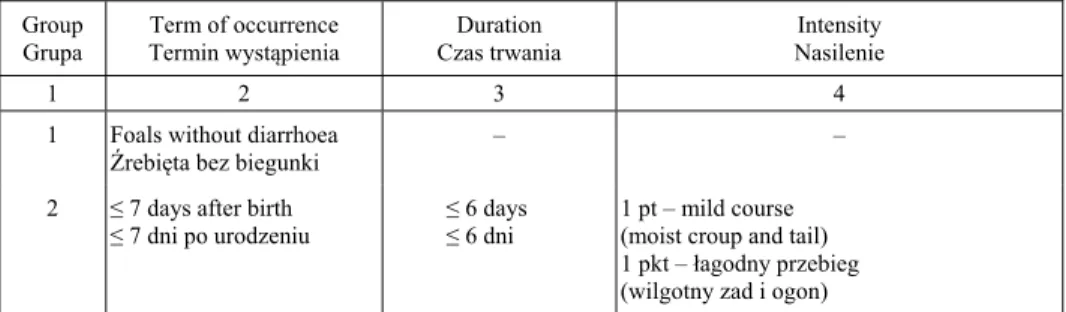
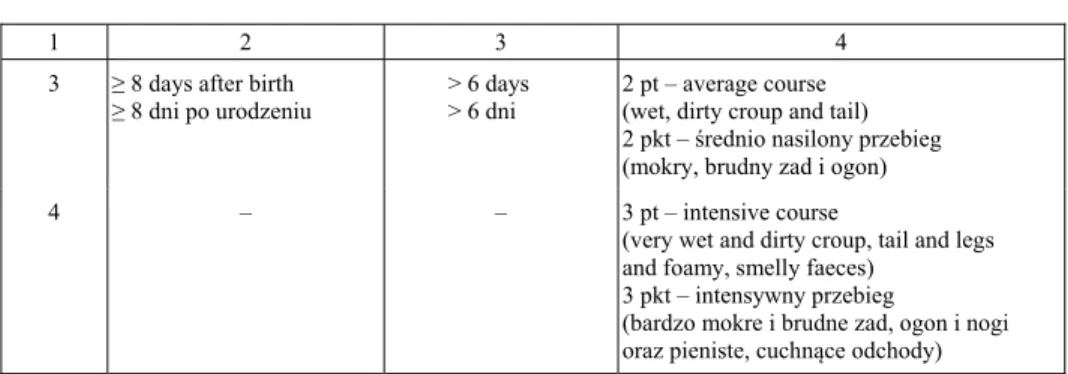
The research was carried out on 30 Arabian mares and their foals. Milk samples were collected to evaluate the main components and macroelements. The first milking was performed on 2nd day after parturition when the milk has changed from colostrum (TISCHNER et AL. 1996). Samples were then collected every 2 days until 30 days after birth. Milk samples (about 150 ml) were obtained manually milking into sterile, plastic bottles with procaine penicillin as a preservative, then frozen to –20°C until chemical analysis. Main components content (total fat, total protein, lactose and dry matter (d.m.) as a percentage of raw milk) was evaluated using Milcoscan apparatus. For macroele-ment levels evaluation (in milligrams per 1 kg of milk) all samples were lyophilized in Labor-Mim 90 apparatus and then mineralized in acids mixture (1 nitric acid : 1.5 per-chloric acid). Ash samples obtained were dissolved in distillate water and analysed with the Philips PU 9100 apparatus. Phosphorus level was evaluated according to colorimet-ric method of Gecolorimet-ricke and Kurmies (SKUMOWSKI 1975) using Unicam apparatus. Ob-servations were made on the term of occurrence, length and intensity of first foal diar-rhoea (heat diardiar-rhoea), during the first month of the foals’ life. Studied population of foals was then divided into groups as follows in Table 1.
Table 1. Groups of studied foals according to the term of occurrence, duration and intensity of heat diarrhoea
Tabela 1. Grupy rebi t w zależno ci od terminu wyst pienia, czasu trwania i nasilenia biegunki rujowej
Group Grupa
Term of occurrence Termin wyst pienia
Duration Czas trwania
Intensity Nasilenie
1 2 3 4
1 Foals without diarrhoea rebi ta bez biegunki
– –
2 ≤ 7 days after birth ≤ 7 dni po urodzeniu
≤ 6 days ≤ 6 dni
Table 1 – cont. / Tabela 1 – cd.
1 2 3 4
3 ≥ 8 days after birth ≥ 8 dni po urodzeniu
> 6 days > 6 dni
2 pt – average course (wet, dirty croup and tail) 2 pkt – rednio nasilony przebieg (mokry, brudny zad i ogon)
4 – – 3 pt – intensive course
(very wet and dirty croup, tail and legs and foamy, smelly faeces)
3 pkt – intensywny przebieg
(bardzo mokre i brudne zad, ogon i nogi oraz pieniste, cuchn ce odchody)
Data were analysed using the computer program Statistica for Windows 8.0. One-factor variance analysis ANOVA and then Tukey’s test were used for evaluation of statistical differences between particular groups of foals in the level of studied milk components.
Results
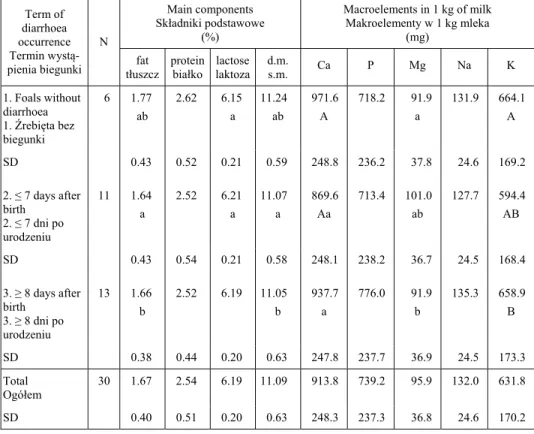
25 from 30 of the observed foals showed signs of diarrhoea as this is the focus of the study. The other young horses were characterised by diarrhoea of different terms, length and intensity. The shortest diarrhoea was noted in two foals (2 days) and the longest (11 days) in one foal. Foals without diarrhoea at all were drinking milk with significant-ly higher level of total fat (1.77%), dry matter (11.24%) and potassium (664.1 mg/kg milk) and with significantly lower level of lactose (6.15%) compare to foals with diar-rhoeas. Foal with later diarrhoeas obtained milk with higher level of phosphorus (776.4 mg/kg milk) and sodium (135.3 mg/kg milk) than other foals but differences between particular groups were not statistically significant (Table 2).
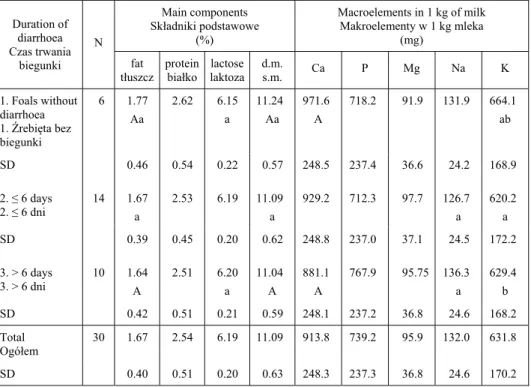
According to diarrhoeas length it was observed that foals with longer diarrhoeas drunk milk with significantly lower level of total fat (1.64%), dry matter (11.04%) and calcium (881.1 mg/kg milk). Also the level of total protein was lower but the differ-ences were not statistically significant. Mothers of foals from this group produced milk with significantly higher level of lactose (6.20%). Foals without diarrhoea drunk milk richer in most studied components (Table 3).
Table 2. Term of heat diarrhoea occurrence in foals depending on content of main components and macroelements in mares milk
Tabela 2. Termin wyst pienia biegunki rujowej u rebi t w zależno ci od zawarto ci składników podstawowych i makroelementów w mleku klaczy
Term of diarrhoea occurrence Termin wyst -pienia biegunki
N
Main components Składniki podstawowe
(%)
Macroelements in 1 kg of milk Makroelementy w 1 kg mleka
(mg)
fat tłuszcz
protein białko
lactose laktoza
d.m.
s.m. Ca P Mg Na K
1. Foals without diarrhoea 1. rebi ta bez biegunki 6 1.77 ab 2.62 6.15 a 11.24 ab 971.6 A 718.2 91.9 a 131.9 664.1 A
SD 0.43 0.52 0.21 0.59 248.8 236.2 37.8 24.6 169.2
2. ≤ 7 days after birth
2. ≤ 7 dni po urodzeniu 11 1.64 a 2.52 6.21 a 11.07 a 869.6 Aa 713.4 101.0 ab 127.7 594.4 AB
SD 0.43 0.54 0.21 0.58 248.1 238.2 36.7 24.5 168.4
3. ≥ 8 days after birth
3. ≥ 8 dni po urodzeniu
13 1.66 b
2.52 6.19 11.05 b 937.7 a 776.0 91.9 b 135.3 658.9 B
SD 0.38 0.44 0.20 0.63 247.8 237.7 36.9 24.5 173.3
Total Ogółem
30 1.67 2.54 6.19 11.09 913.8 739.2 95.9 132.0 631.8
SD 0.40 0.51 0.20 0.63 248.3 237.3 36.8 24.6 170.2
Averages marked in columns with the same small letter differ significantly (p < 0.05). Averages marked in columns with the same capital letter differ highly significantly (p < 0.01).
rednie oznaczone w kolumnach t sam mał liter różni si istotnie (p < 0,05). rednie oznaczone w kolumnach t sam duż liter różni si wysoko istotnie (p < 0,01).
Table 3. Duration of heat diarrhoea in foals depending on content of main components and ma-croelements in mares milk
Tabela 3. Czas trwania biegunki rujowej u rebi t w zależno ci od zawarto ci składników pod-stawowych i makroelementów w mleku klaczy
Duration of diarrhoea Czas trwania
biegunki N
Main components Składniki podstawowe
(%)
Macroelements in 1 kg of milk Makroelementy w 1 kg mleka
(mg)
fat tłuszcz
protein białko
lactose laktoza
d.m.
s.m. Ca P Mg Na K
1. Foals without diarrhoea 1. rebi ta bez biegunki
6 1.77 Aa
2.62 6.15 a
11.24 Aa
971.6 A
718.2 91.9 131.9 664.1 ab
SD 0.46 0.54 0.22 0.57 248.5 237.4 36.6 24.2 168.9
2. ≤ 6 days 2. ≤ 6 dni
14 1.67
a
2.53 6.19 11.09
a
929.2 712.3 97.7 126.7
a
620.2
a
SD 0.39 0.45 0.20 0.62 248.8 237.0 37.1 24.5 172.2
3. > 6 days 3. > 6 dni
10 1.64 A
2.51 6.20 a
11.04 A
881.1 A
767.9 95.75 136.3 a
629.4 b
SD 0.42 0.51 0.21 0.59 248.1 237.2 36.8 24.6 168.2
Total Ogółem
30 1.67 2.54 6.19 11.09 913.8 739.2 95.9 132.0 631.8
SD 0.40 0.51 0.20 0.63 248.3 237.3 36.8 24.6 170.2
Averages marked in columns with the same small letter differ significantly (p < 0.05). Averages marked in columns with the same capital letter differ highly significantly (p < 0.01).
rednie oznaczone w kolumnach t sam mał liter różni si istotnie (p < 0,05). rednie oznaczone w kolumnach t sam duż liter różni si wysoko istotnie (p < 0,01).
Conclusions
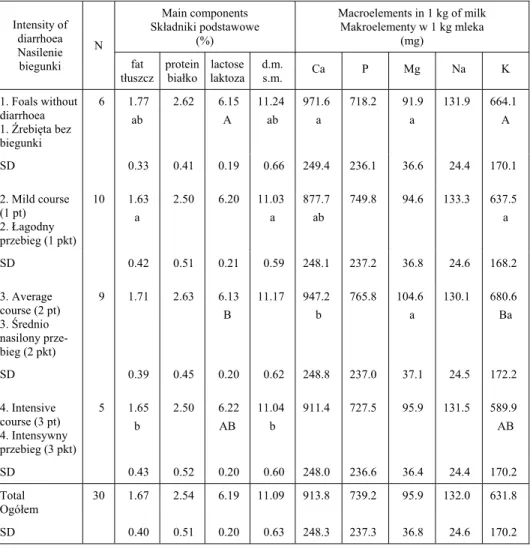
Table 4. Intensity of heat diarrhoea in foals depending on content of main components and ma-croelements in mares milk
Tabela 4. Nasilenie biegunki rujowej u rebi t w zależno ci od zawarto ci składników podstawo-wych i makroelementów w mleku klaczy
Intensity of diarrhoea Nasilenie biegunki N Main components Składniki podstawowe
(%)
Macroelements in 1 kg of milk Makroelementy w 1 kg mleka
(mg)
fat tłuszcz
protein białko
lactose laktoza
d.m.
s.m. Ca P Mg Na K
1. Foals without diarrhoea 1. rebi ta bez biegunki 6 1.77 ab 2.62 6.15 A 11.24 ab 971.6 a 718.2 91.9 a 131.9 664.1 A
SD 0.33 0.41 0.19 0.66 249.4 236.1 36.6 24.4 170.1
2. Mild course (1 pt) 2. Łagodny przebieg (1 pkt)
10 1.63
a
2.50 6.20 11.03
a
877.7
ab
749.8 94.6 133.3 637.5
a
SD 0.42 0.51 0.21 0.59 248.1 237.2 36.8 24.6 168.2
3. Average course (2 pt) 3. rednio nasilony prze-bieg (2 pkt)
9 1.71 2.63 6.13 B 11.17 947.2 b 765.8 104.6 a 130.1 680.6 Ba
SD 0.39 0.45 0.20 0.62 248.8 237.0 37.1 24.5 172.2
4. Intensive course (3 pt) 4. Intensywny przebieg (3 pkt)
5 1.65 b 2.50 6.22 AB 11.04 b
911.4 727.5 95.9 131.5 589.9 AB
SD 0.43 0.52 0.20 0.60 248.0 236.6 36.4 24.4 170.2
Total Ogółem
30 1.67 2.54 6.19 11.09 913.8 739.2 95.9 132.0 631.8
SD 0.40 0.51 0.20 0.63 248.3 237.3 36.8 24.6 170.2
Averages marked in columns with the same small letter differ significantly (p < 0.05). Averages marked in columns with the same capital letter differ highly significantly (p < 0.01).
References
CSAPO-KISS Z.,STEFLER J.,MARTIN T.G., MAKRAY S., CSAPO J., 1995. Composition of mare colostrums and milk. Protein content, amino acids composition and contents of macro- and microelements. Int. Dairy J. 5: 403-415.
DESKUR S.,LEONHARD-KLUZ I.,GROCHOWALSKI K.,RYCHWALSKA-NAHLIK M.,1978. Wyst po-wanie biegunek u rebi t w czasie rui po rebi tnej klaczy matki a skład białek serwatkowych mleka. Rocz. Nauk. Zootech. 5: 115-127.
DOREAU M.,BOULOT S.,CHILIARD Y., 1993. Yield and composition of milk from lactating mares: effect of body condition at foaling. J. Dairy Res. 60: 457-466.
GUSTAFSSON A.,1998. Diarrhoea in foals. Sven. Vet. 50: 8-9.
JOHNSTON R.H.,KAMSTRA L.D.,KOHLER P.D., 1970. Mare’s milk composition as related to foal heat scours. J. Anim. Sci. 31: 549-553.
MARCONI E.,PANFILI G., 1998. Chemical composition and nutritional properties of commercial products of mare milk powder. J. Food Comp. 11: 178-187.
MARIANI P.,MARTUZZI F.,CATALANO A.L., 1993. Composizione e proprieta fisicochimiche del latte di cavalla: varizione dei costituenti azotati e minerali nel corso della latazzione. Ann. Fac. Med. Vet. Univ. Parma. 13: 45-58.
PAGLIARINI E.,SOLAROLI G.,PERI C.,1993. Chemical and physical characteristic of mare’s milk. Ital. J. Food Sci. 4: 323-332.
POOL-ANDERSON K.,RAUB R.H.,WARREN J.A., 1994. Maternal influence on growth and
devel-opment of full-sibling foals. J. Anim. Sci. 7: 1661-1666.
SKUMOWSKI J., 1975. Metody okre lania składu pasz i ich jako ci. PWRiL, Warszawa.
TISCHNER M., NIEZGODA J., WIECZOREK E., M KARSKA A., LISOWSKA A., 1996. Ocena jako ci siary klaczy. Med. Wet. 52: 381-383.
PODSTAWOWY SKŁAD ORAZ ZAWARTO Ć MAKROELEMENTÓW W MLEKU KLACZY PODCZAS PIERWSZEGO MIESI CA PO PORODZIE A WYST POWANIE BIEGUNKI RUJOWEJ U ICH REBI T
Streszczenie. Do dzisiaj nie istnieje dokładne wyja nienie zjawiska pierwszej biegunki, zwanej „biegunk rujow ”, u rebi t. Celem niniejszej pracy było zbadanie zwi zku pomi dzy terminem wyst pienia, czasem trwania i intensywno ci biegunki rujowej a składem mleka klaczy matki w czasie pierwszego miesi ca po porodzie. Badania przeprowadzono na 30 klaczach arabskich i ich rebi tach. Próbki mleka zebrano w celu analizy zawarto ci składników podstawowych i makroelementów. Przeprowadzono również obserwacje dotycz ce terminu wyst pienia, dł
ugo-ci i intensywno ugo-ci pierwszej biegunki rujowej u rebi t. Odnotowano ugo-cisły zwi zek mi dzy składem mleka klaczy i cechami biegunek u rebi t arabskich. Sysaki charakteryzuj ce si bra-kiem biegunki pobierały mleko o wyższym poziomie wi kszo ci badanych składników, oprócz magnezu i laktozy. rebi ta, u których biegunki wyst powały pó niej, piły mleko o wyższym poziomie fosforu i sodu; rebi ta z dłuższymi biegunkami odżywiały si mlekiem z wyższym poziomem laktozy, P i Na; wi ksza intensywno ć biegunki była zwi zana z wi ksz koncentracj laktozy. Problem ten na pewno wymaga dalszych bada .
Corresponding address – Adres do korespondencji:
Magdalena Pieszka, Katedra Hodowli Koni, Uniwersytet Rolniczy im. Hugona Kołłątaja w Kra-kowie,Al. Mickiewicza 24/28, 30-059 Kraków, Poland, e-mail: [email protected]
Accepted for publication – Zaakceptowano do opublikowania: 12.07.2013
For citation – Do cytowania: