Corresponding author: Mohsin Khurshid.
e-mail: [email protected]
Received 4 April 2016
Accepted 26 May 2016
Antimicrobial susceptibility of
Acinetobacter
clinical isolates and emerging antibiogram trends
for nosocomial infection management
Muhammad Sohail
[1],[2], Abid Rashid
[3], Bilal Aslam
[4], Muhammad Waseem
[4],
Muhammad Shahid
[5], Muhammad Akram
[6], Mohsin Khurshid
[3],[4]and Muhammad Hidayat Rasool
[4][1]. Department of Microbiology and Molecular Genetics, Quaid-e-Azam Campus, University of the Punjab, Lahore, Pakistan. [2]. Chughtais Lahore Lab, Lahore, Pakistan. [3]. College of Allied Health Professionals, Directorate of Medical Sciences, Government College University, Faisalabad, Pakistan. [4]. Department of Microbiology, Government College University, Faisalabad, Pakistan. [5]. Department of Bioinformatics and Biotechnology, Government College University, Faisalabad, Pakistan. [6]. Department of Biosciences, COMSATS Institute of Information Technology, Islamabad, Pakistan.
Abstract
Introduction: The drug resistant Acinetobacter strains are important causes of nosocomial infections that are dificult to control and treat. This study aimed to determine the antimicrobial susceptibility patterns of Acinetobacter strains isolated from different clinical specimens obtained from patients belonging to different age groups. Methods: In total, 716 non-duplicate Acinetobacter isolates were collected from the infected patients admitted to tertiary-care hospitals at Lahore, Pakistan, over a period of 28 months. The Acinetobacter isolates were identiied using API 20E, and antimicrobial susceptibility testing was performed and interpreted according to Clinical and Laboratory Standards Institute (CLSI) guidelines. Results: The isolation rate of Acinetobacter was high from the respiratory specimens, followed by wound samples. Antibiotic susceptibility analyses of the isolates revealed that the resistance to cefotaxime and ceftazidime was the most common, in 710 (99.2%) specimens each, followed by the resistance to gentamicin in 670 (93.6%) isolates, and to imipenem in 651 (90.9%) isolates. However, almost all isolates were susceptible to tigecycline, colistin, and polymyxin B. Conclusions: The present study showed the alarming trends of resistance of Acinetobacter strains isolated from clinical specimens to the various classes of antimicrobials. The improvement of microbiological
techniques for earlier and more accurate identiication of bacteria is necessary for the selection of appropriate treatments.
Keywords: Acinetobacter. Antibiotic resistance. Prevalence. Nosocomial infections. Carbapenems.
Major Article
INTRODUCTION
Acinetobacter is a genus of Gram-negative coccobacilli, which are non-motile, oxidase-negative, and catalase-positive, and occur in pairs under magnification(1). Acinetobacter
species are opportunistic pathogens predominantly found in immunocompromised patients. They are widespread in nature, and regarded as commensal microbes of human skin and respiratory tract, however, they may cause serious infections, such as endocarditis, urinary tract infections, pneumonia, wound infections, meningitis, and septicemia, especially in individuals with impaired host defenses(2). Infections caused by Acinetobacter
species are acquired due to hospitalization, mechanical ventilation, respiratory failure, inadequate treatment, previous infection, or antibiotic therapy and catheterization(3). Higher colonization
rates of the throat, and respiratory and digestive tracts are well documented in several previous outbreaks(4) (5).
Acinetobacter species are becoming increasingly resistant to nearly all routinely prescribed antimicrobial agents, including aminoglycosides, fluoroquinolones, and broad-spectrum
β-lactams. The majority of strains are resistant to cephalosporin
class of antimicrobials, whereas the resistance to carbapenems is increasingly reported(6). The antimicrobial susceptibility
testing showed differences between Acinetobacter species, with Acinetobacter baumannii being the most resistant strains(7) (8).
The aim of the study was to compare the isolation frequency of Acinetobacter species form different clinical specimens and the frequency of antibiotic resistance in different age groups. Antimicrobial susceptibility assays were performed using different antibiotics that are frequently recommended by the clinicians.
METHODS
Hospital and clinical isolates
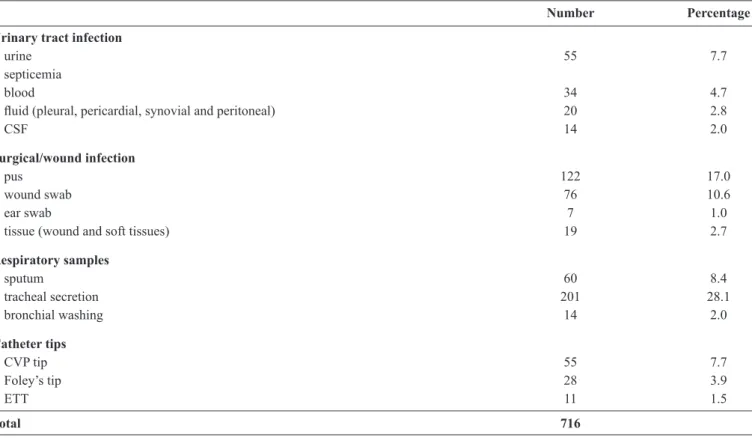
TABLE 1 - Distribution of Acinetobacter isolates obtained from different clinical specimens.
Number Percentage
Urinary tract infection
urine 55 7.7
septicemia
blood 34 4.7
luid (pleural, pericardial, synovial and peritoneal) 20 2.8
CSF 14 2.0
Surgical/wound infection
pus 122 17.0
wound swab 76 10.6
ear swab 7 1.0
tissue (wound and soft tissues) 19 2.7
Respiratory samples
sputum 60 8.4
tracheal secretion 201 28.1
bronchial washing 14 2.0
Catheter tips
CVP tip 55 7.7
Foley’s tip 28 3.9
ETT 11 1.5
Total 716
CSF: cerebro spinal luid; CVP: central venous pressure; ETT: endotracheal tube. April 2014. Various clinical samples were collected, including
urine, pus, blood, luid (pleural, pericardial, synovial and peritoneal), wound swab, cerebro spinal luid (CSF), sputum,
central venous pressure (CVP) catheter tip, stool, throat swab, ear swab, tracheal secret, nasal swab, from the tip of Foley catheter, tissue (wound and soft tissues), bronchial washing sample, and
samples from endotracheal tube (ETT), and PVC tip.
Isolation and identiication of bacteria
The preliminary identification of bacteria was done by standard microbiological procedures(9). The obtained
Acinetobacter isolates were further sub-cultured on MacConkey
agar and confirmed by API 20NE (Biomerieux, France),
according to the manufacturer’s instructions.
Antimicrobial susceptibility analyses
Acinetobacter isolates were tested for the susceptibility to ampicillin/sulbactam, cefepime, cefotaxime, ceftazidime, ceftriaxone, imipenem, meropenem, amikacin, gentamicin, tobramycin, doxycycline, tigecycline, ciprofloxacin, levofloxacin, sulfamethoxazole/trimethoprim, piperacillin/ tazobactam, colistin, and polymyxin B (300U each). These analyses were performed by standard disc diffusion technique and interpreted according to the Clinical and Laboratory Standards Institute (CLSI) guidelines(5). The bacterial suspension
of each sample was made and compared with 0.5McFarland turbidity standard. The cartridges containing antimicrobial
susceptibility discs (Oxoid, UK) were stored at between 4°C and -20°C, and used after the incubation at room temperature. Mueller-Hinton agar plates were inoculated and incubated at 35°C for 18h, and the zones of inhibition were measured. Staphylococcus aureus (ATCC 29213), Escherichia coli (ATCC 25922), and Pseudomonas aeruginosa (ATCC 27853) were used as reference strains, according to the CLSI protocol.
Broth dilution method was used to determine the susceptibilities of the isolated strains to tigecycline and colistin. The Food and Drug Administration (FDA), USA, approved breakpoints for the agents against Enterobacteriaceae were used to determine tigecycline susceptibility in Acinetobacter
isolates (resistance, ≥8mg/L; susceptibility, ≤2mg/L). Minimum
inhibitory concentration (MIC) breakpoints for colistin were
used according to the CLSI guidelines (resistance, ≥4mg/L; susceptibility, ≤2mg/L)(10) (11).
Statistical analysis
Statistical analyses were performed using Microsoft Excel
2010 (Microsoft, USA). The descriptive analysis was performed by calculating frequencies of isolation of Acinetobacter and percentage resistance among isolates to various antimicrobial agents.
RESULTS
60.0 65.0 70.0 75.0 80.0 85.0 90.0 95.0 100.0
0-20 21-50 50
Ceftazidime Cefepime Imipenem Gentamicin Amikacin Doxycycline Ciprofloxacin Co-trimoxazole Piperacillin/tazobactam
Age groups
P
e
rc
e
n
ta
g
e
re
s
is
ta
n
c
e
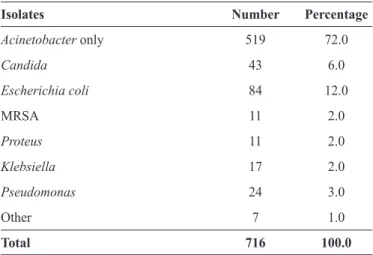
FIGURE 1 - Resistance patterns of Acinetobacter isolates to various classes of antimicrobial agents according to the different age groups. TABLE 2 - Percentage of Acinetobacter isolated alone, or in combination with other isolates from clinical specimens.
Isolates Number Percentage
Acinetobacter only 519 72.0
Candida 43 6.0
Escherichia coli 84 12.0
MRSA 11 2.0
Proteus 11 2.0
Klebsiella 17 2.0
Pseudomonas 24 3.0
Other 7 1.0
Total 716 100.0
MRSA: methicillin-resistant Staphylococcus aureus.
Prevalence of Acinetobacter resistance according to the age group
The prevalence of Acinetobacter strain resistance was shown to be higher in individuals aged between 21 and 50 (Figure 1).The frequency of Acinetobacter strains isolated alone or in the combination with other bacterial strains isolated from the clinical specimens are different, with 72% of Acinetobacter strains isolated alone (519 isolates), as presented in Table 2.
Antimicrobial susceptibility proile
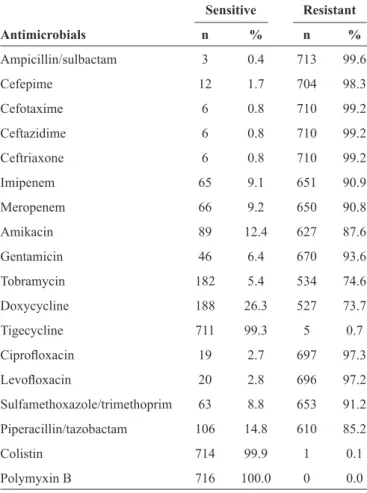
TABLE 3 - Resistance pattern of Acinetobacter isolates to various antimicrobial agents.
Sensitive Resistant
Antimicrobials n % n %
Ampicillin/sulbactam 3 0.4 713 99.6
Cefepime 12 1.7 704 98.3
Cefotaxime 6 0.8 710 99.2
Ceftazidime 6 0.8 710 99.2
Ceftriaxone 6 0.8 710 99.2
Imipenem 65 9.1 651 90.9
Meropenem 66 9.2 650 90.8
Amikacin 89 12.4 627 87.6
Gentamicin 46 6.4 670 93.6
Tobramycin 182 5.4 534 74.6
Doxycycline 188 26.3 527 73.7
Tigecycline 711 99.3 5 0.7
Ciproloxacin 19 2.7 697 97.3
Levoloxacin 20 2.8 696 97.2
Sulfamethoxazole/trimethoprim 63 8.8 653 91.2
Piperacillin/tazobactam 106 14.8 610 85.2
Colistin 714 99.9 1 0.1
Polymyxin B 716 100.0 0 0.0
DISCUSSION
The aim of this study was to characterize Acinetobacter samples obtained from the infected patients and the antimicrobial susceptibility of these isolates to various antibiotics commonly used in clinical practice. In total, 716 Acinetobacter strains were isolated. The higher isolation rates of Acinetobacter from the respiratory samples are in agreement with the results reported previously in other countries(12).
The resistance rates of Acinetobacter isolates were 10-51% against amikacin, 0-81% against gentamicin, 0-81% against
ceftazidime, 19-81% against ciproloxacin, 36-75% against
piperacillin/tazobactam, and 5-19% against imipenem, as reported
in a surveillance study from the intensive care units (ICU) of ive European countries(13). A. baumannii strains collected from 11
European countries between 1997 and 2000 were reported to be
susceptible to imipenem and meropenem, with resistance rates of 16% and 18%, respectively(14). However the subsequent data
from 12 countries revealed a signiicant increase in the resistance
rates against imipenem (42.5%) and meropenem (43.4%)(15).
The antibiotic resistance data collected around the world demonstrated that the resistance rates of Acinetobacter species to imipenem ranged from 0-40% between 2000 and 2004(16).
The prevalence of imipenem resistance in Acinetobacter species
increased from zero in 1991 to 50% in 2001, as shown in a study conducted in a Spanish hospital(17). The resistant rates to
ampicillin/sulbactam, imipenem, and meropenem were 51.6%, 26.3%, and 29.6%, respectively, of Acinetobacter isolates from
30 European centers(18).
Colistin or tigecycline remain the treatment options for the management of most of the cases of infections caused by multi-drug resistant A. baumannii strains. We showed that, among the strains we isolated, only 0.7% and 0.1% were resistant to tigecycline and colistin, respectively. This is in accordance with the previous studies(16) (18). However, the emergence of
Acinetobacter resistance against tigecycline and colistin is reported with an increasing frequency(18) (19). In a surveillance
study in Europe, the resistance of A. baumannii against polymyxin B was shown to be 2.7%(18). A surveillance study
in Greece showed that 3% of Acinetobacter strains isolated from ICU patients were resistant to colistin(20). Furthermore,
tigecycline and colistin resistance rates of A. baumannii strains isolated in Germany were 6% and 2.8%, respectively(21). A study
in Turkey reported considerably higher tigecycline resistance rates (25%) of Acinetobacter strains(22).
Acinetobacter infections are sometimes accompanied by the infections caused by other microorganisms, and here, we showed that these species are mainly Candida, Escherichia coli, methicillin-resistant Staphylococcus aureus (MRSA), Proteus, Klebsiella, and Pseudomonas species (Table 2). These co-infections may increase patient mortality, highlighting the importance of choosing the appropriate antimicrobial therapy(23). The analyses of antibiotic
resistance patterns according to the age groups showed that the number of the strains resistant to most of the antimicrobial agents increased with age, except the strains resistant to co-trimoxazole and piperacillin/tazobactam (Figure 1). Some differences in the antibiotic resistance patterns between the urinary tract pathogens isolated from different age groups were observed, however, the rate of resistance to different antibiotics was higher in pediatrics patients compared with that in the middle aged and elderly patients(24). Another study demonstrated the differences between
the age groups in susceptibility patterns among E. coli urinary tract isolates for all tested antibiotics except co-trimoxazole(25).
A microarray-based study showed that the antibiotic resistance gene diversity is age-related and that these genes accumulate
in the members of human gut microlora starting from infancy,
and their interactions become gradually more complex with age(26). To the best of our knowledge, the differences in the
Acinetobacter susceptibility to different antimicrobial agents between different age groups have not been reported before.
Taken together, this study identiied the differences in the
REFERENCES
1. Allen S, Procop G, Schreckenberger P. Guidelines for the collection, transport, processing, analysis, and reporting of cultures from
speciic specimen sources. In: Winn WC, Koneman EE, editors.
Koneman’s Color Atlas and Textbook of Diagnostic Microbiology. Philadelphia: Lippincott Williams & Wilkins; 2006. p. 68-105.
2. Bergogne-Berezin E, Towner KJ. Acinetobacter spp. as nosocomial
pathogens: microbiological, clinical, and epidemiological features. Clin Microbiol Rev 1996; 9:148-165.
3. Husni RN, Goldstein LS, Arroliga AC, Hall GS, Fatica C, Stoller JK, et al. Risk factors for an outbreak of multi-drug-resistant
Acinetobacter nosocomial pneumonia among intubated patients. Chest 1999; 115:1378-1382.
4. Van Looveren M, Goossens H, Group AS. Antimicrobial resistance of Acinetobacter spp. in Europe. Clin Microbiol Infect 2004;
10:684-704.
5. Clinical and Laboratory Standards Institute (CLSI). Performance standards for antimicrobial susceptibility testing: 20th informational
supplement. Wayne, PA: CLSI; 2010, CLSI document M100-S120. 2010. 6. Lyytikainen O, Koljalg S, Harma M, Vuopio-Varkila J. Outbreak
caused by two multi-resistant Acinetobacter baumannii clones in a burns unit: emergence of resistance to imipenem. J Hosp Infect 1995; 31:41-54.
7. Seifert H, Baginski R, Schulze A, Pulverer G. Antimicrobial susceptibility of Acinetobacter species. Antimicrob Agents Chemother 1993; 37:750-753.
8. Vila J, Marcos A, Marco F, Abdalla S, Vergara Y, Reig R, et al.
In vitro antimicrobial production of beta-lactamases, aminoglycoside-modifying enzymes, and chloramphenicol acetyltransferase by and susceptibility of clinical isolates of Acinetobacter baumannii. Antimicrob Agents Chemother 1993; 37:138-141.
9. Cowan. Cowan and Steel's Manual for the Identiication of Medical
Bacteria. 2nd edition. Cambridge: Cambridge University Press; 1974.
10. Chang KC, Lin MF, Lin NT, Wu WJ, Kuo HY, Lin TY, et al. Clonal spread of multidrug-resistant Acinetobacter baumannii in eastern Taiwan. J Microbiol Immunol Infect 2012; 45:37-42.
11. Gales AC, Reis AO, Jones RN. Contemporary assessment of antimicrobial susceptibility testing methods for polymyxin B and colistin: review of available interpretative criteria and quality control guidelines. J Clin Microbiol 2001; 39:183-190.
12. Suri A, Mahapatra AK, Kapil A. Acinetobacter infection in neurosurgical intensive care patients. Natl Med J India 2000; 13:296-300.
13. Hanberger H, Garcia-Rodriguez JA, Gobernado M, Goossens H, Nilsson LE, Struelens MJ. Antibiotic susceptibility among aerobic gram-negative bacilli in intensive care units in 5 European countries. French and Portuguese ICU Study Groups. JAMA 1999; 281:67-71.
14. Turner PJ, Greenhalgh JM, Group MS. The activity of meropenem and comparators against Acinetobacter strains isolated from European
hospitals, 1997-2000. Clin Microbiol Infect 2003; 9:563-567.
15. Turner PJ. Meropenem activity against European isolates: report on
the MYSTIC (Meropenem Yearly Susceptibility Test Information Collection) 2006 results. Diagn Microbiol Infect Dis 2008; 60:185-192. 16. Perez F, Hujer AM, Hujer KM, Decker BK, Rather PN, Bonomo
RA. Global challenge of multidrug-resistant Acinetobacter baumannii. Antimicrob Agents Chemother 2007; 51:3471-3484.
17. Cisneros JM, Rodriguez-Bano J. Nosocomial bacteremia due to
Acinetobacter baumannii: epidemiology, clinical features and treatment. Clin Microbiol Infect 2002; 8:687-693.
18. Gales AC, Jones RN, Sader HS. Global assessment of the antimicrobial activity of polymyxin B against 54 731 clinical isolates of Gram-negative bacilli: report from the SENTRY antimicrobial surveillance programme (2001-2004). Clin Microbiol Infect 2006; 12:315-321.
19. Rodloff AC, Leclercq R, Debbia EA, Canton R, Oppenheim BA,
Dowzicky MJ. Comparative analysis of antimicrobial susceptibility among organisms from France, Germany, Italy, Spain and the UK as part of the tigecycline evaluation and surveillance trial. Clin Microbiol Infect 2008; 14:307-314.
20. Souli M, Kontopidou FV, Koratzanis E, Antoniadou A, Giannitsioti
E, Evangelopoulou P, et al. In vitro activity of tigecycline against
multiple-drug-resistant, including pan-resistant, gram-negative and gram-positive clinical isolates from Greek hospitals. Antimicrob Agents Chemother 2006; 50:3166-3169.
21. Seifert H, Stefanik D, Wisplinghoff H. Comparative in vitro
activities of tigecycline and 11 other antimicrobial agents against
215 epidemiologically deined multidrug-resistant Acinetobacter
baumannii isolates. J Antimicrob Chemother 2006; 58:1099-1100.
22. Dizbay M, Altuncekic A, Sezer BE, Ozdemir K, Arman D.
Colistin and tigecycline susceptibility among multidrug-resistant
Acinetobacter baumannii isolated from ventilator-associated pneumonia. Int J Antimicrob Agents 2008; 32:29-32.
23. Dent LL, Marshall DR, Pratap S, Hulette RB. Multidrug resistant
Acinetobacter baumannii: a descriptive study in a city hospital. BMC Infect Dis 2010; 10:196.
24. Akram M, Shahid M, Khan AU. Etiology and antibiotic resistance
patterns of community-acquired urinary tract infections in J N M C Hospital Aligarh, India. Ann Clin Microbiol Antimicrob 2007; 6:4.
25. McGregor JC, Elman MR, Bearden DT, Smith DH. Sex- and
age-speciic trends in antibiotic resistance patterns of Escherichia coli
urinary isolates from outpatients. BMC Fam Pract 2013; 14:25. 26. Lu N, Hu Y, Zhu L, Yang X, Yin Y, Lei F, et al. DNA microarray
analysis reveals that antibiotic resistance-gene diversity in human gut microbiota is age related. Sci Rep 2014; 4:4302.
Acknowledgments
We thank Dr. Omar Chughtai for the support and permission to conduct this study in Microbiology Section of his laboratory.
Conlict of interest