ENERGY REHABILITATION STUDIES OF A LARGE GROUP OF HISTORICAL BUILDINGS: A CASE STUDY
A. Rego-Teixeira°,∗, R. S. Duarte∗, L. Brotas∗, P. Almeida∗ and M. A. Brandão°,∗ ° INETI - Instituto Nacional de Engenharia e Tecnologia Industrial Azinhaga dos Lameiros à Estrada do Paço do Lumiar, 1699 Lisboa Codex, Portugal.
Tel. 351.1.7165141, Fax: 351.1.7163797
∗ ITIME - Instituto de Tecnologia e Inovação para a Modernização Empresarial Estrada do Paço do Lumiar, 16, 1600 Lisboa, Portugal.
Tel. 351.1.3502931, Fax: 351.1.7164305
ABSTRACT: In this paper, energy rehabilitation studies of a large group of historical buildings are assessed.
A general methodology and some particular constraints are discussed. For a case study including 65 buildings in one of Lisbon’s historical centres, the methodology used, the proposed energy-efficient measures and the results in terms of heating energy savings and summer thermal convert are presented and discussed.
1. INTRODUCTION
In 1994, Lisbon’s City Council (CML) launched several Integrated Projects for the urban rehabilitation of historical areas. These projects sought an interdisciplinary approach which included, alongside the structural and architectural rehabilitation of the buildings, the revitalisation of the area’s cultural, economic, social and leisure aspects.
One of these Integrated Projects, named “Chafariz de Dentro”, includes 65 buildings (251 flats) located in the area around Largo do Chafariz de Dentro, in Alfama, one of Lisbon’s historical centres. With the objective of improving the energy efficiency and increase the indoor thermal comfort of these buildings to standards closer to current ones, an energy rehabilitation study was carried out in the framework of the SAVE Programme.
In this paper, a general methodology for energy rehabilitation studies of buildings is discussed. In section 2, the main stages of this methodology, some methods frequently used and the most common constraints are mentioned. In section 3, difficulties concerning the study of a group of buildings in historical centres are discussed. The case study of “Chafariz de Dentro” is presented in section 4. After the description of the methodology used and the energy efficient measures proposed for this case, results in terms of the potential heating energy savings for the whole group of buildings in the area, as well as in terms of summer thermal comfort for a typical building are presented. For the same typical building an economic analysis of the proposed measures is also presented. Finally, in section 5, conclusions for energy rehabilitation studies of a large group of buildings in historical centres and for the case study “Chafariz de Dentro” are drawn.
2. MAIN STAGES IN ENERGY REHABILITATION STUDIES
In general, an energy conservation study can be divided in three main stages: pre-diagnosis, diagnosis and monitoring.
In the pre-diagnosis stage, quick and simple methods (e.g., comparisons between reference and calculated energy and economic ratios) are used to enable an a priori evaluation of the potential energy savings of a building or a group of
buildings. This stage is also useful whenever a decision about energy rehabilitation targets, has to be made without resorting to energy audits or in-depth studies. When studying a large group of buildings, the pre-diagnosis stage can, in a first approach, help identify subgroups of buildings with similar energy characteristics and decide which should be the main objectives of the energy conservation study.
In the diagnosis stage, energy audits and in-depth studies are used to identify the existing energy deficiencies and its causes. Based on non-energy related constraints, predicted values of energy savings and economic studies, proposals for the most efficient corrective measures can be made. In a study of a large group of buildings, the identification of the energy deficiencies and their causes can, if necessary, be used for a better definition of subgroups including buildings with similar energy characteristics. Whenever several buildings have identical energy characteristics (sharing identical orientation, geometry, occupation, ...), the end-results of the diagnosis stage for one, or a few buildings, representative of the subgroup being studied, can be sufficient to obtain the results for the whole subgroup.
Figure 1 shows different steps in the diagnosis stage of an energy rehabilitation study.
DECISION FOR AN ENERGY REHABILITATION STUDY
IDENTIFIED ENERGY DEFICIENCIES
POSSIBLE CORRECTIVE SOLUTIONS
PREDICTED ENERGY SAVINGS (AND THERMAL COMFORT)
PROPOSED ENERGY-SAV. SOLUTIONS •VISITS
•ENERGY AUDITS •IDENTIFICATION METHODS •ANALYTICAL METHODS
(...) CONSTRAINTS•URBAN
•STRUCTURAL •ARCHITECTURAL (...)
ANALYTICAL METHODS •DYNAMIC •STATIONARY
•SUBSIDIES •FINANCIAL CONSTRAINTS
ENERGY RELATED DEFICIENCIES IDENTIFICATION
NON-ENERGY RELATED CONSTRAINTS
IDENTIFICATION
PREDICTION OF ENERGY SAVINGS
ECONOMIC ANALYSIS
Figure 1: Different steps in the diagnosis stage of an energy
rehabilitation study.
also be used to check the results predicted by analytical methods. This stage is useful for collecting information for future energy rehabilitation studies.
3. THE PARTICULAR CASE OF BUILDINGS IN HISTORICAL CENTRES
The energy rehabilitation study of a building or a group of buildings in a historical centre may pose uncommon difficulties.
In historical centres, the proposed energy-efficient measures must comply with cultural, historical and patrimonial building and urban constraints. A careful choice of the proposed measures has to be made and, frequently, the integration of passive and active solar systems (e.g., addition of glazed balconies to the southern façades or incorporation of solar collectors on roofs), which imply interventions in the building fabric, can not be used.
The lack of data on the thermal properties of some of the buildings’ constructive elements or on the characteristics of some equipment can also impose added difficulties, specially in the calculation of the potential energy savings using analytical methods. Whenever the thermal properties of any constructive element is not known with certainty (sometimes the case in historical buildings) the results should be reported in terms of energy savings and not in terms of absolute values of energy needs.
For a large group of buildings in a historical area which was subject to no apparent urban planning and/or included, throughout the years, contributions using different styles, constructive techniques and materials, buildings can show a great variation in their energy-related characteristics. In this case, decisions regarding the identification of subgroups of buildings with similar energy-related characteristics and regarding the representativeness of the buildings studied should be carefully examined.
These difficulties, however, should not represent an obstacle to carrying out studies for the definition of the most suitable measures to be used in the energy rehabilitation of buildings in historical centres.
4. CASE STUDY OF “CHAFARIZ DE DENTRO”
This case study refers to the energy rehabilitation study of 65 buildings (251 flats) located in the area around Largo do Chafariz de Dentro, in Alfama, a historical centre located in a Southeast-oriented slope facing the Tagus river, between Lisbon’s commercial centre and its oriental area, the site of EXPO’98.
The main purpose of this study was the evaluation of the potential for heating energy savings which could be attained after the implementation of a coherent and cost-effective set of energy-efficient measures. Another objective was the analysis of the effect of these measures on the summer thermal comfort.
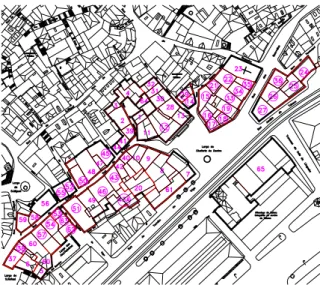
The urban structure of Alfama, dates from the Lisbon’s Arab occupation period and was consolidated without any planning in the following centuries, resulting in a generally intricate mesh with labyrinthical narrow streets and alleys. In Figure 2, the delimiting area of the “Chafariz de Dentro” Integrated Project is outlined.
Figure 2: Delimiting area of the “Chafariz de Dentro” Integrated Project.
The buildings in this area are generally a result of the inclusion of successive contributions from different periods, bringing in different styles and construction techniques. As a result, a dense constructive tissue and a great variation in the buildings geometry, their interior layout and in the nature of the constructive elements can be observed.
On average, buildings are 4 storeys high, with a single dwelling per storey and occupy a ground area of approximately 90 m2. Attics are frequently used as dwelling. Since there are no central heating systems, individual room electrical or gas heaters are used.
Exterior walls present varying thicknesses (±20 to ±70 cm) depending on the storey and the building. In general, these walls are made of irregular calcareous stone masonry. The windows are made of wooden frames with single glazing. The roofs are pitched and use tiles laid on wooden trusses.
Lisbon presents a temperate climate during the heating season (4.3 months). In the coldest month (January), the average temperature is 10.8°C. The average number of degree days for a base temperature of 15°C is 400 DD and the average solar radiation incident on a south facing vertical surface is 400 kWh/m2. In the cooling season (4.5 months), Lisbon’s climate is dry and sunny. The hottest month (August) has an average maximum temperature of 27.7°C.
4.1 Methodology
After site inspections to examine the existant energy-related deficiencies, a set of energy-efficient measures was analysed with the co-operation of CML technical staff to assure that all historical, cultural and patrimonial constraints were respected.
One major difficulty encountered was the lack of data for studying the 65 buildings in the area (data was available for only 32 buildings). Another difficulty was the great variation in the buildings energy-related characteristics, which implied the study of the 32 buildings and the use of a simplified method for calculating the heating energy needs of each building. This method is based on the Portuguese building thermal regulation.
of heating energy savings of each subgroup (gi) was considered
to be equal to the average value for the buildings studied in each subgroup. The percentage of heating energy savings for the 65 buildings (g) is given by weighting the average percentage of heating energy savings of each subgroup with the number (ni) of buildings in each subgroup: g =Σi (gini) / Σini.
In order to evaluate the summer thermal comfort, a typical building was selected and studied with the DOE-2 simulation programme [1], which was also used to assess the cost effectiveness of the energy-saving measures.
4.2 Proposed energy-efficient measures
For choosing the proposed energy-efficient measures, the following was established:
- the buildings and urban outline should not be modified (historical, cultural and patrimonial constraints are mandatory);
- improvements in the energy efficiency of the equipment for space heating and water heating, as well as of the appliances were not considered;
- the use of equipment for space cooling was not considered;
- the proposed energy-efficient measures should, whenever possible, take advantage of the scheduled structural and architectural rehabilitation in order to reduce costs (e.g., scaffolding, exterior walls and roof repairing);
- environment-friendly insulation materials were chosen and the existing wooden window shutters and frames were rapaired or replaced with identical ones.
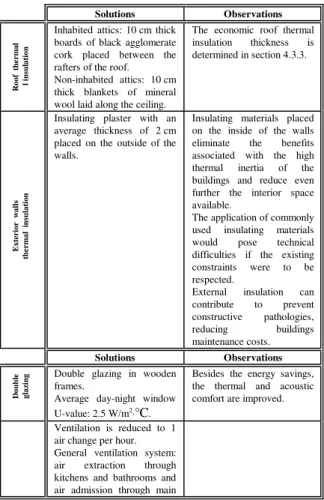
Table I: Proposed energy rehabilitation measures and solutions for its implementation. Solutions Observations R o o f th e rma l l in su la ti on
Inhabited attics: 10 cm thick boards of black agglomerate cork placed between the rafters of the roof.
Non-inhabited attics: 10 cm thick blankets of mineral wool laid along the ceiling.
The economic roof thermal insulation thickness is determined in section 4.3.3.
E x teri o r w a ll s th erma l in su la ti o n
Insulating plaster with an
average thickness of 2 cm
placed on the outside of the walls.
Insulating materials placed on the inside of the walls eliminate the benefits associated with the high thermal inertia of the buildings and reduce even further the interior space available.
The application of commonly used insulating materials would pose technical difficulties if the existing constraints were to be respected.
External insulation can contribute to prevent constructive pathologies, reducing buildings maintenance costs. Solutions Observations Do u b le g laz in
g Double glazing in wooden
frames.
Average day-night window
U-value: 2.5 W/m2·°C.
Besides the energy savings, the thermal and acoustic comfort are improved.
Ventilation is reduced to 1 air change per hour. General ventilation system: air extraction through kitchens and bathrooms and air admission through main
V e n til at ion im pr o v em en t spaces.
Windows air tightness impro-vement with replacement of the frames.
Self-adjusting air admissions control the air change rate.
E ffi ci ent la m p
s Replacement of incandescent
lamps with fluorescent lighting.
Visual comfort could not be improved through a higher daylight admission because of historical and cultural constraints.
Note: The measures presented bellow will be considered in the
calculation of the annual heating energy needs and in the summer thermal convert analysis, with and without the implementation of the measures above. In terna l w indo w in su la ti o n an d sh ad in g Ni gh t ve n tila ti on
Internal wooden shutters. Night ventilation through open windows during the cooling season.
External movable insulation and shading devices could not be used due to historical and cultural constraints.
4.3 Results
This section presents results in terms of annual heating energy savings for the 65 buildings included in the Integrated Project “Chafariz de Dentro” and in terms of summer thermal comfort improvement for a flat of a typical building. For this same building, a cost-benefit analysis of the proposed energy-efficient measures is also presented.
4.3.1 Potential for heating energy savings
Figure 3 shows the annual heating energy savings for each of the 32 buildings studied, obtained with the simplified calculation method and considering the proposed energy efficient measures (efficient lamps excluded). In the calculation of the heating energy needs, with and without the proposed energy-efficient measures, internal movable insulation (wooden shutters) was considered.
0 10 20 30 40 50 60 70 80 90
12 14 15 16 17 18 19 21 22 24 25 26 27 29 33 34 35 36 38 43 43 a
45 46 50 51 52 53 54 55 57 62 63
A n n u al h ea ti n g e n er gy s a vi n gs [ % ] Building identification
Figure 3: Annual heating energy savings for each of the 32
buildings studied. All energy efficient measures considered, except efficient lamps.
The differences in the energy-related characteristics of the buildings (orientation, geometry, construction elements) imply a variation in the annual heating energy savings.
Table II:Annual heating energy savings for the 65 buildings. All energy-efficient measures considered, except efficient lamps.
Energy-efficient measure(s) Annual heating energy
savings [%]
Roof thermal insulation 38
Exterior walls thermal insulation 8
Double glazing 2
Ventilation improvement 22
Whole of the measures 70
The annual heating energy savings for the whole of the energy efficient measures is 70%. The roof thermal insulation and the improved ventilation are responsible for the greatest energy savings. The thermal insulation of the exterior walls account for only 8% savings (the proposed insulating plaster has a thermal conductivity of 0.09 W/m°C, greater than usual for insulating materials). With double glazing, an annual saving of 2% is obtained. This is an expected result for Lisbon’s winter mild climate.
4.3.2 Summer thermal comfort improvement
A thermal comfort analysis was carried out for a typical building in the area in study using the DOE-2 programme. The building studied is 4 storeys high and has a ground area of approximately 53 m2 (see Figure 4).
Figure 4: Axonometric view of the typical building obtained from the input to the DOE-2 programme.
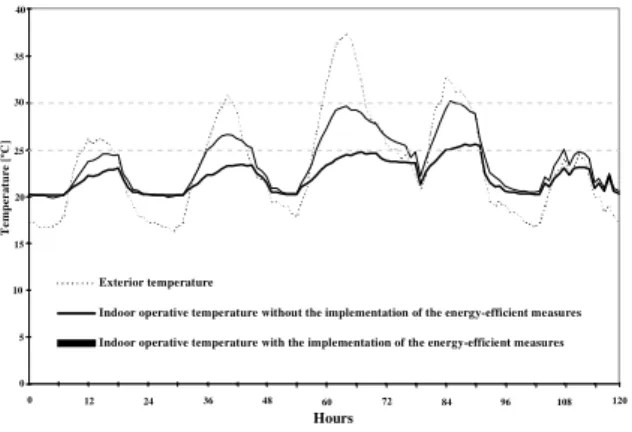
For the living room (oriented NW) of the flat in the highest storey of this building, the indoor operative temperature was determined during 5 days in July. For this period, Figure 5 presents the exterior temperature and the indoor operative temperatures with and without the implementation of the whole of the proposed energy-efficient measures. In both cases, internal shading devices (wooden shutters) and night ventilation are considered.
0 5 1 0 1 5 2 0 2 5 3 0 3 5 4 0
1 7 1 3 1 9 2 5 3 1 3 7 4 3 4 9 5 5 6 1 6 7 7 3 7 9 8 5 9 1 9 7 1 03 1 09 1 15 Exterior temperature
Indoor operative temperature without the implementation of the energy-efficient measures Indoor operative temperature with the implementation of the energy-efficient measures
T
e
m
p
er
at
u
re [
ºC
]
0 12 24 36 48 60 72 84 96 108 120
Hours 0
5 15
10 25
20 35
30 40
Figure 5: Exterior temperature and indoor operative temperatures in a living room of a typical building, with and without the proposed energy-efficient measures, for a 5 days period in July.
With the implementation of the energy-efficient measures, the maximum operative temperatures are significantly reduced and a maximum value of approximately 25ºC is attained. This value should be compared with the 30ºC obtained when no energy-efficient measures are considered.
For the same living room, during the cooling season, the number of hours for which the indoor operative temperature is higher than 25ºC was also calculated. This number of hours is reduced from 908 to 32, when the proposed energy-efficient measures are implemented.
4.3.3 Cost-benefit analysis
For assessing the cost effectiveness of the energy-saving measures, the DOE-2 programme was used to calculate the energy heating savings of the mentioned typical building.
A classical study in terms of global cost [2] was first carried out to determine the economic roof insulation thickness.
In the cost-benefit analysis, the cost of saved energy [3] for each measure was calculated (a zero discount rate was assumed). In this analysis, the following assumptions were made:
- all individual heaters are electrical; - average measure’s lifetime is 20 years;
- the net investment cost of each energy-saving measure is considered as the incremental cost above the scheduled structural and architectural rehabilitation.
• Economic roof thermal insulation thickness
Figure 6 shows the classical approach in terms of global cost, i.e., the cost of the roof thermal insulation plus the present-value cost of the heating energy consumed during 20 years (a discount rate of 5% and an average electricity price of 24.25 PTE were assumed).
600000 800000 1000000 1200000
0 200 400 600 800 1000 1200 1400
Roof thermal insulation thickness
Annual energy heating savings [kWh/year]
H
e
a
ti
n
g
gl
ob
al
c
o
st
f
o
r
20
y
e
a
rs
[
P
T
E
]
3 8
10 cm 12
15
5
Figure 6: Heating global cost (cost of investment + present-value cost of the heating energy consumed during 20 years) for a typical building, considering different roof thermal insulation thicknesses.
• Cost of saved energy
In Figure 7, a “supply curve of saved energy” is presented for each of the energy-efficient measures. Each conservation measure represents a step on the curve whose width equals the percentage of energy saved and whose height equals its cost of saved energy. The measures are stacked in order of increasing cost of saved energy.
0 2 4 6 8 10 12 14 16 18 20
0 10 20 30 40 50 60 70 80 90 100
R
o
of
th
er
m
a
l in
sul
ati
on
Ve
nt
il
atio
n im
pr
ove
m
ent
Electricity price (1998)
Cumulative annual electricity saved for heating [%]
Co
st
of
s
av
e
d
e
n
e
r
g
y [
P
T
E
/k
W
h
]
Ex
te
ri
or
w
alls
the
rm
al
ins
ula
tio
n
Do
ubl
e gla
zin
g
Figure 7: “Supply curve of saved energy” for each of the
energy-efficient measures applied to a typical building.
All the measures are economical — costs of saved energy are lower than the local current price of the avoided energy (electricity): 18.38 PTE. The available potential for more energy savings is low (8%). Ventilation improvement and roof thermal insulation are responsible for the greatest energy savings and are also the most cost-effective measures.
With the replacement of incandescent lamps with fluoerescent lighting, the electricity consumption decreases and the heating energy needs increase; however, energy savings are obtained. Since the cost of saved energy determined considering these savings is lower (1.3 PTE/kWh) than the price of electricity, fluorescent lighting is a cost-effective measure.
5. CONCLUSIONS
The energy rehabilitation study of a building or a group of buildings in a historical centre may pose uncommon difficulties. However, these difficulties should not represent an obstacle to carrying out studies for the definition of the most suitable energy-efficient measures.
The methodology used should be adapted to the specific case under study, taking into consideration the existing constraints in order to define the energy-efficient measures and to choose the required methods for estimating energy savings and evaluating thermal comfort.
Concerning the case study “Chafariz de Dentro”, the following conclusions can be drawn:
- historical, cultural and patrimonial constraints excluded the use of active and passive solar systems (e.g., glazed balconies) — almost all of the proposed rehabilitation measures are energy conservation measures (thermal insulation, double glazing and infiltration reduction); - the implementation of the whole of the proposed
energy-saving measures can reduce by 70% the annual heating energy needs for the 65 buildings studied; - roof thermal insulation and ventilation improvement
have the greatest potential for heating energy savings and are the most cost-effective measures;
- the application of the whole of the energy-saving measures increases significantly the thermal comfort in the summer.
ACKNOWLEDGEMENTS
This work was financially supported by the EC SAVE Programme (Contract 4.1031/Z/95-133) and the Portuguese Directorate-General for Energy (DGE).
The authors would like to thank the support of the Directorate for Urban Rehabilitation of Lisbon’s City Council.
REFERENCES
[1] DOE-2 Building Energy Analysis Programme (version 2.1E), Lawrence Berkeley National Laboratory, University of California, Nov. 1993.
[2] Le Goff, P., Energétique industrielle - Tome 2: Analyse économique et optimisation des procédés, Technique et Documentation, 1984.