ABSTRACT:Objective: To estimate the prevalence and to analyze the factors associated with self-reported hearing handicap by construction workers in the state of Mato Grosso, Brazil. Methods: A cross-sectional study was conducted with 866 construction and heavy construction workers. Participants responded to an epidemiological survey subdivided in: identiication data, sociodemographic data; lifestyle; work environment characteristics; occupational exposure factors; hearing protection measures; and hearing handicap inventory to quantify the psychosocial consequences of work-related hearing loss. Results: The prevalence of hearing impairment among workers in the construction sector was 14.43% (n = 125). There were 311 emotional and social complaints related to hearing problems. Hearing handicap was associated with: 60 or over age group (PR = 1.94, 95%CI 1.01 – 3.71); alcohol consumption (PR = 1.94, 95%CI 1.38 – 2.73); direct exposure to noise (PR = 1.75; 95%CI 1.03 – 2.97); exposure to dust (PR = 1.59, 95%CI 1.13 – 2.24); non-use of earplugs (PR = 1.39, 95%CI 1.00 – 1.93); and non-use of neck lap cap (PR = 1.52, 95%CI 1.09 – 2.13). Conclusion: We observed a high prevalence of hearing impairment among workers in the construction sector associated with: individuals aged 60 years or older; alcoholism; exposure to noise and dust; non-use of earplugs; and non-use of neck lap cap. Therefore, it is necessary to implement policies aimed at preserving the hearing health of construction and heavy construction workers.
Keywords: Hearing loss; Psychosocial impact; Quality of life; Occupational health; Occupational exposure; Construction industry.
Psychosocial hearing disadvantage and
associated factors among construction
workers in Mato Grosso, Brazil
Desvantagem auditiva psicossocial e fatores associados em trabalhadores
do setor da construção em Mato Grosso, Brasil
Andréia Cristina Munzlinger dos SantosI,II, Ageo Mário Cândido da SilvaI,III, Gabriela Coelho Pereira de LucciaII, Clóvis BotelhoI, Delma Regina Della RivaI
IInstitute of Collective Health, Universidade Federal de Mato Grosso – Cuiabá (MT), Brazil. IICentro Universitário de Várzea Grande – Várzea Grande (MT), Brazil.
IIISecretary of Health of the State of Mato Grosso – Cuiabá (MT), Brazil.
Corresponding author: Andréia Cristina Munzlinger dos Santos. Rua Trinta e Três, Quadra 81, Casa 15, Santa Cruz II, CEP: 78077-015, Cuiabá, MT, Brasil. E-mail: [email protected]
Conlict of interests: nothing to declare – Financial support: Brazilian Public Ministry of Labor – Process nº 000003/2013.
INTRODUCTION
Construction workers are constantly exposed to high sound pressure levels due to noise emitted by motor graders, wheel loaders, track tractors and other machines. Workers are also exposed to solvents and paints, as well as to certain types of vibration that can dam-age the auditory system1.
Studies show a high prevalence of hearing loss among workers of the construction sec-tor, which ranges from 13 – 70% and is higher in professionals with longer exposure times.2,3 In Brazil, more than 19 thousand work accidents resulted from hearing problems among construction workers were recorded between 2002 and 20124.
Occupational hearing loss has been an important public health problem since it can afect the development of interpersonal communication, language, speech and social inter-action, which may impair learning and, consequently, the professional development of the afected population5.
In order to quantify the psychosocial consequences of hearing loss, the World Health Organization (WHO) recommends the assessment of the auditory handicap6, which corre-sponds to the emotional and social disadvantages resulting from auditory sensory depriva-tion7. Thus, individuals detected with auditory handicap can present with serious psychoso-cial losses, leading to isolation, stress, diiculties in family relationships, anxiety, decreased self-esteem and depression8.
RESUMO:Objetivo: Estimar a prevalência e analisar os fatores associados ao handicap auditivo autorreferido por trabalhadores do setor da construção do estado de Mato Grosso, Brasil. Métodos: Foi realizado estudo transversal com 866 trabalhadores da construção civil e pesada. Os trabalhadores responderam a um inquérito epidemiológico subdividido em: dados de identiicação; dados sociodemográicos; estilo de vida; características do ambiente de trabalho; fatores de exposição ocupacional; medidas de proteção auditiva; e questionário de handicap auditivo para quantiicar as consequências psicossociais da perda auditiva relacionada ao trabalho. Resultados: A prevalência do handicap auditivo entre os trabalhadores do setor da construção foi de 14,43% (n = 125). Foram referidas 311 queixas emocionais e sociais em função dos problemas de audição. O handicap auditivo foi associado com: faixa etária de 60 anos ou mais (RP = 1,94; IC95% 1,01 – 3,71); etilismo (RP = 1,94; IC95% 1,38 – 2,73); exposição direta a ruídos (RP = 1,75; IC95% 1,03 – 2,97); exposição à poeira (RP = 1,59; IC95% 1,13 – 2,24); não uso de abafador do tipo inserção (RP = 1,39; IC95% 1,00 – 1,93); e não uso de boné do tipo árabe (RP = 1,52; IC95% 1,09 – 2,13).
Conclusão: Os trabalhadores do setor da construção autorreferiram alta presença de handicap auditivo, sendo associada a: possuir 60 anos ou mais; etilismo; exposição a ruídos e poeira; não uso de abafador do tipo inserção; e não uso de boné do tipo árabe. Portanto, faz-se necessária a implementação de políticas que visem à conservação da saúde auditiva dos trabalhadores da construção civil e pesada.
Assessment of the auditory handicap difers from the traditional methods of hearing evaluation, as it is performed through self-referenced questionnaires that aim to understand the psychosocial disadvantages associated with hearing loss. Therefore, the questionnaire is an important tool for monitoring the workers’ quality of life6,7. Diferent from the tradi-tional methods of auditory evaluation, this tool has a low cost since it does not require spe-cialized equipment. For this reason, it can be applied in large scale in occupational hearing screening or even in clinical routine7,8.
In the present study, the assessment of the auditory handicap was useful to provide clues about factors that include the prevalence of the consequences of hearing loss among workers in the construction sector, areas and subgroups of populations at risk and subjec-tive dimension of hearing loss that are not revealed by conventional tests. Thus, our objec-tive was to estimate the prevalence and to analyze the factors associated with self-reported hearing handicap by construction workers in the state of Mato Grosso.
METHODS
We performed a quantitative, observational, cross-sectional study. The interviews were conducted at construction sites in the state of Mato Grosso between September and November 2014, according to prior scheduling with construction workers who were union members.
Inclusion criteria included workers who were fully employed in the construction sector of Mato Grosso, both men and women, aged 18 years and over. Workers on leave or those who did not speak Brazilian Portuguese were excluded.
In order to determine the sample size for inite populations9, we considered a popula-tion of 20 thousand workers in the construcpopula-tion and heavy construcpopula-tion industry of Mato Grosso in 2014. We considered a signiicance level of 5% (corresponding to a 95% coni-dence interval, z [α]/2 = 1.96), a tolerable sampling error of 5%, an estimated hearing loss prevalence of 50% and a design efect of 2% for group surveys, resulting in a required sam-ple of 754 participants. This irst estimate of samsam-ple size was increased by 10% in order to explore associations between health perception and independent variables, making up a minimum sample of 829 workers. In addition, the sample was increased by a further 5% in order to compensate for possible losses and refusals as the survey included other variables with lower outcomes. In this way, the inal number of questionnaires considered for the data collection was 866.
associated with hearing loss. In the present study, to determine the presence of auditory handicap, cut-of point was set as two points or more. Data were entered in the Epi-Info software version 3.5.4 with double independent typing. After veriication and control of errors and inconsistencies, data analysis was performed in STATA software version 13.0.
We used absolute and relative frequencies for the analysis of the prevalence of auditory handicap and psychosocial disadvantages. The Mantel-Haenszel chi-square test (χ2
MH) was used to examine the association efect between dependent (auditory handicap) and inde-pendent variables, with a 95% conidence interval (95%CI). We used Poisson regression for the multivariate analysis, including all variables with p value less than 0.20. For the inal analysis, we considered only the variables with p value less than 0.05.
All participants signed the Informed Consent Form (ICF) and the project was approved by the Research Ethics Committee of the Júlio Müller University Hospital, Mato Grosso, in accordance with Resolution 466/12 of the Brazilian National Health Council.
RESULTS
We interviewed 866 construction workers and observed a predominance of males (90.30%) with a mean age of 34 years (SD = ± 11.99 years), minimum age of 18 years and maximum age of 72 years.
Table 1 shows that the prevalence of self-reported hearing handicap was 14.43% (n = 125). Workers reported 311 psychosocial complaints related to occupational hearing problems. As for the emotional aspect, the most prevalent complaints included feeling embarrassed among strangers (49.60%), feeling frustrated or dissatisied when among family (37.60%) and feeling harmed by the auditory problem (24%). In relation to the social aspect, the most prevalent complaints were diiculty hearing someone whispering (50.40%), attending church less (18.40%) and diiculty when listening to TV or radio (18.40%).
Table 2 shows the associations between the auditory handicap and the sociodemographic and lifestyle variables. After establishing the age group 17 – 29 years as a comparison cate-gory, we found higher prevalences of high auditory handicap only in the age group 60 years or older (PR = 1.94, 95%CI 1.01 – 3.71 ), workers who declared themselves to be more alco-holic compared to the others (PR = 1.94, 95%CI 1.38 – 2.73). For the other variables, we found no statistically signiicant diferences.
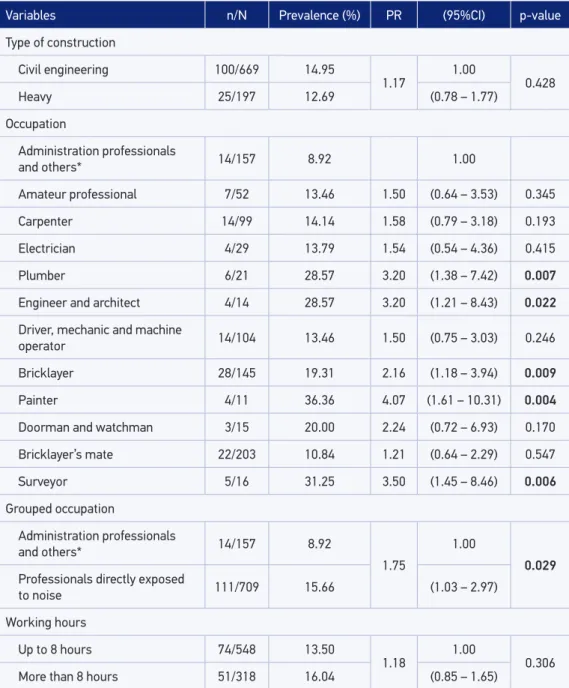
and other workers indirectly exposed, the former group showed higher prevalences of audi-tory handicap (PR = 2.16, 95%CI 1.75-2.97).
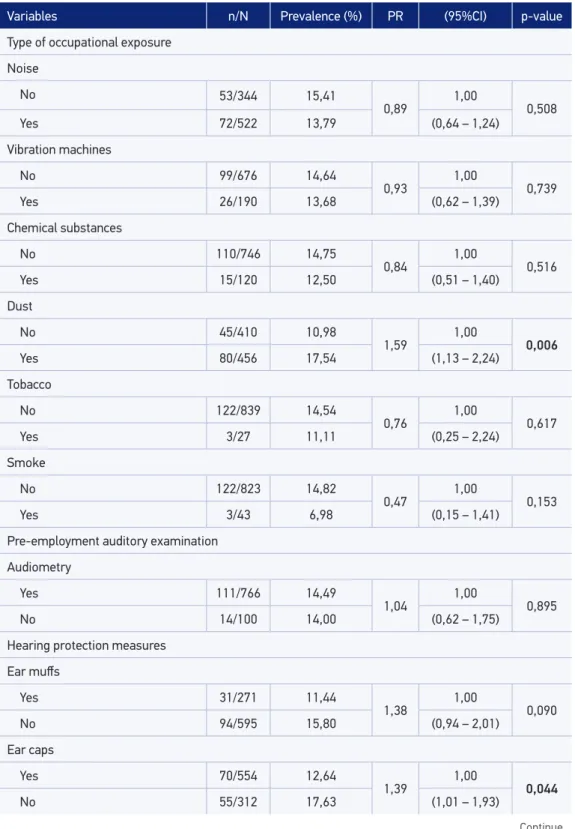
Table 4 shows the prevalence and prevalence ratios of the auditory handicap accord-ing to occupational risks and use of hearaccord-ing protection devices. We observed that the auditory handicap was higher among workers exposed to dust (PR = 1.59; 95%CI 1.13-2.24), who did not use ear caps (PR = 1.39; 95%CI 1.01-1.93) and who did not use neck flap caps (PR = 1.45, 95%CI 1.03-2.04), all with significant statistical differences. Pre-employment testing (audiometry) revealed no significant differences between the ana-lyzed groups.
Table 1. Prevalence of auditory handicap in construction workers in Mato Grosso, 2014.
Variables n %
Auditory handicap
Yes 125 14.43
No 741 85.57
Total 866 100.00
Impact of hearing loss on the emotional aspect*
Feel embarrassed among strangers 62 49.60
Feel frustrated or dissatisied when among family 47 37.60
Feel harmed by the auditory problem 30 24.00
Have limitations in individual or social life 16 12.80
Have arguments with family members because of the auditory problem 12 9.60
Impact of hearing loss on the social aspect*
Diiculty hearing someone whispering 63 50.40
Attend church less 23 18.40
Diiculty when listening to TV or radio 23 18.40
Diiculty when visiting friends 20 16.00
Diiculty when in a restaurant 15 12.00
Grouped impact*
Complaints regarding the emotional aspect 167 53.70
Complaints regarding the social aspect 144 46.30
Total complaints 311 100.00
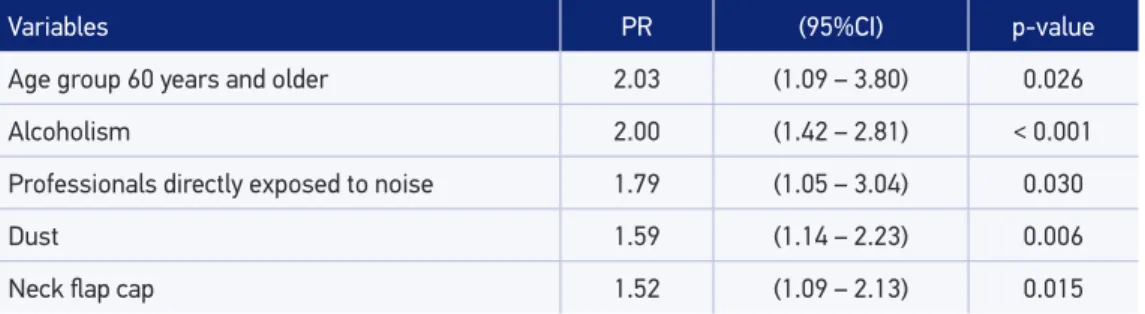
In the inal model (Table 5), the variables associated with the presence of auditory hand-icap included: age group 60 years and older; alcoholism; professionals directly exposed to noise and dust; and no use of neck lap cap.
Table 2. Factors associated with auditory handicap according to sociodemographic and lifestyle characteristics of workers in the construction sector in Mato Grosso, 2014.
Variables n/N Prevalence (%) PR (95%CI) p-value
Demographic data
Sex
Female 13/84 15.48
0.92 1.00 0.775
Male 112/782 14.32 (0.54 – 1.56)
Age group (years)
17 – 29 50/365 13.70 1.00
30 – 39 34/238 14.29 1.04 (0.69 – 1.56) 0.838
40 – 49 18/139 12.95 0.94 (0.57 – 1.56) 0.826
50 – 59 15/94 15.96 1.16 (0.68 – 1.98) 0.575
60 or older 8/30 26.67 1.94 (1.01 – 3.71) 0.049
Grouped education
Illiterate 2/26 7.69
1.90 1.00 0.320 Other education levels 123/840 14.64 (0.49 – 7.28)
Per capta income (BRL)
76 – 499 31/210 14.76 1.00
500 – 749 21/200 10.50 0.71 (0.42 – 1.19) 0.195
750 – 1.199 37/212 17.45 1.18 (0.76 – 1.83) 0.452
1.200 or more 36/244 14.75 0.99 (0.64 – 1.55) 0.998
Lifestyle
Smoking
No 101/682 14.81
0.88 1.00 0.545
Yes 24/184 13.04 (0.58 – 1.33)
Alcoholism
No 44/445 9.89
1.94 1.00 < 0.001
Yes 81/421 19.24 (1.38 – 2.73)
DISCUSSION
The prevalence of hearing handicap among construction workers was 14.43% (n = 125). The interviewees reported several types of emotional and social diiculties resulting from
Variables n/N Prevalence (%) PR (95%CI) p-value
Type of construction
Civil engineering 100/669 14.95
1.17 1.00 0.428
Heavy 25/197 12.69 (0.78 – 1.77)
Occupation
Administration professionals
and others* 14/157 8.92 1.00
Amateur professional 7/52 13.46 1.50 (0.64 – 3.53) 0.345
Carpenter 14/99 14.14 1.58 (0.79 – 3.18) 0.193
Electrician 4/29 13.79 1.54 (0.54 – 4.36) 0.415
Plumber 6/21 28.57 3.20 (1.38 – 7.42) 0.007
Engineer and architect 4/14 28.57 3.20 (1.21 – 8.43) 0.022
Driver, mechanic and machine
operator 14/104 13.46 1.50 (0.75 – 3.03) 0.246
Bricklayer 28/145 19.31 2.16 (1.18 – 3.94) 0.009
Painter 4/11 36.36 4.07 (1.61 – 10.31) 0.004
Doorman and watchman 3/15 20.00 2.24 (0.72 – 6.93) 0.170
Bricklayer’s mate 22/203 10.84 1.21 (0.64 – 2.29) 0.547
Surveyor 5/16 31.25 3.50 (1.45 – 8.46) 0.006
Grouped occupation
Administration professionals
and others* 14/157 8.92
1.75
1.00
0.029 Professionals directly exposed
to noise 111/709 15.66 (1.03 – 2.97)
Working hours
Up to 8 hours 74/548 13.50
1.18 1.00 0.306
More than 8 hours 51/318 16.04 (0.85 – 1.65)
*Other professionals indirectly exposed to noise; PR = prevalence ratio; 95%CI = 95% conidence interval.
Table 4. Factors associated with auditory handicap according to occupational risks of workers in the construction sector in Mato Grosso, 2014.
Variables n/N Prevalence (%) PR (95%CI) p-value
Type of occupational exposure
Noise
No 53/344 15,41
0,89 1,00 0,508
Yes 72/522 13,79 (0,64 – 1,24)
Vibration machines
No 99/676 14,64
0,93 1,00 0,739
Yes 26/190 13,68 (0,62 – 1,39)
Chemical substances
No 110/746 14,75
0,84 1,00 0,516
Yes 15/120 12,50 (0,51 – 1,40)
Dust
No 45/410 10,98
1,59 1,00 0,006
Yes 80/456 17,54 (1,13 – 2,24)
Tobacco
No 122/839 14,54
0,76 1,00 0,617
Yes 3/27 11,11 (0,25 – 2,24)
Smoke
No 122/823 14,82
0,47 1,00 0,153
Yes 3/43 6,98 (0,15 – 1,41)
Pre-employment auditory examination Audiometry
Yes 111/766 14,49
1,04 1,00 0,895
No 14/100 14,00 (0,62 – 1,75)
Hearing protection measures
Ear mufs
Yes 31/271 11,44
1,38 1,00 0,090
No 94/595 15,80 (0,94 – 2,01)
Ear caps
Yes 70/554 12,64
1,39 1,00 0,044
No 55/312 17,63 (1,01 – 1,93)
the auditory problem, which include feeling embarrassed among strangers, frustration, dif-iculty hearing someone whispering and social isolation.
The prevalence of hearing handicap was widely studied among other professionals who are constantly exposed to noise, such as firearm users (10.60%)1,3 garment workers (24.10%)8, oven operators (11.07%)14, foundry workers (14.47%)14, rolling mill opera-tors (16.99%)14, mechanical workshop workers (17.04%)14, fabrication workshop work-ers (16.42%)14, and general service workers (10.37%)14. These prevalences are close to the results obtained in the present study (14.43%), since all workers were exposed to high daily levels of sound pressure. However, we were not able to compare the prev-alence of hearing handicap found in the present study with other workers in the sec-tor because the literature focus mostly on the conventional audiological data and on noise level and neglect the social and emotional conditions that the auditory sensorial deprivation may cause.
The emotional and social diiculties caused by acquired hearing loss are due, among other causes, to the diiculty workers experience when communicating in their social groups15. In this way, when perceiving hearing loss, individuals tends to isolate themselves and com-municate less with co-workers2. In addition, workers with hearing impairment have more
PR: prevalence ratio; 95% IC: 95% conidence interval.
Table 5. Final Poisson model of variables associated with auditory handicap according to occupational risks of workers in the construction sector in Mato Grosso, 2014.
Variables PR (95%CI) p-value
Age group 60 years and older 2.03 (1.09 – 3.80) 0.026
Alcoholism 2.00 (1.42 – 2.81) < 0.001
Professionals directly exposed to noise 1.79 (1.05 – 3.04) 0.030
Dust 1.59 (1.14 – 2.23) 0.006
Neck lap cap 1.52 (1.09 – 2.13) 0.015
Table 4. Continuation.
Variables n/N Prevalence (%) PR (95%CI) p-value
Cap-mount earmuf
Yes 18/156 11,54
1,30 1,00 0,255
No 107/710 15,07 (0,81 – 2,08)
Neck lap cap
Yes 45/390 11,54
1,45 1,00 0,028
No 80/476 16,81 (1,03 – 2,04)
diiculty understanding instructions, following routines and meeting obligations, which can increase the risk of work-related accidents8,16.
In relation to age, older workers reported higher prevalence of hearing handicap. These indings were compatible with previous studies3,8, which revealed that older work-ers in the construction sector are 2-6 times more likely to have hearing problems than pro-fessionals in other activities. This fact is understandable because older individuals tend to be exposed to occupational risk factors for hearing loss for longer periods, and sufer more from the cumulative efect of aging on hearing (presbycusis)7.
The present study identified a higher prevalence of hearing loss among work-ers who declared themselves to be alcoholics. In two systematic reviews17,18, alcohol use and abuse were associated with ototoxicity, with damage to the auditory system. However, some authors have found protective effects of low-risk drinking on hearing loss, stating that moderate drinking activates protection mechanisms against distur-bances in the cochlear blood flow19,20. Still regarding alcohol use, other studies found no significant association between moderate or heavy drinking and hearing loss21,22. Considering the high prevalence (50%) of alcoholism among construction workers found by the present study, it is important to highlight that it is fundamental to pre-vent alcohol abuse, even though the physiological mechanism that may cause hearing loss has not been clarified.
In the present study, bricklayers, plumbers and professionals directly exposed to occu-pational hearing hazards had higher prevalences of hearing loss compared to other work-ers. Leensen et al1. studied medical records of periodic occupational health examinations of construction workers in the Dutch industry and found that bricklayers and plumbers have the highest noise exposure and hearing loss levels. Another study that followed construc-tion workers who underwent periodic occupaconstruc-tional hearing screening for a 4-year period also found direct exposure to noise as the main predictor of hearing loss23. In an audiomet-ric study with shipbuilding workers in Madrid, Spain, Mur et al. also demonstrated that noise-exposed workers had a prevalence of noise-induced hearing loss 3.1-fold higher than professionals in administrative positions24.
It is interesting to note that professional categories supposed to be less exposed to noise and chemical hazards, such as engineers, architects and surveyors, were also associated with high auditory loss rates. One probable explanation is that these professionals, due to their higher level of education, perceive more clearly certain occupational exposure risks, or even their state of health, responding more airmatively to the HHIE-S. Alves and Rodrigues25, in a study on determinants of self-reported health, found that educational level, among other socioeconomic variables, was highly associated with health perception. In addition, occu-pational safety engineers are professionals belonging to the Specialized Services in Safety Engineering and Occupational Medicine (SESMT) who routinely care about work-related accidents and illnesses26.
in conined spaces. Some dust found in the work environment, when penetrating the ear – either by simply obstructing the ear canal or by the degree of ototoxicity of some chemi-cals in its composition – can cause hearing loss, also inluencing the worker to refer a higher hearing loss rate28.
Regarding the use of personal protective equipment (PPE), workers who did not wear neck flap caps and ear muffs revealed higher prevalence of hearing loss. Despite the need for hearing protection, elevated temperatures in the study sites and discomfort cause workers to use PPE improperly. In addition, there was no reference to hearing conservation programs at any construction site where the study was conducted. In view of the results of the present study, we suggest that these programs be implemented in order to identify and evaluate the risks and auditory exams, promote the use of indi-vidual and collective protection and establish training programs to prevent hearing loss among workers29,30.
Regarding hearing tests, we found no statistically significant differences in the high rates of hearing loss among workers who underwent pre-employment audiometry and the others. However, some workers declared that they had never undergone any type of pre-employment hearing test. This situation is worrying, since studies show that the work environment in the construction sector presents high levels of sound pres-sure and other harmful agents to the auditory system, configuring an important pub-lic health problem2-4.
The results of the present study point to the need for hearing monitoring through the investigation of auditory handicap among construction workers, as established by the Occupational Health Medical Control Program (PCMSO) part of the Brazilian Consolidation of Labor Laws (CLT)31. Thus, it is important to reinforce auditory handicap research with routine audiological assessments related to the work environment in order to understand the real dimension of the auditory problem and its consequences to the worker’s quality of life, as well as to support speciic prevention and promotion measures aimed at work-ers’ auditory health.
Some limitations of this study should be considered. We were not able to carry out audiometric tests due to diiculties in the application of an epidemiological inquiry with collection of various other information on exposure and work-related diseases. Thus, we opted to apply the self-reported auditory handicap questionnaire as proxy information for hearing loss. This instrument is recommended for hearing screenings, as a comple-ment to traditional audiological assesscomple-ments and even as validation of the hearing pro-tection process7,8.
It is important to point out that instruments for direct hearing loss assessment, such as audiometry screening, can not deinitively express the real emotional and social impact on daily life32, which makes the assessment of auditory handicap a diferential in this study.
external validity. Another limitation refers to the fact that pre-employment medical tests are performed when workers enter the construction industry, selecting only the healthiest indi-viduals to work in the companies. This selection may lead to the occurrence of a “healthy worker efect”, whereby workers with established hearing loss are rejected after the medical tests33,34. Also, we should not exclude a possible memory bias because the questionnaire is based on participants’ recall, in which the most exposed workers may have better remem-bered the activities with risks of hearing loss.
CONCLUSION
The study showed a presence of self-reported hearing handicap, with emotional and social complaints among workers in the construction sector. Due to the presence of audi-tory alterations, workers reported having undergone various psychosocial problems, hear-ing diiculties and even social isolation.
The assessment of auditory handicap was important for the monitoring of worker’s hearing health. It is necessary to efectively implement public policies for the promotion and prevention of hearing loss induced by high sound pressure levels and the conservation of the auditory health of workers in the construction sector.
1. Leensen MC, Van Duivenbooden JC, Dreschler WA. A retrospective analysis of noise-induced hearing loss in the Dutch construction industry. Int Arch Occup Environ Health 2011 Jun; 84(5): 577-90.
2. Deacon C, Smallwood J, Haupt T. The health and well-being of older construction workers. International Congress Serie 2005; 1280: 172-7.
3. Ringen K, Dement J, Welch L, Dong XS, Bingham E, Quinn PS. Risks of a lifetime in construction. Part II: Chronic occupational diseases. Am J Ind Med 2014 Nov; 57(11): 1235-45.
4. Empresa de Tecnologia e Informações da Previdência Social. [Internet]. Brasília: Base de dados Históricos de Acidentes de Trabalho [s.d.] [cited on 2014 Nov 2014]. Available from: http://www3.dataprev.gov. br/AEAT/greg/reg04/reg04.PHP
5. Cruz MS, Oliveira LR, Carandina L, Lima MCP, César CLG, Barros MBA, et al. Prevalência de deiciência auditiva referida e causas atribuídas: um estudo de base populacional. Cad Saúde Pública 2009 May; 25(5): 1123-31.
6. Organização Mundial da Saúde. Rumo a uma Linguagem Comum para Funcionalidade, Incapacidade
e Saúde CIF [Internet]. Genebra: WHO; 2002 [cited on 2014 Nov 9]. Available from: http://www.paho.org/ bracolab/index.php?option=com_docman&task=doc_ details&gid=105&Itemid=310
7. Menegotto IH, Soldera LCH, Anderle P, Anhaia TC. Correlation between hearing loss and the results of the following questionnaires: Hearing Handicap Inventory for the Adults – Screening Version HHIA-S e Hearing Handicap Inventory for the Elderly – Screening Version – HHIE-S. Arq Int Otorrinolaringol 2011; 15(3): 319-26. 8. Alves AS, Fiorini AC. A autopercepção do handicap auditivo em trabalhadores de uma indústria têxtil. Distúrb comum 2012 Dec; 24(3): 337-49.
9. Luiz RR, Magnanini MMF. A lógica da determinação do tamanho da amostra em investigações epidemiológicas. Cad Saúde Colet 2000; 8(2): 9-28.
10. Ventry IM, Weinstein BE. Audiometric correlates of the hearing handicap inventory for the elderly. J Speech Hear Disord 1983; 48: 379-84.
11. Wieselberg MB. A auto-avaliação do handicap em idosos portadores de deiciência auditiva: o uso do HHIE [dissertação]. São Paulo: Pontifícia Universidade Católica de São Paulo; 1997.
12. Carvalho RM, Iório MCM. Eficácia da aplicação do questionário de handicap em idosos deicientes auditivos. Distúrb Comun 2007; 19(2): 163-72. 13. Stewart M, Pankiw R, Lehman ME, Simpson TH.
Hearing loss and hearing handicap in users of recreational irearms. J Am Acad Audiol 2002; 13(3): 160-8. 14. Gomes J, Lloyd O, Norman N. The health of the
workers in a rapidly developing country: efects of occupational exposure to noise and heat. Occup Med 2002; 52(3): 121-8.
15. Francelin MAS, Motti TFG, Morita I. As Implicações Sociais da Deiciência Auditiva Adquirida em Adultos. Saúde Soc 2010; 19(1): 180-92.
16. Lima II, Aiello CP, Ferrari DV. Correlações audiométricas do questionário de handicap auditivo para adultos. Rev CEFAC 2011 Jun; 13(3): 496-503.
17. Samokhvalov AV, Popova S, Room R, Ramonas M, Rehm J. Disability associated with alcohol abuse and dependence. Alcohol Clin Exp Res 2010 Nov; 34(11): 1871-8. 18. Bellé M, Sartori SA, Rossi AG. Alcoholism: efects on the
cochleo-vestibular apparatus. Braz J Otorhinolaryngol 2007; 73:110-6.
19. Fransen E, Topsakal V, Hendrickx JJ, Van Laer L, Huyghe JR, Van Eyken E, et al. Occupational noise, smoking, and a high body mass index are risk factors for age-related hearing impairment and moderate alcohol consumption is protective: a European population-based multicenter study. J Assoc Res Otolaryngol 2008; 9: 264-76. 20. Popelka MM, Cruickshanks KJ, Wiley TL, Tweed TS,
Klein BE, Klein R, et al. Moderate alcohol consumption and hearing loss: a protective efect. J Am Geriatr Soc 2000; 48: 1273-8.
21. Curhan SG, Eavey R, Shargorodsky J, Curhan GC. Analgesic Use and the Risk of Hearing Loss in Men. Am J Med 2010; 123: 231-7.
22. Curhan SG, Eavey R, Shargorodsky J, Curhan GC. Prospective Study of Alcohol Use and Hearing Loss in Men. Ear Hear 2011; 32(1): 46-52.
23. Leensen MC, Dreschler WA. Longitudinal changes in hearing threshold levels of noise-exposed construction workers. Int Arch Occup Environ Health 2015 Jan; 88(1): 45-60.
24. Mur PG, Bermúdez BP, Monroy AM. Pérdidas auditivas relacionadas con la exposición a ruido en trabajadores de la construcción. Med Segur Trab 2008 Dec; 54(213): 33-40.
25. Alves L, Rodrigues RN. Determinantes da autopercepção de saúde entre idosos do Município de São Paulo, Brasil. Rev Panam Salud Publica 2005; 17(5/6): 333-41. 26. Teixeira MC. A invisibilidade das doenças e acidentes do trabalho na sociedade atual. Rev Dir Sanitário 2012; 13(1): 102-31.
27. Gerges SNY. Critérios importantes. Rev Prot 2007; 183. 28. Liao EC, Chang KC. Mites in the External Auditory
Canal. N Engl J Med 2012 Oct; 367: e19.
29. Comitê Nacional de Ruído e Conservação Auditiva. Boletim nº 6 [Internet]. Arq Fund Otorrinolaringol. 2000 [cited on 2000 Apr/June]; 4(2). Available from: http://arquivosdeorl.org.br/conteudo/acervo_port. asp?id=125
30. Oliveira WTGH, Andrade WTL, Teixeira CF, Lima MLLT. Audição de Trabalhadores Antes e Após o Programa de Conservação Auditiva. Rev Bras Ciên Saúde 2012; 16(4): 517-24.
31. Brasília (Distrito Federal). Portaria nº 24, de 29 de dezembro de 1994. Aprova o Programa de Controle Médico de Saúde Ocupacional. Diário Oicial da União. 30 dez 1994.
32. Rosis ACA, Souza MRF, Iório MCM. Questionário Hearing Handicap Inventory for the Elderly - Screening version (HHIE-S): estudo da sensibilidade e especificidade. Rev Soc Bras Fonoaudiol 2009; 14(3): 339-45.
33. Hardman CM, Barros SSH, Oliveira ESA, Nahas MV, Barros MVG. Inatividade nos deslocamentos para o trabalho e fatores associados em industriários. Saúde Soc 2013 Sep; 22(3): 760-72.
34. Graudenz GS. Indicadores infecciosos e inlamatórios entre trabalhadores da limpeza urbana em São Paulo. Rev Bras Saúde Ocup 2009 Dec; 34(120): 106-14. Received on: 07/14/2016