AMTD
5, 6479–6492, 2012Improving Langley
A. Kreuter et al.
Title Page
Abstract Introduction
Conclusions References
Tables Figures
◭ ◮
◭ ◮
Back Close
Full Screen / Esc
Printer-friendly Version Interactive Discussion
Discussion
P
a
per
|
Dis
cussion
P
a
per
|
Discussion
P
a
per
|
Discussio
n
P
a
per
|
Atmos. Meas. Tech. Discuss., 5, 6479–6492, 2012 www.atmos-meas-tech-discuss.net/5/6479/2012/ doi:10.5194/amtd-5-6479-2012
© Author(s) 2012. CC Attribution 3.0 License.
Atmospheric Measurement Techniques Discussions
This discussion paper is/has been under review for the journal Atmospheric Measurement Techniques (AMT). Please refer to the corresponding final paper in AMT if available.
Improving Langley calibrations by
reducing diurnal variations of aerosol
˚
Angstr ¨om parameters
A. Kreuter, S. Wuttke, and M. Blumthaler
Sektion f ¨ur Biomedizinische Physik, Medizinische Universit ¨at Innsbruck, M ¨ullerstrasse 44, 6020 Innsbruck, Austria
Received: 25 July 2012 – Accepted: 28 August 2012 – Published: 7 September 2012 Correspondence to: A. Kreuter ([email protected])
Published by Copernicus Publications on behalf of the European Geosciences Union.
AMTD
5, 6479–6492, 2012Improving Langley
A. Kreuter et al.
Title Page
Abstract Introduction
Conclusions References
Tables Figures
◭ ◮
◭ ◮
Back Close
Full Screen / Esc
Printer-friendly Version Interactive Discussion
Discussion
P
a
per
|
Dis
cussion
P
a
per
|
Discussion
P
a
per
|
Discussio
n
P
a
per
|
Abstract
Errors in the sun photometer calibration constant lead to artificial diurnal variations, symmetric around solar noon, of the retrieved Aerosol Optical Depth (AOD) and the associated ˚Angstr ¨om exponent α and its curvature γ. We show in simulations that within the uncertainty of state-of-the-art Langley calibrations, these diurnal variations of
5
αandγcan be significant in low AOD conditions, while those of AOD are negligible. We implement a weighted Monte-Carlo method of finding an improved calibration constant by minimizing the diurnal variations inαandγand apply the method to sun photometer data of a clear day in Innsbruck, Austria. The results show that our method can be used to improve the calibrations in two of the four wavelength channels by up to a factor of
10
3.6.
1 Introduction
Sun Photometers (SPM) are radiometers to determine the spectral Aerosol Optical Depth (AOD), the columnar aerosol loading of the atmosphere, which is an important radiative forcing parameter of the earth’s climate system (Solomon, 2007). The AOD is
15
determined from direct sun irradiance measurements and application of the Bouguer-Lambert-Beer law which describes the exponential extinction of light on its way through the atmosphere. Ensuring a constant filter and detector response, the main challenge in sun photometry lies in the calibration (Shaw, 1976).
The best sun photometer calibration methods are the so-called Langley calibrations
20
(and its variations) which are based on extrapolating the diurnal SPM signal to zero air mass (e.g. Forgan, 1994). While no additional equipment is needed, the Langley methods require clear and highly stable atmospheric aerosol conditions, typically only found above the planetary boundary layer on high mountain sites.
Here, we introduce a new method that may alleviate this restriction and improve the
25
AMTD
5, 6479–6492, 2012Improving Langley
A. Kreuter et al.
Title Page
Abstract Introduction
Conclusions References
Tables Figures
◭ ◮
◭ ◮
Back Close
Full Screen / Esc
Printer-friendly Version Interactive Discussion
Discussion
P
a
per
|
Dis
cussion
P
a
per
|
Discussion
P
a
per
|
Discussio
n
P
a
per
|
2 Systematic diurnal variations of AOD and ˚Angstr ¨om parameters
A ground based photo detector pointed at the sun with a narrow field-of-view and a band pass filter measures a signalV that is related to the signal at the top of the atmosphereV0(the calibration constant, sometimes also called extraterrestrial signal) by
5
V =V0/r2×exp(−τ m) (1)
Where r is the normalized sun-earth distance and m is the relative air mass factor. The air mass is approximately 1/cos(θ),θis the Solar Zenith Angle (SZA), refined ex-pressions are given by Kasten and Young (1989). The total extinctionτ is the sum of the contributions of Aerosol Optical Depthτa and τray, the extinction due to
molecu-10
lar Rayleigh scattering (Bodhaine et al., 1999). Here, for simplicity and clarity of the argument, we restrict the discussion to bands outside molecular absorptions.
The logarithm of the signalV has a linear diurnal dependency on the air mass with slopeτand ordinate intercept log (V0/r2). So the calibration constant V0can be found by a linear fit, i.e. extrapolating to zero air mass, which is the basis of the Langley
cal-15
ibration methods. Langley calibrations at high mountain sites (e.g. Mauna Loa, Hawaii or Jungfraujoch, Swiss Alps) are amongst the most accurate methods for SPM calibra-tion and achieve uncertainties below 0.5 % (Holben et al., 1998; Wehrli, 2000).
KnowingV0, the AOD can be calculated straight-forwardly by re-arranging Eq. (1):
τa=−log (r2V/V0)/m−τray (2)
20
Errors in the calibration are typically the largest sources of uncertainty in determining AOD (Shaw, 1976). It follows from Eq. (2) that an error inV0 causes an air mass de-pendent offset in the derived AOD which has been pointed out by several authors (see, e.g. Cachorro et al., 2008). The erroneously derived AOD,τa′ under the assumption of
a wrongV0′ is:
25
τ′
a=τa+log (V
′
0/V0)/m (3)
AMTD
5, 6479–6492, 2012Improving Langley
A. Kreuter et al.
Title Page
Abstract Introduction
Conclusions References
Tables Figures
◭ ◮
◭ ◮
Back Close
Full Screen / Esc
Printer-friendly Version Interactive Discussion
Discussion
P
a
per
|
Dis
cussion
P
a
per
|
Discussion
P
a
per
|
Discussio
n
P
a
per
|
A calibration error manifests itself in an artificial Diurnal Variation (DV) of the derived AOD. The deviation has a maximal magnitude at noon (bigger for higher solar eleva-tions) and vanishes for large air masses at sunset / sunrise and is symmetrical around local solar noon. Cachorro et al. have proposed an improvement of the calibration from that effect, but like all variations of the Langley method, it is intrinsically limited by the
5
natural variations of AOD.
Here we consider the spectral AOD relation because it is not affected by AOD vari-ations if the aerosol type does not change. The AOD dependency on wavelength is usually described by the ˚Angstr ¨om exponent α ( ˚Angstr ¨om, 1964). With ˚Angstr ¨om’s power-law Ansatz, the logτa–logλrelationship is linear with slopeα:
10
logτa=logβ−αlogλ (4)
Withλin units of microns, βis the AOD at wavelength of one micron. More recently, it has become common (e.g. Schuster et al., 2006) to add a quadratic term in logλto account for a possible curvature:
logτa=logβ∗+α∗logλ+γlog2λ (5)
15
The parametersαandγare determined by regression of Eqs. (4) and (5), respectively. To investigate the sensitivity of AOD,α andγ on the calibration, we theoretically sim-ulate the SPM measurement and retrieval process. We consider the case of the pre-cision filter radiometer (PFR) SPM developed by the Physikalisch-Meteorologisches Observatorium (PMOD) in Davos, Switzerland for the Global Atmospheric Watch
20
(GAW) Network (Wehrli, 2000). It features four standard aerosol wavelengths channels: 368 nm, 412 nm, 501 nm and 862 nm, which will be referred to as channels 1 to 4, re-spectively. These are similar to the most commonly used wavelengths measured by the AErosol RObotic NETwork (AERONET) (440 nm, 500 nm, 670 nm, 870 nm, 1020 nm) (Holben et al., 1998).
25
We simulate the diurnal signal V for all wavelengths for a given spectral τa using
AMTD
5, 6479–6492, 2012Improving Langley
A. Kreuter et al.
Title Page
Abstract Introduction
Conclusions References
Tables Figures
◭ ◮
◭ ◮
Back Close
Full Screen / Esc
Printer-friendly Version Interactive Discussion
Discussion
P
a
per
|
Dis
cussion
P
a
per
|
Discussion
P
a
per
|
Discussio
n
P
a
per
|
V0+σ and V0 – σ, where σ is the calibration uncertainty of 0.5 %. From Eq. (2) we derive the erroneous spectral AODτa′ under the assumption ofV0′=V0 from which we obtain the (erroneous)α′ andγ′.
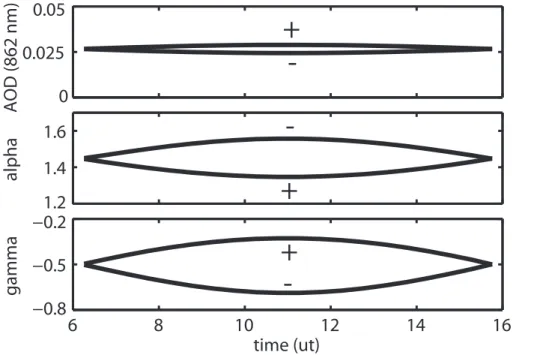
Figure 1 shows the calculation for the example values: β*=0.02, α*=2, and γ=
−0.5, which constitute pristine conditions. The time (UT) corresponds to a SZA be-5
tween 87◦ and 63◦ or air mass between 23 and 2.2 at noon (11.25 UT), beginning of
November at the location of Innsbruck, Austria at 11◦E and 47◦N.
All parameters show the characteristic DV symmetric around noon. The deviation of AOD,α and γ is biggest at local noon (DV amplitude) and approaches the correct values at low solar elevation. The respective effect of V0+σ and V0−σ traces two 10
branches marking the bounds of possible DVs, which are statistically allowed by the calibration uncertainty.
The example reveals that the DV inα and, in particular,γcan be considerable, even ifV0′ lies within theV0 uncertainty. The DV amplitude ofα andγ can reach 0.1 and 0.2 forα and γ, respectively. The amplitude of the DV in AOD (∼0.002 for channel 4) is
15
negligibly small and will likely be obscured by natural variations.
This DV in α and γ is also of specific relevance as these parameters are used as indicator of the size or size distribution of aerosols. King et al. (1978) use α to vert the aerosol size distribution with a priori assumptions on the size modes and in-dex of refraction. A semi-quantitative graphical method has been proposed (Schuster
20
et al., 2006; Gobbi et al., 2007), whereγ (or equivalently, theα-difference dA) is plot-ted against α. Changes in fine mode size and fraction trace curved lines of a grid. Since here we use the more universal parameter of the curvatureγ instead of dA, we call this alpha-gamma representation AGa-plot (in allusion of the AdA-plot in Gobbi’s nomenclature).
25
With its appealing simplicity, this representation reveals, e.g. diurnal aerosol evolu-tion such as humidificaevolu-tion or drying. In this context, the discussion of calibraevolu-tion errors is specifically relevant, because of the sensitivity of the involved parametersα and γ. Their artificial DV may substantially bias the interpretation of the AGa-plot.
AMTD
5, 6479–6492, 2012Improving Langley
A. Kreuter et al.
Title Page
Abstract Introduction
Conclusions References
Tables Figures
◭ ◮
◭ ◮
Back Close
Full Screen / Esc
Printer-friendly Version Interactive Discussion
Discussion
P
a
per
|
Dis
cussion
P
a
per
|
Discussion
P
a
per
|
Discussio
n
P
a
per
|
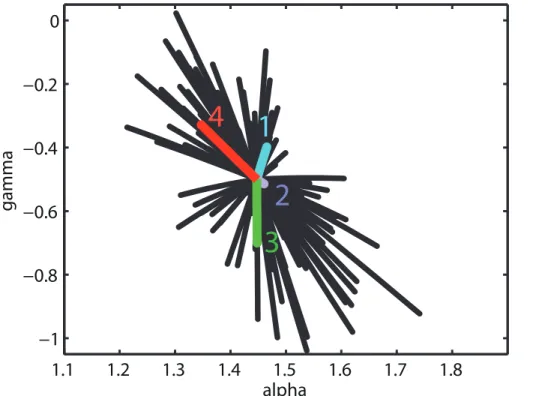
The individual effect of a calibration error in each of the different channels on the AGa-plot is illustrated in Fig. 2. Each colored line represents the resulting DV when adding an error of 1σ(0.5 %) to theV0 of the respective channel. It is apparent that an error in channel 3 or 4 (green and red lines) has the largest impact on the DV inα and γ, while channel 2 has a vanishing influence. The total effect of errors in all channels
5
and the resulting error in the AGa-plot is the sum of the individual effects.
3 Minimization of diurnal variations
As demonstrated, a residual artificial DV in α and γ may persist even after state-of-the-art calibration showing that these parameters are extremely sensitive to calibration errors. The idea here is to harness this sensitivity and improve the calibration by
min-10
imizing any residual DV inα andγ. Consequently, this also improves the accuracy of the AGa-representation and its interpretation. The question is: can one find a set ofV0 for all channels as close as possible to the certified calibration so that DVs inα andγ both vanish?
We propose to solve the problem with a conceptually simple Monte-Carlo (MC)
15
method: trying a large ensemble of random combinations ofV0′ weighted with a Gaus-sian uncertainty function centered onV0and select theV0′ that yields the smallest DV.
Since bothα andγ show independent DVs we consider the Total DV (TDV) amplitude
to be minimized: TDV2=DV2α+DV2γ. The DV amplitudes DVα and DVγ are specified here as their respective difference of their values at noon (lowest SZA) and highest
20
SZA. An ensemble of diurnalα andγ values from 100 generatedV0′ is shown in Fig. 2. The DVs are arranged in a “star” pattern, with the center being the trueαandγvalues approached at low solar elevation and the length of the spikes are the TDV amplitudes. Note that using a random number for V0′ that is normally distributed with σ is an implicit weighting of the solution by the mean squared error (mse) of V0 and V0best.
AMTD
5, 6479–6492, 2012Improving Langley
A. Kreuter et al.
Title Page
Abstract Introduction
Conclusions References
Tables Figures
◭ ◮
◭ ◮
Back Close
Full Screen / Esc
Printer-friendly Version Interactive Discussion
Discussion
P
a
per
|
Dis
cussion
P
a
per
|
Discussion
P
a
per
|
Discussio
n
P
a
per
|
Smaller deviations ofV0′fromV0are more likely generated in the MC-method and hence the solutionV0bestshould be found as close toV0as possible.
4 Application to SPM data
We then apply the above MC method of finding an improvedV0with resulting minimal TDV to real data of our SPM located in Innsbruck/Austria. We have been measuring
5
AOD since 2007 and the 5-yr climatology has recently been submitted for publication (Wuttke et al., 2012).
The SPM has been calibrated by the PMOD and the V0 for the four wavelengths
channels from certificate is:
10
V0C=[4.262(20) 3.778(16) 3.772(30) 3.565(20)]V,
where the 1σ uncertainties are given in brackets, corresponding to relative accu-racies inV0of 0.5 %, 0.4 %, 0.8 % and 0.6 %, respectively.
We found a particularly good example day in Innsbruck with low and fairly constant
15
AOD on 10 November 2011. This cloudless day in late autumn with relatively low solar elevation was characterized by a dominant anti-cyclonic weather situation, no wind and no convective mixing of the boundary layer.
We define DVα as the difference of α at noon (mean of 24 min) and the mean of
α at three hours before and after noon. DVγ is defined accordingly and again the
20
TDV amplitude is considered. We run the MC procedure with 10 000 trials (different combinations of weighted randomV0′) to select theV0′ with the minimal TDV amplitude and find:
V0best=[4.277 3.795 3.730 3.583]V
25
AMTD
5, 6479–6492, 2012Improving Langley
A. Kreuter et al.
Title Page
Abstract Introduction
Conclusions References
Tables Figures
◭ ◮
◭ ◮
Back Close
Full Screen / Esc
Printer-friendly Version Interactive Discussion
Discussion
P
a
per
|
Dis
cussion
P
a
per
|
Discussion
P
a
per
|
Discussio
n
P
a
per
|
The difference to the original certificate is (V0C – V0best)=[−0.015 −0.017 0.043 −0.018], which lies almost within the 1σ uncertainty of the calibration certificate. The
effect of applying this newV0bestto the derivation of the aerosol parameters is shown in Fig. 3a (green curves). The absolute difference in resulting AOD is [0.002 0.002 0.005 0.002]. These differences are of the order of the given AOD uncertainty and smaller
5
than the standard deviation of the AODs (variation) over the day of each channel (except for channel 3 where the standard deviation of AOD is 0.03). No significant DV of AOD can be detected within the natural fluctuations.
The data for α and γ are depicted in the AGa-plot in Fig. 3b. The original DV (red dots) in γ is significant, as it ranges from −0.4 in the morning to −0.9 at noon. The 10
variation in α is less and ranges from 1.5 to 1.6. Consequently, in the AGa-plot the representation has changed significantly after application of V0best. The loci of green
points are now more clustered (standard deviations of α and γ are 0.02 and 0.03,
respectively) and indicate a largerγ, pointing towards a smaller fine mode radius and fraction.
15
5 Discussion
One of the questions after finding a solution with minimal TDV and correspondingV0best is about its uniqueness. One might conclude that aV0′ that minimizes the TDV is nec-essarily closer to the trueV0. This seems not true in general.
The calibration error in each channel results in a different TDV, both in magnitude
20
and direction in the AGa-representation (Fig. 2). This means that a given TDV can be realized by a variety of combinations inV0′ and hence, the sole criterion of a minimal TDV does not yield a unique solution V0best. It is only the result of the additional con-straint of minimizing the root-mean-squared error (rms) with respect to the originalV0
(realized by the normal distribution of trials in the MC method) that a unique solution
AMTD
5, 6479–6492, 2012Improving Langley
A. Kreuter et al.
Title Page
Abstract Introduction
Conclusions References
Tables Figures
◭ ◮
◭ ◮
Back Close
Full Screen / Esc
Printer-friendly Version Interactive Discussion
Discussion
P
a
per
|
Dis
cussion
P
a
per
|
Discussion
P
a
per
|
Discussio
n
P
a
per
|
can be found. Of course, for aV0best with a large rms-distance to the true calibration, the DV in the AOD will become significant and can then be used as a constraint.
The next question is about the uncertainty of the solution V0best and whether it re-ally constitutes an improvement beyond the Langley uncertainty. We repeat the MC-procedure with 100 trials of simulated data for 100 randomV0 in the interval [V0 – σ,
5
V0+σ] and compare each solution V0best with the corresponding target input V0. The standard deviation of the difference of the two is the uncertainty ofV0best. We find that
channels 1 and 2 have similar standard deviations as the σ of 0.5 %. The standard
deviation of channels 3 and 4 are determined to 0.31 % and 0.14 %, respectively. This implies that theV0best of channels 3 and 4 are indeed closer to the trueV0 and reduce
10
their calibration uncertainty to 0.61σand 0.28σ, respectively.
For two reasons the channels at higher wavelengths are more sensitive here. Their wavelength spacing (in logarithmic scale) increases with wavelength. The logarithmic distance between channels 1 and 2 is 1/5 of that of channel 3 and 4. The latter are hence more influential on the determination of α and γ and their calibration is more
15
sensitive. Furthermore, the Rayleigh scattering contribution to the total optical depth becomes dominant at smaller wavelengths, and leads to decreasing sensitivity to cali-bration errors for short wavelength channels.
The reduction of the calibration uncertainty achieved here stems from the consid-eration of the spectral AOD, i.e. the combination of all channels as opposed to each
20
channel individually in the Langley methods. The spectral AOD relations ( ˚Angstr ¨om parameters) are more sensitive to calibration errors and independent of natural AOD variations. This also signifies an alleviation of the requirement for Langley calibrations. In our method, only the variation in α and γ must be small, i.e. aerosol type or size distribution must remain constant. This condition is more often fulfilled at stations like
25
Innsbruck.
AMTD
5, 6479–6492, 2012Improving Langley
A. Kreuter et al.
Title Page
Abstract Introduction
Conclusions References
Tables Figures
◭ ◮
◭ ◮
Back Close
Full Screen / Esc
Printer-friendly Version Interactive Discussion
Discussion
P
a
per
|
Dis
cussion
P
a
per
|
Discussion
P
a
per
|
Discussio
n
P
a
per
|
6 Conclusions
We have shown that the ˚Angstr ¨om parametersα andγare extremely sensitive indica-tors of calibration errors and artificial DVs can be significant under low AOD conditions even if the calibration is within 0.5 % relative uncertainty. The DV amplitudes inαandγ can be reduced by stochastically varying the calibration constantV0using a weighted
5
MC method. The method has been characterized with model simulations and applied to real data from a PFR-SPM on a clear and stable day in Innsbruck. Minimizing the total DV amplitude in α and γ, a new calibration constant V0 has been determined which reduces the calibration uncertainty of two of the PFR-SPM wavelengths chan-nels by a factor of up to 3.6. Our method may be easily generalized to other SPMs with
10
more and/or different aerosol wavelength channels to improve the calibration beyond the Langley uncertainty.
Acknowledgements. We thank G. P. Gobbi for the calculation of the grid lines in the AGa-plots.
References
˚
Angstr ¨om, A.: The parameters of atmospheric turbidity, Tellus, 16, 64–75, 1964. 15
Bodhaine, B. A., Wood, N. B., Dutton, E. G., and. Slusser, J. R.: On rayleigh optical depth calculations, J. Atmos. Ocean. Tech., 16, 1854–1861, 1999.
Cachorro, V. E., Toledano, C., Berjon, A., de Frutos, A. M., Torres, B., Sorribas, M., and Laulainen, N. S.: An “in situ” calibration-correction procedure (KCICLO) based on AOD diurnal cycle: comparative results between AERONET and reprocessed (KCICLO 20
method) AOD-alpha data series at El Arenosillo, Spain, J. Geophys. Res., 113, 02207, doi:10.1029/2007JD009001, 2008.
Forgan, B. W.: General method for calibrating Sun photometers, Appl. Optics, 33, 4841 – 4850, 1994.
Gobbi, G. P., Kaufman, Y. J., Koren, I., and Eck, T. F.: Classification of aerosol properties derived 25
AMTD
5, 6479–6492, 2012Improving Langley
A. Kreuter et al.
Title Page
Abstract Introduction
Conclusions References
Tables Figures
◭ ◮
◭ ◮
Back Close
Full Screen / Esc
Printer-friendly Version Interactive Discussion
Discussion
P
a
per
|
Dis
cussion
P
a
per
|
Discussion
P
a
per
|
Discussio
n
P
a
per
|
Holben, B. N., Eck, T. F., Slutsker, I., Tanre, D., Buis, J. P., Setzer, A., Vermote, E., Reagan, J. A., Kaufman, Y. J., Nakajima, T., Lavenu, F., Jankowiak, I., and Smirnov, A.: AERONET – a fed-erated instrument network and data archive for aerosol characterization, Remote Sens. En-viron., 66, 1–16, doi:10.1016/S0034-4257(98)00031-5, 1998.
Kasten, F. and Young, A. T.: Revised optical air mass tables and approximation formula, Appl. 5
Optics, 28, 4735–4738, 1989.
King, M. D., Byrne, D. M., Herman, B. M., and Reagan, J. A.: Aerosol size distributions obtained by inversion of spectra optical depth measurements, J. Atmos. Sci., 35, 2153–2167, 1978. Schuster, G. L., Dubovik, O., and Holben, B. N.: ˚Angstr ¨om exponent and bimodal aerosol size
distributions, J. Geophys. Res., 111, 1–14, doi:10.1029/2005JD006328, 2006. 10
Shaw, G. E.: Error analysis of multi-wavelength sun photometry, Pure Appl. Geophys., 114, 1–14, 1976.
Solomon, S. (Ed.): Climate Change 2007: The Physical Science Basis, Contribution of WG I to the Fourth AR of the IPCC, Cambridge University Press, New York,2007.
Wehrli, C.: Calibrations of filter radiometers for determination of atmospheric optical depth, 15
Metrologia, 37, 419–422, 2000.
Wuttke, S., Kreuter, A., and Blumthaler, M.: Aerosol climatology in an alpine valley, submitted to J. Geophys. Res., 2012.
AMTD
5, 6479–6492, 2012Improving Langley
A. Kreuter et al.
Title Page
Abstract Introduction
Conclusions References
Tables Figures
◭ ◮
◭ ◮
Back Close
Full Screen / Esc
Printer-friendly Version Interactive Discussion
Discussion
P
a
per
|
Dis
cussion
P
a
per
|
Discussion
P
a
per
|
Discussio
n
P
a
per
|
0
0.025
0.05
AOD (862 nm)
1.2
1.4
1.6
alpha
6
8
10
12
14
16
−0.8
−0.5
−0.2
gamma
time (ut)
+
+
+
-Fig. 1. Simulated DV of AOD′, α′ and γ′ for a calibration error in PFR-SPM channel 4, of
AMTD
5, 6479–6492, 2012Improving Langley
A. Kreuter et al.
Title Page
Abstract Introduction
Conclusions References
Tables Figures
◭ ◮
◭ ◮
Back Close
Full Screen / Esc
Printer-friendly Version Interactive Discussion
Discussion
P
a
per
|
Dis
cussion
P
a
per
|
Discussion
P
a
per
|
Discussio
n
P
a
per
|
1.1
1.2
1.3
1.4
1.5
1.6
1.7
1.8
−1
−0.8
−0.6
−0.4
−0.2
0
alpha
gamma
4
1
3
2
Fig. 2.Calibration error effect in the AGa-representation ofV0′=V0+σ in each individual PFR-SPM channel (colored lines) and that of an ensemble of 100 normally distributed randomV0
errors in all channels (black lines).
AMTD
5, 6479–6492, 2012Improving Langley
A. Kreuter et al.
Title Page
Abstract Introduction
Conclusions References
Tables Figures
◭ ◮
◭ ◮
Back Close
Full Screen / Esc
Printer-friendly Version Interactive Discussion
Discussion
P
a
per
|
Dis
cussion
P
a
per
|
Discussion
P
a
per
|
Discussio
n
P
a
per
|
0 0.5 1 1.5 2 −1
−0.5 0 0.5
alpha
gamma
8 9 10 11 12 13 14 0.02
0.04 0.06 0.08 0.1 0.12
time (ut)
AOD
30% 70%
90%
50%
0.15 µm 0.2 µm
0.1 µm
a) b)
1 2
3
4
Fig. 3. (a)SPM data of 10.11.2011 used for improving the calibration by minimizing the TDV amplitude with a MC method. The difference of retrieved AOD withV0C(red) and the newV0best
(green) is within the measurement uncertainty.(b)The effect of the improved calibration on the AGa-plot is significant. Notably, the green points are more clustered and shifted to a largerγ