Petrology And Geochemistry Of Barite
Mineralisation Around Azara, North Central
Nigeria
Tanko, I. Y., Adam, M., Shettima, B.
ABSTRACT: The Azara barite deposits formed parts of Middle Benue Trough which is located in an elongated rift (or faulted-bounded) mega structural depression trending NE-SW to a length of over 1000 km and a width of 100 km.Petrological and geochemical investigations of Azrara barite deposits were carried out. Eight (8) selected samples of barites were collected from the veins, four from known veins (V1V3V17 and V 18) and four from new veins
(VAVBVCand VD) werecarried out with the aim of determining their mineralisation potentials using petrographic studies and gravimetric method of
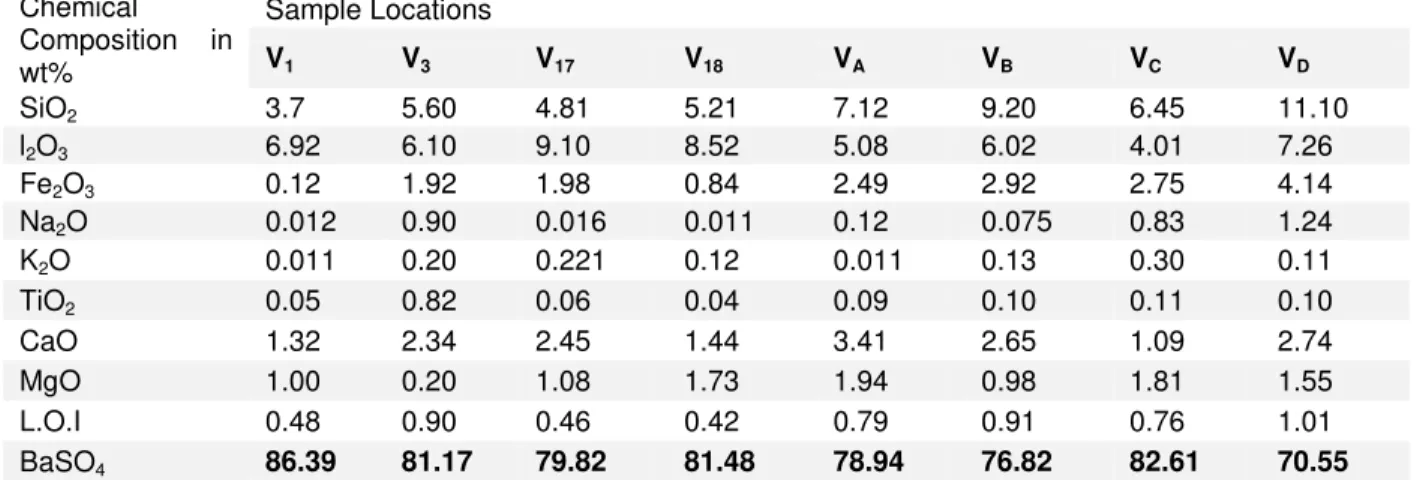
analyses. The Petrographic studies of some of the thin section of the samples conducted using a polarizing microscope to determine the contents, distributions and textures of the various veins (Table 1). The weight percentage composition of barite in the samples are V1 (86.39 %), VC(82.61 %),
V18(81.48 %), V3 (81.17 %), V17 (79.82 %), VA(78.94 %), VB(76.82 %) and VD (70.55 %) respectively. It is deduced from this work that, the chemical
weathering of the carbonates resulted in two distinct types of barites; Barite associated with mainly quartz (SiO2) and limonite (FeO(OH).nH2O) as major
gangue ( ) and barite with siderite (Ferrous Carbonate with high amount of Mg) ankerite (Ca (Fe, Mg) (CO3)) and Calcite (CaCO3). The outcomes were
compared with the barite specification of Weigal,1937 of 95.00 % and were found to be good for making drilling mud for use in the oil industry, paints and other chemicals
————————————————————
1 INTRODUCTION
It was in view of the ever-increasing cost of imported raw materials and the continuous demand for baites in Nigeria‘s fast growing oil industry, that the Nigerian government imposed ban on the importation of such material and encourage local production. It has then become imperative to focus attention on the neglected exploration and exploitation of barite deposits abound in Nigeria. The occurrence of barite in parts of Middle Benue Trough was first reported by [1] in his memorandum, Geological Survey of Nigeria Report No. 1266 and he estimated the reserve to be about 400,800 tons to 18 (m) depth. The Nigerian Mining Corporation in 1979 [2] embarked on preliminary investigation of Azara barite deposits and commenced production in 1986. Since then the exploration of this mineral has been steadily on the decline after the discovery of some major vein deposits in the 80‘s, due to negligence and mismanagement by the past successive governments, which paid little attention to execute plans for adequate production and further search in the area and other places until the emergence of this present government which is poised to improve the search for solid minerals under its reform policies.
Barite, a translucent white to grey-black, heavy and inert mineral is the naturally occurring form of barium sulphate(BaSO4). It is by far the most common barium chemicals and barium metal [3]. The only other common commercial source of barium chemical is the carbonate (whitherite). Because of the high specific gravity of barite, nearly three quarters of the domestic output of the mineral is used in oil industry as drilling fluids. Barite has numerous other uses, for example in the manufacture of glass and white pigment as a filler or extender in paints, ink soil-cloth, and in the manufacture of barium compounds for industrial applications. The above demand formed the basis of this work, which aimed at furthering exploration of the barite mineralization around Azara town and its environs, and to also analyse and process the samples collected in order to ascertain the quality and other industrial applications of barite.
2. LOCATION
The study area is located within Azara district of Awe Local Government Council of Nassarawa State with topographic sheet ―Akiri sheet 232‖. It lies within latitude 8º18.3‘ and 8º25.3‘ and Longitude 9º14.2‘ and 9º20.2‘ covering a total area of about 143 (km2) on a map of scale 1:100,000.
3. REGIONAL GEOLOGY
3.1 Geological Setting of the Benue Trough
The Benue Trough of Nigeria within which the study area is located is an elongated rift (or faulted-bounded) mega structural depression trending NE-SW to a length of over 1000 km and a width of 100 km [4]. It is occupied by up to 6000 m of marine and fluvio-deltaic sediments that have been compressionally folded in a non-organic shield environment [5]. Present day analogy for the crustal structure of the early Benue Trough is the Afar triangle and its extension to the Ethiopian rift. However, there have not been convincing mechanism folding responsible for the compressional folding of the sediments [6]. The fact that few boundary faults have been identified along margins of the Benue Trough may mean either that crustal down ____________________________
Tanko, I.Y B Tech. Applied Geology, MSc Econ Geology and Mineral Exploration, PhD in Mineral Exploration. Lecturer II,
E-mail: [email protected]; phone: +233549607482.
Adam, MBSc Mineral Engineering. Supervisor Thermal Desorption Plant, Omni Energy,
E-mail: [email protected] Phone: +233247747495.
warping was the principal mechanism of subsidence, as it is in parts of the East Africa Rift System [7] or that Isostatic loading by sediments filling an original graben structure has resulted in enhanced down warping of the flanking regions [8]
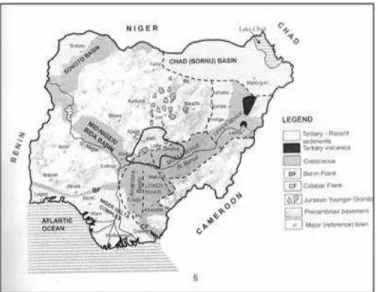
Fig. 1 Geological Map of Nigeria ShowingLocation of the Study Area.
Present day view is that, the Benue Trough was under a tensional regime from that time when it originated as the failed arm of an RRR triple junction (aulacogen) [9]. Throughout its history of sedimentation and formation ormationand that this tensional regime was the result of continued but intermittent uplift of the South Atlantic [10] and [11]. The succession of marine, continental and transitional beds of Middle Albian to Maastrichtian age in the Middle Benue Trough, from all indications, appears to have undergone at least three phases of tectonic activity, reported in Cenomanian, Santonian and Post Maastrichtian times; The folding episodes associated with these geologic events generated the development of prominent anticlinal structures which dominate the Benue Valley [12].
3.2 Regional Stratigraphy
The Benue Trough forms the link between the South Atlantic and the Tethys for part of the Cretaceous. It is subdivided geologically into an Upper, Middle and Lower [13], and the study area falls within Middle Benue Trough. The geology of the Middle Benue Trough was determined mainly by six sedimentary formations [12], the oldest is the Asu River Formation, which occupies the crest of a major structure (The Keana anticline) and is flanked on either side by Awe, Keana and Eze-aku Formations. The youngest formations are the Awgu and Lafia, which are only preserved on the western flank, remnants of some of the younger formations are however found on some of the volcanic hills on the axis of the Keana anticline [14].
3.2.1 Asu River Group (Arufu-Uomba-Gboko)
The Asu River Group is the oldest known Nigerian sedimentary formation. In the middle Benue Trough, the Asu River Group consist of rocks of Albian age comprising essentially of olive-green to grey-dark and pinkish
micaceous siltstones, fissile shales. Mudstone and subordinate clays [15].
3.2.2 Awe Formation
The Asu River Group was overlain with a transitional Awe Formation. This formation is been proposed as a formal lithostratigraphical unit [2]. It was first recognized by Falconer, [13] under the name ―passage beds‖. The Awe Formation lithostratigraphically consist of flaggy, whitish, medium to coarse grained, sometimes calcareous sandstones on the average about 30 cm in thickness and inter bedded with carbonaceous shales or clays from which brines issues copiously. This formation began to build up during the late Albian regression and probably ranges into early Cenomanian. The thickness of the Awe Formation was estimated to be about 1000 m [14].
3.2.3 Keana Formation
The Keana Formation unconformably overlies the Awe Formation, [12] and [13]. The Keana formation was thought to be equivalent to Falconers [14] ―Muri Sandstones‖ or ―Lower Grits and Sadnstones‖. It was correlated with the Bima Sandstone of the upper Benue Trough [16]. The Keana Formation was named ―Keana Formation‖ by Cratchley and Jones, [17] or rather ‗Keana Sandstone‖. The Keana Formation was dated to be Cenomanian [5]. Lithostratigraphically, the formation is heavily current-bedded, fine to very coarse, sometimes conglomeritic, at times indurated, gritty and arkosic [12]. The thickness was estimated at 1500 m.
3.2.4 Eze-Aku Formation
Eze-Aku Formation lies comformably on the Keana and Awe Formations in some places and in other places, it interfingers with it in areas of transitional environment [12]. The Eze-Aku Formation was first recognized by shell B. P. geologists (in particular D. watt) under the name Eze-aku Shales. It was dated to be Cenomanian-Turonian, lithologically, the formation consist essentially of calcareous shales, micaceous fine to medium-grained friable sandstone and occasional beds with limestone. The thickness of the formation was estimated to be about 700 m [12].
3.2.5 Awgu Formation
The Awgu Formation conformably overlies the Eze-aku Formation. This formation was dated to be Turonian-Santonian in age [18] in Geology of Nigeria. Lithologically, Awgu Formation is made up of bluish-grey to dark-black carbonaceous shales, shaly limestone, and coal seams, this suggest rapid changes in the depositional environment [19].
3.2.6 Lafia Formation
4. MATERIAL AND METHOD
The research began with field work carried out mainly by traverses purely on foot across the mapped area. Rock exposures out cropping from stream channels, road cuttings and on the ground surfaces were carefully observed and described. Measurements were taken and recorded. Samples were taken along across veins These samples were studied in the field as hand specimen and subsequently taken to the laboratory for detail petrographic and chemical analysis.
4.1 Petrographic Studies
Eight samples collected were thin sectioned and studied under the microscope to determine the texture and size distribution of the various species in the area. The relative sizes of the gangue or waste minerals found locked up with the barite, will help the mineral processor to choose the right sizes to crush the ore to liberate all locked up particles before carrying out beneficiation.
4.2.3 Description of Rock Samples
According to Offodile [12] and Barko [3] the barite deposits are found generally as veins traversing invariably, the Keana formation. It was on this basis that all the rocks samples collected from the mapped area were classified into two main groups and described based on their lithology, texture and colour similarities. The rock samples collected from the host of barite veins in the area are mostly massive stone, heavily current bedded, fining upward sequence, sometimes conglomeratic, indurated, gritty,
arkosic. The bed are competent while in some locations were affected by folding, during the folding episode (Cenomanian-Maastrichian). The sandstone has colour varying from white, brownish and pinkish. The colour to some extend is determined by the colour of the matrix or cementing material which are mostly ironstone, clay,mica and feldspars.Texturally the quartz grains are angular andoccur together with unaltered feldspars, where indurated the crystals occur with each other. The above characteristics are found to conform to that of Keana Sandstone, hence it is concluded that the ridges, which bear the barite veins are outcrops of Keana Formation. The samples collected from the Northern, Central, Northeastern and the northwestern parts of the mapped area where mostly brine issue in Azara and Akiri villages were covered by alluvium and where exposed, they are fining downward in sequence of sandstone, siltstone and shale. Texturally, the calcareous sandstones are composed of medium to coarse grained and less compacted. The shaly sandstone and shaly siltstone were fine grain, compacted and lightly stratified. The white, pinkish and brownish colour is determined by the cementing materials, feldspar, clay and iron oxide. The sample description is also found to be similar to that of the Awe Formation and hence the conclusion that, the exposed section along the river valley and area where the brine issue in Azara and Akiri villages is Awe Formation. This was confirmed by [15], where he said ―all the brine of Middle Benue issue from environment transitional between predominantly marine and non-marine
environment‖ (Awe Formation).
4.2.4 Microscopic Identification of barite and associated mineral composition
Table 1: Summary of Mineral Composition and Textures of Veins
S/N Vein Type
(Sample No.) Main Minerals Accessory Texture
1 V1 Barite, quartz, feldspars Limonite /goethite Medium grained
2 V3 Barite, quartz, feldspars Limonite Coarse grained
3 V17 Barite, quartz, Siderite, sphalerite, calcite Very coarse grained
4 V18 Barite, quartz, muscovite, feldspars Limonite Medium to coarse grained
5 VA Barite, quartz, muscovite, feldspars Calcite, galena, siderite Medium to coarse grained
6 VB Barite,quartz, feldspars
Ankerite, shpalerite, siderite,
galena Coarse grained
7 VC Barite, quartz, feldspars Limonite Very coarse grained
8 VD Barite, quartz, calcite,feldspar Calcite, siderite galena, ankerite, Coarse grained
4.2 Chemical Analysis
Geochemical analysis of the samples collected from different locations (veins) were carried out using Gravimetric analysis to determine the chemical composition of the barite to ascertain its quality and constituents.
4.2.1 Determination of Barite (BaSO4) by Gravimetric
Method
1. Sample Preparation
The following are stages in sample preparation;
Cleaning/Washing; the samples from the field were washed in a clean water to remove dirt.
Drying: The samples were placed in a watch glass to dry. Crushing: Crushing was carried out to reduce the samples to a representative size using hard ceramic crusher to avoid contamination.
Grinding: Representative sample was ground to a fine size using mortar and pestle made of ceramic to avoid contamination.
Screening: the ground samples were screened through -80 (mm) mesh screen.
Reagents
i. 1.5 (g) of Na2CO3 ii. 1.5 (g) of K2CO3 iii.1:1 HCl
iv 1 (g) NH4Cl v. 1 (g) NH4OH
4.2.2 Procedure
1.5 g of Na2CO3 and K2CO3 was added to 0.2 g finely ground samples in a platinum crucible. The mixture was fused over a high temperature in a furnace at 1000 (ºC) for about 30 minutes. The crucible was taken out of hot zone and rotated to solidify in a thin layer by the side of the crucible. This shorten the time required for leaching. The residue was leached out and fused with 200 ml boiling water in a 500 ml beaker. The product was filtered using filter No. 40 Whatman filter paper and then filter paper residue was washed 10-12 with hot Na2CO3 solution and finally with hot water till it was free from sulphate. The residue was dissolved from the filter paper and small portion of the solid adhering to the platinum crucible with hot 1:1 HCl. 1 g ammonium chloride was added and neutralized with ammonium hydroxide using methyl red as an indicator. The solution was boiled and filteredthrough No. 40 Whatman filter paper and the residue was washed four to five (4-5) times with hot water. The residue was dissolved with hot water for about 5-6 times. This operation was done to bring out any barite that might be occluded with R2O3 precipitate, both filtrates were mixed and proceeded. The filtrate was taken in a 500 ml beaker and few dropsmethyl red gas was added as indicator and the
solution was neutralized with HCl acid and 2 ml of the HCl was added. The solution wasdiluted with 400 ml of distilled water, boiled and 20 ml of 10% hot ammonium sulphate solution with constant stirring was added and boiled for 5 minutes. The flame was removed and allowed to stand for at least 4 hours and was allowed overnight to precipitate. The solution was filtered using No. 41 Whatman filter paper. The residue was thoroughly rinsed with water containing 5 drops of H2SO4 per litre and then with hot water until it was free from chloride ions. The residue transferred at 85 (ºC) and allowed to cool for 30 minutes. The residue was allowed to cool in dessicator and weighed. The BaSO4 was calculated as follow;
BaSO4 = − � 100
Where;
A is the weight of platinum in gram and ignited BaSO4 B is the weight of empty crucible of platinum in gram C is the weight of sample taken in gram.
Table 2 Results of Chemical Analysis of Barite Samples from Azara
Chemical Composition in wt%
Sample Locations
V1 V3 V17 V18 VA VB VC VD
SiO2 3.7 5.60 4.81 5.21 7.12 9.20 6.45 11.10
l2O3 6.92 6.10 9.10 8.52 5.08 6.02 4.01 7.26
Fe2O3 0.12 1.92 1.98 0.84 2.49 2.92 2.75 4.14
Na2O 0.012 0.90 0.016 0.011 0.12 0.075 0.83 1.24
K2O 0.011 0.20 0.221 0.12 0.011 0.13 0.30 0.11
TiO2 0.05 0.82 0.06 0.04 0.09 0.10 0.11 0.10
CaO 1.32 2.34 2.45 1.44 3.41 2.65 1.09 2.74
MgO 1.00 0.20 1.08 1.73 1.94 0.98 1.81 1.55
L.O.I 0.48 0.90 0.46 0.42 0.79 0.91 0.76 1.01
BaSO4 86.39 81.17 79.82 81.48 78.94 76.82 82.61 70.55
Table 3 Comparison of Average Barite Composition from different Localities in the Middle Benue Trough, Nigeria
Localities
Azara Deposit Present Work
Azara Deposit NMC
Chiata Deposit NMC
Gbande Deposit NMC
Keana Deposit NMC
Ibi Deposit NMC
Ave. BaSO4
(wt %) 80.02 86.49 93.53 60.51 93.12 92.91
NMC: Nigerian Mining Corporation [20]
5. DISCUSSION OF RESULTS
This section discusses results of petrological and geochemical investigations
5.2 Barite Mineralisation
Among the systems and mode of occurrence of barite in the study area, the E-W ones are the longest and contain the widest filled crack (e.g. vein 17). The crack system aligned in the N-S directions are the numerous but are all narrow with much shortened strike lengths. They have gentle inclinations of the order of 5º, 10º and 15º with some locally
area appear to have been formed during the later stage. Generally in the field, barite is found as veins traversing invariably the Keana and Awe Formations. It predominates in the northeast-southwest directions. The most important and more massive occurrences are found in Vein 17, Azara. This vein is marked by pronounced ridges, which dominate the topography of the area. However, high grade barite comes from V1 (86.39 %) VC(82.61 %), V18(81.48 %) and V3 (81.17 %). Then followed by V17 (79.82 %) VA(78.94 %), VB(76.82 %) and VD (70.55 %). Petrographically, it is deduced from this work that probably, weathering of the carbonates resulted in two distinct types of barites; Barite associated with mainly quartz (SiO2) and limonite (FeO(OH).nH2O) as major gangue and barite with siderite (Ferrous Carbonate with high amount of Mg), ankerite (Ca (Fe, Mg) (CO3)) and calcite (CaCO3). Therefore, on the basis of persistent association of barite with quartz, limonite/goethite and the low or absent of siderite, ankerite or calcite, mineralized veins can be distinguished from non-mineralised veins in the area.
5.3 Mineralization Potentials of Barite of Azara and its Surroundings
From the results of petrographic investigations summarized in Table 1. The bulk percentage composition reveals about 60-70% barite and 40-30% silica, iron oxide (probably limonite or goethite) and some traces of calcite, ankerite and siderite. Also the result of the analyses from present work in Table 2 showed that, sample V1, VC, V18 and V3 have the highest BaSO4 contents above 80%,V1 (86.39 %), V1 (82.61 %), V1 (81.48 %) and V1 (81.17%) respectively and the remaining samples have the low contents less than 80%. Even though the barite deposits in Azara did not meet up with Weigal‘s (1937) specification of 95% BaSO4 and Fe2O3 (0.14 %). It can still meet up with the demand of our local industries. Comparison of barite deposits in the middle Benue Trough in table 3 suggest that, most of the deposits are of very high quality except, perhaps sample from Gbande, which gave rather relatively low BaSO4 content of slightly above 60%. The low value could be attributed to the very high silica content influenced by quartzitic host rock. The Chiata and Ibi deposits, though small, are very good in quality and should meet some specialized need like the glass, paper and paint industries. The bigger Azara deposits is not as high in quality as the former, but this deficiency can be compensated for by their large reserves; and they should meet the bulkier requirements in the oil industry for the manufacture of drilling mud.
6. CONCLUSIONS
It is evident from the forgoing that, barite mineralization as observed in the Azara area could be attributed to various processes of metasomatism and replacement, commonly associated with veins and cavities. The presence of low temperature minerals such as quartz in barite coupled with the coarse-grained texture of the barite predicts a probable correlation of the process of formation of the barite to low temperature.
Two distinct barite types have been recognized;
1. Barite with quartz and limonite as major gangue. 2. Barite with siderite, ankerite and calcite as major
gangue.
It is concluded that barite from Azara deposits is of good quality, even though they did not satisfy the standard specification of 95% BaSO4 (Weigal, 1937) they presently supply the bulkier needs of our oil industries (drilling mud).
7. REFERENCES
[1] Tate, B.R., Geological Survey of Nigeria Report, No. 1266, 1959.
[2] Anon., Nigeria Mining Corporation, ―On Preliminary Investigation of Azara Barite Deposit‖, Report No. 1, 1979.
[3] Barko, W., Geology and Mineral Processing of Barite of Azara Area of Awe L.G.A of Barite of Plateau State, (Unpublished MSc. Thesis), University of Jos, 1989.
[4] Benkhelil, J., ―The Origin and evolution of the Cretaceous Benue Trough, Nigeria‖, Journal of African Earth Sciences, Vol. 89, pp. 251 – 287, 1989.
[5] Carter, J.D.W and Tait, A.E., ―Geology of Part of Adamaw, Bauchi and Borno Provinces in North Western Nigeria‖, Geological Survey of Nigeria, Bull. 30, 1963.
[6] Wright, J.B., Volcanic Rocks in Nigeria, Geology of Nigeria (Edition C.A. Kogbe), Elizabethan Pub., Lagos, Nigeria, pp. 102 – 104, 1976.
[7] Nigeria Mining Corporation, ―Analysis of Barite of Middle Benue Trough, Report No. 2, pp. 16 – 20, 1984.
[8] Chukwu-Ike, J.M., ―Interpretation of Marginal Enchelon Lineaments in the Middle Trough, Nigeria‖, Journal of Mining and Geology, Vol. 15, pp. 14 – 18, 1978.
[9] Tattam, C.M., General Aspects of the Nigerian Lead-Zinc Field, Report of A.T.M.B. Ltd., 1950.
[10]Olade, M.A and Morton, R.A, Temperatures of Ore Formation and Origin of the Ishiagu Lead-Zinc Deposit, Southern Benue Trough, Nigeria, Journal of Mineral Geology, Vol. 17, No. 2, pp. 119 – 127, 1980.
[11]Offodile, M.E. and Reyment, R.A., ―Stratigraphy of the Keana-Awe Area of the Middle Benue, Nigeria‖, University of Uppsala, Bull. Geology Inst., Vol. 7, pp. 36 – 66, 1976.
[12]Ajayi, C.O., ―Preliminary interpretation of the Gravity Anomalies Associated with some Prominent Salt Springs in the Middle Benue‖, Nigeria, Journal of Mining and Geology, Vol. 27, No. 1. Pp. 87 – 92, 1979.
[14]Offodile, M.E., ―The Geology and Tectonics of Awe Barite Fields‖, Journal of African Earth Science, Vol. 2, No. 3, pp. 191 – 202, 1984.
[15]Offodile, M.E., The Geology of Middle Benue, Nigeria, PhD Thesis, University of Uppsala, Vol. 4, pp. 22-136, 1976.
[16]Cratchley, C.R. and Jones, G.P., ―An Interpretation of the Geology and Gravity Anomalies of the Benue Valley‖, Nigeria, Overseas Geological Survey, Geophysics, Paper No. 1, 1965.
[17]Kogbe, C.A., ―Continental Terminal‖ in the Upper Benue Basin of NE Nigeria, Origin Structure and Mineral Resources of the Benue Trough, Nigeria, Earth Science Evolution 2, pp. 149 – 153, 1981.
[18]Ajayi, C.O., ―The Origin of Salt Springs and Barites in the Middle Benue Trough, A Suggested Model from Gravity Data‖, Current Research in African Earth Sciences Ed. G. Matheis and H. Schandelmier, Balkema Press, Rotterdam, pp. 455 – 456, 1987.
[19]Sheikh, M.G., Mining and Processing of Barites, the Case of Azara Barite Project at Azara, Nigeria Mining Corporation News Edition, No. 1, pp. 14 – 15, 1986.
[20]Farrington, J.I, A Preliminary Description of the Nigerian Lead-Zinc Field, Economic Geology, Vol. 47, pp. 583 – 608, 1952.