* This work is supported by the Ericsson Research - Brazilian Branch under the ERBB/UFC.01 Technical Cooperation Contract. URL: http://www.ericsson.ufc.br
Space-Time Processing with a Decoupled Delayed Decision-Feedback
Sequence Estimator
(*)A. L. F. de Almeida, C. M. Panazio, F. R. P. Cavalcanti, C. E. R. Fernandes
[email protected], [email protected], [email protected], [email protected]GTEL – UFC, Wireless Telecom Research Group, Federal University of Ceara, Fortaleza, Brasil. URL: http://www.gtel.ufc.br
Abstract-This work aims at investigating the performance of
a Decoupled Space-Time processing structure based on a Delayed Decision-Feedback Sequence Estimator (D-ST-DDFSE), in the context of the Enhanced Data rates for GSM Evolution (EDGE) system. The main idea in using Decoupled Space-Time (D-ST) processing structures is to separate Co-Channel Interference (CCI) reduction from Inter-Symbol Interference (ISI) suppression. Consequently, all degrees of freedom of a space-time (ST) front-end are dedicated to treat CCI, leaving ISI to be suppressed by a temporal equalizer. Due to the 8-PSK modulation and the large delay spread values compared to the symbol period, optimum detection becomes too complex in the EDGE system, which makes DDFSE a promising scheme for ISI suppression. The performance of D-ST-DDFSE is analyzed through link-level simulations under the context of COST 259 channel models for Typical Urban (TU) and Bad Urban (BU) propagation scenarios. Improved performance of this D-ST technique over a space-time linear equalizer is observed.
I. INTRODUCTION
In high-data rate mobile communications, co-channel interference (CCI) and intersymbol interference (ISI) are key factors that limit performance and capacity. In the incoming third generation systems as the Enhanced Data Rates for GSM Evolution (EDGE), delay spread can affect several symbol intervals causing a significant distortion on the transmitted signal. The presence of strong CCI sources further contributes to degrade signal quality and system capacity.
Several signal processing techniques have been applied in order to fulfill the requirements of the incoming third generation of mobile communications. The use of antenna diversity is a classical solution for those problems of combating multipath fading and canceling interfering signals [1]. However, practical propagation environments are characterized by rich multipath and it would be required too many antennas to overcome the effects of ISI and CCI.
Improved performance is obtained with space-time (ST) processing techniques. A Space-Time Linear Equalizer (ST-LE) is characterized by the inclusion of a temporal filter at each antenna, which allows exploiting also temporal diversity [2]. The use of fractionally spaced taps may improve CCI reduction, but noise enhancement may degrade performance [2]. Other approaches employ a temporal equalizer following the antenna array, where signal-to-interference-plus-noise ratio (SINR) at the array output should be maximized [3].
However, simultaneous ISI and CCI mitigation may degrade equalizer performance, since the the difference on the characteristics of ISI and CCI may cause ST algorithms based on the Minimum Mean Square Error (MMSE) criterion to combat ISI more, thus causing the presence of residual CCI. Furthermore, in ISI-dominated scenarios with small values of angular separation, mainbeam user paths may severely reduce output SINR and degrade BER performance. Thus, it is reasonable to state that it would be desirable
to treat ISI with an MLSE equalizer , which is the optimum detector in the presence of ISI. Similarly, CCI is better combated with an MMSE equalizer.
A Decoupled Space-Time (D-ST) processing technique can make use of the individual advantages of an MMSE-based algorithm for CCI reduction and an MLSE-based algortihm for ISI supression. This is done by separating CCI and ISI mitigation in two stages. Based on a joint optimization criterion, the coefficients of the ST front-end and the channel estimator filter are jointly adapted in order to maximize the Signal-to-Interference-plus-Noise-Ratio (SINR) at the output of the ST front-end, preserving ISI structure of the desired signal. A temporal equalizer, employed at the output of the ST front-end, treats only ISI of the desired signal.
The D-ST processing concept was already applied in previous works. In [4] and [5], the joint optimization criterion is developed and simulation results are presented in the GSM system context. In [6], an ST Viterbi equalizer is employed at the output of the ST front-end in order to provide both spatial and temporal diversity gains. In [7], adaptive algorithms are described for joint adaptation of an Antenna Array (AA) front-end and the channel estimator filter. Additional simulation results concerning D-ST processing can be found [8] and [9].
In this work we evaluate the performance of a D-ST processing structure based on a Delayed Decision-Feedback Sequence Estimator, namely D-ST-DDFSE, in the context of the Enhanced Data rates for GSM Evolution (EDGE) system. Due to the 8-PSK modulation and the large delay spread values compared to the symbol period, an optimum detection becomes too complex, which makes DDFSE a promising scheme for EDGE since it presents a good trade-off between performance and complexity [10]. The performance of D-ST-DDFSE is compared it to that of ST-LE for Typical Urban (TU) and Bad Urban (BU) propagation scenarios of the context of the COST 259 channel model [11]. Link-level simulation results show that improved performance is achieved with this D-ST structure.
In the remainder of this paper, we organize the sections as follows: The D-ST-DDFSE structure is presented in section II. In section III, TU and BU scenarios of COST 259 channel model are characterized. Link-level simulations results are presented in section IV; and in section V we conclude the paper drawing some conclusions and perspectives.
II. D-ST-DDFSE STRUCTURE
DDFSE EQUALIZER
∑
TEMPORAL ISI SUPRESSION 1
+
2
N
SPACE T IME
LINEAR FILTER MLSE
FEEDBACK FILT ER
–
SPACE-TIME CCI REDUCTION JOINT ADAPT AT ION CHANNEL
EST IMAT OR FILT ER
+
–
dec ided se que nc e
training se quence
e rror signal
computed equalizer coefficients
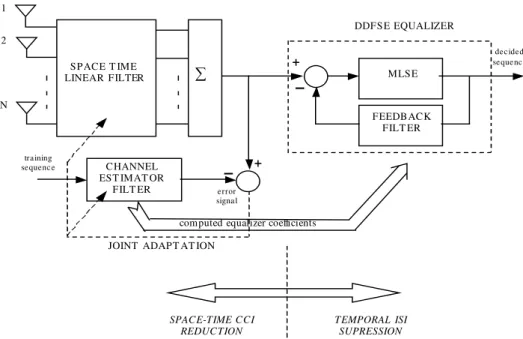
Fig. 1. D-ST-DDFSE structure.
Let us assume a ST linear front-end of N antennas with L taps per antenna and a channel estimator filter of L taps. Let us call W=[w1T, w2T ,…, wLT ]T, where wi =[wi1, wi2, …, wiN]T,
and h=[h1, h2,…, hL]T the coefficients of the ST filter and the
channel estimator respectively. The vector of received samples is denoted by X=[x1T, x2T,…, xLT]T, where
xi = [xi1, xi2, …, xiN]T and d =[d1, d2,…, dL]T is the vector of
training symbols. The optimum solution for both W and h maximizes the SINR at the output of the antenna array as defined below:
(
,)
argmaxSINR argmax 2.H ,
, W X h d
X W h
w
H H
opt opt
− =
=
h w h
w (1)
It can be shown that the maximization of (1) is equivalent to the minimization of the following cost function:
J(W,h) = H 2
d h X
WH − (2)
subject to a constraint imposed on h to avoid the trivial solution. We highligth two different constraints, where the first one is linear while the second one is quadratic. Thus, our problem may be re-written in two ways:
h W,
min J(W,h) subject to cTh =1, c=[0…,cj,…0], cj=1; (3)
h W,
min J(W,h) subject to 2
h =1. (4)
In (3) the selected value for j will identify the number of causal and anti-causal taps of the estimated channel impulse response (CIR). In the second approach the taps of the estimated CIR are normalized to have unity energy. In [7],
classical adaptive algorithms as the Least Mean Square (LMS) and the Recursive Least Squares (RLS) were described concerning the linearly constrained problem of (3). In [9] simulation results were obtained for this optimization approach. In [8] optimum solutions for W and hare derived for (3) and (4), while some authors [4,5,6] deal with the optimization approach of (4). Here, we center our attention on the adaptive implementation of (3) to obtain the results.
The purpose of the ST front-end is to provide both spatial and temporal diversity for CCI reduction when fading is frequency selective. However, it may be reduced to an AA front-end when fading for all CCI sources is flat.
The channel estimator is used to synthesize an estimate of the overall CIR of the desired user. This is done by joint adapting the array weights and the FIR filter coefficients in order to minimize the mean square value of the error signal indicated in Fig. 1. The order of the channel estimator should be sufficiently large to capture the most delayed paths of the desired user. On the contrary, ISI due to the most delayed paths are supressed by the ST front-end.
At the end of the training period, ISI suppression is done by employing the estimated CIR within the DDFSE equalizer, while CCI reduction is performed at the ST front-end.
III. COST 259 CHANNEL MODEL
In this work we use the macrocell radio environment of the COST 259 simulator to generate CIRs of the Typical Urban (TU) and the Bad Urban (BU) scenarios.
In order to generate CIRs, the desired user and the co-channel interferer were uniformly distributed within a 120º sector and cell radius was assumed to be 1 Km. Due to high bit rates of the EDGE system (T
≅
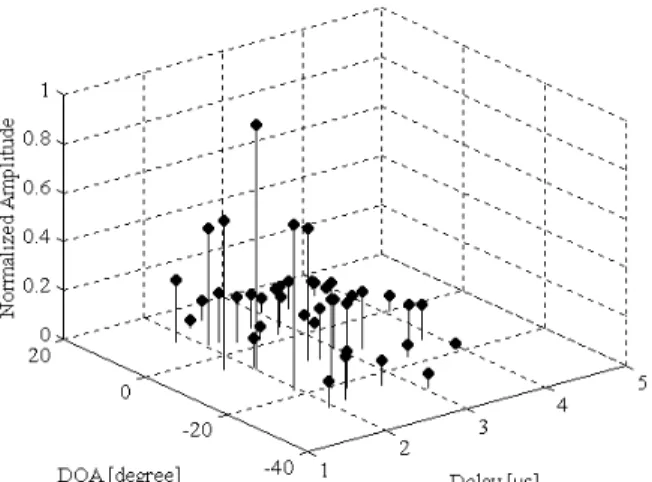
3.7µs), where T is the symbol interval, channel time-variations during a time-slot are very small, and it will not be considered in this work.Fig. 2 and 3 show a typical channel realization of TU and BU channels, respectively. In Fig. 4 and Fig. 5 we plot the CDFs of the RMS delay spread and RMS angle spread, respectively, for both TU and BU scenarios. The CDF curves were obtained from a total 5000 snapshots of the COST 259 directional channel response. It can be seen that in 80% of the cases, delay spread is not superior to 10% of a symbol period in the TU case while in the BU case it reaches 70% of the symbol period. Similarly, the angle spread does not exceed 10º in TU, while it reaches 30º in BU. From Fig. 2 to 5 we observe that
TU scenario is characterized by the presence of a unique cluster of scatterers which are located local to the base station, in most of times, leading to small delay and angle spreads. In BU scenario, additional cluster of scatterers lead to larger delay and angle spreads.
IV. SIMULATION RESULTS
Simulation results are presented here in order to evaluate the BER performance of the D-ST-DDFSE on TU and BU scenarios of the COST 259 channel model. The modulation scheme (8-PSK), slot format and symbol rate used in all simulations follow those of the EDGE system [12,13], except the pulse shaping function, where we use a raised cosine with a roll-off factor of 35%. The RLS algorithm is used as the adaptation algorithm with a forgetting factor of 0.98. The first 26 symbols are used for training while the remaining 114 symbols are used for adaptation in the decision-directed mode. In all simulation results the BER performance is Fig. 2. Example of a TU channel realization showing azimuth
x time delay x power profile: Small delay spread and uniformly distributed scatterers.
Fig. 3. Example of a BU channel realization showing azimuth x time delay x power profile: Larger delay and angle spreads
and the presence of clusters.
plotted versus the Eb/N0 per antenna.
A. Performance evaluation for a pure ISI scenario
The performance of D-ST-DDFSE is evaluated here on BU and TU scenarios, with no co-channel interference. The performances of the AA and the ST-LE, where no D-ST processing is done, are evaluated as a reference for comparison.
We use a 2 antenna-element array in all the structures. The channel estimator of the D-ST-DDFSE has 4 taps on the TU scenario and 6 taps on the BU scenario. The MLSE memory of the D-ST-DDFSE is set to 1. The DFE employs 3 feedback taps on TU scenario and 5 feedback taps on the BU scenario. The ST-LE has 3 taps per antenna and the D-ST-DDFSE uses an AA front-end in this pure ISI scenario. In order to provide full spatial diversity, the 2 antenna elements are separated by 10λ, where λ is the wavelength.
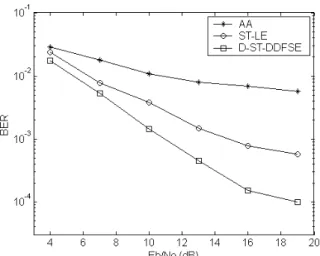
When only ISI is present, it is expected that the D-ST-DDFSE can exploit both spatial and temporal diversity of the desired user channel in order to mitigate ISI. In Fig. 6, it can be seen that the D-ST structure has the best performance on the TU scenario. We observe that the Eb/N0
gain of D-ST-DDFSE incrases with Eb/N0. In Fig. 7 the BU
scenario is considered. We observe that the improvement of D-ST-DDFSE over ST-LE is much greater in the BU where more spatial and temporal diversity is present. For a target uncoded BER of 10-3 the Eb/N0 gain of D-ST-DDFSE over
ST-LE is remarkably 5dB.
B. Performance evaluation in the presence of CCI
In the next simulations we include a single co-channel interferer. The SIR is 0dB and both the desired user and the co-channel interferer follow the same channel profile.
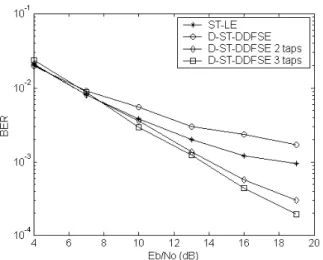
We first consider the TU scenario. In Fig. 8 we observe that the performance of ST-LE is superior when the D-ST-DDDFSE employs an AA as the front-end, i.e. no temporal processing is done at the front-end. When 2 taps are employed at each antenna, we observe an inversion in performances. Still in Fig. 8 it can be seen that the performance of D-ST-DDFSE exhibits a slight improvement when 3 taps per antenna are used instead of 2.
In Fig. 9, BU scenario is considered. We observe that considerable performance gains are obtained by D-ST-DDFSE over ST-LE when more taps are added at each antenna. In opposition to the TU case, the performance improvement is significant on the BU scenario when 3 taps are employed instead 2. This is reasonable, since in BU scenario the delay spread is larger.
V. CONCLUSIONS AND PERSPECTIVES
The D-ST-DDFSE has presented good results on COST 259 BU and TU scenarios, indicating the advantage of using the idea of D-ST processing together with DDFSE, even for practical propagation environments. In the TU case, performance gains of the proposed D-ST equalizer are pronounced for medium to high Eb/N0 values. This was verified for pure ISI scenarios as well as in
the presence of CCI. In the BU case the performance improvement of D-ST-DDFSE over ST-LE is great, indicating the robustness of the proposed D-ST structure in worst-case situations, where a high level of CCI and ISI is present. These simulation results reinforce that D-ST-DDFSE can perform quite well within the EDGE system.
The continuity of this work include a system-level evaluation of D-ST-DDFSE in order to clarify the potential user and data rate capacity gains when employing this D-ST structure in tight frequency reuse pattern scenarios.
Fig. 6. Performance of D-ST-DDFSE on the TU scenario. The performance improvement of D-ST-DFSE increases as
Eb/N0 increases.
Fig. 7. Performance of D-ST-DDFSE on the BU scenario. The Eb/N0 gain of D-ST-DDFSE over ST-LE is 5dB for a
ACKNOWLEDGMENT
We would like to thank the author of the COST 259 simulator program used in this work, Henrik Asplund from Ericsson Research – Stockholm.
REFERENCES
[1] J. H. Winters, “Optimum combining in digital mobile radio with cochannel interference”, IEEE Journal Selec.
Areas Commun., vol. sac-2, no. 4, pp. 528-239, July
1984.
[2] A. J. Paulraj, and C. B. Papadias, “Space-time processing for wireless communications”, IEEE Signal Proc. Mag., vol. 14, No 6, pp. 49-83, Nov. 1997.
[3] S. L. Ariyavisitakul, J. H. Winters, N. R. Sollenberger, “Joint equalization and interference suppression for high data rate wireless systems”, IEEE Journal Selec. Areas
Commun., vol. 18, No 7, pp. 1214-1220, July 2000.
[4] F. Pipon, P. Chevalier, P. Vila, and J. J. Monot, “Joint spatial and temporal equalization for channels with ISI and CCI – theoretical and experimental results for a base station reception”, Proc. of First IEEE SPAWC, pp. 309-312, April 1997.
[5] S. Fanfoni, D. Giancola, U. Girola, S. Parolari, A. Picciriello, U. Spagnolini, “Space-time processing for co-channel interference rejection and channel estimation in GSM/DCS systems”, Proc. of URSI Intern. Symp.
Sig., Syst., and Elect., ISSSE 98, pp. 152-155, 1998.
[6] J.W. Liang, Interference Reduction and Equalization with Space-Time Processing in TDMA Cellular
Networks, Phd Thesis, Stanford University, June 1998.
[7] M. L. Leou, C. C. Yeh, and H. J. Li, “A novel hybrid of adaptive array and equalizer for mobile communications”, IEEE Trans. Veh. Technol., vol. 49, no. 1, pp. 1-10, Jan 2000.
[8] R. Friedman, Y. Bar-Ness, “Combined channel-modified adaptive array MMSE canceller and Viterbi equalizer”,
Proc. of Veh. Technol. Conf., Spring’01, vol. 1, pp.
209-213, 2001.
[9] C. M. Panazio, F. R. P. Cavalcanti, “Decoupled space-time processing: performance evaluation for a TDMA system”, Proc. of IEEE Veh. Technol. Conf., Fall’01, 2001.
[10] A. Duel-Hallen, C. Heegard, “Delayed decision-feedback sequence estimation”, IEEE Trans. Commun., vol. 37, No 5, pp. 428-436, May 1989.
[11] L. M. Correia, Wireless Flexible Personalized Communications, COST 259: European Co-operation in
Mobile Radio Resource, Wiley 2001.
[12] ETSI TS 100 573, Digital cellular telecommunications system (Phase 2+); Physical layer on the radio path; General description (GSM 05.01 version 8.4.0 Release 1999).
[13] ETSI EN 300 959, Digital Cellular Telecommunications System (Phase 2+); Modulation (GSM 05.04 version 8.1.0 Release 1999).
Fig. 8. Performance of D-ST-DDFSE on the TU scenario with CCI. A small performance gain are verified when 3 taps
per are employed instead of 2.
Fig. 9. Performance of D-ST-DDFSE on the BU scenario with CCI. Considerable performance gains are obtained by