Research paper
Synthesis and antitumor activity of selenium-containing
quinone-based triazoles possessing two redox centres, and
their mechanistic insights
Eduardo H.G. da Cruz
a, Molly A. Silvers
b, Guilherme A.M. Jardim
a, Jarbas M. Resende
a,
Bruno C. Cavalcanti
c, Igor S. Bomfim
c, Claudia Pessoa
c,d, Carlos A. de Simone
e,
Giancarlo V. Botteselle
f, Antonio L. Braga
f, Divya K. Nair
g, Irishi N.N. Namboothiri
g,
David A. Boothman
b, Eufr
^
anio N. da Silva Júnior
a,*aInstitute of Exact Sciences, Department of Chemistry, Federal University of Minas Gerais, CEP 31270-901, Belo Horizonte, MG, Brazil
bDepartments of Pharmacology and Radiation Oncology, Simmons Comprehensive Cancer Center, University of Texas Southwestern Medical Center, 6001
Forest Park Road, Dallas, TX, 75390-8807, USA
cNational Laboratory of Experimental Oncology, Department of Physiology and Pharmacology, Federal University of Ceara, CEP 60180-900, Fortaleza, CE,
Brazil
dFiocruz-Ceara, CEP 60180-900, Fortaleza, CE, Brazil e
Institute of Physics, University of S~ao Paulo, 13560-160, S~ao Carlos, SP, Brazil
fDepartment of Chemistry, Federal University of Santa Catarina, 88040-900, Florianopolis, SC, Brazil gDepartment of Chemistry, Indian Institute of Technology Bombay, Mumbai, 400 076, India
a r t i c l e
i n f o
Article history:
Received 27 November 2015 Received in revised form 2 June 2016
Accepted 11 June 2016 Available online 14 June 2016
Keywords:
b-Lapachone Quinone Click chemistry Chalcogens Selenium
a b s t r a c t
Selenium-containing quinone-based 1,2,3-triazoles were synthesized using click chemistry, the copper catalyzed azide-alkyne 1,3-dipolar cycloaddition, and evaluated against six types of cancer cell lines: HL-60 (human promyelocytic leukemia cells), HCT-116 (human colon carcinoma cells), PC3 (human prostate cells), SF295 (human glioblastoma cells), MDA-MB-435 (melanoma cells) and OVCAR-8 (human ovarian carcinoma cells). Some compounds showed IC50values<0.3mM. The cytotoxic potential of the quinones evaluated was also assayed using non-tumor cells, exemplified by peripheral blood mononuclear (PBMC), V79 and L929 cells. Mechanistic role for NAD(P)H:Quinone Oxidoreductase 1 (NQO1) was also elucidated. These compounds could provide promising new lead derivatives for more potent anticancer drug development and delivery, and represent one of the most active classes of lapachones reported.
©2016 Elsevier Masson SAS. All rights reserved.
1. Introduction
Development of diverse therapeutics is of paramount impor-tance in thefight against different types of cancer[1,2]. Quinones are considered as privileged structures and are among the most important drugs used against cancer [3]. Although single-target drugs successfully inhibit or activate a specific target [4], drugs that are able to act simultaneously on diverse biological targets are more attractive in the design of new effective drugs[5]. In this context, quinoidal structures represent an essential multi-target class of compounds[6].
Naturally occurring naphthoquinones such as lapachol and
b-lapachone (b-lap), isolated from the heartwood of Tabebuia, are among the most studied for their potential anti-tumor activity[7]. Docampo et al.[8]found significant activity forb-lap against
Sar-coma 180 ascites tumor cells (S-180 cells) in vitro, and in mice bearing S-180 tumors. Although the antitumor activity ofb-lap
against Yoshida sarcoma and Walker 256 carcinoma cells in culture has been investigated[8,9], the exact mechanism of action was not known until recently[10].b-Lapachone speci
fically destroys cancer cells with elevated endogenous levels of NAD(P)H:quinone oxidoreductase 1 (NQO1) [11]regardless of p53, caspase, or cell cycle status[12]. While in clinical trials,b-lap (i.e., ARQ 501) has been inaccurately touted as a
cell cycle checkpoint activator[13], the major determinant of cell death is through NQO1 expression [11,12a,14]. The drug is not a *Corresponding author.E-mail address:[email protected](E.N. da Silva Júnior).
Contents lists available atScienceDirect
European Journal of Medicinal Chemistry
j o u r n a l h o m e p a g e : h t t p : / / w w w . e l s e v i e r . c o m / l o c a t e / e j m e c h
http://dx.doi.org/10.1016/j.ejmech.2016.06.019
0223-5234/©2016 Elsevier Masson SAS. All rights reserved.
substrate for known multidrug resistance or drug pumps[15,16] and
b-lap cell death is not affected by changes in cell cycle
posi-tion, oncogenic drivers, or pro- or anti-apoptotic factors[11,12a]. Finally, the drug targets (i.e., is‘bioactivated’by) NQO1, a Phase II, carcinogen-inducible enzyme that is also induced by ionizing ra-diation (IR) in some cancer, but not normal, cells[17,18].b-Lap
’s use as a chemotherapeutic agent is curtailed by its high hydrophobicity which causes methemoglobinemia in patients[19]. When mixed with the carrier hydroxypropyl-b-cyclodextrin, the carrier itself can contribute to hemolysis[20]. Recently, Ohayon and coworkers[21]shed light on the hypothesis ofb-lap being able to
act nonreversibly for inhibition of deubiquitinases. These authors suggested that the therapeutic effect ofb-lap could be also related
to ubiquitin specific peptidase 2 (USP2) oxidation, which is likely a downstream effect of reactive oxygen species (ROS) generation via NQO1 futile cycle metabolism ofb-lap. NQO1 is the unique gene,
that when deleted, leads to resistance tob-lap and other NQO1
bioactivatable drugs[22,23], strongly suggesting that most down-stream effects cited by others are a result of upregulation of NQO1-derived ROS and Ca2þintracellular increases, as well as rapid and dramatic losses in NADþ/ATP caused by PARP1 hyperactivation ending in NADþ-Keresis[24].In the last few years, our group has been intensively dedicated to the synthesis and evaluation of lapachones against cancer cell lines [25,26]. We discovered a series of lapachones with modified C-rings (Scheme 1a) with potent activity against cancer lineages [27]. Lately, interest in preparing quinone-based triazoles has been stimulated by our discovery of bioactive compounds endowed with unique subunits in their chemical structures[28]. Recently, Peru-mal et al. [29] prepared amino-1,4-naphthoquinone-appended triazoles with antimycobacterial activity designed by the same molecular hybridization strategy [30].
b-Lapachone-based
1,2,3-triazoles possess significant activity with IC50values below 2mM
for MDA-MB-435 cancer cells. These compounds promoted cell death by an apparent apoptotic cell death mechanism associated with significant ROS production[31]. The approach of inserting a triazole moiety in 1,4-naphthoquinones was also effective, since this unit is known as a potent pharmacophoric group[32]. Recently, 1,4-naphthoquinone-based 1,2,3-triazoles (Scheme 1a) were re-ported as having high activity in the range of 1.4e1.9
mM in HL-60
human promyelocytic leukemia cells[33].From another perspective, organoselenium compounds show antitumor, antimicrobial, anti-neurodegenerative and antiviral properties[34]. A series of selenoproteins are involved in important physiological processes [35]. Jacob and co-workers[36] demon-strated the potential antitumor activity of selenium-containing quinones (Scheme 1b) capable of mimicking the enzymatic activ-ity of the human enzyme, glutathione peroxidase (GPx). GPx tar-gets redox sensitive thiol proteins, while simultaneously generating reactive oxygen species at a critical threshold. Thus, these drugs act as ROS-users and ROS-enhancers to affect downsteam targets[37]. This action would complement the mechanism of action of
b-lap,
since death caused by this agent relies upon the hyperactivation of PARP1, which is stimulated by ROS (H2O2)[24].In continuation of our program for obtaining novel potent antitumor naphthoquinones and based on recentfindings reported by our group, we discovered potent chalcogen-containing
b-lapa-chones (Scheme 1b)[38]. Here, we describefifteen novel selenium-containing quinones and our strategy was based on inserting this pharmacophoric group, generating 1,2,3-triazole selenium-containing lapachones (Scheme 1c). Selected naphthoquinones with a structural framework with recognized activity against several types of cancer cell lines were used in the preparation of the new compounds. The structures were designed as multi-target li-gands potentially giving rise to NQO1 cell death mechanisms ofaction.
2. Results and discussion
2.1. Chemistry
Thefirst class of compounds prepared possessing two redox centres was selenium-containing dihydropyran naphthoquinones obtained from lapachol (1) (Scheme 2).
a-Lapachone
2was pre-pared by acid catalyzed cyclization from1, and then two selenium-containing derivatives, 6 and7, were synthesized from2. Com-pound6, was prepared in moderate yield (75%) by copper(I) cata-lyzed click reaction [39] between compound 4 and (azidomethyl)(phenyl)selane. The intermediate compound 4was obtained by the reaction of 3-ethynylaniline and the bromo de-rivative3. As previously reported[40], 4-azide-a-lapachone (5) was easily synthesized from the reaction of 3 with sodium azide in dichloromethane. The reaction of5and phenyl propargyl selenide affords selenium-containinga-lapachone 1,2,3-triazole
7. Finally, from the azide derivative9, prepared as reported by us [41], b-lapachone-based 1,2,3-triazole 10 containing the chalcogen was obtained as a red solid. Compounds3e10are racemic. However, compounds9and10are single diastereomers, the relative stereo-chemistry is trans. Thetrans-stereochemistry was confirmed by comparison with previously reported data[41,47a].We began the synthesis of selenium-containing dihydrofuran naphthoquinones, the second class of compounds, initially by synthesizing nor-a-lapachone derivatives 15 and 16 (Scheme 3). Since the synthesis of arylamino substituted lapachones and azi-doquinones are well established in our group [25,40,42], com-pounds13and14were prepared as shown inScheme 3. Following click methodology, compounds 13 and 14 were reacted with selenium-containing azide and alkyne, respectively, to furnish the naphthoquinones15and16in 70% and 80% yield, respectively.
From nor-lapachol (17), the bromo intermediate18 was syn-thesized following the methodology described by Pinto and co-workers (Scheme 4)[26,43]. Synthesis of various antitumor com-pounds from18was reported, as for instance, arylamino and alkoxy substituted nor-b-lapachone[26], lapachones in the presence of 1,2,3-triazole moiety [44] and hybrids with chalcones [45]. The unpublished arylamino substituted lapachone19bearing a termi-nal alkyne group was prepared based on the previously described compounds possessing activity against cancer cell lines[26]. The formation of the selenium-containing 1,2,3-triazole 21 from 19 herein described, allowed us to access the product designed with two redox centres. Using the same strategy discussed above, compound22was obtained from the azide derivative20, previ-ously reported by our group[46](Scheme 4).
At this juncture, we described the synthesis of lapachones ob-tained from lapachol (1) and nor-lapachol (17), their inferior ho-mologue. Recently, we reported the synthesis of a new class of naphthoquinone compounds, containing a pendant 1,2,3-triazole motif from C-allyl lawsone (23)[47]. The iodination of23affords compounds24and27in 68% yield and 1:1 ratio (Scheme 5), which were easily separated by column chromatography. With these compounds in hand, the respective azide derivatives, compounds 25 and 28, were synthesized by reaction of sodium azide in dimethylformamide. The respective selenium derivatives, com-pounds26 and29, were prepared by Cu-catalyzed azide-alkyne cycloaddition (Scheme 5).
1,4-naphthoquinone coupled to selenium-containing 1,2,3-triazole was also a subject of our study. From compounds33e35 and39, the respective triazolic derivatives, compounds36e38and 40, were prepared using methodology discussed previously (Scheme 6). Suitable crystals of compounds 35 and 38 were
obtained, and the structures were solved by crystallographic methods.
Recently, we reported a straightforward approach for the obtention of enantio-enriched
a-lapachone derivatives
[48]. In or-der to identify new enantio-enriched antitumor compounds, law-sone (41) was used to prepare the nitro-derivatives42and43via organocatalysis with a chiral squaramide (Scheme 7). The nitro group of the quinones was reduced to the amino group using NiCl2$6H2O/NaBH4 to afford aminoquinones 44 and 45. These compounds were used immediately after synthesis, due to their instability, for the preparation of azidoquinones46and47, after a diazotransfer reaction. In the last step, we prepared the chalcogenium-containing 1,2,3-triazoles 48 and 49 for reaction with phenyl propargyl selenide by using a classical click procedure via catalysis with sodium ascorbate and copper(II) sulfate in a 1:1 mixture of dichloromethane and water.Structures of the novel compounds4,6,7,10,13,15,16,19,21,22, 26,29,36,37,38,40,48and49were determined by1H and13C NMR and 2D NMR spectra (COSY, HMBC and HSQC). Electrospray ionization mass spectra were also obtained to confirm compound identities.
2.2. Biological studies
All of the selenium-containing quinone-based 1,2,3-triazoles described (Schemes 2e7) and their synthetic precursors were evaluatedin vitrousing the MTT assay against six cancer cell lines: HL-60 (human promyelocytic leukemia cells, NQO1-), HCT-116 (human colon carcinoma cells, NQO1), PC3 (human prostate cells, NQO1þ), SF295 (human glioblastoma cells, NQO1þ), MDA-MB-435 (melanoma cells, NQO1þ) and OVCAR-8 (human ovarian carcinoma cells, NQO1þ).
b-Lapachone and doxorubicin were used as positive
controls (Table 1). NQO1- normal cells, human peripheral blood mononucluear (PBMC), and murine fibroblast immortalized cell lines (V79 and L929) were used to evaluate the selectivity of the compounds. Mechanistic aspects of selected compounds were also studied for NQO1-dependency using the fairly specific NQO1 in-hibitor, dicoumarol. As previously described[49], the compounds were classified according to their activity as highly active (IC50<2mM), moderately active (2
mM
<IC50<10mM), or inactive
(IC50>10mM).
The results showed most of compounds were highly active against all cancer cell lines evaluated, with IC50values<2
mM. In
Scheme 1.Overview.
general terms,ortho-quinoidal compounds were more active than para-quinones. However,
a-lapachone derivatives with potent
antitumor activities were also identified.Naphthopyranquinones5e7,9and10presented high to mod-erate activities (IC50in the range of 0.92e5.46
mM) and the
non-active compound 4 was the exception of this class. For the selenium-containing quinones6and10, the strategy of insertion of a second redox centre was a success and these derivatives were more active than their naphthoquinoidal precursors. Recently, we reported the synthesis and antitumor activities of several a-lapa-chone-based 1,2,3-triazoles[33]. It is important to highlight that the selenium-containing-based 1,2,3-triazole 7 displayed better activity than the compounds without the chalcogen.Naphthofuranquinones were the second class of compounds evaluated.Para-naphthoquinones15and16were active against all cancer cell lines studied. In the last few years, we described
nor-a-lapachone-based 1,2,3-triazoles obtained from lapachol (1) with IC50values>2
mM
[33]. The strategy herein used to prepare com-pounds15 and 16 with the presence of selenium improved the activities of nor-a-lapachone-based 1,2,3-triazoles, and these de-rivatives presented IC50values ranging from 0.68 to 1.71mM for
15,and 1.59e2.95
mM for
16.Nor-b-lapachone and derivatives are among the most potent compounds from the lapachol group [25,26]. Recently, we demonstrated[50]the cytotoxicity and genetic toxicity of nor-b-lapachone in human lymphocytes, HL-60 leukemia, and immortal normal murine V79 fibroblasts ranging from 2.5 to 5
mM. This
compound failed to induce DNA damage in nontumor cells, but at the highest concentrations, it induced DNA single and double strand breaks and increased the frequency of chromosomal aber-rations. The biological effects of nor-b-lapachone is related to its ability to deplete reduced glutathione (GSH), which leads to aScheme 2.Synthesis of selenium-containingb-lapachone anda-lapachone-based 1,2,3-triazoles. Radical initiator (In.)¼benzoyl peroxide.
Scheme 3.Synthesis of selenium-containing nor-a-lapachone-based 1,2,3-triazoles. Radical initiator (In.)¼benzoyl peroxide.
GSSG-dominant pro-oxidant cellular status that contributes to its antiproliferative properties.
In this context, we described the potent antitumor activities of nor-b-lapachones [26,28]. Importantly, C-ring modified, nor-b-lapachone with arylamino groups were the most active nor-b-lapachones described [26]. These compounds present significant anti-proliferative effects in human myeloid leukemia cell lines and induce oxidative DNA damage by ROS generation. They also somehow impair DNA repair activity, while triggering cell death, which may be apoptosis[51]. Compound21was designed based on prior experience with these bioactive lapachones. This compound contains the structural framework of the 3-arylamino-nor-b-lapa-chone derivatives reported before, but with a second redox chal-cogen centre inserted by click chemistry reaction. This substance was highly active against all cancer cell lines evaluated, with IC50
values ranging from 0.07 to 0.38
mM. Moreover, compound
21 exhibited a high selectivity index (SI represented by the ratio of cytotoxicities between normal cells and different lines of cancer cells). For instance, PBMC vs HL-60 ¼ 19.8. By comparison,doxorubicin, a standard clinically used drug against various types of cancers, contained a selectivity index value of 10.6. In the same way, compound22(IC50in the range of 1.06e2.56
mM) was more active
than nor-b-lapachone-based 1,2,3-triazole without the chalcogen atom. Herein, two important examples of successful preparation of potent antitumor quinones with two redox centres are reported. Compound26, another nor-lapachone derivative obtained from C-allyl lawsone (23), also exhibited potent antitumor activity. This drug was considered highly active with IC50values ranging from0.07 to 0.29
mM, suggesting a highly active structure. Compounds
21 and 26 presented similar antitumor activities, showing the importance of the ortho-naphthofuranquinone moiety and the triazole selenium-containing group that potentially works together in the same two redox centre structures.1,4-Naphthoquinones 36e40 were also evaluated and the compounds were considered moderately active with exception of compound40, which was inactive against all cancer cells examined. The last compounds evaluated were asymmetric
a-lapachone
48 and49and these substances were inactive. As recently describedScheme 4.Synthesis of selenium-containing nor-b-lapachone-based 1,2,3-triazoles.
Scheme 5.Synthesis of26and29from C-allyl-lawsone (23).
by us [45], the asymmetric
a-lapachone derivatives are inactive
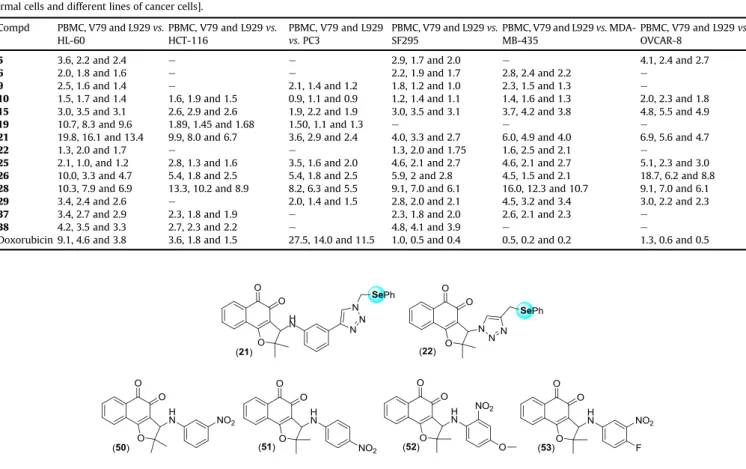
against several cancer cell lines evaluated. Herein, we tried to improve their activities using the approach of insertion of the chalcogen in these quinones, but the strategy failed. Selectivity index for the most active compounds was summarized inTable 2.Previous studies from our laboratory revealed that compounds 50e53(Fig. 1) can be considered as prototypes possessing potent antitumor activities against diverse cancer cells[25,26]. To deepen our knowledge about the mechanism of action of compounds 50e53 and compare the previously reported structures with
Scheme 6.X-ray structures of compounds35and38, and synthesis of selenium-containingpara-quinone-based 1,2,3-triazoles.
Scheme 7.Synthesis of enantio-enriched selenium-containinga-lapachone derivatives-based 1,2,3-triazoles.
selenium-containing lapachone-based 1,2,3-triazoles, we exam-ined their potential NQO1-dependent cytotoxicities using a set two-hour exposure, with or without the NQO1 inhibitor, dicou-marol. Such exposures take advantage of elevated NQO1 levels specifically in most solid cancers compared to associated normal tissue[11]. Within the class of selenium-containing quinones, we selected compounds21and22to evaluate their characteristics by an NQO1-dependent mechanism.
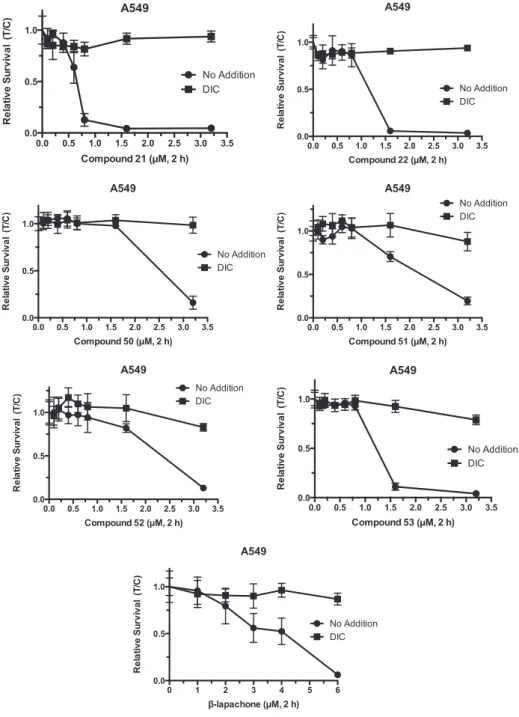
NQO1-dependency assessments. Within the drug
concentra-tion range tested, the compounds showed activity against human A549 non-small cell lung adenocarcinoma, an alveolar basal epithelial cell line. These cells express high levels of NQO1 (3000þ300 enzymatic units). Cell death for many of the com-pounds tested were NQO1-specific, since addition of dicoumarol (DIC, an NQO1 inhibitor) spared their lethality. Based on the
survival curves (Fig. 2), previously reported arylamine substituted nor-b-lapachones have predicted IC50 as follows, compounds:
50¼2.6
mM,
51¼1.8mM,
52¼2.4mM and
53¼1.3mM. Compound
53showed the most dramatic lethality within a narrow therapeutic window, going from 93% viability at 0.8mM to 11% viability at
1.6mM. Overall, compounds
50e53 were NQO1-specific drugs exhibiting similar or lower IC50values thanb-lapachone.
Com-pounds 21 and 22, selenium-containing quinones, with IC50
values¼0.64 and 1.2
mM, respectively, were the most active of this
series and were NQO1-dependent (Table 3). They showed tremendous therapeutic windows using DIC treatment as a surro-gate for responses to NQO1-cells, such as that found for nearly all human normal tissue [12a]. These responses are indicative of NQO1-dependent futile redox cycling of these drugs that create massive ROS, specifically H2O2, that ultimately cause PARP1Table 1
Cytotoxic activity expressed by IC50mM (95% CI) of compounds4e7,9e10,13e16,19e22,25,26,28,29,36e38,39,40,48and49in cancer and normal cell lines after 72 h
exposure, obtained by nonlinear regression for all cell lines from three independent experiments.
Compd HL-60 HCT-116 PC3 SF295 MDA-MB-435 OVCAR-8 PBMC V79 L929
4 >13.99 >13.99 >13.99 >13.99 >13.99 >13.99 >13.99 >13.99 >13.99
5 1.66
(1.09e2.22)
2.96 (2.19e3.81)
2.15 (1.94e2.36)
2.05 (1.52e2.54)
2.72 (2.33e3.28)
1.48 (1.38e1.62)
6.11 (5.65e6.88)
3.67 (2.89e4.45)
4.13 (3.28e4.87)
6 2.00
(1.74e2.25)
4.90 (4.62e5.76)
2.60 (2.18e2.86)
1.88 (1.47e2.26)
1.49 (1.30e1.70)
3.09 (1.98e4.85)
4.16 (3.93e4.44)
3.65 (3.21e3.81)
3.30 (2.81e3.58)
7 5.46
(4.87e6.10)
2.24 (1.71e2.53)
3.89 (3.18e4.47)
4.20 (3.93e4.89)
3.85 (3.49e4.33)
2.55 (2.05e2.95)
4.45 (3.91e5.14)
5.20 (4.62e5.43)
5.46 (4.97e6.00)
9 1.43
(1.32e1.54)a
2.48 (2.32e2.68)
1.68 (1.52e2.02)
1.93 (1.76e2.12)a
1.54 (1.46e1.62)a
2.24 (1.99e2.70)
3.58 (3.34e3.86)a
2.40 (2.29e2.51)
2.04 (1.74e2.43)
10 1.22 (1.13e1.35)
1.11 (0.84e1.26)
1.90 (1.60e2.01)
1.52 (1.44e1.67)
1.31 (1.22e1.52)
0.92 (0.88e1.22)
1.87 (1.45e2.26)
2.17 (2.03e2.31)
1.74 (1.67e1.94)
13 2.59 (2.30e2.94)
4.60 (3.78e5.59)
5.15 (4.63e5.80)
>14.56 3.93
(3.44e4.40)
7.13 (6.12e8.30)
6.46 (5.50e7.10)
6.06 (5.36e6.55)
5.33 (5.15e5.53)
14 2.23 (1.78e2.67)
3.30 (2.90e3.68)
4.09 (3.49e4.57)
3.04 (2.64e3.82)
2.52 (2.23e2.75)
3.53 (3.34e3.75)
3.16 (2.86e3.49)
4.20 (3.82e4.90)
3.68 (3.45e4.34)
15 1.08 (0.86e1.49)
1.28 (1.04e1.57)
1.71 (1.44e2.03)
1.08 (0.94e1.46)
0.88 (0.76e1.06)
0.68 (0.43e1.06)
3.33 (2.94e3.56)
3.78 (3.73e3.94)
3.38 (3.06e3.65)
16 1.59 (1.34e1.87)
2.54 (1.55e2.88)
2.95 (2.22e3.47)
2.65 (2.39e3.34)
2.15 (2.00e2.32)
2.80 (2.45e3.34)
3.23 (2.43e3.96)
4.03 (3.29e4.63)
3.77 (3.06e4.48)
19 0.26 (0.20e0.35)
1.48 (1.34e1.69)
1.86 (1.69e2.39)
2.59 (2.36e2.85)
2.04 (1.78e2.18)
2.53 (2.33e2.74)
2.80 (2.30e3.35)
2.16 (1.83e2.68)
2.50 (2.33e2.77)
20 3.08 1.48e6.46b
0.89 (0.82e1.00)
1.74 (1.22e2.15)
3.23 2.38e4.38b
1.19 1.08e1.34b
1.34 (1.15e1.45)
nd 3.27
(2.97e3.53)
2.67 (2.26e3.49)
21 0.07 (0.02e0.16)
0.14 (0.11e0.25)
0.38 (0.29e0.67)
0.34 (0.20e0.45)
0.23 (0.16e0.38)
0.20 (0.14e0.43)
1.39 (1.12e1.53)
1.13 (1.03e1.26)
0.94 (0.86e1.15)
22 1.29 (1.03e1.59)
2.52 (2.00e2.88)
2.43 (1.87e3.21)
1.31 (1.10e1.59)
1.06 (0.99e1.12)
2.26 (1.66e3.06)
1.76 (1.44e2.11)
2.65 (1.76e3.16)
2.30 (1.89e2.71)
25 0.82 (0.55e1.45)
0.63 (0.43e0.86)
0.51 (0.24e0.59)
0.39 (0.31e0.43)
0.39 (0.27e0.59)
0.35 (0.12e0.47)
1.80 (1.57e2.15)
0.82 (0.67e1.14)
1.06 (0.94e1.18)
26 0.13 (0.04e0.29)
0.24 (0.18e0.31)
0.24 (0.20e0.27)
0.22 (0.20e0.24)
0.29 (0.22e0.33)
0.07 (0.02e0.13)
1.31 (1.11e1.40)
0.44 (0.22e0.60)
0.62 (0.49e0.78)
28 0.31 (0.20e0.43)
0.24 (0.16e0.39)
0.39 (0.16e0.63)
0.35 (0.12e0.47)
0.20 (0.04e0.27)
0.35 (0.27e0.43)
3.21 (2.58e4.27)
2.47 (2.27e3.02)
2.15 (1.88e2.70)
29 0.82 (0.58e1.09)
2.42 (1.80e3.26)
1.40 (1.13e1.71)
0.98 (0.69e1.44)
0.62 (0.42e1.02)
0.91 (0.75e1.11)
2.80 (2.53e3.04)
2.02 (1.64e2.44)
2.15 (2.04e2.53)
36 2.14 (1.99e2.49)
3.25 (3.01e3.76)
2.25 (1.92e2.40)
2.93 (2.77e3.08)
2.01 (1.64e2.47)
2.58 (2.21e2.97)
6.34 (5.70e6.66)
2.51 (2.03e2.86)
3.43 (3.01e3.78)
37 1.11 (0.96e1.23)
1.67 (1.43e2.05)
2.29 (2.07e2.53)
1.61 (1.43e1.89)
1.43 (1.17e1.81)
2.37 (1.87e2.49)
3.86 (3.78e4.04)
3.03 (2.87e3.40)
3.30 (2.97e3.62)
38 1.13 (0.78e1.20)
1.72 (1.42e1.98)
2.08 (1.84e2.41)
0.97 (0.85e1.28)
3.09 (2.72e3.76)
1.89 (1.46e2.67)
4.75 (4.44e5.06)
3.99 (3.40e4.49)
3.83 (3.76e3.97)
39 2.21 (1.91e2.56)
4.27 (4.22e4.52)
2.16 (1.76e2.71)
3.41 (3.11e3.62)
2.36 (1.91e2.91)
3.51 (3.16e4.27)
8.64 (7.53e9.69)
5.77 (4.62e6.73)
5.17 (4.27e5.97)
40 >12.68 >12.68 >12.68 >12.68 >12.68 >12.68 >12.68 >12.68 >12.68 48 8.26
(8.00e9.17)
7.22 (6.78e7.56)
7.79 (7.46e8.07)
5.58 (5.41e6.00)
6.82 (6.23e7.16)
7.90 (7.37e8.19)
7.45 (7.24e7.71)
6.74 (6.04e7.05)
7.16 (6.91e7.50)
49 >8.67 >8.67 >8.67 >8.67 >8.67 >8.67 >8.67 >8.67 >8.67
b-lap. 1.57 1.11e1.69
0.87 0.74e0.95
1.65 1.40e1.94
0.95 0.70e1.03
0.25 0.16e0.33
1.16 0.97e1.25
>20.63 e e
DOXO 0.06
0.02e0.09
0.15 0.09e0.21
0.02 0.02e0.04
0.51 0.43e0.58
0.96 0.87e1.10
0.41 0.36e0.49
0.55 0.41e0.58
0.28 0.21e0.36
0.23 0.15e0.30
aRef.[41].
b Ref.[25]. nd, not determined.
hyperactivation and programmed necrosis[23,24,52].
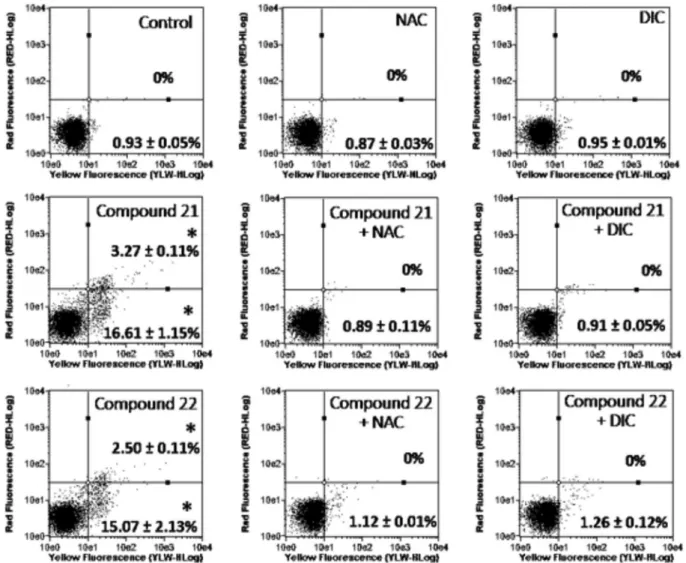
The externalization of phosphatidylserine is considered an important marker in the apoptotic process. After treatments, selected compounds21and22induced a significant increase on populations of PC3 cells with phosphatidylserine expressed on the cell surface (Fig. 3). On the other hand, phosphatidylserine exter-nalization was not observed in cultures pre-treated with NAC before21and22exposure or co-treated with dicoumarol (Fig. 3). Our data show that cytotoxic mechanisms of tested compounds may involve drug bioreduction by quinone reductase NQO1 as well emphasizing the ROS contribution on the cytotoxicity suggesting that tested compounds-induced apoptosis is associated with ROS production. Finally, corroborating these studies, we observed that a short exposure (1 h) to compound 21led to the generation of intracellular ROS. In other hand, in cultures pre-exposed with NAC, compound 21 was not able to generate ROS, which may be explained due the antioxidant protection exercised by NAC (See Fig. S1in the Supporting Information).
3. Conclusions
By using the strategy of conjoining two redox centres, a qui-noidal moiety and the atom of selenium, we prepared and evalu-ated the activities of novel and diverse selenium-containing quinone-based 1,2,3-triazole compounds against cancer versus normal cell lines. We assessed these drugs for lethality overall (Table 1) as well as for specific role of NQO1. In general, our approach was efficient and we identified compounds with IC50
values below 0.3
mM that were more potent than
b-lapachone or
doxorubicin, a standard clinically used agent against several typesof cancers. We also studied the efficacy of two more active com-pounds21and22and found that these are specifically bioactivated by NQO1 with higher potency than nor-b-lapachone, previously published by us. Interestingly, we found that several of these drugs contained glutathione peroxidase (GPx)-like activities with selected selenium-containing nor-b-lapachone-based 1,2,3-triazoles being the most potent, and functionally acting on these two targets. Annexin V cytometry assay was also used to visualize the cell population in viable, early and late apoptosis stage for compounds21and22. The cytotoxic mechanisms of21and22are intrinsically related with ROS contribution on the cytotoxicity suggesting that apoptosis is associated with ROS production. In order, we have described different classes of quinones,ortho- and para-quinoidal systems with potent antitumor activity. For example, compound29 (para-quinone) has IC50 in the range of
0.62e2.42
mM in the cancer cell lines evaluated.
Ortho-quinones, exemplified for compounds10,21,22and26, presented IC50among0.07e2.52
mM. Finally, we have described potent antitumor
naph-thoquinone compounds that emerge as promising molecules for the therapeutic use of cancers overexpressing NQO1.4. Experimental section
4.1. Chemistry
4.1.1. General procedures
Lawsone were acquired from Sigma-Aldrich (St. Louis, MO, USA). Lapachol (1) (2-hydroxy-3-(30-methyl-20 -butenyl)-1,4-naphthoquinone) was extracted from the heartwood ofTabebuia sp. (Tecoma). C-allyl lawsone (23) was prepared from lawsone as
Table 2
Selectivity index for most acticompounds (only IC50values<2mM for cancer cell lines were considered) [Selectivity index, represented by the ratio of cytotoxicities between
normal cells and different lines of cancer cells].
Compd PBMC, V79 and L929vs.
HL-60
PBMC, V79 and L929vs.
HCT-116
PBMC, V79 and L929
vs.PC3
PBMC, V79 and L929vs.
SF295
PBMC, V79 and L929vs. MDA-MB-435
PBMC, V79 and L929vs.
OVCAR-8
5 3.6, 2.2 and 2.4 e e 2.9, 1.7 and 2.0 e 4.1, 2.4 and 2.7
6 2.0, 1.8 and 1.6 e e 2.2, 1.9 and 1.7 2.8, 2.4 and 2.2 e
9 2.5, 1.6 and 1.4 e 2.1, 1.4 and 1.2 1.8, 1.2 and 1.0 2.3, 1.5 and 1.3 e
10 1.5, 1.7 and 1.4 1.6, 1.9 and 1.5 0.9, 1.1 and 0.9 1.2, 1.4 and 1.1 1.4, 1.6 and 1.3 2.0, 2.3 and 1.8
15 3.0, 3.5 and 3.1 2.6, 2.9 and 2.6 1.9, 2.2 and 1.9 3.0, 3.5 and 3.1 3.7, 4.2 and 3.8 4.8, 5.5 and 4.9
19 10.7, 8.3 and 9.6 1.89, 1.45 and 1.68 1.50, 1.1 and 1.3 e e e
21 19.8, 16.1 and 13.4 9.9, 8.0 and 6.7 3.6, 2.9 and 2.4 4.0, 3.3 and 2.7 6.0, 4.9 and 4.0 6.9, 5.6 and 4.7
22 1.3, 2.0 and 1.7 e e 1.3, 2.0 and 1.75 1.6, 2.5 and 2.1 e
25 2.1, 1.0, and 1.2 2.8, 1.3 and 1.6 3.5, 1.6 and 2.0 4.6, 2.1 and 2.7 4.6, 2.1 and 2.7 5.1, 2.3 and 3.0
26 10.0, 3.3 and 4.7 5.4, 1.8 and 2.5 5.4, 1.8 and 2.5 5.9, 2 and 2.8 4.5, 1.5 and 2.1 18.7, 6.2 and 8.8
28 10.3, 7.9 and 6.9 13.3, 10.2 and 8.9 8.2, 6.3 and 5.5 9.1, 7.0 and 6.1 16.0, 12.3 and 10.7 9.1, 7.0 and 6.1
29 3.4, 2.4 and 2.6 e 2.0, 1.4 and 1.5 2.8, 2.0 and 2.1 4.5, 3.2 and 3.4 3.0, 2.2 and 2.3
37 3.4, 2.7 and 2.9 2.3, 1.8 and 1.9 e 2.3, 1.8 and 2.0 2.6, 2.1 and 2.3 e
38 4.2, 3.5 and 3.3 2.7, 2.3 and 2.2 e 4.8, 4.1 and 3.9 e e
Doxorubicin 9.1, 4.6 and 3.8 3.6, 1.8 and 1.5 27.5, 14.0 and 11.5 1.0, 0.5 and 0.4 0.5, 0.2 and 0.2 1.3, 0.6 and 0.5
Fig. 1.Selected compounds for NQO1 studies.
previously reported[53]. A saturated aqueous sodium carbonate solution was added to the sawdust of ipe tree. Upon observing rapid formation of lapachol sodium salt, hydrochloric acid was added, allowing the precipitation of lapachol. Then, the solution was filtered and a yellow solid was obtained. This solid was purified by
recrystallizations with hexane. All chemicals were obtained from commercial sources and used without further purification. Solvents were distilled and when required were dried by distillation ac-cording to standard procedure[54].
For the synthesis of (azidomethyl)(phenyl)selane (PhSeCH2N3):
0.0 0.5 1.0 1.5 2.0 2.5 3.0 3.5 0.0
0.5 1.0
Compound 21 (μM, 2 h)
R e la ti v e Su rv iv a l (T /C ) A549 No Addition DIC
0.0 0.5 1.0 1.5 2.0 2.5 3.0 3.5 0.0
0.5 1.0
Compound 22 (μM, 2 h)
R e la ti v e Su rv iv a l (T /C ) A549 No Addition DIC
0.0 0.5 1.0 1.5 2.0 2.5 3.0 3.5 0.0
0.5 1.0
Compound 50 (μM, 2 h)
R e la ti v e Su rv iv a l (T /C ) A549 No Addition DIC
0.0 0.5 1.0 1.5 2.0 2.5 3.0 3.5 0.0
0.5 1.0
Compound 51 (μM, 2 h)
Rel a ti v e S u rvi v al (T /C ) A549 No Addition DIC
0.0 0.5 1.0 1.5 2.0 2.5 3.0 3.5 0.0
0.5 1.0
Compound 52 (μM, 2 h)
Re la ti v e S u rv iv a l (T /C ) A549 No Addition DIC
0.0 0.5 1.0 1.5 2.0 2.5 3.0 3.5 0.0
0.5 1.0
Compound 53 (μM, 2 h)
R el a ti ve S u rv iva l (T /C ) A549 No Addition DIC
0 1 2 3 4 5 6
0.0 0.5 1.0
β-lapachone (μM, 2 h)
R e la ti v e S u rv iv a l (T /C ) A549 No Addition DIC
Fig. 2.Compounds21,22,50e53andb-lapachone evaluated for NQO1-dependence.
Table 3
NQO1-dependent lethal responses of various compounds. IC50values are reported for cells exposed for two hours in the absence or presence of dicoumarol (DIC).
Compound Activity NQO1 specific IC50(mM) IC50(mM)þDIC DIC protection
21 Yes Yes 0.64 >3.2 Yes
22 Yes Yes 1.2 >3.2 Yes
50 Yes Yes 2.6 >3.2 Yes
51 Yes Yes 1.8 >3.2 Yes
52 Yes Yes 2.4 >3.2 Yes
53 Yes Yes 1.3 >3.2 Yes
b-lapachone Yes Yes 3.4 >10 Yes
Initially (chloromethyl)(phenyl)selane was prepared by the reac-tion of a solureac-tion of diphenyl diselenide (3.0 mmol) in THF (6.0 mL) with NaBH4 (2 eq.) in EtOH (6.0 mL) and CH2Cl2 (30 mL). The
mixture was kept under reflux in inert atmosphere and stirred for 12 h. After this period and subsequently extraction with H2O, the
organic phase were combined, dried over MgSO4, and concentrated
under vacuum. The residue was purified byflash chromatography on silica gel using hexane as the eluent [55]. To a solution of (chloromethyl)(phenyl)selane (PhSeCH2Cl) (3.0 mmol) in CH3CN
(5.0 mL), sodium azide (4.5 mmol) and 18-crown-6 (0.60 mmol) were added at room temperature. Then the reaction mixture was stirred for 48 h under nitrogen atmosphere. After this time, 30 mL of H2O was added and the organic phase was extracted with CH2Cl2.
The organic layers were combined, dried over MgSO4, and
concentrated under vacuum. The residue was purified by flash chromatography on silica gel using hexane as the eluent. The product was obtained in 90% yield[56].
For the synthesis of phenyl propargyl selenide: To a solution of diphenyl diselenide (1.0 mmol) in THF (8.0 mL) with NaBH4(2 eq.)
in EtOH (4 mL). The mixture was kept under agitation at temper-ature of 0C under inert atmosphere and, then, propargyl bromide (2.0 mmol) in THF (4 mL) was added. After 10 min, 30 mL of H2O
was added and the organic phase was extracted with ethyl acetate.
The organic phases were combined, dried over MgSO4, and
concentrated under vacuum. The residue was purified by flash chromatography on silica gel using hexane as the eluent. The product was obtained in 85% yield[57].
Melting points were obtained on a Thomas Hoover and are uncorrected. Column chromatography was performed on silica gel (SiliaFlash G60 UltraPure 60e200
mm, 60 Å). Infrared spectra were
recorded on an FTIR Spectrometer IR Prestige-21-Shimadzu. 1H and13C NMR were recorded at room temperature using a BrukerAVANCE DRX200 and DRX400 MHz, in the solvents indicated, with tetramethylsilane (TMS) as internal reference. Chemical shifts (
d
) are given in parts per million (ppm) and coupling con-stants (J) in Hertz (Hz). The mass spectrometer was operated in the positive ion mode. A standard atmospheric pressure photo-ionization (APPI) source was used to generate the ions. The sample was injected using a constantflow (3mL/min). The solvent was an
acetonitrile/methanol mixture. The APPI-Q-TOF MS instrument was calibrated in the mass range of 50e3000m/zusing an internal calibration standard (low concentration tuning mix solution) supplied by Agilent Technologies. Data were processed employing Bruker Data Analysis software version 4.0. Compounds were named following IUPAC rules as applied by ChemBioDraw Ultra (version 12.0).Fig. 3. Effect onphosphatidylserineexternalization after 6 h-treated PC3 with 5mM of tested compounds. Thephosphatidylserineexternalization was determined byflow cytometry using AnnV-FITC (YLW-HLog) and PI (RED-HLog). Viable cells are plotted at lower left quadrant, cells in early and late apoptosis withphosphatidylserineexternalized are plotted at lower right and upper right quadrants, respectively, and necrotic cells are plotted at upper left quadrant. *p<0.05 compared to control by ANOVA followed by Newman-Keuls test. Data are presented as mean values±S.E.M. from three independent experiments in triplicate.
4.1.2. Procedures to prepare arylamino lapachones4,13and19
To prepare 4 and 13:Compounds3and 12(1.0 mmol) were
dissolved in 25 mL of CH2Cl2 and an excess of 3-ethynylaniline
(117 mg, 1.2 mmol) was added. The mixture was left under stir-ring overnight, followed by the addition of 50 mL of water. The organic phase was extracted with CH2Cl2, washed with 10% HCl
(350 mL), dried over sodium sulfate, andfiltered. The solvent from the crude was evaporated under reduced pressure and it was purified by column chromatography on silica-gel, using eluents with an increasing polarity gradient mixture of hexane and ethyl acetate (9/1 to 7/3).
To prepare 19: To a solution of nor-lapachol (17) (228 mg,
1.0 mmol) in 25 mL of chloroform, 2 mL of bromine was added. The bromo intermediate 18 precipitated immediately as an orange solid. After removal of bromine, by adding dichloromethane and then removing the organic solvent with dissolved bromine by ro-tary evaporator, an excess of 3-ethynylaniline (117 mg, 1.2 mmol) was added in CH2Cl2and the mixture was stirred overnight. The
crude reaction mixture was poured into 50 mL of water. The organic phase was separated and washed with 10% HCl (350 mL), dried over sodium sulfate,filtered, and evaporated under reduced pres-sure. The product 19 was obtained after purification by column chromatography in silica-gel, eluted with an increasing polarity gradient mixture of hexane and ethyl acetate (9/1 to 7/3).
4.1.3. General procedures to prepare the azide derivatives
The previously published azido derivatives5,9,14,20,25,39,46 were prepared as described in the literature [40e42,46e48]. Compound28(1.0 mmol) was prepared from27in the presence of sodium azide (120 mg, 1.85 mmol) in 2 mL of dimethylformamide (DMF). The mixture was stirred at room temperature until product formation was complete as determined by thin layer chromatog-raphy. After extraction with CH2Cl2, the residue was dried over
anhydrous Na2SO4 and concentrated under reduced pressure.
Compound28was obtained after purification by column chroma-tography on silica gel eluting with a gradient mixture of hex-ane:ethyl acetate with increasing polarity. The unpublished azide derivative47was prepared following the same procedure previ-ously described[48].
4.1.4. General procedures for the preparation of 1,2,3-triazole derivatives
The azidoquinones (1.0 mmol) or quinone with terminal alkynes (1.0 mmol) were reacted with CuSO4$5H2O (0.04 mmol) and
so-dium ascorbate (0.11 mmol) and the phenyl propargyl selenide (195 mg, 1.0 mmol) or (azidomethyl)(phenyl)selane (212 mg, 1.0 mmol) in a mixture of CH2Cl2:H2O (12 mL, 1:1, v/v). The mixture
was stirred at room temperature until product formation was complete as determined by thin layer chromatography. The aqueous phase was extracted with CH2Cl2, dried over anhydrous
Na2SO4and concentrated under reduced pressure. The residue was
purified by column chromatography on silica gel eluting with a gradient mixture of hexane:ethyl acetate with increasing polarity.
4.1.5. 4-((3-ethynylphenyl)amino)-2,2-dimethyl-3,4-dihydro-2H-benzo[g]chromene-5,10-dione (4)
Yield: 70%; mp 196e197C; Brown solid.1H NMR (200 MHz, CDCl3)
d
8.11e8.03 (m, 2H), 7.75e7.68 (m, 2H), 7.16 (t,J¼7.5 Hz, 1H), 6.95e6.85 (m, 2H), 6.71 (d,J¼8.0 Hz, 1H), 4.68 (t,J¼3.7 Hz, 1H), 3.03 (s, 1H), 2.27 (dd,J¼3.5 and 14.4 Hz, 1H), 2.02 (dd,J¼5.5 and 14.4 Hz, 1H), 1.54 (s, 6H);13C NMR (CDCl3, 50 MHz)d
183.7, 180.0,155.5, 146.3, 134.6, 133.3, 132.1, 131.0, 129.4, 126.5, 126.3, 123.0, 122.8, 118.4, 117.1, 115.2, 84.1, 79.2, 43.7, 37.4, 28.7, 26.3; HRMS (ESþ) calculated for C23H20NO3[MþH]þ: 358.1443; found: 358.1488.
4.1.6. 2,2-Dimethyl-4-((3-(1-((phenylselanyl)methyl)-1H-1,2,3- triazol-4-yl)phenyl)amino)-3,4-dihydro-2H-benzo[g]chromene-5,10-dione (6)
Yield: 75%; mp 101e102C; Red solid.1H NMR (400 MHz, CDCl3)
d
8.11 (dd,J¼7.1 and 1.7 Hz, H9), 8.07 (dd,J¼7.1 and 1.6 Hz, H6), 7.72 (td,J¼7.1, 7.1 and 1.6 Hz, H8), 7.68 (td,J¼7.1, 7.1 and 1.7 Hz, H7), 7.62 (s, H5-triazole), 7.50 (d,J¼7.4 Hz, H200/600), 7.33e7.39 (m, H400), 7.26e7.28 (m, H20), 7.28e7.33 (m, H300/500), 7.20e7.26 (m, H50), 7.05 (d,J¼7.7 Hz, H40), 6.69 (dd,J¼8.0 and 1.8 Hz, H60), 5.71 (s, H12), 4.78 (dd,J¼5.6 and 3.4 Hz, H4), 2.32 (dd,J¼14.3 and 3.4 Hz, H3aor H3b), 2.06 (dd,J¼14.3 and 5.6 Hz, H3aor H3b), 1.55 (s, H110or H1100), 1.54 (s, H110or H1100);13C NMR (CDCl3, 100 MHz)d
183.5 (C5), 180.0 (C10), 155.3 (C10a), 148.5 (C4-triazole), 147.4 (C10), 134.8 (C200/600), 134.3 (C8), 133.1 (C7), 132.1 (C9a), 131.3 (C30), 130.9 (C5a), 129.8 (C50), 129.6 (C300/500), 129.0 (C400), 127.4 (C100), 126.4 (C9), 126.2 (C6), 119.4 (C5 -tri-azole), 118.9 (C4a), 115.7 (C40), 113.6 (C60), 110.7 (C20), 79.1 (C2), 44.8 (C12), 43.2 (C4), 37.6 (C3), 29.0 (C110or C1100), 26.1 (C110or C1100); HRMS (ESþ) calculated for C30H27N4O3Se [MþH]þ: 571.1248; found: 571.1234.
4.1.7. 2,2-Dimethyl-4-(4-((phenylselanyl)methyl)-1H-1,2,3-triazol-1-yl)-3,4-dihydro-2H-benzo[g]chromene-5,10-dione (7)
Yield: 70%; mp 168e169C; Yellow solid.1H NMR (200 MHz, CDCl3)
d
8.18e8.09 (m, 1H), 8.04e7.96 (m, 1H), 7.80e7.68 (m, 2H), 7.50e7.39 (m, 2H), 7.24e7.10 (m, 4H), 5.71 (t,J¼6.3 Hz, 1H), 4.13 (s, 2H), 2.73 (dd,J¼5.5 and 14.4 Hz, 1H), 2.29 (dd,J¼6.3 and 14.4 Hz, 1H), 1.50 (s, 3H), 1.21 (s, 3H); 13C NMR (CDCl3, 50 MHz)d
182.7,179.5, 156.3, 145.3, 134.7, 133.7, 131.8, 131.1, 129.7, 129.1, 127.5, 126.8, 126.6, 122.0, 115.0, 79.4, 49.6, 39.0, 27.0, 26.5, 20.8; HRMS (ESþ) calculated for C24H21N3O3SeNa [MþNa]þ: 502.0646; found: 502.0643.
4.1.8. 3-Bromo-2,2-dimethyl-4-(4-((phenylselanyl)methyl)-1H-1,2,3-triazol-1-yl)-3,4-dihydro-2H-benzo[h]chromene-5,6-dione (10)
Yield: 90%; mp 105e106C; Orange solid.1H NMR (400 MHz, CDCl3)
d
8.11 (dd,J¼7.6 and 1.4 Hz, H7), 7.90 (dd,J¼7.6 and 1.2 Hz, H10), 7.73 (td,J¼7.6, 7.6 and 1.2 Hz, H8), 7.63 (td,J¼7.6, 7.6 and 1.4 Hz, H9), 7.48e7.52 (m, H20/60), 7.48 (s, H5-triazole), 7.22e7.25 (m, H30/50), 7.22e7.25 (m, H40), 5.55 (d,J¼8.9 Hz, H4), 4.93 (d,J¼8.9 Hz, H3), 4.17 (d,J¼13.3 Hz, H12a), 4.13 (d,J¼13.3 Hz, H12b), 1.71 (s, H110 or H1100), 1.64 (s, H110or H1100);13C NMR (CDCl3, 100 MHz)
d
177.8 (C6), 176.4 (C5), 162.7 (C10b), 144.5 (C4-triazole), 135.2 (C8), 134.1 (C20/60), 132.3 (C9), 130.6 (C10a), 130.5 (C6a), 129.4 (C10), 129.2 (C7), 129.1 (C30/50), 127.6 (C40), 125.3 (C10), 125.0 (C5-triazole), 110.3 (C4a), 83.4 (C2), 54.4 (C3), 58.9 (C4), 20.7 (C110or C1100), 27.4 (C110or C1100), 20.7 (C12); HRMS (ESþ) calculated for C24H21BrN3O3Se [MþH]þ: 557.9931; found: 557.9923.
4.1.9. 3-((3-ethynylphenyl)amino)-2,2-dimethyl-2,3-dihydronaphtho[2,3-b]furan-4,9-dione (13)
Yield: 65%; mp 165e167C; Brown solid.1H NMR (200 MHz, CDCl3)
d
8.14e8.04 (m, 2H), 7.78e7.66 (m, 2H), 7.15 (t,J¼8.0 Hz, 1H), 6.91 (d,J¼7.5 Hz, 1H), 6.74 (s, 1H), 6.62 (dd,J¼2.1 and 8.0 Hz, 1H), 4.87 (s, 1H), 3.03 (s, 1H), 2.27 (s, 1H), 1.65 (s, 3H), 1.54 (s, 3H);13C NMR (CDCl
3, 50 MHz)
d
181.7, 178.7, 159.9, 146.8, 134.6, 133.2,133.1, 131.5, 129.4, 126.5, 126.3, 123.0, 122.4, 122.1, 116.3, 114.0, 94.9, 83.9, 62.2, 29.5, 27.1, 21.5; HRMS (ESþ) calculated for C
22H17NO3Na
[MþNa]þ: 366.1106; found: 366.1257.
4.1.10. 2,2-Dimethyl-3-((3-(1-((phenylselanyl)methyl)-1H-1,2,3- triazol-4-yl)phenyl)amino)-2,3-dihydronaphtho[2,3-b]furan-4,9-dione (15)
Yield: 70%; mp 120e122 C; Red solid.1H NMR (400 MHz, CDCl3)
d
8.10 (dd,J¼7.4 and 1.4 Hz, H8), 8.07 (dd,J¼7.4 and 1.6 Hz,H5), 7.73 (td,J¼7.4, 7.4 and 1.6 Hz, H7), 7.68 (td,J¼7.4, 7.4 and 1.4 Hz, H6), 7.60 (s, H5-triazole), 7.50 (d,J¼7.5 Hz, H200/600), 7.27e7.39 (m, H300/500), 7.27e7.39 (m, H400), 7.22 (t,J¼7.8 Hz, H50), 7.20 (s, H20), 7.04 (d,J¼7.8 Hz, H40), 6.61 (dd,J¼7.8 and 1.8 Hz, H60), 5.71 (s, H11), 4.96 (s, H3), 4.05 (sl, NH), 1.67 (s, H100or H1000), 1.57 (s, H100or H1000);
13C NMR (CDCl
3, 100 MHz)
d
181.8 (C4), 178.6 (C9), 159.8 (C9a), 148.3(C4-triazole), 147.5 (C10), 134.8 (C200/600), 134.5 (C7), 133.2 (C8a), 133.1 (C6), 131.9 (C30), 131.6 (C4a), 129.9 (C50), 129.6 (C300/500), 129.0 (C400), 127.4 (C100), 126.5 (C8), 126.2 (C5), 122.3 (C3a), 119.4 (C5-triazole), 115.9 (C40), 113.1 (C60), 110.5 (C20), 95.5 (C2), 62.3 (C3), 44.7 (C11), 27.2 (C100 or C1000), 21.6 (C100 or C1000); HRMS (ESþ) calculated for C29H25N4O3Se [MþH]þ: 557.1092; found: 557.1101.
4.1.11. 2,2-Dimethyl-3-(4-((phenylselanyl)methyl)-1H-1,2,3-triazol-1-yl)-2,3-dihydronaphtho[2,3-b]furan-4,9-dione (16)
Yield: 80%; mp 172e174C; Yellow solid.1H NMR (400 MHz, CDCl3)
d
8.18 (dd,J¼7.4 and 1.6 Hz, H8), 8.08 (dd,J¼7.4 and 1.6 Hz, H5), 7.80 (td,J¼7.4, 7.4 and 1.6 Hz, H7), 7.76 (td,J¼7.4, 7.4 and 1.6 Hz, H6), 7.40 (dd,J¼7.9 and 1.4 Hz, H20/60), 7.08e7.19 (m, H30/50), 7.08e7.19 (m, H40), 6.98 (s, H5-triazole), 5.92 (s, H3), 4.14 (d, J¼13.5 Hz, H11), 4.09 (d,J¼13.5 Hz, H11), 1.67 (s, H100or H1000), 1.02 (s, H100or H1000);13C NMR (CDCl3, 100 MHz)d
180.5 (C4), 177.8 (C9), 151.1 (C9a), 145.8 (C4-triazole), 134.9 (C7), 133.9 (C20/60), 133.6 (C6), 132.7 (C8a), 131.6 (C4a), 129.13 (C10), 129.06 (C30/50), 127.5 (C40), 126.8 (C8), 126.5 (C5), 121.2 (C5-triazole), 118.3 (C3a), 94.5 (C2), 67.3 (C3),27.4 (C100orC1000), 20.7 (C100orC1000), 20.5 (C11); HRMS (ESþ) calcu-lated for C23H19N3O3SeNa [MþNa]þ: 488.0489; found: 488.0486.
4.1.12. 3-((3-ethynylphenyl)amino)-2,2-dimethyl-2,3-dihydronaphtho[1,2-b]furan-4,5-dione (19)
Yield: 70%; mp 205e206 C; Red solid. 1H NMR (200 MHz, CDCl3)
d
8.10 (dd,J¼2.0 and 8.0 Hz, 1H), 7.76e7.58 (m, 3H), 7.12 (t, J¼7.8 Hz, 1H), 6.88 (d,J¼7.8 Hz, 1H), 6.69 (s, 1H), 6.58 (dd,J¼2.0 and 8.0 Hz, 1H), 4.79 (s, 1H), 3.02 (s, 1H), 1.68 (s, 3H), 1.57 (s, 3H);13CNMR (CDCl3, 50 MHz)
d
175.4, 169.7, 147.1, 134.7, 132.7, 131.2, 129.6,129.4, 128.6, 125.2, 122.9, 122.2, 116.1, 115.0, 114.1, 96.8, 84.1, 61.5, 27.4, 21.8; HRMS (ESþ) calculated for C
22H17NO3Na [MþNa]þ: 366.1106; found: 366.1108.
4.1.13. 2,2-Dimethyl-3-((3-(1-((phenylselanyl)methyl)-1H-1,2,3- triazol-4-yl)phenyl)amino)-2,3-dihydronaphtho[1,2-b]furan-4,5-dione (21)
Yield: 50%; mp 135e137C; Red solid.1H NMR (400 MHz, CDCl3)
d
8.12 (d,J¼7.4 Hz, H6), 7.70 (td,J¼7.4, 7.4 and 1.1 Hz, H7), 7.74 (dd, J¼7.4 and 1.1 Hz, H9), 7.64 (td,J¼7.4, 7.4 and 1.6 Hz, H8), 7.59 (s, H5 -triazole), 7.50 (d,J¼6.9 Hz, H200/600), 7.28e7.40 (m, H300/500), 7.28
e7.40
(m, H400), 7.14 (s, H20), 7.20 (dd, J¼8.1 and 7.7 Hz, H50), 7.02 (d, J¼7.7 Hz, H40), 6.56 (dd,J¼8.1 and 2.2 Hz, H60), 5.51 (s, H11), 4.89 (s, H3), 3.70e4.37 (sl, NH), 1.60 (s, H100or H1000), 1.17 (s, H100or H1000);13C NMR (CDCl3, 100 MHz)
d
181.0 (C5), 175.4 (C4), 169.6 (C9b), 148.3 (C4-triazole), 147.8 (C10), 134.8 (C200/600), 134.6 (C7), 132.5 (C8), 131.3 (C30), 131.2 (C9a), 129.8 (C50), 129.6 (C300/500), 129.5 (C6), 128.9 (C400), 127.5 (C5a), 127.4 (C100), 125.1 (C9), 119.5 (C5-triazole), 115.5 (C40), 115.1 (C3a), 113.0 (C60), 110.2 (C20), 96.9 (C2), 61.6 (C3), 44.8 (C11), 27.5 (C100 or C1000), 21.8 (C100 or C1000); HRMS (ESþ) calculated for C29H24N4O3SeNa [MþNa]þ: 579.0911; found: 579.0890.
4.1.14. 2,2-Dimethyl-3-(4-((phenylselanyl)methyl)-1H-1,2,3-triazol-1-yl)-2,3-dihydronaphtho[1,2-b]furan-4,5-dione (22)
Yield: 80%; mp 186e188C; Yellow solid.1H NMR (200 MHz, CDCl3)
d
8.19 (d,J¼7.3 Hz, H6), 7.68e7.82 (m, H7), 7.68e7.82 (m, H8), 7.68e7.82 (m, H9), 7.41 (d,J¼7.1 Hz, H20/60), 7.08e7.21 (m, H30/50), 7.08
e7.21 (m, H40), 7.00 (s, H5-triazole), 5.86 (s, H3), 4.05
e4.16
(m, H11), 1.70 (s, H100or H1000), 1.05 (s, H100or H1000);13C NMR (CDCl3, 50 MHz)
d
180.0 (C5), 174.5 (C4), 171.1 (C9b), 145.5 (C4-triazole), 134.9(C7), 134.0 (C20/60), 133.4 (C8), 131.4 (C9a), 129.9 (C6), 129.2 (C10), 129.1 (C30/50), 127.5 (C40), 126.6 (C5a), 125.6 (C9), 121.2 (C5-triazole), 111.2 (C3a), 95.9 (C2), 66.7 (C3), 27.6 (C100or C1000), 20.9 (C100or C1000), 20.6 (C11); HRMS (ESþ) calculated for C23H19N3O3SeNa [MþNa]þ: 488.0489; found: 488.0482.
4.1.15. 2-((4-((phenylselanyl)methyl)-1H-1,2,3-triazol-1-yl) methyl)-2,3-dihydronaphtho[1,2-b]furan-4,5-dione (26)
Yield: 85%; mp 163e164C; Orange solid.1H NMR (400 MHz, CDCl3)
d
8.00 (dd,J¼7.4 and 1.5 Hz, H6), 7.59 (td,J¼7.4, 7.4 and 1.4 Hz, H7), 7.53 (td,J¼7.4, 7.4 and 1.5 Hz, H8), 7.44 (dd,J¼7.4 and 1.1 Hz, H9), 7.33e7.41 (m, H20/60), 7.31 (s, H5-triazole), 7.13e7.18 (m, H30/50), 7.13e7.18 (m, H40), 5.33e5.42 (m, H2), 4.55 (dd,J¼14.6 and 7.3 Hz, H10a), 4.64 (dd,J¼14.6 and 3.9 Hz, H10b), 4.11 (s, H11), 3.23 (dd,J¼15.8 and 10.2 Hz, H3a), 2.83 (dd,J¼15.8 and 7.0 Hz, H3b);13C NMR (CDCl3, 100 MHz)d
180.4 (C5), 175.2 (C4), 186.6 (C9b), 146.4(C4-triazole), 134.7 (C7), 132.9 (C20/60), 132.3 (C8), 130.6 (C9a), 129.8 (C6), 129.8 (C10), 129.2 (C30/50), 127.5 (C40), 126.9 (C5a), 124.4 (C9), 122.7 (C5-triazole), 114.7 (C3a), 84.3 (C2), 53.3 (C10), 29.6 (C3), 20.2 (C11); HRMS (ESþ) calculated for C
22H18N3O3Se [MþH]þ: 452.0513; found: 452.0896.
4.1.16. 2-(azidomethyl)-2,3-dihydronaphtho[2,3-b]furan-4,9-dione (28)
Yield: 90%; mp 116e117C; Yellow solid.1H NMR (200 MHz, CDCl3)
d
8.06e7.94 (m, 2H), 7.71e7.57 (m, 2H), 5.23e5.09 (m, 1H), 3.75 (dd,J¼3.7 and 13.3 Hz, 1H), 3.56 (dd,J¼5.0 and 13.3 Hz, 1H), 3.26 (dd,J¼10.8 and 17.4 Hz, 1H), 3.02 (dd,J¼7.5 and 17.4 Hz, 1H);13C NMR (CDCl
3, 50 MHz)
d
181.8, 177.1, 159.4, 134.1, 133.0, 132.6,131.2, 126.1, 125.8, 124.0, 83.6, 53.5, 30.0; HRMS (ESþ) calculated for C13H10N3O3[MþH]þ: 256.0722; found: 256.0716.
4.1.17. 2-((4-((phenylselanyl)methyl)-1H-1,2,3-triazol-1-yl) methyl)-2,3-dihydronaphtho[2,3-b]furan-4,9-dione (29)
Yield: 90%; mp 169e171C; Yellow solid.1H NMR (400 MHz, CDCl3)
d
8.00 (dd,J¼7.4 and 1.5 Hz, H8), 7.93 (dd,J¼7.4 and 1.6 Hz, H5), 7.66 (td,J¼7.4, 7.4 and 1.6 Hz, H7), 7.62 (td,J¼7.4, 7.4 and 1.5 Hz, H6), 7.32e7.37 (m, H5-triazole), 7.32e7.37 (m, H20/60), 7.11e7.17 (m, H30/50), 7.11e7.17 (m, H40), 5.23e5.32 (m, H2), 4.64 (dd, J¼14.7 and 3.9 Hz, H10b), 4.57 (dd,J¼14.7 and 5.6 Hz, H10a), 4.05 (s, H11), 3.26 (dd,J¼17.4 and 10.6 Hz, H3b), 2.95 (dd,J¼17.4 and 8.1 Hz, H3b);13C NMR (CDCl3, 50 MHz)d
181.6 (C4), 177.2 (C9), 159.0(C9a), 146.4 (C4-triazole), 134.4 (C7), 133.1 (C20/60), 132.7 (C8a), 133.2 (C6), 131.3 (C4a), 129.7 (C10), 129.1 (C30/50), 127.4 (C40), 126.4 (C8), 126.2 (C5), 124.1 (C3a), 123.1 (C5-triazole), 83.0 (C2), 52.9 (C10), 30.1 (C3),
20.3 (C11); HRMS (ESþ) calculated for C22H18N3O3Se [MþH]þ: 452.0513; found: 452.0512.
4.1.18. 2-Chloro-3-(((1-((phenylselanyl)methyl)-1H-1,2,3-triazol-4-yl)methyl)amino)-1,4-naphthoquinone (36)
Yield: 65%; mp 127e128C; Orange solid.1H NMR (200 MHz, CDCl3)
d
8.14 (dd,J¼1.2 and 7.5 Hz, 1H), 8.03 (dd,J¼1.2 and 7.5 Hz, 1H), 7.97e7.57 (m, 2H), 7.51e7.40 (m, 3H), 7.33e7.23 (m, 3H), 6.49 (sl, 1H), 5.68 (s, 2H), 5.10 (d,J¼ 6.3 Hz, 2H);13C NMR (CDCl3, 50 MHz)d
180.0, 176.7, 144.8, 143.6, 134.8, 134.7, 132.5, 132.3, 129.7, 129.5, 129.0, 126.9, 126.8, 126.7, 121.8, 111.6, 43.6, 40.0; HRMS (ESþ) calculated for C20H16ClN4O2Se [MþH]þ: 459.0127; found: 459.0128.4.1.19. 2-Bromo-3-(((1-((phenylselanyl)methyl)-1H-1,2,3-triazol-4-yl)methyl)amino)-1,4-naphthoquinone (37)
Yield: 60%; mp 124e126C; Orange solid.1H NMR (200 MHz, CDCl3)
d
8.13 (dd,J¼1.2 and 8.0 Hz, 1H), 8.01 (dd,J¼1.2 and 8.0 Hz, 1H), 7.77e7.57 (m, 2H), 7.48 (s, 1H), 7.46e7.41 (m, 2H), 7.36e7.20 (m, 3H), 6.50 (sl, 1H), 5.68 (s, 2H), 5.11 (d,J¼6.3 Hz, 2H);13C NMR (CDCl3, 50 MHz)d
180.1, 176.7, 146.2, 145.0, 135.0, 132.8, 132.3, 130.0,129.8, 129.3, 127.2, 127.1, 122.1, 44.6, 40.7; HRMS (ESþ) calculated for C20H16BrN4O2Se [MþH]þ: 502.9622; found: 502.9612.
4.1.20. 2-(((1-((phenylselanyl)methyl)-1H-1,2,3-triazol-4-yl) methyl)amino)-1,4-naphthoquinone (38)
Yield: 60%; mp 162e164C; Red solid.1H NMR (200 MHz, CDCl3)
d
8.10 (dd,J¼7.6 and 1.3 Hz, H8), 8.06 (dd,J¼7.6 and 1.3 Hz, H5), 7.74 (td,J¼7.6, 7.6 and 1.3 Hz, H6), 7.64 (td,J¼7.6, 7.6 and 1.3 Hz, H7), 7.46 (dd, J ¼ 7.8 and 1.5 Hz, H20/60), 7.39 (s, H5-triazole), 7.27e7.35 (m, H30/50), 7.27e7.35 (m, H40), 6.22e6.35 (m, NH), 5.77 (s, H3), 5.68 (s, H10), 4.45 (d,J¼5.8 Hz, H9);13C NMR (CDCl3, 50 MHz)d
183.0 (C1), 181.6 (C4), 147.4 (C4-triazole), 143.2 (C2), 134.82 (C20/60), 134.78 (C6), 133.4 (C4a), 132.2 (C7), 130.4 (C8a), 129.7 (C30/50), 129.1 (C40), 127.0 (C10), 126.3 (C5), 126.2 (C8), 121.7 (C5-triazole), 101.7 (C3), 44.7 (C10), 38.1 (C9); HRMS (ESþ) calculated for C20H17N4O2Se [MþH]þ: 425.0517; found: 425.0512.4.1.21. 2-(4-((phenylselanyl)methyl)-1H-1,2,3-triazol-1-yl)-1,4-naphthoquinone (40)
Yield: 60%; mp 117e120C; Brown solid.1H NMR (200 MHz, CDCl3)
d
8.36 (s, 1H), 8.24e8.12 (m, 2H), 7.88e7.79 (m, 2H), 7.72 (s, 1H), 7.59e7.48 (m, 2H), 7.29e7.26 (m, 2H), 4.25 (s, 2H), 1.6 (s, 1H);13C NMR (CDCl
3, 50 MHz)
d
183.6, 179.1, 146.8, 139.1, 134.9, 134.2,133.4, 131.3, 130.9, 129.3, 129.1, 127.6, 127.1, 126.4, 126.2, 123.8, 20.2; HRMS (ESþ) calculated for C
19H14N3O2Se [MþH]þ: 396.0251; found: 396.0242.
4.1.22. (3R,4S)-3-azido-4-(naphthalen-1-yl)-3,4-dihydro-2H-benzo [g]chromene-5,10-dione (47)
Yield: 78%; mp 115e117 C; Light yellow solid. 1H NMR (200 MHz, CDCl3)
d
8.27 (d,J¼8.3 Hz, 1H), 8.23e8.20 (m, 1H), 8.03e8.00 (m, 1H), 7.93 (d,J¼8.1 Hz, 1H), 7.80 (d,J¼8.1 Hz, 1H), 7.76e7.68 (m, 3H), 7.59 (t,J¼8.1 Hz, 1H), 7.35 (t,J¼7.3 Hz, 1H), 7.11 (d,J¼7.3 Hz, 1H), 5.14 (dd,J¼2.3 and 1.8 Hz, 1H), 4.46 (dt,J¼12.5 and 2.3 Hz, 1H), 4.19 (d,J¼12.5 Hz, 1H), 4.13 (d,J¼1.8 Hz, 1H);13C NMR (CDCl3, 100 MHz)d
183.2, 179.1, 155.7, 136.0, 134.6, 133.6,132.3, 131.3, 130.6, 129.7, 129.0, 127.6, 126.8, 126.7, 126.5, 126.2, 125.4, 122.2, 119.7, 64.6, 56.9, 36.4; HRMS (ESþ) calculated for C23H15N3O3Na [MþNa]þ: 404.1006; found: 404.1007.
4.1.23. (3R,4S)-4-phenyl-3-(4-((phenylselanyl)methyl)-1H-1,2,3-triazol-1-yl)-3,4-dihydro-2H-benzo[g]chromene-5,10-dione (48)
Yield: 70%; mp 187e188 C; Yellow solid.1H NMR (200 MHz, CDCl3)
d
8.22e8.16 (m, 1H), 8.02e7.98 (m, 1H), 7.78e7.73 (m, 2H), 7.40e7.26 (m, 7H), 7.15 (s, 1H), 7.13e7.02 (m, 3H), 4.98e4.96 (m, 1H), 4.70e4.65 (m, 2H), 4.50e4.44 (m, 1H), 4.10 (s, 2H);13C NMR (CDCl3, 50 MHz)d
182.3, 178.4, 154.6, 145.8, 140.0, 134.5, 133.5,133.4, 131.7, 130.7, 129.2, 128.9, 128.0, 127.7, 127.4, 126.5, 120.3, 119.7, 64.6, 58.3, 40.7, 20.2; HRMS (ESþ) calculated for C28H21N3O3SeH [MþH]þ: 528.0826; found: 528.0821.
4.1.24. (3R,4S)-4-(naphthalen-1-yl)-3-(4-((phenylselanyl)methyl)- 1H-1,2,3-triazol-1-yl)-3,4-dihydro-2H-benzo[g]chromene-5,10-dione (49)
Yield: 65%; mp 185e188 C; Yellow solid.1H NMR (400 MHz, CDCl3)
d
8.41 (d,J¼8.6 Hz, H900), 8.12 (dd,J¼6.9 and 1.9 Hz, H9), 7.89 (dd, J ¼6.8 and 2.0 Hz, H6), 7.84 (d, J¼ 8.1 Hz, H600), 7.72 (d, J¼8.2 Hz, H400), 7.64e7.70 (m, H7), 7.64e7.70 (m, H8), 7.62 (dd, J¼8.6 and 7.5 Hz, H800), 7.50 (dd,J¼8.1 and 7.5 Hz, H700), 7.31 (d, J¼7.4 Hz, H20/60), 7.25 (dd,J¼8.2 and 7.1 Hz, H300), 7.20 (s, H5 -tri-azole), 7.06 (d,J¼7.1 Hz, H200), 7.00 (t,J¼7.4 Hz, H30/50), 6.92 (t, J¼7.4 Hz, H40), 5.42 (s, H4), 5.00 (s, H3), 4.54 (d,J¼12.8 Hz, H2a), 4.36 (dl,J¼12.8 Hz, H2b), 4.04 (s, H11);13C NMR (CDCl3, 100 MHz)d
182.2 (C5), 178.4 (C10), 155.0 (C10a), 145.9 (C4-triazole), 135.9 (C10), 134.5 (C8), 134.3 (C500), 133.5 (C20/60), 133.6 (C7), 131.9 (C9a), 130.9(C5a), 130.4 (C1000), 129.3 (C10), 129.2 (C600), 129.1 (C400), 128.9 (C30/50), 127.8 (C800), 127.5 (C40), 126.7 (C6), 126.6 (C9), 126.5 (C700), 125.7 (C200), 124.9 (C300), 122.7 (C900), 120.3 (C5-triazole), 120.0 (C4a), 64.4 (C2), 56.4 (C3), 37.2 (C4), 20.3 (C11); HRMS (ESþ) calculated for
C32H24N3O3Se [MþH]þ: 578.0983; found: 578.0982.
4.2. Crystallographic data
The structures of the compounds35and38were determined from X-ray diffraction on an Enraf-Nonius Kappa-CCD diffractom-eter (95 mm CCD camera on
k-goniostat) using graphite
mono-chromated MoKaradiation (0.71073 Å), at room temperature. Data collections were carried out using the COLLECT software[58]up to 50in 2q. Final unit cell parameters were based on 6482 reflections for compound 35and 10,161 reflections for compound38. Inte-gration and scaling of the reflections, correction for Lorentz and polarization effects were performed with the HKL DENZO-SCALEPACK system of programs[59]. The structures were solved by direct methods with SHELXS-97[60]. The models were refined by full-matrix least squares on F2using SHELXL-97[61]. The pro-gram ORTEP-3[62]. was used for graphic representation and the program WINGX [63]to prepare materials for publication. All H atoms were located by geometric considerations placed (CeH ¼0.93e0.97 Å; NeH¼0.86 Å) and refined as riding with Uiso(H)¼1.5Ueq(C-methyl) or 1.2Ueq(other). An Ortep-3 diagram of compounds35and38are shown inScheme 6and the main crys-tallographic data are listed as following:For compound 35: Empirical formula: C13H7BrNO2; Formula
weight: 289.11; Temperature: 293(2) K; Wavelength: 0.71073 Å; Crystal system: triclinic; Space group:P 1; Unit cell dimensions: a¼7.2940(3) Å; b¼7.9110(3) Å; c¼9.7940(4) Å;
a
¼77.133(2);b
¼89.477(2);g
¼84.157(2); Volume: 548.03(4) Å3;Z: 2; Density (calculated): 1.75 Mg/m3; Absorption coefficient: 2.140 mm 1; F(000): 286; Crystal size: 0.320.220.10 mm3; Theta range for data collection: 3.5e27.5; Index ranges: 9h9, 9k10, 12l12; Reflections collected: 8533; Independent reflections: 2498 [R(int) ¼ 0.092]; Refinement method: Full-matrix least-squares on F2; Data/restraints/parameters: 2190/0/154;Goodness-of-fit on F2: 1.06; Final R indices [I > 2sigma(I)]: R1 ¼ 0.042, wR2¼0.109; R indices (all data): R1¼0.048, wR2¼0.114.
For compound 38: Empirical formula: C20H16N4O2Se; Formula
weight: 419.3; Temperature: 293(2) K; Wavelength: 0.71073 Å; Crystal system: monoclinic; Space group: C2/c Unit cell di-mensions: a¼34.0429(8) Å; b¼4.7831(2) Å; c¼23.3921(7) Å;
a
¼90;b
¼111.3;g
¼90; Volume: 3548.6(2) Å3;Z: 8; Density (calculated):1.57 Mg/m3; Absorption coefficient: 2.140 mm 1; F(000): 1680; Crystal size: 0.280.110.10 mm3;Theta range for data collection: 2.6e27.54; Index ranges: 43 h 44, 5k6, 30l30; Reflections collected: 16,701; Indepen-dent reflections: 4026 [R(int)¼0.063]; Refinement method: Full-matrix least-squares on F2; Data/restraints/parameters: 2822/0/244; Goodness-of-fit on F2: 1.12; Final R índices [I> 2sigma(I)]: R1 ¼ 0.047, wR2 ¼ 0.128; R indices (all data): R1 ¼ 0.073, wR2¼0.144.
Crystallographic data for the structures were deposited in the Cambridge Crystallographic Data Centre, with numbers CCDC 1063533 and 1063534.
4.3. Antitumor activity
Compounds were tested for antitumor activity in cell culture in vitrousing several human cancer cell lines obtained from the National Cancer Institute, NCI (Bethesda, MD). The L929 cells (mousefibroblast L cells NCTC clone 929) were obtained from the American Type Culture Collection (Manassas, VA), MDCK cells were