ISSN 0104-6632 Printed in Brazil
www.abeq.org.br/bjche
Vol. 34, No. 01, pp. 263 - 272, January - March, 2017 dx.doi.org/10.1590/0104-6632.20170341s20150168
Brazilian Journal
of Chemical
Engineering
EVALUATION OF LIMESTONE IMPURITIES IN
THE DESULFURIZATION PROCESS OF COAL
COMBUSTION GAS
F. de Souza and S. R. Bragança
*Federal University of Rio Grande do Sul, Av. Osvaldo Aranha, 99/711, CEP: 900135-190, Porto Alegre - RS, Brazil.
Phone: + 55 51 3308-3594; Fax: + 55 51 3308-3405 E-mail: [email protected]
(Submitted: March 12, 2015 ; Revised: September 9, 2015 ; Accepted: December 21, 2015)
Abstract - Limestones have been used to capture SO2 emitted during the combustion of coal for decades.
However, due to the complexities of the variables involved in this process, many issues are still being studied. Some tests were performed in a fluidized bed reactor, which was used to evaluate the performance of the limestones in the bed for flue gas desulfurization, burning low sulfur coal. Metamorphic dolomitic limestones of low cost were evaluated considering the impurity level and need for beneficiation. They were characterized chemically, physically and microstructurally (X-ray fluorescence, X-ray diffraction, laser particle size analyzer, scanning electronic microscope). The data obtained were compared to a calcitic limestone of elevated purity and higher market value. The results showed little effect of the major impurities present in the dolomitic limestones in the calcination and desulfurization processes. Microcrystalline impurities showed a marked effect promoting grain sintering in calcination conditions of TGA/DTA tests in different atmospheres, as shown in SEM images. Dolomitic limestones generate more solid waste and capture less SO2 per kcal (a
slightly decrease in the thermal efficiency of the reactor) compared to calcitic limestones. However, due to the lower cost, they were considered to be attractive for the FBC process (2 mg SO2/kcal at Ca/S=3).
Keywords: Limestones; Impurities; Calcination; Desulfurization; Oxy-combustion.
INTRODUCTION
Limestones are injected into the combustor chamber of boilers and furnaces at firing
tempera-tures above the temperature of CaCO3 calcination.
This compound immediately decomposes to CaO, which reacts with the SO2 to form a solid, relatively
stable product - calcium sulfate (CaSO4). The
abun-dance and low cost of limestone explain its wide use as a means of controlling sulfur emissions. Regener-able sorbents, considering the cost, have not yet be-come competitive, and their commercial use is re-stricted (Anthony, 2001).
Calcitic and dolomitic limestones are the main
sorbents used for the removal of sulfur compounds (SOx) emitted in the combustion of coal in power generation. The future installation of a thermoelec-tric plant using fluidized bed technology in southern Brazil, a region of huge coal reserves, is expected. The fact that this plant will use limestone as a sorbent of sulfur emissions boosted this study (CGTEE, 2014; CRM, 2014). However, there are mainly dolomitic limestones in the region, which exhibit a strong variation in the content of impurities depending on the deposit from which they are ex-tracted (Moraes, 1996).
important in the differentiation of the chemical com-position and minerals present, among different types of rocks. The physical properties such as particle size, surface area, pore volume and the description of the texture with microscopic techniques are generally used in the analysis of the raw materials. However, carbonate minerals have similar physical properties, and it is difficult to distinguish them in different limestones (Luz, 2005). An adequate characterization is needed for better understanding of the properties most important to desulfurization. It is noted that contradictory results can be found in the literature about the performance of calcitic and dolomitic limestones. Depending on the experimental condi-tions and/or limestone origin, the efficiency of desul-furization may change. It is possible to find experi-mental results in which calcitic and dolomitic lime-stones change places as being indicated as the best sorbent (Montagnaro, 2010; Kaljuvee, 2005; Laursen, 2000; De Diego, 2013a). A dolomite showed superior
performance as sorbent for CO2 capture in a
post-combustion system due to higher MgO resistance to sintering that stabilizes CaO structure (Valverde, 2015).
The influence of the impurities present in lime-stone rock, such as silica, salts and oxides of alkali metals, on the desulfurization process is still an ob-ject of doubt in the literature. Moreover, the perfor-mance of limestone-type regarding the content of magnesium oxide, as previously mentioned, is also in dispute. Different information can be found:
The formation of eutectic compounds reduces
the melting temperature, increasing the reactivity of the limestone, by forming a liquid phase, which causes an expansion and increased intraparticle pore diffusion (Han, 2005).
The specific surface area available for reaction is reduced by increasing the sintering (Hu, 2006). Chen (2012) demonstrated that, even impurities orig-inating from coal combustion (Al and Si) can be detrimental due to the preferential formation of eu-tectic calcium aluminosilicate, thus reducing the
amount of calcium available for desulfurization.
Impurities such as iron and aluminum oxides tend to produce lower surface areas in both the limestones and their calcines (Trikkel, 2005).
Recent studies in oxy-combustion conditions have presented new questions about the use of lime-stones, because the differences in the firing atmos-phere of the fuel significantly affect the SO2
reten-tion process. Thus, issues such as the influence of firing temperature, gas concentration and attrition of limestone in the bed, for example, come into conten-tion. Furthermore, the sulfation mechanism can
change, since direct sulfation of the carbonate can occur, and at higher temperatures, indirect sulfation may prevail (Montagnaro, 2010; De Diego, 2013a; Chen, 2012). The analysis of published data shows that the optimum desulfurization temperature changes from 850 °C to ~ 920 °C (De Diego, 2013; Las Obras-Loscertales, 2013). In general, emissions of NO, N2O and CO do not change in the conditions of
oxy-combustion (De Diego, 2013b). Due to research on climate change, the new trend is on more restriction of emissions of carbon dioxide, aiming at zero emis-sions (IPCC, 2014). Consequently, the use of oxy-combustion technology must be the future choice as a mean of continuing to use coal.
In the present study, dolomitic limestones are tested as SO2 sorbents, comparing them with a calcitic
limestone of higher purity. As it is known, dolomitic limestones are not suitable for the cement industry and have a low market value; therefore, due to their lower price, they are more attractive as sorbents than calcitic limestones. The physicochemical characteri-zation was carried out, seeking to relate limestone properties with the performance in desulfurization. In addition, the use of a limestone of very high impu-rity content, which is run of mine (very low com-mercial cost), was analyzed. The issue of the need of mineral beneficiation for the purification of this limestone (or the use with its impurities) is analyzed from an economic and technical point of view. Tests in a fluidized bed reactor were also realized to vali-date the use of these limestones.
MATERIALS AND METHODS
The limestones used in this work are metamor-phic rocks, and were classified as marble-serpentine, according to a previous study (Moraes, 1996). A dolomite (Do), two dolomitic limestones (D1 and D2), one calcitic dolomite (Cd) and a calcitic lime-stone (C), from southern Brazil, were tested. For simplification, all the sorbents are treated as lime-stone and were classified using Petijohn’s nomencla-ture (Petijohn, 1957). The potential use of Cd lime-stone with a high content of impurities, from the same geological deposit of D2, but without any treatment except grinding (run of mine) was investi-gated. Cd limestone was studied in parallel with the processed limestone D2 and with a high purity lime-stone (limelime-stone C) in order to contrast the character-ization analyses, comparatively, by studying in detail the presence and type of the impurities.
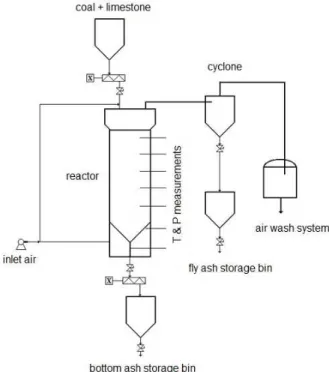
the D1 limestone and the dolomite Do, which are usually on the market. They have different amounts of MgO and CaO, but approximated the same weight loss on ignition (LOI). Gaseous emissions were moni-tored continuously using an infrared analyzer (MIR 9000 - emissión s.a.). The coal used is from the Can-diota-RS mine – coal reserves of approximately one billion tons. Combustion tests were carried out in a cylindrical stainless steel reactor (belonging to the
Fundação de Ciência e Tecnologia – CIENTEC-RS), bench scale, and coated externally with glass wool, with an electric heating system for the initial heating up. The cross section of the bed is 177 cm2 and the coal processing capacity is 5 kg/h. Coal combustion
emissions: SO2 900 ppm; CO 150 ppm; CO2 6%.
The limestone is mixed with the coal prior to injec-tion into the reactor, directly in the combusinjec-tion chamber, by a screw feeder system and auxiliary air. Minimum fluidization velocity: Limestone (0.042 cm) = 19.1 cm/s; coal (0.074 cm) = 29.7 cm/s. Ex-perimental conditions and coal analyses are shown in Table 1. The reactor scheme is shown in Figure 1.
The chemical and mineralogical compositions of the limestones were analyzed by X-ray fluorescence (Shimadzu spectrometer, XRF - 1800) and X-ray diffraction (Philips X'Pert), respectively. A laser par-ticle size analyzer (Cilas, Model 1180) was used to determine the particle size. Microstructural analysis was carried out by SEM on a Hitachi 3000 with EDS probe.
Table 1: Candiota coal analyses and reactor ex-perimental conditions (atmospheric pressure).
Proximate analysis
Plant scale Bench
Fixed carbon (%)
25.1 Temperature 850 ºC +/- 5ºC
Volatile matter (%)
18.7 Bed initial material
Sand (mean size 0.04cm) Ash (%) 56.2 Cross section
area
177 cm2
Ultimate analysis
Reactor height 120 cm
Carbon (%) 31.6 Bed height (sand)
Static/Expanded
15 cm 40 cm
Hydrogen (%) 2.1 Gas residence time
0.6 s
Oxygen and others (%)
8.3 Air flow 21 kg/h
Nitrogen (%) 0.7 Air velocity 67 cm/s Sulfur (%) 1.1 Air excess +/- 190% Moisture (%) 11.7 O2 in exhaust
gas
12%
Gross C.V. (kJ/kg)
11.9 Coal flow 2 kg/h
Figure 1: Reactor scheme.
Tests in the thermobalance (Mettler Toledo TGA/ DTA 851e) were performed between 20-1200 °C at a heating rate of 10 K/min and with a gas flow rate of
10 mL/min (NTP) in an atmosphere of pure O2, 12%
CO2 + synthetic air (furnace conditions) and 80%
CO2 + 20% O2 (oxy-combustion conditions). The
synthetic gases were supplied by Linde Industrial Gases.
RESULTS AND DISCUSSION
Characterization of Limestones as Raw Material
Table 2: Chemical composition, mineral phases and particle size of the limestones Do, D1, D2, Cd and C.
Compounds (%) Do D1 D2 Cd C
CaO 29.00 42.62 37.40 35.23 56.60
MgO 19.52 5.61 10.53 10.93 -
SiO2 13.54 10.27 12.38 21.46 0.40
Al2O3 0.56 1.84 1.44 2.47 0.21
Fe2O3 0.86 0.88 0.65 1.14 0.07
Na2O 0.02 0.14 - - -
K2O 0.08 0.74 0.36 0.51 0.04
Others 0.08 0.18 0.04 0.11 -
LOI (%) 36.18 37.42 37.20 28.16 43.20
∑ impurities* 15.14 14.05 14.89 25.69 0.74
Mean Particle size (mm) 0.350 0.410 0.484 0.444 0.422 Major phases (DRX) Calcite and
Dolomite
Calcite and Dolomite
Calcite and Dolomite
Calcite and Dolomite
Calcite
*Obs: all oxides without CaO and MgO.
Figure 2: XRD limestones Cd, D2, and C. a: aluminosilicate; c: calcite; d: dolomite; m: muscovite; k: kaolinite; q: quartz.
Figures 3 and 4 show the distribution of impuri-ties in the limestone particles (Cd). Impuriimpuri-ties may have little influence on calcination/desulfurization, because it is possible to find them separated from the limestone particles as shown in Figure 3 and Figure 4 (e.g., particle with high content of silicon). This type of impurity may have good potential to be separated by a simple mineral beneficiation process, e.g., quartz has higher hardness than limestone, so it tends to concentrate as the coarser fraction in gravi-metric processing (simple grinding and sieving). Moreover, the need to remove it is questionable, because in general the reactor bed is periodically
fed with sand (a quartz-rich rock).
Figure 3: Optical micrograph of limestone Cd showing the presence of impurities.
Figure 4: SEM images and EDS mappings of Cd limestone.
The most important impurities are microcrys-talline phases because they can act as fluxes, provid-ing the local meltprovid-ing or sinterprovid-ing of the raw material and potentially decreasing the porosity (Chen, 2012). As a result, the loss of specific area decreases the desulfurization efficiency. Another study states that the impurities present in the limestone may have little influence on the process, depending on the re-actor operating conditions (Anthony, 2001). This author concluded that there is no consensus about the role of impurities in desulfurization, so that investi-gations are required before the industrial use of the limestones.
Therefore, although some limestone rocks have a high content of impurities, as shown in Cd, they may have a good potential for use in desulfurization, es-pecially due to their low cost in the market. In addi-tion, this cost can be further reduced by eliminating or simplifying the gravimetric process and the mate-rials preparation step.
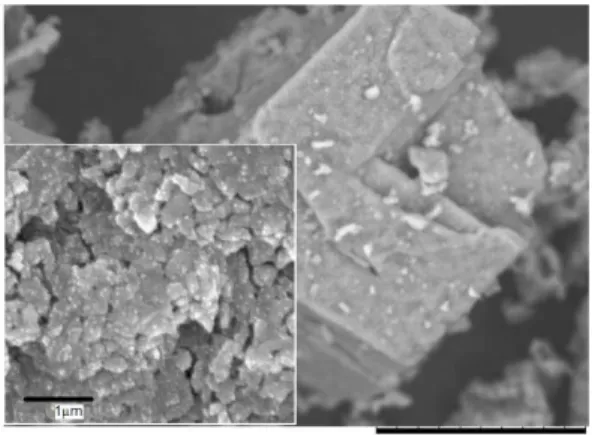
mill-ing. One can also observe the rhombohedral mor-phology which is characteristic of calcite and dolo-mite crystals. Although a relationship between the morphology and microstructure of the limestone rock with sulfur capture efficiency could be expected, no such study has shown it due to changes occurring in calcination (Laursen, 2000; Anthony, 2001). After calcination, the CaO generated has a structure which is completely different from that of the parent rock.
Figure 5: SEM. A) limestone Cd. B) limestone C.
Calcination in the Thermobalance
The analysis of the calcination in the thermo-balance (TGA/DTA) was performed on samples of similar mean particle size (Cd, C, and D2). Table 3 and Figure 6 show the initial and final calcination temperatures and weight loss. The investigated lime-stones showed similar behavior in a pure O2
atmos-phere, but with significant differences in the calcina-tion temperature range. At higher CO2 concentration,
the effect of the delay of the initial and final
tem-peratures of calcination is evident. The weight losses for different limestones remained approximately constant at the different gas mixtures used but, in all cases, they were higher for C (Table 3). This lime-stone has a higher concentration of carbonates, and lower amount of impurities. On the contrary, the lowest weight loss is for Cd as a result of the pres-ence of impurities (SiO2 ~ 21%; Table 2). Some
min-erals are inert to burning, such as quartz, but clay minerals present some weight loss due to structural water break up.
At higher PCO2 (partial pressure of CO2), the
main effect observed for Cd and D2 was the appear-ance of a two-step decomposition pattern, which did not occur for C. The separation between the peaks at ~725 and ~ 925 °C is evident at 80% CO2, as can be
seen in Figure 6. The increase of CO2 concentration
in the carrier gas results in a delay in the onset of the
calcination temperature for MgCO3, but a stronger
delay for CaCO3 and, as a result, the two
endother-mic peaks are well separated. More recent studies consider the decomposition of the dolomite mineral CaMg(CO3)2 in one step, with subsequent
recarbona-tion of CaO to form (Mg)-calcite and the decomposi-tion of (Mg)-calcite in a second step (Rodriguez-Navarro, 2012).
Therefore, from a practical point of view, the amount of impurities facilitates the calcination pro-cess: the higher the level of impurities the lower are the initial and final calcination temperatures. This was demonstrated in oxidizing conditions and at higher PCO2. As can be seen in Figures 3 and 4,
im-purities dilute the concentration of carbonate sites, which may favor calcination due to a lower local CO2 concentration at the reaction surface. The
differ-ences in calcination behavior of the limestones in industrial use must be considered to ensure the com-plete calcination according to the burning tempera-tures, as shown in Table 3.
Table 3: Initial and final calcination temperatures and weight loss in TGA / DTA in different reac-tion atmospheres. Cd, C and D2 limestones.
Sample Carrier gas Calcination
temperatures (°C) Weight loss(%)
Initial Final
O2 384 804 33
Cd 12%CO2 + air 432 840 32.7
80%CO2 + O2 468 918 32.5
O2 654 828 43
C 12%CO2 + air 765 882 43
80%CO2 + O2 868 953 43
O2 564 810 36.7
D1 12%CO2 + air 636 860 37.9
Figure 6: TGA/DTA curves for Cd, C and D2 cal-cined in different atmospheres: (a) pure O2; (b) 80%
CO2 + 20% O2.
The best temperature for maximum desulfuriza-tion of the flue gas will depend on the limestone type. Depending on the reactor temperature, reaction
mechanisms of direct (CaCO3) or indirect (CaO)
sulfation of the limestone may occur. It has been demonstrated that indirect sulfation reached the highest efficiency of desulfurization, so that operat-ing temperatures must be regulated in order to pro-mote this reaction, i.e., above 900 °C (reducing at-mosphere) (De Diego, 2013ab; de Souza, 2013). Hence, complete calcination is a key factor for high-er desulfurization efficiency. On the othhigh-er hand, pro-longed residence times in fluidized bed systems will lead to extensive decreases in the surface area and porosity of the particles, which inhibits limestone reactivity and diminishes sulfation efficiency (Stan-more, 2005).
Figure 7 shows the surface of a particle after the calcination of limestone Cd in the thermobalance at
80% CO2. It can be assumed that the calcination is
complete from ~918 °C, as evidenced by the TG curve (Figure 6). This sample has a different aspect compared to the limestone raw material (Figure 5), and has no direct relationship to the developed po-rosity, as cited before. At 1200 °C, it is easier to vis-ualize the effect of burning temperature on the sam-ples, due to prolonged sintering and the grain growth mechanism. Sintering occurred significantly, as high-lighted in Figure 7. This is evidenced by the direct
bonding between the grains, typically a solid-phase sintering (Reed, 1995). It can be noted that sintering leads to a reduction in porosity, but the sample still has open pores near to the zero porosity region. Ac-cordingly, in oxy-combustion, an increase in temper-ature is required for complete conversion of lime-stone due to the delay in calcination temperature, as explained above. However, an increase in tempera-ture may enhance sintering. It was also pointed out
that the presence of CO2 in the gas phase promotes
sintering (Stanmore, 2005). Therefore, the calcina-tion temperature must be chosen carefully since it determines the pore structure of CaO formed, which in turn is directly related to the desulfurization effi-ciency (Hu, 2008; Chen, 2008). Calcination is also important in the determination of the best residence time of the sorbent in FBC (Scala, 2010). The mor-phology aspect of C is similar to Cd, despite the higher amount of impurities of Cd. Thus, the kind of impurities present in limestone Cd does not affect the behavior of CaO (or MgO) grains in sintering. As shown before, impurities may be separated from CaO grains (Figures 3 and 4). The behavior shown in C and Cd particles indicates that sintering occurs in CaO grains, and almost independently of external impurities (out of the calcitic particle).
Figure 7: SEM of Cd (A) and C (B). Calcination at
Figure 8: SEM of C limestone. Calcination tempera-ture 850 ºC. Sintering can only be observed at higher magnification.
In Figure 8, it can be observed that sintering had already occurred at 850 °C even in the relatively pure limestone C. A cuboidal particle (width = ~40 µm) consisting of grains of 200-300 nm shows submi-cron-particles or grain clusters, which are formed with grains linked to each other. This means that the particles shrunk upon calcination (Anthony, 2001).
Pore size and grain cluster sizes met those of pub-lished data. For example, Garcia-Labiano (2002) showed grain clusters of about 1 µm, and Laursen (2000) showed grains of 0.2-0.5 µm. The aspect of microstructure and sintering behavior of the lime-stones studied are similar of those in the literature (Laursen, 2000; Cheng, 2004).
Therefore, the role of impurities is to accelerate sintering, but the most influential impurities are the ones in the carbonatic phase (intra- and intercrystal-line), such as foreign ions, which promote lattice dif-fusion (Figure 4 shows a dispersion of ions through-out the microstructure). The presence of intrinsic de-fects and mainly extrinsic dede-fects in the crystal structure would explain the sintering behavior of lime-stones in the calcination process due to the high melt-ing temperature of calcium oxide.
Evaluation of Limestones Do and D1 in FBC
The results of the tests in the fluidized bed reactor (Figure 9) show that both limestones (Do and D1) had similar performance in desulfurization, despite their differences in chemical composition. They
reached the same SO2 emission in milligrams per
kilocalories, at a Ca/S molar ratio of 3. Therefore, it was possible to fit the emissions within the standards for large thermoelectric plants (2 mg/kcal) (CONA-MA, 1990). In this case, the compositional differ-ences between the two limestones did not influence
the desulfurization process, since the amount of cal-cium oxide used in each test is the same equalized by the molar ratio. Both limestones reached ~70% of desulfurization efficiency. Other results of the lime-stones from southern Brazil used in desulfurization on bench and pilot scale can be found in the works of one of the authors (Bragança, 2003, 2009; Sebag, 2001).
Figure 9: SO2 emissions as a function of Ca/S molar
ratio. D1 and Do limestones.
The main disadvantage of the use of limestone Do is the smallest amount of calcium oxide (Table 2). On a weight basis, it only achieves the same desulfurization efficiency obtained with D1 lime-stone if Do is added in larger amounts, approxi-mately 1.5 times more. That means 10 t D1 lime-stone/100 t of coal; while Do needs 15 t/100 t of coal. The same occurs in relation to energy consump-tion, considering sensible heat and calcination heat (calcination of limestone is a highly endothermic reaction; H = + 182.1 kJ mol-1; Stanmore, 2005):
Energy consumption Mass of limestone
(cp T+ Hcalcination)
Consequently, a higher MgCO3 content, as occurs
CONCLUSIONS
The characterization of Cd (dolomitic limestone) with a high impurities content (~ 26%) showed that these impurities may be individual particles or may be in the same particle adjacent to the calcitic phase. During calcination, limestone particles undergo ther-mal shock, fragmentation, friction and the develop-ment of porosity as the decomposition proceeds, which may separate impurities from the calcitic phase. Consequently, the role of this kind of impuri-ties, considering the way they are distributed in the studied limestone, may interfere very little in the calcination (and desulfurization) process. Thus, there is no need to remove them by mineral processing, and the limestone Cd can be employed in raw form (run of mine), manly in furnace conditions.
The analysis of the microstructure of Cd and C (calcitic limestone of high purity) revealed similarity in grain morphology. The presence of grain sintering was explained by the influence of microcrystalline impurities, dispersed in the microstructure, as can be seen in EDS mappings. Foreign ions occur fre-quently in the mineral formation and can increase the extrinsic defects concentration in the crystal struc-ture, which promotes lattice diffusion and enhances sintering.
Tests in the thermobalance in an atmosphere of pure oxygen showed a similar profile in TGA/DTA curves, and differences in initial and final calcination temperatures of the limestones analyzed. At higher carbon dioxide concentrations, there are significant
differences in the calcination curve. At 12% CO2
(typical of boilers) the dolomite calcination occurs in
a two-step pattern, which is clearer at 80% CO2
(oxy-combustion), because the separation of peaks increases. Thus, a higher temperature in a CO2
at-mosphere is necessary for the calcination to take place completely (~50 °C higher than in oxidizing conditions). Final calcination temperatures were approximately 20 °C to 30 °C lower for dolomitic limestones (D2 and Cd, respectively); in comparison to limestone C. The decomposition temperature depends on limestone purity and is favored by the amount of impurities. This can be an advantage for dolomitic limestones in terms of energy consumption.
The limestones studied here vary in chemical composition and other physical properties, but they have the same geological origin. Nevertheless, they showed similar desulfurization efficiency (~70% at Ca/S=3) in fluidized bed coal combustion. The re-sults for the same Ca/S molar ratio and strongly oxi-dizing atmosphere showed little influence of the impurities and the magnesium oxide content in the
combustion gas desulfurization process. Dolomitic limestones require larger amounts on a weight basis (1.5 times more), relative to calcitic limestones to achieve the emission levels obligatory by regulatory standards. This means a penalty in terms of caloric consumption in the combustor. However, the lower cost of dolomites and their proximity to the thermoe-lectric plants may be the most important factors in the economic analysis.
ACKNOWLEDGEMENT
The authors acknowledge CNPq for the scholar-ship.
REFERENCES
Anthony, E. J., Granatstein, D. L., Sulfation phe-nomena in fluidized bed combustion systems. Progress in Energy and Combustion Science, 27, p. 215-236 (2001).
Bragança, S. R., Castellan, J. L., FBC desulfurization process using coal with low sulfur content, high oxidizing conditions and metamorphic limestones. Brazilian Journal of Chemical Engineering, 26(02), p. 375-383 (2009).
Bragança, S. R., Jablonski, A., Castellan, J. L., Desul-furization kinetics of coal combustion gases. Brazilian Journal of Chemical Engineering, 20(02), p. 161-169, (2003).
CGTEE, Companhia de Geração Térmica de Energia Elétrica – Eletrobras. <http://www.cgtee.gov.br> (2014). (In Portuguese).
Chen, J., Yao, H., Zhang, L., A study on the calcina-tion and sulphacalcina-tion behaviour of limestone during oxy-fuel combustion. Fuel, 102, p. 386-95 (2012). Chen, Z., Grace, J. R., Lim, C. J., Limestone particle attrition and size distribution in a small circulat-ing fluidized bed. Fuel, 87, p. 1360-1371 (2008). Cheng, L., Chen, B., Liu, N., Lou, Z., Cen, K., Effect
of characteristic of sorbents on their sulphur cap-ture capability at fluidized condition. Fuel, 83 p. 925-932 (2004).
CONAMA, Conselho Nacional do Meio Ambiente RESOLUÇÃO/N.º 008. Brazilian Standards (Based on US-EPA) (1990). (In Portuguese).
CRM, CIA Riograndense de Mineração. <http:// www.crm.rs.gov.br> (2014). (In Portuguese). De Diego, L. F., de Las Obras-Loscertales, M., Rufas,
conditions: Effect of flue gas recirculation. Applied Energy, 102, p. 860-867 (2013).
De Diego, L. F., Rufas, A., García-Labiano, F., de Las Obras-Loscertales, M., Abad, A., Gayán, P., Adánez, J., Optimum temperature for sulphur re-tention in fluidised beds working under oxy-fuel combustion conditions. Fuel, 114, p. 106-113 (2013).
de Souza, F., Bragança, S. R., Thermogravimetric analysis of limestones with different contents of MgO and microstructural characterization in oxy-combustion. Thermochimica Acta, 561, p. 19-25, (2013).
Garcia-Labiano, F., Abad, A., de Diego, L. F., Gayan, P., Adanez, J., Calcination of calcium-based
sor-bents at pressure in a broad range of CO2
con-centrations. Chem. Eng. Sci., 57, p. 2381-2393 (2002). In: Rodriguez-Navarro, C., Kudlacz, K., Ruiz-Agudo, E., (2012).
Han, K., Lu, C., Cheng, S., Zhao, G., Wang, Y., Zhao, J., Effect of characteristics of calcium-based sor-bents on the sulfation kinetics. Fuel, 84, p. 1933-1939 (2005).
Hu, G., Dam-Johansen, K., Wedel, S., Hansen, J. P., Review of the direct sulfation reaction of lime-stone. Progr. Ener. Comb. Sci., 32, p. 386-407 (2006).
Hu, G., Dam-Johansen, K., Wedel, S., Oriented nu-cleation and growth of anhydrite during direct sulfation of limestone. Crystal Growth & Design, 8(4), p. 1181-1185 (2008).
IPCC, Intergovernmental Panel on Climate Change. <http://www.ipcc.ch/> (2014).
Kaljuvee, T., Trikkel, A., Kuusik, R., Bender, V., The
role of MgO in the binding of SO2 by lime
con-taining materials. Journal Ther. Anal. Cal., 80(3), p. 591-597 (2005).
Las Obras-Loscertales, M., Rufas, A., De Diego, L. F., García-Labiano, F., Gayán, P., Abad, A., Adánez, J., Effects of temperature and flue gas
recycle on the SO2 and NOx emissions in
oxy-fuel fluidized bed combustor. Energy Procedia, 37, p. 1275-1282 (2013).
Laursen, K., Duo, W., Grace, J. R., Lim, J., Sulfation and reactivation characteristics of nine lime-stones. Fuel, 79, p. 153-163 (2000).
Luz, A. B., Lins, F. A., Freitas, F. Rochas & Minerais
Industriais: Usos e Especificações (Rocks and Minerals: Uses and Specifications). Centro de Tecnologia Mineral, Rio de Janeiro (2005). (In Portuguese).
Montagnaro, F., Salatino, P., Scala, F., The influence of temperature on limestone sulfation and attri-tion under fluidized bed combusattri-tion condiattri-tions. Exp. Therm. Fluid Sci., 34, p. 352-358 (2010). Moraes, F. C., Geological characterization of the
gauchos marbles aiming its use as a desulfurizing agent of coal combustion gases. Master Thesis, Universidade Federal do Rio Grande do Sul, UFRGS-PPGEM, Brazil (1996).
Petijohn, F. J., Sedimentary Rocks. New York, Har-per and Brothers (1957).
Reed, J. S., Principles of Ceramic Processing. 2nd Ed., John Wiley & Sons, New York (1995). Rodriguez-Navarro, C., Kudlacz, K., Ruiz-Agudo,
E., The mechanism of thermal decomposition of dolomite: New insights from 2D-XRD and TEM analyses. Amer. Miner., 97, p. 38-51 (2012). Scala, F., Salatino, P., Flue gas desulphurization
un-der simulated oxyfiring fluidized bed combustion conditions: The influence of limestone attrition and fragmentation. Chemical Engineering Sci-ence, 65, p. 556-561 (2010).
Sebag, M. G., Bragança, S. R., Jablonski, A., The behavior of heavy metals in the process of desul-furization of Brazilian coal combustion gases by addition of limestone. Brazilian Journal of Chemi-cal Engineering, 18(2), p. 139- 147 (2001). Stanmore, B. R., Gilot, P., Review-calcination and
carbonation of limestone during thermal cycling for CO2 sequestration. Fuel Processing
Technolo-gy, 86, p. 1707-1743 (2005).
Trikkel, A., Estonian calcareous rocks and oil shale
ash as sorbents for SO2. PhD Thesis, Tallinn
Technical University (2001). In: Stanmore, B. R., Gilot, P., Review-calcination and carbonation of limestone during thermal cycling for CO2
seques-tration. Fuel Processing Technology, 86, p. 1707-1743 (2005).
Valverde, J. M., Sanchez-Jimenez, P. E., Perez-Maquedab, L. A., Ca-looping for postcombustion CO2 capture: A comparative analysis on the