Volume 35, número 1, 2010
resumo: Um método “spot-test” qualitativo e seqüencialmente quantitativo é proposto para análise de dipirona em fármaco “puro” e em preparações farmacêuticas. A formação de colora-ção vermelho-violeta indica um resultado qualitativo positivo. Na seqüência, um procedimento quantitativo pode ser realizado no mesmo frasco. Os resultados quantitativos obtidos foram comparados estatisticamente com os resultados obtidos pelo método indicado pela Farmaco-péia Brasileira, utilizando o teste t de Student e o teste F. Considerando a concentração em uma alíquota de 100 µL, o limite qualitativo visual de detecção foi de cerca 5×10⁻⁶ g; instru-mentalmente o limite de detecção foi de LOD ≅ 1.4×10⁻⁴ mol L-1 e o limite de quantificação de LOQ ≅ 4.5×10⁻⁴ mol L-1.
Palavras-chave: dipirona, spot-test, análise, qualitativa, quantitativa
references
[1] Brazilian Pharmacopoeia, 3rd ed., Organização Andrei Editora, São Paulo, Brazil, 1977, p 406-8.
[2]I.M.Benseñor, São Paulo Med. J., 119 (2001) 190. [3] H. Ergün, D. A. C. Frattarelli and J. Aranda, J. Pharma-C. Frattarelli and J. Aranda, J. Pharma-ceut. Biomed., 35 (2004) 479.
[4] P. Danielli, and M.B Leal, Rev. Bras. Farm.,84 (2003) 17.
[5] Y. Bentur, and O. Cohen, J. Toxicol.-Clin. Toxic., 42 (2004) 261.
[6] S. C. Pierre, R. Schmidt, C. Brenneis, M. Michaelis, G. Geisslinger, and K. Scholich, Br. J. Pharmacol., 151 (2007) 494.
[7] G. Suarez-Kurtz , F.M. Ribeiro, R.C.E. Estrela, F.L. Vi-cente, and C J. Struchiner, Braz. J. Med. Biol. Res., 34 (2001) 1475.
[8]Brasil, Anvisa, Agência Nacional de Vigilância Sanitária, Rev. Saúde Pública, 38 (2004) 748.
[9] F.G.D.
Vieira, J. M. Crubellate, I.G. Silva, and
W.R. Silva, RAE eletron
.,
1 (2002) 1.
[10]
H.Senyuva, I. Aksahin, S. Ozcan, and B.V. Kabasakal, Anal. Chim. Acta, 547 (2005)73-7.[11] K.A. Sakiara, L. Pezza, C. B. Melios, H. R. Pezza, and M. Moraes, Farmaco, 54 (1999) 629.
[12] J. L. F. C. Lima, S. M. O. Sá, J. L. Santos, and E. A. G. Zagatto, J. Pharmaceut. Biomed.,32 (2003)1011.
[13] L. H. Marcolino Jr, R. A. Souza, O. Fatibello Filho, and F.C. Moraes, Anal. Lett., 38 (2005) 2315.
[14] A.V. Pereira, L. Penckowski, M. Vosgerau, and M. F. Sassá, Quím. Nova 25 (2002)553.
[15] A. P. Nascimento, M. G. Trevisan, E. R. M. Kedor-Hack-mann, and R. J. Poppi, Anal. Lett., 40 (2007) 975.
[16] J. S. Albuquerque, V. L. Silva, F. Lima, A. Araújo, and M. C. B. S. M.Montenegro, Anal. Sci., 19 (2003) 692
[17] T. R. L. C. Paixão, C. R. Matos, and M. Bertotti, Talanta, 61 (2003) 725.
[18] E. P. Medeiros, S.L. Castro, F. M. Formiga, S. R. B. San-tos, M. C. U. Araújo, and V. B. Nascimento, Microchem. J.,
78 (2004) 91.
[19] L. H. Marcolino Jr, V. G. Bonifácio, and O. Fatibello Filho, Quím. Nova, 28 (2005) 783.
[20] M. F. S Teixeira, L. H. Marcolino Jr., O. Fatibello Filho, E. R. Dockal, and E. T. G. Cavalheiro, J. Braz. Chem. Soc.,
15 (2004) 803.
[21] P. L.Weinert, L. Pezza, and H.R. Pezza, J. Braz. Chem. Soc., 18 (2007) 846
[22] F. Feigl, Spot Tests in Organic Analysis, 7th ed., Elsevier, Amsterdan, 1966, p. 434-36 and 635.
[23] L. Pezza, M. Tubino, C. B. Melios, and H. R. Pezza, Anal. Sci., 16 (2000) 313.
[24] K. Eckschlager, Errors, Measurement and Results in Chemical Analysis, Van Nostrand Reinhold Company, Lon-don, 1972, p. 109-120.
[25] P. Karrer, Organic Chemistry, 4th ed.; Wiley, New York, 1950, p. 798.
[26] P. E. Georghiou, and C.K. Ho, Can. J. Chem., 67 (1989) 871
Artigo/Article
ProDuCtion oF BioDieSeL From BABASSu oiL
uSing metHAnoL-etHAnoL BLenDS
F. C. Silva A*, K. S. B. Cavalcante A,B, H. C. Louzeiro A,B, K. R. M. Moura A, A. P. Maciel A, L. E. B. Soledade B, A. G. Souza B
a Departamento de Química, universidade Federal do Maranhão, uFMA, Avenida dos Portugueses s/n, Campus Bacanga, CEP
65080-040, São Luís, MA, Brazil.
b Departamento de Química, universidade Federal da Paraíba, uFPB, Campus i, Cidade universitária, CEP 58059-900, João Pessoa,
PB, Brazil.
* Corresponding author. Phone: +55-98-2109-8277 E-mail address: [email protected]
Abstract: Maranhão state in Brazil presents a big potential for the cultivation of several olea-ginous species, such as babassu, soybean, castor oil plant, etc... These vegetable oils can be transformed into biodiesel by the transesterification reaction in an alkaline medium, using methanol or ethanol. The biodiesel production from a blend of these alcohols is a way of adding the technical and economical advantages of methanol to the environmental advantages of ethanol. The optimized alcohol blend was observed to be a methanol/ethanol volume ratio of 80 % MeOH: 20 % EtOH. The ester content was of 98.70 %, a value higher than the target of the ANP, 96.5 % (m/m), and the biodiesel mass yield was of 95.32 %. This biodiesel fulfills the specifications of moisture, specific gravity, kinematic viscosity and percentages of free alcohols (methanol plus ethanol) and free glycerin.
Keywords: Babassu oil, methanol, ethanol, methyl esters, ethyl esters.
i. introduction
Babassu nut is the main product of the vege-tal extractive activities in Maranhão state, Brazil, and one quarter of its territory is covered by such native palm tree (Orbignya phalerata). The activi-ties related to the babassu nut generate about 300 thousand jobs, from the collect normally made by
the “babassu breakers”, up the oil reining [1,2].
Maranhão is the biggest producer of ba-bassu nuts in Brazil. It is responsible for the production of almost 80% of the country output, corresponding to 120 thousand metric tons in the 2005 base year. [3]. The local industries produce about 60 thousand metric tons /year of babassu oil, being most of it transported to other Brazilian states [4].
Babassu oil displays a high percentage of saturated fatty acids, 91%, mainly composed of lauric acid (48%), myristic acid (16%), palmitic acid (10%), stearic acid (2%) and others (5%). It also presents 19% of unsaturated fatty acids,
chie-ly oleic (14%) and linoleic (5%) acids [5].
Maranhão is also the second biggest soy-bean producer in Northeastern Brazil, only behind Bahia state. In the 2006/2007 harvest, according to CONAB, the soybean production in Maranhão was of about 0.967 million metric tons, while the whole Brazilian output was of around 56.71 million metric tons [6].
geogra-Ecl. Quím., São Paulo, 35(1): 47 - 54, 2010 48
Artigo Article
Ecl. Quím., São Paulo, 35(1): 47 - 54, 2010 49
Artigo Article
phic location and agricultural tradition. A big part of such production can be transformed in the bio-diesel fuel.
Biodiesel is deined as a fuel composed of
alkyl esters of long chain fatty acids, derived from vegetable oils or animal fats [7,8]. This fuel can be used in any diesel cycle engine, without the need of adaptations.
Owed to technical and economic reasons, the industries use more often methanol (MeOH) in the biodiesel production process. However, this alcohol presents several drawbacks, such as its high toxicity, being synthesized from non re-newable sources, besides the fact that Brazil is not
auto-suficient in its production [9].
Although ethanol has a higher cost per ton, the biodiesel production by means of the ethanol route is attractive under the strategic standpoint, as Brazil is the biggest ethanol producer in the world. As for the environmental aspects, ethanol is not toxic and since it is produced from ble sources, the whole biodiesel is 100% renewa-ble [10,11].
One of the ways of combining the techni-cal and economic advantages of methanol with the environmental advantages of ethanol is to obtain biodiesel from a blend of these alcohols. Therefo-re, the proposal of this work was the improvement
of the transesteriication process of degummed, neutralized and clariied babassu oil, using blends
of different proportions of these alcohols with ho-mogeneous catalysis [12].
ii. experimental
The reagents utilized were: commercial
clariied babassu oil (OLEAMA), anhydrous
ethanol (Petrobrás Distribuidora), methanol P.A. (Quimis) and potassium hydroxide 85 % (Qui-mis) as catalyst. The raw materials were analyzed following the Standard Methods for the Analysis of Oils, Fats and Derivatives (SMAOFD). For the characterization of the methyl/ethyl biodie-sel from babassu were utilized the standards from the Brazilian Association of Technical Standards (ABNT) and the American Society for Testing and Materials (ASTM), indicated in the Resolution
number 42 of the Brazilian National Petroleum Agency (ANP) [7].
In the experiments, were utilized a pHme-ter Quimis model Q400M2, a mechanical stirrer and a gas chromatograph VARIAN CP 3800.
The procedure for the transesteriication re -action starts by dissolving KOH in the methanol/ ethanol blend, under stirring at room temperature. Next, add to this solution 100 g of oil under stirring and allow the reaction up to the phase separation. Remove the alcohol excess by distillation under reduced pressure. Transfer the mixture of esters and glycerin to a separatory funnel and allow set-tling for 12 hours. Afterwards, separate and weigh both phases and wash the biodiesel, using the air
bubbling technique. For the irst washing, utilize
a 0.1 M HCl solution, followed by washings with water until reaching the pH 7.0. Dry the biodiesel in an oven at 100 ºC for 3 hours, allow cooling and weigh, for further physico-chemical tests.
iii. results and discussion
The best reaction conditions to obtain me-thyl and eme-thyl babassu biodiesel were determined by Silva and Brandão: oil/methanol molar ratio of 1:4.6, KOH content of 1.5 %, 30 min of reaction time, stirring of 1760 rpm and room temperature [13]. Using the methanol mass as reference, seve-ral MeOH:EtOH ratios were investigated, aiming at the optimization of the babassu oil
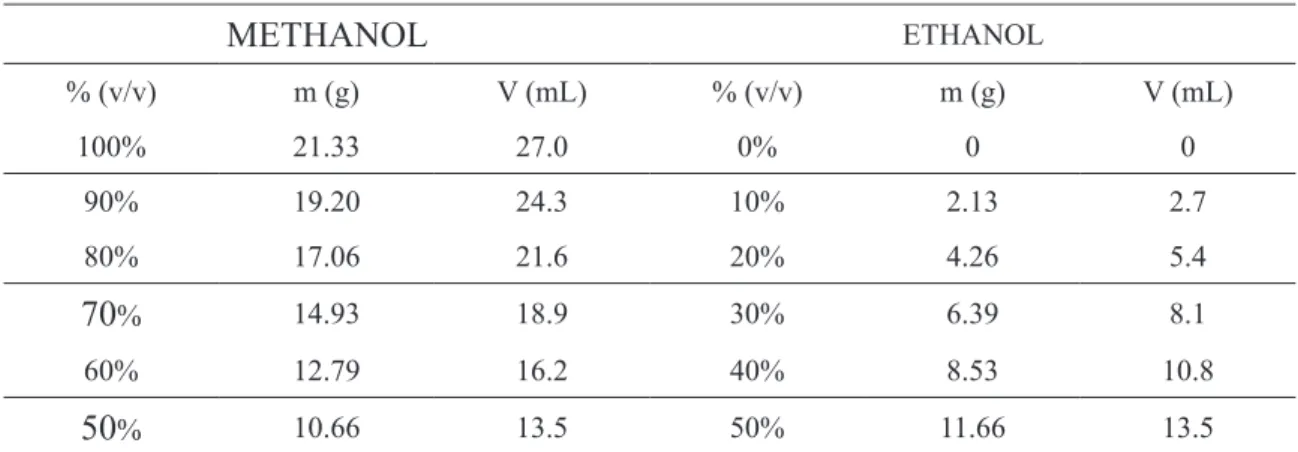
transesteri-ication process. Table 1 presents the percentages
and volumes of the alcohols used in the babassu
oil transesteriication reactions.
table 1. Methanol/ethanol proportions used for obtaining methyl/ethyl babassu biodiesel
METHANOL
ETHANOL% (v/v) m (g) V (mL) % (v/v) m (g) V (mL)
100% 21.33 27.0 0% 0 0
90% 19.20 24.3 10% 2.13 2.7
80% 17.06 21.6 20% 4.26 5.4
70
% 14.93 18.9 30% 6.39 8.160% 12.79 16.2 40% 8.53 10.8
50
% 10.66 13.5 50% 11.66 13.5In order to determine the best methanol/ethanol ratio, the process of spontaneous biodiesel/ glycerin separation was analyzed. The produced biodiesel is composed of methyl and ethyl esters of the fatty acids that make up the babassu oil. In the chromatogram of Figure 1, it can be observed that there are two peaks derived from the same fatty acid. This occurs because one peak is obtained from the fatty acid reacting with methanol and the other peak reacting with ethanol. As they display different retention times, it is possible to detect them separately.
Figure 1 - Chromatogram of the babassu methyl/ethyl biodiesel.
Figure 1. Chromatogram of the babassu methyl/ethyl biodiesel
table 2. Inluence of the ethanol/methanol ratio on the yield and ester percentages of babassu biodiesel
%EtOH %MeOH treaction %mBP %E
0 100
30 min
95.32 98.84
10 90 91.70 97.17
20 80 95.32 98.70
30 70 93.70 98.18
40 60 92.29 98.44
50 50 84.26 96.77
PB: Pure biodiesel E: Esters
mPB: Mass yield of pure biodiesel mE: Ester content
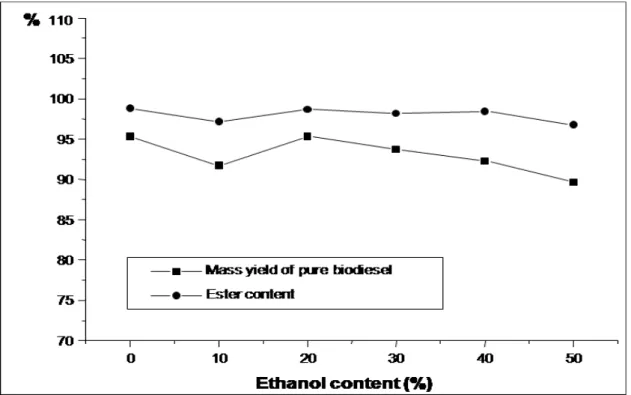
The separation of the biodiesel/glycerin mixture does not occur spontaneously using ethanol per-centages higher than 50%, even with the removal of the alcohol excess by means of distillation under reduced pressure. It was observed that the mass yield of pure biodiesel tends to diminish with the
incre-ase of the ethanol proportion in the blend, due to the dificulty of the biodiesel/glycerin separation. In Figure 2 shows the inluence of the ethanol percentage of the methanol/ethanol blends on the ester content and the mass yield of pure biodiesel, for a ixed reaction time of 30 min.
Figure 2 - Influence of the MeOH:EtOH ratio on the ester content and on the ma
Figure 2. Inluence of the MeOH:EtOH ratio on the ester content and on the mass yield of pure biodiesel,for a reaction time of 30 min.
The results point out that, for a ixed re -action time of 30 min, there was no meaningful change in the amount of methyl/ethyl esters with the increase of the ethanol percentage. All the samples presented ester contents in the average of 98%, values above the requirements of the ANP [7], with the exception of the biodiesel obtained with a MeOH:EtOH 50:50 ratio. The mass yields of pure biodiesel obtained do not decrease with the ethanol percentage up to 20% (v/v) ethanol. Ho-wever, for higher ethanol concentrations, it is sho-wn a tendency of decreasing the mass yield with further ethanol enrichment in the blend. The value for pure methyl ester (95.32%) is higher than the value reported by Oliveira et al. (91%), also for
the transesteriication reaction of babassu oil with
pure methanol [5]. These results point out an
opti-mum methanol/ethanol ratio of 80% MeOH:20% EtOH, with a mass yield of 95.32 % and an ester content 98.70 %, a valor higher than the minimum value required by ANP [7].
The transesteriication reaction carried out
with 50 % ethanol with a reaction time of 30 mi-nutes displayed the smallest mass yield of pure biodiesel. Nevertheless, it is known that the
tran-sesteriication reactions with methanol rapidly
achieve equilibrium, whereas with ethanol bigger reaction times are needed to reach the maximum conversion of triglycerides into esters. In order to assess if it is possible to obtain higher reaction yields in the reactions employing 50% ethanol,
an investigation on the inluence of the reaction
time was carried out, whose results are presented in Table 3.
table 3. Babassu oil transesteriication reactions with 50% ethanol using different reaction times
%EtOH %MeOH Treaction (min) %mPB %E
50 50
30 84.26 96.77
60 83.22 98.13
90 84.52 99.03
Figure 3 shows that the ester content increases with the reaction time. It was experimentally
Ecl. Quím., São Paulo, 35(1): 47 - 54, 2010 52
Artigo Article
Ecl. Quím., São Paulo, 35(1): 47 - 54, 2010 53
Artigo Article
Figure 3 – Influence of the reaction time on the mass yield of pure biodie
Figure 3. Inluence of the reaction time on the mass yield of pure biodiesel and the ester content.
As for the physico-chemical properties, the babassu oil was analyzed utilizing SMAOFD [14] methods and the methyl/ethyl biodiesel analyses employed ASTM and ABNT standards. Table 4 shows the results of some physico-chemical tests of the biodiesel sample obtained with the 80:20
methanol/ethanol blend, as well as the speciica -tion limits of the standards.
iV. Conclusions
The following reaction conditions were shown to optimize the biodiesel production from
the transesteriication of babassu oil with a blend
of alcohols: methanol/ethanol ratio of 80% MeOH : 20% EtOH and 30 minutes of reaction time. With these conditions, a biodiesel mass yield equal or higher than 95.32 % was obtained and also an es-ter content of 98.70 % was achieved, thus meeting
the speciication of the ANP. It was also observed
that it is possible to utilize an ethanol/methanol mass ratio of 50:50, provided that the reaction
time is of 60 minutes, in order to obtain satisfac-tory ester contents (98.13 %). The samples of bio-diesel produced with the 80% MeOH:20%EtOH
blend meet the speciications required by ANP,
taking into account the physico-chemical tests lis-ted in Table 4.
table 4. Physico-chemical analyses of babassu oil and the biodiesel obtained from a 80:20 methanol/ethanol blend
Tests Babassu oil Methyl/ethyl biodiesel Biodiesel Analysis Method Biodiesel Limits Moisture and sediments (% v/v) 0.039 0.028 ASTM D-2709 0.050 Speciic gravity at 25ºC (kg/m3) 923.0 887.2 ASTM D-4052* 860-900 Kinematic viscosity at 40°C ( mm2/s) 34.840 4.830 ASTM D-445*
-Methanol/Ethanol (% m/m) - 0.453 ABNT NBR 15343** 0.5 (max.) Free glycerin (% m/m) - 0.026 ASTM D-6584* 0.02 (max.) Esters (% m/m) - > 96.500 ABNT NBR 15342** 96.5 (min.)
* Standards from ASTM - American Society for Testing and Materials ** Standards from ABNT – Brazilian Association for Technical Norms
Acnowledgements
The authors acknowledge CAPES and CNPq for the scholarships and FAPEMA,
ELETRONOR-TE and BNB for the inancial support.
resumo: O Estado de Maranhão no Brasil apresenta um potencial grande para o cultivo de vá-rias espécies oleaginosas, como babaçu, feijão-soja, planta de óleo de rícino, etc... Estes óleos vegetais podem ser transformados em biodiesel pela reação de transesterificação em meio alcalino, usando metanol ou etanol. A produção de biodiesel a partir da mistura destes álcoois é uma forma de acrescentar as vantagens técnicas e econômicas do metanol às vantagens am-bientais do etanol. A mistura de álcool otimizada foi observada usando a relação de volume metanol/etanol de 80 % MeOH: 20 % EtOH. O teor de ésteres foi de 98.70 %, um valor acima do exigido pela ANP, 96.5 % (m/m), e um rendimento de biodiesel em massa foi de 95.32 %. Este biodiesel cumpre as especificações de umidade, massa específica, viscosidade cinemática e percentagens de álcoois livres (metanol mais etanol) e glicerina livre.
Palavras chaves: Óleo de babaçu, metanol, etanol, ésteres metílicos, ésteres de etílicos.
references
[1] Zilbersztajn D. Reorganization of the babassu farm busi-ness in Maranhão state, Brazil. 1st ed. São Paulo: USP, 2000. [2] Pinheiro CUB, Frazão JMF. Integral processing of ba-bassu palm (orbignya phalerata, arecaceae) fruits: village le-vel production in Maranhão, Brazil. Econ Bot 1995;49:31-9. [3] IBGE – Brazilian National Institute of Geography and Statistics. Production of vegetable extraction and forestry. Brasília:IBGE Press;2004.
[4] SINDÓLEO - Syndicate of the vegetable oil producing in-dustries of Maranhão state, Brazil, Maranhão, Brazil, 2004. [5] Oliveira JS, Montalvão R, Daher L, Suarez PAZ, Ru-bim JC. Determination of methyl ester contents in biodiesel blends by FTIR-ATR and FTNIR spectroscopies. Talanta 2006;69:1278–84.
[6] CONAB - Brazilian National Supply Company, Brazilian Ministry of Agriculture, Cattle Raising and Supply. Available at: http://www.conab.gov.br. Accessed at March 12, 2007. [7] ANP - Brazilian National Agency for Petroleum, Natural Gas and Biofuels. Resolution number 7, of March 19, 2008. Brasília, DF, Brazil: Diário Oficial da União.
[8] Fangrui M, Clements LD, Milford AH. Biodiesel fuel from animal fat. Ancillary studies on transesterification of beef tal-low, Ind Eng Chem Res 1998;37:3768-71.
[9] Costa Neto PR, Rossi LFS, Zagonel GF, Ramos LP. The utilization of used frying oil for the production of biodiesel. Quim. Nova 2000;23:531-7.
[10] Schuchardt U, Sercheli R, Vargas RM. Transesterifica-tion of vegetable oils: a review. J Braz Chem Soc 1998;9:199-210.
an-Volume 35, número 1, 2010
odic stripping voltammetry using a carbon paste electrode modified with ion-exchange resin Amberlite IR120. Ecl Quim 2006;31:45-52.
[12] Ferrari RA, Oliveira VS, Scabio A. Biodiesel from soy-bean: characterization and consumption in an energy genera-tor. Quim Nova 2005;28:19-23.
[13] Silva FC, Brandão KSR. Optimization of methyl and eth-yl biodiesel from babassu. Proceedings of the First Congress of the Brazilian Biodiesel Technology Network, v. 2, p.119-125. Brasília, Brazil, 2006.
[14] IUPAC - Standard methods for the analysis of oils, fats and derivatives. 7th ed. London: Blackwell Scientific Publi-cations; 1987.
Artigo/Article
SenSitiVe SPeCtroPHotometriC
DeterminAtion oF LAmotrigine in BuLK Drug
AnD PHArmACeutiCAL FormuLAtionS uSing
BromoCreSoL green
N. Rajendraprasad, K. Basavaiah* and K. B. Vinay
Department of Chemistry, university of Mysore, Manasagangothri, Mysore-570 006, india *Corresponding e-mail: [email protected]. Mobile: +91-9448939105
Fax: 0091-821-2421263, 2516133.
Abstract: Two new, simple, rapid and reproducible spectrophotometric methods have been de-veloped for the determination of lamotrigine (LMT) both in pure form and in its tablets. The first method (method A) is based on the formation of a colored ion-pair complex (1:1 drug/dye) of LMT with bromocresol green (BCG) at pH 5.02±0.01 and extraction of the complex into di-chloromethane followed by the measurement of the yellow ion-pair complex at 410 nm. In the second (method B), the drug-dye ion-pair complex was dissolved in ethanolic potassium hydro-xide and the resulting base form of the dye was measured at 620 nm. Beer ’s law was obeyed in the concentration range of 1.5-15 µg mL-1 and 0.5-5.0 µg mL-1 for method A and method B, respectively, and the corresponding molar absorptivity values are 1.6932 x 10⁴ and 3.748 x 10⁴ L mol-1cm-1. The Sandell sensitivity values are 0.0151 and 0.0068 µg cm-2 for method A and method B, respectively. The stoichiometry of the ion-pair complex formed between the dug and dye (1:1) was determined by Job’s continuous variations method and the stability constant of the complex was also calculated. The proposed methods were applied successfully for the determination of drug in commercial tablets.
Keywords: lamotrigine; spectrophotometry; ion-pair complex; bromocresol green; pharmaceuticals
introduction
Lamotrigine, (LMT),
[6-(2,3-dichlorophenyl)-1,2,4-triazine-3,5-diami-ne], is an anticonvulsant drug. As an antiepileptic, it has been used successfully to treat epilepsy and bipolar disorder as monotherapy and as an adjunct with other antiepileptics for treatment of partial and generalized toxic-chronic seizures. It is also used to treat neurological lesions and as a tranqui-lizer [1, 2].
Lamotrigine is not oficial in any phar -macopoeia. The analysis of LMT in biological