Original Article
Artigo Original ISSN 2317-1782 (Online version)
This is an Open Access article distributed under the terms of the Creative Commons Attribution License, which permits unrestricted use, distribution, and reproduction in any medium, provided the original work is properly cited.
Acoustic and aerodynamic measures in
singers: a comparison between genders
Medidas acústicas e aerodinâmicas em
cantores: comparação entre homens
e mulheres
Patrícia de Freitas Lopes Genilhú1Ana Cristina Côrtes Gama1
Keywords
Voice Acoustics Evaluation Music Dysphonia
Descritores
Voz Acústica Avaliação Música Disfonia
Correspondence address:
Patrícia de Freitas Lopes Genilhú Departamento de Fonoaudiologia, Faculdade de Medicina, Universidade Federal de Minas Gerais – UFMG Av. Alfredo Balena, 190, sala 249,
Santa Efigênia, Belo Horizonte (MG),
Brasil, CEP: 30130-100. E-mail: [email protected]
Received: November 11, 2017
Accepted: January 24, 2018
Study conduct at Programa de Pós-graduação em Ciências Fonoaudiológicas, Universidade Federal de Minas Gerais – UFMG - Belo Horizonte (MG), Brasil.
1 Departamento de Fonoaudiologia, Faculdade de Medicina, Universidade Federal de Minas Gerais – UFMG -
Belo Horizonte (MG), Brasil.
Financial support: nothing to declare.
Conflict of interests: nothing to declare. ABSTRACT
Purpose: Compare acoustic and aerodynamic voice measures between male and female singers. Methods: A cross-sectional, observational, comparative study conducted with a convenience sample. Study participants were 30 male and 30 female singers. Acoustic (vocal intensity and fundamental frequency) and aerodynamic
(expiration time, air pressure, expiratory and voice airflow, expiratory volume, aerodynamic power and resistance, acoustic impedance, and aerodynamic efficiency) measures were assessed during emission of the syllable /pá/,
at usual frequency and intensity, for seven consecutive times. These emissions enable extraction of air pressure
measures (obtained by the plosive consonant /p/, which estimates glottic pressure), as well as of airflow and acoustic voice measures (obtained by the vowel /a/ and the syllable /pá/). Results: Women presented higher
values of fundamental frequency compared with those of men. No differences were identified in the evaluation
of aerodynamic measures between the groups. Conclusion: Values of aerodynamic measures do not differ
between male and female singers.
RESUMO
Objetivo: Comparar medidas acústicas e aerodinâmicas da voz em homens e mulheres cantores. Método: Trata-se
de um estudo transversal, observacional, comparativo, com amostra de conveniência. Participaram do estudo 30 homens e 30 mulheres cantores. Foi realizada avaliação das medidas acústicas (intensidade e frequência fundamental) e aerodinâmicas (tempo de expiração, pressão aérea, fluxo de ar expirado e vozeado, volume expiratório, potência e resistência aerodinâmica, impedância acústica e eficiência aerodinâmica) durante a emissão da sílaba /pá/ em frequência e intensidade habituais, sete vezes consecutivas. Estas emissões permitem
a extração de medidas de pressão aérea (obtidas da consoante plosiva /p/ que estima a pressão glótica) e das
medidas de fluxo aéreo e acústicas da voz (obtidas da vogal /a/ da sílaba /pá/). Resultados: Na comparação de
INTRODUCTION
An individual’s vocal quality results from the interaction
of aerodynamic forces characterized by expired airflow,
myoelastic forces of the larynx, in addition to contributions
of the vocal tract filter(1). The larynx functions as a transducer,
converting aerodynamic energy into acoustic energy. The airflow
is transformed into acoustic energy by means of the opening and closing cycles of the vocal folds. The respiratory system is responsible for providing the energy needed for phonation;
therefore, impairments in this system may affect professionals
who use their voice as a working tool(2).
Voice production presents a multidimensional function, and
through assessment of the different vocal parameters is possible
to (1) quantify voice quality more accurately; (2) understand the
effects of a given treatment, either surgical, pharmacological, or phonotherapeutic; and (3) correlate the different vocal evaluation
data for a better understanding of the functional mechanisms involved in phonation(2-3).
Assessment of the aerodynamic measures of singers is of utmost importance, because they use respiration as a basis for the adequate production of the quality of their singing voice.
Increased airflow and subglottic pressure can occur at any moment, and any respiratory or laryngeal inefficiency may
impair vocal production(4). The specific scientific literature
reports that singers differ from the general population regarding
the values of aerodynamic measures because of the muscular training they perform(5). Singers tend to present lower airflow
and subglottic pressure values than non-singers, demonstrating
that these professionals have greater aerodynamic efficiency(6).
A study conducted with singers of different musical styles
observed that the aerodynamic measures of subglottic pressure
and expiratory volume were different, because each singer
makes particular vocal adaptations to language, type of music, interpretation, and individual characteristics(4).
Singing requires control and precision of breathing and
phonation and, consequently, greater glottal airflow efficiency(6).
Lack of harmony in one of the functions of these systems can
generate imbalances and affect the ability to maintain adequate
sound quality(7). An individual with good respiratory training
in singing uses glottal airflow properly.
Aerodynamic analysis of the voice is becoming increasingly viable and common in clinical practice in vocal health as a result
of scientific advances. The first aerodynamic measurements
were direct, thus invasive, considering that they measured subglottic pressure through puncture of the cricothyroid membrane(8). Technological advances enabled extraction of
aerodynamic measures indirectly, and parameters of airflow and
subglottic pressure began to be estimated by intraoral pressure measurements(9).
Anatomical and functional differences in the larynx and the
acoustic characteristics of the voice of men and women have been previously analyzed in the literature comprehensively(10-12).
However, few studies have investigated differences in the aerodynamic parameters of airflow and subglottic air pressure
associated with gender(13-15), and no studies analyzing these
differences in singers have been found.
Understanding the acoustic and aerodynamic characteristics
of the voice in singers and the differences between these aspects
regarding gender is of fundamental importance to subsidize the vocal training of singers. It is known that the anatomical
differences between the male and female vocal apparatus
interfere with the acoustic characteristics of the voice(10-12) and
with the aerodynamic parameters of the spoken voice(13-15),
but the differences generated by gender in the acoustic and
aerodynamic parameters of the voice of singers have not yet
been studied in the specific literature. It is assumed that male and female singers present different acoustic and aerodynamic measures of the voice as a result of anatomical differences in
the larynx and respiratory system.
In this context, the objective of this study was to compare acoustic and aerodynamic voice measures between male and female singers.
METHODS
This cross-sectional, observational, comparative study was conducted with a convenience sample and approved by the Research Ethics Committee of the Universidade Federal de Minas Gerais (UFMG) under protocol no. CAAE 48085815.2.0000.5149. All participants were informed about the objectives and procedures of the study and signed an Informed Consent Form (ICF).
Study participants were 60 individuals of both genders: 30 men aged 19-48 years (mean=28.6) and 30 women aged 18-36 years (mean=26.1). The groups were matched for age (p=0.208), musical genre, and singing experience time. All participants were selected at singing schools.
Inclusion criteria were as follows: professional or amateur singers with absence of vocal complaints and/or impairments and presence of normal larynx, aged 18-55 years - because this is considered the period of greater vocal stability, thus eliminating any impairment associated with the phase of voice change or with aging. Exclusion criteria comprised smokers, pregnant women, or women in the menstrual period.
Laryngeal assessment was performed through high-speed videolaryngoscopy, which accurately and clearly captures the glottic opening and closing phases, using a Computerized Speech Lab (CSL) Kay Pentax™ Model 6103 console (Lincoln Park, NJ, USA), by a single otolaryngologist. Larynxes whose exams presented complete glottic closure were considered normal, or in the cases of women with posterior triangular cleft, and without lesions in both vocal folds.
All participants were evaluated for presence of vocal and voice quality complaints by a speech-language pathologist with
expertise in voice and over five years of practice. Participants
without vocal complaint and with neutral vocal quality were included in the study.
21 (70%) were popular singers with 4-12 years (mean=7.3) of experience and nine (30%) were classical singers with 3-10 years (mean=6.6) of experience. In the group of men, 19 (63.3%) were popular singers and 11 (36.7%) were classical singers, with 5-13 years (mean=7.5) and 4-15 years (mean=6.9) of experience, respectively.
Acoustic and aerodynamic measures of voice were obtained with the CSL Kay Pentax™ Model 6103 program (Lincoln Park, NJ, USA) with a Phonatory Aerodynamic System (PAS) module installed in a Dell, Optiplex GX260 personal computer and a Direct Sound professional sound card at the Observatory of Functional
Health in Speech-Language Pathology of the Medical School of
UFMG (OSF/UFMG). These measures were obtained through
emission of the syllable /pá/ at usual frequency and intensity for
seven consecutive times. According to the manual “Phonatory aerodynamic system: a clinical manual Kay Pentax™”, these emissions enable extraction of air pressure measures (obtained by the plosive consonant /p/, which estimates glottic pressure),
as well as of airflow and acoustic voice measures (obtained by the vowel /a/ and the syllable /pá/)(16).
Aerodynamic measures were recorded using a silicone face mask placed on the participant’s mouth. This mask was coupled to a device connected to a pressure transducer, and the intraoral pressure was measured by means of a small-diameter polyethylene catheter inserted into the mask through a lateral
orifice and positioned in the central part of the participant’s
tongue; the other end of the catheter was attached to the pressure transducer (Figure 1).
Acoustic measures of vocal intensity and fundamental frequency (f0) were obtained using a unidirectional condenser microphone attached to the back of the face mask. All signals from the transducer and the microphone were sent to the CSL program for analysis. The acoustic and aerodynamic measurements were conducted in acoustically treated environment, with ambient
noise <50 dBNPS defined by an Instrutherm Model DEC-490
sound pressure level meter.
The following acoustic parameters were analyzed:
• Maximum intensity: maximum value of vocal intensity measured in dBNPS.
• Mean intensity: mean value of vocal intensity measured in dBNPS.
• Mean intensity of voiced segments: mean intensity value considering the voiced segments measured in dBNPS.
• Fundamental frequency (f0): mean value of the fundamental
frequency measured in Hz.
The aerodynamic measures assessed were grouped into five
categories as follows:
1. Temporal Measure:
• Expiration time: it measures the expired airflow time, or
positive airflow, in seconds.
2. Air pressure measures:
• Peak air pressure: this measure is the highest value of air pressure observed in the emission of one or more plosive
syllables, measured in cm H2O.
• Mean peak air pressure: it is mean value of peak air
pressure, measured in cm H2O.
3 Airflow measures:
• Peak expiratory airflow: it is maximum value of the
expiratory air flow, measured in L/s.
• Peak voiced airflow: this measure represents the mean
airflow of voiced speech segments, measured in L/s.
• Mean airflow during voicing: it is the quotient of the total expiratory air volume by the duration of voiced segments, measured in L/s.
4. Volume measure
• Expiratory volume: this measure is the total volume of expiratory air measured in liters.
5. Aerodynamic measures
• Aerodynamic power: is the product of the mean peak air
pressure value, the air flow during voicing, and the conversion
factor 0.09806, measured in watts.
• Aerodynamic resistance: is the quotient of the mean peak
air pressure value by the air flow during voicing, measured in cm H2O/(L/s). It is equivalent to the acoustic impedance
measure multiplied by the conversion factor 0.9806. Figure 1. Illustration of the Kay Pentax Model 6103 console (Lincoln
• Acoustic impedance: is the quotient of the mean peak air
pressure value by the air flow during voicing measured in
dyne s/cm5.
• Aerodynamic efficiency: this is a dimensionless value
defined in parts per million (ppm) that represents the quotient
of acoustic power by aerodynamic power.
Statistical analysis of the data was processed using the Statistical Package for the Social Sciences (SPSS 17.0). First, a descriptive analysis of the data was performed with measures of
central tendency and dispersion; after that, the non-parametric Mann-Whitney test was applied to the independent samples for
cross analysis of the variables. A 95% confidence interval was
considered for all statistical analyses.
RESULTS
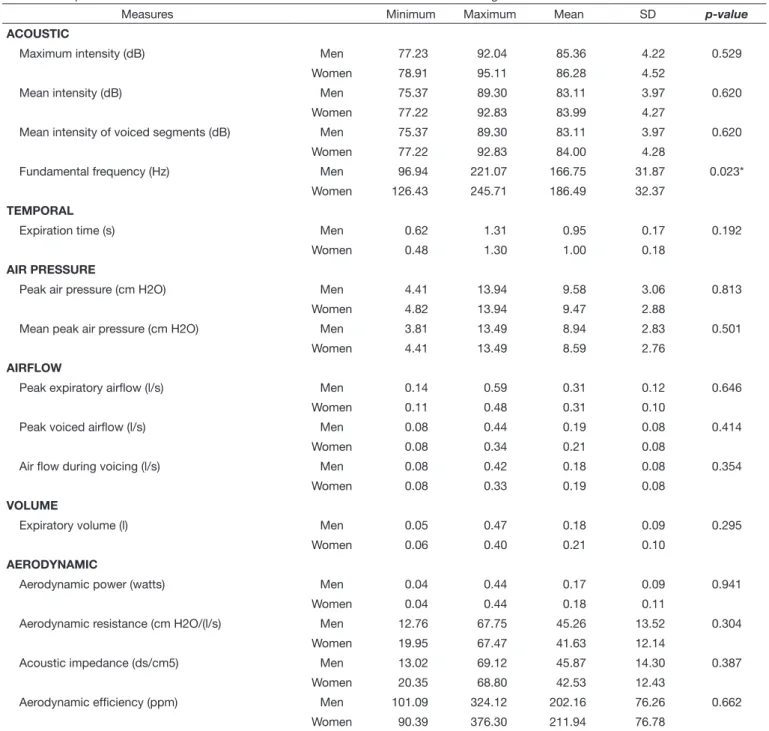
Women presented higher values of fundamental frequency (f0) compared with those of men. No differences were identified in the evaluation of aerodynamic measures between genders (Table 1).
Table 1. Comparison of measures of habitual vocal emissions between male and female singers
Measures Minimum Maximum Mean SD p-value
ACOUSTIC
Maximum intensity (dB) Men 77.23 92.04 85.36 4.22 0.529
Women 78.91 95.11 86.28 4.52
Mean intensity (dB) Men 75.37 89.30 83.11 3.97 0.620
Women 77.22 92.83 83.99 4.27
Mean intensity of voiced segments (dB) Men 75.37 89.30 83.11 3.97 0.620
Women 77.22 92.83 84.00 4.28
Fundamental frequency (Hz) Men 96.94 221.07 166.75 31.87 0.023*
Women 126.43 245.71 186.49 32.37
TEMPORAL
Expiration time (s) Men 0.62 1.31 0.95 0.17 0.192
Women 0.48 1.30 1.00 0.18
AIR PRESSURE
Peak air pressure (cm H2O) Men 4.41 13.94 9.58 3.06 0.813
Women 4.82 13.94 9.47 2.88
Mean peak air pressure (cm H2O) Men 3.81 13.49 8.94 2.83 0.501
Women 4.41 13.49 8.59 2.76
AIRFLOW
Peak expiratory airflow (l/s) Men 0.14 0.59 0.31 0.12 0.646
Women 0.11 0.48 0.31 0.10
Peak voiced airflow (l/s) Men 0.08 0.44 0.19 0.08 0.414
Women 0.08 0.34 0.21 0.08
Air flow during voicing (l/s) Men 0.08 0.42 0.18 0.08 0.354
Women 0.08 0.33 0.19 0.08
VOLUME
Expiratory volume (l) Men 0.05 0.47 0.18 0.09 0.295
Women 0.06 0.40 0.21 0.10
AERODYNAMIC
Aerodynamic power (watts) Men 0.04 0.44 0.17 0.09 0.941
Women 0.04 0.44 0.18 0.11
Aerodynamic resistance (cm H2O/(l/s) Men 12.76 67.75 45.26 13.52 0.304
Women 19.95 67.47 41.63 12.14
Acoustic impedance (ds/cm5) Men 13.02 69.12 45.87 14.30 0.387
Women 20.35 68.80 42.53 12.43
Aerodynamic efficiency (ppm) Men 101.09 324.12 202.16 76.26 0.662
Women 90.39 376.30 211.94 76.78
Mann-Whitney test. *Statistical significance: p<0.05
DISCUSSION
The singing voice requires a refined coordination between the
respiratory and phonatory systems. The ability to accurately and
efficiently control airflow and subglottic pressure is important
for singers to properly produce their musical repertoire(7).
The minimum air pressure necessary to cause vocal fold vibration is described as Phonation Threshold Pressure (PTP)(17),
and the specific scientific literature reports that air pressure
variation in a usual conversation varies from 0.3 to 1.2 KPa, but that these values are higher in singing(18), evidencing that
the singing voice presents aerodynamic requirements greater than those of the spoken voice(2). Studies comparing the
characteristics of vocal cord nodule size with aerodynamic parameters in singers and non-singers found that the latter
presented positive correlation between lesion size and airflow
parameters. Such correlation was not observed in singers(5),
suggesting that singing voice training favors the development of particular aerodynamic mechanisms that are present even in situations of glottal impairment.
Technological advances are making aerodynamic assessment of the voice increasingly common in vocal clinical practice(19).
Aerodynamic analyses can be used to detail phonological physiology and determine compensatory functional mechanisms in individuals with dysphonia(20). The literature describes that
aerodynamic measures present good test-retest agreement(20)
and are sensitive to evaluate dysphonic conditions, and should be used as a complementary voice assessment instrument(3).
Results of this study show that women presented values of fundamental frequency (f0) higher than those of men. These results are consistent with the literature(15,21) and can be justified by the
fact that the vocal folds of women and men differ with respect
to the size and number of cycles of vibration per second(22).
The natural vocal fold length and larynx size of females are smaller compared with those of males, thus the habitual values of f0 are lower in men(23).
Some mean values of f0 described in the literature for young
Brazilian women are 206Hz(21), 215.42Hz(24), and 208.28Hz(15),
whereas f0 values of 120Hz(21), 127.61Hz(24), and 136.56Hz(15) are
found for young Brazilian men. The f0 values observed in this
study for young women and men were 186.49Hz and 166.75Hz, respectively. These results are different from those described
in the literature, which shows increased values for males and
decreased values for females. The differences observed can be justified by the fact that this study evaluated the f0 of singers,
who can present different vocal adjustments according to their
practice of the singing voice. Further studies are needed to understand whether vocal adjustments of the singing voice are
really important to justify modifications in f0.
Aerodynamic measurements are essential for studies on the physiological bases of voice production(25). Aerodynamic
assessment with extraction of airflow, air pressure and expiratory
volume measures is recommended as part of a multidimensional
assessment of the voice by the American Speech-Language-Hearing Association (ASHA)(26).
The present study shows that female and male singers do
not present differences in aerodynamic measures regarding the parameters of expiration time, air pressure, airflow, expiratory volume, aerodynamic power and efficiency, and acoustic impedance.
Studies conducted with speakers of Brazilian Portuguese have reported that aerodynamic measures of men and women are
differentiated by the parameters of laryngeal resistance (quotient of the subglottic pressure values by the airflow values) and laryngeal efficiency (quotient of the vocal intensity values by the values of air pressure and airflow), with such values higher
in the female gender(15). These findings, despite being obtained
with samples of the Brazilian population, can not be directly compared with those of the present study, because they were
extracted using a different aerodynamic measurement equipment whose parameters and units of measurement are different from
those used for the development of this study.
The literature shows that aerodynamic measures in English
speakers differ according to gender regarding airflow values,
with higher values observed either in men(27) or in women(13),
whereas air pressure measures were sensitive to gender in situations of dysphonic voices(14). Although these studies used
the same equipment to obtain the aerodynamic measures,
the versions of the analysis software were different(13,27), and
dysphonic voices were also analyzed(14). As for the participants’
mother tongue, the surveys evaluated speakers of American(14,27)
and Australian(13) English. All of these variables can explain
the differences observed in the literature. Studies addressing
aerodynamic measures associated with gender in singers have not been found in the literature.
Understanding the aerodynamic and acoustic characteristics
of the voice of male and female singers is important to define
vocal and respiratory parameters in singing voice production. Findings of this study demonstrate that male and female singers presented the same aerodynamic characteristics of the voice, evidencing that, unlike in spoken voice, gender
interferes with measures of airflow(13,27) and air pressure(14), in
singing voice the aerodynamic parameters of male and female singers are the same. These results suggest that singing voice
training develops specific singing respiratory mechanisms that do not seem to be influenced by the anatomical differences of
the vocal apparatus between men and women. Further studies
conducted with male and female singers considering different
musical genres are important in order to better understand the phonatory and respiratory mechanisms involved in singing, and
how the different singing styles can influence the acoustic and
aerodynamic parameters of the singing voice.
CONCLUSION
Female singers present higher fundamental frequency values than male singers. Values of aerodynamic measures do not
differ between male and female singers speakers of Brazilian
REFERENCES
1. Jiang JJ, Maytag AL. Aerodynamic measures of glottal function: what extra can they tell us and how do they guide management? Curr Opin
Otolaryngol Head Neck Surg. 2014;22(6):450-4. http://dx.doi.org/10.1097/ MOO.0000000000000107. PMid:25254405.
2. Carroll LM, Sataloff RT, Heuer RJ, Spiegel JR, Radionoff SL, Cohn JR. Respiratory and glottal efficiency measures in normal classically trained singers. J Voice. 1996;10(2):139-45. http://dx.doi.org/10.1016/S0892-1997(96)80040-3. PMid:8734388.
3. Yiu EML, Yuen YM, Whitehill T, Winkworth A. Reliability and applicability of aerodynamic measures in dysphonia assessment. Clin Linguist Phon. 2004;18(6-8):463-78. http://dx.doi.org/10.1080/02699200410001703592 . PMid:15573484.
4. Stone RE Jr, Cleveland TF, Sundberg J, Prokop J. Aerodynamic and acoustical measures of speech, operatic, and broadway vocal styles in a professional female singer. J Voice. 2003;17(3):283-97. http://dx.doi. org/10.1067/S0892-1997(03)00074-2. PMid:14513952.
5. Stepp CE, Heaton JT, Stadelman-Cohen TK, Braden MN, Jetté ME, Hillman RE. Characteristics of phonatory function in singers and non-singers with vocal fold nodules. J Voice. 2011;25(6):714-24. http://dx.doi.org/10.1016/j. jvoice.2010.06.003. PMid:21216129.
6. Connolly J, Gerwin H, Russell BA. The effects of vocal training on singers aerodynamic measures [Internet]. New York: State University of New York at Fredonia, Department of Speech Pathology & Audiology; 2013 [citado em 2017 Nov 11]. Disponível em: http://www.fredonia.edu/studentexpo/ connr.htm
7. Lundy DS, Roy S, Casiano RR, Evans J, Sullivan PA, Xue JW. Relationship between aerodynamic measures of glottal efficiency and stroboscopic findings in asymptomatic singing students. J Voice. 2000;14(2):178-83. http://dx.doi.org/10.1016/S0892-1997(00)80025-9. PMid:10875569. 8. Plant RL, Hillel AD. Direct measurement of subglottic pressure and
laryngeal resistance in normal subjects and in spasmodic dysphonia. J Voice. 1998;12(3):300-14. http://dx.doi.org/10.1016/S0892-1997(98)80020-9. PMid:9763180.
9. Smitheran JR, Hixon TJ. A clinical method for estimating laryngeal airway
resistance during vowel productions. J Speech Hear Disord.
1981;46(2):138-46. http://dx.doi.org/10.1044/jshd.4602.138. PMid:7253590.
10. Lovato A, Colle W, Giacomelli L, Piacente A, Righetto L, Marioni G, et al. Multi-Dimensional Voice Program (MDVP) vs Praat for assessing euphonic subjects: a preliminary study on the gender-discriminating power of acoustic analysis software. J Voice. 2016;30(6):765.e1-5. http://dx.doi. org/10.1016/j.jvoice.2015.10.012. PMid:26975896.
11. Yamauchi A, Yokonishi H, Imagawa H, Sakakibara KI, Nito T, Tayama N, et al. Quantitative analysis of digital videokymography: a preliminary study on age- and gender-related difference of vocal fold vibration in normal speakers. J Voice. 2015;29(1):109-19. http://dx.doi.org/10.1016/j. jvoice.2014.05.006. PMid:25228432.
12. Yamauchi A, Yokonishi H, Imagawa H, Sakakibara KI, Nito T, Tayama N, et al. Age and gender-related difference of vocal fold vibration and glottal configuration in normal speakers: analysis with glottal area waveform. J Voice. 2014;28(5):525-31. http://dx.doi.org/10.1016/j.jvoice.2014.01.016. PMid:24836359.
13. Goozée JV, Murdoch BE, Theodoros DJ, Thompson EC. The effects of age and gender on laryngeal aerodynamics. Int J Lang Commun Disord. 1998;33(2):221-38. http://dx.doi.org/10.1080/136828298247884. PMid:9709440.
14. Zhuang P, Sprecher AJ, Hoffman MR, Zhang Y, Fourakis M, Jiang JJ, et al. Phonation threshold flow measurements in normal and pathological phonation. Laryngoscope. 2009;119(4):811-5. http://dx.doi.org/10.1002/ lary.20165. PMid:19263409.
15. Oliveira KV, Faria BS, Silva JPG, Reis C, Ghio A, Gama ACC. Análise
das medidas aerodinâmicas no português brasileiro por meio do método
multiparamétrico de avaliação vocal objetiva assistida (EVA). Rev CEFAC. 2013;15(1):119-27. http://dx.doi.org/10.1590/S1516-18462012005000053. 16. Stemple J, Weinrich B, Brehm SB. Phonatory aerodynamic system: a
clinical manual. Chicago: Kay Pentax; 2008.
17. McHenry M, Evans J, Powitzky E. Singers phonation threshold pressure and ratings of self-perceived effort on vocal tasks. J Voice. 2013;27(3):295-8. http://dx.doi.org/10.1016/j.jvoice.2012.12.013. PMid:23462685. 18. Titze IR. Principles of voice production. 2nd ed. Lowa City: National
Center for Voice and Speech; 2000.
19. Schaeffer N. Pre- and poststimulation study on the phonatory aerodynamic system on participants with dysphonia. J Voice. 2017;2(2):254.e1-9. http:// dx.doi.org/10.1016/j.jvoice.2016.06.020.
20. Awan SN, Novaleski CK, Yingling JR. Test-retest reliability for aerodynamic measures of voice. J Voice. 2013;27(6):674-84. http://dx.doi.org/10.1016/j. jvoice.2013.07.002. PMid:24119644.
21. Felippe ACN, Grillo MHMM, Grechi TH. Normatização de medidas acústicas para vozes normais. Rev Bras Otorrinolaringol. 2006;72(5):659-64. http://dx.doi.org/10.1590/S0034-72992006000500013.
22. Hollien H. Vocal fold dynamics for frequency change. J Voice. 2014;28(4):395-405. http://dx.doi.org/10.1016/j.jvoice.2013.12.005. PMid:24726331. 23. Izadi F, Mohseni R, Daneshi A, Sandughdar N. Determination of fundamental
frequency and voice intensity in iranian men and women aged between 18 and 45 years. J Voice. 2012;26(3):336-40. http://dx.doi.org/10.1016/j. jvoice.2011.05.008. PMid:21889298.
24. Araujo SA, Grellet M, Pereira JC, Rosa MO. Normatização de medidas acústicas da voz normal. Rev Bras Otorrinolaringol. 2002;68(4):540-4. http://dx.doi.org/10.1590/S0034-72992002000400014.
25. Joshi A, Watts CR. Phonation Quotient in Women: A measure of vocal efficiency using three aerodynamic instruments. J Voice. 2017;31(2):161-7. http://dx.doi.org/10.1016/j.jvoice.2016.06.007. PMid:27430861.
26. ASHA: American Speech and Hearing Association. Committee on
Instrumental Voice Assessment Protocols – IVAP. Recommended protocols for instrumental assessment of voice: draft summary of recommendations.
Rockville: ASHA; 2015.
27. Zraick RI, Smith-Olinde L, Shotts LL. Adult normative data for the Kay Pentax Phonatory Aerodynamic System Model 6600. J Voice. 2012;26(2):164-76. http://dx.doi.org/10.1016/j.jvoice.2011.01.006. PMid:21600731.
Author contributions