
0103 - 5053 $6.00+0.00
Article
* e-mail: [email protected]
Platinum Complexes with Non-Symmetric Fluorodithioethers. Molecular Structures of
cis
-[PtCl
2(CH
3SCH
2CH
2SR
f)] (R
f= C
6F
5, C
6H
4F-3) and
trans
-[PtCl
2(CH
3SCH
2CH
2SC
6F
5)
2]
Amaranta Ramíreza, José G. Alvaradob, Sylvain Bernsc, Luís Ortiz-Fradea, Ezequiel Huiped and Hugo Torrens*,a
a
DEPg, Facultad de Química, Universidad Nacional Autónoma de México, Ciudad Universitaria, 04510 México D.F., Mexico
b
CIQ, Universidad Autónoma del Estado de Hidalgo, Unidad Universitaria, Pachuca, Hidalgo, Mexico
c
CQIC, Universidad Autónoma de Puebla, A.P. 1613 72000 Puebla, Puebla, México
d
Instituto Tecnológico de Morelia, Morelia, Michoacan, Mexico
Este trabalho descreve a síntese e caracterização dos ligantes não simétricos CH3SCH2CH2SRf (Rf = C6F5, C6HF4-4, C6H4F-2, C6H4F-3, C6H4F-4) bem como seus derivados de platina(II) cis -[PtCl2(CH3SCH2CH2SRf)] (Rf = C6F5, C6HF4-4, C6H4F-2, C6H4F-3, C6H4F-4) e trans -[PtCl2(CH3SCH2CH2SRf)2] (Rf = C6F5, C6HF4-4). O espectro de RMN de 19F desses complexos mostra os isômeros syn e anti, consistente com um rápido dobramento do anel metalacíclico e uma inversão lenta de configuração nos átomos de enxofre do tioéter. As estruturas molecular e cristalina dos compostos cis-[PtCl2(CH3SCH2CH2SC6F5)], cis-[PtCl2(CH3SCH2CH2SC6H4F-3)] e trans -[PtCl2(CH3SCH2CH2SC6F5)2], resolvida por difração de raios-X, são também descritas.
This paper describes the synthesis and characterization of the non-symmetric ligands CH3SCH2CH2SRf (Rf = C6F5, C6HF4-4, C6H4F-2, C6H4F-3, C6H4F-4) as well as their platinum(II) derivatives cis-[PtCl2(CH3SCH2CH2SRf)] (Rf = C6F5, C6HF4-4, C6H4F-2, C6H4F-3, C6H4F-4) and trans-[PtCl2(CH3SCH2CH2SRf)2] (Rf = C6F5, C6HF4-4). 19F NMR of these complexes show the presence of syn and anti isomers, consistent with a fast flipping of the metallacycle ring and a slow inversion of configuration at the dithioether sulfur atoms. The molecular and crystalline structures of the compounds cis-[PtCl2(CH3SCH2CH2SC6F5)], cis-[PtCl2(CH3SCH2CH2SC6H4F-3)] and trans -[PtCl2(CH3SCH2CH2SC6F5)2], solved by X-ray diffraction are also described.
Keywords: fluorodithioeteres, platinum, 19F NMR, X-ray diffraction
Introduction
The co-ordination chemistry of sulfur containing ligands-thiolates, thioetheres etc, is a traditional area still growing at a fast speed. Its interest steams from the importance of these compounds in catalytic processes, oil dehydrodesulfurization, biological systems and chemical synthesis amongst others. The equivalent chemistry involving fluoro-containing ligands,1,2 is younger, proportionally less known, but not less interesting. Fluorinated compounds are becoming of increasing
importance in modern pharmacology,3 design of new
materials4 and catalysis of fluorinated organic compounds.5
Substitution of hydrogen by fluorine has two general consequences. The first one is topological, as a result of the different dimensions between hydrogen and fluorine atoms. The second is an electronic one, caused by the difference on the electroatractor character of these two elements. It is possible to generalize in a broad sense, by stating that a fluorinated molecule is stereochemically similar to its normal hydrogenated analogue but considerably different as far as its electronic properties is concerned. The chemical reactivity derived from morphological changes is hardly altered whereas chemical behavior depending on electronic parameters is profoundly affected.
et al. J. Braz. Chem. Soc.
is that related with sulfur containing polydentate ligands, especially those systems in which each sulfur atom has a different coordinating ability. In this paper we describe the synthesis and characterization of the non-symmetric ligands CH3SCH2CH2SRf (Rf = C6F5L1, C6HF4-4 L2, C6H4F-2 L3,
C6H4F-3 L4 and C6H4F-4 L5) as well as their platinum(II)
derivatives cis-[PtCl2(CH3SCH2CH2SRf)] (Rf = C6F5 1,
C6HF4-4 2, C6H4F-2 3, C6H4F-3 4 and C6H4F-4 5) as chelating
ligands and trans-[PtCl2(CH3SCH2CH2SRf)2] (Rf = C6F5 6
and C6HF4-4 7) as monodentate ligands. The 19F NMR spectra of complexes 1-5, show the presence of syn and anti
isomers, consistent with a fast flipping of the metallacycle ring and a slow inversion of configuration at the dithioether sulfur atoms. The molecular and crystalline structures of the compounds cis-[PtCl2(CH3SCH2CH2SC6F5)] 1,
cis-[PtCl2(CH3SCH2CH2SC6H4F-3)] 4 and trans [PtCl2 (CH3SCH2CH2SC6F5)2] 6 , solved by X-ray diffraction are
also described.
Results and Discussion
CH3SCH2CH2SRf
Reactions of CH3SCH2CH2Cl with lead fluorothiolates Pb(SRf)2 (Rf = C6F5,7 C
6HF4-4, C6H4F-2, C6H4F-3 and C6H4 F-4) yield the corresponding dithioethers CH3SCH2CH2SRf (Rf = C6F5L1, C6HF4-4 L2, C6H4F-2 L3, C6H4F-3 L4 and
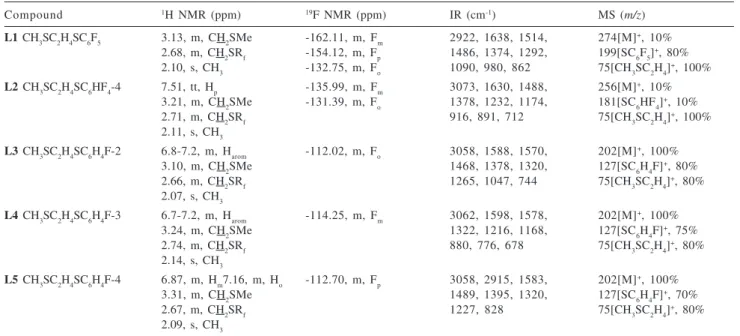
C6H4F-4 L5) as clear, dense oils. IR, 1H and 19F NMR as well as EI-MS data, shown in Table 1, confirm the identity of each ligand.
[PtCl2(CH3SCH2CH2SRf)]
The reactions of bisulphides CH3SCH2CH2SRf, L1-L5,
with alcohol-water solutions of K2[PtCl4], reaction 1, yield the compounds cis-[PtCl2(CH3SCH2CH2SRf)], (Rf = C6F5
18 C6HF4-4 2, C6H4F-2 3, C6H4F-3 4 and C6H4F-4 5), as air
stable, yellow microcrystalline solids, soluble in acetone and dichloromethane. As expected for planar platinum(II) complexes, compounds 1-5 are diamagnetic. Physical and
spectroscopic data for compounds 1-7 are collected in Table
2.
K2[PtCl4] + CH3SCH2CH2SRf→
[PtCl2(CH3SCH2CH2SRf)] + 2KCl (1)
Infrared spectra
As expected for a cis configuration, IR spectra of
compounds 1-5, show two absorptions in the
330-310 cm-1 range, assigned to the symmetric and
asymmetric Pt-Cl vibrations. Δν = νsym – νasym, span from 11 to 15 cm-1 but without apparent correlation with the fluorinated substituent at the sulfur atom. The IR spectra are useful in terms of characterization since they exhibit the absorptions associated to both the ligands and the cis-PtCl2 fragment. Unfortunately since absorptions are relatively wide, this spectroscopy is insensitive to structural changes and therefore, for identification purposes, only characteristic bands are reported for compounds 1 to 7.
Table 1. NMR, IR and MS data for compounds CH3SCH2CH2SRf, L1 to L5
Compound 1H NMR (ppm) 19F NMR (ppm) IR (cm-1) MS (m/z)
L1 CH3SC2H4SC6F5 3.13, m, CH2SMe -162.11, m, Fm 2922, 1638, 1514, 274[M]+, 10% 2.68, m, CH2SRf -154.12, m, Fp 1486, 1374, 1292, 199[SC6F5]+, 80% 2.10, s, CH3 -132.75, m, Fo 1090, 980, 862 75[CH3SC2H4]+, 100% L2 CH3SC2H4SC6HF4-4 7.51, tt, Hp -135.99, m, Fm 3073, 1630, 1488, 256[M]+, 10%
3.21, m, CH2SMe -131.39, m, Fo 1378, 1232, 1174, 181[SC6HF4]+, 10% 2.71, m, CH2SRf 916, 891, 712 75[CH3SC2H4]+, 100% 2.11, s, CH3
L3 CH3SC2H4SC6H4F-2 6.8-7.2, m, Harom -112.02, m, Fo 3058, 1588, 1570, 202[M]+, 100% 3.10, m, CH2SMe 1468, 1378, 1320, 127[SC6H4F]+, 80% 2.66, m, CH2SRf 1265, 1047, 744 75[CH3SC2H4]+, 80% 2.07, s, CH3
L4 CH3SC2H4SC6H4F-3 6.7-7.2, m, Harom -114.25, m, Fm 3062, 1598, 1578, 202[M]+, 100% 3.24, m, CH2SMe 1322, 1216, 1168, 127[SC6H4F]+, 75% 2.74, m, CH2SRf 880, 776, 678 75[CH3SC2H4]+, 80% 2.14, s, CH3
NMR spectra
Compounds with general formulae [PtX2 (RSCH2
CH2SR)] can give rise to different isomers depending, as shown in Figure 1, on the relative position of the sulfur substituents -syn and anti- and also, depending of the relative configuration of the PtS2C2 cycle, A, B, C and D
isomers.
In solution at room temperature, the A, B or C, D isomers
are, in general, NMR indistinguishable because flipping of the PtS2C2 ring is too fast on the time scale of this spectroscopy. There are some examples, with large R substituents, that allow distinct configurations of the
Table 2. Physical and spectroscopic data for compounds [PtCl2(CH3SCH2CH2SRf)], 1 to 5 and [PtCl2(CH3SCH2CH2SRf)2], 6 and 7 Analyses
Compound Yield(%) mp(oC) Found(%) 19F NMR IR (cm-1) MS (m/z)
Calculated(%)
1 [PtCl2(CH3SCH2CH2SC6F5)] 8 6 243-245 C 20.44, H 1.55, S 11.93 isomer A 1642, 1514, 539[M]+ C 20.03, H 1.29, S 11.87 -156.63, m, Fm 1483, 1091, 504[M-Cl]+
-143.56, m, Fp 1027, 974, 860, 469[M-2Cl]+ -127.00, m, Fo 632, 338, 316 274[M-PtCl2]+ isomer B
-156.79, m, Fm -143.93, m, Fp -127.35, m, Fo A:B, 1:1.
2 [PtCl2(CH3SCH2CH2SC6HF4-4)] 7 6 236-237 C 20.44, H 1.55, S 11.93 isomer A 1609, 1497, 521 [M]+ C 20.73, H 1.54, S 12.28 -134.34, m, Fp 1440, 1381, 486 [M-Cl]+
-128.68, m, Fo 1178, 1127, 922, 451 [M-2Cl]+ isomer B 913, 847, 710, 256 [M-PtCl2] -134.55, m, Fp 334, 319
-129.12, m, Fo A:B, 1:1
3 [PtCl2(CH3SCH2CH2SC6H4F-2)] 8 1 255-257 C 22.8, H 2.1, S 13.6 isomer A 3058, 1588, 467 [M]+ C 23.1, H 2.4, S 13.7 -104.36, m, Fo 1570, 1468, 432 [M-Cl]+
isomer B 1378, 1320, 1265, 397 [M-2Cl]+ -103.77, m, Fo 1047, 744, 674, 202 [M-PtCl2] A:B, 1:1 337, 323
4 [PtCl2(CH3SCH2CH2SC6H4F-3)] 8 1 234-236 C 23.1, H 2.1, S 13.5 isomer A 3061, 1602, 467 [M]+ C 23.1, H 2.4, S 13.7 -106.86, m, Fm 1582, 1482, 432 [M-Cl]+
isomer B 1322, 1166, 397 [M-2Cl]+ -106.37, m, Fm 1101, 1071, 889, 202 [M-PtCl2] A:B, 2:1 798, 654, 516,
331, 320
5 [PtCl2(CH3SCH2CH2SC6H4F-4)] 8 1 215-217 C 22.9, H 2.2, S 13.6 isomer A 2924, 1583, 467 [M]+ C 23.1, H 2.4, S 13.7 -105.916, m, Fp 1488, 1217, 829, 432 [M-Cl]+
isomer B 629, 524, 336, 397 [M-2Cl]+ -106.43, m, Fp 322 202 [M-PtCl2] A:B, 2:1
6 [PtCl2(CH3SCH2CH2SC6F5)2] 8 6 <290 d. C 26.4, H 1.5, S 15.6 -154.72, m, Fm 1644, 1513, 813[M]+ C 26.57, H 1.72, S 15.74 -143.29, m, Fp 1481, 1092, 778[M-Cl]+
-126.12, m, Fo 1026, 978, 863, 743[M-2Cl]+ 639, 340
7 [PtCl2(CH3SCH2CH2SC6HF4-4)2] 8 8 <290 d. C 27.3, H 2.1, S 16.48 -135.63, m, Fp 1609, 1497, 777[M]+ C 27.8, H 2.06, S 16.47 -129.13, m, Fo 1440, 1381, 742[M-Cl]+
1178, 1127, 922, 707[M-2Cl]+ 913, 847, 710,
334, 319
Figure 1. Isomers syn (A, B) and anti (C, D) derived from a flipping
fragment SCH2CH2S and the observable syn and anti isomers from
et al. J. Braz. Chem. Soc.
SCR2CR2S- skeleton to be measured at low temperatures.8 Normally however, all one can detect is a dynamic average between both stereoisomers shown in Figure 1.
Isomers syn and anti -Figure 1- can also interconvert to each other through a process known as inversion of configuration9 at the sulfur atoms. This inversion requires energies between 40 and 80 kJ mol-1 and therefore at room temperature both isomers can, normally, be experimentally detected by NMR.10
Each of the sulfur substituents used in this work show second order magnetic systems. Experimentally the expected multiplicity for each absorption has been obtained. 19F NMR parameters for compounds 1 to 5 are shown in Table 2.
Compounds 1 to 5 show NMR spectra consistent with
the presence of syn and anti isomers. As an example, Figure 2 shows the spectrum of cis-[PtCl2(CH3SCH2CH2SC6F5)] 1.
The presence of only two absorptions (isomers) requires fast (in the NMR time scale) conformational changes at
the metallacycle otherwise up to four isomers would have been detected, see Figure 1.
At room temperature both isomers are in equilibrium with nearly equal abundances for compounds 1 to 4 and
with a ca. 2:1 relative abundance for compound 5. It is
worth mentioning that the presence of both isomers implies that inversion of configuration could not be only and simultaneously at both sulfur atoms.
From NMR data it is not possible to assign unambiguously a set of signals to a particular isomer (syn or anti). It has been suggested before11 that the more abundant isomer corresponds frequently to the anti isomer, since this geometry minimizes the steric interactions. This does not seem to be the case for the complexes studied in this work, since they do not show significant differences between the relative syn:anti proportions observed. The relative sizes of both substituents -CH3 and Rf- are similar for all 1 to 5
complexes and apparently the steric hindrance of the methyl group has no effect on the orientation adopted by the fluorinated benzene ring.
19F NMR spectrum of compound [PtCl
2(CH3SCH2 CH2SC6F5)] 1, Figure 2, exhibits two sets of absorptions
arising from the syn and anti isomers –magnetic system A2B2C– with nearly equal relative intensities. Each group includes three absorptions corresponding to fluorine nuclei at ortho, meta and para positions with relative intensities of 2:2:1 respectively.
[PtCl2(CH3SCH2CH2SC6F4H)] 2 exhibits a 19F NMR spectrum with two groups of signals assigned to the syn
and anti isomers –magnetic system A2B2X– with 1:1
relative intensities. Each set shows two absorptions arising from the fluorine nuclei in ortho and meta positions with nearly equal relative intensities. 19F NMR spectra of compounds [PtCl2(CH3SCH2CH2SC6H4F)] 3 to 5, with a
single fluorine atom in ortho, meta or para positions display the expected single absorption for each isomer.
Figure 3. ORTEP diagram of compound cis-[PtCl2(CH3SCH2
CH2SC6F5)] 1 with vibrational ellipsoids at 50%. Hydrogen atoms are represented by spheres of arbitrary size.
Figure 2. 19F NMR spectrum of cis-[PtCl
Molecular structures
cis-[PtCl2(CH3SCH2CH2SC6F5)] 1 and cis-[PtCl2(CH3
SCH2CH2SC6H4F-3)] 4 were studied by X-ray diffraction
methods. Table 3 shows the principal bond angles and distances from these molecules. ORTEP diagrams are shown in Figures 3 and 4.
Molecules 1 and 4 have platinum atoms bonded to
both sulfur atoms of the chelating ligands with practically equal Pt-S bond lengths. 1: Pt-S1 2.244(2), Pt-S2 2.252(2)
and 4: Pt-S1 2.257(3), Pt-S2 2.252(3) Å. Despite the
presumed electronic differences between C6F5 and C6H4 F-3 there is no evidence of cis-effect since the S1 and Pt-S2 are practically equal for both compounds.
In contrast, trans bond distances, 1: Pt-Cl1 2.306(2),
Pt-Cl2 2.330(2) and 4: Pt-Cl1 2.318(3), Pt-Cl2 2.322(3) Å,
are significantly different and probably reflect a larger trans-influence of the SC6F5 as compared with that of SC6H4F-3. Bond angles around the central platinum atoms as well as bond distances with sulfur and chlorine ligands define an almost perfect square.
Both substituents at the sulfur atoms are located above the S2Cl2 plane, adopting a syn configuration, probably as a result of crystal packing effects. Similar anti isomers are found in the solid state structures of [PtCl2(CF3SCH(CH3)CH2SCF3)],12 [PtCl
2(CH3SCH(CF3) CH(CF3)SCH3)],13 [Pt(SC
6F5)2(CH3SCH(CF3)CH(CF3) SCH3)]14 and [PtCl
2(CH3SCF2CH2SCH3)].15
H3C9-S-Pt and RfC1-S-Pt bond angles (108o, average)
suggest the geometry around the sulfur atoms is pyramidal, close to a tetrahedral arrangement (109.5o) and therefore
each sulfur atom could be considered as having sp3
hybridization.
A noticeable feature on these structures is that the crystal seems to be stabilized by intermolecular interactions in which the ortho-fluorine atoms of C6F5 in a molecule have short contacts with the para-fluorine atoms of C6F5 in a neighbor molecule.
Trans-[PtCl2(CH3SCH2CH2SRf)2]
Reactions of compounds cis-[PtCl2(CH3SCH2CH2 SC6F5)] 1 and cis-[PtCl2(CH3SCH2CH2SC6HF4-4)] 2 with
additional stoichiometric amounts of CH3SCH2CH2SC6F5 or CH3SCH2CH2SC6HF4-4, respectively, in acetone and room temperature yield the trans compounds [PtCl2(CH3SCH2CH2SC6F5)2] 6 and [PtCl2(CH3SCH2
CH2SC6HF4-4)2] 7. Clearly, the presence of free ligand allows
the donor sulfur atoms in CH3S- and RfS- to compete. Despite the chelating effect, the more basic CH3S group
displaces the labile RfS moiety and
trans-Table 3. Bond lengths (Å) and angles (o) for compounds [PtCl2(CH3SCH2CH2SC6F5)] 1 and [PtCl2(CH3SCH2CH2SC6H4F-3)] 4
Compound 1 Compound 4
Pt(1)-S(1) 2.244(2) 2.257(3)
Pt(1)-S(2) 2.252(2) 2.252(3)
Pt(1)-Cl(1) 2.306(2) 2.318(3)
Pt(1)-Cl(2) 2.330(2) 2.322(3)
S(1)-C(1) 1.787(8) 1.796(12)
S(1)-C(7) 1.842(9) 1.833(14)
S(2)-C(9) 1.775(11) 1.808(14)
S(2)-C(8) 1.815(9) 1.828(14)
S(1)-Pt(1)-S(2) 90.29(8) 91.01(13) S(1)-Pt(1)-Cl(1) 178.36(10) 172.54(12) S(2)-Pt(1)-Cl(1) 88.39(10) 87.65(13) S(1)-Pt(1)-Cl(2) 88.65(9) 91.48(13) S(2)-Pt(1)-Cl(2) 175.17(9) 174.24(12) Cl(1)-Pt(1)-Cl(2) 92.75(10) 90.54(14) C(1)-S(1)-C(7) 102.0(4) 102.9(6) C(1)-S(1)-Pt(1) 108.3(3) 109.6(4) C(7)-S(1)-Pt(1) 103.7(3) 101.1(4) C(9)-S(2)-C(8) 102.2(5) 101.7(8) C(9)-S(2)-Pt(1) 108.6(4) 107.3(5) C(8)-S(2)-Pt(1) 102.8(3) 102.9(5)
Figure 5. Displacement of the labile RfS-Pt moiety by an incoming MeS group. Figure 4. ORTEP diagram of compound cis-[PtCl2(CH3SCH2
et al. J. Braz. Chem. Soc.
Table 4. Bond lengths (Å) and angles (o) for compound trans -[PtCl2(CH3SCH2CH2SC6F5)2] 6
Bond (Å) Angle (o)
Pt(1)-Cl(1) 2.3004(13) Cl(1)-Pt(1)-S(1) 85.06(5) Pt(1)-S(1) 2.3121(12) C(2)-S(1)-Pt(1) 104.24(16) S(1)-C(11) 1.805(5) C(2)-C(3)-S(4) 112.7(4) S(1)-C(2) 1.815(5) C(11)-S(1)-Pt(1) 111.9(2) C(3)-S(4) 1.820(5) C(3)-C(2)-S(1) 114.2(3) C(2)-C(3) 1.507(7) C(5)-S(4)-C(3) 99.5(2) S(4)-C(5) 1.772(5) C(6)-C(5)-S(4) 121.9(4)
C(10)-C(5)-S(4) 121.2(4) C(11)-S(1)-C(2) 101.0(3) Symmetry transformations used to generate equivalent atoms: #1 -x+2, -y, -z.
Figure 6. ORTEP diagram of compound trans
-[PtCl2(CH3SCH2CH2SC6F5)2] 6 with vibrational ellipsoids at 50%. Hydrogen atoms are represented by spheres of arbitrary size.
[PtCl2(CH3SCH2CH2SRf)2] compounds are formed predominantly as shown in Figure 5.
X-ray diffraction data for compound trans-[PtCl2(CH3SCH2CH2SC6F5)2] 6 are shown in Table 2. The
corresponding ORTEP diagram is shown in Figure 6.
Experimental
All reactions were carried out under an atmosphere of oxygen-free dinitrogen using Schlenk techniques. Solvents were purified and degassed prior to use according to published methods.16 Thin-layer chromatography (TLC) (Merck, silica gel 60 F254 and neutral aluminium oxide 60 F254) was used to monitor the progress of the reactions under study. All reagents were purchased from Aldrich and used as received.
CH3SCH2CH2SC6F5,7 [PtCl
2(CH3SCH2CH2SC6F5)]8 and the lead thiolates Pb(SRf)2 (Rf = C6F5, SC6HF4-4, SC6H4F-2, SC6H4F-3 and SC6H4F-4,17,18 were synthesized following published reports.
Infrared spectra were recorded on a 750 Nicolet Fourier Transform Magna-IR Spectrometer over the 4000-300 cm-1 range on CsI. Elemental Analyses were determined by Galbraith Laboratories Inc., USA. 1H and 19F-{1H} nuclear magnetic resonance spectra were recorded on a Varian Unity INOVA-300 spectrometer operating at 300 MHz and 282.23
MHz respectively. Chemical shifts are in ppm positive at low field, relative to TMS=0 ppm for 1H and CFCl
3=0 ppm for 19F.
FAB+ mass spectra were recorded on a JEOL
JMS-SX102A mass spectrometer operating with an acceleration voltage of 10 KV. Samples were desorbed from a 3-nitrobenzyl alcohol matrix using 3KeV xenon atoms. FAB+ mass measurements were carried out with resolution of 3000 using magnetic field scan and the matrix ions as reference or as electric field scan with the sample peak flanked by two poly(ethylene glycol) or CsI ions as reference.
For both, dithioethers -CH3SCH2CH2SRf- and
platinum(II) derivatives -cis-[PtCl2(CH3SCH2CH2SRf)] and trans-[PtCl2(CH3SCH2CH2SRf)2]- a detailed experimental procedure is described.
CH3SCH2CH2SRf , L1-L5
CH3SCH2CH2Cl (0.88g, 8 mmol) in acetone (25 mL) were added to a solution of Pb(SRf)2 (4.0 mmol) in acetone (25 mL) and refluxed overnight. The white precipitate (PbCl2) was filtered off and the solvent transferred under vacuum. The oily colorless products were purified through a chromatographic column with silica and (CH3)2CO/ CH3COOEt 1:1 as eluent. Yields: 97-98%.
cis-[PtCl2(CH3SCH2CH2SRf)], 1-5
CH3HSCH2CH2SRf, (0.242 mmol) in acetone (20 mL) was added dropwise to (100.0mg, 0.242mmol) of K2[PtCl4] dissolved in a 1:1 water-acetone mixture (20 mL). The color changes slowly from red to yellow and after 24 h at room temperature the solvent was evaporated under vacuum. The yellow solid of cis-[PtCl2(CH3SCH2CH2SRf)] was washed with cold water and dried under vacuum at room temperature 4 h.
trans-[PtCl2(CH3SCH2CH2SRf)2], 6-7
CH3SCH2CH2SC6F5 L1 (0.28mg, 1 mmol), dissolved
in acetone (10 mL) was added to [PtCl2(CH3SCH2CH2 SC6F5)] 1 (0.540g, 1 mmol) dissolved in acetone (10 mL).
The color solution changes between yellow tones and after 24 h at room temperature the solvent was evaporated to obtain cis-[PtCl2(CH3SCH2CH2SC6F5)2] 6 (0.710g, 0.88
mmol).
X-ray diffraction data
Air stable single crystals of complexes 1,4, and 6 were
5. The diffraction data for 1 was collected at room temperature
on a Enraf CAD4 diffractometer using graphite monochromated Mo-Kα radiation (λ = 0.71073 Å) and θ/2θ
or ω scan mode with variable scan speed. Structures was solved and refined using routine procedures19 on the basis of absorption-corrected data (ψ-scans). Structure 1 was refined
without restraints. H atoms were placed on idealized positions and final least-squares cycles were carried-out using anisotropic displacement parameters for non-H atoms.
The diffraction data for 4 and 6 were collected at room
temperature on a Siemens P4/PC 20,20 diffractometer using graphite monochromated Mo-Ka radiation (λ = 0.71073 Å) and θ/2θ or ω scan mode with variable scan speed. Structures were solved and refined using routine procedures19 on the basis of absorption-corrected data (ψ -scans). Structures 4 and 6 were refined without restraints.
H atoms were placed on idealized positions and final least-squares cycles were carried-out using anisotropic displacement parameters for non-H atoms.
Supplementary Information
Crystallographic data (excluding structure factors) for the structures reported in this paper have been deposited with the Cambridge Crystallographic Data Centre as supplementary publication no. CCDC 265984 (compound
1), 266404 (compound 4) and 266807 (compound 6).
Copies of the data can be obtained, free of charge via www.ccdc.cam.ac.uk/conts/retrieving.html (or from the Cambridge Crystallographic Data Centre, CCDC, 12 Union Road, Cambridge CB2 1EZ, UK ; fax: +44 1223 336033; or e-mail: [email protected]).
Table 5. Crystallographic data for compounds [PtCl2(CH3SCH2 CH2SC6F5)] 1, [PtCl2(CH3SCH2CH2SC6H4F-3)] 4 and [PtCl2(CH3SCH2 CH2SC6F5)2] 6
1 4 6
Formula C9H7Cl2F5S2Pt C9H11Cl2FS2Pt C18H14Cl2F10S4Pt
Group P2(1)/c P P
a, Å 11.4095(5) 8.121(5) 7.5978(7)
b, Å 7.8309(3) 8.704(5) 7.6467(7)
c, Å 16.0595(7) 10.387(5) 11.4709(15) α, deg 9 0 113.460(5) 104.670(9) β, deg 106.9970(10) 104.516(5) 103.384(9) γ, deg 9 0 94.360(5) 90.773(8) V, Å3 1372.19(10) 639.1(6) 625.36(12)
Z 4 2 2
ρcalc gcm-3 2.958 2.433 2.163 μ, cm-1 11.352 11.698 6.239
R1a% 3.50 6.74 3.30
wR2b% 8.63 15.66 6.51
aR= Σ⏐⏐Fo⏐-⏐Fc⏐⏐/Σ⏐Fo⏐. bR
W=[Σw(⏐Fo⏐-⏐Fc⏐)2/Σw⏐Fo⏐2]1/2.
Acknowledgements
We are grateful to DGAPA-UNAM (IN119305) and CONACYT (44494) for financial support.
References
1. Torrens, H.; Coord. Chem. Rev. 2000, 196, 331.
2. Redón, R.; Cramer, R.; Berns, S.; Morales-Morales, D.; Torrens, H.; Polyhedron2001, 20, 3119.
3. Spracklin, D.K.; Kharasch, E.D.; Chem. Res. Toxicol. 1996, 9,
696.
4. Martin, E.; Torrens, H.; Tovilla, T.; Rev. Soc. Quim. Mex.
2000, 44, 108.
5. Redón, R.; Torrens, H.; Wang, Z.; Morales-Morales, D.; J. Organomet. Chem. 2002, 654, 16.
6. Cruz-Garritz, D.; Martin, E.; Mayoh, K.A.; Smith, A.J.; Torrens, H.; Trans. Metal. Chem. 1991, 16, 236.
7. Sharp, D.W.A.; Torrens, H.; Israel J. Chem. 1978, 17, 144.
8. Cross, R.J.; Rycroft, D.S.; Sharp, D.W.A.; Torrens, H.; J. Chem. Soc., Dalton Trans.1980, 2434.
9. Abel, E.W.; Bhargava, S.K.; Orrel, K.G.; Prog. Inorg. Chem.
1984, 32, 1.
10. Shaver, A.; Morris, S.; Turrin, R.; Day, V.M.; Inorg. Chem.
190, 29, 3622; Abel, E.W.; Bhargava, S.K.; Orrell, K.G.; Prog. Inorg. Chem. 1984, 32, 1.
11. Cross, R.J.; Dalgleish, I.G.; Smith, G.J.; Wardle, R.; J. Chem. Soc., Dalton Trans.1972, 992.
12. Cross, R.J.; Manojlovic-Muir, L.; Muir, K.W.; Rycroft, D.S.; Sharp, D.W.A.; T. Solomun, T.; Torrens, H.; J. Chem. Soc., Chem. Comm.1976, 291.
13. Hunter, W.N.; Muir, K.W.; Sharp, D.W.A.; Acta Cryst. 1984, C40, 37.
14. Martin, E.; Toledo, B.; Torrens, H.; Lahoz, F.J.; Terreros, P.;
Polyhedron 1998, 17, 4091.
15. Cano, O.; Leal, J.; Quintana, P.; Torrens, H.; Inorg. Chim. Acta
1984, 89, L9.
16. Riddick, J.A.; Bunger, W.B.; Sakaro, T.K.; Organic Solvents: Physical Properties and Methods of Purification, 4th ed.,
Wiley-Interscience: N.Y., 1970, vol. II.
17. Bertran, A.; del Rio, F.; Torrens, H.; Sulfur Lett. 1992, 15, 11.
18. Peach, M.E.; Can. J. Chem. 1968, 46, 2699; Bertran, A.; Garcia,
J.; Martin, E.; Sosa, P.; Torrens, H.; Rev. Soc. Quim. Mex.
1993, 37, 185.
19. Sheldrick, G.M.; SHELX97 Users Manual, University of
Göttingen: Göttingen, 1997.
20. Fait, J.; XSCANSUsers Manual, Siemens Inc.: Madison, 1991.
Received: December 5, 2004
![Table 2. Physical and spectroscopic data for compounds [PtCl 2 (CH 3 SCH 2 CH 2 SR f )], 1 to 5 and [PtCl 2 (CH 3 SCH 2 CH 2 SR f ) 2 ], 6 and 7](https://thumb-eu.123doks.com/thumbv2/123dok_br/18990264.460381/3.892.94.824.134.863/table-physical-spectroscopic-data-compounds-ptcl-sch-ptcl.webp)
![Figure 3. ORTEP diagram of compound cis-[PtCl 2 (CH 3 SCH 2 CH 2 SC 6 F 5 )] 1 with vibrational ellipsoids at 50%](https://thumb-eu.123doks.com/thumbv2/123dok_br/18990264.460381/4.892.69.411.493.1060/figure-ortep-diagram-compound-ptcl-sch-vibrational-ellipsoids.webp)
![Table 3. Bond lengths (Å) and angles ( o ) for compounds [PtCl 2 (CH 3 SCH 2 CH 2 SC 6 F 5 )] 1 and [PtCl 2 (CH 3 SCH 2 CH 2 SC 6 H 4 F-3)] 4 Compound 1 Compound 4 Pt(1)-S(1) 2.244(2) 2.257(3) Pt(1)-S(2) 2.252(2) 2.252(3) Pt(1)-Cl(1) 2.306(2) 2.318(3)](https://thumb-eu.123doks.com/thumbv2/123dok_br/18990264.460381/5.892.479.824.148.498/table-bond-lengths-angles-compounds-ptcl-compound-compound.webp)
![Figure 6. ORTEP diagram of compound trans- trans-[PtCl 2 (CH 3 SCH 2 CH 2 SC 6 F 5 ) 2 ] 6 with vibrational ellipsoids at 50%.](https://thumb-eu.123doks.com/thumbv2/123dok_br/18990264.460381/6.892.67.412.392.559/figure-ortep-diagram-compound-trans-trans-vibrational-ellipsoids.webp)
![Table 5. Crystallographic data for compounds [PtCl 2 (CH 3 SCH 2 CH 2 SC 6 F 5 )] 1, [PtCl 2 (CH 3 SCH 2 CH 2 SC 6 H 4 F-3)] 4 and [PtCl 2 (CH 3 SCH 2 CH 2 SC 6 F 5 ) 2 ] 6 1 4 6 Formula C 9 H 7 Cl 2 F 5 S 2 Pt C 9 H 11 Cl 2 FS 2 Pt C 18 H 14 Cl 2 F 1](https://thumb-eu.123doks.com/thumbv2/123dok_br/18990264.460381/7.892.92.437.549.791/table-crystallographic-data-compounds-ptcl-ptcl-ptcl-formula.webp)
