Case Report
Relato de Caso
Camila de Castro Corrêa¹ Giédre Berretin-Felix¹
Descritores
Fonoaudiologia Terapia Miofuncional Orofaringe Apneia do Sono Tipo Obstrutiva Transtornos do Sono Keywords
Speech Language and Hearing Sciences Myofunctional Therapy
Oropharynx Sleep Apnea Obstructive Sleep Disorders
Correspondence address:
Camila de Castro Corrêa
Alameda Octávio Pinheiro Brisola, 9-75, Bauru (SP), Brasil , CEP: 17012-901. E-mail:[email protected]
Received: 12/10/2014
Study carried out at the Speech-Language Pathology and Audiology Department of Dentistry School of Bauru, Universidade de São Paulo – USP – São Paulo (SP), Brazil.
(1) Speech-Language Pathology and Audiology Department of Dentistry School of Bauru, Universidade de São Paulo – USP – São Paulo (SP), Brazil.
Conlict of interests: nothing to declare.
Myofunctional therapy applied to upper
airway resistance syndrome: a case report
Terapia miofuncional orofacial aplicada à
Síndrome do aumento da resistência das
vias aéreas superiores: caso clínico
ABSTRACT
The literature presents publications on the treatment of patients with obstructive sleep apnea syndrome (OSAS) by myofunctional therapy, but there are no reports of this approach to patients with upper airway resistance syndrome (UARS). The objective was to verify the effect of myofunctional therapy in a case of UARS in relation to morphological and functional aspects of the stomatognathic system, anthropometric data, and quality of sleep. Patient, aged 61 years, diagnosed with UARS, underwent 12 sessions of myofunctional therapy for 3 months with exercises aimed at the suprahyoid, the tongue, and the soft palate muscles. Evaluations were performed before the start of the therapeutic process, right after the end, as well as 1, 2, 4, and 10 months after the completion of the treatment, considering: tonicity and mobility of the suprahyoid muscles, the tongue, and the soft palate; modiied Mallampati grade; neck circumference; body mass index; and parameters of sleep quality. After the therapeutic process, there was a decrease in scores related to the tonus of the suprahyoid muscles, mobility, and tonus of the tongue and of the soft palate. The Mallampati grade was IV in the initial evaluation, and III in subsequent assessment. There was a reduction of 2 cm in neck circumference and BMI remained similar over time. In analyzing the three parameters of sleep quality, improvement was observed in all evaluations after discharge. Therefore, the effect of myofunctional therapy in a case of UARS was positive for all parameters.
RESUMO
INTRODUCTION
Upper airway resistance syndrome (UARS) is the diag-nosis given to cases that do not present the same polysomno-graphic characteristics to patients with obstructive sleep apnea syndrome (OSAS).
The clinical condition of UARS is characterized by apnea and sleep fragmentation, brief electroencephalographic awak-enings and increased upper airway resistance to the inspira-tory airlow(1), although there is not a signiicant reduction in airlow or oxyhemoglobin desaturation, as observed in cases of OSAS. The region where the obstruction occurs at the time of apnea or hypopnea is the oropharynx, which is more susceptible to closing in patients with OSAS and UARS(2). Even with the polysomnographic differences, patients with UARS present symptoms such as daytime somnolence, head-aches, and depression correlated with the nocturnal breath-ing disorder(3).
The action of speech-language pathology and audiology in the ield of orofacial myofunctional therapy can achieve significant positive results, with a change of the tone of muscles that make up the oropharynx in cases of sleep dis-orders, especially in patients with the diagnosis of OSAS(4). However, there are no reports of speech-language therapy in patients with UARS.
With the possible similarity between the implication of the reduced tone in oropharyngeal muscles in the occurrence of obstruction and/or reduction in the diameter of this anatomi-cal region in cases of OSAS and UARS, and knowing the pos-sibility of orofacial myofunctional therapy in cases of OSAS, the hypothesis is that this mode of treatment may also beneit patients with UARS.
This study aimed to investigate the effect of orofacial myo-functional therapy in a case of UARS in relation to morphologi-cal and functional aspects of the oropharyngeal musculature, anthropometric data, and quality of sleep.
METHODS
Study design and ethical aspects
The study design is classiied as a case report of an analyti-cal intervention study(5).
The work is based on a clinical case, with a patient who received care in the speech-language pathology and audiology clinic of the institution involved, who signed an authorization form for use of data.
Participant
The study subject was a 61-year-old male patient with high blood pressure, with the diagnosis of UARS. In the polysom-nography, the arousal index presented was of 19.5 per hour; sleep latency increased in 69 min; altered sleep architecture with an increase of 16.2% of total sleep time during N1 stage and a decrease of 63.8% in sleep eficiency. There were exclusively obstructive events with a predominance of hypopneas, while
the smallest saturation was of 88%. It should also be stressed that the patient presented complaints of daytime somnolence, as well as the presence of snoring.
The treatment indicated by the otorhinolaryngologist, a specialist in sleep medicine, was the mandibular advance-ment device, but without success. Through media reports, the patient discovered the possibility of speech-language therapy and sought the Speech-Language Pathology and Audiology Clinic of Faculdade de Odontologia de Bauru – Universidade de São Paulo, with the following complaint: “I wake up scared about 6 times during the night and I feel tired during the day.”
After an orofacial myofunctional evaluation, orofacial myo-functional disorder was veriied, characterized by the reduction of tone and mobility of the muscles of the soft palate, uvula, tongue, and suprahyoid region. Speech-language therapy in the ield of orofacial motricity was adopted.
Procedures – Orofacial Myofunctional Therapy
For 3 months, weekly sessions of orofacial myofunctional therapy were carried out, lasting 50 min each, totaling 12 ses-sions. In addition to attending the therapy sessions, the patient was instructed to perform every day orofacial myofunctional exercises three times a day.
In therapy, the patient was positioned in front of a mirror for visual feedback on the proper performance of the requested exercises. The therapeutic process was conducted by a speech-language pathologist with experience in the care of patients with sleep disorders.
The orofacial myofunctional exercises were changed in all 12 sessions, seeking to require more reined movements and adjust muscle tone using the isotonic and isometric exercises. Thus, Chart 1 shows the list of myofunctional exercises used in the therapeutic process. It is noteworthy that during each week the patient performed from three to a maximum of six different types of exercises. This therapy format was based on the model proposed by Guimarães et al.(4).
The use of different muscle groups was performed using isotonic and isometric exercises, enabling to work on the mobility and tone. Initially, priority was given to isotonic exercises, and after achieving coordination and precision in the execution of movements, isometric exercises began to be performed sequentially to the isotonic ones. In addition, it addressed the importance of the proper performance of orofacial functions for maintaining the orofacial myofunc-tional structure.
A week after the 12th therapy session, the patient was reas-sessed and was prescribed maintenance orofacial myofunctional exercises, four in total, covering suprahyoid muscles, the tongue and the soft palate, which should be done only once a day.
Procedures – evaluations
Orofacial Myofunctional and Anthropometric Evaluations
Aspects of the evaluation orofacial motricity were analyzed, considering the scores proposed by the orofacial myofunctional MBGR evaluation(6) protocol for tone and mobility of the supra-hyoid muscles, tongue, and soft palate. Therefore, for tongue movements, the following indexes were used: 0 for “normal,” 1 for “approximate,” 2 for “attempts to perform,” and 3 for “does not perform.” For soft palate mobility, the score was 0 for “nor-mal,” 1 for “reduced movement,” and 2 for “no movement.” As for the tone of suprahyoid muscles, tongue, and soft palate, the score was 0 for “normal,” 1 for “increased,” and 2 for “reduced.”
Regarding soft palate mobility, four tests were requested: Uttering [a] repeatedly, yawning, voluntary lift movement, and maintaining the lifting movement. It is noteworthy that only the uttering [a] repeatedly task is contained in the MBGR protocol.
The modified Mallampati grade was classified in the evaluations(7). To this end, the patient was requested to swal-low and then open his mouth. Thus, it can be classiied into grade I, II, III, and IV, depending on the ease of viewing the oropharyngeal light: the higher the grade, the less this space could be viewed.
They ? have also been tested for anthropometric data on neck circumference and body mass index (BMI). To mea-sure neck circumference, the standard meamea-sure adopted was the laryngeal prominence, using a metric plastic tape with a maximum length of 150 centimeters (cm) (Figure 1). To obtain the BMI, there was a measurement of weight and height in a Welmy scale, model 110, and the mass was then calculated by the division of the individual’ mass by his r height squared.
Chart 1. List of objectives of treatment planning for the clinical case, orofacial myofunctional exercises, with the frequency and duration
Objective Orofacial myofunctional exercises Frequency and duration of exercises
Mandibular mobility Opening and closing the mouth while keeping the apex of the tongue in contact with the palatine buds.
10 consecutive repetitions, followed by keeping the mouth open with a tongue stimulator for 10 s (3 series)
Tone of suprahyoid muscles
Pressing the center of the hard palate with the tip of the tongue, with the mouth closed. Holding the pressure for
2 s and stopping.
10 repetitions (3 series)
Coupling the apex and the body of the tongue on the
palate and sustaining resistance. 10 s (3 series)
Tongue mobility
Sliding the apex of the tongue on the palate in anteroposterior direction. The exercise starts with the mouth open, and, after learning, is performed with the
mouth closed and tooth not closed.
10 repetitions (3 series)
Elevating the apex of the tongue toward the right posterior teeth of the upper arch. Repeating the movement until reaching the left posterior teeth, simulating the motion of counting all the teeth of the
upper arch.
5 sequences (from right to left + from left to right)
Downloading the back of the tongue, keeping his mouth open and his tongue in contact with the lower incisors.
Staying in this position for 2 s and relax.
10 repetitions (3 series)
Tongue tone
Pressing the anterior third of the tongue against the wooden spatula in the direction of the hard palate (up).
Up to 10 s in each portion - medial and lateral, both sides (3 series)
Lowering the back of the tongue, keeping the tip of the
tongue in contact with the lower incisors. Sustaining contraction for up to 10 s (3 series) Elevating the body and apex of the tongue into the
oral cavity, without contact with the palate, contracting the tongue as much as possible for two seconds and
then relaxing.
5 repetitions with a 10-second rest, keeping the lips closed. Repeating for a total of 3 min
Perception of mobility of
the soft palate Uttering the vowel “a” intermittently. 10 sequences.
Soft palate mobility
Blowing on the disposable saliva ejector for 1 s and
stopping airflow. Leftover air is not used. 5 repetitions with 10-second intervals (3 min)
Yawning 10 repetitions (3 series)
Elevating the soft palate on a voluntary basis. 5 repetitions (3 min)
Soft palate tone
Blowing on the disposable saliva ejector for 5 s. Leftover
air is not used. (3 min)
Elevating the soft palate on a voluntary basis and
Quality of Sleep Parameters
The Berlin Questionnaire(8), was applied, covering 10 items organized into three categories relating to: witnessed snoring and apneas (5 items), daytime somnolence (4 items), and high blood pressure/obesity (1 item), with two or three positive cat-egories being indicative of increased risk for presenting OSAS. The Epworth sleepiness scale(9) was also used regarding the probability of an individual dozing off in 8 situations of daily living, classifying each situation in a scale of 0 to 3 points: the higher the score, the more likely they were to doze off. The total score ranges from 0 to 24 points, with a result above 10 points suggesting a condition of excessive daytime sleepiness.
For more extensive monitoring of the condition, subjectively, a visual analog scale of 10 cm was created, in which the patient indicated the quality of the previous night’s sleep by drawing a line. The closer it was drawn to the far left, the worse the qual-ity, and the closer to the far right, the better the quality of sleep. For the quantiication, the scale was later measured from the left end to the line drawn by the patient with a millimeter ruler.
RESULTS
Orofacial Myofunctional and Anthropometric Evaluations
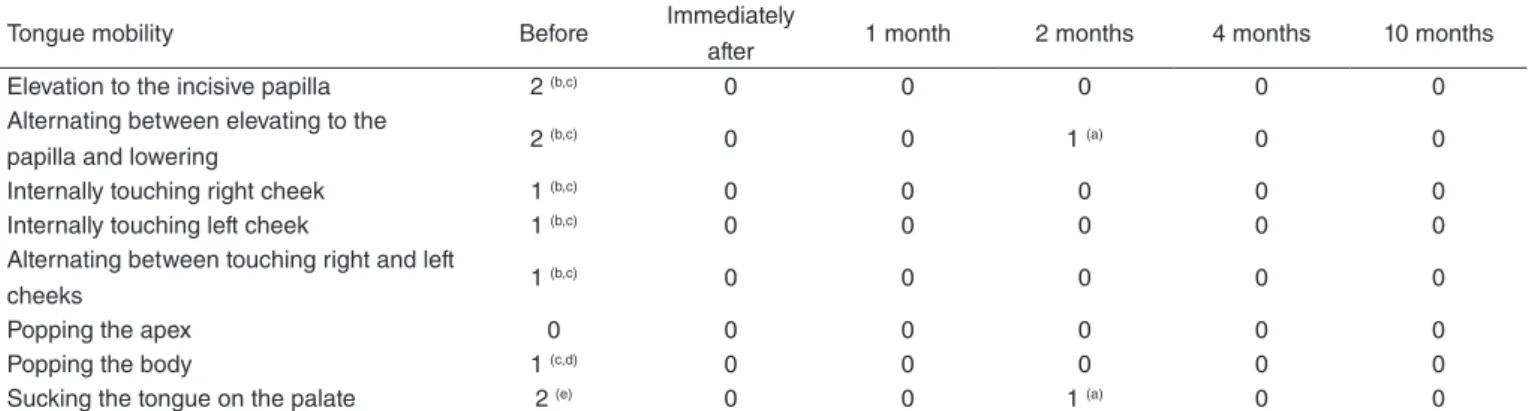
Regarding mobility and muscle tone, we observed evolu-tion after the therapeutic process, as well as the maintenance
of these aspects. However, in the reevaluation 2 months after discharge, results observed were similar to previous ones except for two tongue movements. Even with the patient’s report of continuing satisfaction with the results (to be sleeping bet-ter, with fewer episodes of nighttime waking, and waking up rested), another exercise was added for improving the accuracy of tongue mobility (Table 1).
Regarding the mobility of the soft palate, in the assess-ment before therapy, the score observed in the moveassess-ments of “uttering [a] repeatedly” and “yawning” was 1; in the “volun-tary elevation movement” and “maintaining the lifting move-ment”, the score was 2. For the four movements, in the period immediately after therapy, and 1, 2, 4, and 10 months after dis-charge, the score was 0.
In the evaluation of muscle tone, a score of 1 (decreased) was obtained for the tongue, loor of the mouth and soft palate in the assessment carried out prior to therapy. The score was 0 for muscle tone of the tongue, loor of the mouth, and soft pal-ate immedipal-ately after therapy, as well as 1, 2, 4, and 10 months after discharge.
In the initial clinical assessment, the Mallampati grade was IV, showing slight improvement in subsequent assessments to grade III (Table 2).
Regarding the measured anthropometric data, there was a reduction of 2 cm in neck circumference, and BMI remained similar during the evaluations, indicating that the patient’ weight was appropriate to his height (Table 2).
Quality of Sleep Parameters
The results of the Epworth sleepiness scale, the Questionnaire of Berlin, and the visual analog scale showed improvement in the three parameters, as shown in Table 3.
Table 1. Tongue mobility results in evaluations before the therapy sessions; immediately after discharge; and 1, 2, 4, and 10 months after discharge
Tongue mobility Before Immediately
after 1 month 2 months 4 months 10 months
Elevation to the incisive papilla 2 (b,c) 0 0 0 0 0
Alternating between elevating to the
papilla and lowering 2
(b,c) 0 0 1 (a) 0 0
Internally touching right cheek 1 (b,c) 0 0 0 0 0
Internally touching left cheek 1 (b,c) 0 0 0 0 0
Alternating between touching right and left
cheeks 1
(b,c) 0 0 0 0 0
Popping the apex 0 0 0 0 0 0
Popping the body 1 (c,d) 0 0 0 0 0
Sucking the tongue on the palate 2 (e) 0 0 1 (a) 0 0
(a) slight tremor; (b) moderate tremor; (c) contraction of neck muscles; (d) instability in the movement execution; (e) inability to contain the entire tongue against the palate.
Table 2. Results of the Mallampati classification, the measurement of neck circumference, and body mass index calculation in the evaluations
before and after therapy sessions; immediately after discharge; and 1, 2, 4, and 10 months after discharge
Mallampati classification and
anthropometric data Before
Immediately
after 1 month 2 months 4 months 10 months
Malampati grade (I to IV) IV III III III III III
Neck circumference (cm) 39 37 37 37 37 37
BMI (kg/m²) 22.3 22.3 22.0 22.3 22.6 22.9
Worst sleep
Best possible sleep
Table 3. Results of the Epworth Sleepiness Scale, Berlin Questionnaire and visual analog scale in the evaluations before the therapy sessions; immediately after discharge; and 1, 2, 4, and 10 months after discharge
Quality of sleep parameters Before Immediately
after 1 month 2 months 4 months 10 months
Epworth sleepiness scale (points) 13 12 9 13 15 10
Berlin Questionnaire
(Positive categories) 3 2 1 1 1 1
Visual analog scale (cm) 4.8 6.7 7.0 7.8 6.0 7.9
In addition to the indings of the evaluations, the patient reported during treatment that he felt a signiicant improvement in sleep quality, waking at most three times a night and having noticed to be more rested during the day. It is noteworthy that, in the lon-gitudinal follow-up, the patient reported the maintenance of the beneits, with no improvement or worsening of the symptoms.
During the therapeutic process, the speech-language pathologist worked closely with the cardiologist, due to patient’s high blood pressure condition, and with an otorhinolaryngologist (specialized in sleep medicine), who performed the diagnosis and indicated dental treatment. There were no changes in the medical reevalua-tions, including in the results of the polysomnography examination. The conduct for the case was keeping on with three exer-cises for the tongue, suprahyoid muscles, and soft palate once a day for the maintenance of conditions obtained during sleep.
DISCUSSION
The publication of case studies involving sleep disorders brings the experience of the practice of orofacial myofunctional treat-ment, which still needs to be understood, so that the performance of speech-language pathology and audiology can be emphasized.
In this study, we opted for the application of the Orofacial Myofunctional MBGR evaluation protocol(6), due to it allow-ing the classiication of aspects in scores, and because it cov-ers all myofunctional orofacial structures and functions. Even so, it was necessary to add items to evaluate the mobility of the soft palate, which expressed the need for development or adaptation of guiding protocols for these patients.
The therapy was structured based on what was proposed by Guimaraes, by following the strategies and amount of exercises, but was adapted according to the patient’s response. In a critical review of the literature, there was a shortage of in-depth studies on the effects of orofacial myofunctional exercises on the mus-cles on an individual basis, without scientiic evidence to support the frequency and amount for the implementation of these(10).
Improved mobility and tone of the orofacial and pharyngeal muscles after orofacial myofunctional therapy, in this case, is in accordance with the results obtained in patients with OSAS(4).
Speciically regarding the muscle tone, in addition to observ-ing improvement after 12 therapy sessions, the maintenance of its results was also observed up to 10 months after discharge. This concern stems from the indings that lingual force can reduce within 2–4 weeks after cessation of orofacial myofunc-tional exercises(11). It is emphasized that the exercises were not suspended at discharge, but reduced in quantity and frequency.
This study resulted in a little variation in the modiied Mallampati grade, though this assessment should be considered in future
studies because of its correlation with the severity of obstructive sleep apnea, and thus the Mallampati grade is a possible predictor of obstruction in upper airways(7,12), as well as its correlation with the ability to raise, lower, and lateralize the tongue(13).
The association of BMI with the worsening of the level of upper airway obstruction(12) is a factor that can affect the results of orofacial myofunctional therapy, which did not occur in the case of this patient because his BMI was within the normal parameters during the whole process.
For patients with UARS, there is no deinition of gold standard treatment(14), which implies the need to track sleep quality param-eters, checking the effectiveness of the treatment adopted. Thus, the use of three measurements of quality of sleep were adopted in all evaluations, two which were the Epworth sleepiness scale and the Berlin Questionnaire, standardized tools that are often applied in cases of sleep disorders. The third measurement, by means of a visual analog scale, showed increased sleep quality, as well as the two other instruments, and there was a study in which patients with mild-to-moderate OSAS and UARS responded to a visual analog scale before and after uvulopalatoplasty, but related to snoring(15), differing from the one used in this study, because the patient’s complaint was the frequent awakening.
Contact with the two specialists who have already been following the case was essential for the support of quantita-tive tests, ensuring that the subjecquantita-tive response of the patient’s positive report, together with evaluations carried out by the speech-language pathologist, agreed with the patient’s overall health and well-being.
Evidence of the beneicial role of speech-language ther-apy in cases of UARS requires further research with a larger sample and with the use of quantitative assessment methods, enabling their correlation with qualitative parameters such as the patient’s report. This study had the participation of only one patient, limiting the level of evidence, but the patient showed high compliance to the treatment. Further studies with larger samples are suggested, adopting the control of exercises applied and longitudinal assessments.
CONCLUSION
The effect of orofacial myofunctional therapy has shown to be effective in a case of UARS due to improved orofacial mobility and tone, decreased Mallampati grade and neck circumference, and increased sleep quality after the thera-peutic process.
REFERENCES
1. Bower C, Buckmiller L. What´s new in pediatric obstructive sleep apnea. Curr Opin Otolaryngol Head Neck Surg. 2001;9(6):352-8.
2. Singhal P. Upper airway resistance syndrome (uars) – simple snoring or mild obstructive sleep apnea. J Assoc Physicians India. 2010;58:413. 3. Gupta RK, Chandra A, Verm AK, Kumar S. Obstructive sleep apnea: a
clinical review. J Assoc Physician India. 2010;58:438-41.
4. Guimarães KC, Drager LF, Genta PR, Marcondes BF, Lorenzi-Filho G. Effects of oropharyngeal exercises on patients with moderate obstructive sleep apnea syndrome. Am J Respir Crit Care Med. 2009;179(10):962-6. 5. Hochman B, Nahas FX, Oliveira Filho RS, Ferreira LM. Desenhos de
pesquisa. Acta Cir Bras. 2005;20(suppl.2):2-9.
6. Genaro KF, Berretin-Felix G, Rehder MIBC, Marchesan IQ. Avaliação miofuncional orofacial: protocolo MBGR. Rev CEFAC. 2009;11(2):237-55. 7. Friedman M, Vidyasagar R, Bliznikas D, Joseph N. Does Severity
of Obstructive Sleep Apnea-Hipopnea syndrome predict Uvulopalatopharyngoplasty outcome? Laryngoscope. 2005;115(12):2109-13. 8. Vaz AP, Drummond M, Mota PC, Severo M, Almeida J, Winck JC. Tradução
do Questionário de Berlim para língua Portuguesa e sua aplicação na
identiicação da SAOS numa consulta de patologia respiratória do sono. Rev Port Pneumol. 2011;17(2):59-65.
9. Bertolazi NA, Fagondes SC, Hoff LS, Pedro VD, Barreto SSM, Johns MW. Validação da escala de sonolência de Epworth em português para uso no Brasil. J. bras. pneumol. 2009;35(9):877-883.
10. Ferreira TS, Mangilli LD, Sassi FC, Fortunato-Tavares T, Limongi SCO, Andrade CRF. Fisiologia do exercício fonoaudiológico: uma revisão crítica da literatura. J. Soc. Bras. Fonoaudiol. 2011;23(3):288-96.
11. Clark HM, O´Brien K, Calleja A, Corrie SN. Effects of directional exercise on lingual strenght. J Speech Lang Hear Res. 2009;52(4):1034-47. 12. Karakoc O, Akcam T, Gerek M, Genc H, Ozgen F. The upper airway
evaluation of habitual snorers and obstructive sleep apnea patients. ORL J Otorhinolaryngol Relat Spec. 2012;74(3):136-40.
13. Colak A, Yilmaz A, Sut N, Memis D, Ulucam E, Cigali BS et al. Investigation of the availability of tongue movements in Mallampati classiication. Saudi Med J. 2011;32(6):607-11.
14. Pépin JL, Guillot M, Tamisier R, Lévy P. The upper airway resistance syndrome. respiration. 2012;83(6):559-66.