Verbal and visuospatial executive
functions in healthy elderly
The impact of education and frequency
of reading and writing
Laura Damiani Branco1, Charles Cotrena1, Natalie Pereira1, Renata Kochhann1, Rochele Paz Fonseca1
ABSTRACT. Objective: To assess the predictive role of education and frequency of reading and writing habits (FRWH) on the cognitive flexibility, inhibition and planning abilities of healthy elderly individuals. Methods: Fifty-seven healthy adults aged between 60 and 75 years with 2 to 23 years of formal education were assessed as to the frequency with which they read and wrote different types of text, as well as their number of years of formal education. Executive functions were evaluated using the Hayling Test and the Modified Wisconsin Card Sorting Test (MWCST). Results: Weak to moderate positive correlations were found between education, FRWH and the number of categories completed in the MWCST, while negative correlations were identified between these variables and the number of perseverative and non-perseverative errors on the task. Only the FRWH was significantly correlated with the number of failures to maintain set. Speed and accuracy on the Hayling Test were only correlated with participant education. Both education and FRWH significantly predicted performance on the MWCST, and the combination of these two variables had a greater predictive impact on performance on this task than either of the two variables alone. Variability in scores on the Hayling Test was best accounted for by participant education. Conclusion: In this sample of elderly subjects, cognitive flexibility was sufficiently preserved to allow for adequate performance on verbal tasks, but may have benefitted from the additional stimulation provided by regular reading and writing habits and by formal education in the performance of more complex non-verbal tasks.
Key words: aging, education, reading, writing, executive function.
FUNÇÕES EXECUTIVAS VISUOESPACIAIS E VERBAIS EM IDOSOS: IMPACTO DA ESCOLARIDADE E DA FREQUÊNCIA DE HÁBITOS DE LEITURA E DE ESCRITA
RESUMO. Objetivo: Avaliar o papel preditivo da educação e da frequência de hábitos de leitura e de escrita (FHLE) na flexibilidade cognitiva e planejamento de idosos saudáveis. Métodos: Cinquenta e sete adultos saudáveis com idade entre 60 e 75 anos e de 2 a 23 anos de escolaridade foram avaliados quanto à frequência com que liam e escreviam diferentes tipos de texto, assim como seu número de anos de educação formal. Ainda, suas funções executivas foram examinadas pelos Testes Hayling e Wisconsin de Classificação de Cartas Modificado (MWCST). Resultados: Correlações positivas de fracas a moderadas foram encontradas entre a educação, a FHLE e o número de categorias completadas no MWCST. Ainda, estas variáveis correlacionaram-se negativamente com o número de erros perseverativos e não perseverativos na tarefa. Somente a FRWH correlacionou-se com o número de rupturas no MWCST. O tempo e acurácia no Teste Hayling correlacionaram-se apenas com a educação de participantes. Tanto a educação quanto a FHLE foram preditores significativos do desempenho no MWCST, e a combinação destas duas variáveis teve maior impacto no desempenho da tarefa do que qualquer uma delas isoladamente. A variabilidade no desempenho no teste Hayling foi melhor explicada pela educação dos idosos. Conclusão: Nesta amostra de indivíduos idosos, a flexibilidade cognitiva esteve suficientemente preservada para permitir um desempenho adequado em tarefas verbais. No entanto, pode ter se beneficiado do estímulo adicional fornecido por hábitos de leitura e escrita regulares e por maior quantidade de anos de estudo formal em demandas não-verbais mais complexas. Palavras-chave: envelhecimento, educação, leitura, redação, função executiva.
1Graduate Psychology Program - Department of Psychology - Pontifical Catholic University of Rio Grande do Sul - PUCRS. Porto Alegre, RS – Brazil. Renata Kochhann. Av. Ipiranga, 6681 / Prédio 11 / 9º andar / sala 932 – 90619-900 Porto Alegre RS – Brazil. E-mail: [email protected] Disclosure: The authors report no conflicts of interest.
INTRODUCTION
T
he role of individual and sociocultural factors in cog-nition has been a major focus of study in neuropsy-chology,1,2 as has the inluence of aging on cognition.3-5Most neuropsychological investigations of the impact of sociodemographic factors on cognitive ability have fo-cused on the role of education,6 socioeconomic status,7
sex/gender,8 and, in more recent studies, of the
frequen-cy of reading and writing in cognitive performance.9,10
Education, usually deined as the number of years of formal study completed, has proved to be an important determinant of neuropsychological performance.11-15
Higher educational achievement has been associated with a greater neuronal reserve, as well as an increased number of synapses and improved cerebral vasculariza-tion, all of which have also been found to contribute signiicantly to cognitive recovery from several types of acquired brain injury.16 Studies have also suggested
that higher education levels may lead to better cogni-tive performance as well as better cognicogni-tive and brain reserve,17,18 while lower educational attainment may be
associated with neuropsychological test patterns similar to those observed in cases of neurological impairment.19
Lastly, studies have also found that sociodemographic factors, such as education, may interact with age to pro-vide a protective efect against cognitive aging.13
Recently, reading and writing habits have also been found to exert an impact on neurocognitive perfor-mance. he quality of what is read and written by par-ticipants, their reading proiciency,20 as well as the
fre-quency with which individuals engage in reading and writing9,10 may all have an inluence on cognitive
abil-ity. In fact, some authors claim that reading and writ-ing habits may contribute more signiicantly than the number of years of formal education to neurocognitive performance.21 In light of these indings, it has been
suggested that the frequency of reading and writing habits (FRWH) may enhance the efects of education on cognition,9 especially in individuals with higher
edu-cational levels.10 However, most studies on the
associa-tion between educaassocia-tion, FRWH and cogniassocia-tion have fo-cused on general intellectual ability rather than speciic cognitive components. Furthermore, the literature on cognitive reserve tends to be biased toward the study of dementia, and therefore, focuses predominantly on memory and IQ rather than other cognitive functions.18
Given their complexity, relevance to activities of dai-ly living and close interaction with most cognitive com-ponents, the executive functions (EF) are among the most extensively studied cognitive functions in the cur-rent cognitive and clinical neuropsychological literature.
he EF consist of goal-oriented cognitive functions such as problem solving, planning, resistance to distraction, cognitive lexibility, initiation and inhibition.22 hese
are multimodal and multifactorial abilities involved in the processing of both verbal23,24 and visuospatial
stim-uli,25 although their role in the latter has been far more
widely explored than in the former.
he involvement of EF in verbal processing has tra-ditionally been studied through tasks requiring lexical-semantic processing, such as verbal luency and the Hayling Test.26,27 Performance on the Hayling Test relies
heavily on inhibitory control, cognitive lexibility, and verbal processing, both for the generation of context-appropriate responses (in part A of the task) as well as for the suppression of semantically primed words (in part B of the task). his task has been successfully used in the assessment of several neurological populations, and has produced especially interesting results when used in combination with tests involving diferent input and output modalities, such as the Wisconsin Card Sort-ing Test. his and other related tasks, such as the Modi-ied Wisconsin Card Sorting Test (MWCST),28 rely more
heavily on the use of visuospatial planning, behavioral inhibition and rule maintenance.
Card sorting tests have been widely used to assess executive components such as cognitive lexibility, plan-ning and categorization. Successful performance on these tasks requires the involvement of several cogni-tive processes such as working memory, processing speed and set-shifting.29,30 Additionally, like other
non-verbal tasks, card sorting tests involve the mental simu-lation of outcomes. his process is closely related to EF in that it requires the selection of a speciic stimulus, the inhibition of surrounding distractors and inappropriate responses, as well as the ability to shift between possible cognitive strategies.30,31
Studies of the association between EF and indi-vidual and sociocultural variables have found that the inhibition of prepotent responses30 is strongly
inlu-enced by age.32 Age-related inhibition impairment has
been found to inluence several other cognitive abilities, such as attention, learning33 and memory.34 Inhibitory
control also appears to be impacted by education level.26
However, no studies have assessed the inluence of the FRWH on inhibitory control using tasks such as the Hayling Test.
In addition to inhibitory control, another key execu-tive component discussed in the literature consists of set-shifting.30 his EF is intimately related to cognitive
inefective behaviors in favor of more adaptive ones.35
Like inhibitory control, cognitive lexibility has also been found to be positively correlated with education by several studies investigating the association between sociocultural variables and executive performance.36
he occurrence of age-related executive decline has been well documented in the literature;37 however, the
inluence of the FRWH and its association with that of education has only been scarcely studied. One investi-gation found that older individuals with higher educa-tional attainment and reading levels as well as better vocabulary make more eicient use of their neural re-sources than those with lower educational and reading levels, and poorer vocabulary.38 he authors also found
that these variables were associated with performance on measures of EF. A second study has also found that higher reading levels were associated with improved executive performance.39 Lastly, a third study assessed
the relationship between cognitive functioning and the FWRH and found that a higher frequency of reading and writing combined with higher educational levels were associated with improved executive functioning.10
However, it is important to note that each of the afore-mentioned studies focused on diferent executive com-ponents, such that the indings precluded identiication of which speciic components are more inluenced by the FRWH.
Although a large number of studies have focused on the assessment of EF, few investigations have assessed the impact of sociocultural factors other than educa-tion on these cognitive abilities. his is especially true for the FRWH, which has only been scarcely studied in the current literature. herefore, the goal of the present study was to assess the predictive role of sociocultural variables, such as education and the FRWH, on the cog-nitive lexibility, initiation, inhibition, processing speed and planning abilities of healthy elderly individuals, as assessed by the MWCST and the Hayling Test.
METHOD
Sample. Fifty-seven healthy adults (n=46; 80.7% fe-males) aged between 60 and 75 years and with 2 to 23 years of formal education were included in the sample. Participants were recruited by convenience from com-munity, workplace and university settings. Only Brazil-ian-born and native speakers of Brazilian Portuguese, with no uncorrected sensory deicits or any signs of dementia according to the Mini-Mental State Examina-tion,40,41 were included in the study. Participants with
a current or prior history of alcohol-related problems, illicit drug or benzodiazepine use were excluded from
the sample. he sociodemographic data of the sample is given in Table 1.
Material and method. Participants took part in individual assessment sessions lasting approximately 45 minutes each. he present study was approved by the Research Ethics Committee of the institution at which it was con-ducted, and all participants provided written consent prior to enrollment in the study. he following instru-ments were used for data collection:
Sociodemographic and health questionnaire43 – his is a
self-report instrument used to collect data on variables such as gender, age, years of formal education, socioeco-nomic status and FRWH, as well as clinical conditions which may inluence performance on cognitive tasks, and would, therefore, imply participant exclusion (e.g. neurological and psychiatric conditions, visual or hear-ing impairment, alcohol-related problems and use of psychoactive drugs). he questionnaire includes the CAGE scale, which screens for symptoms of alcohol de-pendence (version adapted by Amaral & Malbergier,44
a reading and writing inventory, which inquires as to the frequency with which individuals read newspapers, magazines, books or other types of reading material, and write essays, notes or other types of text. Each ac-tivity is assigned a score from 0 to 4, where higher scores are indicative of higher frequencies. Item scores are summed for a total ranging from 0 to 28.
Modiied Wisconsin Card Sorting Task (MWCST)28 – he
task involves a deck of 48 cards on which geometric ig-ures varying in number, shape and color are printed. Participants must match the cards according to a par-ticular set of rules, which they must identify based on accuracy feedback following each response. he MWC-ST assesses planning, abstract reasoning, learning, rule maintenance, and cognitive lexibility. In the present study, the total number of categories completed, the
Table 1. Participant sociodemographic data.
Variables M SD
Age 66.37 3.90
Education (years) 10.46 5.89
FRWH 13.27 4.74
MMSE 26.54 2.83
SES 6.43 11.59
number of perseverative and non-perseverative errors, as well as failures to maintain set were analyzed.
Hayling Test27 – Adapted to Brazilian Portuguese by
Fonseca, Oliveira, Gindri, Zimmermann & Reppold.45
his is a two-part assessment instrument, consisting of two sets of 15 sentences in which the last word is omit-ted. he participant is asked to complete each sentence as quickly as possible with a word that logically its the sentence (Part A) or with a word which is semantically unrelated to the sentence (Part B). Cognitive functions assessed by this instrument include processing speed, initiation, inhibitory control and cognitive lexibility. In the present study, the latency of responses to the stimu-li in Parts A and B of the test, the number of correct and incorrect responses, as well as the diference between the time taken to complete each part of the test were analyzed.
Data analysis. Data were analyzed using the SPSS soft-ware package, version 17.0. Kolmogorov-Smirnov tests were used to identify deviations from normal distribu-tions, and Pearson and Spearman coeicients were used to assess the relationship between parametric and non-parametric variables, respectively. hese results were used to construct a multiple linear regression model with neuropsychological performance as the dependent variable and education and FRWH as independent fac-tors. Results were considered signiicant at 5%.
RESULTS
Participant scores on the Hayling Test and MWCST are given in Table 2.
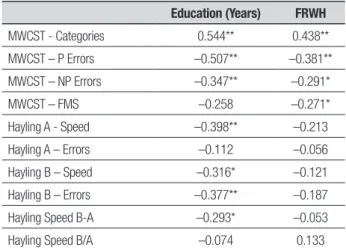
he results of correlations between performance on the two tasks and participants’ education and FRWH are shown in Table 3.
he results in Table 3 suggest that both the number of years of formal schooling completed by each partici-pant as well as their FRWH were weakly to moderately correlated with the number of categories completed on the MWCST, and inversely associated with the number of perseverative and non-perseverative errors on the task. Interestingly, only the FRWH was signiicantly correlated with the number of failures to maintain sets. Speed and accuracy on the Hayling Test were only cor-related with participant educational levels. Based on these results, a multiple linear regression model was constructed to assess the efects of education and the FRWH on scores in both of these tasks. he results of this analysis are shown in Table 4.
Education and FRWH accounted for 28.9% of the
Table 2. Participant scores on the Hayling Test and MWCST.
Variable M SD
MWCST Categories Completed(/6) 4.14 1.89
MWCST Perseverative errors 12.30 10.05
MWCST Non-perseverative errors 3.37 2.60
MWCST Failures to maintain set 0.56 0.80
Hayling Test Part A speed 19.12 6.48
Hayling Test Part A errors (/15) 0.54 0.93
Hayling Test Part B speed 61.16 29.61
Hayling Test Part B errors (/15) 6.96 3.47
Hayling Test Part B speed – Part A speed 41.90 26.59
Hayling Test Part B speed/ Part A speed 3.28 1.33
Table 3. Correlation coefficients between education, FRWR, and
perfor-mance on the Hayling Test and MWCST.
Education (Years) FRWH
MWCST - Categories 0.544** 0.438**
MWCST – P Errors –0.507** –0.381**
MWCST – NP Errors –0.347** –0.291*
MWCST – FMS –0.258 –0.271*
Hayling A - Speed –0.398** –0.213
Hayling A – Errors –0.112 –0.056
Hayling B – Speed –0.316* –0.121
Hayling B – Errors –0.377** –0.187
Hayling Speed B-A –0.293* –0.053
Hayling Speed B/A –0.074 0.133
FRWH: Frequency of reading and writing habits; MWCST: Modified Wisconsin Card Sorting Task; MWCST-FMS: Modified Wisconsin Card Sorting Task – Failure to Maintain Set. *p<0.05; **p<0.01.
Table 4. Multiple linear regression model of performance on the Hayling Test and MWCST according to education and FRWH of healthy elderly subjects.
Variables B SE (B) b R2
MWCST Categories
Education 0.129 0.041 0.396 0.289**
FRWH 0.094 0.051 0.236
MWCST P Errors
Education –0.555 0.235 –0.318 0.198*
FRWH –0.441 0.286 –0.208
MWCST NP Errors
Education –0.108 0.063 –0.239 0.137*
FRWH –0.110 0.077 –0.201
MWCST FMS FRWH –0.030 0.023 –0.177 0.031
Hayling A Speed Education –0.421 0.137 –0.383 0.147*
Hayling B Speed Education –1.651 0.639 –0.331 0.110*
Hayling B Errors Education –0.203 0.075 –0.345 0.119*
Hayling Speed B-A Education –1.232 0.585 –0.275 0.076*
variability in the number of completed categories in the MWCST, 19.8% of the number of perseverative errors and 13.7% of the non-perseverative errors on the task. Interestingly, the combination of these two variables had a greater predictive impact on performance on this task than either of the two variables alone (data not shown). On the other hand, the variability in scores on the Hayling Test was best accounted for by participant education, which accounted for 14.7% of the speed and 11% of the accuracy in part A of the task, and 11.9% of the accuracy in part B of the instrument, as well as 7.6% of the discrepancy between the time taken to complete both parts of the test.
DISCUSSION
he aim of the present study was to assess the predic-tive impact of the sociocultural factors education and FRWH on the EF of healthy elderly. Cognitive lexibility and planning were assessed by the MWCST, a predomi-nantly visuospatial task, while initiation, inhibition, processing speed and cognitive lexibility were evaluat-ed using the Hayling Test, a two-part verbal assessment instrument. Although scores on both tasks appeared to be inluenced by the number of years of formal educa-tion and FRWH, the combinaeduca-tion of these two variables appeared to have a more signiicant impact on the EF underlying performance on the MWCST.
hese indings suggested that, while education had a more signiicant inluence on verbal initiation, in-hibition and cognitive lexibility, both education and the FRWH were found to inluence planning, working memory, short-term memory and cognitive lexibility, as assessed by a non-verbal instrument. As such, our hy-pothesis that the two sociocultural variables inluence performance on both tasks, but have a greater impact on Hayling Test scores due to the verbal nature of its stimuli, was only partially conirmed. Although both variables had some inluence on performance on the Hayling Test, only education was able to accurately pre-dict the variability in its scores. he relative linguistic simplicity of the Hayling Test may have accounted for these results, since sentence completion may be con-sidered an automatic language task for elderly individu-als. his hypothesis is supported by studies which show that, although some language abilities may decline with age,46 several cognitive-communicative processes
re-main stable over time.47 However, we believe that if a
discourse processing task had been used as an assess-ment tool for verbal EF, its increased complexity and the associated increase in cognitive demand (due to the need to access verbal language beyond the word level,
and verbal working memory overload) may have suf-fered a greater inluence from the FRWH.48
On the other hand, on the MWCST, the two vari-ables were found to have a greater predictive impact when analyzed in combination rather than individually. Previous studies involving the same neuropsychological instruments have found that both age and education inluenced performance on the tasks, with elderly in-dividuals performing worse than younger participants, and subjects with higher education levels obtaining su-perior scores than those with lower educational attain-ment.32,49 Other studies have also found correlations
be-tween performance on highly complex discourse tasks with signiicant executive demands and scores on the WCST, suggesting that, even though the latter is a non-verbal task, it relies on the same cognitive abilities un-derlying verbal tests.23
However, no studies have assessed the combined impact of education and the FRWH on performance in these tasks among elderly individuals. Furthermore, the few studies which have looked into the beneicial inlu-ence of reading habits on EF did not use the same as-sessment tasks as the present study, and assessed read-ing level based on proiciency tests rather than on the reported frequency of reading and writing.38,39 he only
study which has assessed reading and writing habits in the same way as the present investigation used difer-ent instrumdifer-ents to assess EF, namely, verbal luency and simple problem-solving tasks.10 hese limitations
pre-clude the comparison of the present indings with those of other investigations in the literature.
he FRWH is an ecological measure of cognitive stimulation and allows for an assessment of current intellectual activity, whereas education levels only indi-cate the duration of previous periods of continuous cog-nitive stimulation, which may have occurred long before participants are assessed as part of a neuropsychological study. Although the FRWH may not have an especially relevant impact on less complex verbal tasks, it may pre-dict performance on more complex or non-verbal tasks, as shown by the present indings. he Hayling Test, which predominantly involves sentence completion, is simpler for both discourse and verbal luency tasks, both of which rely more heavily on executive processes, and would therefore be more likely to be inluenced by the FRWH.
partici-pants may have beneitted from the additional stimu-lation provided by regular reading and writing habits. Although education still seems to be the most relevant sociocultural factor for EF in old age, the present ind-ings suggest that the FRWH must be taken into account in combination with the education variable when more complex cognitive functions are considered.
he present study provided preliminary evidence of the impact of sociocultural factors on EF in aging, highlighting the role of education in simpler tasks and the combined inluence of this variable and FRWH in more complex ones. he present indings must be inter-preted in light of some limitations, such as the inher-ent diiculties in assessing participant education, and
the problems associated with measuring the frequency and quality of reading and writing habits. However, in spite of these limitations, our indings showed that the importance of the quality of elderly individuals’ educa-tional background and of continuous cognitive stimula-tion through reading and writing after exposure to for-mal education must be further explored. Additionally, the interaction between these factors in both healthy elderly and clinical populations should be investigated in future studies.
Acknowledgements. he authors thank CAPES, FAPERGS, and PUCRS for the inancial support in the form of grants, scholarships and a post-doctoral fellowship (RK).
REFERENCES
1. Ardila R. The nature of psychology: the great dilemmas. Am Psychol 2007;62:904-912.
2. Sánchez JL, Torrellas C, Martín J, Barrera I. Study of sociodemographic variables linked to lifestyle and their possible influence on cognitive re-serve. J Clin Exp Neuropsychol. 2011;33:874-891.
3. Ska B, Joanette Y. Normal aging and cognition. Med Sci (Paris). 2006;22:284-287
4. Wasylyshyn C, Verhaeghen P, Sliwinski MJ. Aging and task switching: a meta-analysis. Psychol Aging. 2011;26:15-20.
5. Wong CEI, Cotrena C, Cardoso C, Fonseca RP. Memoria visual: relación con factores sociodemográficos. Rev Mex Neuropsicol 2010;5:10-18. 6. Peña-Casanova J, Gramunt-Fombuena N, Quiñones-Úbeda S, et
al. Spanish Multicenter Normative Studies (NEURONORMA Project): norms for the Rey-Osterrieth complex figure (copy and memory), and free and cued selective reminding test. Arch Clin Neuropsychol 2009;24:371-393.
7. Jang SN, Choi YJ, Kim DH. Association of socioeconomic status with successful ageing: differences in the components of successful ageing. J Biosoc Sci 2009;41:207-219.
8. Varnava A, Halligan PW. Influence of age and sex on line bisection: A study of normal performance with implications for visuospatial neglect. Neuropsychol Dev Cogn B Aging Neuropsychol Cogn 2007;14:571-585. 9. Jefferson AL, Gibbons LE, Rentz DM, et al. A life course model of cog-nitive activities, socioeconomic status, education, reading ability, and cognition. J Am Geriatr Soc 2011;59:1403-1411.
10. Pawlowski J, Remor E, Parente MAMP, de Salles JF, Fonseca RP, Ban-deira DR. The influence of reading and writing habits associated with education on the neuropsychological performance of Brazilian adults. Read Writ 2012;25:2275-2289.
11. Parente MAMP, Scherer LC, Zimmermann N, Fonseca RP. Evidências do papel da escolaridade na organização cerebral. Neuropsicol Lati-noam 2009;1:72-80.
12. Ardila A, Rosselli M. Illiterates and cognition: The impact of education. In: Uzzell BP, Ponton MO, Ardila A, editors. International handbook of cross-cultural neuropsychology. New Jersey: Lawrence Erlbaum Asso-ciates, Inc.; 2007:181-98.
13. Ardila A, Ostrosky-Solis F, Rosselli M, Gómez C. Age-related cognitive decline during normal aging: the complex effect of education. Arch Clin Neuropsychol 2000;15:495-513.
14. Byrd DA, Jacobs DM, Hilton HJ, Stern Y, Manly JJ. Sources of errors on visuoperceptual tasks: Role of education, literacy, and search strategy. Brain Cogn 2005;58:251-7.
15. Seo EH, Lee DY, Choo IH, et al. Performance on the Benton Visual Retention Test in an educationally diverse elderly population. J Gerontol Ser B Psychol Sci Soc Sci 2007;62:191-193.
16. Valenzuela MJ, Sachdev P. Brain reserve and dementia: a systematic review. Psychol Med 2006;36:441-454.
17. Cabeza R. Hemispheric asymmetry reduction in older adults: the {HAR-OLD} model. Psychol Aging 2002;17:85.
18. Stern Y. Cognitive Reserve. Neuropsychologia 2009;47:2015-2028. 19. Lezak MD, Howieson DB, Bigler ED, Tranel D. Neuropsychological
As-sessment. 5th ed. New York: Oxford University Press; 2012. 20. Gee GC, Walsemann KM, Takeuchi DT. English proficiency and
lan-guage preference: testing the equivalence of two measures. Am J Pub-lic Health 2010;100:563.
21. Dotson VM, Kitner-Triolo MH, Evans MK, Zonderman AB. Effects of race and socioeconomic status on the relative influence of education and literacy on cognitive functioning. J Int Neuropsychol Soc 2009; 15:580-589.
22. Chan RC, Shum D, Toulopoulou T, Chen EY. Assessment of execu-tive functions: Review of instruments and identification of critical issues. Arch Clin Neuropsychol 2008;23:201-216.
23. Matsuoka K, Kotani I, Yamasato M. Correct information unit analysis for determining the characteristics of narrative discourse in individuals with chronic traumatic brain injury. Brain Inj 2012;26:1723-1730.
24. Coelho CA, Grela B, Corso M, Gamble A, Feinn R. Microlinguistic defi-cits in the narrative discourse of adults with traumatic brain injury. Brain Inj 2005;19:1139-1145.
25. Head D, Kennedy KM, Rodrigue KM, Raz N. Age differences in per-severation: Cognitive and neuroanatomical mediators of performance on the Wisconsin Card Sorting Test. Neuropsychologia 2009;47:1200-1203.
26. Bielak AA, Mansueti L, Strauss E, Dixon RA. Performance on the Hay-ling and Brixton tests in older adults: norms and correlates. Arch Clin Neuropsychol 2006;21:141-149.
27. Burgess PW, Shallice T. The Hayling and Brixton Tests: Thames Valley Test Company Bury St. Edmonds, England. 1997.
28. Nelson HE. A modified card sorting test sensitive to frontal lobe defects. Cortex 1976;12:313-324.
29. Ashendorf L, McCaffrey RJ. Exploring age-related decline on the Wis-consin Card Sorting Test. Clin Neuropsychol 2008;22:262-272. 30. Miyake A, Friedman NP, Emerson MJ, Witzki AH, Howerter A, Wager TD.
The Unity and Diversity of Executive Functions and Their Contributions to Complex “‘ Frontal Lobe ’” Tasks: A Latent Variable Analysis. Cogn Psychol 2000;41:49-100.
31. Marton K. Visuo-spatial processing and executive functions in chil-dren with specific language impairment. Int J Lang Commun Disord 2008;43:181-200.
32. Borella E, Ghisletta P, De Ribaupierre A. Age differences in text pro-cessing: The role of working memory, inhibition, and processing speed. J Gerontol Ser B Psychol Sci Soc Sci 2011;66:311-320.
33. Persad CC, Abeles N, Zacks RT, Denburg NL. Inhibitory changes after age 60 and their relationship to measures of attention and memory. J Gerontol Ser B Psychol Sci Soc Sci 2002;57:P223-P232.
34. Anderson MC, Reinholz J, Kuhl BA, Mayr U. Intentional suppression of unwanted memories grows more difficult as we age. Psychol Aging 2011;26:397-405.
JK. Not all executive functions are related to intelligence. Psychol Sci 2006;17:172-179.
36. Tombaugh TN. Trail Making Test A and B: normative data stratified by age and education. Arch Clin Neuropsychol 2004;19:203-214. 37. Drag LL, Bieliauskas LA. Contemporary review 2009: cognitive aging. J
Geriatr Psychiatry Neurol 2010;23:75-93.
38. Steffener J, Barulli D, Habeck C, O’Shea D, Razlighi Q, Stern Y. The Role of Education and Verbal Abilities in Altering the Effect of Age-Re-lated Gray Matter Differences on Cognition. PLoS One 2014;9:e91196. 39. Soto-Añari M, Flores-Valdivia G, Fernández-Guinea S. Nivel de lectura
como medida de reserva cognitiva en adultos mayores. Rev Neurol 2013;56:79-85.
40. Chaves MLF, Izquierdo I. Differential diagnosis between dementia and depression: a study of efficiency increment. Acta Neurol Scand 1992; 85:378-82.
41. Kochhann R, Varela JS, Lisboa CSM, Chaves MLF. The Mini Mental State Examination Review of cutoff points adjusted for schooling in a large Southern Brazilian sample. Dement Neuropsychol 2010;4:35-41. 42. Associação Brasileira de Empresas de Pesquisa (ABEP). Critério de
classificação econômica Brasil/2008 [Internet]. 2008. Available from: http://www.abep.org/codigosguias/criterio_brasil_2008.pdf
43. Fonseca RP, Zimmermann N, Pawlowski J, Oliveira CR, Gindri G, Scherer LC, et al. Métodos em avaliação neuropsicológica: pressup-ostos gerais, neurocognitivos, neuropsicolingüísticos e psicométricos
no uso e desenvolvimento de instrumentos. In: Landeira-Fernandez J, Fukusima SS, editors. Métodos de pesquisa em neurociência clínica e experimental. São Paulo: Manole; 2012. p. 266-96.
44. Amaral RA, Malbergier A. Effectiveness of the {CAGE} questionnaire, gamma-glutamyltransferase and mean corpuscular volume of red blood cells as markers for alcohol-related problems in the workplace. Addict Behav 2008;33:772-781.
45. Fonseca RP, Oliveira C, Gindri G, Zimmermann N, Reppold C, Parente M. Teste Hayling: um instrumento de avaliação de componentes das funções executivas. Avaliação psicológica e neuropsicológica de crian-ças e adolescentes 2010:337-364.
46. Burke DM, MacKay DG, James LE. Theoretical approaches to language and aging. In: Perfect T, Maylor E, editors. Models of cognitive aging. Oxford: Oxford University Press; 2000:204-237.
47. Abrams L, Farrel MT. Language processing in normal aging. In: Guen-douzi J, Loncke F, Williams MJ, editors. The Handbook of Psycholin-guistic and Cognitive Processes: Perspectives in Communication disor-ders. New York: Psychology Press; 2011:603-624.
48. Fleming VB. Early Detection of Cognitive-Linguistic Change Associated With Mild Cognitive Impairment. Communication Disorders Quarterly 2014;35:146-157.