Frictional forces in stainless steel and plastic
brackets using four types of wire ligation*
Vanessa Nínia Correia Lima**, Maria Elisa Rodrigues Coimbra***, Carla D’Agostini Derech****, Antônio Carlos de Oliveira Ruellas*****
Objective: This in vitro study evaluated and compared the frictional resistance of stainless steel and polycarbonate (PC) composite brackets tied with metal wire and elastomeric ligation. Methods: Four stainless steel and four polycarbonate composite brackets for premolars were placed in a universal testing machine for the traction of a piece of 0.019 x 0.025-in wire at 0.5 mm/min and total displacement of 8 mm. Ligations were performed according to the fol-lowing alternatives: metal ligation with Steiner tying pliers; metal ligation using Mathieu tying pliers; Morelli™ elastomeric ligation; and TP Orthodontics™ elastomeric ligation. Results and Conclusions: Elastomeric modules generated more friction than the metal ligations, and the ligation with the Mathieu tying pliers caused less friction than all the other conditions under study. PC brackets generated less friction than metal brackets, but the choice of material to be used in clinical conditions should take into consideration other variables, such as resistance to shearing and to fractures, as well as color stability and microorganism adherence.
Abstract
Keywords: Friction. Orthodontic ligation. Metal bracket. Plastic bracket.
** DDS, Rio de Janeiro, Brazil.
*** Master in Orthodontics, UFRJ. PhD in Material Sciences, IME, Rio de Janeiro, Brazil.
**** PhD in Orthodontics, UFRJ. Professor, Graduate Course in Orthodontics, Universidade Federal de Santa Catarina (UFSC), Florianópolis, Brazil. ***** PhD, Professor, Department of Orthodontics, UFRJ, Rio de Janeiro, Brazil.
* Study conducted as a requisite of the Scientific Initiation Program of the Department of Orthodontics, School of Dentistry, Universidade do Brasil, Universidade Federal do Rio de Janeiro (UFRJ), Rio de Janeiro, Brazil.
INTRODUCTION
Orthodontics is based on the movements of teeth within the alveolar bone bed due to the forces applied. This process may be facilitated or complicated by the subsequent response of tissues and the appropriate and rational use of the mechanical resources available.8 Frictional forces pose clinical challenges: they should be understood and controlled because their in-crease may be an advantage when used for
an-chorage, but harmful because of their effects in sliding mechanics.12
The nature of friction in orthodontics de-pends on several factors and is determined by mechanical and biological factors:1,3,9
Physical/mechanical factors
• Type of ligation between wire and bracket: material and ligation, and type of instrument used.
• Properties of the bracket: material, surface treatment, manufacturing process, slot dimen-sions, number of wings.
• Orthodontic apparatus: interbrackets dis-tance, difference in height between brackets and force applied for retraction.
Biological and environmental factors
• Saliva, bacterial plaque, acquired film. • Corrosion.
In summary, the force generated depends pri-marily on the materials used in the system, their physical properties, their interactions with the environment and their application, including their ligation.
Esthetic brackets have been focused by the orthodontic material industry. Several materi-als have been tested: zirconium, porcelain and polycarbonate. They are currently produced with small changes in their structures, depend-ing on the manufacturer. Although clear brack-ets are more esthetic than metal brackbrack-ets, they have a series of disadvantages, such as the high
incidence of fracture and damage to the enamel during debonding in the case of porcelain, and lack of stability of color, little resistance to wear and failure in incorporating the torque forces in the case of plastic brackets.
However, esthetic brackets are part of our current practice, and their future in orthodontics seems clear. Therefore, this study evaluated their mechanical properties, particularly frictional forces, in association with the following vari-ables: type of bracket material (metal or poly-carbonate composite), type of ligation (metal or elastomeric) and instrument used (Mathieu or Steiner tying pliers).
MATERIAL AND METHODS
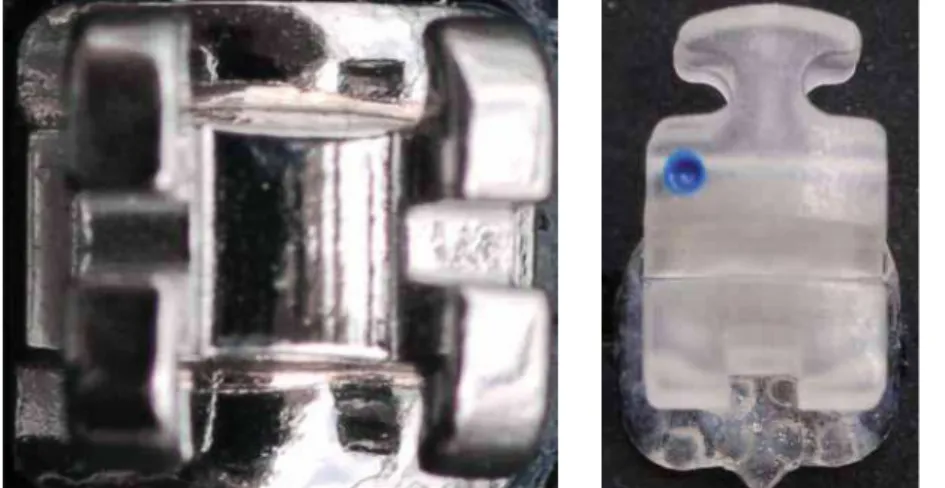
Eight twin brackets for premolars were used; four were made of stainless steel (Fig 1) and four, of polycarbonate composite (PC) reinforced with 30% glass fiber (Fig 2), whose slots mea-sured 0.022 x 0.030-in. The brackets were bond-ed with epoxy resin to a metal support and the set was placed in a universal testing machine for traction of the stainless steel wire segment with a rectangular section of 0.019 x 0.025-in, at 0.5 mm/min at a total of 8.0 mm displacement in dry medium (Fig 3).
FIGURE 1 - Metal bracket used in the study. FIGURE 2 - Polycarbonate com-posite (plastic) bracket used in the study.
According to information provided by manu-facturers, the polycarbonate composite brackets are injected parts with a density of 1.4 g/cm3 and typical hardness of 74 in the Shore scale; and conventional or unsintered metal brackets had a density of 7.4 to 7.9 g/cm3.
The instruments for ligation were the Steiner or the Mathieu tying pliers, which were used, for each experimental situation, by the same op-erator using a 0.010-in-thick stainless steel wire (10 loops). Elastic tying was simple, around the bracket wings, and performed with two types of elastomeric ligations: TP Orthodontics™ and Morelli™. The ligation was positioned using an adaptor for elastomeric ligations.
Fifteen repetitions were performed for each
TABLE 1 - Characteristics of the 8 sample groups.
GROUP Mean SD Minimum value Maximum value
PL Steiner 93.93 10.94 75.00 107.15
PL Mathieu 41.43 4.28 33.93 46.43
PL Morelli 95.72 11.84 82.15 108.93
PL TP 72.56 7.68 60.18 80.05
Met Steiner 125.34 22.49 104.80 167.28
Met Mathieu 46.85 4.30 39.81 52.29
Met Morelli 177.52 17.18 149.77 199.98
Met TP 254.63 24.51 215.19 283.77
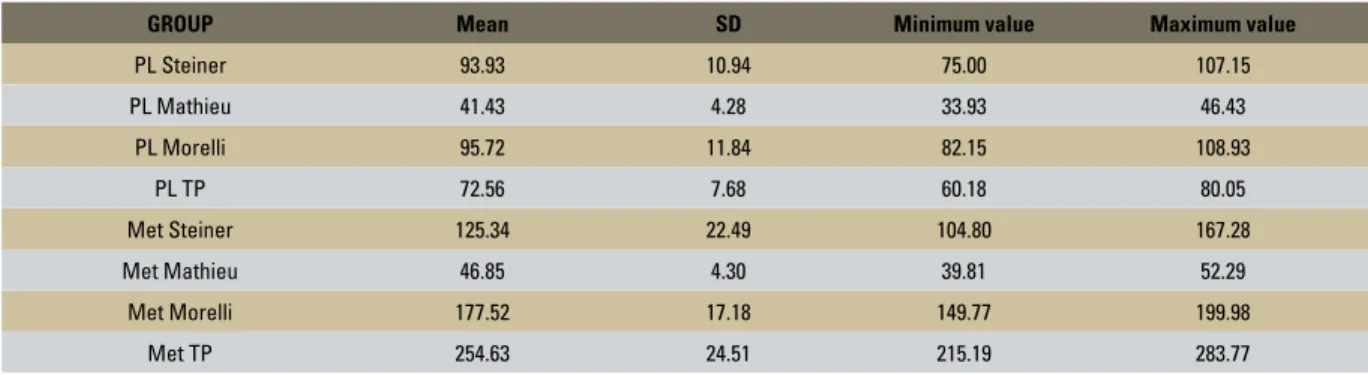
TABLE 2 - Descriptive statistics: means, standard deviations (SD), minimum and maximum values of friction generated in gram-force in the various condi-tions analyzed (n = 15).
of the 8 conditions or groups (Table 1).
Results were described as mean, standard deviation, minimum and maximum values. Analysis of variance (ANOVA) was used to as-sess the significance of statistical differences between groups, and the Tukey test was used for multiple comparisons between pairs at a 95% confidence interval (p < 0.05). The pairs studied were: PL Steiner x PL Mathieu; PL Mo-relli x PL Steiner; Met Steiner x Met Mathieu; Met Morelli x Met TP; PL Steiner x Met Stein-er; PL Mathieu x Met Mathieu; PL Morelli x Met Morelli; PL TP x Met TP.
RESULTS
Table 2 describes mean frictional forces (gf) generated during the mechanical trial in the 8 conditions studied, as well as their standard de-viations and minimum and maximum values.
The analysis of variance (ANOVA) revealed statistically significant differences between means in the 8 groups (p < 0.05). Similarly, when the variable bracket type was kept con-stant and the type of tying was changed, a statis-tically significant difference was also found, both for the metal and the plastic brackets (p < 0.05). The Tukey test revealed that all the pairs un-der evaluation had statistically significant differ-ences (p < 0.05) in frictional forces generated, except the PL Mathieu x Met Mathieu pair, whose results were statistically similar.
GROUP Bracket Tying
PL Steiner plastic metal with Steiner pliers
PL Mathieu plastic metal with Mathieu pliers
PL Morelli plastic Morelli elastomeric ligation
PL TP plastic TP elastomeric ligation
Met Steiner metal metal with Steiner pliers
Met Mathieu metal metal with Mathieu pliers
Met Morelli metal Morelli elastomeric ligation
DISCUSSION
There was great variation in the genera-tion of fricgenera-tional forces (41.43 gf to 254.63 gf), and the greatest variation was found when the metal bracket and wire were tied using the TP Orthodontics elastomeric ligation, and the lowest, for the plastic bracket, metal wire and Mathieu pliers.
In general, frictional forces generated in the groups of metal brackets were greater than the ones for the plastic brackets and metal ligation. The groups in which Mathieu pliers were used had the lowest friction, with either a plastic or a metal bracket.
The sequence of groups in growing order of friction generated was: PL Mathieu, Met Ma-thieu, PL TP, PL Steiner, PL Morelli, Met Stein-er, Met Morelli, Met TP.
Graph 1 shows that metal brackets gener-ated greater friction than plastic brackets in this study. Previous studies showed that sur-face irregularity of polycarbonate brackets is significantly lower than that of other esthetic materials, such as porcelain.14 However, when compared with metal (stainless steel) brack-ets, findings in the literature have shown that
plastic brackets generate greater friction dur-ing sliddur-ing, probably due to their deformation when tied.11,13 It may be inferred that, in our tests, there was not enough deformation of plastic brackets to increase friction between brackets and the metal wire.
Although plastic brackets generated less friction than the metal brackets, the choice of material to be used in clinical settings should take into consideration other variables, such as the resistance to shearing, fracture, and defor-mation, as well as color stability and microor-ganism adherence.
Ligations may range from 50 to 300 gf and the elastomeric modules generate about 225 gf with gradual decrease due to relaxation.9 In this study, elastic ligation tended to generate more friction than the metal ligation, in agree-ment with findings by Berdnar, Gruendeman and Sandrik,2 in 1991. However, Omana, Moore and Bagby,10 in 1992, opportunely added that, although theses procedure generated less resis-tance, it is difficult to standardize the force em-ployed.10 It is important to keep in mind that lubricated elastomeric ligations generate less friction than the ones that are not lubricated, as used in this study.4,7
The Mathieu pliers, as a tying instrument, produced less friction than the Steiner pli-ers when used with metal or plastic brackets, which was already expected, because light metal tying produces less friction than when adjusted.7,9
Classically, the standard surface of sliding mechanics is metal, particularly stainless steel. However, other orthodontic materials have satisfactory results, or better than in previous trials, particularly when using plastic brackets, which, in this study, had a better frictional re-sult than metal brackets. However, as materials are modified or replaced, the constant investi-gation of friction generated by new and update materials is fundamentally important.5,6
GRAPH 1 - Box graph of friction force (gf) in the eight situations under analysis.
PL
Steiner 400
300
200
100
0
n = 15 15 15 15 15 15 15 15
PL
Mathieu PL
Morelli PL
TP Met
Steiner Met
Mathieu Met
Morelli Met
CONCLUSIONS
1. Frictional forces varied considerably be-tween the eight conditions under study; such variation is positive because it provides several options in orthodontic mechanics and more or less friction according to the needs for each case.
2. Plastic brackets generated less friction than metal brackets.
3. Elastomeric materials generated more fric-tion than metal ligafric-tions, and the ligafric-tion with the Mathieu tying pliers caused less friction than all the other conditions under study.
Contact address Carla D’Agostini Derech Av. Rio Branco, 333/306 – Centro CEP: 88.015 201 – Florianópolis, Brazil E-mail: [email protected] 1. Bággio PE, Telles CS, Domiciano JB. Avaliação do atrito
pro-duzido por braquetes cerâmicos e de aço inoxidável, quando combinados com fios de aço inoxidável. Rev Dental Press Ortodon Ortop Facial. 2007 jan-fev;12(1):67-77.
2. Bednar JR, Gruendeman GW, Sandrik JL. A comparative study of frictional forces between orthodontic brackets and arch wires. Am J Orthod Dentofacial Orthop. 1991 Dec;100(6):513-22.
3. Braga CP, Vanzin GD, Marchioro EM, Beck JC. Avaliação do coeficiente de atrito de braquetes metálicos e estéticos com fios de aço inoxidável e beta-titânio. Rev Dental Press Ortodon Ortop Facial. 2004 nov-dez;9(6):70-83.
4. Chimenti C, Franchi L, Di Giuseppe MG, Lucci M. Friction of orthodontic elastomeric ligatures with different dimensions. Angle Orthod. 2005;75(3): 377-81.
5. Eliades T. Orthodontic materials research and applications: Part 2. Current status and projected future developments in materi-als and biocompatibility. Am J Orthod Dentofacial Orthop. 2007 Feb;131(2):253-62.
6. Faltermeier A, Rosentritt M, Reicheneder C. Experimental composite brackets: Influence of filler level on the me-chanical properties. Am J Orthod Dentofacial Orthop. 2006 Dec;130(6):699.e9-14.
REFERENCES
7. Hain M, Dhopatkar A, Rock P. The effect of ligation method on friction in sliding mechanics. Am J Orthod Dentofacial Orthop. 2003 Apr;123(4):416-22.
8. Mostafa Y, Weaks-Dybvig M, Osdoby P. Orchestration of tooth movement. Am J Orthod. 1983 Mar;83(3):245-50.
9. Nanda R, Ghosh J. Biomechanical considerations in sliding mechanics. In: Nanda R. Biomechanics in Clinical Orthodontics. Philadelphia: WB Saunders; 1997. p. 188-217.
10. Omana HM, Moore RN, Bagby MD. Frictional proper-ties of metal and ceramic brackets. J Clin Orthod. 1992 Jul;26(7):425-32.
11. Riley JL, Garrett SG, Moon PC. Frictional forces of ligated plastic and metal edgewise brackets [abstract]. J Dent Res. 1979;8:98.
12. Rossouw PE. Friction: an overview. Semin Orthod. 2003 Dec; 9(4):218-22.
13. Tselepis M, Brockhurst P, West VC. The dynamic frictional resistance between orthodontic brackets and arch wires. Am J Orthod Dentofacial Orthop. 1994 Aug;106(2):131-8. 14. Zinelis S, Theodore E. Comparative assessment of the
rough-ness, hardrough-ness, and wear resistance of aesthetic bracket materials. Dental Mater. 2005;21:890-4.