Cop
yright
© ABE&M t
odos os dir
eit
os r
eser
vados
.
Arq Bras Endocrinol Metab. 2010;54/6 546
original article
Biochemical acromegaly in patients
with prolactinoma during treatment
with dopaminergic agonists
Acromegalia bioquímica em pacientes com prolactinoma em tratamento com agonistas dopaminérgicos
Pedro W. Rosário1,2, Saulo Purisch2
ABSTRACT
Objective: To evaluate the frequency of subclinical acromegaly (in the absence of clinical phe-notype but biochemically uncontrolled) in patients with prolactinoma during treatment with dopaminergic agonists. Subjects and methods: One hundred twenty one patients without a phenotype suggestive of acromegaly were studied. Results: Initially, the laboratory diagnosis of acromegaly was unequivocal (elevated IGF-1 for gender and age with nadir GH > 1 µg/L) in two patients, and likely (elevated IGF-1 with nadir GH > cut-off but < 1 µg/L) in another patient. In two other patients, this diagnosis was possible (normal IGF-1 with nadir GH > 1 µg/L). Repetition of the tests 6 months after withdrawal of the dopaminergic agonist conirmed the diagnosis of subclinical acromegaly (elevated IGF-1 for gender and age with nadir GH > 1 µg/L) in these 5 patients. False-positive results were excluded in all cases. Conclusion: In patients with prolac-tinomas, acromegaly should be investigated not only in cases with a clinical phenotype. Arq Bras Endocrinol Metab. 2010;54(6):546-9
Keywords
Acromegaly; prolactinoma; growth hormone; IGF-1
RESUMO
Objetivo: Avaliar a frequência de acromegalia subclínica (na ausência de fenótipo clínico, mas bioquimicamente não controlada) em pacientes com prolactinoma em tratamento com agonis-tas dopaminérgicos. Sujeitos e métodos: Cento e vinte e um pacientes sem fenótipo de acro-megalia foram estudados. Resultados: Inicialmente, o diagnóstico laboratorial de acroacro-megalia foi inequívoco (IGF-1 elevado para sexo e idade com nadir do GH > 1 µg/L) em dois pacientes, e provável (IGF-1 elevado com nadir do GH > valor de corte ensaio-especíico mas < 1 µg/L) em outro paciente. Em outros dois, esse diagnóstico foi possível (IGF-1 normal com nadir do GH > 1 µg/L). A repetição dos testes seis meses após a suspensão dos agonistas dopaminérgicos conirmou o diagnóstico de acromegalia subclínica (IGF-1 elevado para sexo e idade com nadir do GH > 1 µg/L) em cinco desses pacientes. Os resultados falso-positivos foram excluídos em todos os casos. Conclusão: Em pacientes com prolactinomas, a acromegalia deveria ser inves-tigada não apenas nos casos com fenótipo clínico. Arq Bras Endocrinol Metab. 2010;54(6):546-9
Descritores
Acromegalia; prolactinoma; hormônio de crescimento; IGF-1
1 Laboratório ANALYS, Belo
Horizonte, MG, Brazil
2 Departamento de
Neuroendocrinologia, Serviço de Endocrinologia, Santa Casa de Belo Horizonte, MG, Brazil
Correspondence to:
Pedro W. Rosário
Programa de Pós-graduação, Santa Casa de Belo Horizonte Av. Francisco Sales, 1111, 9ºD 30150-221 − Belo Horizonte, MG, Brazil
Received on Dec/18/2009 Accepted on May/11/2010
INTRODUCTION
C
o-secretion of prolactin (PRL) and growth hormone (GH) by pituitary adenomas and hyperprolactinemia secondary to a reduction of dopaminergic tonus in GH-producing macroadenomas are not rare (1,2).Cop
yright
© ABE&M t
odos os dir
eit
os r
eser
vados
.
547 Arq Bras Endocrinol Metab. 2010;54/6
Acromegaly and prolactinoma
When patients with prolactinoma and co-secretion of GH are treated with dopaminergic agonists, nor-malization of PRL accompanied by the remission of hyperprolactinemia symptoms is the rule (1). Dificul-ties lie in that the same response is not observed for GH and insulin-like growth factor 1 (IGF-1) in a mar-ked proportion of patients (4-6), with persistence of hypersecretion of these hormones. Since biochemically uncontrolled acromegaly, even when asymptomatic, is associated with higher morbidity and mortality (2),the identiication of these cases is important. This study evaluated the frequency of biochemically uncontrolled acromegaly in patients with prolactinoma during tre-atment with dopaminergic agonists. The objective was to identify subjects without clinical phenotype and pa-tients for whom there is currently no recommendation for routine investigation of acromegaly (1).
SUBJECTS AND METHODS
This was a cross-sectional study. A total of 121 sub-jects with a diagnosis of prolactinoma, who were al-ready being treated with dopaminergic agonists, were studied. Inclusion criteria were: a) hyperprolactinemia (> 100 ng/mL for macroprolactinoma and > 50 ng/mL for microprolactinoma), excluding medications that can cause hyperprolactinemia, primary hypothyroidism and macroprolactinemia; b) pituitary adenoma upon imaging (magnetic resonance or computed tomogra-phy)(> 10 mm for macroprolactinoma and ≤ 10 mm for microprolactinoma); c) normalization of PRL levels accompanied by a > 50% reduction in tumor size after dopaminergic agonist treatment.
Exclusion criteria were the presence of a phenotype suggestive of acromegaly (the objective was to iden-tify clinically not suspected cases); moderate elevation of PRL (< 100 ng/mL) associated with a non-cystic macroadenoma; or no change or only a small reduction in macroadenoma despite normalization of PRL after some months of treatment with dopaminergic agonists. The last two conditions lead to the diagnosis of non-prolactinoma macroadenoma (1)for which investiga-tion of GH hypersecreinvestiga-tion is already recommended (7-9) (the objective was to identify cases for which there is currently no recommendation for the investigation of acromegaly). Acral enlargement including thickness of soft tissue of hands and feet, prognathism, jaw maloc-clusion, hypertrophy of frontal bones were considered for the deinition of the phenotype suggestive of acro-megaly (2,10).
The study was approved by the local Ethics Com-mittee.
Serum IGF-1 and basal GH were assayed. Patients presenting elevated IGF-1 levels for gender and age or basal GH > 0.25 µg/L for men or > 0.7 µg/L for wo-men (11)were reevaluated after 1 week by the measu-rement of GH during the oral glucose tolerance test (OGTT) and a new measurement of IGF-1. Nadir GH in the OGTT > 0.25 µg/L for men or > 0.7 µg/L for women (11)or persistently elevated IGF-1, in the absence of any other apparent cause of these indings, were considered to be abnormal. The tests were repe-ated 6 months after withdrawal of the dopaminergic agonist in patients with initially altered nadir GH or IGF-1 to guarantee the persistence of laboratory ano-malies and to rule out the effect of drug treatment in cases in which nadir GH and IGF-1 were discordant.
PRL was measured using the ICMA Immulite kit (Diagnostic Products Corporation, Los Angeles, CA), with a reference value of 2.5-17 ng/mL for men and 2.5-20 ng/mL for women. IGF-1 was measured by the IRMA DSL-5600 Active assay (Diagnostic Syste-ms Laboratories, Inc., Webster, TX) using standards calibrated to the 2nd WHO IS 87/518 and age- and gender-speciic reference values. GH was assayed using the ICMA Immulite kit (Diagnostic Products Corpo-ration) using standards calibrated to the 2nd WHO IS 98/574 and a previously established cut-off (11).
OGTT: Serum samples were obtained before and 30, 60, 90 and 120 minutes after oral administration of 75 g glucose. The samples were collected in the mor-ning after an approximately 10-h fast, with the subject resting for 20 min before and during the test.
Statistical analysis
Sample size was calculated using the following formula:
2
2
(
1
)
p c
Z
n
ε
π
π −
=
where n = sample size; Zc (reliability) = 1.96; π
(estima-ted frequency) = 4% (12); Єp (error estimate) = 3.5%.
RESULTS
Cop
yright
© ABE&M t
odos os dir
eit
os r
eser
vados
.
548 Arq Bras Endocrinol Metab. 2010;54/6
Acromegaly and prolactinoma
Table 1. Characteristics of the population studied
Characteristic Microprolactinoma (n = 80)
Macroprolactinoma (n = 41)
Gender 70 women, 10 men 27 women, 14 men
Age at assessment [range (median)]
20-66 (35 years) 21-73 (42 years)
Symptomatic* (at diagnosis) 76 (95%) 41 (100%)
Prolactin levels at diagnosis [range (median)]
52-382 (160 µg/L) 156-7.200 (910 µg/L)
Tumor size [range (median)] 3-10 (6 mm) 11-41 (18mm)
Hypopituitarism 0 13 (31.7%)
Duration of dopaminergic agonists treatment [range (median)]
12-60 (32 months) 12-58 (30 months)
Use of bromocriptine 38 (47.5%) 12 (29.2%)
Daily bromocriptine dose [range (median)]
1.25-10 (5 mg) 5-15 (7.5 mg)
Use of cabergoline 42 (52.5%) 29 (70.3%)
Weekly cabergoline dose [range (median)]
0.5-2 (0.5 mg) 0.5-3 (1 mg)
* Women: oligo- or amenorrheic, chronic anovulation, galactorrhea; men: hypogonadism.
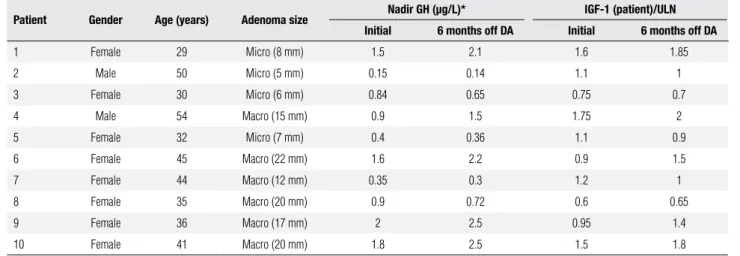
Table 2. Characteristics and results of the patients with initially altered nadir GH and/or IGF-1
Patient Gender Age (years) Adenoma size Nadir GH (µg/L)* IGF-1 (patient)/ULN Initial 6 months off DA Initial 6 months off DA
1 Female 29 Micro (8 mm) 1.5 2.1 1.6 1.85
2 Male 50 Micro (5 mm) 0.15 0.14 1.1 1
3 Female 30 Micro (6 mm) 0.84 0.65 0.75 0.7
4 Male 54 Macro (15 mm) 0.9 1.5 1.75 2
5 Female 32 Micro (7 mm) 0.4 0.36 1.1 0.9
6 Female 45 Macro (22 mm) 1.6 2.2 0.9 1.5
7 Female 44 Macro (12 mm) 0.35 0.3 1.2 1
8 Female 35 Macro (20 mm) 0.9 0.72 0.6 0.65
9 Female 36 Macro (17 mm) 2 2.5 0.95 1.4
10 Female 41 Macro (20 mm) 1.8 2.5 1.5 1.8
DA: dopaminergic agonist; ULN: upper limit of the reference value for gender and age. * Gender- and assay-specific cut-off: > 0.25 µg/L for men and > 0.7 µg/L for women (11).
In every case, situations associated with false-posi-tive GH and IGF-1 results were excluded (pregnancy, thyroid dysfunction, puberty, malnutrition, diabetes, kidney or liver disease, and drugs including anovulatory agents, estrogens or corticosteroids). After this step, la-boratory anomalies were interpreted as follows (1,7-9). The diagnosis of biochemically active acromegaly was unequivocal (elevated IGF-1 for gender and age with nadir GH > 1 µg/L) in two patients (patients 1 and 10 in table 2). This diagnosis was likely (elevated IGF-1 with nadir GH > cut-off but < IGF-1 µg/L) in another patient (patient 4). In two other patients (patients 6
and 9), this diagnosis was possible (normal IGF-1 with nadir GH > 1 µg/L). In three patients (patients 2, 5 and 7 in table 2) with discretely elevated IGF-1, ade-quate suppression of GH in the OGTT ruled out active acromegaly. Finally, two cases (patients 3 and 8) with normal IGF-1 and discretely elevated nadir GH were classiied as not having active acromegaly. Repetition of the tests 6 months after withdrawal of the dopaminer-gic agonist conirmed the diagnosis in patients 1, 4 and 10 and resulted in an unequivocal diagnosis in patients 6 and 9.
Patients 6 and 10 were submitted to transsphenoidal surgery and immunohistochemistry conirmed the po-sitivity for GH and PRL. In patients 1 and 4, octreotide LAR was added to the initial treatment (dopaminergic agonist), and on the last assessment IGF-1 was 1.1 and 1.2 time the upper limit of the reference range, res-pectively. Patient 9 had still not started treatment with octreotide LAR and was only using a dopaminergic agonist.
DISCUSSION
Cop
yright
© ABE&M t
odos os dir
eit
os r
eser
vados
.
549 Arq Bras Endocrinol Metab. 2010;54/6
dopaminergic agonist treatment and normalization of PRL (1).Investigation of acromegaly is not recommen-ded in the remaining cases (1).
Following current recommendations for the treat-ment of prolactinomas (1), there is a high likelihood that underlying GH hypersecretion will not be control-led. Surgery is indicated in exceptional cases. Patients with microprolactinomas cannot be treated or only re-ceive sex hormones. Dopaminergic agonists, the main therapeutic modality for prolactinomas, do not nor-malize GH or IGF-1 levels in a marked proportion of cases, even in the presence of PRL co-secretion (4-6).
Since biochemically uncontrolled acromegaly is as-sociated with higher morbidity and mortality (2,13), the identiication of these patients is important. If no intervention is indicated, speciic follow-up is recom-mended for cases of only discretely altered GH or IGF-1 in order to detect the progression of laboratory anomalies, and greater attention should be paid to cli-nical signs of excess GH/IGF-1. More importantly, treatment might be modiied in the case of patients with altered GH and IGF-1, with the indication of surgery or treatment with somatostatin analogs even in the absence of clinical activity (2,13).Even in the case of patients who achieve remission (normal GH/ IGF-1) with treatment with dopaminergics agonists, co-morbidities related to excess GH/IGF-1 may also be present, and their detection and speciic manage-ment are important (14).
Analysis of our patients with prolactinoma during successful treatment with dopaminergic agonists sho-wed a frequency of biochemically uncontrolled acro-megaly of 4.1%. This rate is relevant since it speciically refers to patients without a clinical phenotype. This was a cross-sectional study and we are unable to de-termine when biochemical GH/IGF-1 hypersecretion occurred. If we assume that all patients presented inap-propriate GH secretion since diagnosis, the prevalence might be higher than that observed since altered GH and IGF-1 could have been present before treatment with dopaminergic agonists in patients presenting nor-mal parameters on this assessment. Since Andersen and cols. (12) showed that GH hypersecretion not detected at diagnosis of the prolactinoma can arise subsequently, it is possible that the onset of hypersecretion occurred after the diagnosis in some of the patients and the
fre-quency found in this cross-sectional study may still in-crease over time.
In summary, we conclude that among patients with prolactinomas, acromegaly should be investigated not only in cases with clinical phenotype. Since biochemi-cally uncontrolled acromegaly is associated with higher morbidity and mortality, the identiication of these pa-tients is important.
Acknowledgments and disclosure: This study was supported by grants from Novartis Biociências.
REFERENCES
1. Casanueva FF, Molitch ME, Schlechte JA, Abs R, Bonert V, Brons-tein MD, et al. Guidelines of the Pituitary Society for the diag-nosis and management of prolactinomas. Clin Endocrinol (Oxf). 2006;65:265-73.
2. Melmed S. Medical progress: acromegaly. N Engl J Med. 2006;355:2558-73.
3. Sakharova AA, Dimaraki EV, Chandler WF, Barkan AL. Clinically silent somatotropinomas may be biochemically active. J Clin En-docrinol Metab. 2005;90:2117-21.
4. Jaffe CA, Barkan AL. Treatment of acromegaly with dopamine agonists. Endocrinol Metab Clin N Am. 1992;121:713-35. 5. Abs R, Verhelst J, Maiter D, Van Acker K, Nobels F, Coolens JL,
et al. Cabergoline in the treatment of acromegaly: a study in 64 patients. J Clin Endocrinol Metab. 1998;83:374-8.
6. Sherlock M, Fernandez-Rodriguez E, Aragon AA, Reulen RC, Ayuk J, Clayton RN, et al. Medical therapy in patients with acromegaly; predictors of response and comparison of eficacy of dopamine agonists and somatostatin analogues. J Clin Endocrinol Metab. 2009;94:1255-63.
7. Molitch ME. Nonfunctioning pituitary tumors and pituitary inci-dentalomas. Endocrinol Metab Clin N Am. 2008;37:151-71. 8. Mavrakis A, Tritos N. Diagnostic and therapeutic approach to
pi-tuitary incidentalomas. Endocr Pract. 2004;10:438-44.
9. Daly AF, Burlacu MC, Livadariu E, Beckers A. The epidemiolo-gy and management of pituitary incidentalomas. Horm Res. 2007;68(Suppl 5):195-8.
10. Ezzat S, Forster MJ, Berchtold P, Redelmeier DA, Boerlin V, Har-ris AG. Acromegaly. Clinical and biochemical features in 500 pa-tients. Medicine (Baltimore). 1994;73:233-40.
11. Rosario PW, Furtado MS. Growth hormone after oral glucose overload: revision of reference values in normal subjects. Arq Bras Endocrinol Metab. 2008;52:1139-44.
12. Andersen M, Hagen C, Frystyk J, Schroeder HD, Hagen C. De-velopment of acromegaly in patients with prolactinomas. Eur J Endocrinol. 2003;149:17-22.
13. Melmed S, Colao A, Barkan A, Molitch M, Grossman AB, Klein-berg D, et al.; Acromegaly Consensus Group. Guidelines for acromegaly management: an update. J Clin Endocrinol Metab. 2009;94:1509-17.
14. Colao A, Ferone D, Marzullo P, Lombardi G. Systemic complica-tions of acromegaly: epidemiology, pathogenesis, and manage-ment. Endocr Rev. 2004;25:102-52.