Original Research Paper
Characterizations of nanostructured nickel aluminates as catalysts for
conversion of glycerol: Influence of the preparation methods
Antonio S.B. Neto
a, Alcemira C. Oliveira
b,1, Josué M. Filho
b,1, Norma Amadeo
c, Maria L. Dieuzeide
c,
Francisco F. de Sousa
d, Alcineia C. Oliveira
a,⇑aUniversidade Federal do Ceará, Campus do Pici-Bloco 940, Departamento de Química Analítica e Fisioquímica, 60.000.000 Fortaleza, Ceará, Brazil bUniversidade Federal do Ceará, Campus do Pici-Bloco 922, Departamento de Física, Fortaleza, Ceará, Brazil
cITHES CONICET-UBA, Buenos Aires, Argentina
dUniversidade Federal do Pará, Campus Universitário de Marabá, Cep: 68505-080 Marabá, Pará, Brazil
a r t i c l e
i n f o
Article history:
Received 14 August 2016
Received in revised form 18 September 2016
Accepted 21 September 2016 Available online 18 October 2016
Keywords:
Nickel aluminates Nanostructures Characterizations Preparation method Glycerol
a b s t r a c t
Three different preparation methods were applied to prepare nickel aluminates (i.e. nanocasting (NiAlN), coprecipitation (NiAlC) and wet impregnation (NiAlW) methods). All catalysts exhibited the NiAl2O4 phase besides that of NiO andc-Al2O3.The NiAlN catalyst showed nanoparticles of the aforesaid oxides whereas NiAlxOywas the predominant phase found over NiAlW catalyst. The performances of the nickel aluminate-based catalysts were evaluated in glycerol dehydration to produce valuable chemical com-pounds through the dehydration of glycerol. The sintering effects were responsible for the decreased per-formance of NiAlC in glycerol dehydration. On the contrary, NiAlN is found to be deactivated due to the lesser stability of its supported nanoparticles, being the glycerol conversion of ca. 3.3% at the end of the reaction. Besides, the reaction efficiently proceeded on NiAlW, which had a high catalytic performance with 19.7% glycerol conversion to acetol and others products and no deactivation along of the time for 25 h of time on stream was observed. This was due to the stability of the NiAlxOyphase, which impeded phase transformation and was resistant to heavy coking.
Ó2016 The Society of Powder Technology Japan. Published by Elsevier B.V. and The Society of Powder Technology Japan. All rights reserved.
1. Introduction
Nickel aluminates can be synthesized by various preparation methods and they are very efficient catalysts or carries for the dehydration of a variety of alcohols: ethanol, glycerol, octanol, pro-panol, 4-hydroxy valeric, among other hydrocarbons[1–3]. It is a partially inverse spinel oxide structure with an ideal unit cell of a cubic system of NiAl2O4, being a class of chemically and thermally
stable materials[2,3].
The role played by the structure of nickel aluminates for alcohol transformation reactions is not clear in the open literature, although several papers showed the Ni2+centers are very efficient
to convert the alcohols through the cleavage of the CAC, OAH and CAH bonds[4–6].
Moreover, the catalytic properties of the nickel aluminates depend on the preparation method, calcination temperature, among other aspects[5–7]. Therefore, the design of active,
selec-tive and recyclable nickel aluminate catalyst for glycerol dehydra-tion is a challenging goal in the field of dehydradehydra-tion catalysis.
In this context, several attempts have been made by researchers for exploitation of uses for glycerol[8–11]. The dehydration of the tri-alcohol reaction constitutes an important research area because it represents the core of a variety of chemical processes to convert the trialcohol into valuable products such acrolein or acetol [12,13]. Acrolein (2-propenal) is a very useful chemical intermedi-ate with widespread applications in antifreeze, polyester fibers, resins, pharmaceuticals, cosmetics, flavors and fragrances, among others whereas acetol (1-hydroxyacetone) is widely used as organic synthesis intermediate for polyols and used in food and cosmetic industry products[10].
The acetol formation through dehydration of glycerol is observed, when catalysis possessing Lewis acidity, or strong basic sites on their surface are used and this reaction occurs via protona-tion of the terminal hydroxyl group of glycerol with consecutive elimination of water molecule and formation of an enol intermedi-ate[11,13]. Considering the acrolein production by dehydration of glycerol, catalysts having Brønsted acid sites give high acrolein selectivity[12]. In this direction, a variety of catalysts such as
oxi-http://dx.doi.org/10.1016/j.apt.2016.09.013
0921-8831/Ó2016 The Society of Powder Technology Japan. Published by Elsevier B.V. and The Society of Powder Technology Japan. All rights reserved.
⇑ Corresponding author. Fax: +55 85 33 66 90 51/9982.
E-mail address:[email protected](A.C. Oliveira).
1 Fax: +55 85 33 66 94 83.
Contents lists available atScienceDirect
Advanced Powder Technology
des, sulfates, metal-based catalysts, phosphates, niobic acid, heteropolyacids, hydrotalcite-type compounds and silica and alu-mina supported solids, zeolites have been investigated [11,14– 16]. Since these catalysts suffer from particle sintering, leaching of the active sites or even carbon deposition, there is a great inter-est for the development of alternative catalysts. This is a very important factor regarding a possible catalysts’ commercial application.
In contrast with the huge research effort focused in the recent years to find out new catalytic applications of nickel aluminates material, almost no papers can be found in the open literature dealing with the nickel aluminate deactivation in dehydration of glycerol. As observed in steam reforming process and glycerol hydrogenolysis, the significant features of NiAl2O4oxide catalysts
includes elevated textural properties, profound redox and acid– base properties, high thermal stability and strong mechanical strength[2,3]. In addition, Ni/Al2O3based catalysts have been used
widely in glycerol steam reforming andin situtransformations lead to active Nio/NiAl
2O4phase[1,5]. However, the changes in Ni
par-ticle sizes and morphologies during the reaction and the interac-tions between the alumina carrier and the supported metal may result in detrimental effects such as coking and sintering for the catalyst.
Thus, in this paper, nanostructured nickel aluminates obtained by three preparation methods are evaluated in gas phase dehydra-tion of glycerol. Many different synthetic procedures have been developed to obtain nickel aluminates. Among them, solid-state reaction (ceramic method) and aqueous solution (wet chemical method) such as coprecipitation and sol-gel methods are exten-sively studied [5,17,18]. The main advantages of wet chemical methods are increased homogeneity and high surface area of the resulting precipitate or gel, which lead to smaller particle size. Emphasis was given in the correlation between the structural properties of the solids after the reaction and their catalytic performance.
2. Experimental
2.1. Preparation of the catalysts
Three wet methods were used for the preparation of the cata-lysts containing about 10–12 wt% of Ni: coprecipitation, nanocast-ing and wet impregnation .
The NiAlC catalyst was prepared by the coprecipitation of metal nitrates method. Under stirring, a 10% aqueous solution of alu-minum nitrate (Al(NO3)39H2O Reagen, 99 wt%) and nickel nitrate
Ni(NO3)26H2O, Vetec, 99 wt%) were added slowly with vigorous
stirring into a sodium carbonate and sodium hydroxide solutions at room temperature. Then, the pH of the final mixture was adjusted to 11 by dropping a 1 molL 1aqueous solution of sodium hydroxide. After stirring and standing the colloidal mixture for 1 h, the resulting precipitate was aged at 60°C for additional 2 h and
then was filtered, washed with deionized water several times until the pH reached 7, dried at 80°C overnight and calcined in air flow
at 700°C using a heating rate of 1°C min 1for 6 h.
In case of NiAlW, the catalyst was prepared by the incipient wetness impregnation method studied[5]. For this purpose, aque-ous solution of Ni(NO3)26H2O (99% Merck) was prepared and
c-Al2O3 (Rhone Poulenc) was used. The
c-Al
2O3 was impregnatedwith 10% of Ni and the subsequent drying of the samples was per-formed in a muffle at 120°C for 6 h, followed by the calcination
from room temperature to 700°C using a heating rate of
1°C min 1and held at 700°C for 6 h.
For nanocasted NiAlN, the preparation method was based on previous work[19]. The synthesis was performed at constant pH
in the presence of 10 g of each metal source e.g., nickel acetate and tri-sec butoxide, which were dissolved in isopropanol, under vigorous stirring. After adding the solutions, about 1.0 g of silica template was dispersed in 40 mL of n-hexane with stirring for 3 h. Then, the obtained slurry was added dropwise to 1 mL of the metal precursor solutions with vigorous stirring for 24 h. The resulting mixture was then isolated by filtration and washed with water, being dried afterwards. The prepared solid was calcined at 700°C with a heating rate of 1°C min 1 and maintained at that
temperature for 6 h, under nitrogen flow. The template was par-tially removed by stirring the composite in a 5% HF solution and further washed with ethanol, filtered and dried to obtain the resul-tant oxide sample.
2.2. Characterization of the catalysts
The NiAlC and NiAlN catalysts were characterized by chemical analysis (ICP-OES), X-ray diffraction (XRD), N2 adsorption
iso-therms, Raman spectroscopy, and Transmission Electron Micro-scopy (TEM) techniques.
The chemical analyses of the solids were performed by induc-tively coupled plasma optical emission spectroscopy (ICP-OES). The analyses were carried out with a Shimadzu ICPS-7500 spec-trometer. About 100 mg of the solid was prepared by dissolution in concentrated nitric acid. The precipitated formed was diluted again in a 1% nitric acid solution to perform the measurements.
XRD analyses of fresh solids were performed on a Rigaku (DMAXB model) diffractometer with Cu Karadiation (40 kV and 30 mA). The diffractograms can be found in the papers published elsewhere[3,19,20]. The spent solids used in the reaction were also characterized by XRD and the diffraction pattern was identified through comparison with those included in the ICDD (International Center of Diffraction Data) database. Moreover, characterizations of fresh NiAlW catalyst (XRD and chemical analyses) are found in a previous paper[20].
The nitrogen adsorption isotherms at 196°C were carried out
using a Bel Japan, BELSORP Mini II. Before adsorption measure-ments, samples (ca. 0.05 g) were heated at 200°C for 4 h under
nitrogen flow. Surface areas of the fresh and spent solids were cal-culated by the Brunauer–Emmett–Teller (BET) method and pore diameters were obtained by BJH method. The surface areas of the microporous solids were measured by t-plot method.
Raman spectra of the fresh and spent catalysts were obtained using a T64000 Jobin Ivon spectrometer. Approximately, 10 mg of each sample was used with an argon laser at 514.5 nm and a power of 10 mW. Raman spectrum of NiAlC and NiAlW samples were obtained in a Horriba Jobin Yvon Labram1000 microscope with a 514.5 nm laser line. The power of 10 mW using a 100 times objec-tive and a 600 mm 1grating were applied.
The Transmission Electron Microscopy (TEM) images of the spent solids were obtained on a FEI Tecnai transmission electron microscope at 120 kV with a resolution of 0.17 nm. Previously, samples were dispersed in ethanol and placed in the grids to per-form the analyses.
2.3. Activity testing
The gas-phase dehydration of glycerol was typically conducted at 250°C,P= 1 atm, using 100 mg of catalyst. The reactant 20wt% of aqueous solution of glycerol was introduced in the in a fix bed reactor and the reaction was carried out at 250°C. The products
%Glycerol conversion¼moles of glycerol in the feedmoles of glycerol reacted 100 ð1Þ
%Product selectivity¼moles of carbon in specific product
moles of carbon in glycerol reacted100
ð2Þ
3. Results and discussion
3.1. Structural and textural features of fresh solids
Fig. 1illustrates the Raman spectra of the fresh solids. The spectrum of NiAlN exhibits an intense and broad line at around 520 cm 1, accompanied by lower wavenumber modes at
about 187, 254 and 342 cm 1. The broad lines of the spectrum
con-firm the XRD results that showed the solid has low crystallinity. The vibration at around 187 cm 1 is attributed to the E
g while those at lower wavenumber are due to T2g modes from NiO [21,23]. The modes representing a large structured band extending from 372 to 650 cm 1may be assigned to the normal cubic spinel
withFd3mspace group of NiAl2O4[21]. When assessing the
long-range correlation for the arlong-rangements of atoms, it can be inferred that NiAlN has only symmetric respiration modes of NiAl2O4
besides those of NiO.
The NiAlW has almost the same features of NiAlN in terms of the presence of the aforesaid vibrations, although the modes have major intensities in the former solid. The vibrations at around 264, 509, 564 and 658 cm 1 attributed to be from both NiAlxOyand
NiAl2O4[23,24]are mostly missing in the spectrum. The features
of the spectrum are nearly of NiO, mainly for the modes at about 77, 188 and 436 cm 1. This is probably due to the impregnation
process of the solids that promotes the dispersion of fine NiO, NiAlxOyand NiAl2O4particles on the
c-Al
2O3 support surface. Asconsequence, the modes of the nickel aluminates experience a hardening in reason of the interaction with the support. Neverthe-less, the NiAlC spectrum reveals clear differences comparing with the NiAlW and NiAlN. Raman measurements of NiAlC reveal a spectral feature with low intensity modes that can be attributed to NiO and NiAl2O4. However, the positions of NiO and NiAl2O4
modes are maintained and they are narrower suggesting that the sites are well defined due to the high crystallinity of the bulk.
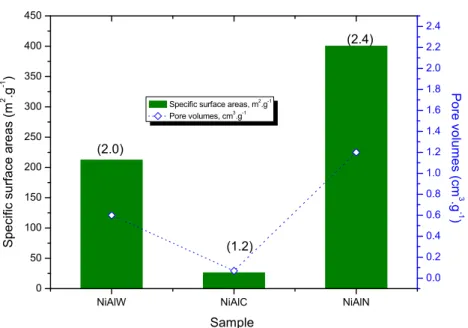
The textural properties of the fresh solids are illustrated in Fig. 2.
The NiAlN displays a mesoporous character with relatively large pore sizes e.g., 2.4 nm. Assuming that the nanocasting method afford to high textural properties, the surface area of ca.400 m2g 1.
Such features was used earlier for describing a type IV isotherm [20]. The pore volume of 1.2 cm3g 1is expected due to the
nano-sized character of the solid provided by the preparation method. There is no significant evidence of the amorphous silica remaining in the solid (neither observed by Raman nor XRD) could block the pores and prevent the final formation of an ordered nickel alumi-nate structure. The textural properties of NiAlW indicate the for-mation of micropores in addition to the presence of mesopores [23].
Although the surface areas, pore volume and diameters of NiAlW are lesser than that of NiAlN, BET surface area and pore vol-ume values correlated well with the nanosized feature of dispersed nanoparticles in alumina support, as suggested by Raman results. The lowest textural properties are shown by NiAlC, which can be most likely explained by the sizes of its crystallites of ca. 22 nm for NiAl2O4and 32 nm attributed to be from NiO phase, as further
shown by XRD. These values illustrates that large particles are formed, having the solid a bulk feature[21,23].
The summary of the physicochemical properties of the solids is displayed inTable 1.
The ICP-OES results (Table 1) shows that the Ni content is about 10 wt% for NiAlW and NiAlC while Ni composition of NiAlN is about 12 wt% .
XRD features of nanocasted NiAlN composite displays the high-angle reflection peaks, which are typical of NiO cubic structure (ICDD 4-0835) and
c-Al
2O3(ICDD 50-741), as previously published [3]. Reflections with low intensity of cubic NiAl2O4phase are alsodetected, which points to very small or poorly crystalline particles [19]. In case of the solid obtained by wet impregnation namely, NiAlW, wide reflections of low intensity can be associated with non-stoichiometric NiAlxOyspinel phase and there is also broad contribution from stoichiometric NiAl2O4one in some regions of
the diffractogram [20]. The XRD patterns of NiAlC obtained by coprecipitation most likely consists of very high intense peaks related to NiAl2O4crystallites[12]. However, because of the
over-lap with the NiO and
c-Al
2O3peaks, a reliable estimation of therel-ative amount of NiAl2O4cannot be made.
According to the TEM results of the fresh NiAlC and NiAlN [12,20,24], three sets of lattice stripes and planes of 0.21, 0.64 and 0.34 nm are found, which are attributed to be from NiO, NiAl2
O4and
c-Al
2O3, respectively. The mean size of the spinel phases isabout 29 and 13.6 nm, respectively for NiAlC and NiAlN. In case of NiAlW, the same phases observed by XRD are suggested by TEM with the spinel ones having sizes of 10- and 5 nm, respectively for NiAl2O4and NiAlxOy.
In summary, the Raman, XRD and TEM data agreed that the con-tribution of NiAl2O4 appeared in the diffractogram of the wet
impregnated nickel aluminates and nanocasted. In contrast, a very small contribution of aforesaid phase is observed for the solid obtained by co-precipitation, being the peaks more intense than the others samples and thus the solid has high crystallinity.
3.2. Catalytic results in glycerol dehydration
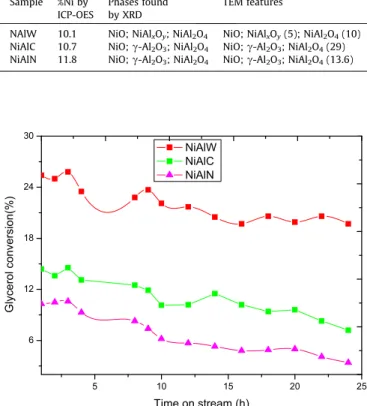
Fig. 3depicts the glycerol conversion versus time on stream, when the nickel aluminates derived catalysts are tested in the pro-cess of dehydration of glycerol. After 1 h on stream, all catalysts are actives in the reaction. NiAlN catalyst shows a glycerol conversion of 10% and it gradually drops to 3.3% in 25 h of time on stream. XRD and Raman measurements of NiAlN suggest that the nanoparticles of spinel-type NiAl2O4 or NiAlxOy phases are supported on the
mesoporous silica matrix[19], and additional Ni2+atoms may have
migrated into the Al2O3to form the nickel aluminates[25–28]. As
found elsewhere[3], small and well dispersed Niocrystallites
com-ing from Ni2+reduction can be formed during glycerol
transforma-tion reactransforma-tions and promotes a noticeable coke formatransforma-tion. Thereby, the coking effects might be responsible for the decreased perfor-mance of the solid (further shown by Raman spectroscopy of spent solid). It is worthy to say that the conversion of glycerol obtained over NiAlN is lower than that tested using a 10% aqueous solution of glycerol (e.g. 50% of glycerol conversion for 6 h of reaction)[19]. As the amount of glycerol is lesser than that of current work, this suggests that more active sites on surface are available and con-tributed to the overall glycerol conversion. Also, it evidences that the Ni2+coming from NiO and NiAl
2O4active phases are required
to fully convert the molecules of the trialcohol.
On the contrary, NiAlC is found to be little more active catalyst due to the higher stability of their large particles (latter shown by TEM of spent solids). However, NiAlC exhibits identical behavior of NiAlN in terms of deactivation, being the glycerol conversion is about 8.4% at the end of the reaction (Table 2). Even if the Ni2+
100 200 300 400 500 600 700 800 190
192 194 196 198 200
100 200 300 400 500 600 700 800 1000
1010 1020
100 200 300 400 500 600 700 800 995
1000 1005
Intensity (a.u.)
Intens
ity (a.
u
.)
NiAlN
Intensity (a.u.)
Wavenumber (cm-1)
Wavenumber (cm-1)
NiAlW
Wavenumber (cm-1)
NiAlC
Fig. 1.Raman spectra of the fresh solids.
NiAlW NiAlC NiAlN
0 50 100 150 200 250 300 350 400 450
Specific surface areas, m2
.g-1
Pore volumes, cm3
.g-1
Sample
Specif
ic surface
are
a
s
(m
2 .g
-1 )
0.0 0.2 0.4 0.6 0.8 1.0 1.2 1.4 1.6 1.8 2.0 2.2 2.4
(2.0)
(1.2)
Po
re vo
lu
mes (cm
3
.g
-1
)
(2.4)
catalyst ability to avoid coking on its surface, although sintering effects may be possible.
Furthermore, the reaction efficiently proceeds on NiAlW, which has a high catalytic performance with 24% glycerol conversion observed without catalyst deactivation along of the time on stream. The catalytic performance of NiAlW is due to the presence of NiAlxOyprevailing over NiAl2O4phase, even though the latter
specie also promotes the reaction.
Studies on molecular sieves containing silica and alumina cata-lysts have shown that glycerol dehydration is favoured mainly by the alumina presence giving high acidity to solids [27,29]. As noticed elsewhere[26,27], although pure aluminas e.g.,
g-Al
2O3,c-Al
2O3are poorly actives in the reaction, the high selectivity to1-hydroxyacetone over the aluminas is found be related to their largest amount of basic surfaceAOH groups and acid–base pair sites. Thus, even possessing
c-Al
2O3in their composition, theactiv-ity of the solids during the reaction could be not only due to alu-mina presence. Additionally, it can be suggested that the NiO phase is not sufficiently active in catalyzing glycerol dehydration, but apparently enhances glycerol hydrogenolysis, when partially
reduced. This is consistent with previous reports where the volatile products by CAC hydrogenolysis of glycerol are formed[28–31]. The results obtained are therefore interpreted as NiAlxOycan be explicitly the active phase for the reaction. Also, it is plausibly con-cluded that NiO and
c-Al
2O3species can promote the reaction, buteither large particles or coke formation could lead to a decrease in the catalytic activity of NiAlC and NiAlN.
Table 2also illustrates the products obtained in the condens-able phase in the steady state condition. The major products detected in the liquid phase are 1-hydroxyacetone (acetol), ace-tone, ethanol and acetic acid. This demonstrates that glycerol can be dehydrated to acetol over the nickel aluminate catalysts, in spite of acrolein formation. On basic sites present in acidic catalysts, ace-tol is most likely formed with a decreased acrolein production, which occur with typical Brønsted acid catalysts[10,28,29]. There is no significant evidence of acrolein formation from GC analysis, since it could be involved in parallel reaction with glycerol or other products.
Moreover, oxidation products such as acetaldehyde, propanedi-ols, aromatics and furane derivates are formed, namely others, mainly on NiAlC. In addition, the concentrations of gases such as methane, hydrogen, acrolein and CO2are very small over NiAlW
and NiAlN and there may be attributed to the glycerol hydrogenol-ysis or aqueous reforming of glycerol reactions on Ni sites. This fact suggests that the free NiO coming from the catalysts is less active than that coming from the NiAlxOyspinel oxide. Notably, the liquid production distribution is about 80% for NiAlW and NiAlN whereas the amount for NiAlC is around 55% with the concomitant decrease in the acetol production most likely due to the gas phase oxidation products or glycerol hydrogenolysis reactions.
It is also very important to highlight that the great quantities of 1-hydroxyacetone is formed in NiAlW, which undergoes a conver-sion of 19.7% at the end of reaction.Table 2shows that the NiAlN gives similar product distributions with 3.4% of glycerol conversion in the steady state. As discussed before, this behavior is caused by the predominance of the presence of the NiAlxOy spinel oxide phase in NiAlW. In contrast, NiAlC having a glycerol conversion of 8.4% displays a lesser acetol production than NiAlW and NiAlN. This implies that the NiO species of former catalyst i.e., the prevail-ing phase in the NiAlC, as seen by Raman and XRD results, require the hydrogen formed during the reaction to be reduced and form products from glycerol reforming or hydrogenolysis reactions. This hypothesis is confirmed further by the results obtained with the characterization of the spent catalysts.
3.3. Spent catalysts characterizations
XRD results of the spent solids are shown inFig. 4.
After using the solids in the reaction, XRD pattern of NiAlN reveals an amorphous feature. This is a sound proof of the forma-tion of heavy carbonaceous deposits during the reacforma-tion on solid surface, as further confirmed by Raman and TEM measurements. The XRD peaks of spent catalysts prepared by impregnation method are basically similar to that of NiAl2O4. For instance, the
diffractogram displays two broad peaks at 2h= 37.2°(3 1 1), 44.9°
(4 0 0) and 65.2°(4 4 0) from the spinel lattice possessing a cubic
structure belonging to the Fd3 m space group. Even though XRD peaks do not exhibit clearly the presence of NiO, it cannot ensure its absence, since the peaks at around 2h= 36.3° (1 1 1), 43.1°
(2 0 0) and 62.7°(4 4 0) assign the cubic NiO peaks, which could
be overlapped with those of NiAl2O4. Furthermore, a board band
about confirms the presence of carbonaceous species, most likely, the graphite at 2h= 25°(0 0 2) with the P63/mmc space group.
The XRD profile of spent NiAlC catalyst depicts a broad peak with no visible reflections and this can be associated with the Table 1
Summary of the physicochemical characterizations of the fresh solids. The values in parenthesis are the sizes of the spinel phase particles obtained by TEM.
Sample %Ni by ICP-OES
Phases found by XRD
TEM features
NAlW 10.1 NiO; NiAlxOy; NiAl2O4 NiO; NiAlxOy(5); NiAl2O4(10)
NiAlC 10.7 NiO;c-Al2O3; NiAl2O4 NiO;c-Al2O3; NiAl2O4(29)
NiAlN 11.8 NiO;c-Al2O3; NiAl2O4 NiO;c-Al2O3; NiAl2O4(13.6)
5 10 15 20 25
6 12 18 24 30
Glycerol conversion(%)
Time on stream (h) NiAlW NiAlC NiAlN
Fig. 3.Catalytic runs for the nickel aluminate based catalysts in the dehydration of glycerol. Reaction conditions:T= 250°C, 20 wt% glycerol aqueous solution with 100 mg catalyst for 25 h reaction time.
Table 2
The textural properties of the solids, after the catalytic test. Sample Sg (m2
g 1) Vp (cm3 g 1)
NAlW 198a 0.60
NiAlC 12b 0.03
NiAlN 107a 0.31
carbon deposition on solid surface, as latter shown by Raman analyses.
TEM micrographs of spent solids are performed to search for a deeper understanding of the particles’ morphology (Fig. 5).
The micrograph of NiAlW (Fig. 5a) clearly exhibits very small particles (e.g., black dots in the image) with sizes ranging from 5 to 15 nm supported in a matrix e.g., gray plate. It may be assumed that these particles can be NiAl2O4or NiAlxOy. Moreover, it can be
rationalized that these particles do not suffered from sintering since their sizes do not change significantly compared to the fresh solid i.e. 3–10 nm. In addition, some crystallites that grow on top of the plate (supposed to be
c-Al
2O3) are believed to be from Nio. Thisconfirms the assumptions taken in the catalytic results where free NiO is reduced to form light gases products.
TEM micrograph for NiAlN unveils an unlike dimensional struc-ture for the particles, presenting continuous circular rings, which are assigned to carbon. The sequence of the images shows the appearance of large particles with loose agglomerated spherical shape. This consistent with the fact that the low activity of the sample is attributed to the presence of NiO and NiAl2O4
nanoparti-cles, which suffered from sintering and coking during the reaction. TEM image of NiAlC displays large particles ranging from 12 to 50 nm and possessing with irregular spherical shape and loosely agglomerated. This is an evidence of sintering of NiO particles, which explain the decreased performance of the solid.
Textural properties after the catalytic test (Table 3) shows that NiAlC has a very low surface area of 12 m2
g 1and pore volume of
ca. 0.03 cm3
g 1 while NiAlN possesses BET surface area of ca.
107 m2g 1and pore volume of ca. 0.31 cm3g 1, respectively.
10 20 30 40 50 60 70
NiAlC NiAlW NiAlN
Intensi
ty (a.u.)
2θ (degree)
Fig. 4.XRD patterns of the spent solids used in the reaction for 25 h reaction time.
(a)
(b)
(c)
In contrast, NiAlW has the relatively large textural parameters after the catalytic test. Obviously, the values are lesser than that of fresh solids (Fig. 2). The decrease in the textural parameters of NiAlC and NiAlN can be attributed to the increase in particle sizes, as a consequence of the deactivation by sintering (or coking) dur-ing the glycerol transformation, as already predicted by TEM. It is clear that when the NiAlW is used in the reaction, glycerol conver-sion with time on stream is maintained. Thus, deactivation is less pronounced over this solid, which means that it is stable compared with NiAlN and NiAlC.
The vibrational properties of the spent solids are analyzed by Raman spectroscopy.Fig. 6gives the Raman spectra of the solids, after being used in glycerol dehydration at 250°C, 25 h of reaction
with a 20 wt% aqueous solution of glycerol.
The Raman spectrum of spent NiAlN catalyst displays the disorder-induced planes of carbon and graphite bands at about 1330 cm 1and 1590 cm 1, respectively. They are attributed to be
from the so called D and G bands. The distinctive border band at 1590 cm 1appears in the spectrum, suggesting a very high amount
of carbon species being richer in graphite carbon from glycerol decomposition[24]. Comparing with the spectrum of fresh catalyst (Fig. 1), it can be seen that the vibrational modes of NiAl2O4and
NiO at low wavenumbers are vanished due to carbon covering the solid surface. The spent NiAlC exhibits the same features as NiAlN, as observed by the Raman spectrum. However, a lesser amount of disordered carbon at around 1345 cm 1is observed in
the solid obtained by coprecipitation. The amount of the latter car-bon species is higher than the graphite one, judging from the fact that the intensity of the D band is low. It can be either from heavy by-products glycerol dehydration formation or glycerol cracking reaction.
Carbon deposition seems inevitable on surface NiAlW, however, the catalyst is not severely damaged by coking, probably because its textural properties do not change drastically. Furthermore, the Raman spectrum shows that NiAlW maintain a structure (e.g., NiAlxOy), which does not suffer from phase transformation and is resistant to heavy coking.
The Niospecie can be formed by glycerol aqueous reforming
parallel reaction[32]over NiAlW, according to the large amount of gaseous products formed only over this catalyst. The water vapor can act to reoxidize Nioto Ni2+ on the surface and thus,
the good catalytic conversion and stability are observed in NiAlW. Contrary, the nanostructured NiAlN and bulk NiAlC are deactivated by carbonaceous deposits and phase transformation as shown by Raman, TEM and XRD measurements.
4. Conclusions
Among various nickel aluminate catalysts screened, the solid prepared by a wet impregnation method exhibited excellent cat-alytic performance for glycerol dehydration and also its hydrogenolysis. Acetol was largely produced over the solids while acrolein was produced in negligible level, which was possibly attributed to the parallel reaction involving glycerol and its derived compounds. The analogous coprecipitated and nanocasted cata-lysts had both NiO and NiAl2O4phases, however sintering and
cok-ing effects caused the deactivation of the solids. Results suggested that NiAl2O4 phase improved dehydrogenation–hydrogenolysis
reactions but nanosized NiAlxOyactive phase led to high glycerol conversions and catalytic stability.
Acknowledgments
The authors would like to acknowledge the CNPq (CNPq Grant no. 473568/2012-8), and the FUNCAP/CAPES Areas Estrategicas Program with Contract 23038.008860/2013-92.
References
[1]M.K. Nazemi, S. Sheibani, F. Rashchi, V.M. Gonzalez-DelaCruz, A. Caballero, Preparation of nanostructured nickel aluminate spinel powder from spent NiO/ Al2O3 catalyst by mechano-chemical synthesis, Adv. Powder Technol. 23 (2012) 833–838.
[2]D. Visinescu, Papa, A.C. Ianculescu, I. Balint, O. Carp, Nickel-doped zinc aluminate oxides: starch-assisted synthesis, structural, optical properties, and their catalytic activity in oxidative coupling of methane, J. Nanopart. Res. 15 (2013) 1456.
[3]R.M. Freire, F.F. de Sousa, A.L. Pinheiro, E. Longhinotti, J.M. Filho, A.C. Oliveira, P.T.C. Freire, A.P. Ayala, A.C. Oliveira, Studies of catalytic activity and coke deactivation of spinel oxides during ethylbenzene dehydrogenation, Appl. Catal. A: Gen. 359 (2009) 165–179.
[4]L. Zhang, W. Li, J. Liu, C. Guo, Y. Wang, J. Zhang, Ethanol steam reforming reactions over Al2O3SiO2-supported Ni–La catalysts, Fuel 88 (2009) 511–518.
[5]M.L. Dieuzeide, M. Jobbagy, N. Amadeo, Glycerol steam reforming over Ni/Mg/ c-Al2O3catalysts effect of Ni(II) content, Int. J. Hydrogen Energy 39 (2014) 16976–16982.
[6]S. Sepehri, M. Rezaei, Preparation of highly active nickel catalysts supported on mesoporous nanocrystalline c-Al2O3 for methane autothermal reforming, Chem. Eng. Technol. 38 (2015) 1637–1645.
[7]A.H.M. Batista, F.S.O. Ramos, T.P. Braga, C.L. Lima, F.F. De Sousa, A.S. de Oliveira, E.B. Barros, J.R. de Souza, A. Valentini, J. Mendes Filho, A.C. Oliveira, Mesoporous MAl2O4 (M = Cu, Ni, Fe or Mg) spinels: characterisation and application in the catalytic dehydrogenation of ethylbenzene in the presence of CO2, Appl. Catal. A:Gen. 382 (2010) 148–157.
[8]N.H. Tran, G.S. Kamali Kannangara, Conversion of glycerol to hydrogen rich gas, Chem. Soc. Rev. 42 (2013) 9454–9479.
[9]M. Kouzua, M. Tsunomori, S. Yamanaka, J. Hidaka, Solid base catalysis of calcium oxide for a reaction to convert vegetable oil into biodiesel, Adv. Powder Technol. 21 (2010) 488–494.
[10] C. Zhou–H, J.N. Beltramini, Y.-X. Fan, C.Q. Lu, Chemoselective catalytic conversion of glycerol as a biorenewable source to valuable commodity chemicals, Chem. Soc. Rev. 37 (2008) 527–549.
[11]D.C. Carvalho, L.G. Pinheiro, A. Campos, E.R.C. Millet, F.F. de Sousa, J.M. Filho, G. D. Saraiva, E.C. da Silva Filho, M.G. Fonseca, A.C. Oliveira, Characterization and catalytic performances of copper and cobalt-exchanged hydroxyapatite in
Table 3
Steady state conversion of glycerol in 25 h of reaction. Liquid products distribution in the dehydration of glycerol over NiAl-based catalysts. Operating conditions: 250°C, 20 wt% glycerol aqueous solution with 100 mg catalyst for 25 h reaction time.
Catalyst NiAlW NiAlC NiAlN Conversion (%) 19.7 8.4 3.3
Products distribution (%)
1-Hydroxyacetone 28.4 9.6 26.7 Acetic acid 20.0 5.3 22.6
Acetone 14.8 6.4 13.5
Ethanol 12.5 8.2 11.7
Others 7.1 25.3 6.2
1100 1200 1300 1400 1500 1600 1700 1800
NiAlN NiAlC NiAlW
Ra
m
a
n in
te
n
s
it
y (
a
.u
.)
Wavenumber (cm-1)
glycerol conversion for 1-hydroxyacetone production, Appl. Catal. A: Gen. 471 (2014) 39–49.
[12]C.-J. Yue, M.M. Gan, L.-P. Gu, Y-F. Zhuang, In situ synthesized nano-copper over ZSM-5 for the catalytic dehydration of glycerol under mild conditions, J. Taiwan Inst. Chem. Eng. 45 (2014) 1443–1448.
[13]A.S. de Oliveira, S.J.S. Vasconcelos, J.R. de Sousa, F.F. de Sousa, J.M. Filho, A.C. Oliveira, Catalytic conversion of glycerol to acrolein over modified molecular sieves: activity and deactivation studies, Chem. Eng. J. 168 (2011) 765–774.
[14]S. Chokkaram, R. Srinivasan, D.R. Milburn, B.H. Davis, Conversion of 2-octanol over nickel-alumina, cobalt-alumina, and alumina catalysts, J. Mol. Catal. A: Chem. 121 (1997) 157–169.
[15]I. Gandarias, P.L. Arias, J. Requies, M. El Doukkali, M.B. Güemez, Liquid-phase glycerol hydrogenolysis to 1,propanediol under nitrogen pressure using 2-propanol as hydrogen source, J. Catal. 282 (2011) 237–247.
[16]B. Dou, C. Wang, Y. Song, H. Chen, Y. Xu, Activity of Ni–Cu–Al based catalyst for renewable hydrogen production from steam reforming of glycerol, Energy Convers. Manage. 78 (2014) 253–259.
[17]A.A. Lemonidou, M.A. Goula, I.A. Vasalos, Carbon dioxide reforming of methane over 5 wt% nickel calcium aluminate catalysts – effect of preparation method, Catal. Today 46 (1998) 175–183.
[18]A. Tirsoaga, D. Visinescu, B. Jurca, A. Ianculescu, O. Carp, Eco-friendly combustion based synthesis of metal aluminates MAl2O4 (M = Ni, Co), J. Nanopart. Res. 13 (2011) 6397–6408.
[19]F.A.A. Barros, H.S.A. de Sousa, A.C. Oliveira, M.C. Junior, J.M. Filho, B.C. Viana, A. C. Oliveira, Characterisation of high surface area nanocomposites for glycerol transformation: effect of the presence of silica on the structure and catalytic activity, Catal. Today 212 (2013) 127–136.
[20]A. Romero, M. Jobbágy, M. Laborde, G. Baronetti, N. Amadeo, Ni(II)–Mg (II)–Al(III) catalysts for hydrogen production from ethanol steam reforming: influence of the Mg content, Appl. Catal. A:Gen. 470 (2014) 398–404.
[21]F.A.A. Barros, A.J.R. Castro, J.M. Filho, B.C. Viana, A. Campos, A.C. Oliveira, Characterisation and catalytic properties of Ni Co, Ce and Ru nanoparticles in mesoporous carbon spheres, J. Nanop. Res. 14 (2012) 1096.
[22]L.-Z. Tao, S.-H. Chai, Y. Zuo, W.-T. Zheng, Y. Liang, B.-Q. Xu, Sustainable production of acrolein: acidic binary metal oxide catalysts for gas-phase dehydration of glycerol, Catal. Today 158 (2010) 310–316.
[23]M.A. Laguna-Bercero, M.L. Sanjuna, R.I. Merino, Raman spectroscopic study of cation disorder in poly- and single crystals of the nickel aluminate spinel, J. Phys.: Condens. Matter 19 (2007) 186217.
[24]A.L. Pinheiro, A.N. Pinheiro, A. Valentini, J.M. Filho, F.F. de Sousa, J.R. de Sousa, M.G.C. Rocha, P. Bargiela, A.C. Oliveira, Analysis of coke deposition and study of the structural features of MAl2O4catalysts for the dry reforming of methane, Catal. Commun. 11 (2009) 11–14.
[25]B. Valle, B. Aramburu, A. Remiro, J. Bilbao, A.G. Gayubo, Effect of calcination/ reduction conditions of Ni/La2O3–a-Al2O3catalyst on its activity and stability for hydrogen production by steam reforming of raw bio-oil/ethanol, Appl. Catal. B: Environ. 147 (2014) 402–410.
[26]Y.T. Kim, K.-D. Jung, E.D. Park, Gas-phase dehydration of glycerol over silica– alumina catalysts, Appl. Catal. B: Environ. 107 (2011) 177–187.
[27]J.P. Lourenço, A. Fernandes, R.A. Bértolo, M.F. Ribeiro, Gas-phase dehydration of glycerol over thermally-stable SAPO-40 catalyst, RSC Adv. 5 (2015) 10667– 10674.
[28]W. Suprun, M. Lutecki, R. Gläser, H. Papp, Catalytic activity of bifunctional transition metal oxide containing phosphated alumina catalysts in the dehydration of glycerol, J. Mol. Catal. A: Chem. 342–343 (2011) 91–100. [29]C.L. Lima, H.S.A. Sousa, S.J.S. Vasconcelos, J.M. Filho, A.C. Oliveira, F.F. Sousa, A.
C. Oliveira, Effect of sulfatation on the physicochemical and catalytic properties of molecular sieves, React. Kinet. Mechan. Catal. 102 (2011) 102487–102500.
[30]B.C. Miranda, R.J. Chimentão, J.B.O. Santos, F. Gispert-Guirado, J. Llorca, F. Medina, F. López Bonillo, J.E. Sueiras, Conversion of glycerol over 10%Ni/c -Al2O3catalyst, Appl. Catal. B: Environ. 147 (2014) 464–480.
[31]P. Hirunsit, C. Luadthong, K. Faungnawakij, Effect of alumina hydroxylation on glycerol hydrogenolysis to 1,2-propanediol over Cu/Al2O3: combined experiment and DFT investigation, RSC Adv. 5 (2015) 11188–11197. [32]C. He, J. Zheng, K. Wang, H. Lin, J.-Y. Wang, Y. Yang, Sorption enhanced aqueous