DOI: http://dx.doi.org/10.5007/1980-0037.2012v14n3p254
original article
RBCDH
Licence Creative Commom
CC
BY
1 University of Campinas. Faculty of Physical Education. Campinas, SP. Brazil.
2 Federal University of Rio Grande do Norte. Natal, RN. Brazil.
3 State University of Londrina. Londrina, PR. Brazil.
4 University of Campinas. Faculty of Medical Science. Campinas, SP. Brazil.
Received: 16 November 2011 Accepted: 26 January 2012
Can neuromuscular fatigue threshold be
determined by short and non-exhaustive
bouts?
Pode o limiar de fadiga neuromuscular ser determinado
por testes curtos e não exaustivos?
Eduardo Bodnariuc Fontes1
Alexandre Hideki Okano2
Bruno de Paula Smirmaul1
Leandro Ricardo Altimari3
Ezequiel Moreira Gonçalves4
Ricardo Okada Triana1
Antonio Carlos Moraes1
Resumo– The present study determined the neuromuscular fatigue threshold (NFT) us-ing four diferent time-periods of analysis of the electromyographic signal and compared these estimations with critical power (CP). Fiteen healthy young men (73.6 ± 5.1 kg, 177.8 ± 7.0 cm, 23.4 ± 5.2 years) performed 3-4 diferent severe constant workload trials until exhaustion on a cycle ergometer with simultaneous SEMG signals acquisition. he obtained data permitted NFT estimation with four diferent periods of analysis as follows: initial 30s (T30), 1min (T1), 2min (T2) and total time (TT), as well as CP. T30 and T1 were signiicantly higher than TT and CP and, T2 and TT did not difer between each other, and both were signiicantly higher than CP. In addition, TT was signiicantly correlated
to CP (0.72; P < 0.05) and to T2 (0.58; P < 0.05). We conclude that NFT overestimates CP,
independent of the time-period analysis used for its determination.
Palavras-chave:Electromyography; Exercise test; Muscle fatigue; Physical itness.
Aerobic training has been widely used throughout several sports modalities and recreational physical activities. he role of the intensity has been shown to be determinant to produce positive efects on this type of exercise1,2.
Usually, coaches and trainers apply testing protocols in order to identify aerobic parameters to use as reference markers on the day-by-day training sessions3,4. However, most of these tests involve expansive equipments and
exhaustive procedures4,5, which become unpractical for most of the athletes.
herefore, simple and practical methods that indicate training intensities might optimize training prescription and evaluation of exercise programs.
Surface electromyography (SEMG) has been demonstrated to be an
interesting non-invasive method to quantify neuromuscular fatigue6. he
technology improvement of the last two decades has turned this method attractive to clinicians and researchers, as well as coaches and physical trainers, since with simple procedures and good data quality, muscular en-durance indices can be easily assessed7,8. deVries et al.9 using SEMG
analy-sis, suggested a procedure to determine the highest intensity sustainable without evidence of neuromuscular fatigue. he so-called neuromuscular fatigue threshold (NFT)10, has been derived from a linear rate of increase
of the exercising muscle electric activity (SEMG slope) during 3-4 constant high-intensity workloads (i.e., not until exhaustion). A linear regression between SEMG slope and intensity predicts the power output associated with zero SEMG slope, which theoretically corresponds to the upper limit of exercise without neuromuscular fatigue10,11. he NFT is highly related
to performance10 and can be used as a parameter for physical training or
itness evaluation11. However, controversial data is presented when
compar-ing NFT with other well established aerobic indices10-14. Such a discrepancy
could be attributed to the diferent periods of the SEMG signal analysis of the constant workload tests since one and two minutes, or total trial duration have been used.
he critical power (CP) has been shown to be a reliable and non-invasive aerobic index15,16. Contrary to NFT, CP has presented consistent results
when assessing aerobic capacity17,18. In this procedure, only workloads and
the respective times to exhaustion are used to it the predictive equations15.
Neuromuscular fatigue threshold by short bouts Fontes et al.
Hence, the purposes of the present study were (1) to establish the NFT calculated from diferent periods of analysis of the SEMG signal during the constant workload tests and (2) to compare these estimations with CP. We hypothesized that all periods of analysis would estimate similar values for NFT, and that they would not difer from CP.
METHODS
Subjects
Initially, 15 healthy young men (73.6 ± 5.1 kg, 177.8 ± 7.0 cm, 23.4 ± 5.2 years) volunteered to the present study, however, one dropped out ater reporting extreme discomfort during the irst test, and was excluded. he participants were physically active (~3 session per week of recreational physical activities) and non-smokers, and were also instructed to avoid vigorous activities and to not ingest beverages containing alcohol or cafeine in the 24-h prior to each test. All the subjects were fully informed about all testing procedures and completed a health questionnaire before signing a written informed consent. his study was approved by the local Ethics Committee. All procedures were performed according to the Declaration of Helsinki.
Experimental design
All the testing procedures took place within 4-week period. Each subject reported to the lab 5 times. he subjects were all fully familiarized with the tests and experimental procedures, since they had already participated in previous studies with similar design and equipments. he tests consisted of 3-4 diferent severe constant workload trials, performed randomly until exhaustion on a cycle ergometer, with simultaneous SEMG signals acquisition (as described in SEMG recordings and analysis). he obtained data permitted NFT estimation with four diferent periods of analysis as follows: 30s, 1min, 2min and total time; they also permitted CP to be calculated. hese estima-tions were then compared and correlated to each other to test the hypothesis that they would not be diferent and would represent similar physiological in-dices (i.e., upper limit intensity maintained without neuromuscular fatigue).
Predictive tests
he subjects performed 3-4 exhaustive tests on separated days to esti-mate the NFT and CP. All the tests were performed on an electronically braked cycle ergometer (Corival-400, Quinton Instruments, Netherlands). Individual seat and handlebar heights were recorded in the irst test and reproduced for all subsequent tests, in such a way that there was a slight bend in the knee joint when the pedal was at its lowest point. Subjects were required to keep an upright trunk position throughout the trials. Prior to each test, a warm-up at 50 W was carried out for 3-min, followed by 2-min rest. he power outputs during the tests were empirically chosen in order to induce exhaustion within 1-15 min, as previously described11,14.
s, despite strong verbal encouragement. he exhaustion time was recorded to the nearest second. No feedback about the power output or elapsed time was provided to the subjects during the trials. he SEMG signals were continuously recorded until exhaustion (as described below).
SEMG recordings and analysis
For SEMG recording, active bipolar (20 mm center-to-center) surface
elec-trodes (TSD 150TM, Biopac Systems®, CA, USA; common mode rejection
ratio, 95 dB) were used to record activity from the vastus lateralis muscle on the dominant side of the body. he electrodes were positioned between the motor point and the proximal tendon19. Inter-electrode impedance was
minimized by careful skin shaving and alcohol cleaning. he reference elec-trode was placed over the anterior iliac crest. he SEMG signal was ampliied (MP150 Electromyogram Ampliier, Biopac Systems Inc, Santa Barbara, Ca. USA) with a frequency band ranging from 20 to 500 Hz. SEMG signal was digitized with a sampling frequency of 2000 Hz and processed by calculating
the root-mean-square (RMS) of 5 s periods (AcqKnowledge 3.8.1TM sotware,
Biopac Systems®, CA, USA). All data were normalized as a percentage of
the initial 5 s period from each constant load test.
Determination of Neuromuscular Fatigue Threshold (NFT)
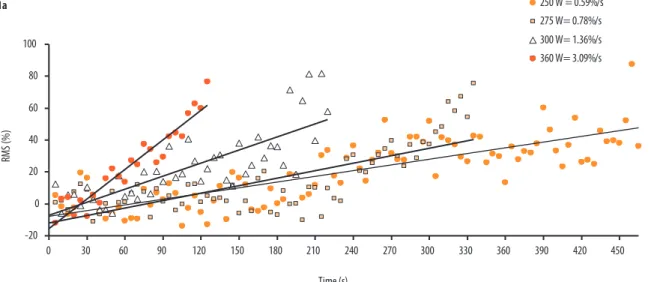
he NFT was estimated by the mathematical model proposed by deVries et al.9, in which the SEMG slope in function of time from each of 3-4
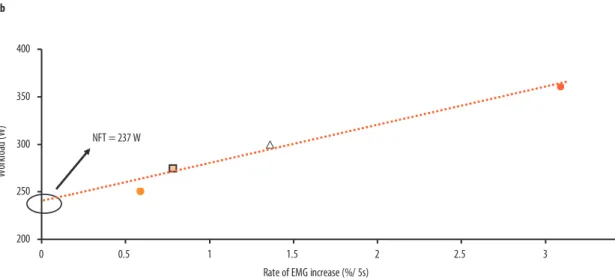
con-stant-load tests (Figure 1) is plotted against its respective power. he NFT is considered the y-intercept from the projected regression line (Figure 2), which, in theory, represents the maximal power that can be performed for long periods without evidence of neuromuscular fatigue. his procedure was completed to each time period of analysis: initial 30 seconds (T30), 1 minute (T1), 2 minutes (T2) and total time (TT).
Neuromuscular fatigue threshold by short bouts Fontes et al.
Figure 1b. Determination of the neuromuscular fatigue threshold (NFT) obtained via regression line between the rate of SEMG increase (slope - %.s-1) and respective power output.
Statistics
he results are presented as mean ± standard deviation. Ater normal-ity assurance, ANOVA for repeated measures was used to compare NFT
established by diferent periods of analysisand CP, while Schefé post hoc
test was applied to identify the diferences when necessary. he correla-tion between variables was determined using Pearson product-moment correlations. he signiicance level was set at P < 0.05 (STATISTICA 6.0TM,
STATSOFT®, OK, USA).
RESULTS
he mean power outputs and times to exhaustion from the constant workload tests were 231, 264, 287 and 325 W, and 531, 289, 204 and 136 s, respectively. he SEMG slope (%.s-1) and their respective coeicient of determination (r2)
for all constant workloads in the diferent periods of analysis are presented in Table 1. Table 2 depicts the NFTestimations based on the diferent periods of analysis (T30, T1, T2 and TT), as well as the CP estimation. T30 and T1 were signiicantly higher than TT and CP. Despite the fact that T2 and TT did not show diference between each other, both were signiicantly higher than CP. In addition, TT was signiicantly correlated to CP (0.72;
P < 0.05) and to T2 (0.58; P < 0.05).
Table 1. Rate of SEMG increase (slope - %.s-1) and its respective coeicient of determination (r2) for all constant workloads (W) in the diferent periods of analysis (T30, T1, T2 and TT).
T30 T1 T2 TT
workload (W) slope r2 slope r2 slope r2 slope r2
231 -0.24 0.05 0.13 0.36 0.04 0.02 0.18 0.4
264 1.11 0.92 0.84 0.29 0.26 0.21 0.33 0.62
287 1.3 0.75 1.04 0.25 0.12 0.21 0.47 0.71
T30 T1 T2 TT CP
NFT (W) 266,9
abc*
± 26.0
243,4 a
± 16.2
232.6* ± 18.3
217.2* ± 23.1
177.9 ± 27.3
r2 0.47 0.65 0.8 0.95 0.93
a
P < 0.01 vs. TT; b
P < 0.01 vs. T2; c
P < 0.01 vs. T1; *
P < 0.01 vs. PC.
DISCUSSION
he main indings of the present study indicate that the increase of the SEMG during high intensity and constant workload is not linear and, NFT varies when estimated from diferent periods of SEMG analysis (30s, 1min, 2min and total time). In addition, all the NFT estimations were signiicantly higher than CP.
he increase in the amplitude of the SEMG during constant workload exercise has been suggested to be associated to the additional and progres-sive recruitment of larger motor units to maintain the force-loss from the fatigued ibers11. According to the Henneman size principle, these larger
motor units would innervate larger muscle ibers and consequently gener-ate higher amplitude of the SEMG signal when activgener-ated. In addition, the intramuscular accumulation of hydrogen ions (H+) and decrease in pH during high-intensity exercise has been shown to impair muscle contractil-ity, making it necessary to recruit additional motor units to maintain the required metabolic rate11,20. hus, we believe that the exhaustive workloads
performed in the present study might had induced similar physiological changes mentioned above. Moreover, the higher rates of SEMG activity found during the higher workloads may also be explained by the similar mechanism since greater physiological disturbances are evidenced in such intensities.
deVries et al.9 using exhaustive, but short time periods bouts (1~4min),
originally proposed NFT as a method to evaluate the aerobic capacity which, in theory, represents the highest intensity with steady state of muscle recruit-ment. However, these authors observed that the NFT overestimated CP in 11%, but both were highly correlated (r = 0.86). Our results conirm this overestimation, as well as the correlation between the NFT and CP during the TT analysis (22% and r = 0.72, respectively). herefore, the intensity predicted by the NFT seems to not represent the same phenomenon that CP (i.e., highest intensity that can be performed by long periods without exhaustion15). Additionally, Pavlat et al.12 veriied the time to exhaustion
im-Neuromuscular fatigue threshold by short bouts Fontes et al.
provements of aerobic capacity ater three weeks of high intensity interval training, but it did not change ater 6 weeks when even though ventilatory threshold increased. We believe that this may be attributed to the improve-ments in discharge rates of motor units22 (e.g., additional recruitment of
motor units during constant load) which may be more evident during initial
phase of itness programs. Furthermore, Mäestu et al.10 showed that NFT
established in rowers overestimated the ventilatory threshold, however, when using total time-period, NFT showed a high relationship to performance (r=0.96). Together, the data provided by Kandell et al.21 and Maestu et al.10
may suggest that, despite this method does not represent the transition of aerobic / anaerobic metabolisms, NFT may be associated to the accumulation of muscle fatigue and able to detect neural adaptation to training.
Several studies have been using SEMG to estimate the aerobic-anaerobic transition during incremental exercise23-25, the so called electromyographic
threshold. However, this protocol is high metabolic demanding and its practical application is limited on the day-by-day itness programs. On
the other hand, Nakamura et al.26 have provided a new method to
esti-mate critical power by non-exhaustive tests using the ratings of perceived exertion. But, despite the fact that this method showed to be a reliable aerobic index for whole body capacity, limited information is available for local and speciic muscle adaptation. herefore, the present study aimed to verify if NFT from a representative exerting muscle in cycling (i.e., VL) could be enhanced by enabling its determination with very short and non-exhaustive exercise. We determined NFT with 30s of SEMG data from each workload performed, and unfortunately, our data showed that both NFT estimated by T30 and T1 were signiicantly higher than T2 and TT. his overestimation by lower periods of SEMG analysis may be explained by the fact that the SEMG signals, when treated in RMS and plotted against time, do not present a linear fashion throughout the high intensity and constant workload tests, even though several studies showed its
linear-ity9-11,21. Hence, our data indicated that this aspect may vary according to
the time period used for the analysis. Additionally, we observed that the highest coeicient of determination was found during the TT analysis (Table 1), meaning that the most linear pattern and, consequently, the most useful information of neuromuscular fatigue arises from this analysis. his dissociation of linearity behavior during the exercise may be explained by (1) the activation of diferent muscle iber types along the exercise, which can result in diferent SEMG activity24,25; (2) the muscle activation pattern
among the muscles’ limb may change to maintain the constant workload during fatiguing cycling27; and (3) the time window for the RMS averages
used here was 5s, and not the usually 10s used9-11,21, which might be more
implies that the SEMG slope is low in the beginning of the tests and increases towards the end. In this way, Smirmaul et al.28 identiied a break-point in
diferent lower limb muscles (i.e., Vastus Lateralis; Rectus Femoris; Biceps Femoris; Semitendinosus; Tibialis Anterior) during constant workload cy-cling. We believe that the initial muscle activity should be more related to oxidative muscle ibers which have been suggested to be less fatigable than the glycolytic ibers. hus, when the oxidative ibers were not able to sustain the required workload, the non-oxidative may play a more signiicant role on maintaining required exertion and higher rates of additional muscle recruitment might be observed. Furthermore, our results are in agreement with the data provided by Camata et al.29, which also showed higher rates of
muscle recruitment during the later periods of similar exhaustive exercise.
CONCLUSION
In light of the results, it is possible to conclude that NFT can not be used interchangeably with CP, since the former overestimated the latter in 22%. In addition, the NFT estimation using diferent time of SEMG analysis produces diferent results when compared to each other, suggesting that the rate of increase in the SEMG signal is not constant throughout the constant load tests. We suggest that the NFT is not a reliable method to evaluate the aerobic capacity during whole body exercises. Further inves-tigation should aim to present a method to estimate aerobic capacity by non-exhaustive exercise that will be applicable in special populations, as obese and diseased, as well for high performance athletes during their training routine.
Acknowledgements
he authors would like to thank FAPESP 04/12589-0 for inancial support, as well as the Brazilian Federal Agency for the Improvement of Higher Education (CAPES) and National Council for Scientiic and Technological Development (CNPq) for providing post-graduation scholarships.
REFERENCES
1. American College of Sports Medicine position stand. Quantity and quality of
exercise for developing and maintaining cardiorespiratory, musculoskeletal, and neuromotor itness in apparently healthy adults: guidance for prescribing exercise. Med Sci Sports Exerc 2011;43(7):1334-59.
2. Bishop D, Girard O, Mendez-Villanueva A. Repeated-sprint ability - part II:
recom-mendations for training. Sports Med 2011;41(9):741-56.
3. Lourenço T, Tessuti L, Martins L, Brenzikofer R, Macedo D. Interpretação
meta-bólica dos parâmetros ventilatórios obtidos durante um teste de esforço máximo e sua aplicabilidade no esporte. Rev Bras Cineantropom Desempenho Hum 2007;9(3):303-10.
4. Bosquet L, Léger L, Legros P. Methods to determine aerobic endurance. Sports
Neuromuscular fatigue threshold by short bouts Fontes et al.
5. Okano A, Altimari L, Simões H, Moraes A, Nakamura F, Cyrino E. Comparação
entre limiar anaeróbio determinado por variáveis ventilatórias e pela resposta do lactato sanguíneo em ciclistas. Rev Bras Med Esporte 2006;12(1):39-44.
6. Enoka, R. Neuromechanics of Human Movement. Champaign, Human Kinetics,
4th edition; 2008.
7. Hug F, Laplaud D, Lucia A, Grelot L. EMG threshold determination in eight lower
limb muscles during cycling exercise: a pilot study. Int J Sports Med 2006;27(6):456-62.
8. Vøllestad NK. Measurement of human muscle fatigue. J Neurosci Methods
1997;74(2):219-27.
9. deVries HA, Moritani T, Nagata A, Magnussen K. he relation between critical
power and neuromuscular fatigue as estimated from electromyographic data. Ergonomics 1982;25(9):783-91.
10. Mäestu J, Cicchella A, Purge P, Ruosi S, Jürimäe J, Jürimäe T. Electromyographic
and neuromuscular fatigue thresholds as concepts of fatigue. J Strength Cond Res 2006;20(4):824-8.
11. Moritani T, Takaishi T, Matsumoto T. Determination of maximal power output at
neuromuscular fatigue threshold. J Appl Physiol 1993;74(4):1729-34.
12. Pavlat DJ, Housh TJ, Johnson GO, Schmidt RJ, Eckerson JM. An examination of
the electromyographic fatigue threshold test. Eur J Appl Physiol Occup Physiol 1993;67(4):305-8.
13. Pavlat DJ, Housh TJ, Johnson GO, Eckerson JM. Electromyographic responses at
the neuromuscular fatigue threshold. J Sports Med Phys Fitness 1995;35(1):31-7.
14. Matsumoto T, Ito K, Moritani T. he relationship between anaerobic threshold and
electromyographic fatigue threshold in college women. Eur J Appl Physiol Occup Physiol 1991;63(1):1-5.
15. Hill DW. he critical power concept. A review. Sports Med. 1993;16(4):237-54.
16. Monod H, Scherrer J. he work capacity of a synergic muscular group. Ergonomics
1965;8:329-38.
17. Vautier JF, Vandewalle H, Arabi H, Monod H. Critical power as an endurance
index. Appl Ergon 1995;26(2):117-21.
18. Vanhatalo A, Jones AM, Burnley M. Application of critical power in sport. Int J
Sports Physiol Perform 2011;6(1):128-36.
19. Hermens HJ, Freriks B, Disselhorst-Klug C, Rau G. Development of
recommenda-tions for SEMG sensors and sensor placement procedures. J Electromyogr Kinesiol 2000;10(5):361-74.
20. Tesch, PA, Komi, PV, Jacobs, I, Karlsson, J, and Viitasalo, JT. Inluence of lactate
accumulation of EMG frequency spectrum during repeated concentric contrac-tions. Acta Physiol Scand 1983;119:61-67.
21. Kendall, KL, Smith, AE, Graef, JL, Walter, AA, Moon, JR, Lockwood, CM, Beck,
TW, and Stout, JR. Validity of electromyographic fatigue threshold as a non-invasive method for tracking changes in ventilatory threshold in college-aged men. J Strength Cond Res 2010:24(1):109-13.
22. Duchateau J, Semmler JG, Enoka RM. Training adaptations in the behavior of
human motor units. J Appl Physiol 2006;101(6):1766-75.
23. Hug F, Laplaud D, Savin B, Grélot L. Occurrence of Electromyographic and
ven-tilatory thresholds in professional road cyclists. Eur J Appl Physiol 2003;90:643-6.
24. Lucía A, Pardo J, Durántez A, Hoyos J, Chicharro JL. Physiological diferences
between professional and elite road cyclists. Int J Sports Med 1998;19(5):342-8.
25. Lucía A, Sánchez O, Carvajal A, Chicharro JL. Analysis of the aerobic-anaerobic
transition in elite cyclists during incremental exercise with the use of electromyo-graphy. Br J Sports Med 1999;33(3):178-85.
26. Nakamura FY, Okuno NM, Perandini LA, S Caldeira LF, Simões HG, Cardoso JR,
Address for Correspondence
Eduardo Bodnariuc Fontes Faculty of Physical Education, Department of Sports Science University of Campinas - UNICAMP Av. Érico Veríssimo, 701,
CEP 13083-851 - Campinas, SP. Brazil. Email: [email protected]
2009;49(6-7):311-9.
28. Smirmaul BP, Dantas JL, Fontes EB, Altimari LR, Okano AH, Moraes AC.
Compari-son of electromyography fatigue threshold in lower limb muscles in trained cyclists and untrained non-cyclists. Electromyogr Clin Neurophysiol 2010;50:149-54.
29. Camata TV, Altimari LR, Bortolotti H, Dantas JL, Fontes EB, Smirmaul BP, et al.