RBCDH
Licence Creative Commom
CC
1 Universidade do Estado de Santa Catarina. Centro de Ciências da Saúde e do Esporte. Florianópolis, SC. Brazil
Received: 28 July 2011 Accepted: 21 November 2011
A non-exercise prediction model for
estimation of cardiorespiratory itness
in adults
Equações de predição da aptidão cardiorrespiratória de
adultos sem teste de exercícios físicos
Juan Marcelo Simões Cáceres1
Anderson Zampier Ulbrich1
Tiago Facchini Panigas1
Magnus Benetti1
Abstract– he most accurate tool for assessment of cardiorespiratory itness is cardiopul-monary exercise testing (CPET). However, CPET requires expensive equipment, trained technicians and time, which limits their use in population studies. In view of this issue, the present study aims to develop regression equations for predicting the cardiorespira-tory itness of adults using simple measurement variables. he study used data from 8,293 subjects, 5,291 male and 3,235 female (age range, 18 to 65 years). he sample was recruited in Florianopolis, Santa Catarina. To develop equations for prediction of peak oxygen uptake (VO2peak), the data associated were: itness, age, body mass, height, resting heart rate, hypertension, diabetes, dyslipidemia and smoking. Ater statistical analyses, two equations for men and two for women were developed. he complete equations showed an adjusted R2 = 0.531 and a standard error of estimate (SEE) = 7.15 ml-1∙kg-1∙min for men and R2 = 0.436 and SEE = 5.68 ml-1∙kg-1∙min for women. We conclude that the model developed for prediction of cardiorespiratory itness is feasible and practical for prediction of VO2peak in epidemiological studies or when CPET cannot be performed.
Key words: Cardiorespiratory itness; Regression equation; VO2peak.
Resumo– A ferramenta mais precisa para avaliação da aptidão cardiorrespiratória é o teste cardiopulmonar de esforço. Entretanto, para sua utilização, são necessários equipamentos de custo elevado, técnicos bem treinados e tempo, restringindo sua utilização em estudos populacionais. Desta forma, o objetivo do estudo foi desenvolver modelos de predição da aptidão cardiorrespiratória de adultos, por meio de variáveis de simples mensuração. Foram utilizados os dados de 8.293 sujeitos, sendo 5.291 homens e 3.235 mulheres. A amostra constituiu-se de dados retrospectivos da cidade de Florianópolis – SC, abrangendo sujeitos entre 18 e 65 anos. Para estimar o consumo de oxigênio de pico (VO2pico), mensurado de maneira direta, foram associados os dados de: idade, massa corporal, condicionamento, estatura, frequência cardíaca pré-esforço, dislipidemia, hipertensão arterial, tabagismo, diabetes. Após a realização dos procedimentos estatísticos por intermédio de regressão linear múltipla, foram desenvolvidas duas equações para o sexo masculino e duas para o sexo feminino. O modelo completo para o sexo masculino apresenta R2 ajustado de 0,531
e erro padrão de estimativa (EPE) de 7,15 ml-1∙kg-1∙min, enquanto que o modelo completo
para o sexo feminino apresenta R2 ajustado de 0,436 e EPE de 5,68 ml-1∙kg-1∙min. Conclui-se
Prediction of cardiorespiratory itness Cáceres et al.
INTRODUCTION
Cardiorespiratory itness (CRF) is considered a physiological determinant of middle- and long-distance running performance1. Its use, however, is
not restricted to sports performance. It may also be used as a diagnostic measure of health and for prescribing physical exercise2.
he determination of oxygen uptake (VO2) is the primary criterion for measuring cardiorespiratory itness3; the cardiopulmonary exercise test with
direct gas analysis is the gold standard for measuring VO2. However, the use of this test is limited by equipment cost, space required for the equipment, and the time and qualiied professionals required for the evaluations4-6.
he limitations associated with this method stimulated the search for alternative methods for determination of VO2. he methods include prediction models without physical exercise, which are low-cost, time efective, and can be used in large population studies7-12.Epidemiological
studies have shown that low VO2 levels are associated with an increase in cardiovascular diseases, diabetes mellitus, and some types of cancer13-15.
Low VO2 levels are also considered an independent risk factor for death due to all causes. hese associations justify the evaluation of VO2 with large population samples15-17.
In Brazil, there is a need for studies that investigate alternative meth-ods18,19. he aim of the present study is to develop equations to predict CRF
using variables that are easy to measure and do not require exercise testing.
METHODS
Participants
We carried out a cross-sectional, retrospective study with a descriptive correlation design. he study included 8,293 participants out of which 5,597 were physically active (1,969 women and 3,628 men) and 2,696 were sedentary (1,188 women and 1,508 men). he data were obtained from the CardioSport Clinic data base, in the city of Florianópolis, Santa Cata-rina, Brazil. he evaluations were carried out between January 2004 and December 2010. All participants had signed an informed consent form that allowed their data to be used in population studies. he research was approved by the Ethics Committee for Research with Human Beings of the Universidade do Estado de Santa Catarina, protocol number 97/2010.
Data collection
Body mass (BM) was measured using a Filizola™ scale with 100-g resolution; stature was measured using a SANNY stadiometer with 0.1-cm accuracy. he measures were collected following Anthropometric Standardization Reference Manual20 criteria.
Sex, smoking habits (yes or no), age, and physical activity status (sed-entary or active) were obtained from patient medical history. Participants were considered physically active based on the criteria reported by Blair et al.21: 30 min of exercise per day.
he data on arterial hypertension, diabetes, and dyslipidemia were obtained from the data base; they were obtained by specialists in the area following the recommendations of the Brazilian Society of Cardiology22.
Peak oxygen uptake (VO2peak) was determined by uphill treadmill walk-ing. he test did not have stages, only constant load increases (increase in treadmill slope and speed) gradually distributed during the test period. he ratio of load increase is deined individually, and it lasted from eight to 12 minutes. he participants started the test walking (speed between three and six km/h) with 0.0% treadmill slope. he test parameters evolved according to each participant’s physical condition and following criteria established by the Brazilian Cardiology Society (II Guidelines for Ergometric Tests)23
.
We used a motorized treadmill (Imbrasport-ATL, Brazil 1999) and three-derivation ECG (ECG Digital; Micromed® - Brasília, DF - Brazil). he analysis
of VO2peak was carried out using a mixing chamber (Metalyzer II, Cortex™ Germany, 2003) and the Ergo PC Elite version 3.3.6.2 (Micromed™, Brazil) sotware. he VO2 values are reported relative to body mass (ml-1∙kg-1∙min).
he test was interrupted when two of the following three criteria were met: maximum exhaustion (fatigue or dyspnea); respiratory rate above 1.15; progressive angina that hindered continuation of the test; indication of signiicant change in ECG. he VO2peak was determined based on visual inspection of the behavior of oxygen uptake curves and carbon dioxide output relative to body mass.
Data Analysis
Data were analyzed using SPSS version 17.0 for Windows™. he normal distribution of the independent variables was assessed using the Kolmog-orov-Smirnov test. Descriptive analysis was carried out to characterize the population sample; data are reported with averages, standard deviation, and minimum and maximum values. he contingency table chi-square test was used to measure the dispersion between categorical variables.
he dependent variable was the VO2peak, the independent variables were sex, physical activity status, age, body mass index (BMI), HRpre-t, smoking habits, diabetes, hypertension, and dyslipidemia.
Prediction of cardiorespiratory itness Cáceres et al.
RESULTS
Table 1 shows the description of the population sample (n = 8,293) variables.
Table 1. Population variables.
Variable Minimum Maximum Average SD
Women n=3,157
Age (years) Stature (cm) BM (kg) BMI (kg/m2
)
HRpre-t(bpm) VO2peak (ml-1 ∙kg -1 ∙min) 18.02 142.50 39.00 15.99 41.00 16.00 64.99 190.00 111.00 39.84 130.00 62.84 40.45 162.71 62.64 23.68 83.90 31.38 12.40 6.50 10.50 3.90 13.80 7.60 Men n=5,136
Age (years) Stature (cm) BM (kg) BMI (kg/m2
)
HRpre-t(bpm) VO2peak (ml-1 ∙kg -1 ∙min) 18.00 145.00 42.20 16.73 41.00 16.05 64.99 208.00 145.00 39.89 130.00 75.57 39.58 176.31 81.17 26.09 77.39 40.65 12.50 7.20 12.60 3.60 13.30 10.40
Legend: n = number of participants; BM = body mass; SD = standard deviation; HRpre-t = pre-test heart rate; BMI = body mass index; VO2peak = peak oxygen uptake
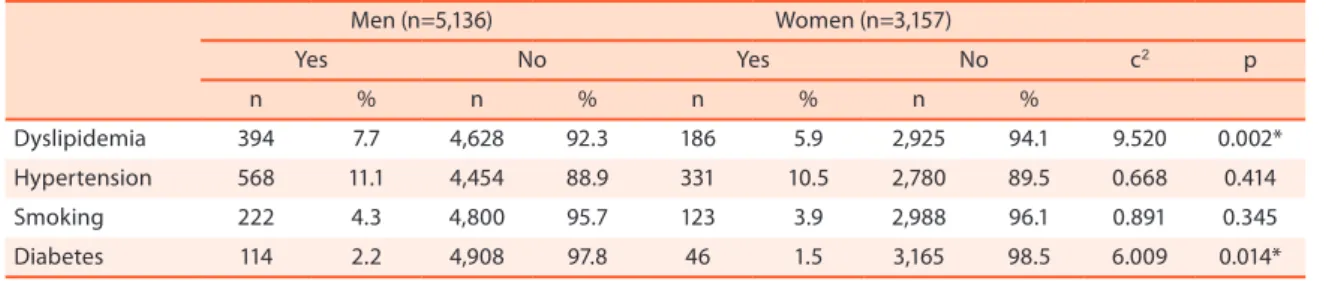
he highest percentage of dyslipidemic and diabetic participants was observed among men. he other comorbidities did not show statistically signiicant diferences between the sexes.
Table 2. Percentage of comorbidities and diference between men and women
Men (n=5,136) Women (n=3,157)
Yes No Yes No c2 p
n % n % n % n %
Dyslipidemia 394 7.7 4,628 92.3 186 5.9 2,925 94.1 9.520 0.002* Hypertension 568 11.1 4,454 88.9 331 10.5 2,780 89.5 0.668 0.414 Smoking 222 4.3 4,800 95.7 123 3.9 2,988 96.1 0.891 0.345 Diabetes 114 2.2 4,908 97.8 46 1.5 3,165 98.5 6.009 0.014*
Legend: n = number of participants; *p<0.05; c2: chi-square.
Box 1 shows the Female Gender-Speciic Equation 1 (F1), Female Gender-Speciic Equation 2 (F2), Male Gender-Speciic Equation 1 (M1), and Male Gender-Speciic Equation 2 (M2). M1 includes nine variables and for F1 the diabetes variable was removed (it was not statistically signiicant and was thus removed from the model). For equations M1 and F1 the ad-justed R2 were 0.531 and 7.150 and the SEE 7.309 and 5.687 ml-1∙kg-1∙min,
respectively. For M2 and F2 we removed the variables HRpre-t, dyslipidemia, diabetes, and arterial hypertension to make the equation simpler and the calculation faster. M2 and F2 had an adjusted R2 of 0.510 and 0.425 and
SEE of 7.309 and 5.743 ml-1∙kg-1∙min, respectively. he independent
M1
VO2peak = 47.189 – 0.394 (age) – 0.282 (BM) – 4.289 (physical activity) + 0.231 (stature) – 0.090 (HRpre-t) – 2.092 (dyslipidemia) – 1.925 (hy-pertension) – 2.901 (smoking) – 2.295 (diabetes)
0.729 0.531 7.150 ml-1∙kg-1∙min
M2 VO2peak = 39.390 – 0.409 (age) – 0.307 (BM) – 4.437 (physical activity)
+ 0.254 (stature) – 3.081 (smoking) 0.714 0.510
7.309 ml-1∙kg-1∙min
F1
VO2peak = 37,844 – 0.250 (age) – 0.208 (BM) – 3.428 (physical activity) + 0.139 (stature) – 0.053 (HRpre-t) – 1.327 (dyslipidemia) – 1.508 (smok-ing) – 1.009 (hypertension)
0.661 0.436 5.687 ml-1∙kg-1∙min
F2 VO2peak = 31.733 – 0.244 (age) – 0.219 (BM) – 3.598 (physical activity)
+ 0.151 (stature) – 1.486 (smoking) 0.652 0.425
5.743 ml-1∙kg-1∙min
Legend: M1: Male equation 1; M2: Male equation 2; F1: Female equation 1; F2: Female equation 2; r: correlation; R2 adjusted: adjusted coeicient of determination; SEE: standard error of estimate; VO2 peak: peak oxygen uptake (ml-1∙kg-1∙min); Values applied in the formula: age in years; stature in centimeters (cm); body mass in kg; physical activity: sedentary (0) and active (1); dyslipidemia: no (0) and yes (1); smoking: no (0) and yes (1); hypertension: no (0) and yes (1); diabetes: no (0) and yes (1) and FCpre-t: value in beats per minute (bpm).
he data in Box 2 show that in terms of the strength of prediction of the independent variables (β weights), age, BM, and physical activity status contributed the most in the prediction.
Box 2 . β weights for the three values with the highest strength of prediction
Equation Variable
F1 F2 M1 M2
Age -0.408* -0.398* -0.474* -0.491*
BM -0.290* -0.304* -0.339* -0.369*
Physical activity -0.219* -0.230* -0.187* -0.198*
Legend: F1: Female equation 1; F2: Female equation 2; M1: Male equation 1; M2: male equation 2; BM: body mass; BMI: body mass index; * p < 0.001
DISCUSSION
CRF is considered an indicator of risk for development of cardiovascular diseases and other chronic degenerative diseases. However, its evaluation and use, either by direct gas analysis or equations based on physical exercise, is limited by equipment cost, space required for the equipment, and the time and qualiied professionals required for the evaluations15. he evaluation of
CRF using regression analyses and variables that do not include physical exercise is a cost-efective and practical alternative for the other methods; it may also be efective for epidemiological studies3,16,17.
Matthews et al.24 concluded that VO2 may be predicted without physical
exercise in epidemiological studies. he participants evaluated were divided into quintiles according to their CRF (measured directly). he model showed that 83.0% of all subjects were either classiied correctly or within one quintile of measured CRF. Misclassiication of a low it individual as high it was only observed in 0.13% of cases24.
Whaley et al.25 agreed that models for predicting CRF are valid because
Prediction of cardiorespiratory itness Cáceres et al.
are insuiciently accurate for predicting CRF in epidemiological studies aimed at evaluating the risk for development of chronic degenerative dis-eases; an opinion contrary to other studies14,16,17.
Our results show that VO2 prediction models that do not require physi-cal exercise can produce valid estimates for the VO2peak for both men and women who are apparently healthy, active or sedentary, and aged 18 to 65 years. Our results are similar to those reported by Blair et al.26 (adjusted R2 =
0.59; SEE not reported); Nes et al.27 (R2 = 0.61 SEE = 5.70 ml-1∙kg-1∙min for men
and R2 = 0.56 and SEE 5.15 ml-1∙kg-1∙min for women); and the Jackson et al.12
equation (adjusted R2 = 0.61 and SEE = 5.70 ml-1∙kg-1∙min), which used BMI
as an alternative for body fat percentage (adjusted R2 = 0.66 and SEE = 5.35)
in the main equation. he reason for using BMI is that it is easy to measure. We also produced alternative equations (M2 and F2). he alternatives did not compromise accuracy to a great extent, and the variables used are simple to measure and can be used in situations where it is no longer possible to obtain data on HRpre-t, arterial hypertension, diabetes, and dyslipidemia. It is a viable, simple and fast alternative.
Wier et al.28 investigated the use of waist circumference as a replacement
for body indexes in equations for predicting CRF without exercise. hree models were developed which difered in terms of waist circumference (R2
= 0.65 SEE= 4.80), body fat percentage (R2 = 0.67 SEE= 4.72) and BMI (R2 =
0.64 SEE= 4.90). However, the model systematically overestimated 3 ml-1∙kg -1∙min among individuals of low CRF, and 7 ml-1∙kg-1∙min among individuals
with high CRF. he equation was more accurate for individuals older than 50 years, less physically active, and with VO2max between 30 and 50 ml-1∙kg -1∙min27. Nes et al.27 also obtained a high accuracy for values between 35 and
50 ml-1∙kg-1∙min for men, and 30 and 40 ml-1∙kg-1∙min for women.
In order to be useful as a tool for stratifying health risks, the model must be able to identify low CRF individuals27. he models27,28 show that
the values in the lower tiers of CRF may misclassify individuals at risk as healthy; therefore, the models should be used with caution. One of the limitations of the present study was that we did not investigate the loss of accuracy at the extremes of VO2peak.
he beta weights (Picture 2) show that the most important variable for predicting CRF was age, with values between -0.398 and -0.491. hese val-ues are similar to those reported by Mailey et al.17: -0.450, and Nest et al.27
who obtained scores of -0.435 and -0.436 for men and women, respectively. he results are higher than those obtained by Heil et al.13, Whaley et al.25
and Bradshaw et al.29. he literature indicates that VO2 reduces between
eight and 10.0% per decade of life ater 25 years of age30,31. Ravagnani et al.31
predict CRF without physical exercise; the importance of these variables is shown by the statistical results17-19,26,29. However, to our knowledge, no
other study evaluated the efect of metabolic (dyslipidemia and diabetes) and hemodynamic (arterial hypertension) disorders for the prediction of VO2. Poorly-explored variables may help improve the strength of prediction of models. hese variables were statistically signiicant for the prediction; however, when removed, their impact is relatively small in the reduction of adjusted R2 and SEE. his is shown by the comparison between equations
M1 and M2 (Figure 1). he simpler equation shows a reduction of 0.021 in adjusted R2 and an increase of 0.159 ml-1∙kg-1∙min in SEE; a similar efect can
be veriied in the F1 and F2 equations (Figure 1), for which the reduction in R2 is of 0.011 and the increase in SEE is 0,056 ml-1∙kg-1∙min. herefore, the F2
and M2 models may be used without a signiicant loss in accuracy when it is either not possible or convenient to obtain information on these disorders. Few studies developed equations for predicting CRF without using tests that involve physical exercise in the Brazilian population18,19. hese studies
had a reduced population sample in comparison to the present study, and they analyzed speciic populations. he importance of the present study is in its population size (8,293 individuals, 3,157 women and 5,136 men, broad age range (19 to 65 years), and CRF range (16 to 75.57 ml-1∙kg-1∙min). he
combination of these factors may allow for useful generalization of the data. However, if compared to the Barbosa et al.19 study, the present study
showed a reduced accuracy. he authors reported an adjusted R2 of 0.90
and an SEE of 3.44 ml-1∙kg-1∙min. he diference is possibly associated with
the reduced range of individuals evaluated in the Barbosa et al. study, and with the classiication of CRF into four categories. One of the limitations of the present study is the retrospective characteristic of the variables used.
CONCLUSION
he equations developed in the present study showed satisfactory predic-tive accuracy based on the statistical requirements for predicting CRF in adults. he equations applied easily-obtained variables and aimed at the evaluation of large population sizes. he equations must be used with cau-tion if the goal is to more accurately predict VO2peak in patients or athletes.
REFERENCES
1. Midgley AW, Mcnaughton LR, Wilkinson M. Is there an optimal training intensity for enhancing the maximal oxygen uptake of distance runners? Empirical research indings, current opinions, physiological rationale and practical recommendations. Sports Med 2006;36:117-32.
2. Duncan GE, Li SM, Zhou XH. Cardiovascular Fitness among U.S. Adults: NHANES 1999-2000 and 2001-2002. Med Sci Sports Exerc 2005; 37(8):1324-8.
Prediction of cardiorespiratory itness Cáceres et al.
4. Tanasescu M, Leitzmann MF, Rimm EB, Willett WC, Stampfer MJ, Hu FB. Exercise type and intensity in relation to coronary heart disease in men. JAMA 2002;288:1994-2000.
5. Lee D, Artero EG, Sui X, Blair SN. Mortality trends in the general population: the importance of Cardiorespiratory itness. J. Psychopharmacology 2010;24:27-35. 6. Bouchard C, Shephard RJ, Stephens T. Physical activity, itness, and health:
interna-tional proceedings and consensus statement. Champaign, IL: Human Kinetics; 1994. 7. Pate RR , Pratt M, Blair SN, Haskell WL, Macera CA, Bouchard C, et al. Physi-cal activity and public health. A recommendation from the Centers for Disease Control and Prevention and the American College of Sports Medicine. JAMA 1995;273:402-7.
8. Noakes TD. Implications of exercise testing for prediction of athletic performance: a contemporary perspective. Med Sci Sports Exerc 1988;20:319-30.
9. Skinner JS. MCLELLAN, T. H. he transition from aerobic to anaerobic metabolism. Res Q Exerc Sport 1980;51:234-48.
10. Wasserman K, Hansen JE, Sue DY, Stringer WW, Whipp BJ. Principles of exercise testing and interpretation. 2a ed. Philadelphia: Lea & Febiger; 1994.
11. American College Of Sports Medicine (ACSM). Diretrizes do ACSM para os testes de esforço e sua prescrição. 6a ed. Rio de Janeiro: Guanabara Koogan; 2003. 12. Jackson AS, Blair SN, Mahar MT, Wier LT, Ross MR, Stuteville JE. Prediction of
functional aerobic capacity exercise testing. Med Sci Sports Exerc 1990;22:863-70. 13. Heil DP, Freedson PS, Ahlquist LE, Price J, Rippe JM. Nonexercise regression mod-els to estimate peak oxygen consumption. Med Sci Sports Exerc 1995;27:599-606. 14. George JD, Stone WJ, Burkett LN. Non-exercise VO2max estimation for physically
active college students. Med Sci Sports Exerc 1997;29;415-23.
15. Maranhão Neto GA, Farinatti PTV. Equações de predição da aptidão cardiorres-piratória sem testes de exercícios e sua aplicabilidade em estudos epidemiológicos: revisão descritiva e análise dos estudos. Rev Bras Med Esporte 2003;9:304-14. 16. Jurca R, Jackson AS, LaMonte MJ, Morrow JR, Blair SN, Wareham NJ, et al.
As-sessing cardiorespiratory itness without performing exercise testing. Am J Prev Med 2005;29:185-93.
17. Mailey EL, White SM, Wójcicki TR, Szabo AN, Kramer AF, McAuley E. Construct validation of a non-exercise measure of cardiorespiratory itness in older adults. BMC Public Health 2010;10:s/p.
18. Lima DF, Abatti PJ. Formulação de equação preditiva do VO2máx. baseada em dados que independem de exercícios físicos. Semina 2006;27:139-49.
19. Barbosa, FP, Fernandes Filho J, Roquetti-Fernandes P, Irany-Knackfuss M. Modelo matemático para levantamento epidemiológico da aptidão física cardiorrespiratória sem teste de esforço. Rev Salud Publica 2008;10:260-68.
20. Lohman WS, Roche AF, Martello R. Anthropometric standardization reference manual. Chanpaign, IL: Human Kinetics,1988.
21. Blair SN, LaMonte MJ, Nichaman MZ. he evolution of physical activity recom-mendation: how much is enough? Am J Clin Nutr 2004;79(suppl);913S-20S. 22. Brandão AP, Brandão AA, Nogueira AR, Suplicy H, Guimarães JI, Oliveira JEP. I
Diretriz Brasileira de Diagnóstico e tratamento da Síndrome Metabólica. Arq Bras Cardiol 2005;84(SI):2-28.
23. Andrade J, Brito FS, Vilas-Boas F, Castro I, Oliveira JÁ, Guimarães JI, et al. So-ciedade Brasileira de Cardiologia. II Diretrizes sobre teste ergométrico. Arq Bras Cardiol 2002;78(supl. 1):1-17.
24. Matthews CE, Heil DP, Freedson PS, Pastides H. Classiication of cardiorespiratory itness without exercise testing. Med Sci Sports Exerc 1999;31:486-93.
25. Whaley, MH, Kaminsky LA, Dwyer GB, Getchell LH. Failure of predicted VO2máx to discriminate physical itness in epidemiological studies. Med Sci Sports Exerc 1995;27:85-91.
Address for Correspondence
Juan Marcelo Simões Cáceres Rod. Amaro Antonio Vieira 2489/107 Bairro Itacorubi.
CEP 88034-102 - Florianópolis, SC. Brazil.
E-mail: [email protected] Sports Exerc 2011; 43:2024-30.
28. Wier LT, Jackson AS, Ayers GW, Arenare B. Nonexercise Models for Estimat-ing VO2max with Waist Girth, Percent Fat, or BMI. Med Sci Sports Exerc 2006; 38(3):555-61.
29. Bradshaw DI, George JD, Hyde A, LaMonte MJ, Vehrs PR, Hager RL, et al. An Accurate VO2max. Nonexercise regression model for 18-65-year-old adults. Res Q Exerc Sport 2005;76:426-32.
30. Jackson AS, Beard EF, Wier LT, Ross RM, Stuteville JE, Blair SN. Changes in Aerobic Power of Men Aged 25-70 Yr. Med Sci Sports Exerc 1995;27(1):113-20.