w w w.jo u r n als . e l s e vie r . c o m / r e v i s t a - b r a s i l e i r a - d e - f a r m a c o g n o s i a
Short
communication
Evaluation
of
the
antimicrobial
activity
of
chitosan
and
its
quaternized
derivative
on
E.
coli
and
S.
aureus
growth
Rejane
C.
Goy
a,
Sinara
T.B.
Morais
b,
Odilio
B.G.
Assis
b,∗ aEmbrapaInstrumentac¸ão,SãoCarlos,SP,BrazilbCursodeCiênciasBiológicas,UniversidadeFederaldeSãoCarlos,SãoCarlos,SP,Brazil
a
r
t
i
c
l
e
i
n
f
o
Articlehistory:
Received25May2015 Accepted8September2015 Availableonline18November2015
Keywords:
Biopolymer Chitosan
N,N,N-trimethylchitosan Antimicrobialactivity Turbiditymeasurements Quaternizationprocess
a
b
s
t
r
a
c
t
Chitosanislargelyknownforitsactivityagainstawiderangeofmicroorganisms,inwhichthemost acceptableantimicrobialmechanismisfoundtoincludethepresenceofchargedgroupsinthe poly-merbackboneandtheirionicinteractionswithbacteriawallconstituents.Thisinteractionsuggeststhe occurrenceofahydrolysisofthepeptidoglycansinthemicroorganismwall,provokingtheleakageof intracellularelectrolytes,leadingthemicroorganismtodeath.Thechargespresentinchitosanchains aregeneratedbyprotonationofaminogroupswheninacidmediumortheymaybeintroducedvia structuralmodification.Thislattercanbeachievedbyamethylationreactionresultinginaquaternized derivativewithahigherpolymericchargedensity.Sincethechargesinthisderivativearepermanents, itisexpectedamostefficientantimicrobialactivity.Hence,inthepresentstudy,commercialchitosan underwentquaternizationprocessesandboth(motherpolymerandderivative)wereevaluated,ingel form,againstStaphylococcusaureus(Gram-positive)andEscherichiacoli(Gram-negative),asmodel bacte-ria.Theresults,asacquiredfromturbiditymeasurements,differbetweenmaterialswithanexpressive reductionontheGram-positivemicroorganism(S.aureus)growth,whileE.coli(Gram-negative)strain waslesssensitivetobothpolymers.Additionally,theantibacterialeffectivenessofchitosanwasstrongly dependentontheconcentration,whatisdiscussedintermsofspatialpolymerconformation.
©2015SociedadeBrasileiradeFarmacognosia.PublishedbyElsevierEditoraLtda.Allrightsreserved.
Introduction
Chitosanisanaturalunbranchedhomopolymerobtainedfrom
chitin,anabundantby-productofseafoodprocessing,viaa
deacety-lationreaction(removalofacetylgroupsCOCH3 fromthechitin
originalstructure) withalkali (Kurita, 2006).Thefinal chitosan
structurehasoneprimaryamineandtwo freehydroxyl groups
foreachmonomerandcanbeexpressedbythegeneralformula
C6H11O4N.Chitosanhasgoodfilm-formingabilityandduetoits
highversatility,thispolymerhasbeenextensivelyevaluatedfor
usesinfoodconservation(BrittoandAssis, 2007a),in
biomedi-calapplications(SinghandRay,2000),asmaterialforchemicals
encapsulationandcontrolledrelease(PatelandJivani,2009)and
inenvironmentalremediation(AssisandBritto,2008).
Commercially,chitosanisfoundfromavarietyofsourcessuch
ascrabs,shrimp,lobsteretc.,usuallysoldinpowderorasflakes
form.Themolecularweightandthedegreeofdeacetylationare
themainparameterswhichdefinessolubilityandphysic-chemical
∗ Correspondingauthor.
E-mail:[email protected](O.B.G.Assis).
propertiesofthispolymer.Tobetransformedinfilmsorpieces,
thechitosanshouldbefirstsolubilizedintogelbyappropriate
sol-ventdissolution.Crudechitosanhowever,isonlysolubleinacid
medium,inpHbelowitspKa(around6.4).Suchmeansadrawback
forbroaderapplicationsofchitosan,asthepHplaysanimportant
roleonitsbiocompatibility(Kurita,2006)andonfilmmechanical
properties(Brittoetal.,2005).
Whenchitosanmoleculesaresubmittedtoanintensive
meth-ylationprocess,aderivativesaltwithpermanentpositivecharges
isgeneratedasconsequenceofthequaternizationoftheamino
groups(identifiedastrimethylchitosan–TMC)(BrittoandAssis,
2007b).Thepresenceofthesechargesinthepolymerbackbone
givestochitosanacationiccharacteristicindependentofthe
sol-vent pH.TMCcanbepreparedinto gelin neutralmedium and
therefore,bettersuited,mainlyforfoodandmedicalapplications
(SinghandRay,2000;Jietal.,2009).
Additionallyseveralmodelssuggestedthat theantimicrobial
activityofchitosanisaresultfromitscationicnature(Rabeaetal.,
2003;Goyetal.,2009).Theelectrostaticinteractionbetween
posi-tivelychargedR N(CH3)3+sitesandnegativelychargedmicrobial
cellmembranes,ispredictedtoberesponsibleforcellularlysisand
assumedasthemainantimicrobialmechanism(Rabeaetal.,2003;
http://dx.doi.org/10.1016/j.bjp.2015.09.010
NH2 CH2OH
(CH3)2SO4
H3C HO
O O
O N+
CH3 CH3 CH2OH
HO HaOH
O O
O
Fig.1.Schematicrepresentationofthereactionleadingtothequaternizationofthe aminogroupsofchitosanresultinginN,N,N-trimethylchitosan(TMC). Quaterniza-tionexperimentaldetailsandTMCcharacterizationandcanbefoundinBrittoand Assis(2007a,b).
Tripathietal.,2008).Chargedchitosancanalsointeractwith
essen-tialnutrientsthereforeinterferingonmicrobialgrowth(Jiaetal.,
2001).Consequentlyisexpectedthatpolymerswithhighercharge
densitiesresultedinanimprovedantimicrobialactivity.
Inthepresentstudy,commercialchitosanwasusedasprecursor
fortransformationintochargedderivativeTMCandboth
materi-als,ingelform,wasevaluatedasantimicrobialagentagainstthe
Gram-negativebacteriumE.coliandtheGram-positiveS.aureus
(commonfoodborneandhospital-acquiredpathogen)asafunction
ofpolymerconcentration.
Materialsandmethods
Methylationprocess
The starting chitosan was of medium molecular weight
(400,000g/mol,75–85%unitiesdeacetylated–shrimporigin)
pur-chased from Sigma-Aldrich Co. (St. Louis, MO, USA) and used
assupplied.For themethylation reaction,a developed
method-ology patented by Embrapa (Empresa Brasileira de Pesquisa
Agropecuária)(BrittoandAssis,2007c),wasused.Inbriefthe
reac-tionconsistsintheadditionof1.2gofNaOH(0.015mol)plus0.88g
ofNaCl(0.015mol)inasuspensionof1gofchitosan(0.005mol)in
16mlofdimethylsulfate(Synth,R.Janeiro,Brazil)and4mlof
deion-izedwater.Themixturewasstirredandthederivativeobtainedby
precipitationwithacetonewasrinsedandvacuumdried.
Themethylationprocessresultsinthequaternizedderivative
TMC(N,N,N-trimethylchitosan),byinsertingmethylfunctionality
ontochitosanaminogroupsattheC-2position(Fig.1).Methylation
detailsandafullcharacterizationofTMCstructurecanbefound
elsewhere(BrittoandAssis,2007a,b).
Gelforming
Gelswerepreparedbydissolvingthechitosanin1%aceticacid
(pH4.0)indeionizedwater andtheTMCsolubilizeddirectlyin
distillatedwater(pH6.6).Thegelswerehomogenizedfor2hunder
moderatedmagneticstirring.Polymerconcentrationsof0.5,1.0,1.5
and2.0g/lwerepreparedforeachmaterial.
Inoculumspreparation
Escherichiacoli(ATCC8739)andStaphylococcus aureus(ATCC
25923)bothprovidedbyFundac¸ãoTropicalAndréTosello,
Campi-nas,Brazil,wereusedasbacteriamodelstoevaluatetheactivity
ofparentandderivatepolymer.Thebacteriapre-culturewas
incu-batedunderaerobiosisandmoderateshakingfor24h.TheE.coli
waskeptat37◦CandtheS.aureusat32◦C,consideringtheideal
temperatureforeachcolonygrowth(Anejaetal.,2009).The
bacte-rialkineticwasdeterminedbymeasuringtheabsorbanceat620nm
wavelengthhourly,followingBohincetal.(2015)procedure,using
aShimadzuUVPC2000(ShimadzuCo.Kyoto,Japan)
spectropho-tometer.Thestationaryphasewastakenasareferencetimefor
comparingthepolymericeffectonbacterialgrowth.
Time (h)
Abs (OD
. at 620 nm)
1.6 1.8
1.4
1.2
1.0
0.8
0.6
0.4
0.2
0.0
0 2 4 6 8 10 12 14
E. coli S. aureus
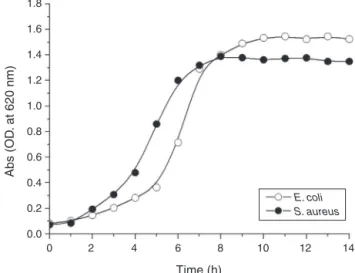
Fig.2.GrowthprofileforE.coli(Gram-negative)andS.aureus(Gram-positive)as assayedbyturbiditymethodat620nm.
Antibacterialassay
The inhibitory effects of chitosan and TMC on the bacterial
growthwerefirstestimatedbymeansofturbiditymeasurements.
Wetook2×108bacteria/mlasareferenceforinitialcolony
quan-tification(Koch,1994).Toattainthisfigure,sequentialdilutionwas
necessary(sixforE.coliandfourforS.aureus)accordingto
simulta-neouscountingofplatecolonies(CFU).Forantimicrobialanalysis,
aliquotsof1mlofbacterialbrothwereaddedto9mlofchitosan
dilutedsuspensionsandkeptundermoderateshakingatroom
tem-perature.Theturbiditywasmeasuredineachpolymericsample
solutionsbyaddingtothemixtureoftheculturedbacteriamedium
andPBS(Phosphate-bufferedsaline),pH7.4.
Theplatewelldiffusionmethod(Raynetal.,1996),wasalsoused
tovisualizetheformationofazoneofinhibitioninaTSB(tryptic
soybroth)solidculturemedium.Theprocedurecarriedusedinthis
analysisfollowstheagardiffusionmethodaccordingtoDuttaetal.
(2009)procedure,inwhichsmallcircularcavitiesarepuncturedin
theculturemediumandfilledwithapproximately0.25mlofgels
foreachpolymerconcentration.50lofbacterialsuspensionwere
spreadandtheplatesstoredfor24hat32–37◦Ctoallow
microor-ganismgrowth.Inhibitionzonesweremeasuredonbasesofthe
averagediameterofthecleararea,directlyonthedishes.Three
replicateplateswereusedforeachconcentrationanddatawere
subjectedtostatisticalevaluationbyone-wayanalysisofvariance
(ANOVA).Thesignificancep≤ 0.05wasconsideredusingaMicrocal
Origin9.0software(OriginLabCo.,Northampton,MA,USA).
Resultsanddiscussion
ThegrowthkineticscurvesofE.coliandS.aureus,asmeasured
byturbidityat620nm,is presentedin Fig.2,whereODstands
forOpticalDensity.Bothbacteriagrowinasimilarwaybutwith
differencesinturbidity.Itis recordedanexponentialincreasing
(logphase)duringthefirst6–8h,followedbythestable
station-aryphase.ThelogphaseforE.coliappearstobelongerthanthat
measuredforS.aureus.Thekineticscurvesforbothbacteriaare
incompleteagreementtoseveralexamplesfoundintheliterature
(Duffyetal.,1999;FujikawaandMorozumi,2006).Theturbidity
readingswiththepolymeradditionwerethencarriedoutafter12h
incubation,assuringtheattainmentofmaximummicroorganisms
pervolume(plateau).
When the polymeric medium is mixed with thereferential
Polymer concentration (g/l)
Absorbance (OD
. at 620 nm)
0.5 1.6 1.4 1.2 1.0 0.8 0.6 0.4 0.2 0.0
0 1.0 1.5
b b c c b b a a E. coli Chitosan TMC 2.0
Fig.3.Absorbance,asmeasuredat620nm,asafunctionofchitosanandTMC con-centrationaddedinthemediumwithE.coli,accordingtoturbiditymethodafter 12hinteraction.Zeropolymericconcentrationmeanstheabsorbancemeasuredin bacterialgrowthinneatTSBmedium.Barswithdifferentlettersarestatistically differentatp<0.05.
onthemaximumabsorbance.FortheGram-negativebacteriaE.coli,
theeffectofcommercialchitosanandTMCadditionasafunction
ofpolymerconcentrationisshowninFig.3,asmeasuredat620nm
wavelength.
Theresultsindicatethatbothpolymersactpositivelyin
reduc-ingbacteria proliferationbut withina shortrange of statistical
significancebetweenmaterials.Foralltestedpolymer
concentra-tionsinthegel(0.5–2.0g/l),chitosan anditschargedderivative
showeda similareffect against E. coli withan apparent linear
tendencyin reducing bacterial populationas theconcentration
increases,ascanbefollowedbythedashedlineinFig.3.
Adifferentbehaviorhoweverwasobservedwhenthese
poly-mers were tested against the Gram-positive bacteria S. aureus
(Fig.4).For thisstrain,both materialsshowa reduction onthe
growthcolonies,wherethechitosanconcentrationisconfirmed
toplayimportantroleintheantimicrobialactivity.Forsolutions
ataconcentrationof1g/lofcommercialchitosan,theabsorbance
issignificantlyreducedindicatingthisasanefficient
concentra-tionforinhibitingtheS.aureusgrowthinliquidmedium.TheTMC,
althoughefficienttooinreducing numberof colonies,doesnot
showaquantitativedependenceontheconcentration.
Tobetterquantifythereduction ofthebacterialgrowthasa
functionofpolymerconcentration,theantimicrobialefficiencycan
bemathematicallydeducedfromtheturbiditydataby
consider-ingthetimederivativeatthemaximumabsorbancemeasuredin
eachsample.Inotherwords,aninhibitory“efficiency”canbeset
asarelationbetweenthemaximumbacterialcolonies(Nc)growth
intheculturemediumwithoutpolymer(control)andthe
propor-tionalmaximum(Npi)asmeasuredinthepresenceofeachpolymer.
Inthestationaryphase theabsorbanceattaineda plateau(Silva
etal.,2010),sotheabsorbanceintensitycanbeconsideredasOD
atdN/dt=0,then:
Ic⇒
dNcdt
controlmax
= 0 and Ipi⇒
dNpi dt
polymermax
= 0 (1)
whereIcandIpiarethemaximumabsorbance,forcontrol(c)andfor
themediumwithaddedpolymer(pi),whenthebacterialgrowth
reachthemaximumpopulation(maximumabsorbance).
Suchaderivativerelationisusefulindefiningthe“Inhibitory
Proportional Factor” (If), which can be considered as the ratio
Polymer concentration (g/l)
Absorbance (OD
. at 620 nm)
0.5 1.6 1.4 1.2 1.0 0.8 0.6 0.4 0.2 0.0
0 1.0 1.5
c b b b b b a S. aureus Chitosan TMC 2.0
Fig.4. Absorbance,asmeasuredat620nmasafunctionofchitosanandTMC con-centrationincontaminatedmediumwithS.aureus,accordingtoturbiditymethod after12hinteraction.Zeropolymericconcentrationmeanstheabsorbance mea-suredinbacterialgrowthinneatTSBmedium.Barswithdifferentlettersare statisticallydifferentatp<0.05.
Polymer concentration (g/l)
Inhibitor y propor tional f actor (%) 0.5 100 90 80 70 60 50 40 30 20 10 1.0 1.5 E. Coli S. aureus Chitosan TMC 2.0
Fig.5. VariationofInhibitoryproportionalfactor(If),accordingtoEq.(2).Thecurves indicatetheproportionalbacterialreductionineachanalyzedculture(S.aureusand
E.coli)infunctionofpolymerconcentrationinthemedium.
betweenthemaximumspecificgrowthforthecontrolsampleand
thosemeasuredwithpolymeradditions,byasimplerelationas:
If=
Ic− Ipi Ic
×100% (2)
AsIfincreases,greatercanbeconsideredtheantibacterialeffect.
Regardingtheturbiditydataasmeasuredinthiswork,the
deriva-tiverelation(2)canbegraphicallyrepresentedforbothtypesof
bacteriaasafunctionofpolymerconcentrationasplottedinFig.5.
Thegraphic indicatesa higher antimicrobialactivityof both
polymers against the Gram-positive specie S. aureus. For this
microorganism,all testedconcentrations of TMCresulted inan
inhibitionascloseas50%over thebacterialcoloniesrelativeto
growthasmeasuredinthecontrolculturemedium.Themaximum
activityisattainedwhen1g/lofcommercialchitosanisadded(for
thisthepeakindicatesapopulationreductionof96%inthecolonies
Chitosan 1 g/l - (
E.coli
)
Chitosan 1 g/l
(S. aureus)
Chitosan 2 g/l
(S. aureus)
Chitosan 2 g/l - (
E.coli
)
Fig.6.Examplesofwellinhibitoryzonesformedbythepresenceofchitosangel,intheconcentrationsof1and2.0g/l,inculturemediuminoculatedwithE.coliandS.aureus
bacteriaafter24hofinteraction.FollowingDuttaetal.(2009),proposedmethod.
observedastheamountofpolymerincreases,reaching
approxi-matelythesameasmeasuredtoTMCwhen2g/lofchitosanwas
added.
The decrease on antibacterial activity as the concentration
increasescanbediscussedintermsofthespatialarrangementof
thepolymerchains:lowpolymerconcentrationsyieldsa better
moleculardistributioninthesolventwitharelativelysmall
num-berinteractionbetweentheneighboringchains,sothecharged
sitesavailableforexternalcouplingaremaximized(Palermoand
Kuroda,2010).Additionally,asstatedbyGabrieletal.(2009),few
numbersofchain–chainbondsmakeseasythemobilityofactive
moieties bypositioningthem onopposite sidesof thepolymer
backbone, which favors interfacial interactions. As the
concen-trationincreases,theformationofhydrogenandcovalentbonds
amongst the functional groups of the chitosan chains is
facili-tated;reducingthedispersionandleadsthestructuretoassume
adenselyoverlapping coiledconformation(Freitas etal.,2010).
Suchrandom-coilshapeofchitosaninsolutionislargelycitedin
theliteratureandattributedtotheextensiveintraand
intermolec-ularbondsatlagermoleculardensities(HejaziandAmiji,2002;
Morrisetal.,2009;Halabalovaetal.,2011).Thisinturnimposes
spatialrestrictionstofunctionalgroups(Solomonidouetal.,2001).
Consequently,aninferiornumberofchargedsiteswillbeavailable
tointeractiontherebyhamperingbindingtobacterialcellwalls.
Thiswasrecentlyconfirmedinourgroupbyanalyzingthe
varia-tionofchitosanconcentrationinfilmprocessinganditseffecton
antimicrobialactivity(GoyandAssis,2014).Ontheotherhand,this
effectisnotregisteredfortheTMC,whichcanbeunderstoodasthe
resultofitshighchargedensityenhancingtherepulsionbetween
thechains.
Concerning the efficiency against the Gram-negative E. coli
strain,bothpolymersshowedinferioractivitywhencomparedto
theeffectmeasuredontheGram-positiveS.aureus.Neither
chi-tosannortheTMCattainedactivitysuperiorto25%inreducingthe
bacterialgrowth.Asmallconcentrationofpolymersalsoappearsto
bemoreeffectiveagainstE.coliwithpeaksofmaximumefficiency
alsoattainedwhen1g/lofTMCand1.5g/lofchitosanwereadded
(Fig.5).
Ingeneral,theantimicrobialeffectivenessofchitosanandits
derivativeagainst Gram-positive and Gram-negativebacteria is
somewhatcontroversial.Insomepublishedworks,theliterature
presentsthatunmodifiedchitosangenerallyactsstrongeron
Gram-negativethanonGram-positivestrains(Noetal.,2002;Silvaetal.,
2010).Suchbetterantimicrobialefficiencyhasbeenattributedto
bacteriumwallcharacteristics,consideringthattheGram-negative
cellwallisthinnerandconsequentlymore susceptiblethanthe
Gram-positive’s.
Therearehowever,contradictoryevidencespresentedby
sev-eral otherauthors,for whom greater activitiesof chitosan and
itsderivativesoverGram-positivestrainswerereportedas
pre-dominant(Sudarshanet al.,1992;Eatonet al.,2008).Although
Polymer concentration (g/l)
Inhibition z
one (mm)
0.5 2 3 4 5 6 7 8 9 10
11 E. coli S. aureus
1.0 1.5 2.0
Fig.7.Sizeofinhibitionzoneasafunctionofcommercialchitosanconcentration inthegel,asmeasuredagainsttheGram-positiveS.aureusandtheGram-negative
E.colibacteria.
groupsandnegativelychargedsitesonmicrobialcellisassumed
as themain antimicrobial mechanism (Rabea et al., 2003), the
thicknessofthepeptidoglycan layercanplay animportantrole
inprovidingarigidstructurewhichcanactasabarrieragainst
chi-tosaninteractions(ZhengandZhu,2003).ThecellwallofE.coli,
forexample,hasathicknessof7–8nmwhilethewallofS.aureus
(Gram-positive)isaround20–80nm(Eatonetal.,2008),whatcan
difficultthecellularlysis.
Byusingtheagarwelldiffusionassaytesting,theactivity
inten-sitycanbevisuallycheckedbyassessingthelocalinhibition(Rayn
etal.,1996),asillustrativeexamplesshowedinFig.6.Duetohigh
solubilityofTMC,it wasnotpossibletoassesstheresultsfrom
thismaterial.Itsdissolutionandfastinfiltrationintotheculture
mediummakesholdingthegelinalimitedwellimpracticaland
thusnotreliable foranydefinitionor inhibitionzone
measure-ments.
The variation of the inhibition for commercial chitosan as
concentrations changes is graphicallyrepresented in Fig.7. By
comparing the action on both types of bacteria, the
inhibi-tion zone method confirms an activity more effective of this
polymer against the Gram-positive bacterium S. aureus (larger
areas) in agreement to results attained from the turbidity
tests.
Itshouldbenotedthattherealantimicrobialactivityofchitosan
isacomplexprocessandforacomplete appraisalseveralother
factors,both intrinsic and extrinsic,shouldbe consideredsuch
as:
(i)Thepolymermolecularweightandthesizeofcoiledofchitosan
chainsarereportedtohaveimportanteffectonmicroorganism
growthandmultiplication(Omuraetal.,2003;ZhengandZhu,
2003;Goyetal.,2009).
(ii)The degree of acetylation: some studies suggested that as
lowerthedegreeofacetylation,higherwillbethe
antimicro-bialeffectiveness(Noetal.,2002;Rabeaetal.,2003)and,
(iii)TheinteractingpH.AslowerthepHmoreintensewillbethe
ioninteraction,since theaminegroupsare protonatedand
apairof electronsontheaminenitrogenbecameavailable
for iondonation generatingahydrolysis ofthe
peptidogly-cansmicroorganismwallconstituents(Sudarshanetal.,1992;
Ngamviriyavongetal.,2010).
Conclusions
Chitosan and its water soluble derivative N,N,N
-trimethylchitosan (TMC), showed antimicrobial activity against
bothGram-positiveandGram-negativebacteriumstrains.Ingel
form, the antibacterial tests carried out by turbidity and well
inhibition zone showed that the chitosan is consistently more
active against the Gram-positive S. aureus than Gram-negative
E.coli.Thechitosanconcentrationinthegelalsoplaysanimportant
role,where apeak ofefficiencyis attainedfor additionof1g/l.
ThederivativeTMC,intheconditionsheretested,showedgood
activitydespite of inferior comparative resultsin all evaluated
concentration.ConcerningtheactionontheGram-negativespecie
E.coli,bothmaterialsresultedininferiorinhibition,independent
oftheusedconcentration.
Ethicaldisclosures
Protectionofhumanandanimalsubjects. Theauthorsdeclare
thatnoexperimentswereperformedonhumansoranimalsfor
thisstudy.
Confidentialityofdata. Theauthorsdeclarethatnopatientdata
appearinthisarticle.
Righttoprivacyandinformedconsent. Theauthorsdeclarethat
nopatientdataappearinthisarticle.
Authors’contributions
RCG(Post-docfellow)wasresponsibleformostofexperimental
work(quaternizationreaction, polymerand gel and
characteri-zationandturbidityessays);STBM(undergraduatestudent)was
responsibleforculturemediumpreparationandbacterialgrowth
andagarwellmethodmeasurements.OBGAdesignedthestudyand
supervisedtheexperiments.Alltheauthorshaverealcontribution
tothefinalmanuscriptwritingandapprovedthesubmission.
Conflictsofinterest
Theauthorsdeclarenoconflictsofinterest.
Acknowledgments
TheauthorthankstoFAPESP(grant07/58715-4)andRede
Agro-Nano(Embrapa)forfinancialsupport.
References
Assis,O.B.G.,Britto,D.,2008.Formed-in-placepolyelectrolytecomplexmembranes foratrazinerecoveryfromaqueousmedia.J.Polym.Environ.16,192–197. Aneja,K.R.,Jain,P.,Aneja,R.,2009.ATextbookofBasicandAppliedMicrobiology.
NewAgeInternationalPublishersLtd.,NewDelhi,India.
Bohinc,K.,Mojca,J.,Rok,F.,Goran,D.,Peter,R.,2015.Surfacecharacteristicsdictate microbialadhesionability.In:Prokopovich,P.(Ed.),Biologicaland Pharmaceu-ticalApplicationsofNanomaterials.,1sted.CRCPress,BocaRaton,p.p208. Britto,D.,Campana-Filho,S.P.,Assis,O.B.G.,2005.Mechanicalpropertiesof
N,N,N-trimethylchitosanchloridefilms.Polímeros5,129–132.
Britto,D.,Assis,O.B.G.,2007a.Synthesisandmechanicalpropertiesofquaternary saltsofchitosan-basedfilmsforfoodapplication.Int.J.Biol.Macromol.41, 198–203.
Britto,D.,Assis,O.B.G.,2007b.Anovelmethodforobtainingquaternarysaltof chitosan.Carbohydr.Polym.69,305–310.
Britto,D.,Assis,O.B.G.,2007.Obtenc¸ãodeN,N,N-Trimetilquitosanapormétodo sim-plificadoempregandodimetilsulfatocomoagentemetilante–Patentdeposition at16/Mar/2007.Protocolnumber0120700262INPI/DE-DF.Brasília,2007. Duffy,G.,Whiting,R.C.,Sheridan,J.J.,1999.Theeffectofacompetitivemicroflora,
pHandtemperatureonthegrowthkineticsofEscherichiacoliO157:H7.Food Microbiol.16,299–307.
Eaton,P.,Fernandes,J.C.,Pereira,E.,Pintado,M.E.,Malcata,F.X.,2008.Atomicforce microscopystudyoftheantibacterialeffectsofchitosansonEscherichiacoliand
Staphylococcusaureus.Ultramicroscopy108,1128–1134.
Freitas,R.A.,Drenski,M.F.,Alb,A.M.,Reed,W.F.,2010.Characterizationofstability, aggregation,andequilibriumpropertiesofmodifiednaturalproducts:thecase ofcarboxymethylatedchitosans.Mater.Sci.Eng.C30,34–41.
Fujikawa,H.,Morozumi,S.,2006. ModelingStaphylococcusaureusgrowthand enterotoxinproductioninmilk.FoodMicrobiol.23,260–267.
Gabriel,G.J.,Maegerlein,J.A.,Nelson,C.F.,Dabkowski,J.M.,Eren,T.,Nüsslein,K.,Tew, G.N.,2009.Comparisonoffaciallyamphiphilicversussegregatedmonomersin thedesignofantibacterialcopolymers.Chem-Eur.J.15,433–439.
Goy,R.C.,Britto,D.,Assis,O.B.G.,2009.Areviewoftheantimicrobialactivityof chitosan.Polímeros19,241–247.
Goy,R.C.,Assis,O.B.G.,2014.Antimicrobialanalysisoffilmsprocessedfromchitosan andN,N,N-trimethylchitosan.Braz.J.Chem.Eng.31,643–648.
Halabalova,V.,Simek,L.,Mokrejs,P.,2011.Intrinsicviscosityandconformational parametersofchitosanchains.RasayanJ.Chem.4,223–241.
Hejazi, R., Amiji, M., 2002. Chitosan-baseddelivery system: physicochemical propertiesandpharmaceuticalapplications.In:Dumitriu,S.(Ed.),Polymeric Biomaterials,RevisedandExpande,2nded.MarcelDekkerInc.,NewYork,pp. 213–238.
Ji,Q.X.,Chen,X.G.,Zhao,Q.S.,Liu,C.S.,Cheng,X.J.,Wang,L.C.,2009.Injectable thermosensitivehydrogelbasedonchitosanandquaternizedchitosanandthe biomedicalproperties.J.Mater.Sci.Mater.Med.20,1603–1610.
Jia,Z.,Shen,D.,Xu,W.,2001.Synthesisandantibacterialactivitiesofquaternary ammoniumsaltofchitosan.Carbohydr.Res.333,1–6.
Koch,A.L.,1994.Growthmeasurement.In:Gerhardt,P.,et,al.(Eds.),Methodsfor GeneralandMolecularBacteriology.Washington,AmericanSocietyfor Micro-biology,pp.248–277.
Kurita,K.,2006.Chitinandchitosan:functionalbiopolymersfrommarine crus-taceans.Mar.Biotechnol.89,2203–2226.
Morris,G.A.,Castile,J.,Smith,A.,Adams,G.G.,Harding,S.E.,2009. Macromolec-ularconformationofchitosanindilutesolution:anewglobalhydrodynamic approach.Carbohydr.Polym.76,616–621.
Ngamviriyavong,P.,Thananuson,A.,Pankongadisak,P.,Tanjak,P.,Janvikul,W., 2010.Antibacterialhydrogelsfromchitosanderivatives.J.Met.Mater.Miner. 20,113–117.
No,H.K.,Park,N.Y.,Lee,S.H.,Meyers,S.P.,2002.Antibacterialactivityofchitosans andchitosanoligomerswithdifferentmolecularweights.Int.J.FoodMicrobiol. 74,65–72.
Palermo,E.F.,Kuroda,K.,2010.Structuraldeterminantsofantimicrobialactivityin polymerswhichmimichostdefensepeptides.Appl.Microbiol.Biotechnol.87, 1605–1615.
Omura,Y.,Shigemoto,M.,Akiyama,T.,Saimoto,H.,Shigemasa,Y.,Nakamura,I., Tsuchido,T.,2003.Antimicrobialactivityofchitosanwithdifferentdegreesof acetylationandmolecularweights.Biocontrol.Sci.8,25–30.
Patel,J.K.,Jivani,N.P.,2009.Chitosanbasednanoparticlesindrugdelivery.Int.J. Pharm.Sci.Nanotech.2,517–522.
Rabea,E.I.,Badawy,M.E.-T.,Stevens,C.V.,Smagghe,G.,Steurbaut,W.,2003.Chitosan asantimicrobialagent:applicationsandmodeofaction.Biomacromolecules4, 1457–1465.
Rayn,M.P.,Rea,M.C.,Hill,C.,Ross,R.P.,1996.Anapplicationincheddarcheese manufactureforastrainofLactococcuslactisproducinganovelbroad-spectrum bacteriocin,lacticin3147.Appl.Environ.Microbiol.62,612–619.
Silva,L.P.,Britto,D.,Seleghim,M.H.R.,Assis,O.B.G.,2010.Invitroactivityof water-solublequaternarychitosanchloridesaltagainstEcoli.WorldJ.Microbiol. Biotechnol.26,2089–2092.
Singh,D.K.,Ray,A.R.,2000.Biomedicalapplicationsofchitin,chitosan,andtheir derivatives.JMSRev.Macromol.Chem.Phys.C40,69–83.
Solomonidou,D.,Cremer,K.,Krumme,M.,Kreuter,J.,2001.Effectofcarbomer concentrationanddegreeofneutralizationonthemucoadhesivepropertiesof polymerfilms.J.Biomat.Sci-Polym.E12,1191–1205.
Sudarshan,N.R.,Hoover,D.G.,Knorr,D.,1992.Antibacterialactionofchitosan.Food Biotechnol.6,257–272.
Tripathi,S.,Mehrotra,G.K.,Dutta,P.K.,2008.Chitosanbasedantimicrobialfilmsfor foodpackagingapplications.e-Polymers93,1–7.