Disorders and Schooling:
knowledge in perspective
Carla K. VasquesI
Claudio Roberto BaptistaI IUniversidade Federal do Rio Grande do Sul (UFRGS), Porto Alegre/RS – Brazil
ABSTRACT – Pervasive Developmental Disorders and Schooling: knowl-edge in perspective. This article examines the education of subjects with Pervasive Developmental Disorders (PDD) considering 107 theses and dis-sertations produced between 2000 and 2012, as well as the guidelines for inclusion and the philosophical hermeneutics. The concepts of PDD, school and education are analyzed here considering the subjects under study, the recurring questions, the gaps and the epistemologies. Results obtained include: increased enrollments; the multiplying of meanings regarding these students and the educational possibilities; an update of old dilem-mas before the new and the different. I fat the level of principles equality and differences are both recognized, the notion of different as unequal still remains within the research context.
Keywords: Special Education. Education. Pervasive Developmental Disor-ders. State of Knowledge.
RESUMO – Transtornos Globais do Desenvolvimento e Escolarização: o conhecimento em perspectiva. O presente artigo aborda a escolarização de sujeitos com Transtornos Globais do Desenvolvimento (TGD) a partir de 107 teses e dissertações produzidas no período entre 2000-2012, das diretri-zes inclusivas e da hermenêutica-filosófica. Considerando os temas abor-dados, as questões recorrentes, as lacunas e as epistemologias, são anali-sadas as concepções de TGD, de escola e escolarização. Como resultados: o incremento dos estudos; a proliferação dos sentidos sobre estes alunos e as possibilidades escolares; a atualização de antigos impasses perante o novo, o diferente. Se, no âmbito dos princípios, são reconhecidas a igualdade e as diferenças, no âmbito das pesquisas ainda persiste a noção do diferente como desigual.
Infidels claim that the rule in the Library is not “sense”, but “nonsense”, and that “rationality” (even humble, pure coherence) is an almost miraculous exception. Jorge Luis Borges, The Library of Babel
The idea of inclusion, seen in the light of the movement that fights for the universalization of human rights, has stood as the guiding per-spective for public policies, for the proposals of public service and for professional formation in different areas of knowledge and social sec-tors1. In the last decades, special education has observed the movements of this discussion with regard to the access of pupils with disability to regular education and, particularly, to their belonging in these spaces based on the recognition of alterity. Such assumptions stirred a great number of discussions and productions focused, among others, on spe-cial education services, on the implementation of policies, on teacher education, on curriculum and management. Despite this activity, the lack of knowledge about school education vis-à-vis the demands of in-clusiveness is still wide (Baptista; Caiado; Jesus, 2008).
With the purpose of constructing a basis of understanding that takes as its premise the valuation of schooling processes, we follow the paths of Brazilian scientific-academic production, theses and disserta-tions. Different authors justify the importance of surveying and system-atizing certain areas and themes in the sense of understanding their movements, their amplitude and their theoretical and methodological trends. According to them, apart from contributing to the advancement of knowledge, this effort can have an impact on teachers’ practices and on the processes of democratization and qualification of the school and of education (Ferreira, 2002; Sander, 2007). We share in their wager, hav-ing as our focus the studies produced in the period between 2000 and 2012, in the field of Pervasive Developmental Disorders (PDD) and un-der the lens of the philosophical hermeneutics.
The German philosopher Hans-Georg Gadamer (1900-2002) dis-cusses in his 1960 Truth and Method the event of understanding. Un-derstanding through interpretation. The dialogue between tradition and the interpreter; the linguistic aspects of understanding versus an impossibility of an objective interpretation.
Understanding is a precondition for the existence of man. The awareness that he himself and the world exist. The objective is not to validate an interpretation and compose a unitary truth. Rather, it is about forsaking the search for an ultimate foundation whence absolute truths spring; about questioning crystallized models that objectify and naturalize the human condition; about defending the historicity of con-cepts that need constant interpretations.
There is, though, a remainder that the word, the letter, does not encom-pass. An impossible, an emptiness of essence and determination from which an ever-contingent knowledge is built. By emptying the human condition from a previous substantiality, Gadamer’s thinking allows us to conceive of being in the world as an enunciative position constructed in the relation with the culture, with the symbolic, with the other.
How does one understand? It is an act laden with prejudices and presuppositions. Hence the importance of a continual movement of self-clarification about our judgments and presuppositions. The reflec-tive process about the basis of proceeding is fundamental, for the non-clarification leads to non-accountability (Hermann, 2002).
In a study of bibliographic character, such presuppositions tran-scend the conventionality of reading, of annotations or of the mechani-cal use of information. The power does not lie in mapping information, despite its constituting an essential stage of the process, but in the countless possibilities opened by the act of interpreting. From the inter-action between the text and the reader, multiple nuances arise. The art of reading the invisible, of looking beyond and of noting. Arts that are made through another art, that of the dialogue. A dialogue to be estab-lished in the sense of opening to the other, trusting in the fruitfulness of exposing oneself and assuming a reflective stance. It is not, however, an effort to translate or reconcile, but of giving visibility to differences and, perhaps, of creating networks of intelligibility between them….
With the threads of theory, of the legal rulings that give bounds to the experience of life and of surveying researches we weave the questions that guide our reflection under the inspiration of the essay (Adorno, 2003), conferring consistency to the arguments by the fabric of threads, and not by the search of a definition.
From the Encyclopedic Inventory to the Construction of
the Archive: reading gestures
We all read ourselves and the world around us in order to glimpse what and where we are. We read to understand, or to begin to understand. We cannot do but read. Reading, almost as much as breathing, is our essential function.
Alberto Manguel, A History of Reading
The point of departure for this investigation was the appreciation of these questions: what is the knowledge produced between 2000 and 2012 by Brazilian graduate programs on subjects with Pervasive Devel-opmental Disorders2? What are the areas involved? What is the place attributed to schooling?
As search categories, keywords, we used nomenclatures accept-ed by the different theoretical fields that deal with this theme: autism; infantile autism; infantile psychosis; pervasive developmental distur-bances; invasive developmental disorders; pervasive developmental disorders; Asperger; autistic spectrum; typical conducts3. At a second moment, we crossed those terms with the following keywords: educa-tion; schooling; special education services; school inclusion4.
We identified 366 academic productions distributed between 2000 and 2012. The references were accessed in full, constituting the documental archive or corpus of the research. As to the analytic pro-cedures, we initially read all abstracts. Later, we organized a database with the following categories: areas of knowledge; institutes of higher education and geographical regions; periodicity of the studies; master and doctorate levels; objects of investigation and methodologies5. From this first reading effort, we obtained a wide picture of the production of graduate students. After that, the works that mentioned schooling, directly or indirectly, where read in full.
The field of Pervasive Developmental Disorders, of autism and in-fantile psychosis has a recent and complex history. Initially unknown as entities, they were part of the wider group of “idiocies”, a nosographic category current up to the 19th century that included a whole range of deficit problems.
The process of transformation of these concepts occurred from the 20th century onwards, and can be subdivided into two major mo-ments. The first moment corresponds to the first 40 years, when the initial – and essential – movement was one of accepting the existence of psychopathologies in childhood. The second moment is character-ized by the revolution in the history of psychopathologies that occurred since 1943 with the works by Leo Kanner. More important than the de-scription of a new nosological condition – the Autistic Disturbances of Affective Contact –, his act defined a psychopathology proper to child-hood and to the child (Berquez, 1991).
The picture described by Kenner was widely disseminated among professionals. However, it became apparent that not all children dis-played characteristics similar to the ones initially identified. Numer-ous investigations were then initiated on developmental problems and, particularly, the controversies associated to terminology and etiology intensified.
Analyzing the documental sources, we observed the continuity of the theoretical and conceptual discussions. The opinions and per-spectives are disparate and controversial, without consensus as to who these subjects are, what are their subjective, social, and educational possibilities, and what strategies or resources could stimulate (or not) their development, constitution, schooling etc.
Linguistics, Literature and the Arts (6.5%), ten from the Biological Sci-ences (2.8%), two from Engineering (0.5%), one from Computer Science (0.25%), and one from the Exact Sciences (0.25%). Considering the areas, Psychology concentrates the largest number of studies (175, or 71%), fol-lowed by Education with seventy-three documents (29%).
We identified five major themes: schooling (107, or 29.3%); thera-peutics and therapies (101, or 27.6%); assessment, scales and testing (90, or 24.6%); diagnostics/etiology (51, or 13.9%); social inclusion (17, or 4.6%).
Generally speaking, the archive reveals: the recent and fragile in-terest of the public sphere in the construction of legal devices that allow more agility and quality of social assistance, schooling and medical ser-vices; the processes related to assessment (scales and testing), to thera-peutics and therapies and, particularly, to schooling as themes privi-leged by of authors and theories; the still incipient dialogue between the different disciplines. There are also some consensual matters: some unity regarding the multiplicity of clinical and subjective expressions; the precariousness of services offered, and the ephemeral nature of the knowledge built so far.
Amidst so many “truths”, the archive can be regarded as a place of contiguity and rupture. Continuity with the modern scientific dis-course, with the prestige of mathematical thinking as a measure of all sciences and of philosophy itself; with the belief in reason as the only way of knowing the truth, mistrusting any knowledge seen as intuitive, aesthetic etc.; with the unconditional freedom of man to rule his des-tiny; with ideas and ideals of subject and autonomy; with the conviction that tradition can be ignored, and that we can devote ourselves entirely to the future (Chauí, 2005; Hermann, 2002).
Manguel (2006) says that, faced with this clear, diurnal, system-atic and structured reading, we can devise a different form of reading: nocturnal, adulterous, with blurred limits and certainties. In this sense, the archive can also be read as questioning this scientific, technically rational ideal that is typical of it; of the method as the single valid way of constructing knowledge; of the epistemological bonds and record-ing tables. Ruptures are thereby sought, capable of shakrecord-ing, disturbrecord-ing the familiarity of our thinking, of our forms of reading, perceiving and interpreting…
A second reading gesture focused on the academic-scientific “ge-ography” of the 107 documents relative to the “schooling” theme. How is this theme approached? What are the recurring questions, the gaps and tendencies?
re-signifies guidelines, alternatives, interpretive dilemmas and disputes. There is not a single meaning, neither is it possible to know or interpret everything. This limit makes it possible to oppose the objectivation, the domestication and tyrannizing of the other, of the different, sometimes engendered by ingenuous or “politically correct” readings.
Under this ethical drive, we propose to establish a dialogue be-tween the graduate students’ academic production and the special edu-cation policies. It is important to stress that most studies about school-ing do not refer to legal and normative documents directly; there are allusions, footnotes and loud silences, especially when the focus is on the teachers’ practice. It is as if the pedagogical practice, the teaching and learning were self-determined. We adopt a different interpretive route by understanding that the letter of the law guides produces and draws important boundaries to the state of knowledge. It is not, how-ever, a case of continuity, direct interdependence or subservience. The policies face the subjects and the institutions with problems. The the-ory and the intellectual efforts allow a different discursivity by unveil-ing, subverting and interrogating naturalizations and objectivations, constructing a degree of alterity with respect to political interests and the short-termism of the practice. The political text gives contours to a reality whose quality is decided in the arena of the disputes, resistances and combats. The letter of the law does not circumscribe completely the possibilities of the event. As letter, it implies reading. And as reading, it implies – no matter how much one wants to sweep away the equivocal in its expression – an opening to the meanings. Reading is never linear, univocal or consensual…
The Schooling Between Ruptures, Repetitions and
Forgetfulness: traces of a reading…
Why do we seek definitions of identity in words, and what is, in such a quest, the storyteller’s role? How does language itself determine, limit, and enlarge our imagination of the world? How do stories we tell help us perceive ourselves and others? [...] And to conclude, is it possible for stories to change us and the world we live in?
Alberto Manguel, The City of Words
The persistence, the growth and intensification of this situation, alongside the universalization of basic education and the international conferences that deal with those who are “outside”, introduced the in-clusion guidelines in the political landscape. Brazil implemented a se-ries of laws, policies and programs focused on the reduction of inequal-ity, and on school inclusion.
In the last nineteen years, special education has followed this movement re-signifying itself as an area of knowledge and modality of education service. The 02/2001 CNE-CEB Resolution, for example, moves forward by stipulating that schooling must take place under reg-ular education. In this same decade, we observe a series of initiatives aiming at the expansion of the number of subjects educated (Baptista, 2011).
With the 2008 National Policy for Special Education in the Per-spective of Inclusive Education this approach is strengthened:
More than a guiding document, the Policy constitutes a landmark in the organization of the inclusive education system [...] strengthening a concept of special education that does not allow, not even in exceptional circumstanc-es, the use of this service in substitution of the schooling carried out in regular education (Griboski, 2008, p. 57).
In that text and in the legal documents that preceded it, the sub-jects with PDD see their schooling guaranteed for the first time, being identified as people who display,
[…] a condition of alteration in their neuropsychomotor development, deficit in social relations and in commu-nication, motor stereo typicalities. Pupils with classic autism, Asperger syndrome, Rett syndrome, childhood disintegrative disorders (psychoses), and invasive disor-ders without further specification are to be included here (Brasil, 2008, p. 9).
It is a “symbolic birth” for these children and teenagers in the field of educational legislation, followed by the possibility of our questioning diagnostics conducted under closed categorizations.
The definitions of target population must be brought into context, and are not exhausted by the simple categoriza-tion and specificacategoriza-tions attributed to a condicategoriza-tion of handi-cap, disorders, disturbances and aptitudes. It is consid-ered that people change continuously, transforming the context in which they are immersed (Brasil, 2008).
The legal ordering transforms school, and the increase in enrol-ment is observed in the census basis and in the studies. The right to education guarantees access to school. The rights to equality and to difference reorganize the services, the concepts and the profession-als involved with the school context, projecting new contours profession-also on the sphere of the researches6. Social, political and scientific-academic agendas are rewritten…
It is in this historical, cultural and political process-ness that we understand the gradual increase in the number of studies focused on the schooling processes, as well as the themes and their approaches.
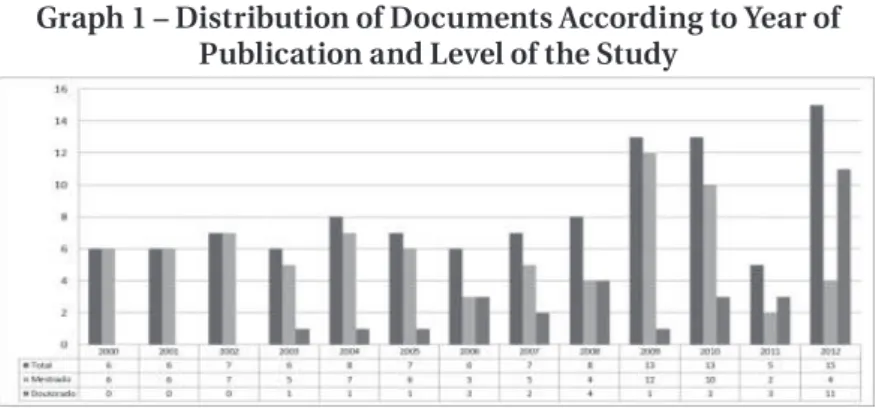
Graph 1 – Distribution of Documents According to Year of Publication and Level of the Study
Source: BRASIL. MEC/CAPES/BDTD and BIBLIOTECAS DIGITAIS IES. Data systematized by the authors.
According to Graph 1, there has been in increase of 150% in the total number of studies between 2000 and 2012. Among the studies, sev-enty-seven (71.9%) are master’s studies, and thirty (28.1%) are doctoral studies.
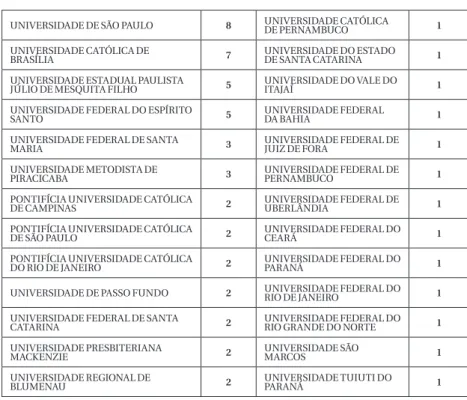
We have thirty-two Institutions of Higher Education (IHE) mostly concentrated in the South East and South Regions, with a predomi-nance of the Universidade Federal do Rio Grande do Sul (18); Univer-sidade Federal de São Carlos (17); UniverUniver-sidade do Estado do Rio de Janeiro (11); Universidade de São Paulo (8) e Universidade Católica de Brasília (7).
Table 1 – Number of Documents According to Region of Production
IHE NumberTotal IHE NumberTotal
UNIVERSIDADE FEDERAL DO RIO
GRANDE DO SUL 18 PONTIFÍCIA UNIVERSIDADE CATÓLICA DE GOIÁS 1
UNIVERSIDADE FEDERAL DE SÃO
CARLOS 17
PONTIFÍCIA UNIVERSIDADE CATÓLICA DO RIO GRANDE
DO SUL 1
UNIVERSIDADE DO ESTADO DO RIO DE
UNIVERSIDADE DE SÃO PAULO 8 UNIVERSIDADE CATÓLICA DE PERNAMBUCO 1
UNIVERSIDADE CATÓLICA DE
BRASÍLIA 7 UNIVERSIDADE DO ESTADO DE SANTA CATARINA 1
UNIVERSIDADE ESTADUAL PAULISTA
JÚLIO DE MESQUITA FILHO 5 UNIVERSIDADE DO VALE DO ITAJAÍ 1
UNIVERSIDADE FEDERAL DO ESPÍRITO
SANTO 5 UNIVERSIDADE FEDERAL DA BAHIA 1
UNIVERSIDADE FEDERAL DE SANTA
MARIA 3 UNIVERSIDADE FEDERAL DE JUIZ DE FORA 1
UNIVERSIDADE METODISTA DE
PIRACICABA 3 UNIVERSIDADE FEDERAL DE PERNAMBUCO 1
PONTIFÍCIA UNIVERSIDADE CATÓLICA
DE CAMPINAS 2 UNIVERSIDADE FEDERAL DE UBERLÂNDIA 1
PONTIFÍCIA UNIVERSIDADE CATÓLICA
DE SÃO PAULO 2 UNIVERSIDADE FEDERAL DO CEARÁ 1
PONTIFÍCIA UNIVERSIDADE CATÓLICA
DO RIO DE JANEIRO 2 UNIVERSIDADE FEDERAL DO PARANÁ 1
UNIVERSIDADE DE PASSO FUNDO 2 UNIVERSIDADE FEDERAL DO RIO DE JANEIRO 1
UNIVERSIDADE FEDERAL DE SANTA
CATARINA 2 UNIVERSIDADE FEDERAL DO RIO GRANDE DO NORTE 1
UNIVERSIDADE PRESBITERIANA
MACKENZIE 2 UNIVERSIDADE SÃO MARCOS 1
UNIVERSIDADE REGIONAL DE
BLUMENAU 2 UNIVERSIDADE TUIUTI DO PARANÁ 1
Source: BRASIL. MEC/CAPES/BDTD and BIBLIOTECAS DIGITAIS IES. Data systematized by the authors.
Schooling, as an ordering and classifying category, refers to the rights to education, to equality and to difference; to the implementation of special education policies in an inclusive perspective within educa-tion systems, in the classrooms and in the organizing forms of peda-gogical work; to regular education as a privileged space in which to be a pupil; to the wager on educability. Such questionings, tensions and in-tentionalities, according to Table 2, belong to several fields of knowledge.
Table 2 – Distribution According to Areas of Knowledge
MAJOR AREAS AREAS SUBAREAS
HUMAN SCIENCES (100)
Education (73)
Special education (62) Fundamentals of education (6)
Educational technology (4)
Educational planning (1)
Psychology (27)
Psychology of human development (13)
Psychology of teaching and learning (4)
Psychological treatment and prevention (7)
HEALTH SCIENCES (3)
Collective health (1)
Speech therapy (1)
Public health (1)
Communication disorders (1)
Physical education
(1) Adapted sports (1) EXACT AND
EARTH SCIENCES
(1) Mathematics (1) Mathematical education (1)
COMPUTER SCIENCES (1)
Computing methodologies and
techniques (1) Applied computing (1)
LINGUISTICS, LITERATURE AND ARTS (2) Arts (2)
Music (1)
Plastic arts (1)
Source: BRASIL. MEC/CAPES/BDTD and BIBLIOTECAS DIGITAIS IES. Data systematized by the authors.
Summarizing, condensing, and structuring: movements that, by constructing visibilities and lights produce, paradoxically, selections, omissions, and shadows. In the effort to describe and understand the state of knowledge about the schooling of subjects with PDD, we have to stress once more: the presence of words, themes and sub themes in common does not imply the sharing of ideas and ideals. There is not a unique reading about pupils, school, education, school inclusion etc. The existence of multiple interpretations precludes consensus about the pupils, their learning and schooling possibilities, as well as about the function of the school and of education. Such divergences, if un-derstood from the viewpoint of a historic-cultural process-ness, do not constitute a practical-theoretical limit. On the contrary, the plurality of the meanings can represent a first step towards allowing different solu-tions for the quessolu-tions raised in the encounter with these children and adolescents.
Classifications create classifications, according to Borges (2007) and Perec (2006). A new gesture of reading collected the studies accord-ing to six wide themes (Table 3), divided into sub themes accordaccord-ing to the specificities described by the author7.
Table 3 – Categories of Studies According to Theme
CATEGORIES NUMBER OF STUDIES
TEACHING AND LEARNING PROCESSES 31
PEDAGOGICAL WORK 25
DIAGNOSTICS AND IDENTIFICATION PROCESSES 21
RELATIONS BETWEEN THE CLINIC AND THE SCHOOL 14
SCHOOL INCLUSION 09
RELATIONS BETWEEN SCHOOL AND FAMILY 07
Total 107
How does one teach children and teenagers, and what can they learn? From the measurement of abilities and from the profiles consid-ered as typical of autism, teaching and learning processes derive. We have to identify, evaluate and describe behaviors in order to define teaching plans and learning goals. Which structured teaching and training pro-grams? The TEACCH – Treatment and Education of Autistic and Com-munication Handicapped Children, the NFC – Natural Functional Cur-riculum and the ITP – Individualized Teaching Program, are considered the most adequate to the specificities of these subjects8.
Under a different perspective, the teaching and learning process-es are built in the encounter of subjects and institutions. It is important to reflect on how learning is conceived by the teacher, to emphasize the body as a possibility for intercommunication (gestures, displace-ments, looks); to understand the relational dynamics of this segment of pupils and their demands upon the teacher. How do prejudices, social representations and the stigmas in the forms of teaching and learning become present? These are questions that motivate qualitative studies, and individual or group case studies.
Considering the relational difficulties and the problems in speech and language, is it possible to think about computer and technological resources as mediators of teaching and learning? The accessibility to curriculum, to communication and to technology facilitates the devel-opment of social interaction by allowing the school inclusions of chil-dren with autism, some researchers say.
Various studies focus on the pedagogical work within an inclusive context: which didactics, content and techniques are more adequate to the practice in the classroom? How do we organize school time and space? How do we adapt curricula, teaching plans and the classes? How do we assess those that do not seem to be learning? Which continued education, strategies, methodologies and knowledge are necessary for the development of didactics and techniques focused on the special educative needs of autists?
The studies approach different and, sometimes, conflicting theo-retical perspectives as, for example, the Theory of Structural Cognitive Modifiability, the historical materialism, and the systemic and psycho-analytic perspective, in order to underline the importance of a critical reflective attitude, of shared teaching and of pedagogical innovation as prerequisites.
to individualized educational programs and psychoeducational treat-ment. The other group of researchers investigates classification systems and their impact on schooling processes, the medical model and the weakening of the teacher’s role following a reading that sees the sub-jects with PDD as deficient and inept, which overrates the knowledge of experts to the detriment of the knowledge built in the school experi-ence. Such studies question these themes in school systems, at school, in the classroom, in publications and specialized scientific-academic documents. In search of alternatives, many bet on the deficiency so-cial model as a framework capable of constructing new interpretations. They say that discrimination, the disadvantages and inabilities associ-ated to the PDD and the suffering caused by this encounter are themes that are present throughout the issue of school inclusion. One does not value or consider as equal just about anyone, and in order for that rec-ognition to occur there must be a work done so that the non-similarity, or rather the alterity, does not become a threat. How does the dialogue between treating and educating, between the clinical and the school, influence the constitution of this possibility? How do we keep to these paths when we notice a vision that values the socializing dimension of the school to the detriment of the systematization of formal knowledge?
Studies approach reading and writing as subjectifying for these children. Based on the psychopedagogical and psychoanalytic clinic, and on the school inclusion in public education, studies deal with the specificities of these productions due to the overflow of psychotic sub-jectivation in the text, of the strangeness that such writings and read-ings cause in the school space and of the possibilities of constructing knowledge for these subjects as long as such strangeness is not natural-ized or domesticated. The authors defend the need to construct spaces for the recognition and valuation of singularity, so that the school oc-cupies a constitutive and therapeutic function.
What are the limits and possibilities derived from the access to, and permanence in, regular education? How do we sustain school inclu-sion of pupils with PDD? What are its effects for the school, the manage-ment and the teachers’ work? As themes to be studied we observed: the significations, the dilemmas and teachers’ representations; the effects of these representations in the relations between the school, the family and the pupils; the decision to enroll in regular education, the entry in this space and this strategies for the permanence and progress in early childhood education and in fundamental education.
Relying on educability and, especially, on the cultural-historical approach as a theoretical and ethical lens, studies reveal the delicate and arduous path to literacy, to the place of a pupil as a learner, and to the possibility of inhabiting the school in its multiple spaces and mar-gins.
children themselves faced with the demands associated to school in-clusion. Based on reports of teachers and parents, they catalog failures, dilemmas and sufferings originated in a school that has as its metric the normality and the homogeneous production of knowledge and know-how.
What is the place of the family in the schooling processes? How does one establish relations that allow cooperative work? Can the fam-ily choose which space is more adequate to educate their child with PDD? Trying to apprehend the perceptions, the points of view of par-ents, brothers and/or caretakers regarding the treatmpar-ents, institutional and relational experiences etc., authors have paid attention to the rela-tions between school and family in the context of a specialized educa-tional service, of special schools, and of common schools.
The theme also circumscribes a universe of significations, rep-resentations, affects and reactions associated to the life of the autistic child or teenager at home and/or at school. Through case studies, both qualitative and quantitative, the family dynamics, the communicative styles and, more recently, the coping strategies, that is, the resources employed by family members to adapt to adverse circumstances, such as the efforts made to deal with stressing, chronic or acute situations related to inadequate, stereotyped, or aggressive behavior by their chil-dren or brothers, have been described, measured and interpreted. To capacitate the health or education professional to deal with such de-mands through clinical service and educational programs, as well as to identify the nuances and changes in the family functioning in order to propose interventions are some of the objectives of these researchers.
In our coarse map of the state of knowledge about the schooling of subjects with PDD, it calls attention the incipient presence of studies that deal with the specialized educational service as a complementary action; the recurrent question about the limits and impossibilities of school inclusion in the context – even physical – of special schools and classes; the teacher formation centered mainly on technical and instru-mental aspects of a professional know-how; early childhood education as the priority locus of inclusive actions.
What conceptions of PDD, of school and schooling ground the studies? In order to expand the horizons of our understanding, it is nec-essary to put in perspective the epistemological strands related to the themes and sub themes categorized.
autism, in order to perfect the processes of teaching and learning, of pedagogical work and evaluation. Evaluation and the detailed descrip-tion of observable behavior are, therefore, fundamental. They allow the drawing of distinctions and boundaries in the spectrum or continuum of autism. Through experimental or quasi-experimental research, the paths, didactics, teaching plans and training programs are generalized.
The investigative procedures are objective and aim at accurate measures or reflections of the object, taken as independent from the researcher. They believe in the possibility of measuring and predict-ing aspects related to subjects with PDD and their reality. Amenable to quantification and statistical analysis, these aspects would be suitable to systematic organization, such as, for example, behavioral repertoires, communicative, adaptive, and cognitive profile etc. These descriptions are central to the educational process insofar as they organize curri-cula and proposals for intervention in residential, special school, and regular education contexts. It represents education under a behaviorist strand, focused on the teaching and learning of abilities considered as functional and useful; whose objectives are behavioral and attitudinal change.
For ninety researchers (84.2%), the phenomenological-herme-neutic or quantitative perspective establishes a penetrating criticism of scientific objectivism, proposing instead subjectivity as the found-ing element of human acts and social reality. Based on an interpretive understanding, they focus on human experience, on complexity, and on the historical, social and cultural milieus that constituted it. The interpretive process implies a constant movement, a dialogue between subjects, situations and objects investigated, without any absolute be-ginning or end (Sanchez Gamboa, 1996).
According to latter assumptions, the main purpose of these stud-ies is to understand the dynamics (psychic, unconscious, cultural, his-torical, school etc.) of the subjects with autism and infantile psychosis, as well as of their family members, educators and institutions. The eti-ologies and interpretations are manifold, according to the classifica-tion systems, to different psychoanalytic, sociohistorical, cognitivist or systemic explanations. In some texts, it is highlighted the singularity of these conditions, in opposition to a reading bound by the patterns of normality. Based on case studies with teachers, pupils and/or institu-tions, and bibliographical and theoretical researches, they reflect upon school inclusion, public educational policies, and the constitutive func-tion of school and of the educator. In this sense, they seek to understand the present possibilities and limits within the school context of Brazil, bringing to light the tiny, unique encounters built at the borders of one or various disciplines.
lan-guages and dialects. The interpretations and outlooks diverge, con-verge, multiply, and smother one another.
Conceived after the classification systems, such as the ICD-10 (OMS, 2000) and the DSM-IV-TR (APA, 2002), the notion of autism as a single condition comprising different levels of gravity (dependent, above all, on language and/or intelligence) is accepted by the major-ity of researchers, independently of their epistemological standpoint. However, the diagnostics and descriptive psychopathology are not in-terpreted uniformly. Some authors do not problematize such references, treating them generically, that is, they use them as a way of ‘identifying’ the subject to be studied, without contextualizing the historicity of con-cepts, their limits and implications; others adhere to this framework as long as the etiology is not better defined, which temporarily precludes a different kind of classification; there are also those who proclaim them-selves categorically atheoretical. When taking in our hands the text that constitutes these manuals, we observe erasures, reading noises, some passages underlined, others forgotten…
Sometimes infantile psychosis and autism, or psychosis and au-tism, are referred to as different conditions. Others say that none of this exists, that what is correct is to confirm autism or autism spectrum ac-cording to the notion of continuum, that is, of one condition with differ-ent degrees of gravity. There are those who say: we speak of metabolic errors, of neuropsychiatric disorders that, even without an identified biological marker, imply cognitive deficits. Others reply: we speak of madness and, even more, of infantile madness with characteristics dif-ferent from that of the adult. And therein one speaks, for example, of ‘refrigerator mothers’, responsible for the ‘empty fortresses’ into which their children have turned. Or of psychoses and infantile autism as sub-jective positions.
The dialogue with diagnostic systems and classification logics is intense but not always sufficiently clarified. The crucial point of the ab-sence of reflection about the historical determinants and of the concep-tions of subject present in the creation of the diagnostics is the fact that different understandings carve different school trajectories, inscribing different fates.
The place of the subject, of the teacher and of the pupil is then subtracted, deflated by a causality that imposes itself even before any act by any one of them may be in-scribed. A causality that is not constructed from the ef-fects of the practices and encounters, but that arrives first – before the subjects themselves –, and removes responsi-bility from the scene (Rickes, 2004, p. 12).
‘constel-lations of symptoms’ remains veiled and unclear. The autist’s reality is natural to him/her, been explained by science and made clear through diagnostics, classifications and evaluations. The failure or limits of the schooling process, under this perspective, are on the autistic pupil – be-cause of their genes, behavioral changes, neurological and affective im-balances etc. The different made unequal is responsible for the school and equality. To Arroyo (2010), this perspective has deep roots in Brazil-ian school culture.
Another recurrent meaning supposes, even with respect to the State and its policies, the culpability of the teacher for the school and ‘inclusive’ dilemmas. There is technical incapacity of the teacher to ca-ter for subjects with such special educative needs. From the technicist logic, derive as solutions adapted and individualized programs, of a be-havioral or cognitivist nature, in common and special schools.
A few studies try to understand the encounter of these pupils, their teachers and schools that takes place between the political statements and diagnostics, economic and historical edicts, a space ‘between’. By expanding the understanding horizons, the questions and the possible answers are complexified, understood as partial and provisory. Every boundary includes and at the same time excludes and, in the educative situation, there will remain unpredictable aspects and grey areas. The schooling of pupils with PDD requires a work to be developed in the col-lective, as well as the construction of a particular style of teaching and the responsibility for a process to be sustained at different levels.
From the encyclopedic inventory to the invention of a reading, we understand that the experience of schooling involves a shared con-struction. Terms like autism, infantile psychosis, PDD, school, school-ing, school inclusion etc. refer to concepts and linguistic constructions originated in different rationalities and epistemologies. Systems more or less closed that erect certain perspectives. The interpretation takes place based on the understanding horizons. It is the historicity, the rationalities, the conditions of production of the texts, the hegemon-ic meanings that amalgamate certain perspectives. There is always the risk of ‘essentializing’ or ‘naturalizing’ our lens and conceptions, particularly if we generally disregard the limits of knowledge, if we de-politicize its contents. Hence the need for constant self-clarifying, for reflecting upon the basis of our doings.
Subjects With PDD towards School and the Learning: a
horizon under construction…
What is important is not just listening to what others say, but to listen to one another. Solely that is understanding. Hans-Georg Gadamer, Truth and Method
Develop-mental Disorders considering the possible relations, dialogues and setbacks that constitute the Brazilian graduate student academic pro-duction in the period between 2000 and 2012 has surprised us at ev-ery page. We observed the closer contact between the disciplines, the most complete reciprocal and even derogatory strangeness, the loudest and most embarrassing silences. In search of the multiple relations that cross each other within the archive, we noticed that the texts placed next to each other told a story that none of them could tell alone. To give visibility and voice to such polyphony, thereby contributing to multiply and refine our look upon and with these subjects and their school pos-sibilities, was the main challenge of this article.
In the construction of these possibilities, it seems to us that it is urgent to question the conception of ideal pupil and teaching; of secu-rity and control over the teaching and learning process; of a subject as an essence to be unveiled, measured, and labelled. The school experi-ence involves a shared construction based on the assumptions about school, education, the society etc. The political text – its lines, margins and between the lines – offers a first outlook, it establishes the limits of a stage where takes place the ballet of the significants that, by articu-lating themselves, engender singular meanings. What are the possible significations?
Answering this question was not the prime objective of this essay, which concentrated rather on situating the need to put it on stage. True to the essay tradition, “It starts not with Adam and Eve but with what it wants to talk about; it says what occurs to it in that context and stops when it feels finished rather than when there is nothing to say” (Adorno, 2003, p. 16-17).
With the educational guidelines of a decidedly inclusive charac-ter, a new chapter in special education and in the scientific-academic agenda is written. The rights to education guarantees unrestricted ac-cess to schooling. The rights to equality and to difference reorganize the services, the concepts, the ‘geography’ of the studies, there land-scape, boundaries and gaps. To what extent do such movements decon-struct meanings that correlate difference to inequality, to abnormality and to uneducability?
Considering our archive, the themes and su bjects approached are multiple, as are also multiple the forms of interpreting the policy, of producing and reproducing meanings related to difference through the lens of inequality and/or identity. If, at the level of the principles, equal-ity and differences are recognized, in research there persists the notion of the different as unequal. The different is equated to abnormality and one ends up reproducing (and justifying) inequality. In this context, the fascinating and efficacious scientific knowledge offered by the classi-fication manuals justifies impoverished and objectifying understand-ings and school trajectories. The efficacy and fascination derive from the form: a descriptive, classificatory model, in which everything is accounted for and organized. The harmonious closure of what there is and what there is not, of what is and what is not. The representation of something considered as clear, concluded, known. What are the effects of this harmonious equation faced with the immensity of the human? A totalizing knowledge that limits the universe of the spoken: the disor-ders become a priori phenomena, independent of the social bonds that give them existence. The schooling of pupils with PDD is governed by impossibility, by the culpability of the subjects, either children or their teachers.
From this enunciative position issues a meaning with profound roots in school culture: the pedagogical practices exist independently of their context, of interpretations and policies. The organic, social, psy-chic, and behavioral differences are equated to identities. These identi-ties give birth to curricula and interventions that justify the school in-equalities. The autist! This state in which one is everyone and no one, the singularity is subjugated by the repetition of the identical. Gadamer says that the notion of identity is detrimental to social justice. In the name of a difference read as identity, we removed from the scene alter-ity, the difference as a condition of being. It is not the recognition of the other, but his/her erasure.
The different as different. Amidst the nuances of understanding, in the encounter with the other, with the plural, it may be possible to readjust focus, to build new ‘others’, expanding and perhaps modify-ing the understandmodify-ing horizons. The hermeneutic experience proposes the availability to openness, to the unpredictable. It relies on dialogue; however, its happening requires listening to the other as an other, keep-ing his/her alterity. This is the challenge. A challenge to be sustained by policies of belonging, and not by the “ideal of unicity as synonymous with equality of rights. Education (in abstract), right (in abstract) of every(abstract) citizen. Without faces” (Arroyo, 2010, p. 1386).
forms of thinking about them. The attempts to recognize the different have been made through violent abstraction, and in order to affirm the universal right to education we have excluded the strange, the other, the different.
Is there a single understanding of this movement? To establish an inflexible meaning is to believe that policies and researches can exist independently of the context and of teachers, pupils, schools and re-searchers; of the times and conditions of the reading. The world values objects/subjects in the way it relates to them. Just like this valuation, the relating is modified. The same transition occurs with the percep-tion of the interpreters. The text/pupil assumes a different meaning to each reader/teacher at each moment in which they come into contact. The song can only exist, be appreciated and understood if someone in-terprets it. Each artist inin-terprets the same song, the same melody, with his/her own style, influenced by the historic moment in which he or she is immersed. Therefore, there is no such thing as the song in itself, a de-finitive version. Also, there is no such thing as an interpretation of that song that sounds definitive or immutable. Education, research and art share the property of in their actualization always keeping a place for the new…
Received on 24th March 2014.
Accepted on 10th May 2014.
Notes
1 We view here the theme of inclusion and exclusion in the context of the rights to education, to equality, and to difference.
2 The present work expands a previous state of the art survey about the theme of schooling of pupils with PDD (Vasques, 2008; 2009). In this context, the time period between 2000 and 2012 is justified by the stability of national databases for this period and by the possibility of integral access to the docu-ments researched.
3 The actual Portuguese keywords employed were: autismo; autismo infantil; psicose infantil; distúrbios globais do desenvolvimento; transtornos invasivos do desenvolvimento; transtornos globais do desenvolvimento; asperger; espectro autístico; condutas típicas (Translator’s note).
4 The actual Portuguese keywords employed were: educação; escolarização; atendimento educacional especializado; inclusão escolar (Translator’s note).
5 Within the limits of this article it is not possible to refer to all documents that comprise our archive, or still to all documental sources of our research. It is our intention to make the database public as soon as possible.
6 In a previous study on the academic production of Brazilian graduate students in the period between 1987 and 2006 we observed that the studies had as their main focus the clinical-diagnostic sphere (Vasquez, 2008; 2009).
7 The six categories present the main themes discussed by the authors, being counted only once. The works were listed in more than one sub theme. 8 The TEACCH Method is understood by some authors as one of the main
better through visualization, they appreciate routine, and are not fond of sur-prises. It therefore values structured learning, gives importance to routine and to visual information. According to this proposal, it is necessary to organize and simplify the environment, offering few simultaneous sense stimuli. This makes it easier to focus attention on the relevant details. The child is evaluated indi-vidually. The basic objective is to increase independent working. The Natural Functional Curriculum (NFC) and the Individualized Teaching Program (ITP) are characterized by selecting teaching procedures compatible with the abili-ties of severely handicapped pupils, aiming at making them independent and productive. Broadly speaking, these proposals are based on the functionality of abilities to be hired and in keeping them through natural contingencies of learning (Assumpção Jr., 2003). In all studies analyzed here, these theoretical conceptions and practices of educational service are widely recognized by the different areas of knowledge, constituting the main recommendation at the therapeutic and educational levels.
References
ADORNO, Theodor W. O Ensaio como Forma. In: Notas de Literatura I. São Pau-lo: Editora 31, 2003. P. 15-45.
ARROYO, Miguel. Políticas Educacionais e Desigualdades: à procura de novos significados. Educação & Sociedade, Campinas, v. 31, n. 113, p. 1381-1416, out./ dez. 2010.
ASSOCIAÇÃO DE PSIQIATRIA AMERICANA. Manual Diagnóstico e Estatístico
de Transtornos Mentais (DSM-IV-TR). Porto Alegre: Artes Médicas, 2002.
ASSUMPÇÃO JR., Francisco. Transtornos Abrangentes do Desenvolvimento. In: ASSUMPÇÃO Jr., Francisco; KUCZYNSKI, Evelyn (Org.). Tratado de Psiquiatria
da Infância e Adolescência.São Paulo: Atheneu, 2003. P. 265-280.
BAPTISTA, Claudio Roberto; CAIADO, Katia; JESUS, Denise. Educação Espe-cial: diálogo e pluralidade. Porto Alegre: Mediação, 2008.
BAPTISTA, Claudio Roberto. Ação Pedagógica e Educação Especial: a sala de re-cursos como prioridade na oferta de serviços especializados. Revista Brasileira
de Educação Especial,Marília, v. 17, p. 59-76, maio/ago. 2011.
BRASIL. Ministério da Educação. Secretaria de Educação Especial. Política
Na-cional de Educação Especial na Perspectiva da Educação Inclusiva. Brasília:
MEC/SEESP, 2008.
BERQUEZ, George. O Autismo Infantil e Kanner. Estudo Histórico e Conse-quências Teóricas. In: MAZET, Phillip; LEBOVICI, Serge. Autismo e Psicoses da
Criança.Porto Alegre: Artes Médicos, 1991. P. 20-30.
CHAUÍ, Marilena. Convite à Filosofia. 13 ed. São Paulo: Ática, 2005.
FERREIRA, Norma Sandra. As Pesquisas Denominadas “Estado da Arte”.
Edu-cação e Sociedade,Campinas, v. 23, n. 79, p. 257-272, ago. 2002. Disponível em:
<http://www.propp.ufms.br/ppgedu/geppe/textoestadodaarte.pdf>. Acesso em: 15 jan. 2006.
GADAMER, Hans-Georg. Verdade e Método I. Petrópolis: Vozes, 2007 (Original de 1960).
GRIBOSKI, Claudia. Opinião. Inclusão: revista de educação especial, Brasília, v. 4, n. 1, p. 57, jan./jun. 2008.
MARQUEZAN, Reinoldo. O Deficiente no Discurso da Legislação. Campinas: Papirus, 2009.
ORGANIZAÇÃO MUNDIAL DE SAÚDE. Classificação de Transtornos Mentais e
de Comportamento da CID-10 - Descrições Clínicas e Diretrizes Diagnósticas.
Porto Alegre: Artes Médicas, 1993.
PEREC, Georges. A Coleção Particular.São Paulo: Cosac & Naify, 2006.
RICKES, Simone. Psicanálise e Educação: do vazio da determinação como pro-pulsora da produção de sentidos. In: REUNIÃO ANUAL DA ASSOCIAÇÃO DE PÓS-GRADUAÇÃO E PESQUISA EM EDUCAÇÃO, 2004, Caxambu. Anais... Cax-ambu: ANPED, out. 2004. P. 1-15. Disponível em: < http://www.anped.org.br/ reunioes/27/gt20/t2011.pdf >. Acesso em: 13 maio 2012.
SÁNCHEZ GAMBOA, Silvio. Epistemologia da Pesquisa em Educação. Campi-nas: Práxis, 1996.
SANDER, Benno. A Pesquisa sobre Política e Gestão da Educação no Brasil: uma leitura introdutória sobre sua construção. Revista Brasileira de Política e
Ad-ministração da Educação, Porto Alegre, v. 23, n. 3, p. 421-448, set./dez. 2007.
TURATO, Egberto. Tratado da Metodologia da Pesquisa Clínico-Qualitativa: construção teórico-epistemológica, discussão comparada e aplicação nas áreas da saúde e humanas. Rio de Janeiro: Vozes, 2005.
VASQUES, Carla K. Alice na Biblioteca Mágica: uma leitura sobre o diagnóstico e a escolarização de crianças com autismo e psicose infantil. 2008. 195 f. Tese (Doutorado em Educação) – Programa de Pós-Graduação em Educação, Univer-sidade Federal do Rio Grande do Sul, Porto Alegre, 2008.
VASQUES, Carla K. Transtornos Globais do Desenvolvimento e Educação: análise da produção científico-acadêmica. In: REUNIÃO ANUAL DA ASSO-CIAÇÃO DE PÓS-GRADUAÇÃO E PESQUISA EM EDUCAÇÃO, 2009, Caxambu.
Anais... Caxambu: ANPED, out. 2009. P. 1-15. Disponível em: <http://www.anped.
org.br/reunioes/31ra/1trabalho/GT15-4469--Int.pdf>. Acesso em: 06 ago. 2013.
Carla K. Vasques is a psychologist with training in psychoanalysis. She holds a PhD in Education and is a professor at the School of Education and the Graduate Program in Education at Universidade Federal do Rio Grande do Sul (UFRGS). She is also the Coordinator of the Research in Psychoanaly-sis, Education and Culture Group, NUPPEC / UFRGS and her research in-terests are the subjects of special education and the schooling processes. E-mail: [email protected]
Claudio Roberto Baptista holds a Ph.D. in Education from the University of Bologna. He is a professor at the School of Education and the Graduate Pro-gram in Education at Universidade Federal do Rio Grande do Sul (UFRGS). He also coordinates NEPIE - Center for Research on School Inclusion Poli-cies / UFRGS and his research interests are the processes of school inclu-sion and special education.
E-mail: [email protected]