Article
0103 - 5053 $6.00+0.00
*e-mail: [email protected]
Highly Regioselective Synthesis of Novel 1,4’-Bipyrazoles
Marcos A. P. Martins,* Gabriela F. Fiss, Clarissa P. Frizzo, Fernanda A. Rosa, Helio G. Bonacorso and Nilo Zanatta
aNúcleo de Química de Heterociclos, Departamento de Química,
Universidade Federal de Santa Maria, 97105-900 Santa Maria-RS, Brazil
Este trabalho descreve a síntese de 1,4’-bipirazóis inéditos pela da reação de ciclocondensação de novas β-dimetilaminoenonas com as monoidrato de hidrazina, tert-butil hidrazina, fenil hidrazina, carboximetilhidrazina. Os produtos foram obtidos com alta regiosseletividade em rendimentos de bons a moderados (50-80%). A técnica de cristalograia de raios-X foi utilizada para a elucidação da regiosseletividade da formação dos produtos. 1,4’-Bipirazolilisoxazóis também foram descritos.
Novel 1,4’-bipyrazoles were synthesized via highly regioselective cyclocondensation reactions of β-dimethylaminoenones with hydrazine monohydrate, tert-butylhydrazine hydrochloride, phenylhydrazine hydrochloride or carboxymethylhydrazine. X-ray diffraction technique was used in the elucidation of the regiochemistry of the β-dimethylaminoenaminones and of the 1,4’-bipyrazoles. 1,4’-Bipyrazolylisoxazoles were also reported.
Keywords: enaminones, bipyrazoles, heterocycles, cyclocondensation, regioselectivity
Introduction
Many heterocyclic compounds have interesting biological activities. Pyrazoles and isoxazoles figure prominently in this regard.1 The recent success of a pyrazole
COX-II inhibitor has further highlighted the importance of these heterocycles in medicinal chemistry.2 The past
few years have also witnessed explosive developments in combinatorial chemistry and solid-phase synthesis. Currently, there is a particular interest in bipyrazoles substituted in studies on intermolecular interactions with the participation of pyrazoles and their derivatives.3-9 The
structure of pyrazole molecules, containing the fragment RN–N(H)–, is favorable in the formation of various hydrogen bonded complexes and associates in solid-cyclic dimers, trimers and tetramers, linear chains and helices, depending on the substituent.9-11 A literature survey turned
up a few reports on 1,4’-bipyrazole and isoxazole synthesis and structure.12 The most promising method is a four-steps
synthesis via the cyclization of an α-oxo-α -(3,5-dimethyl-1H-pyrazole-1-yl ketene dithioacetal with hydrazine monohydrate or phenylhydrazine in reluxing ethanol.13
1,4’-Bipyrazoles have been also prepared by the reaction
of 2-pyrazolyl-3-dimethylamino acrylate and acrylonitrile with hydrazine monohydrate and phenylhydrazine hydrochloride under microwave irradiation conditions.14
Our research group has been dedicated to the development of synthetic routes to heterocyclic compounds for around twenty years.15 We have extensively explored the potential
of enones such as: 4-alkoxy-1,1,1-trihalo-3-alken-2-ones15
and enaminones16 as building blocks in cyclocondensation
reactions. Our results have shown that the obtainment of heterocycles with high regioselectivity is generally dependent on the structure of the building block and sometimes it is dependent on the reaction conditions. Now we are interested in inding an alternative route to 1,4’-bipyrazoles and 1,4’-bipyrazoylisoxazoles. In view of the formation of new bonds C–C or C–N especially in the 4-position of the pyrazolyl ring, herein we reported our investigation in the regioselectivity of the cyclocondensation reactions of β-dimethylaminoenones with different 1,2-dinucleophiles such as hydrazine
monohydrate, tert-butylhydrazine hydrochloride,
Results and Discussion
The irst step involves the synthesis of 2-(3,5-dimethyl-1H-1-pyrazolyl)acetophenone 2a in (71% yield) and
3-(3,5-dimethyl-1H-1-pyrazolyl)acetophenone 2b
(in 75% yield) through the alkylation reactions of 3,5-dimethyl-1H-pyrazole with 2-bromoacetophenone 1a and 2-bromopropiophenone 1b, respectively, under reflux of anhydrous acetone containing potassium carbonate for 5 h.17 The second step consists of the
condensation reactions of these compounds with 1.2 equivalents of neat N,N-dimethylformamide dimethylacetal (DMFDMA) under relux for 10 h. After removal of the excess reagent, 3-dimethylamino-2-(3,5-dimethyl-1H -1-pyrazolyl)-1-phenyl-2-propen-1-one 3a (in 92% yield) and 3-dimethylamino-2-(3,5-dimethyl-1H -1-pyrazolylmethyl)-1-phenyl-2-propen-1-one 3b (in 98% yield) were obtained.
Although carbanions resulting from proton abstraction from N-alkylpyrazoles might also be stabilized by the electron-attracting inductive effect of the ring nitrogen, the reactivity of such a species towards
N,N-dimethylformamide dimethylacetal was demonstrated. The structure of the compounds was determined by 1H
NMR and 13C NMR spectroscopy, MS espectrometry,
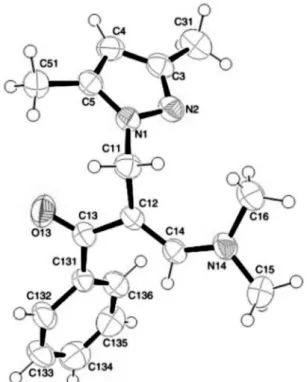
and HRMS analysis. Moreover, X-ray crystallography data conirmed the structure of compound 3b.By carrying out a single crystal X-ray analysis, E-conigutation of the products was unequivocaly determined, showing that a single isomer was obtained (Figure 1).
In the last step, the β-dimethylaminoenones were converted to 1,4’-bipyrazoles by treatment with hydrazine monohydrate, tert-butylhydrazine hydrochloride, phenylhydrazine hydrochloride and carboxymethylhydrazine. When the β-dimethylaminoenones 3a-b reacted with hydrazine monohydrate in ethanol at room temperature for 5 h, the corresponding 1,4’-bipyrazoles 4a (in 71% yield) and 4b (in 80% yield) were obtained; and when reacted with tert-butylhydrazine hydrochloride or phenylhydrazine hydrochloride in ethanol at 60 °C for 5 h, 1,4’-bipyrazoles 5a-b and 6a-b were obtained, respectively. After an initial screen of solvents and reaction temperatures, the 1,4’-bipyrazole 7a was synthesized by the cyclocondensation reaction of the β-dimethylaminoenone 3a with carboxymethylhydrazine and the use of one equivalent of BF3•OEt
2 in anhydrous
MeOH under relux for 10 h in 72% yield. On the other hand, the reaction of the β-dimethylaminoenone 3b with carboxymethylhydrazine using these conditions did not give the expected 1,4’-bipyrazole 7b. Our preparative results are summarized in Scheme 1 and Table 1.
Figure 1. ORTEP of the compound 3b.
hydrazine, EtOH reflux, 60°C, 5 h
N H
N Me
NN
Ph O n
2a-b
Me
Me
Me + Ph 71-75%
O X
1a-b
n
N N
n-1
O
3a-b
Me
Me
Ph NMe2
DMFDMA, reflux, 10 h
92-98%
H
50-80% N N
n-1
Z N Ph
4a-b,5a-b 6a-b,7a-b
Me
Me
K2CO3,
acetone, reflux, 5 h
Z = NH, N-tert-Bu, N-Ph, N(C(O)OMe
Scheme 1.
Table 1. Reaction conditions to synthesis of the 1,4’-bipyrazoles 4-7
Conditions Z n Product Yield (%)a
NH2NH2•H2O, NH 1 4a 71
EtOH, rt, 5 h NH 2 4b 80
tBuNHNH
2•HCl, N
tBu 1 5a 50
EtOH, 60 °C, 5 h NtBu 2 5b 66
PhNHNH2•HCl, NPh 1 6a 64
EtOH, 60 °C, 5 h NPh 2 6b 67
NH2NHCO2Me, NCO2Me 1 7a 72
The highly regioselective cyclocondensation reactions of the β-dimethylaminoenones 3a-b with different hydrazines gave 1,5-regioisomerrather than the potential
1,3-regioisomer. Moreover, the regiochemistry of the compound 5b was unequivocally determined by single crystal X-ray diffraction data,18 conirming the formation
of the 1,5-regioisomer as a single product (Figure 2). Thus, the β-dimethylaminoenones 3a-b reacted with different hydrazines to afford, in each case, only one of the two possible regioisomers. Similarly, when the β-dimethylaminoenone 3a reacted with hydroxylamine hydrochloride in ethanol at 60 °C for 5 h, the 1,5-regioisomer of the 1,4’-bipyrazoylisoxazole (8a) was obtained with high regioselectivity in 61% yield. When the β-dimethylaminoenone 3b reacted with hydroxylamine hydrochloride in ethanol at 60 °C for 5 h, the 1,5-regioisomer of the 1,4’-bipyrazoylisoxazole (8b) was obtained in 50% yield. Therefore, we can say that the cyclocondensation reactions of the β-dimethylaminoenones 3a and 3b with hydroxylamine hydrochloride in these conditions are highly regioselective in both cases. Our preparative results are summarized in Scheme 2.
The same synthetic route was repeated via the synthesis of (3,5-dimethyl-1H-1-pyrazolyl)acetone 2c (Scheme 3).
Thus, the compound 2c was synthesized by the alkylation reaction of 3,5-dimethyl-1H-pyrazole with chloroacetone 1c in the presence of triethylamine under
relux of anhydrous toluene for 5 h in 67% yield. Then the compound 2c condensed with 1.2 equivalents of neat DMFDMA under relux of toluene for 48 h. After removal of the excess reagent, the 4-dimethylamino-3-(3,5-dimethyl-1H-1-pyrazolyl)-3-buten-2-one 3c was obtained in 94% yield. Although the condensation reaction with two equivalents of DMFDMA may in theory lead to a mixture of 3c and 3c’ (Figure 3), in our experiment only 3c was formed. The 1H NMR spectra of 3c revealed the
presence of a singlet corresponding to methyl at d 2.25, and the absence of the two olefinic doublets, which would be observed in the 1H NMR spectra of 3c’. The
β-dimethylaminoenone 3c was used as starting material for the synthesis of the 1,4’-bipyrazole 4c through the cyclocondensation reaction with hydrazine monohydrate in ethanol at room temperature for 5 h resulting in the product with 71% yield.
Figure 2. ORTEP of the compound 5b.
N N
O
3b
Me
Me
Ph NMe2
H
NH2OH.HCl, EtOH, 60 °C, 5 h
50% N N
ON Ph
8b
Me
Me N N
3a
Me
Me NH2OH.HCl,
EtOH, 60 °C, 5 h
61% N N
8a
Me
Me
NMe2
H O
Ph O N
Ph
Scheme 2.
Scheme 3.
N
H N
Me
N N
Me O
2c
Me
Me
Me + Me 67%
O
Cl
1c
N N
NMe2
3c
Me
Me
DMFDMA, toluene reflux, 48 h
94%
NH2NH2, EtOH, r.t., 5 h
71% N N
4c
Me
Me
O
Me H HN N
Me
Et3N, toluene, reflux, 5 h
N N
Me
Me
NMe2
O Me2N
Conclusions
The β-dimethylaminoenones 3a-c were synthesized via
highy regioselective condensation reactions. A convenient synthetic route to 1,4’-biazoles, containing a variety of neutral, electron-donating and electron-withdrawing substituents, by a simple procedure from the β-dimethylaminoenones 3a-c is now available. Studies on the syntheses of other heterocyclic rings from 3a-c are in progress.
Experimental
Unless otherwise indicated, all common reagents and solvents were used as obtained from commercial suppliers without further puriication. The indicated solvents were dried and puriied according to recommended procedures.19
The 1H and 13C NMR spectra were acquired on a Bruker DPX
200 or Bruker DPX 400 spectrometer (1H at 200.13 MHz
or 400.13 MHz and 13C at 50.32 MHz or 100.61 MHz,
respectively), in 5 mm tube, and CDCl3 was used as solvent, containing TMS as internal standard at 298 K (digital resolution of ± 0.01 ppm). The mass spectra were registered in a HP 5973 MSD connected to a HP 6890 GC and interfaced by a Pentium PC. The GC was equipped with a split-splitless injector, autosampler, cross-linked to a HP-5 capillary column (30 m, 0.32 mm of internal diameter), and helium as carrier gas. The high-resolution mass spectrum were obtained from a MicroTOF Ic Bruker Daltonics (Instituto de Química, Universidade de São Paulo, Brazil). The melting points were measure using a Microquímica MQAPF 301. The melting points were not corrected.
General procedure for synthesis of2a-b
A m i x t u r e o f 2 - b r o m o a c e t o p h e n o n e 1 a o r 3-bromopropiophenone 1b (20 mmol), 3,5-dimethyl-1H -pirazole (20 mmol) and potassium carbonate (20 mmol) was stirred at relux temperature of anhydrous acetone (20 mL) for 5 h. Then the mixture was iltered, extracted with dichloromethane (20 mL) and washed with water (3 × 20 mL). The organic layer was dried with anhydrous magnesium sulfate, iltered, and the solvent was evaporated under reduced pressure. The products 2a-b were puriied by recrystallization in hexane as solvent.
2-(3,5-Dimethyl-1H-1-pyrazolyl)acetophenone (2a)
mp 76-79 °C (from hexane) (lit.17 90-91 °C); 1H NMR
(400 MHz, CDCl3/TMS, 25 °C) d 2.15 (s, 3 H, Me), 2.23 (s, 3 H, Me), 5.45 (s, 2 H, CH2), 5.90 (s, 1 H, CH), 7.49 (t, JH,H= 7.7 Hz, 2 H, Ph), 7.61 (t, JH,H = 7.1 Hz, 1 H, Ph), 7.97 (d, JH,H = 7.4 Hz, 2 H, Ph) ppm; 13C NMR (100 MHz,
CDCl3/TMS, 25 °C) d 10.9 (Me), 13.4 (Me), 55.2 (CH2), 105.8, 140.4, 148.2 (1H-1-pyrazolyl), 128.0, 128.8, 129.6, 133.1 (Ph), 192.7 (CO) ppm; MS (EI, 70 eV) m/z 214 (M+,
5%), 199 (2), 185 (100); HRMS (ESI+) m/z [M + H]+ calc.
for C13H14N2O: 215.1184; found: 215.1185.
3-(3,5-Dimethyl-1H-1-pyrazolyl)propiofenona (2b)
mp 59-62 °C (from hexane); 1H NMR (400 MHz,
CDCl3/TMS, 25 °C) d 2.19 (s, 3 H, Me), 2.29 (s, 3 H, Me), 3.56 (t, JH,H = 6.8 Hz, 2 H, CH2), 4.37 (t, JH,H = 6.8 Hz, 2 H, CH2), 5.74 (s, 1 H, CH), 7.44 (t, JH,H = 8.4 Hz, 2 H, Ph), 7.55 (t, JH,H = 7.4 Hz, 1 H, Ph), 7.93 (d, JH,H = 7.1 Hz, 2 H,
Ph) ppm; 13C NMR (50 MHz, CDCl
3/TMS, 25 °C) d 10.9
(Me), 13.3 (Me), 38.6 (CH2), 42.8 (CH2), 104.6, 139.1, 147.5, (1H-1-pyrazolyl), 127.9, 128.4, 133.2, 136.2 (Ph), 197.6 (CO) ppm; MS (EI, 70 eV) m/z 228 (M+, 14%), 123
(100); HRMS (ESI+) m/z [M + H]+ calc. for C
14H16N2O:
229.1341; found: 229.1343.
Procedure for synthesis of 2c
A mixture of chloroacetone 1c (10 mmol), 3,5-dimethyl-1H-pirazole (10 mmol) and triethylamine (10 mmol) was stirred at relux temperature of anhydrous toluene (3 mL) for 5 h. Then the mixture was extracted with dichloromethane (10 mL) and washed with water (3 × 10 mL). The organic layer was dried with anhydrous magnesium sulfate, iltered, and the solvent was evaporated under reduced pressure. The product 2c was puriied by recrystallization in hexane as solvent.
(3,5-Dimethyl-1H-1-pyrazolyl)acetone 2c
mp 49-51 °C (from hexane) (lit.20 67-68 °C); 1H NMR
(200 MHz, CDCl3/TMS, 25 °C) d 2.10 (s, 3 H, Me), 2.16 (s, 3 H, Me), 2.22 (s, 3 H, Me), 4.76 (s, 2 H, CH2), 5.89 (s,
1 H, CH) ppm; 13C NMR (50 MHz, CDCl
3/TMS, 25 °C) d
10.9 (Me), 13.4 (Me), 26.8 (Me), 58.3 (CH2), 105.9, 139.8, 148.4 (1H-1-pyrazolyl), 203.0 (CO) ppm; MS (EI, 70 eV)
m/z 152 (M+, 49%), 137 (1), 109 (100); HRMS (ESI+) m/z
[M + H]+ calc. for C
8H12N2O: 153.1028; found: 153.1023.
General procedure for synthesis of β-dimethylaminoenones
3a-b
(Z)-3-Dimethylamino-2-(3,5-dimethyl-1H-1-pyrazolyl)-1-phenyl-2-propen-1-one (3a)
Oil; 1H NMR (200 MHz, CDCl
3/TMS, 25 °C) d 1.94
(s, 3 H, Me), 2.26 (s, 3 H, Me), 2.35 (s, 3 H, NMe), 3.11 (s, 3 H, NMe), 5.79 (s, 1 H, CH), 7.22-7.35 (m, 3 H, Ph), 7.41-4.46 (m, 2 H, Ph), 7.61 (s, 1 H,CH) ppm; 13C NMR
(50 MHz, CDCl3/TMS, 25 °C) d 11.3 (Me), 13.7 (Me), 36.4 (NMe2), 105.4, 143.3, 148.3 (1H-1-pyrazolyl), 106.9 (C2), 109.9 (CH), 127.8, 127.9, 129.9, 139.7 (Ph), 190.3 (CO) ppm; MS (EI, 70 eV) m/z 269 (M+, 7%), 268 (8),
239 (40), 188 (100); HRMS (ESI+) m/z [M + H]+ calc. for
C16H19N3O: 270.1606; found: 270.1614.
( E ) 3 D i m e t h y l a m i n o 2 ( 3 , 5 d i m e t h y l 1 H 1 -pyrazolylmethyl)-1-phenyl-2-propen-1-one (3b)
mp 115-118 °C (from ethyl acetate); 1H NMR
(200 MHz, CDCl3/TMS, 25 °C) d 2.19 (s, 3 H, Me), 2.39 (s, 3 H, Me), 3.23 (s, 6 H, NMe2), 5.12 (s, 2 H, CH2), 5.73 (s, 1 H, CH), 7.13 (s, 1 H, CH), 7.32-7.37 (m, 3 H, Ph), 7.41-7.45 (m, 2 H, Ph) ppm; 13C NMR (50 MHz, CDCl
3/
TMS, 25 °C) d 11.2 (Me), 13.6 (Me), 41.7 (CH2), 43.8 (NMe2), 104.4, 141.3, 146.6 (1H-1-pyrazolyl), 105.3 (C2), 127.7, 128.2, 129.3, 139.8 (Ph), 157.2 (CH), 195.8 (CO) ppm; MS (EI, 70 eV) m/z 283 (M+, 7%), 268 (8), 239
(40), 188 (100); HRMS (ESI+) m/z [M + Na]+ calc. for
C17H21N3ONa: 306.1583; found: 306.1585.
Experimental procedure for synthesis of β -dimethyl-aminoenone 3c
A mixture of (3,5-dimethyl-1H-1-pyrazolyl)acetone 2c (3 mmol) and DMFDMA (3.6 mmol) was stirred at relux temperature of anhydrous toluene (1 mL) for 48 h. Then the mixture was submitted at reduced pressure for 1 h. The product 3c was puriied by iltration in a column chromatographic silica gel with dichloromethane as an eluent.
(Z)-4-Dimethylamino-3-(3,5-dimethyl-1H-1-pyrazolyl)-3-buten-2-one (3c)
Oil; 1H NMR (200 MHz, CDCl
3/TMS, 25 °C) d 1.78
(s, 3 H, Me), 2.10 (s, 3 H, Me), 2.25 (s, 3 H, Me), 2.29 (s, 3 H, NMe), 3.11 (s, 3 H, NMe), 5.91 (s, 1 H, CH), 7.65 (s, 1 H, CH) ppm; 13C NMR (100 MHz, CDCl
3/TMS,
25 °C) d 11.4 (Me), 13.6 (Me), 24.5 (Me), 36.2 (NMe), 47.3 (NMe), 105.2, 142.9, 148.8 (1H-1-pyrazolyl), 105.4 (C3), 109.3 (CH), 189.6 (CO) ppm; MS (EI, 70 eV) m/z
207 (M+, 53%), 192 (100), 164 (31), 135 (16); HRMS
(ESI+) m/z [M + H]+ calc. for C
11H17N3O: 208.1450;
found: 208.1432.
General Procedure for synthesis of 1,4’-bipyrazoles 4a-c
A mixture of β-dimethylaminoenone 3a, 3b or 3c (1 mmol), hydrazine monohydrate (1.2 mmol) and ethanol (1 mmol) was stirred at room temperature for 5 h. Then the mixture was extracted with dichloromethane (3 mL) and washed with water (3 × 3 mL). The organic layer was dried with anhydrous magnesium sulfate, iltered, and the solvent was evaporated under reduced pressure. The products 4a-c were puriied by iltration in a column chromatographic silica gel with dichloromethane as an eluent.
3,5-Dimethyl-5’-phenyl-1H-1,4’-bipyrazole (4a)
Oil; 1H NMR (200 MHz, CDCl
3/TMS, 25 °C) d 1.88 (s,
3 H, Me), 2.31 (s, 3 H, Me), 5.95 (s, 1 H, CH), 7.25-7.35 (m, 6 H, Ph and NH), 7.67 (s, 1 H,CH) ppm; 13C NMR
(100 MHz, CDCl3/TMS, 25 °C) d 11.1 (Me), 13.4 (Me), 105.8, 125.7, 128.2, 128.6, 128.6, 129.7, 132.3, 141.9, 143.2, 149.2 (2 × 1H-1-pyrazolyl and Ph) ppm; MS (EI, 70 eV) m/z 238 (M+, 49%), 223 (100); HRMS (ESI+) m/z
[M + H]+ calc. for C
14H14N4: 239.1296; found: 239.1292.
1-(3,5-Dimethyl-1H-1-pyrazolyl)-1-(5-phenyl-1H-4-pyrazolyl)methane (4b)
Oil; 1H NMR (200 MHz, CDCl
3/TMS, 25 °C) d 1.97 (s,
3 H, Me), 2.19 (s, 3 H, Me), 5.14 (s, 2 H, CH2), 5.76 (s, 1 H, CH), 7.14 (br s, 1 H, NH), 7.26-7.34 (m, 4 H, Ph and CH), 7.41-7.46 (m, 2 H, Ph) ppm; 13C NMR (100 MHz, CDCl
3/
TMS, 25 °C) d 10.7 (Me), 13.3 (Me), 43.5 (CH2), 105.2, 114.6, 127.8, 127.9, 128.1, 128.5, 131.4, 133.7, 138.8, 147.4 (2 ´ 1H-1-pyrazolyl and Ph) ppm; MS (EI, 70 eV)
m/z 252 (M+, 41%), 223 (1), 157 (100); HRMS (ESI+) m/z
[M + H]+ calc. for C
15H16N4: 253.1453; found: 253.1455.
3,5-Dimethyl-5’-methyl-1H-1,4’-bipyrazole (4c)
Oil; 1H NMR (400 MHz, CDCl
3/TMS, 25 °C) d 2.12 (s,
3 H, Me), 2.15 (s, 3 H, Me), 2.28 (s, 3 H, Me), 5.95 (s, 1 H, CH), 7.55 (s, 1 H, CH) ppm; 13C NMR (100 MHz, CDCl
3/
TMS, 25 °C) d 9.6 (Me), 11.3 (Me), 13.4 (Me), 105.3, 105.3, 141.4, 141.4, 148.9, 148.9 (2 × 1H-1-pyrazolyl) ppm; MS (EI, 70 eV) m/z 176 (M+, 100%), 161 (6), 148
(8), 134 (24), 81 (15), 66 (12); HRMS (ESI+) m/z [M + H]+
calc. for C9H12N4: 177.1140; found: 177.1137.
General procedure for synthesis of 1,4’-biazoles 5a-b,
6a-b and 8a-b
A mixture of β-dimethylaminoenone 3a or 3b (1 mmol),
was extracted with dichloromethane (3 mL) and washed with water (3 × 3 mL). The organic layer was dried with anhydrous magnesium sulfate, iltered, and the solvent was evaporated under reduced pressure. The oil products were puriied by iltration in a column chromatographic silica gel with dichloromethane as an eluent, and the product 5b was puriied by recrystallization in hexane as solvent.
1’-(tert-Butyl)-3,5-dimethyl-5’-phenyl-1H-1,4’-bipyrazole (5a)
Oil; 1H NMR (400 MHz, CDCl
3/TMS, 25 °C) d
1.48 (s, 9 H, tBu), 2.14 (s, 3 H, Me), 2.24 (s, 3 H, Me), 5.52 (s, 1 H, CH), 7.31 (m, 5 H, Ph), 7.62 (s, 1 H,
CH) ppm; 13C NMR (100 MHz, CDCl
3/TMS, 25 °C) d
10.9 (Me), 13.3 (Me), 30.9, 68.7 (tBu), 105.9, 127.8, 128.1, 128.3, 128.9, 129.9, 130.7, 133.1, 133.9, 148.3 (2 × 1H-1-pyrazolyl and Ph) ppm; MS (EI, 70 eV) m/z
294 (M+, 100%), 279 (2), 237 (29), 223 (83), 209 (6),
143 (6); HRMS (ESI+) m/z [M + H]+ calc. for C
18H22N4:
295.1922; found: 295.1920.
1-[1-(tert-Butyl)-5-phenyl-1H-4-pyrazolyl]-1-(3,5-dimethyl-1H-1-pyrazolyl)methane (5b)
mp 101-104 °C (from hexane); 1H NMR (400 MHz,
CDCl3/TMS, 25 °C) d 1.41 (s, 9 H, tBu), 1.85 (s, 3 H, Me), 2.17 (s, 3 H, Me), 4.70 (s, 2 H, CH2), 5.67 (s, 1 H, CH), 7.23-7.25 (m, 2 H, Ph), 7.38 (s, 1 H, CH), 7.39-7.42
(m, 3 H, Ph) ppm; 13C NMR (100 MHz, CDCl
3/TMS, 25
°C) d 10.7 (Me), 13.4 (Me), 30.9, 61.2 (tBu), 43.0 (CH2), 104.8, 117.9, 128.1, 128.4, 128.7, 130.9, 132.4, 136.3, 138.5, 147.1 (2 × 1H-1-pyrazolyl and Ph) ppm; MS (EI, 70 eV) m/z 308 (M+, 14%), 293 (1), 251 (11), 213 (19),
157 (100); HRMS (ESI+) m/z [M + H]+ calc. for C
19H24N4:
309.2079; found: 309.2078.
1’,5’-Diphenyl-3,5-dimethyl-1H-1,4’-bipyrazole (6a)
Oil; 1H NMR (400 MHz, CDCl
3/TMS, 25 °C) d 1.79 (s,
3 H, Me), 2.28 (s, 3 H, Me), 5.84 (s, 1 H, CH), 6.99-7.02 (m, 2 H, Ph), 7.19-7.24 (m, 3 H,Ph), 7.30-7.33 (m, 5 H,Ph), 7.88 (s, 1 H,CH) ppm; 13C NMR (100 MHz, CDCl
3/TMS,
25 °C) d 11.1 (Me), 13.6 (Me), 105.5, 122.1, 127.7, 127.8, 128.5, 128.7, 128.9, 129.0, 125.2, 138.2, 138.7, 141.5, 149.1, 139.8 (2 × 1H-1-pyrazolyl and 2 × Ph) ppm; MS (EI, 70 eV) m/z 314 (M+, 100%), 285 (1); HRMS (ESI+) m/z
[M + H]+ calc. for C
20H18N4: 315.1609; found: 315.1609.
1-(3,5-Dimethyl-1H-1-pyrazolyl)-1-(1,5-diphenyl-1H-4-pyrazolyl)methane (6b)
Oil; 1H NMR (200 MHz, CDCl
3/TMS, 25 °C) d 1.95 (s,
3 H, Me), 2.23 (s, 3 H, Me), 5.06 (s, 2 H, CH2), 5.76 (s, 1
H, CH, 7.16-7.26 (m, 7 H, Ph), 7.35-7.38 (m, 3 H,Ph), 7.59 (s, 1 H,CH) ppm; 13C NMR (50 MHz, CDCl
3/TMS, 25 °C)
d 10.7 (Me), 13.1 (Me), 43.1 (CH2), 105.5, 117.1, 119.7, 124.6, 127.1, 128.6, 128.7, 128.7, 128.7, 128.8, 129.4, 129.6, 129.9, 140.1 (2 × 1H-1-pyrazolyl and 2 × Ph) ppm; MS (EI, 70 eV) m/z 328 (M+, 14%), 233 (100), 219 (3);
HRMS (ESI+) m/z [M + H]+ calc. for C
21H20N4: 329.1766;
found: 329.1769.
4-(3,5-Dimethyl-1H-1-pyrazolyl)-5-phenylisoxazole (8a)
Oil; 1H NMR (200 MHz, CDCl
3/TMS, 25 °C) d 1.92
(s, 3 H, Me), 2.31 (s, 3 H, Me), 5.99 (s, 1 H, CH), 7.32-7.35 (m, 3 H, Ph), 7.40 (m, 2 H, Ph), 8.74 (s, 1 H,
CH) ppm; 13C NMR (50 MHz, CDCl
3/TMS, 25 °C) d 11.1
(Me), 13.5 (Me), 106.8, 126.1, 126.8, 127.2, 128.9, 129.1, 130.3, 150.5, 156.4, 158.2 (2 × 1H-1-pyrazolyl and Ph) ppm; MS (EI, 70 eV) m/z 239 (M+, 100%), 210 (46), 144
(44); HRMS (ESI+) m/z [M + H]+ calc. for C
14H13N3O:
240.1137; found: 240.1137.
1-(3,5-Dimethyl-1H-1-pyrazolyl)-1-(5-phenyl-4-isoxazolyl)methane (8b)
Oil; 1H NMR (400 MHz, CDCl
3/TMS, 25 °C) d 2.05
(s, 3 H, Me), 2.21 (s, 3 H, Me), 5.19 (s, 1 H, CH), 5.82 (s, 2 H, CH2), 7.49-7.52 (m, 3 H, Ph), 7.67-7.69 (m, 2 H, Ph), 7.96 (s, 1 H, CH) ppm; 13C NMR (50 MHz, CDCl
3/
TMS, 25 °C) d 10.8 (Me), 13.3 (Me), 42.2 (CH2), 105.9, 111.6, 125.7, 127.1, 129.0, 130.2, 138.9, 148.1, 151.1, 164.5 (1H-1-pyrazolyl, Ph and isoxazolyl) ppm; MS (EI, 70 eV) m/z 253 (M+, 100%), 238 (8), 224 (17), 158 (37);
HRMS (ESI+) m/z [M + H]+ calc. for C
15H15N3O: 254.1293;
found: 254.1296.
Experimental procedure for synthesis of 1,4’-bipyrazole 7a
A mixture of β-dimethylaminoenone 3a (1 mmol), carboxymethylhydrazine (1.2 mmol) and BF3.OEt
2
(1.2 mmol) was stirred at relux temperature of methanol (1 mL) for 10 h. Then the mixture was extracted with dichloromethane (3 mL) and washed with water (3 × mL). The organic layer was dried with anhydrous magnesium sulfate, iltered, and the solvent was evaporated under reduced pressure. The product 7a was purified by iltration in a column chromatographic silica gel with dichloromethane as an eluent.
3,5-Dimethyl-5’-phenyl-1’-methylcarboxyl-1H-1,4’-bipyrazole (7a)
Oil; 1H NMR (400 MHz, CDCl
3/TMS, 25 °C) d 2.07 (s,
13C NMR (100 MHz, CDCl
3/TMS, 25 °C) d 11.1 (Me),
13.2 (Me), 55.3 (OMe), 105.7, 126.4, 126.9, 128.0, 128.6, 128.6, 128.8, 129.4, 133.9, 148.4, (2 × 1H-1-pyrazolyl and Ph), 155.3 (CO) ppm; MS (EI, 70 eV) m/z 296 (M+, 25%),
281 (100), 265 (1), 237 (3); HRMS (ESI+) m/z [M + Na]+
calc. for C16H16N4O2Na: 319.1171; found: 319.1172.
Acknowledgments
The autors thank the Conselho Nacional de Desenvolvimento Cientíico e Tecnológico em Pesquisa (CNPq/PADCT), Coordenação de Aperfeiçoamento de Pessoal de Nível Superior (CAPES) and Fundação de Amparo à Pesquisa do Estado do Rio Grande do Sul (FAPERGS) for inancial support. The fellowships from CNPq, CAPES and FAPERGS are also acknowledged.
References
1. For example, there are 2292 pyrazoles and 906 isoxazoles in the MDL Drug Report (MDDR-3D, 99.2), representing 3.0% of entries. They are 1.6% of entries in Comprehensive Medicinal Chemistry (CMC-3D 99.1). Both databases are from MDL Information Systems.
2. Penning, T. D.; Talley, J. J.; Bertenshaw, S. R.; Carter, J. S.; Collins, P. W.; Docter, S.; Graneto, M. J.; Lee, L. F.; Malecha, J. W.; Miyashiro, J. M.; Rogers, R. S.; Rogier, D. J.; Yu, S. S.; Anderson, G. D.; Burton, E. G.; Cogburn, J. N.; Gregory, S. A.; Koboldt, C. M.; Perkins, W. E.; Seibert, K.; Veenhuizen, A. W.; Zhang, Y. Y.; Isakson, P. C.; J. Med. Chem. 1997, 40, 1347.
3. Smith, J. A. S.; Wehrle, B.; Aguilar-Parrilla, F.; Limbach, H.-H.; Foces-Foces, M. C.; Cano, F. H.; Elguero, J.; Baldy, A.; Pierrot, M.; Khurshid, M. M. T.; Larcombe-McDouall, J. B.; J. Am. Chem. Soc.1989, 111, 7304.
4. Foces-Foces, C.; Echevarria, A.; Jagerovich, N.; Alkorta, I.; Elguero, J.; Langer, U.; Klein, O.; Minguet-Bonvehi, M.; Limbach, H. -H.; J. Am. Chem. Soc.2001,123, 7898. 5. Bertolasi, V.; Gilli, P.; Ferretti, V.; Gilli, G.; Fernandez-Castaño,
C.; Acta Crystallogr. Sect. B1999,55, 985.
6. De Paz, J. L. G.; Elguero, J.; Foces-Foces, C.; Llamas-Saiz, A. L.; Aguilar-Parrilla, F.; Klein, O.; Limbach, H. -H.; J. Chem. Soc., Perkin Trans.1997, 2, 101.
7. Foces-Foces, C.; Hager, O.; Jagerovic, N.; Jimeno, M.L.; Elguero, J.; Chem. Eur. J.1997, 3,121.
8. Claramunt, R. M.; Maria, M. D. S.; Forfar, I.; Aguilar-Parrilla, F.; Minguet-Bonvehi, M.; Klein, O.; Limbach, H. -H.; Foces- Foces, C.; Llamas-Saiz, A.L.; Elguero, J.; J. Chem. Soc., Perkin Trans. 1997,2, 1867.
9. Claramunt, R. M.; Sanz, D.; López, C.; Jiménez, J. A.; Magn. Res. Chem.1997, 35,35.
10. Elguero, J.; Cano, F. H.; Foces-Foces, C.; Llamas-Saiz, A. L.; Limbach, H.- H.; Aguilar-Parrilla, F.; Claramunt, R. M.; López, C.; J. Heterocycl. Chem.1994, 31, 695.
11. Llamas-Saiz, A. L.; Foces-Foces, C.; Elguero, J.; J. Mol. Struct.
1994, 319, 231.
12. Sellier, N.; J. Heterocycl. Chem.1999, 36, 1291; Shironina, T. M.; Igidov, N. M.; Koz’minykh, E. N.; Kon’shina, L. O.; Kasatkina, Yu. S.; Koz’minykh, V. O.; Russ. J. Org. Chem. 2001, 37, 1555; Vicente, V.; Fruchier, A.; Elguero, J.; ARKIVOC2004, iii, 5; Bouabdallah, I.; Touzani, R.; Zidane, I.; Ramdani, A.; Radi, S.; ARKIVOC2006, xiv, 46; Bakavoli, M.; Feizyzadeh, B.; Rahimizadeh, M.; Tetrahedron Lett.2006, 47, 8965; 13. Chen, H. S.; Li, Z. M.; Wang, Z. W.; Chin. Chem. Lett. 1999,
10, 643.
14. Hoz, A. de la; Díaz, A.; Elguero, J.; Jiménez, A.; Moreno, A.; Ruiz, A.; Sánches-Migallón, A.; Tetrahedron 2007, 63, 748.
15. Martins M. A. P.; Frizzo, C. P.; Moreira, D. N.; Zanatta, N.; Bonacorso H. G.; Chem. Rev. 2008, 108, 2015 and references therein; Martins, M. A. P.; Cunico, W.; Pereira, C. M. P; Flores, A. F. C.; Bonacorso H. G.; Zanatta, N.; Curr. Org. Synth. 2004, 1, 391 and references therein; Bonacorso, H. G.; Lopes, I. S.; Wastowski, A. D.; Zanatta, N.; Martins, M. A. P.; J. Fluorine Chem.2003, 120, 29; Flores, A. F. C.; Brondani, S.; Zanatta, N.; Rosa, A.; Martins, M. A. P.; Tetrahedron Lett.2002, 43, 8701; Flores, A. F. C.; Zanatta, N.; Rosa, A.; Brondani, S.; Martins, M. A. P.; Tetrahedron Lett.2002, 43, 5005.
16. Martins, M. A. P.; Cunico, W.; Scapin, E.; Emmerich, D. J.; Fiss, G. F.; Rosa, F. A.; Bonacorso, H. G.; Zanatta, N.; Flores, A. F .C.; Lett. Org. Chem. 2006, 3, 358;Zanatta, N.; Flores, D. C.; Amaral, S. S.; Bonacorso, H. G.; Martins, M. A. P.; Flores, A. F. C.; Synlett 2005, 3079; Martins, M. A. P.; Pereira, C. M. P.; Cunico, W.; Moura, S.; Rosa, F. A.; Peres, R. L.; Machado, P.; Zanatta, N.; Bonacorso, H. G.; Ultrason. Sonochem.2006, 13, 364; Martins, M. A. P.; Cunico, W.; Brondani, S. Peres, R. L.; Zimmermann, N.; Rosa, F. A.; Fiss, G. F.; Zanatta, N.; Bonacorso, H. G.; Synthesis 2006,9, 1485; Rosa, F. A.; Machado, P.; Bonacorso, H. G.; Zanatta, N.; Martins, M. A. P.; J. Heterocyclic. Chem.2008, 45, 879; F. A. Rosa, Machado, P.; Rossatto, M.; Vargas, P. S.; Fernandes, T. S.; Bonacorso, H. G.; Zanatta, N.; Martins, M. A. P.; Synlett 2008, 1673; Rosa, F. A.; Machado, P.; Fiss, G. F.; Vargas, P. S.; Bonacorso, H. G.; Zanatta, N.; Martins, M. A. P.; Synthesis 2008, 3639.
17. Solomons, T. W. J.; Fowler, F. W.; Calderazzo, J.; J. Am. Chem. Soc.1965, 87, 528.
The Director, CCDC, 12 Union Road, Cambridge CB2 1EZ, UK (Fax: + 44 1223 336033; e-mail: [email protected], or www: http://ccdc.cam.ac.uk).
19. Perrin, D. D.; Armarego, W. L. F.; Puriication of Laboratory Chemicals, Pergamon: Oxford, 1998.
20. Mohamed, M. H.; Abdel-Khalik, M. M.; Elnagdi, M. H.; J. Heterocycl. Chem. 2001, 38, 685.
Received: March 27, 2009