Ar
ti
cl
e
0103 - 5053 $6.00+0.00
*e-mail: [email protected], [email protected]
Electron Paramagnetic Resonance Characterization of a Humic Acid-Type
Polymer Model
Marcilene F. Barriquello,*,a Sergio da Costa Saab,b Nelson Consolin Filhoc and
Ladislau Martin-Netod
aInstituto Federal de Educação, Ciência e Tecnologia do Acre,
69900-000 Rio Branco-AC, Brazil
bDepartamento de Física, Universidade Estadual de Ponta Grossa,
84030-900 Ponta Grossa-PR, Brazil
cCentro de Ciência Biológicas e da Natureza, Universidade Federal do Acre,
69900-000 Rio Branco-AC, Brazil
dEmbrapa Instrumentação Agropecuária, CP 741, 13560-970 São Carlos-SP, Brazil
Modelos de ácidos húmicos do tipo poliméricos tem mostrado semelhanças químicas com os ácidos húmicos naturais (AH). Devido à complexidade das substâncias húmicas (SH), esses modelos de ácidos húmicos do tipo poliméricos, no qual os sítios ligantes podem ser melhores deinidos, podem ser usados no estudo de metais e outras aplicações. Neste estudo, obteve-se um polímero com características análogas às dos AH coletados em área de cultivo com sistema plantio direto por 9 anos, por meio de reações de síntese, através da polimerização oxidativa em meio alcalino utilizando como precursor a para-benzoquinona. Foi realizado um estudo do ácido húmico (AH) e do ácido húmico sintético (AHS) utilizando espectroscopia de ressonância paramagnética eletrônica (RPE). O sinal dos radicais livres do tipo semiquinona foi detectado para o AHS. Nos espectros observam-se sinais semelhantes entre o AH de solo e o AH sintético complexado com íons Fe3+, Cu2+ e Mn2+.
Humic acid-type polymer models have been shown to be similar to natural humic acids (HA) in terms of chemical properties. Due to the complexity of humic substances (HS), this humic acid-type polymer models, in which the ligand sites are better deined, can be used in the study of metals and for other applications. In this study, a polymer with characteristics analogous to those of humic acids isolated from soil surface cultivated using a no-tillage system for nine years, was obtained by means of synthesis reactions, through oxidative polymerization in an alkaline medium using para-benzoquinone as precursor. An EPR spectroscopy study was made of natural humic acids (HA) and synthetic humic acids (SHA). A semiquinone-type free radical signal was detected in the SHA. The spectra showed similar signals for HA from soil and synthetic HA complexed with Fe3+, Cu2+ and Mn2+ ions.
Keywords: synthetic humic acid, metal cations, EPR
Introduction
Humic substances (HS) are well known for being the major component of soil organic matter (SOM) and for their ability to interact with various elements of the environment. HS play a signiicant role in soil and aquatic chemistry.
make difficult its characterization. To obtain further information about the chemical structure of the HS, synthetic compounds with polymeric chains have been used whose characteristics are analogous to those of HS, such as phenolic polymers.2-6 Zunino et al.7 used models of polymeric-type humic and fulvic acids to study the competitive behavior of Zn2+ and Mg2+. Signiicant progress in the study of metals can be achieved using polymers as models similar to HS, in which the ligand sites are better deined, since functional groups and electron donor atoms can be deined using speciic precursors.
The literature contains several examples of the application of electron paramagnetic resonance (EPR) in the study of HS.8-10 EPR spectroscopy is one of the only techniques that can supply structural information, without artifacts or restrictive experimental conditions, about the complexation of metallic ions (Fe3+, Cu2+, Mn2+, VO3+, Cr3+ and others) with HS from soils, water and sediments.11 EPR can also detect free radicals in HS, determining their concentration and sometimes their origin. HS contain stabilized free radicals in their structure, and it has been proposed that they may be associated with polymerization/ depolymerization reactions, and with the degree of aromaticity and humiication of organic matter, possibly interacting with pesticides and toxic organic pollutants.11
MacCarthy12 postulated that humic substances are unique in nature and have qualities unlike any other natural substances. The irst principle postulates that humic substances represent a supermixture of an extremely wide array of chemical structures. Thus, the probability of finding two identical structures is exceedingly remote.13 Humic substances, of which humic acid (HA, insoluble at acidic pH) and fulvic acid (FA, water-soluble at acidic to alkaline pH) are the major fractions, present various chemically reactive functional groups, including carboxyls, and phenolic and alcoholic hydroxyls with pH-dependent properties.14 This diversity of their chemical composition allows HS to be used in different situations. Venancio et al.15 demonstrated that the properties of HS can be used in the fabrication of sensor arrays for use in the classiication of humic substances present in aqueous systems, as well as the possibility of using HS for the production of self-assembled ilms. A novel and simple method electrode with rapid preparation was developed with humic acid and polypyrrole. The modified electrode displayed good and reversible extraction properties.16 Some speciic humic molecules play an important role in industrial and pharmacological applications, such as the production and use of therapeutic chemicals from humic acids and the manufacture of commercial humates for use in soils.17
Within this context, the objective of this research was to study polymeric models of humic acids, using EPR spectroscopy confronting the results with the HAs extracted from soil under no-tillage system for nine years.
Experimental
Sample preparation
Two different materials were evaluated, a natural humic acid (HA) extracted from a soil, and a compound synthesized (SHA) from para-benzoquinone. The soil sample used for the extraction of humic acid (HA) was collected from surface (0 to 25 mm) an area under nine years of management, involving no-tillage system in the cultivation of oats with common vetch/corn with cowpea. The soil type corresponds to a Typic Paleudult by US taxonomy with 540 sand, 240 silt, and 220 g kg−1 clay. The clay fraction type is composed mainly of kaolinite (720 g kg−1) and iron oxides (Fe
2O3,109 g kg
−1).
Humic acid (HA) was extracted from Paleudult soil, following the methodology proposed by the International Humic Substances Society (IHSS).18
The polymer (SHA) was prepared with 5.4 g of para -benzoquinone dissolved in 60 mL of water containing 2.8 g of KOH. The solutions were placed in lasks and a stream of puriied air was bubbled into them at a rate of 1 L min−1. The air was puriied by irstpassing it through solid NaOH pellets, after which it was bubbled in a solution of 0.8 mol L−1 NaOH. After 22 h of air bubbling, the resulting black viscous solutions were treated with 6 mL of concentrated hydrochloric acid under mechanical stirring until it precipitated into a brownish black mass. The polymeric products were collected by vacuum iltration, washed repeatedly with deionized water, and dried in air for one day and subsequently at 60 °C for one day.
Preparation of synthetic humic acids (SHA) metal complexes
Elemental analysis and determination of the ash contents
The elemental composition of the resulting humic acids was characterized based on the quantiication of nitrogen, carbon, hydrogen and sulfur, using a CHNS-O analyzer (CE-Instruments EAGER 200), and determination of the difference in percentage by mass of oxygen: %O = 100 − [(C + H + N + S)%].
The ash content was determined gravimetrically by weighing and calcining approximately 10 mg of humic acid (HA and SHA) in a platinum crucible at a temperature of 600 °C until it reached a constant mass.
EPR analyse
The experiments were carried out with a Bruker EMX EPR spectrometer operating at X-band (9 GHz), with a frequency modulation of 100 KHz, using a rectangular cavity. The samples were placed in a 3.5 mm diameter quartz tube, in duplicate, with a sample height of 50 mm and mass varying from 10 to 30 g. The central ield was H0 = 340 mT, ν = 9.72 GHz, and the microwave power was 0.2 mW with
a modulation amplitude of 0.2 mT at room temperature. The semiquinone-type free radicals were quantiied by the secondary standard method,using a ruby crystal (Al2O3) containing 0.5% of Cr3+per weight.19 Its g factor is 1.9797 and it therefore does not interfere with the signal of the semiquinone free radical, shoes g values is around 2.003.20
To identify the metal ions complexed with HA and SHA, measurements were taken using the following parameters: for the Fe3+, the central ield was H
0 = 286 mT, scan rate ∆H = 400 mT, frequency ν = 9.453 GHz, microwave
power = 10 mW, and modulation amplitude = 1.0 mT at room temperature. The same parameters were used for Cu2+ and Mn2+, except that the scan rate was 200 mT at room temperature and at the temperature of liquid nitrogen.
Results and Discussion
Obtaining natural and synthetic humic acids
In the extraction of humic acid from the soil, 710.5 mg of humic acid per 0.08 kg of soil were obtained.
It is known that polyhydroxy phenols, as well as hydroquinones and quinones such as para-benzoquinone, are highly sensitive to the action of aqueous alkali solution, yielding polymeric products known as synthetic humic acids (SHA).21 The reason for synthesizing these polymers was that the information obtained from these synthetic precursors can be used to shed light on the complex structure of natural humic acids.
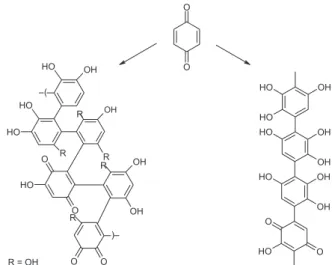
The SHA polymer formed from the para-benzoquinone reaction provides a compound composed mostly of polyhydroxy phenols, in which the main adsorbing groups are -OH and -COOH. This structure can be described by a sequence of phenyl rings having three hydroxyl groups
per ring intercalated by monohydroxylated quinone units (Figure 1).21 The presence of the carboxylic group is derived from the degradation of the aromatic ring during polymerization. This structure is similar to lignin, one of the major constituents of the organic matter of soil.21
The SHA synthesis presented an excellent performance, yielding 76.36% in weight of polymerized para -benzoquinone.
Elemental analysis and determination of ash content
Table 1 lists the results of the elemental analysis and the ash content, indicating that the SHA contained a large amount of oxygen exceeding 40% (values calculated by difference), which is similar to the amount of oxygen found in natural humic acid, which also contains more than 40% of oxygen. According to Schnitzer and Kahn,22 the elemental composition of humic acids contains average amounts of 53.8-58.7% of carbon, 3.2-6.2% of hydrogen, 32.8-38.3% of oxygen, 0.8-4.3% of nitrogen and 0.1-1.5% of sulfur. These values are similar to the ones obtained from the HA extraction. The synthesized polymer differed only in the values described by Schnitzer and Kahn for sulfur and nitrogen content of SHA, which was expected due to the precursor compounds.
EPR study
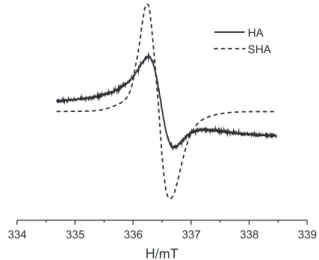
Figure 2 shows the EPR spectra of the SHA and HA samples. These signals are typical of organic free
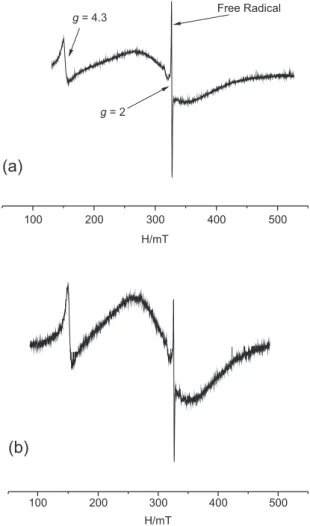
radicals.23 Table 2 lists the values obtained for the number of spins g−1 HA of free radicals, the values of g, and the spectral linewidth. The g factor provides information about the chemical nature of the species that contains the unpaired electron, in the case of free radicals. Note the sloping baseline in the spectrum of the soil HA sample, which is due to overlapping of the signal (broadening) of Fe3+ at g = 2, as indicated in Figure 4.
Table 2 indicates that the linewidth ranged from 0.395 to 0.418 mT and the calculated g factor was ca. 2.003, thus demonstrating that the paramagnetic resonance of the species, both in the humic acid (HA) sample extracted from soil and in the synthetic humic acid sample, has the same origin, i.e., it is the semiquinone free radical.24 A comparison of the spectra in Figure 2 indicates a similarity between the HA spectrum and that of the SHA. Thus, the present data clearly shows that SHA can serve as a good model of the radical of the HA. There was a higher concentration of spins in SHA than in HA, but this apparently lower degree of humiication of the sample of natural humic acid may be due to suppression of the EPR signal by paramagnetic ions.25 Natural humic acid and SHA probably contain more aromatic and carboxylic groups. According to the literature, the content of carboxylic and aromatic groups increases as the humiication process advances,26,27 because these groups
are constituents of lignin, whose content diminishes with the transformations of organic matter in soil.27
Study of synthetic humic acid with complexed metals
The complexation of copper ions with SHA is favored because the structure obtained for the synthetic humic acid prepared from the p-benzoquinone precursor has a predominance of oxygenated groups. In the spectrum measured for SHA complexed with copper, we found that these can be formated of copper-oxygen complex. The value of g// decreases as the number of N atoms increases, instead of oxygen, coordinated in the equatorial position, and the value of A// increases.9,25 Martin-Neto et al.28 found a Cu2+ complex with an axial symmetry, with g = 2.28 and A = 17 mT, in which the copper was coordinated with nitrogen atoms. Figure 3 shows the spectrum of the SHA samples complexed with Cu2+, showing a value of g
// = 2.32 and A// = 14.3 mT, which are similar parameters as those
Table 1. Elemental compositions of humic acid isolated from soil (HA) and synthetic humic acids (SHA) (given as percentages of ash-free substance basis)
Samples N C H S O* Ash content
% (m/m) %
HA 3.90 ± 0.01 44.50 ± 0.01 4.91 ± 0.01 0.71 ± 0.02 45.99 ± 0.02 7.0
SHA 0.30 ± 0.01 55.61 ± 0.02 3.40 ± 0.01 0 40.69 ± 0.02 0.8
*Calculated by difference: %O = 100 – [(C + H + N + S)%]
Figure 2. EPR spectrum of the humic acid (HA) sample extracted from soil, and of the sample synthesized from para-benzoquinone (SHA without metals), showing the free radical signal.
Table 2. Organic free radical content, linewidth, and g factor for humic acid (HA) from soil and synthetic humic acid (SHA)
Sample No. of spins g−1
HA, SHA
Linewidth (mT) (HA, SHA)
g
HA 2.39 × 10¹⁷ 0.418 2.0032
SHA 8.72 × 10¹⁸ 0.395 2.0035
found by Boyd et al.,29 Senesi et al.30 and Senesi et al.9 for complexes of humic substances with Cu2+ coordinated with oxygen.
Figure 4 shows the spectrum of HA from soil (4a) and SHA complexed with Fe3+ (4b) in the region of the Fe3+ signals, indicating the values of g = 4.3 and g = 2. The
g = 4.3 is due to Fe3+ with a rhombic symmetry, while
g = 2 is probably due to the Fe3+ ion in the form of oxide.31 Note that the HA from soil and the synthetic HA with Fe3+ ions show similar signals, indicating that in the soil HAs can be happening the same types of retention of iron ions and native HAs.
Figure 5 depicts the EPR signal of the Mn2+ ion complexed in the SHA with hyperine A = 8.7 mT. The EPR spectrum of Mn2+ is readily recognized in humic acids by its six hyperine lines centered around g = 2. Mn2+ signals are not usually found in puriied HA from soil.32 Values of A between 8.4 and 8.8 mT to HA indicate complex in inner sphere and the functional groups possibly involved they would be carboxylic, hydroxyls phenolic and carbonyl.22
Conclusions
In this work, using the technique of EPR, the humic acid produced at laboratory with polymeric of
para-benzoquinone, structural likeness was shown with humic acid from soil. The sign of the free radical was identiied in SHA and with parameters similar to the found in the sign of soil HA. When complexed SHA with metals Fe3+, Cu2+ and Mn2+ identiied characteristic signs of these metals when accomplished measures with soil HA.
Acknowledgments
The authors are indebted to Otaciro Rangel Nascimento for making the EPR facilities available. We gratefully acknowledge CAPES-PRODOC (Coordenação de Aperfeiçoamento de Pessoal de Nível Superior) and CNPq (Conselho Nacional de Desenvolvimento Científico e Tecnológico) for their inancial support, and Embrapa (Empresa Brasileira de Pesquisa Agropecuária) for its structural support.
References
1. Stevenson, F. J.; Humus Chemistry. Genesis, Composition,
Reactions, John Wiley: New York, 1994.
2. Cosovic, B.; Vojvodic, V.; Boskovic, N.; Plavsic, M.; Lee, C.;
Org. Geochem.2010,41, 2000.
3. Giannakopoulos, E.; Drosos, M.; Deligiannakis, Y.; J. Colloid Interface Sci. 2009, 336, 59.
4. Wang, M. C.; Huang, P. M.; Geoderma2003, 112, 31. 5. Wunderwald, U.; Kreisel, G.; Braun, M.; Schulz, M.; Appl.
Microbiol. Biotechnol.2000, 53, 441.
6. Hanninen, K. I.; Klöcking, R.; Helbig, B.; Sci. Total Environ.
1987, 62, 201.
Figure 4. EPR spectrum of (a) the HA sample extracted from soil, and (b) SHA with iron.
7. Zunino, H.; Aguilera, M.; Caiozzi, M.; Peirano, P.; Borie, F.; Martin, J. P.; Soil Sci.1979, 128, 257.
8. Rosa, A. H.; Simões, M. L.; de Oliveira, L. C.; Rocha, J. C.; Martin-Neto, L.; Milori, D. M. B. P.; Geoderma2005, 127, 1. 9. Senesi, N.; Adv. Soil Sci.1990, 14, 77.
10. Czechowiski, F.; Iwona, G.; Jezierski, A.; Spectrochim. Acta, Part A2004, 60, 1387.
11. Martin-Neto, L.; Vaz, C. M. P.; Crestana, S.; Instrumentação
Avançada em Ciência do Solo, Embrapa Instrumentação
Agropecuária: São Carlos, 2007.
12. MacCarthy, P. In Soil Sampling and Methods of Analisys; Carter, M. R.; Gregorich, E. G., eds.; Canadian Society of Soil Science, CRC Press: USA, 2008.
13. Anderson, D. W.; Schoenau, J. J. In Soil Sampling and Methods of Analisys; Carter, M. R.; Gregorich, E. G., eds.; Canadian Society of Soil Science, CRC Press: USA, 2008.
14. Stevenson, F. J.; Humus Chemistry: Genesis, Composition,
Reactions, Wiley: New York, 1982.
15. Venancio, E. C.; Consolin Filho, N.; Constantino, C. J. L.; Martin-Neto, L.; Mattoso, L. H. C.; J. Braz. Chem. Soc.2005,
16, 24.
16. Antilén, M.; Armijo, F.; J. Appl. Polym. Sci.2009, 113, 3619. 17. MacCarthy, P.; Rice, J. A. In Humic Substances in the Global
Environment and Implications on Human Health; Senesi, N.,
Eds.; Elsevier: Amsterdam, 1994.
18. http://ihss.gatech.edu/ihss2/soilhafa.html, accessed in March 2010.
19. Singer, L.S; J. Appl. Phys. 1959, 30, 1463.
20. Martin-Neto, L.; Rosell, R.; Sposito, G.; Geoderma1998, 81, 305.
21. Cataldo, F.; Polym. Int.1998, 46, 263.
22. Schnitzer, M.; Kahn, S. U.;Soil Organic Matter,Elsevier Scientiic: Amsterdam, 1978.
23. Saab, S. C.; Martin-Neto, L.; Quim. Nova2003, 26, 497. 24. Saab, S. C.; Martin-Neto, L.; J. Braz. Chem. Soc.2004, 15, 34. 25. Novotny, E. H.; Martin-Neto, L.; Geoderma 2002, 106, 305. 26. Catroux, G.; Schnitzer, M.; Soil Sci. Soc. Am. J.1987, 51, 1200. 27. Zech, W.; Senesi, N.; Guggenberger, K. K.; Lehmann, J.; Miano,
T. M.; Miltner, A.; Schroth, G.; Geoderma1997,79, 117. 28. Martin-Neto, L.; Nascimento, O. R; Talamoni, J.; Poppi, N. R.;
Soil Sci. 1991, 151, 369.
29. Boyd, S. A.; Sommers, L. E.; Nelson, D. W.; West, D. X.; Soil Sci. Soc. Am. J.1983, 47, 43.
30. Senesi, N.; Sposito, G.; Martin, J. P.; Sci. Total Environ.1986,
55, 351.
31. Saab, S. C.; Martin-Neto, L.; J. Braz. Chem. Soc.2008, 19, 413. 32. Moreira, S. G.; Prochnow, L. I.; Kiehl, J. C.; Martin-Neto, L.;
Pauletti, V.;R. Bras. Ciênc. Solo2006, 30, 121.
Submitted: April 22, 2010
Published online: September 14, 2010