An Efficient Screening Approach to be Used in Plasma Modeling
and Ion-Surface Collision Experiments
J. Pomarico, D. I. Iriarte, and H. O. Di Rocco Instituto de F´ısica Arroyo Seco,
Facultad de Ciencias Exactas. UNCPBA, Pinto 399. (7000) Tandil. Buenos Aires, Argentina
Received on 22 November, 2003
In this work we show that the Layzer theory for atomic calculations, not only provides a theoretical framework but also a powerful computational approach if correct rules for the calculation of the screening parameters are given. Using the virial as a model for potential energy and splitting of two-body operators as sum of one-body operators, a neat definition of screening is given, satisfying diverse physically indispensable properties. Many different experimental and theoretical results are reproduced with high accuracy, with no fitting procedure involving energy levels or numerical potentials. AC+ +code and an executable file are available upon request.
I. INTRODUCTION
The use of screened hydrogenic models (SHM) for mod-eling plasmas and surface ion collision experiments has been well documented in recent works [1], [2]. Different methods are available for systematic numerical calculations of atomic parameters, based on the self-consistent Hartree-Fock proce-dure [3] [4]. However, it is important to have an efficient an-alytical approach, suitable for the calculation of energies of a large number of excited states. The purpose of this article is to give explicit formulas for the average energies of arbitrary complex configurations, specially of medium to highly ion-ized atoms. However, also good results for neutral and almost neutral atoms are obtained.
The starting point is the Layzer’s formulation of the Z-dependent theory of the many-electron atom truncated to sec-ond order [4][5] [6]. Many authors pointed out in the past that the screening approximation is not very useful; however, that statement is not right provided that correct rules are given for calculating the screening. Moreover, relativistic corrections to the energy can be easily made and configuration interaction effects can be properly considered. It is important to point out that several published screening rules produce negative ionization potentials (IP) for neutral or few ionized systems [2] [7]. Other authors obtain the screening parameters either in order to reproduce the IP’s calculated by Hartree-Fock [9] [10] or by adjusting analytical potentials with numerical re-sults [11].
In this work, no empirical adjustments are made nor neg-ative IP’s emerge from our calculations. For the screening parameters, we use the approach due to Kregar [12] general-ized by one of us [13], based on the splitting of the two-body potential energy operators into the sum of effective one-body operators. Total binding energies, ionization potentials and energies of complex excited configurations are in good or very good agreement with both, theoretical and experimental val-ues.
In the following, we use the atomic units, where the elec-tron charge and mass and the Dirac constant are equal to one (e=me=~=1) and the energies are measured in Hartrees: 1Ht≡27.21eV. A numerical code written inC+ +and an executable file are available upon request.
II. A BRIEF SUMMARY OF THE THEORY
A. TheZ−1expansion
Layzer’s formulation of the Z-dependent theory of the many-electron atom is the starting point of our work [4], [5] [6]. The approximate non-relativistic Hamiltonian in atomic units given by
H(N,Z) =−1
2 N
∑
i=1µ
∇2
i+
2Z ri
¶ +
∑
i>j 1 ri j
. (1)
Introducing the new variableρ=Zr, it can be shown that the totalnon-relativisticenergy can be written as the expan-sion [4]
E(N,Z) =Z2E0+ZE1−E2+Z−1E3... (2) where,exactly
E0=hψ0|H0|ψ0i=− 1 2
N
∑
i=11
n2i (3)
and
E1=hψ0|H1|ψ0i. (4) E1 is given by the sum of the average Coulomb energy for electron pairs {i j} (see below, Equation 10), and therefore in terms of the Slater’s integralsFk andGk, evaluated with hydrogenic wavefunctions with Z =1 [3][14]. For non-equivalent orbitals:
{i j}=F0(i j)−
∑
kgkGk(i j) (5)
whereas for the equivalent ones:
{ii}=F0(ii)−
∑
k>0the coefficientsgkand fkcan be found in the above cited ref-erences.
If we restrict the expansion (2) up toE2,the energy can be written as
E=−
∑
n,lwnl(Z−σnl)2
2n2 (7)
wherewnlis the number of electrons in then,lshell andσnlis the corresponding screening parameter. Comparing Equations (2) and (7), we find that theσnl’s satisfy
E1=
∑
n,lwnl
n2σnl (8)
and
E2=
∑
n,lwnl 2n2σ
2
nl. (9)
Then, to second-order approximation in the non-relativistic context, the average energy of a configuration is given by
Eav = − Z2
2 ½
w1s+
w2s+w2p
4 +
w3s+w3p+w3d
9 +...
¾
(10)
+Z (
1
2
∑
i wi(wi−1){ii}+∑
i,jwiwj{i j} )−E2
wherewiis a short notation forwnili, the number of electrons
in theni,lishell.
Comparing Equation 8 with Equation 10, we see thatE1 can be calculated by two ways: in terms of the Slater integrals Fk andGkor in terms of theσ’s. Indeed, if we are capable of select a good method forσ′scalculations, the two values must be nearly equal. One of the merits of this work is the algorithm used for this calculus.
B. The calculation and desirable properties of the screening parameters
The concept of screening (and screened orbitals) is of old data and it is impossible to give a short account in this pa-per. In the past, screening parameters were obtained using spectroscopic data, numerical calculations and theoretical ap-proaches. A short review can be found in the paper from one of the authors [6].
Screening parameters must have several indispensable properties: i) it must be derived theoretically in a neat form, ii) it must be dependent onZandN,accounting for the contrac-tion of the orbitals, iii) the sum given by Equacontrac-tion 8 must be verynearly to the value 12∑iwi(wi−1){ii}+∑i,jwiwj{i j}; this property is verified and it is exact for Z → ∞, when
σ→σ0 (see below, Eq. 11), iv) the corresponding values of E2 must follow a law of the typeE2∼a+b/Z in order to reproduce the non-relativistic calculations using the Cowan ´s code (see below, section Results), v) it must satisfy theZ expansion
σ(Z) =σ0+σ1Z−1+... (11)
We use the point of view introduced by Kregar generalized by one of us, based on the virial as potential energy and the
splitting of the two-body potential energy operators into the sum of effective one-body operators (see below Equation 12) [12][13]. Briefly, in the zero approximation, disregarding for a moment the exchange and sub-shell corrections, as can be viewed in Equations 5 and 6, the average Coulomb energy of electron pairs is (thei−thelectron is equally or more strongly bound that thej−thone)
¿ i j ¯ ¯ ¯ ¯ 1 ri j
¯ ¯ ¯ ¯ i j À
=F0(i j) = ¿ i ¯ ¯ ¯ ¯
gi j ri ¯ ¯ ¯ ¯ i À + ¿ j ¯ ¯ ¯ ¯ fji rj ¯ ¯ ¯ ¯ j À
so that the operator 1/ri jcan be written as
1/ri j=gi j/ri+fji/rj; (12) wheregi jand fjiare the external and internal screening para-meters, respectively. Wheni= j, fii=gii≡kii.For a given value ofr,inner screening is associated with electrons atr′≤r, outer screening is due to a shell of charge located atr′>r, adding a constant to the potentialV(r). As it was shown in the References [12] and [13], the two parameters can be ex-pressed in simple form in terms ofy=Zinj/Zjni;Zi andZj are the screened charge seen by each electron. A neat demon-stration of this result can be found in reference [13].
To add the exchange and sub-shell corrections implies the changes
gi j→gi j(1−εi j), fji→ fji(1−εi j)
and can be accounted for as the ratio between the second term of the r.h.s. of Equations 5 and 6 andF0.
Then, taking into account the exchange interaction and sub-shell effects, effective charges are given by
Zi=Z− "
∑
j<iqiqjfji+
∑
j>iqiqjgi j+ (qi−1)kii #
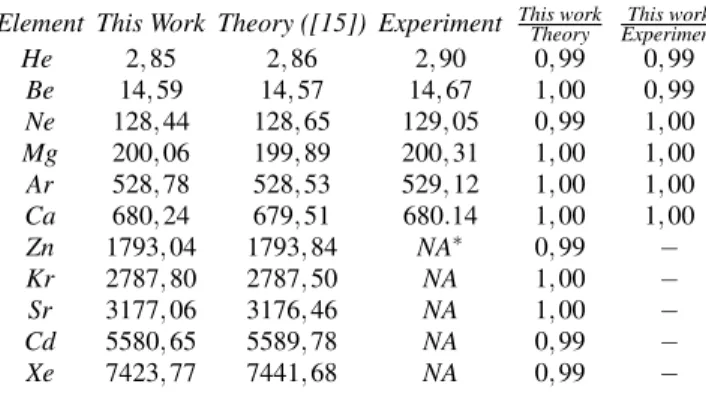
TABLE 1: Center of gravity binding energies (inHt) including relativistic corrections for ground configurations.
Element This Work Theory ([15]) Experiment This workTheory ExperimentThis work He 2,85 2,86 2,90 0,99 0,99
Be 14,59 14,57 14,67 1,00 0,99 Ne 128,44 128,65 129,05 0,99 1,00 Mg 200,06 199,89 200,31 1,00 1,00 Ar 528,78 528,53 529,12 1,00 1,00 Ca 680,24 679,51 680.14 1,00 1,00 Zn 1793,04 1793,84 NA∗ 0,99 − Kr 2787,80 2787,50 NA 1,00 − Sr 3177,06 3176,46 NA 1,00 − Cd 5580,65 5589,78 NA 0,99 − Xe 7423,77 7441,68 NA 0,99 −
∗NA: not available data.
whereqi,qjare the occupation number of the respective sub-shells. As (see details in [13]), in terms ofy=Zinj/Zjni
gi j= ·
1 1+y
¸3+2lj
∑
kak ·
y 1+y
¸k ,
fji= · y
1+y ¸3+2li
∑
kbk ·
1 1+y
¸k
, (14)
a short and simple iterative procedure must be used for their determination. The iteration can be reduced to one or two steps if, as zero approximation, Slater-like rules are used as starting point forZi (see below, section 3). Explicit expres-sions for the coefficientsakandbk can be found in reference [13].
Both the Layzer and the Kregar formulations ensures exact energy levels for H-like ions in the non-relativistic regime; for He-like ions, σ0=5/16, as deduced for the variational principle.
C. Relativistic corrections
From the Breit-Pauli Hamiltonian the relativistic shift oper-atorHRShas five terms [4]:
HRS=HMC+HD1+HD2+HOO+HSSC
that signifies respectively: mass correction, one- and two-body Darwin, spin-spin contact and orbit-orbit terms. Far, the more important are the two first ones, that scale asZ4. These energy shifts can be estimated very simple and correctly as the sum of contributions
Erel=−
α2
2
∑
i Z4 n3iµ 1 li+0.5
−0.75 ni
−δ(li,0) 
. (15)
The remaining terms scale asα2Z3and will be ignored in this work. An analysis is presented in the work by Safronova et al [2].
III. RESULTS AND COMPARISON WITH EXPERIMENTS
AND OTHER CALCULATIONS
The comparison with experiment, in order to see the Z−dependence of experimental binding energies it is difficult, because there are relativistic effects dependent ofZ4andZ3 [8] and higher powers ofZ. Therefore, we compare in first place our expansion with non-relativistic calculations. We verified that the non-relativistic values from the Cowan’s code follow a dependence of the type
E(N,Z) =Z2E0+ZE1−E2(1+a/Z);
moreover, the Cowan values with relativistic corrections are very similar to the results from the Dirac-Hartree-Fock values from Huang et al. [15].
In Table 1, we show the center-of-gravity binding energies, including relativistic corrections for ground configurations, for atoms with closed (sub)shells. As we can see, our values are in very good agreement both with Hartree-Fock ([3], [15]) and experimental ones (up toZ=20,because there are not experimental results for all elements and ionization degrees).
In Figure 1 we show the first ionization potential for the above cited elements, jointly with experimental values. The relation is of the order of two and better values can not be expected. In fact, the Layzer theory is valid, in principle, for largeZ.Therefore this, the most rigorous test for our choice of the screening evaluation, is very promissory.
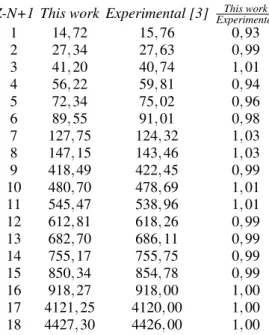
In Table 2 are shown the ionization energies for the Ar isonuclear sequence; the relative values are near one.
In Table 3, are shown the ionization energies of theAr iso-electronic sequence; as it is expected, the relation between our values and the Cowan values are in excellent agreement.
4 10 12 18 20 36 38 48 54 5
10 15 20 25 30
Ion
iz
a
tion
E
n
ergy [eV
]
Z This work
Experiment, Ref.[1]
FIG. 1: The first ionization potentials of the elements with closed (sub)shells. Note that in the present approach all values are posi-tive. Better values can not be expected because the theory is valid for higher ionization degrees.
TABLE 2: Ionization energies (ineV) for Ar isonuclear se-quence.
Z-N+1 This work Experimental [3] ExperimentalThis work
1 14,72 15,76 0,93
2 27,34 27,63 0,99
3 41,20 40,74 1,01
4 56,22 59,81 0,94
5 72,34 75,02 0,96
6 89,55 91,01 0,98
7 127,75 124,32 1,03
8 147,15 143,46 1,03
9 418,49 422,45 0,99
10 480,70 478,69 1,01
11 545,47 538,96 1,01
12 612,81 618,26 0,99
13 682,70 686,11 0,99
14 755,17 755,75 0,99
15 850,34 854,78 0,99
16 918,27 918,00 1,00
17 4121,25 4120,00 1,00
18 4427,30 4426,00 1,00
TABLE 3: Ionization potentials (ineV) for the isoelectronic sequence of Ar I.
Z This work Experimental[3] ExperimentalThis work
18 14,73 15,76 0,93
19 30,74 31,62 0,92
20 50,16 50,91 0,99
21 72,86 73,47 0,99
24 159,93 161,10 0,99
25 195,16 196,46 0,99
26 233,52 235,04 0,99
28 319,48 321,00 1,00
30 417,76 419,70 1,00
32 528,36 529,28 1,00
1s 2s 2p 3s 3p 4s 3d 4p 4d
0.6 0.8 1.0 1.2 1.4 1.6 1.8
Bi
ndi
ng Energi
es
Rati
o
Xe inner shell
This work / Theory, Ref.[16] This work / Experiment, Ref.[16]
FIG. 2: Binding energies of the internal sub-shells of Xe (Z=54).
TABLE 4: Transitions of the typeΦ0Φ1−2p−13dΦ0Φ1for the Xe atom compared with the values of reference[2].
N∗ This work [2] This work[2] 10 4607,80 4647 0,992 11 4583,12 4621 0,992 12 4559,12 4595 0,992 13 4535,80 4568 0,993 14 4513,20 4542 0,994 15 4491,31 4516 0,995 16 4470,13 4490 0.996 17 4449,67 4464 0,997 18 4429,96 4438 0,998 19 4411,00 4412 1,000
∗N=10+n, being n the number of 3d electrons.
As other example of complex transitions, we show in Table 4 transitions of the typeΦ0Φ1−2p−13dΦ0Φ1as defined in Reference [2]: Φ0=1s22s22p6, Φ1=3dnΦ0. Both values are within 1%, but it must be mentioned that the approach of Safronova et al. produces very bad values (negatives!) of the ionization energies for neutral and almost-neutral elements.
A. Calculation of terms and energy levels
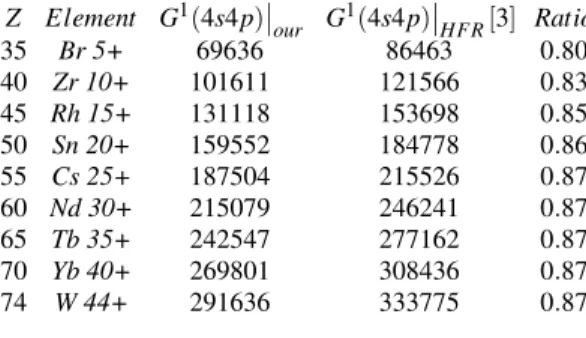
TABLE 5.Scaled Slater integralG1(4s4p)for the Zn isoelectronic sequence, incm−1. Z Element G1(4s4p)¯
¯our G1(4s4p) ¯
¯HFR[3] Ratio
35 Br 5+ 69636 86463 0.80
40 Zr 10+ 101611 121566 0.83
45 Rh 15+ 131118 153698 0.85
50 Sn 20+ 159552 184778 0.86
55 Cs 25+ 187504 215526 0.87
60 Nd 30+ 215079 246241 0.87
65 Tb 35+ 242547 277162 0.87
70 Yb 40+ 269801 308436 0.87
74 W 44+ 291636 333775 0.87
TABLE 6. Iteratively determined screening parameters fji(values above diagonal) andgi j(values below diagonal) for electron pairs for Kr-like ions, withZ→∞.Diagonal elements (bold characters) arekii.
1s 2s 2p 3s 3p 3d 4s 4p
1s 0.3125 0.6924 0.8776 0.8095 0.9299 0.9967 0.8636 0.9539 2s 0.0258 0.3008 0.2230 0.6055 0.6466 0.7756 0.7290 0.7630 2p 0.0149 0.3668 0.3492 0.6617 0.6821 0.8452 0.7650 0.7887 3s 0.0068 0.0528 0.0471 0.2988 0.2435 0.2164 0.5512 0.5737 3p 0.0034 0.0674 0.0635 0.3121 0.3104 0.2561 0.5861 0.5914 3d 0.0002 0.0562 0.0368 0.4213 0.4066 0.3765 0.6281 0.6391 4s 0.0026 0.0189 0.0167 0.0776 0.0746 0.0678 0.2982 0.2545 4p 0.0011 0.0238 0.0223 0.0900 0.0855 0.0784 0.2889 0.2987
[14]. In particular, and as an example, G1(4s4p;Z=1) = 0.02444565Ry.
Table 5 shows the values of G1(4s4p;Z) = 0.02444565(Z−σnl)for the configuration 4s4pofZn−like with Z =30−74. These results are compared with the relativistic Hartree-Fock approximation (HXR). It is very important take into account that in practice, in order to give a better accordance with experimental spectroscopy, the theoretical Slater integrals must be multiplied by “fudge” factors lesser than 1 [3].
B. Slater-like rules and constant values for thegi j’s and the fji’s forZ→∞.
As stated above (see equation 11), a desirable property for
σis that forZ→∞,σ→σ0.This is verified by our approach and implies that for Z →∞, the values of fi j andgi j trend themselves to constant values, which we can denominate fi j∞ andg∞i j.An example is given in table 6 for the particular case of the orbitals ofKr-like ions. These values, once known, can be stored and reliably reused either in calculations for high ionization stages or, as input parameter to reduce the number of iterations needed to achieve convergency in Eq. 14. For example, using Eq. 13,σ1s=0.4973,σ2s=5.0253,etc.
IV. CONCLUSIONS
In this work we showed that the Layzer expansion is not only a theoretical framework but also a very convenient
quan-titative method when a correct approach for screening para-meter calculations is given. We select the point of view intro-duced by Kregar, generalized by one of us, taking into account subshell and exchange corrections. With our approach, we always obtain positive ionization potentials, even for neutral atoms, the most difficult test. This fact is easily understood because the Layzer theory is an expansion valid for largeZ. In practice, for slightly ionized atoms (as low as three times), results are very accurate accordingly with the main scope of this work: plasma modelling and collision experiments. It it important to point out that in the present work no fitting procedure is used although, if we want to extend the method for neutral and almost neutral atoms, a correction factor (very close to 1) for theσ′scould be used. Moreover, it should be
[1] J.G. Rubiano, R. Rodr´ıguez, J.M. Gil, F. H. Ruano, P. Maretel, and E. M´ınguez, J. Quant. Spectrosc. Radiat. Transfer,72, 575 (2002).
[2] U. I. Safronova et al., Phys. Scripta47, 364 (1993); M.W. Clark et al, Phys. Rev. A47, 3983 (1993).
[3] R. D. Cowan,The Theory of Atomic Structure and Spectra (Uni-versity of California Press, Berkeley and Los Angeles, 1981). [4] C. Froese Fischer, T. Brage, and P. Jonsson, Computational
Atomic Structure(IoP Publishing, Bristol, 1997).
[5] D. Layzer, Ann. Phys.8, 271 (1959); D. Layzer et al., Ann. Phys.29, 101 (1964).
[6] H.O. Di Rocco, Il Nuovo Cimento D20, 131 (1998).
[7] G. Faussurier, C. Blancard, and A. Decoster, J. Quant. Spec-trosc. Radiat. Transfer58, 233 (1997).
[8] D. Layzer, Int. J. Quantum Chemistry1 S, 45 (1967).
[9] R. M. More, J. Quant. Spectrosc. Radiat. Transfer 27, 345 (1982).
[10] F . Perrot, Phys. Scripta39, 332 (1989).
[11] P. Martel, J.G. Rubiano, J.M. Gil, L. Doreste, and E. M´ınguez, J. Quant. Spectrosc. Radiat. Transfer,60, 623 (1998).
[12] M. Kregar, Phys. Scripta29, 438 (1984), Phys. Scripta31, 246 (1985).
[13] H. O. Di Rocco, Brazilian Journal of Physics22, 227 (1992). [14] E. U. Condon and H. Odabasi, Atomic Structure (University
Press, Cambridge, 1980).